Key Takeaways
Option A
New EV Tax Credit (Section 30D)
The larger, more complex credit for new electric vehicle purchases.
Best for: Buyers purchasing a brand-new qualifying EV from a licensed dealer who meet income limits and want up to $7,500 in savings.
Option B
Used EV Tax Credit (Section 25E)
The accessible, lower-value credit for pre-owned clean vehicle purchases.
Best for: Budget-conscious buyers purchasing a used EV from a dealer at $25,000 or less who meet tighter income thresholds.
If you want maximum federal savings and can afford a new EV
New EV Tax Credit (Section 30D)
The $7,500 credit is significantly larger and applies to a wide range of new models. If your income qualifies and the vehicle passes eligibility tests, it's the bigger financial lever.
If you're on a tight budget and your household income is moderate
Used EV Tax Credit (Section 25E)
A used EV under $25,000 combined with a $4,000 credit can make EV ownership genuinely affordable. The lower purchase price often delivers more total savings than a new vehicle with the larger credit.
If your income is too high for the used credit but within new EV limits
New EV Tax Credit (Section 30D)
The new EV credit allows higher MAGI thresholds, making it accessible to buyers who exceed the used credit's income caps.
If you want to apply the credit at the dealership rather than wait until tax season
New EV Tax Credit (Section 30D)
Both credits now support point-of-sale transfers, but new EV dealerships have broader familiarity with the transfer process. Either credit works — just confirm your dealer is registered with the IRS.
If the specific new EV you want doesn't qualify due to assembly or battery rules
Used EV Tax Credit (Section 25E)
Used EVs are exempt from the North American assembly and critical mineral requirements, so more models qualify — including some popular imports that don't pass the new EV tests.
Two Credits, Two Sets of Rules
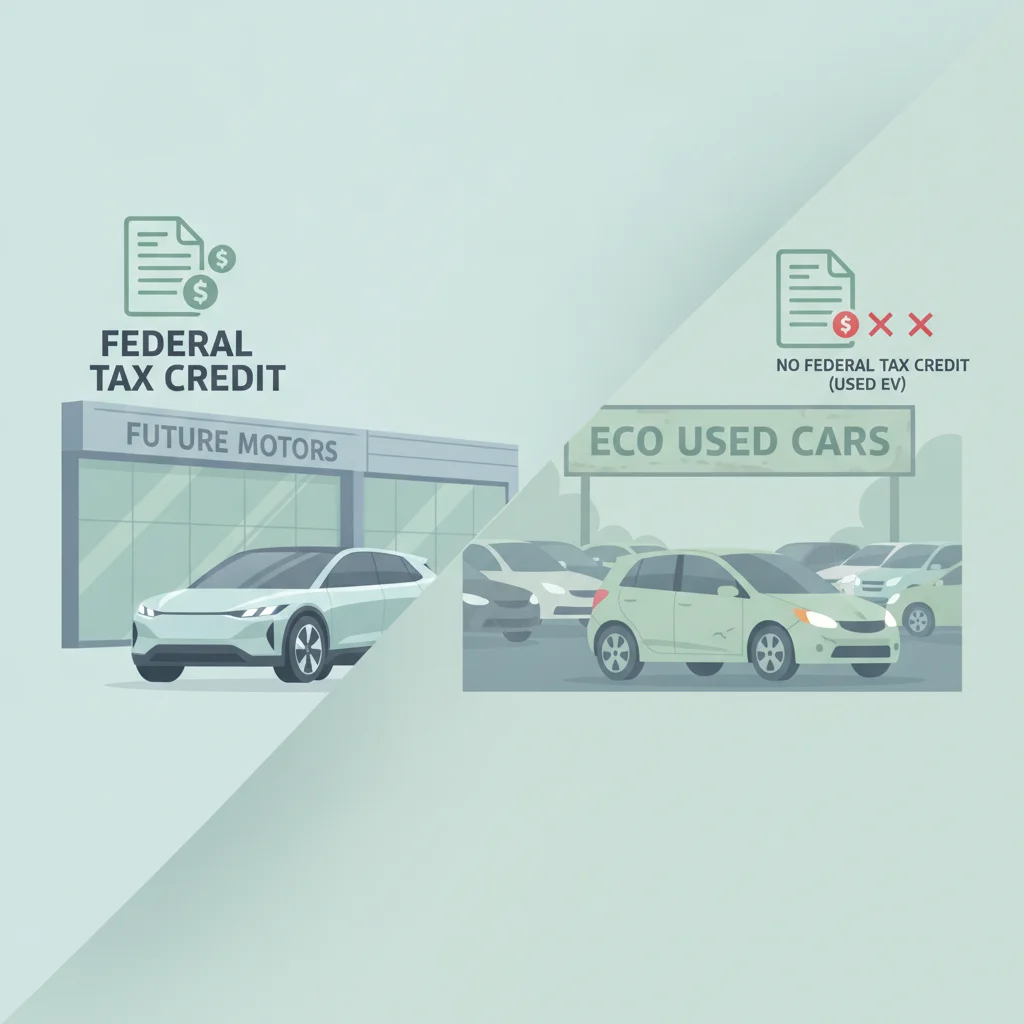
The Inflation Reduction Act of 2022 restructured federal EV incentives into two distinct programs: the Clean Vehicle Credit (Section 30D) for new EVs and the Previously Owned Clean Vehicle Credit (Section 25E) for used EVs. These are not variations of the same credit — they operate under separate rules, have different maximum values, and carry different eligibility requirements for both the buyer and the vehicle.
Understanding which program you're eligible for — and whether the vehicle you're considering actually qualifies — is the essential first step before you calculate any savings. Many buyers assume any EV purchase automatically comes with a federal credit. That's not the case. Both programs have income tests, vehicle price caps, and dealer requirements that can disqualify buyers or vehicles entirely.
For a broader overview of how these programs came to be structured this way, see The Federal EV Tax Credit, Explained. This article focuses specifically on how the new and used programs compare — and which one is likely to apply to your situation.

New EV Credit (Section 30D): Structure and Requirements
The new vehicle credit offers up to $7,500, but that amount is not guaranteed. It's built from two components of up to $3,750 each — one tied to battery critical mineral sourcing and one tied to battery component manufacturing. A vehicle can qualify for one component, both, or neither. In practice, many models currently qualify for the full amount, but that can shift as IRS guidance evolves.
Vehicle Requirements
- Must be a new, previously untitled vehicle purchased from a licensed dealer
- Final assembly must occur in North America — a requirement that excludes some popular models made in Europe or Asia. See How North American Assembly Rules Affect EV Credit Eligibility for current model details.
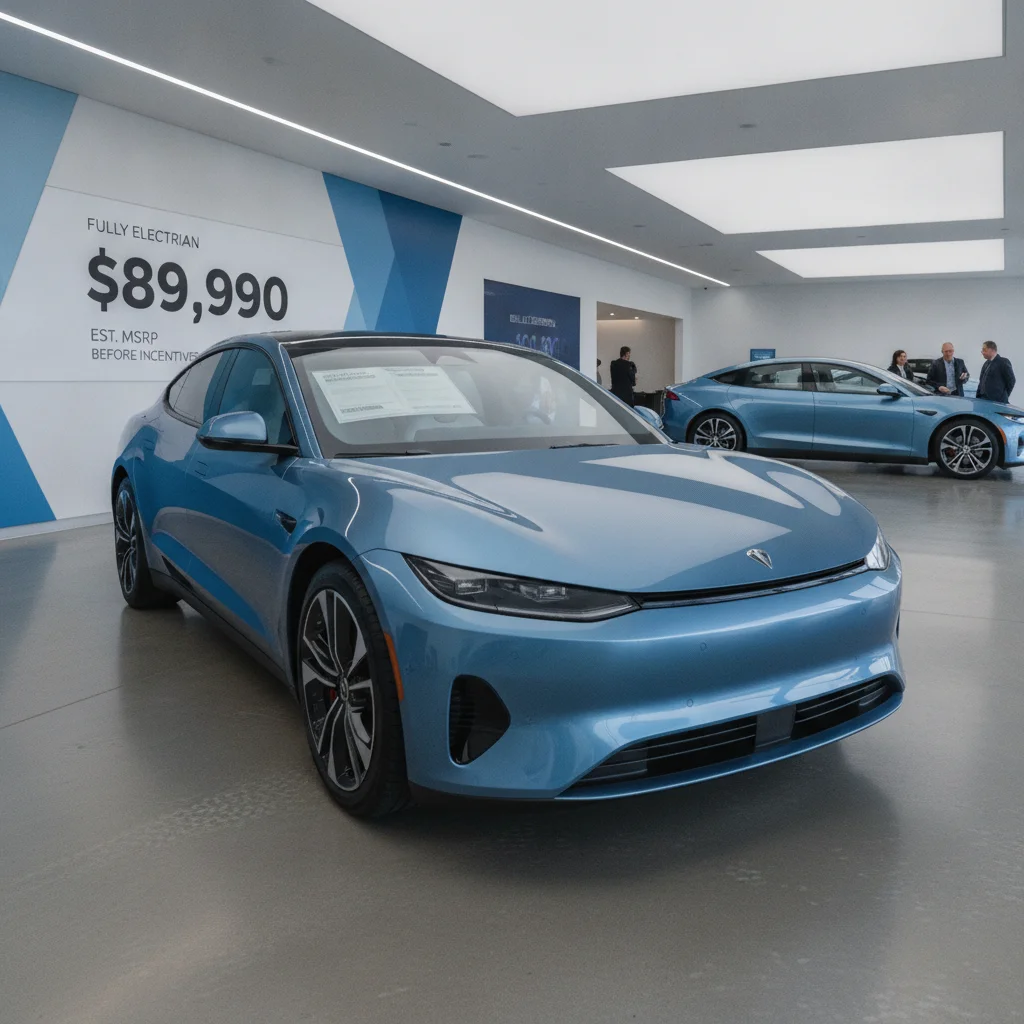
- MSRP caps apply: $80,000 for SUVs, vans, and trucks; $55,000 for sedans and other cars. Vehicles priced above these caps are ineligible regardless of their battery specs. MSRP Caps and the EV Tax Credit explains how these limits interact with trim levels and dealer markups.
- Battery sourcing requirements must be met (critical minerals and components thresholds set by the IRS)
Buyer Income Requirements
Your modified adjusted gross income (MAGI) must not exceed:
- $150,000 for single filers
- $225,000 for heads of household
- $300,000 for married filing jointly
The IRS uses the lower of your MAGI in the year of purchase or the prior year, which gives buyers some flexibility. If your income fluctuates — as it often does for self-employed or gig workers — Making the Most of EV Credits When You're Self-Employed or Have Variable Income walks through strategies for managing that calculation.
| Criterion | New EV Credit (30D) | Used EV Credit (25E) |
|---|---|---|
| Maximum credit value | $7,500 | $4,000 (30% of sale price) |
| Vehicle price cap | $55,000–$80,000 (MSRP, by type) | $25,000 (sale price) |
| Income limit (single filer) | $150,000 MAGI | $75,000 MAGI |
| Income limit (married filing jointly) | $300,000 MAGI | $150,000 MAGI |
| North American assembly required | Yes | No |
| Battery sourcing requirements | Yes (critical minerals + components) | No |
| Vehicle age requirement | Must be new (untitled) | Must be 2+ model years old |
| Must purchase from licensed dealer | Yes | Yes |
| Point-of-sale transfer available | Yes (from Jan 2024) | Yes (from Jan 2024) |
| Credit type | Nonrefundable | Nonrefundable |
Used EV Credit (Section 25E): Structure and Requirements
The used EV credit is worth up to $4,000 — specifically, 30% of the vehicle's sale price, capped at $4,000. So a $15,000 used EV generates a credit of $4,000 (30% of $15,000 = $4,500, capped at $4,000). A $10,000 vehicle generates a $3,000 credit (30% of $10,000).
This credit was created to open EV ownership to buyers who can't afford new vehicles. The rules reflect that intent — vehicle prices are capped low and income limits are tighter than the new EV program.
Vehicle Requirements
- Must be at least two model years old at the time of sale — so in 2025, the oldest model year that qualifies is 2023
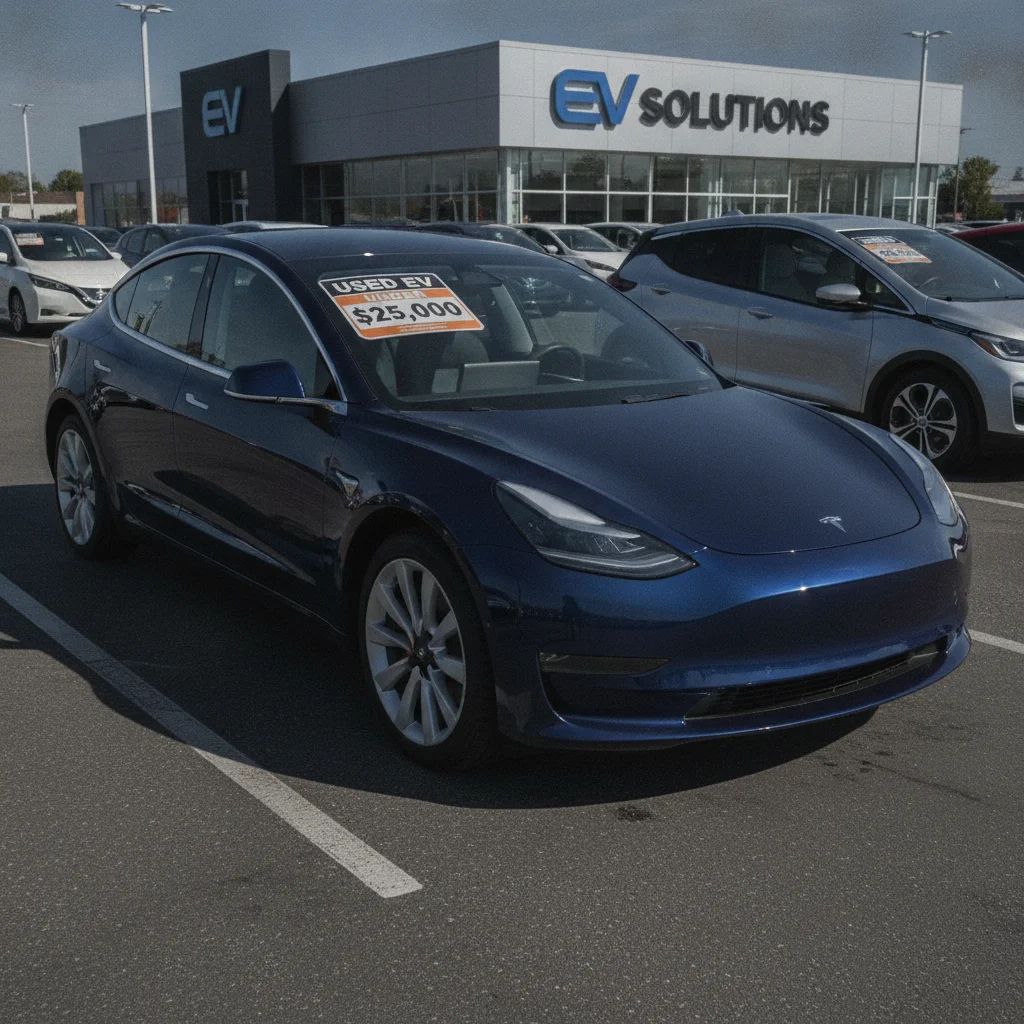
- Sale price must be $25,000 or less — this is a hard cap, not an MSRP ceiling
- Must be purchased from a licensed dealer — private party sales do not qualify
- Must be the buyer's first time claiming this credit on that specific vehicle — the credit can only be claimed once per vehicle in its lifetime
- No North American assembly requirement — this is a meaningful distinction, as it allows used imports that would fail the new EV test to qualify
- Vehicle must be a qualifying clean vehicle type (BEV, PHEV, fuel cell) with at least 7 kWh of battery capacity for PHEVs
Buyer Income Requirements
Income thresholds are lower than for the new EV credit:
- $75,000 for single filers
- $112,500 for heads of household
- $150,000 for married filing jointly
These limits are exactly half the new EV thresholds. A household earning $160,000 filing jointly qualifies for the new EV credit but is completely locked out of the used EV credit. The program is explicitly targeted at moderate-income buyers.
For a detailed breakdown of all used credit conditions, see Claiming the Used EV Credit: Income Rules, Vehicle Age, and Price Limits.
What Both Credits Have in Common
Despite their differences, the new and used EV credits share several structural features that buyers should understand before they get excited about headline savings numbers.
Both Are Nonrefundable
This is the most consequential shared trait. A nonrefundable credit can reduce your federal income tax liability to zero — but it cannot generate a refund beyond that. If you owe $3,000 in federal taxes and claim a $7,500 new EV credit, you eliminate your $3,000 tax bill but you don't get the remaining $4,500 back. It evaporates. The same logic applies to the $4,000 used EV credit.
Nonrefundable vs. Refundable Tax Credits: What EV Buyers Need to Understand covers this in depth — it's worth reading before you assume the full credit value translates directly into savings.
The Point-of-Sale Transfer Has a Catch
When you transfer the credit to a dealer at purchase, you're essentially receiving an advance on a credit the IRS will verify when you file your taxes. If your actual tax liability turns out to be lower than the credit amount you received, you may owe money back to the IRS at tax time. Make sure you have a realistic estimate of your annual tax liability before choosing the point-of-sale option — it works cleanly for buyers whose tax bill reliably exceeds the credit value, but can create surprises for others.
Credit Eligibility Can Change Mid-Model-Year
The IRS updates the list of qualifying vehicles periodically as battery sourcing rules tighten and manufacturers report compliance data. A vehicle that qualified when you started shopping may lose eligibility before you complete your purchase — or vice versa. Always verify current eligibility on the IRS website or fueleconomy.gov immediately before you finalize a purchase, not weeks earlier when you first started looking.
One Credit Per Vehicle, Per Lifetime (Used EVs)
The used EV credit can only be claimed once on any given vehicle over its lifetime. If you're buying a used EV, the seller or dealer should be able to confirm whether the credit has already been claimed on that VIN. If a prior buyer already claimed the Section 25E credit on that vehicle, you are not eligible to claim it again — even if you otherwise meet all requirements.
Both Support Point-of-Sale Transfer (Starting 2024)
As of January 1, 2024, buyers can transfer either credit to a participating dealer and receive it as an immediate price reduction at purchase — you don't have to wait until you file your taxes. The dealer receives the credit value from the IRS. This is particularly useful for buyers who want to reduce their loan amount rather than claim the credit a year later.
The mechanics of this process are important to understand. See How the Point-of-Sale EV Credit Transfer Works at the Dealership for a step-by-step breakdown.
Both Require a Licensed Dealer
Private party purchases — from a friend, through Craigslist, or at an auction — do not qualify for either credit. The dealer must be registered with the IRS and must submit the required reports at the time of sale. Confirm your dealer is properly registered before you count on either credit.
$7,500
Maximum new EV federal credit
The Section 30D credit is split into two $3,750 components based on battery mineral sourcing and domestic manufacturing thresholds set by the IRS.
$4,000
Maximum used EV federal credit
The Section 25E credit equals 30% of the vehicle's sale price, capped at $4,000, and applies only to vehicles priced at $25,000 or less.
$25,000
Used EV price cap
The sale price ceiling for used EV credit eligibility is $25,000 — a hard limit that excludes many higher-demand pre-owned models.
50%
Lower income cap for used credit vs. new
The used EV income limits are exactly half those of the new EV credit — single filers cap at $75,000 vs. $150,000 for the new vehicle program.
2 years
Minimum vehicle age for used credit
A qualifying used EV must be at least two model years old at the time of purchase, as defined by IRS rules under Section 25E.
Vehicle Eligibility: Where the Programs Diverge Most
The starkest practical difference between the two programs is how they treat vehicle eligibility. New EVs face a gauntlet of supply chain tests that many models fail. Used EVs bypass most of those requirements.
New EVs: Assembly and Battery Sourcing Rules
To qualify under Section 30D, a new EV must:
- Be finally assembled in North America
- Meet IRS thresholds for critical mineral sourcing (lithium, cobalt, nickel, etc.) from qualifying countries
- Meet IRS thresholds for battery component manufacturing in North America
These requirements phase in over time and are updated annually. Some vehicles that qualified in prior years have lost eligibility as thresholds tightened. Check the IRS's official list of qualifying vehicles and the Which EVs Qualify for the Federal Tax Credit Right Now reference before assuming a vehicle qualifies.
It's also worth knowing that PHEVs and full BEVs are treated differently under the credit rules. Plug-In Hybrid vs. Battery Electric: How the Tax Credit Treats Each Differently explains the key distinctions. And for a broader overview of which vehicle types qualify at all, Federal Tax Credits and Which EV Types Qualify covers BEVs, PHEVs, and HEVs under current law.
Used EVs: Simpler Vehicle Tests
The used vehicle credit imposes no assembly location requirement and no battery sourcing test. The vehicle simply needs to be a qualifying clean vehicle type (BEV, PHEV with at least 7 kWh battery, or fuel cell), at least two model years old, and priced at or below $25,000. This means some imported EVs that can't qualify as new vehicles — because they're assembled outside North America — become eligible once they hit the used market two years later.
The $25,000 price cap is the binding constraint for most used EV shoppers. As EV prices have declined and the used EV market has matured, more vehicles fall under that ceiling — but high-demand used models (particularly certain Tesla configurations) can still exceed it, disqualifying the purchase.
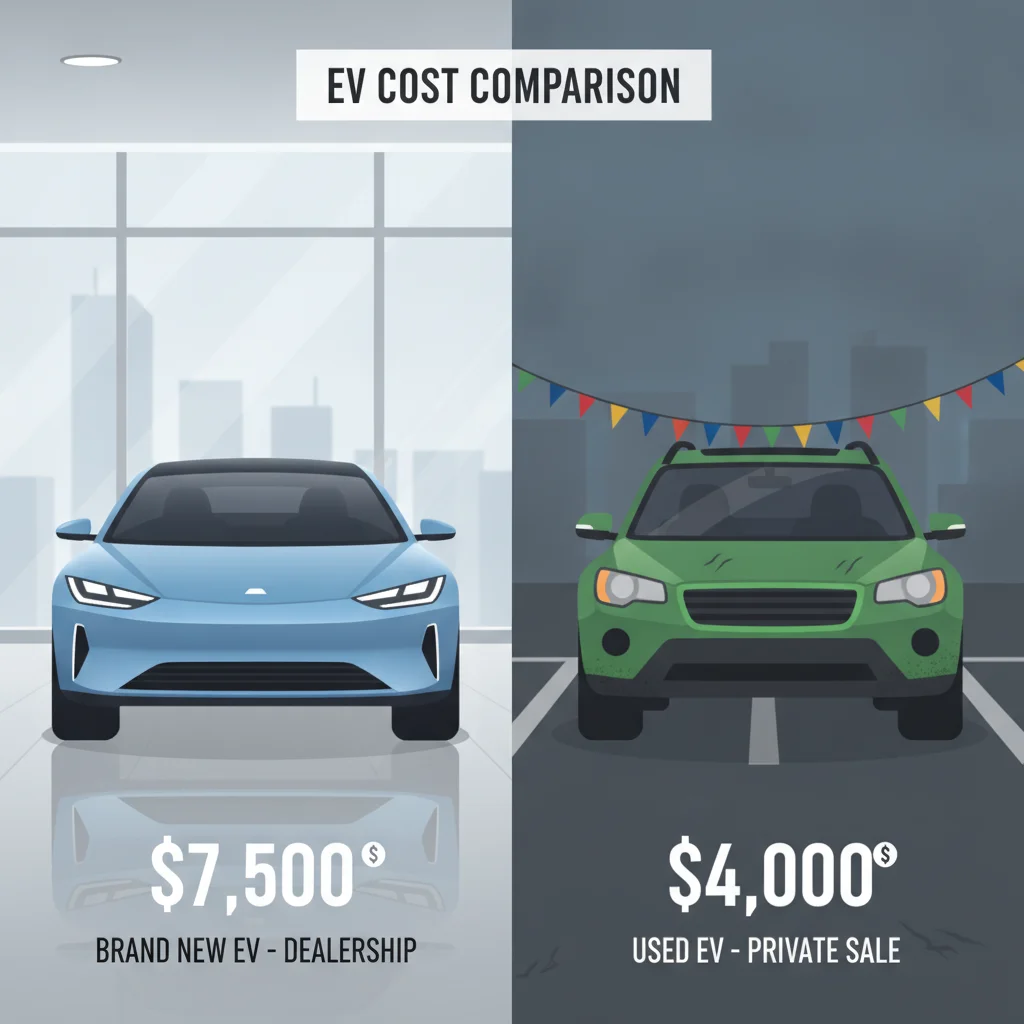
Running the Numbers: Which Credit Delivers More Real-World Value?
On paper, the new EV credit's $7,500 maximum dwarfs the used credit's $4,000 cap. But the actual value to a specific buyer depends on three factors: their tax liability, the total cost of the purchase, and the net cost after the credit.
Scenario 1: Moderate-Income Buyer, New vs. Used
A buyer filing jointly with $120,000 MAGI qualifies for both credits. If they buy a new EV at $42,000 with the full $7,500 credit, net cost before financing is $34,500. If they buy a qualifying used EV at $22,000 with a $4,000 credit (30% × $22,000 = $6,600, capped at $4,000), net cost is $18,000. The used vehicle saves more money in absolute terms — even with a smaller credit — because the base price is dramatically lower.
Scenario 2: High-Income Buyer
A single filer earning $130,000 MAGI qualifies for the new EV credit but not the used EV credit (which caps at $75,000 for single filers). Their decision is essentially made for them: if they want a federal incentive, it must come through the new EV program.
Scenario 3: Low Tax Liability
A buyer who owes only $2,500 in federal taxes gets only $2,500 of value from either credit — regardless of whether the credit is $7,500 or $4,000. The nonrefundable structure makes tax liability the ceiling on actual savings. Buyers in lower tax brackets should be realistic about what they'll actually capture. The point-of-sale transfer option partially addresses this by letting buyers take the credit upfront — but the IRS will claw back any excess if the buyer's actual tax liability is lower than the credit applied at the dealer.
If you're considering leasing rather than buying to sidestep some of these complexity issues, Leasing an EV vs. Buying One: How the Tax Credit Plays Out Differently explains the commercial vehicle loophole that applies to leased EVs — including how that can sometimes benefit buyers who wouldn't qualify under either consumer credit program.
Don't forget that state-level incentives can stack on top of either federal credit. Federal EV Credit vs. State Rebate: Understanding the Structural Differences explains how to think about combining federal and state savings — and why the structural differences between credits and rebates matter for your planning.


All claims are backed by peer-reviewed research. Sources on request.