Key Takeaways
When comparing two EVs with similar range, check whether one uses LFP chemistry — if so, you can safely charge it to 100% daily without meaningfully accelerating degradation, which effectively gives you more usable range on a routine basis.
LFP cathodes are significantly more tolerant of full charges than NMC or NCA, because the flat voltage curve at the top of the charge range doesn't stress the cathode crystal structure the same way.
Ask specifically about the thermal management system, not just the range rating. An EV with active liquid cooling in a warm climate is worth more than one with passive air cooling, even if the range specs look identical on paper.
Real-world fast-charging capability and long-term capacity retention both depend heavily on the pack's ability to dissipate heat during high-power events.
If you're considering a structural battery pack vehicle like the Texas-built Model Y, factor repair cost risk into your insurance decision — comprehensive coverage matters more when minor undercarriage damage could involve expensive battery work.
Insurance claim data has flagged structural battery repairs as disproportionately costly relative to the severity of the initial collision, particularly in low-speed underside impacts.
The reported kWh figure in an EV's marketing materials is almost always the gross capacity. Look for the usable capacity figure — often disclosed in the owner's manual or third-party testing — to accurately compare real-world range potential.
Usable capacity buffers vary by 3–10% across manufacturers, which can meaningfully change how the vehicles rank when rated on a per-kWh-available basis.
Why Battery Architecture Matters to Buyers
When you're shopping for an electric vehicle, the spec sheet offers a kilowatt-hour number and a range estimate. That's about it. But behind those two figures lies a complex engineering system — one that has real consequences for how your EV performs in January, how quickly it degrades over five years, and how expensive it is to repair after a collision.
Battery architecture isn't just engineer territory. It's a framework that explains why two EVs with identical pack sizes can deliver very different real-world range, why one might handle summer heat better than another, and why repair costs vary so wildly across brands. The more you understand about how cells, modules, and packs are structured, the better equipped you are to evaluate any EV on the market today.
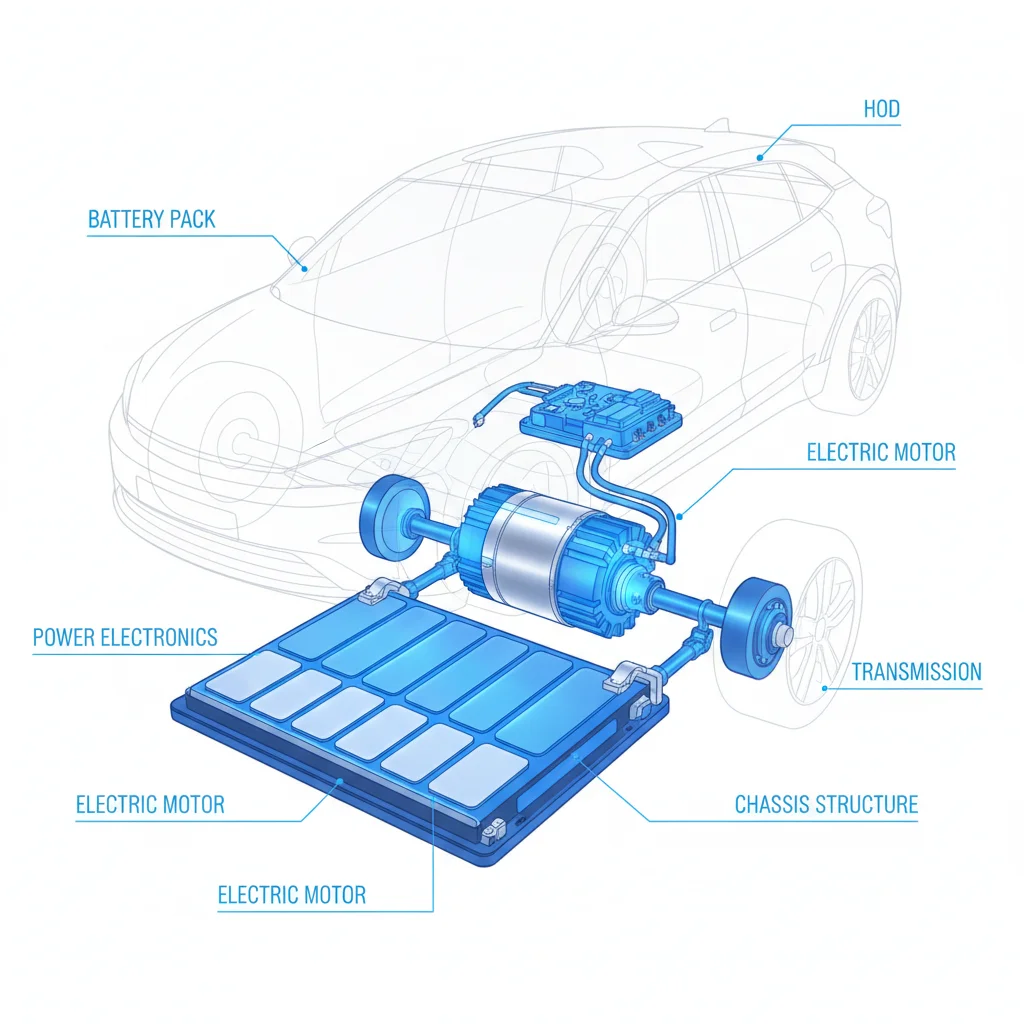
This guide walks through every layer of the battery hierarchy — from the electrochemical reactions inside a single cell all the way to the structural decisions automakers make when packaging an entire pack into a vehicle's floor. Think of it as the technical foundation that makes sense of everything else you'll read about EVs. If you're new to the broader powertrain picture, the complete introduction to all-electric powertrains is a good starting point before diving into the battery specifics here.
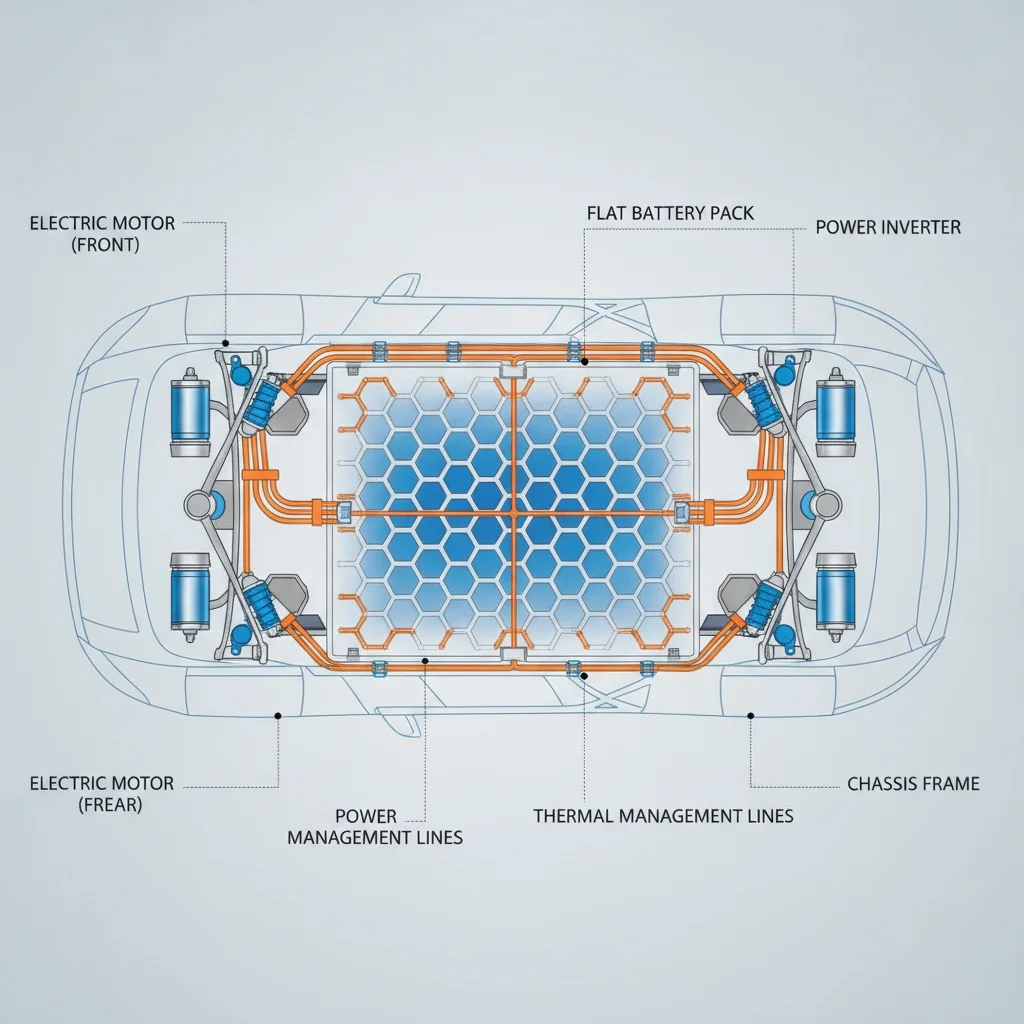
The Battery Cell: Where Energy Actually Lives
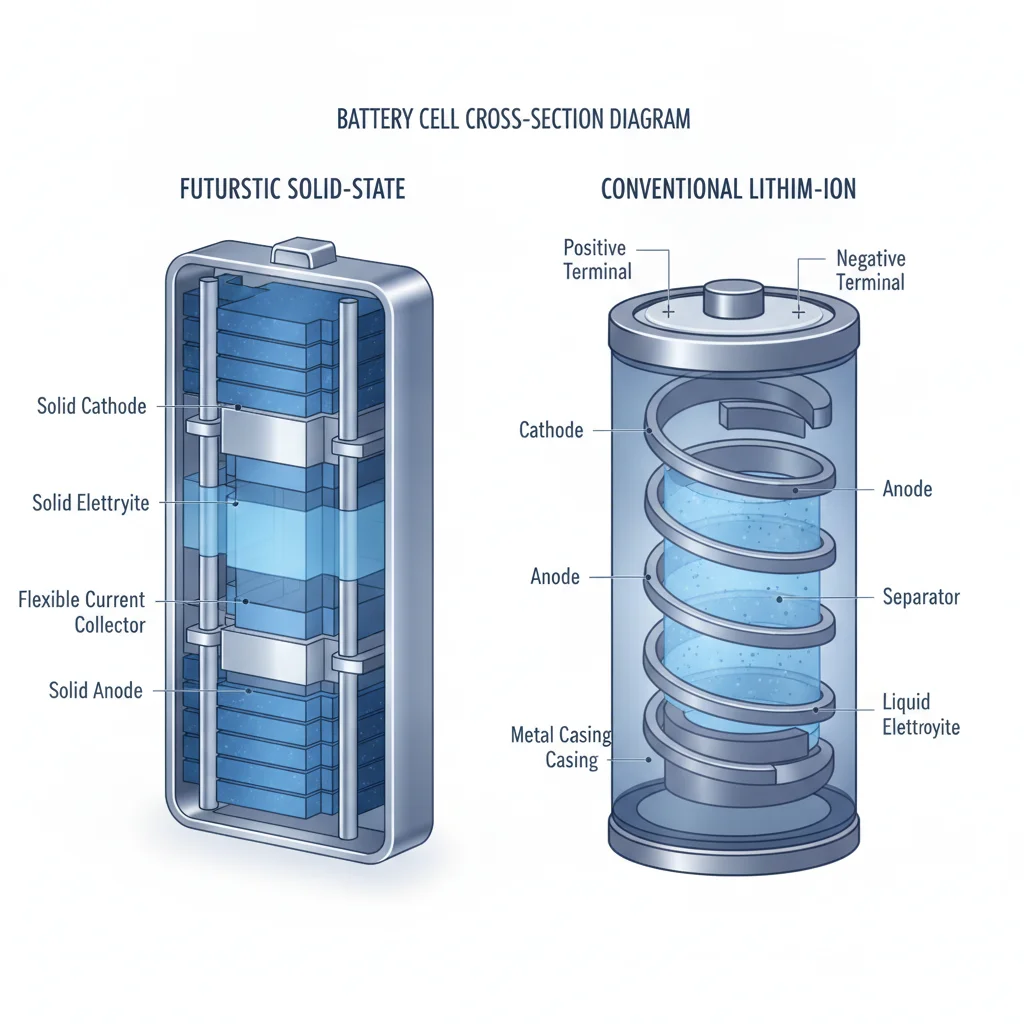
Every EV battery starts at the same place: a single electrochemical cell. A cell is a self-contained unit that stores and releases electrical energy through a chemical reaction between two electrodes — the anode and the cathode — separated by an electrolyte.
Anodes and Cathodes
In a lithium-ion cell, the anode is typically made of graphite. During charging, lithium ions migrate from the cathode and intercalate (slot into) the graphite structure. During discharge — when you're driving — those ions flow back to the cathode, releasing electrons that travel through the external circuit and power the motor.
The cathode material is where most of the meaningful chemistry differences between EV batteries lie. Common cathode chemistries include:
- NMC (Nickel Manganese Cobalt): High energy density, widely used in premium EVs. Offers good range but uses cobalt, which raises cost and supply-chain concerns.
- NCA (Nickel Cobalt Aluminum): Tesla's long-standing chemistry, delivering high energy density and strong performance.
- LFP (Lithium Iron Phosphate): Lower energy density than NMC/NCA but superior thermal stability, longer cycle life, and no cobalt. Increasingly common in standard-range models and vehicles built in China.
- LMFP (Lithium Manganese Iron Phosphate): A newer variant that improves energy density over LFP while retaining much of its safety advantage.
The Electrolyte
The electrolyte allows lithium ions to move between electrodes while blocking electrons (which must travel through the external circuit). In conventional lithium-ion cells, the electrolyte is a liquid — typically a lithium salt dissolved in an organic solvent. That liquid electrolyte is why thermal management is so critical: it's flammable, and its conductivity changes significantly with temperature. Replacing it with a solid material is the central promise of next-generation technology — a topic covered in depth in the solid-state batteries vs. today's lithium-ion packs comparison.
~90%
Drop in battery pack cost since 2010
BloombergNEF's annual battery price survey tracks lithium-ion pack costs from over $1,100/kWh in 2010 to below $120/kWh by 2023.
30–50%
Share of EV cost attributable to the battery pack
Industry estimates consistently place the battery pack as the single largest cost component in a battery electric vehicle.
800V
Charging architecture enabling 200+ kW DC fast charging
Vehicles like the Hyundai Ioniq 6, Porsche Taycan, and Lucid Air use 800V systems that can accept substantially higher charging rates than 400V platforms.
59–95°F
Optimal lithium-ion operating temperature range
Battery performance, efficiency, and longevity are all maximized within this relatively narrow thermal window, per battery engineering consensus.
8 yrs / 100K mi
Federally mandated minimum EV battery warranty
U.S. federal law requires automakers to warrant EV traction battery packs for at least 8 years or 100,000 miles, whichever comes first.
Nominal Voltage and Capacity
A single lithium-ion cell typically operates between 2.5 and 4.2 volts, with a nominal voltage around 3.6–3.7V. Its capacity is measured in ampere-hours (Ah). Combining voltage and capacity gives you watt-hours (Wh) — the energy stored in that one cell. A large-format prismatic cell might store 100–200 Wh; a small cylindrical cell around 15–20 Wh. It takes hundreds or thousands of cells to build a pack capable of driving 200–400 miles.
Cell Formats: Cylindrical, Prismatic, and Pouch
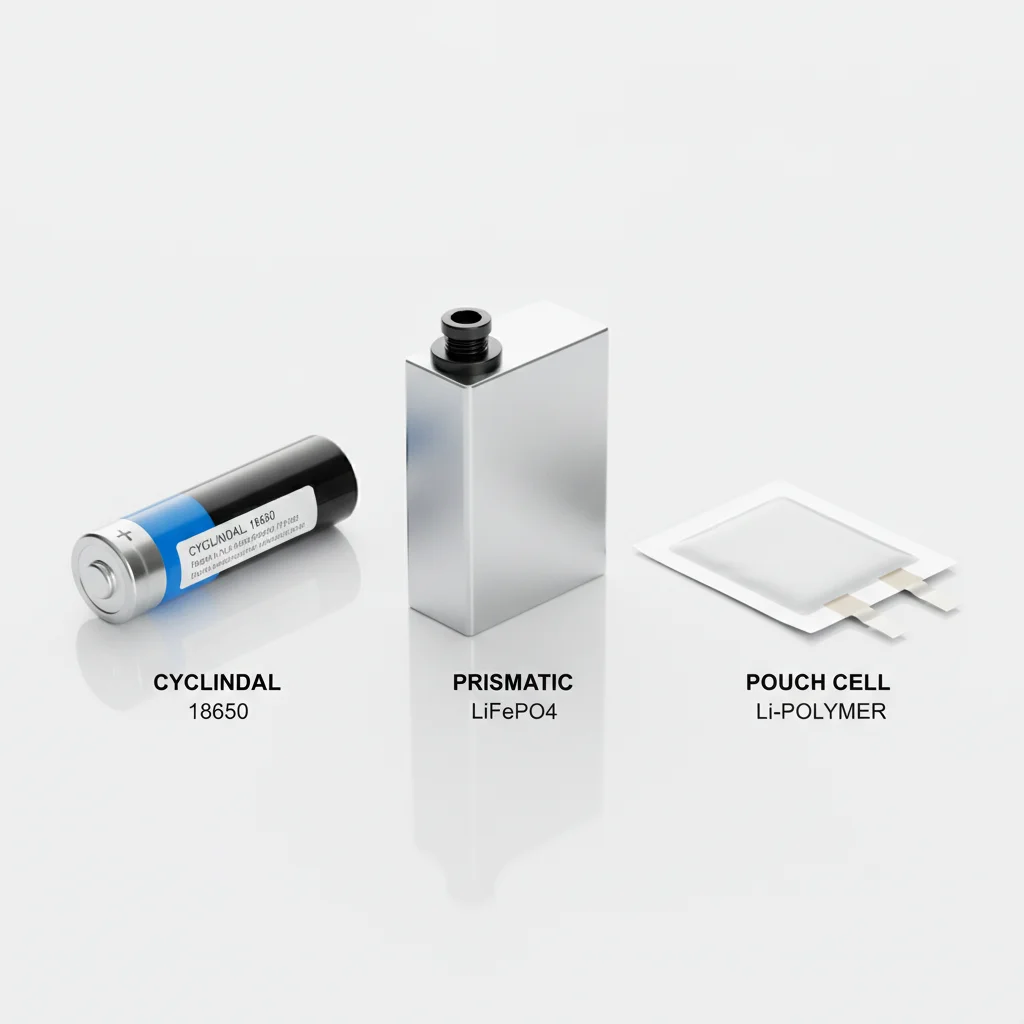
The same basic lithium-ion chemistry can be packaged in three distinct physical formats. Each has trade-offs that ripple up through module design, thermal management strategy, and ultimately pack cost and performance.
Cylindrical Cells
Cylindrical cells look like oversized AA batteries. They're manufactured at enormous scale, which keeps per-cell costs low. The cylindrical form creates a naturally rigid structure with good mechanical stability. Tesla pioneered their use at scale with the 18650 cell (18mm diameter, 65mm height), later transitioning to the larger 2170 format used in Model 3 and Model Y. The even larger 4680 cell — 46mm × 80mm — is now in production and promises to reduce the cell count while dramatically increasing energy per cell.
Cylindrical cells have one notable downside: packing circles leaves air gaps, reducing volumetric efficiency. Thousands of individual cells also mean thousands of spot-weld connections, which adds manufacturing complexity and potential failure points.
Prismatic Cells
Prismatic cells are rectangular, typically housed in a rigid aluminum or steel can. They pack more efficiently than cylinders and are common in vehicles from BMW, Volkswagen Group, and most Chinese automakers. A single prismatic cell can store significantly more energy than a cylindrical cell, so fewer are needed — simplifying assembly. The downside is that the rigid case makes thermal management more challenging and the cells can swell with repeated charge cycles.
Pouch Cells
Pouch cells use a flexible laminated foil casing, allowing them to be made in virtually any shape and to pack together with minimal wasted space. GM's Ultium platform and many Korean-built EVs use pouch cells. They offer excellent energy density and design flexibility. However, they require external compression structures to manage swelling, and their soft casing provides less inherent mechanical protection than prismatic or cylindrical formats.
| Format | Energy Density | Manufacturing Cost | Thermal Management | Notable Users |
|---|---|---|---|---|
| Cylindrical | Medium–High | Low (high volume) | Moderate (gaps allow airflow) | Tesla, Rivian |
| Prismatic | Medium–High | Medium | Challenging (rigid case) | BMW, BYD, VW Group |
| Pouch | High | Medium–High | Requires compression frame | GM (Ultium), Hyundai/Kia |
When comparing two EVs with similar range, check whether one uses LFP chemistry — if so, you can safely charge it to 100% daily without meaningfully accelerating degradation, which effectively gives you more usable range on a routine basis.
LFP cathodes are significantly more tolerant of full charges than NMC or NCA, because the flat voltage curve at the top of the charge range doesn't stress the cathode crystal structure the same way.
Ask specifically about the thermal management system, not just the range rating. An EV with active liquid cooling in a warm climate is worth more than one with passive air cooling, even if the range specs look identical on paper.
Real-world fast-charging capability and long-term capacity retention both depend heavily on the pack's ability to dissipate heat during high-power events.
If you're considering a structural battery pack vehicle like the Texas-built Model Y, factor repair cost risk into your insurance decision — comprehensive coverage matters more when minor undercarriage damage could involve expensive battery work.
Insurance claim data has flagged structural battery repairs as disproportionately costly relative to the severity of the initial collision, particularly in low-speed underside impacts.
The reported kWh figure in an EV's marketing materials is almost always the gross capacity. Look for the usable capacity figure — often disclosed in the owner's manual or third-party testing — to accurately compare real-world range potential.
Usable capacity buffers vary by 3–10% across manufacturers, which can meaningfully change how the vehicles rank when rated on a per-kWh-available basis.
From Cells to Modules: The Middle Layer
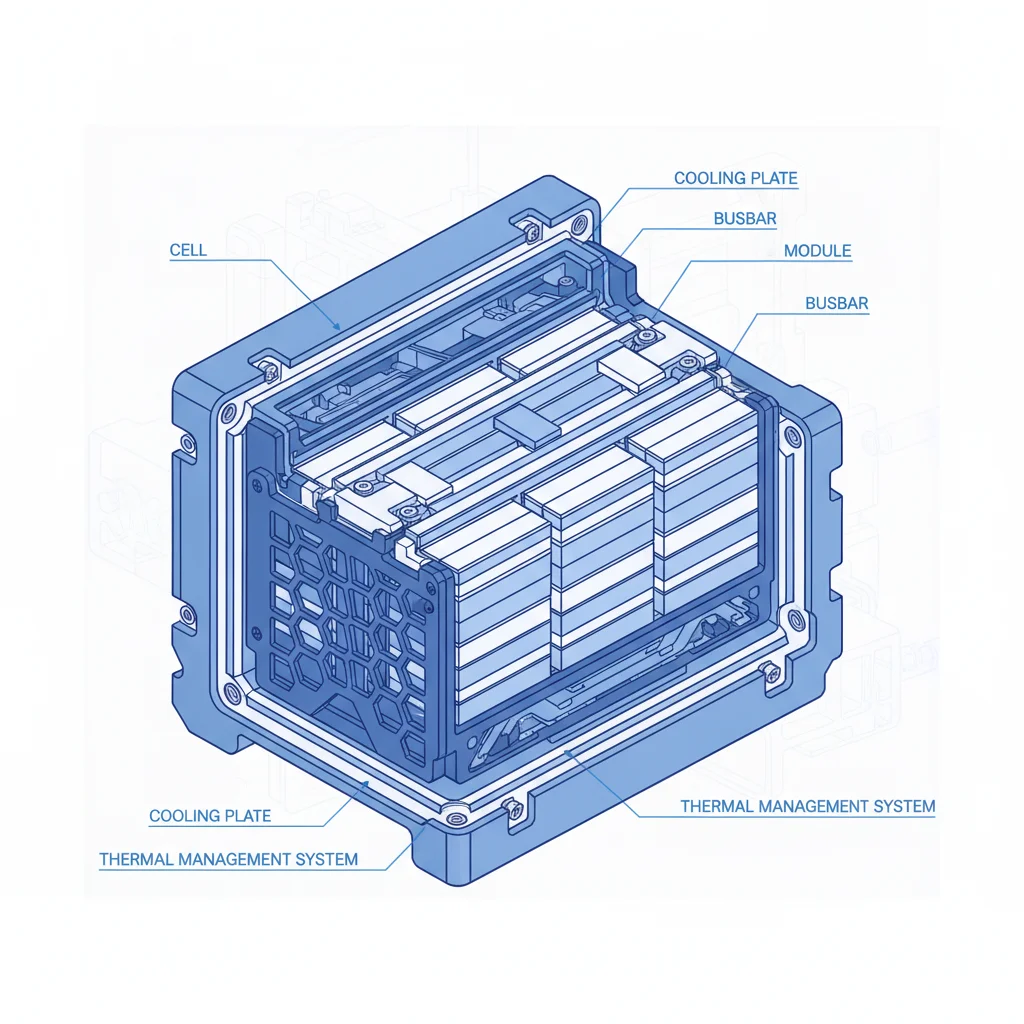
Individual cells are almost never used in isolation. They're grouped together into modules — manageable sub-assemblies that serve several practical functions before the full pack is assembled.
What a Module Does
A module bundles a fixed number of cells in a defined series/parallel configuration, connects them electrically, routes coolant (in liquid-cooled systems), and incorporates local sensing for the battery management system. Modules also act as a safety containment layer — if a cell fails or undergoes thermal runaway, the module structure is designed to limit propagation to adjacent cells.
Module size varies widely. A small module might contain 12 cylindrical cells; a large prismatic module might hold just 4–6 cells. A full battery pack might contain anywhere from 4 to 24 modules depending on the vehicle's size and architecture.
Series vs. Parallel Connections
Within a module, cells can be connected in series (which adds voltage) or parallel (which adds capacity). A 4S3P configuration, for example, means four groups of three parallel cells wired in series — tripling the capacity of a single cell while quadrupling the voltage. Getting this balance right is fundamental to achieving the pack's target voltage (often 400V or 800V) and kilowatt-hour rating.
Series and Parallel: A Quick Clarification
Connecting cells in series increases voltage without adding capacity. Connecting them in parallel increases capacity without changing voltage. EV packs use both configurations — series strings of parallel groups — to simultaneously achieve the target system voltage (often 400V or 800V) and the desired energy capacity in kilowatt-hours. The shorthand notation like '96s2p' means 96 cells in series, each position being 2 cells in parallel.
Why Modules Exist (and Why Some Designs Are Moving Past Them)
The modular approach makes manufacturing, quality control, and serviceability easier. If a module fails, a technician can potentially replace just that unit rather than the entire pack. However, modules add weight, complexity, and dead space. That's why some newer architectures are eliminating them entirely — more on that in a later section.
The Battery Pack: Putting It All Together
The battery pack is the complete assembly that goes into the vehicle. It contains the modules (or in newer designs, the cells directly), the battery management system, thermal management hardware, high-voltage busbars and cabling, safety disconnects, and a structural enclosure that doubles as a chassis component in most modern EVs.
Pack Voltage: 400V vs. 800V
Most EVs on the road today use a nominal 400-volt architecture. A growing number — including the Hyundai Ioniq 6, Porsche Taycan, Kia EV6, and Lucid Air — use 800V systems. Higher voltage allows for faster charging (the same power at twice the voltage means half the current, which reduces heat and cable thickness). An 800V system can accept more kilowatts through a DC fast charger without overheating, which is why these vehicles can achieve 200+ kW charging speeds.
The trade-off is cost and complexity — 800V components (inverters, motors, onboard chargers) are more expensive to design and manufacture, though prices are falling as the technology matures.
Pack Capacity: Gross vs. Usable
Every EV's battery pack has a gross capacity (total energy stored at full chemistry potential) and a usable capacity (the portion the BMS actually allows you to access). Automakers deliberately leave a buffer at both the top and bottom of the charge range to protect cell longevity. A pack with 82 kWh gross capacity might offer only 77.4 kWh usable — meaning the spec-sheet number you see advertised is never the full physical capacity.
Usable Capacity Is What You Actually Drive On
The kilowatt-hour figure an automaker advertises is often the gross capacity — the theoretical maximum stored in the pack. The BMS restricts access to a portion of that to protect long-term cell health. When comparing two EVs on range or battery size, always confirm whether you're looking at gross or usable capacity. The difference can be 5–10% and will meaningfully affect your real-world range comparison.
Pack weight is another significant factor. EV battery packs typically weigh between 900 and 1,500 pounds, constituting 25–35% of the vehicle's total curb weight. This is why battery chemistry advances that improve energy density — getting more kWh per kilogram — matter so much to vehicle dynamics, efficiency, and payload capacity. For a deeper look at how pack size interacts with real-world range outcomes, see battery size vs. efficiency.
Battery Management Systems: The Brain of the Pack
A battery pack is only as good as the software and sensors managing it. The Battery Management System (BMS) is an embedded computer that monitors every cell — or group of cells — in real time and enforces operating limits that protect the pack from damage.
Core BMS Functions
- State of Charge (SoC) estimation: Calculating how much energy remains, accounting for current draw, temperature, and aging effects.
- State of Health (SoH) tracking: Monitoring long-term capacity fade to report accurate remaining range and flag degradation.
- Cell balancing: Ensuring all cells in the pack reach the same charge level. Imbalanced cells reduce effective capacity and accelerate degradation. Balancing can be passive (burning off excess charge as heat) or active (redistributing charge between cells).
- Thermal monitoring: Reading temperature sensors throughout the pack and triggering cooling or heating responses.
- Overcurrent and overvoltage protection: Cutting power if conditions could damage cells or create safety hazards.
- Fault logging: Recording anomalies that technicians can access during diagnostics.
The BMS is also what enforces the charge limits you set in your vehicle's app — when you cap charging at 80% to preserve long-term health, the BMS is the system honoring that instruction at the cell level.
“The battery management system is what separates a safe, long-lived EV battery from a collection of cells that would otherwise be unpredictable. Without it, the chemistry alone can't protect itself.”
— Venkat Srinivasan, Director, Argonne Collaborative Center for Energy Storage Science (ACCESS)
Thermal Management: Keeping Temperatures in Check
Lithium-ion cells perform best within a relatively narrow temperature band — roughly 59°F to 95°F (15°C to 35°C). Below that range, ion mobility slows and available power drops. Above it, degradation accelerates and, in extreme cases, thermal runaway becomes a risk. Managing temperature is therefore not an optional feature — it's a core engineering requirement for any EV battery pack.
Passive Air Cooling
The simplest approach uses air — either ambient or forced — to dissipate heat. Nissan used this approach on early LEAF models. It's inexpensive but limited: air has low thermal conductivity, and in hot climates, ambient air temperatures can be too high to provide meaningful cooling. Early LEAFs became notorious for accelerated capacity degradation in hot markets like Phoenix and Las Vegas.
Liquid Cooling
The dominant approach in most modern EVs routes a water-glycol coolant through channels that run along or between cells. Liquid has far greater thermal conductivity than air, enabling precise temperature control even under fast charging or aggressive driving. Most liquid-cooled systems also include a heat pump or dedicated heater to warm the battery in cold weather — a critical capability for maintaining range and charging speed in winter.
Immersion Cooling
An emerging approach submerges cells directly in a thermally conductive but electrically non-conductive dielectric fluid. This maximizes surface contact between coolant and cells, enabling very high charge rates with minimal thermal stress. It's not yet common in consumer EVs but is gaining traction in commercial and high-performance applications.
The consequences of poor thermal management aren't just about performance — they're about ownership economics. Batteries that frequently operate at temperature extremes degrade faster, meaning earlier capacity loss and higher repair costs. The summer heat and EV range article breaks down exactly what happens at the cell level when temperatures spike.
Air-Cooled Packs in Hot Climates: A Real Risk
If you live in a consistently hot climate — the Southwest, Southeast, or anywhere with frequent 90°F+ summers — an air-cooled battery pack is a meaningful long-term risk. Nissan's early LEAF experience is the clearest real-world example: owners in Phoenix and Las Vegas reported significantly faster capacity fade than owners in milder climates. Prioritize liquid thermal management if you're in a hot region and plan to fast charge regularly.
Don't Conflate Gross and Usable Capacity
Automakers don't always advertise which capacity figure they're quoting. Some market the gross number; others lead with usable. A 5 kWh difference between gross and usable capacity represents real range that's simply unavailable to you. Always confirm which figure is being cited before comparing EVs on battery size alone.
Cell-to-Pack and Structural Battery Designs
Traditional battery architecture stacks cells into modules, then assembles modules into a pack enclosure — a three-tier hierarchy. Newer designs are collapsing that hierarchy, with significant implications for cost, weight, and energy density.
Cell-to-Pack (CTP)
In a cell-to-pack design, the module layer is eliminated entirely. Cells — typically large-format prismatic or blade cells — are arranged directly within the pack enclosure. BYD pioneered this approach with its Blade Battery, and CATL has followed with its own CTP platform. Without module casings and inter-module connections, pack-level energy density improves substantially, and manufacturing costs fall.
The trade-off is serviceability. When a module fails in a traditional pack, you can theoretically replace just that module. In a CTP pack, damage to cells often requires replacing a larger section of the pack, which can increase repair costs after a collision. That said, CTP packs are engineered to be more structurally robust, so real-world damage rates may be lower to begin with.
Structural Battery Packs
Tesla's structural battery design — used in the Model Y built at Gigafactory Texas — goes a step further. The battery pack itself becomes part of the vehicle's structural floor, bonded directly to the front and rear castings. This eliminates the need for a separate battery enclosure floor and the frame structure that would traditionally sit beneath it.
The engineering benefits are real: lower center of gravity, weight savings, and a stiffer vehicle structure. But it comes with a significant repairability concern. Accessing individual cells or modules in a fully structural pack requires far more disassembly than in a conventional design, and the repair costs after even moderate collision damage can be substantial. It's a genuine trade-off that buyers should understand before purchasing.
Ask About Repairability Before You Buy
If collision repairability concerns you, ask your insurance agent or a body shop whether they have experience with the specific battery architecture of the EV you're considering. Structural battery packs can result in total-loss declarations for damage that would be a routine repair on a conventional pack. Knowing this upfront lets you make an informed coverage decision.
How Pack Design Affects Cost, Weight, and Range
Battery pack architecture is not an abstract engineering concern — it has direct, measurable effects on the metrics that matter most to buyers.
Cost
The battery pack remains the single most expensive component in an EV, typically accounting for 30–50% of total vehicle cost. Cell chemistry drives a large portion of that cost (cobalt is expensive; LFP chemistry eliminates it), but pack architecture matters too. Eliminating the module layer in CTP designs reduces material and labor costs. Improving cell formats that enable simpler assembly — like the 4680 cylindrical cell with its tabless design — further reduces manufacturing expense. Battery costs have fallen roughly 90% over the past decade and continue to decline, which is the primary driver of EV price parity with internal combustion vehicles.
~90%
Drop in battery pack cost since 2010
BloombergNEF's annual battery price survey tracks lithium-ion pack costs from over $1,100/kWh in 2010 to below $120/kWh by 2023.
30–50%
Share of EV cost attributable to the battery pack
Industry estimates consistently place the battery pack as the single largest cost component in a battery electric vehicle.
800V
Charging architecture enabling 200+ kW DC fast charging
Vehicles like the Hyundai Ioniq 6, Porsche Taycan, and Lucid Air use 800V systems that can accept substantially higher charging rates than 400V platforms.
59–95°F
Optimal lithium-ion operating temperature range
Battery performance, efficiency, and longevity are all maximized within this relatively narrow thermal window, per battery engineering consensus.
8 yrs / 100K mi
Federally mandated minimum EV battery warranty
U.S. federal law requires automakers to warrant EV traction battery packs for at least 8 years or 100,000 miles, whichever comes first.
Weight
Pack weight scales with capacity, but architecture influences how efficiently that capacity is packaged. Energy density at the pack level — measured in Wh/kg — reflects not just the cells' chemistry but the efficiency of the entire enclosure structure. A CTP pack with fewer structural elements can achieve higher pack-level energy density even if the cells themselves are unchanged. This matters for two reasons: a heavier pack hurts efficiency (it takes more energy to move a heavier vehicle), and it affects how much of the vehicle's payload capacity remains for passengers and cargo.
Range
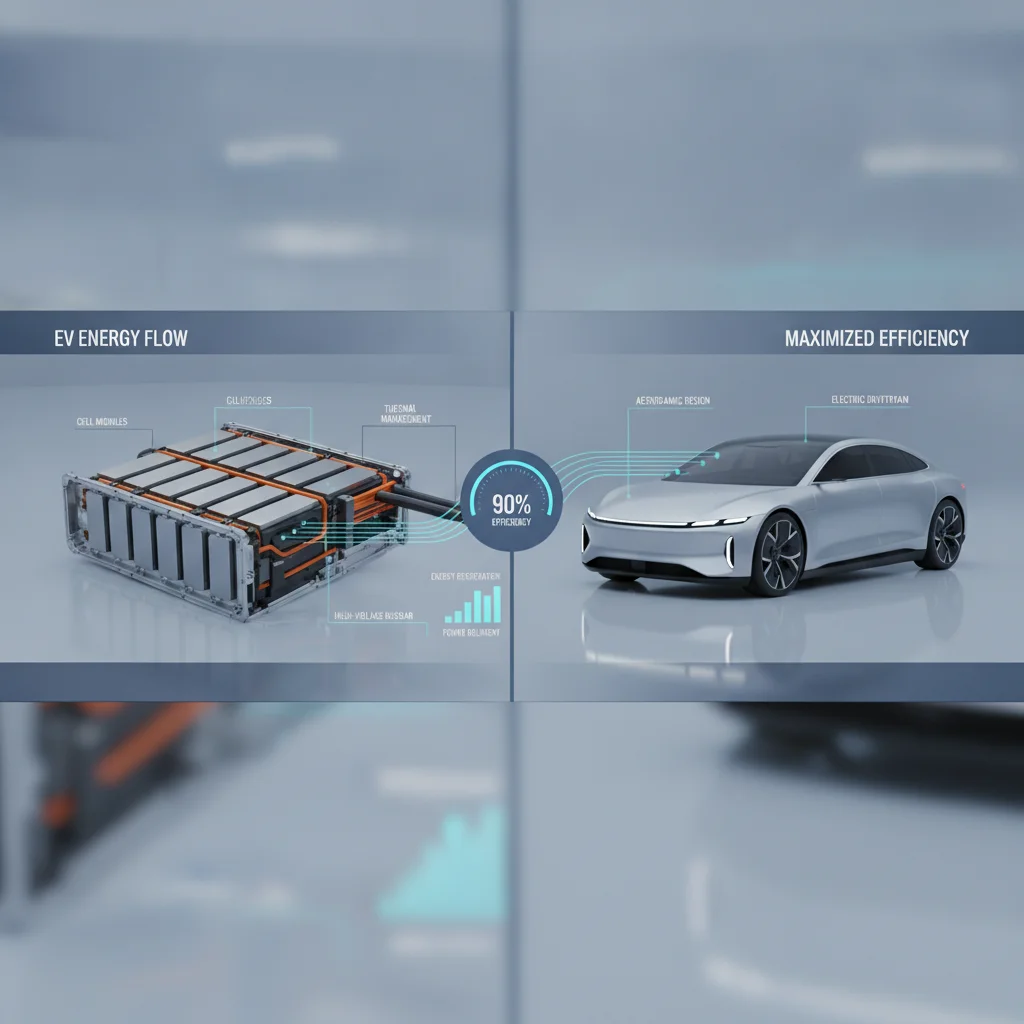
Usable pack capacity in kWh is one determinant of range, but efficiency — how many miles the vehicle extracts per kWh — is equally important. Architecture influences efficiency indirectly: a lighter pack improves efficiency; better thermal management maintains peak efficiency across a wider temperature range; and higher pack voltage (800V) enables faster charging without the efficiency losses associated with high-current charging at lower voltages. Understanding this interaction is essential context for any range comparison — and it's explored in detail in battery size vs. efficiency: which one actually determines real-world range.
What This Means When You're Shopping for an EV
You don't need to memorize cathode chemistry or cell formats to make a smart EV purchase. But a working understanding of pack architecture lets you ask better questions and interpret specs more accurately.
Questions Worth Asking
- What's the usable capacity vs. the gross capacity? This tells you how conservatively the automaker has calibrated the BMS buffer — a wider buffer typically means longer-term cell health.
- What cell chemistry does the pack use? LFP is thermally stable and can safely charge to 100% daily without significant degradation. NMC delivers higher energy density but benefits from the 20–80% charging discipline.
- Does the pack use active liquid cooling? In hot climates or if you fast charge frequently, this is a meaningful differentiator. Air-cooled packs are a legitimate red flag for high-use scenarios.
- What's the pack voltage? 800V architecture enables faster public charging and future-proofs the vehicle as high-speed charging infrastructure expands.
- What's the battery warranty? Federal law requires a minimum 8-year/100,000-mile warranty on EV batteries, but coverage thresholds — typically a capacity floor of 70% — vary by manufacturer.
Architecture and Long-Term Ownership Costs
Pack design also affects what happens years down the road. A modular pack may offer more targeted repair options after a collision or a single module failure. A structural or CTP pack may cost more to repair but degrade more slowly due to superior thermal management. Neither approach is strictly better — the right answer depends on how you use the vehicle, where you live, and your risk tolerance for repair costs.
For practical guidance on protecting your investment over time, the habits that preserve long-term battery capacity covers the charging and driving behaviors that matter most. And for the broader ownership context, the EV maintenance basics hub is a useful reference point for understanding how EV upkeep differs from what you're used to with a gas vehicle.
The bottom line: battery architecture is one of the most important differentiators between EVs, and it's almost never discussed on a car lot. Walking in with this knowledge puts you in a genuinely stronger position — both at the point of purchase and over the years of ownership that follow.
Solid-State vs. Lithium-Ion: What's Coming Next
Understand how solid-state batteries differ from today's liquid-electrolyte packs and what the technology timeline looks like for buyers. <a href="/electric-vehicles/ev-basics/how-evs-work/solid-state-batteries-vs-todays-lithium-ion-packs">Read the comparison</a>
Battery Size vs. Efficiency: Real-World Range Explained
A larger pack doesn't automatically mean more range. This guide unpacks how efficiency ratings interact with capacity to produce real-world results. <a href="/electric-vehicles/ev-basics/ev-range-efficiency/battery-size-vs-efficiency-which-one-actually-determines-real-world-range">See the analysis</a>
EV Battery Health: Habits That Protect Long-Term Capacity
Charging discipline, temperature management, and driving habits all affect how quickly your battery degrades. These evidence-backed practices help you protect your investment. <a href="/electric-vehicles/ev-ownership-costs/ev-maintenance-basics/ev-battery-health-the-habits-that-preserve-long-term-capacity">Read the habits guide</a>
EV Maintenance Basics Hub
A full resource center covering what EV ownership maintenance actually looks like — from brake fluid to software updates — and how it compares to gas vehicle upkeep. <a href="/electric-vehicles/ev-ownership-costs/ev-maintenance-basics">Explore the hub</a>

All claims are backed by peer-reviewed research. Sources on request.