Key Takeaways
Our Verdict
Neither 0% APR nor the cash rebate is universally superior — the winner depends on three variables: the size of the rebate, the market rate you actually qualify for, and the loan term. In most scenarios involving rebates above $2,500 and loan terms under 48 months, the cash rebate wins. For large loan amounts, long terms, and top-tier credit that still can't beat 0%, the no-interest deal edges ahead.
| Best for | Recommended |
|---|---|
| Buyers with average-to-good credit (650–720) who can't secure a sub-3% market rate | 0% APR Financing |
| Buyers with excellent credit (720+) who qualify for competitive bank or credit union rates | Cash Rebate |
| Those financing large amounts ($35,000+) over 60–72 months | 0% APR Financing |
| Buyers with short loan terms (36–48 months) or who plan to pay off early | Cash Rebate |
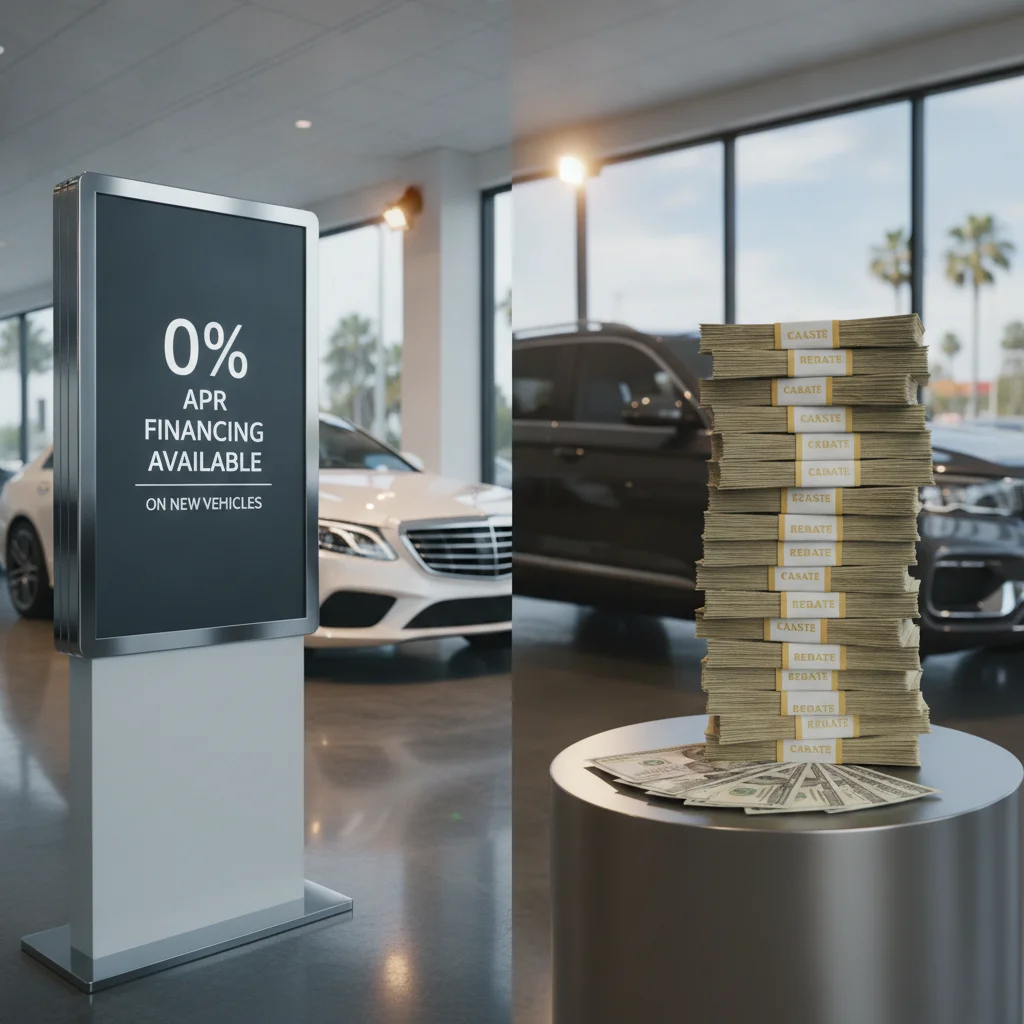
Why You Can't Have Both
Every time a manufacturer runs a promotional financing deal, there's a funding source behind it — usually the automaker's captive finance arm (think Ford Motor Credit or Toyota Financial Services). They're subsidizing the interest on your behalf, and that cost has to come from somewhere. The somewhere is almost always the cash rebate you would have received otherwise.
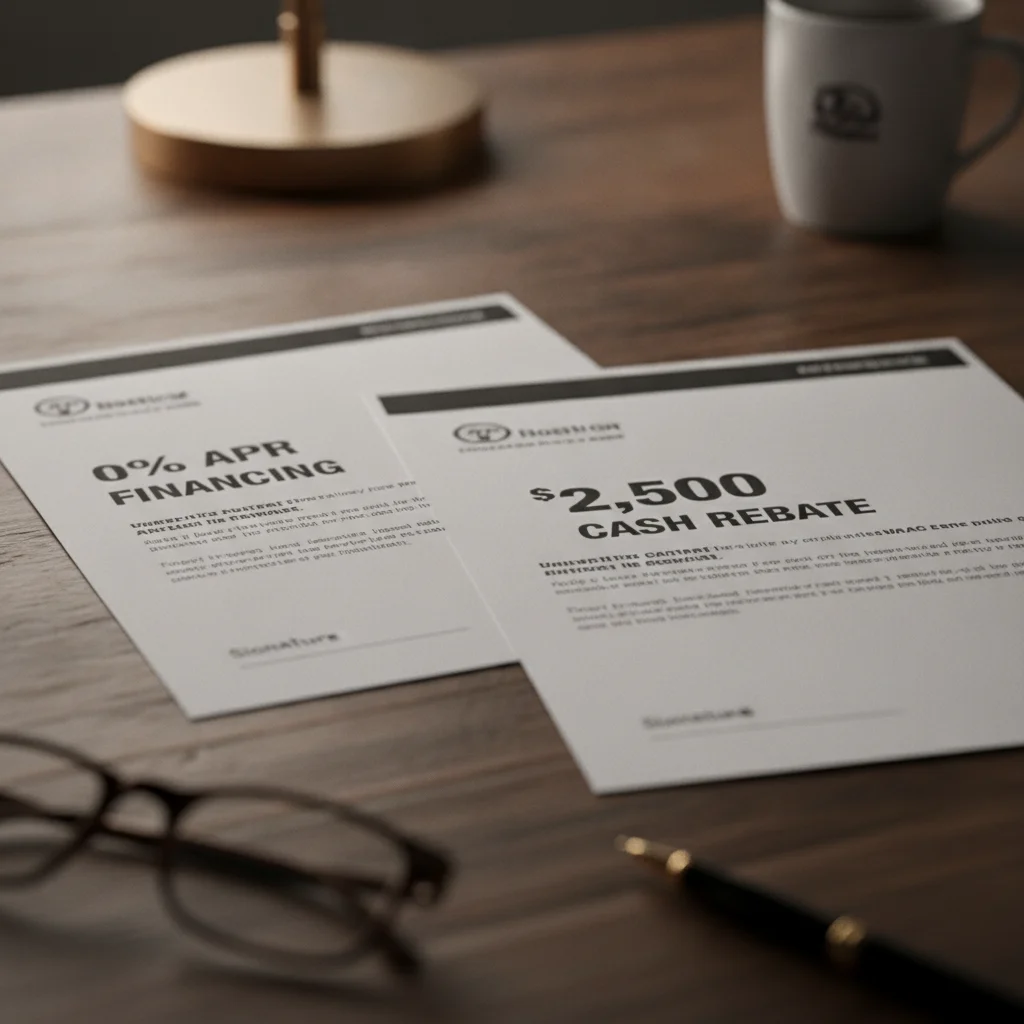
So the dealer presents you with a fork in the road: take 0% APR for 60 months, or take a $3,000 cash rebate applied to the purchase price and finance at the current market rate. Almost never both. Dealers occasionally offer a scaled version — a smaller rebate alongside a reduced but non-zero APR — but the core trade-off remains.
This is a deliberate manufacturer incentive structure, and it's been standard practice for decades. Understanding it is the first step to not getting played by it. See our deep-dive on what 0% APR actually means for the full fine print picture before you sign anything.
The Math: Running a Real Comparison
Let's use concrete numbers. Say you're buying a $35,000 vehicle and the manufacturer is offering either 0% APR for 60 months or a $3,000 cash rebate with financing at whatever rate you can get.
Scenario A: 0% APR for 60 months
- Loan amount: $35,000
- Monthly payment: $583.33
- Total paid: $35,000
- Interest paid: $0
Scenario B: $3,000 rebate, market rate of 6.5% for 60 months
- Loan amount after rebate: $32,000
- Monthly payment: $623.99
- Total paid: $37,439
- Interest paid: $5,439
At 6.5%, Scenario A wins by $2,439 over the life of the loan. The 0% deal is genuinely better here.
Scenario B2: Same rebate, but your credit scores a 5.9% rate
- Loan amount after rebate: $32,000
- Monthly payment: $617.57
- Total paid: $37,054
- Interest paid: $5,054
Still worse than 0%. Now try a credit union rate of 4.49%:
Scenario B3: $3,000 rebate, credit union rate of 4.49% for 60 months
- Loan amount after rebate: $32,000
- Monthly payment: $594.75
- Total paid: $35,685
- Interest paid: $3,685
Now the gap narrows dramatically. The rebate path costs only $685 more in total, but you have a lower monthly payment and more flexibility — and if you refinance or pay it off early, you can flip the outcome entirely. See how refinancing after purchase can cut your total interest cost further.
| 0% APR Financing | Cash Rebate + Market Rate | |
|---|---|---|
| Total interest paid (60mo, 6.5% market) | $0 | ~$5,439 (on $32,000) |
| Effective purchase price reduction | None — full price financed | $1,500–$5,000+ rebate |
| Credit score requirement | Typically 720+ FICO | Based on lender, often 660+ |
| Flexibility to refinance later | Possible but no additional savings | Yes — further rate reduction possible |
| Benefit of early payoff | No interest savings gained | Eliminates remaining interest charges |
| Best loan term fit | 60–72 months | 36–48 months |
| Negotiation leverage on price | Same as rebate path | Rebate stacks with price negotiation |
| Sales tax savings | None | Tax applied to rebate-reduced price |
$2,500–$5,000
Typical manufacturer cash rebate range
According to Edmunds incentive data, mainstream segment cash rebates have averaged $2,500–$5,000 during high-inventory periods in 2023–2024.
720+
FICO score required for most 0% APR offers
Most manufacturer captive finance arms require Tier 1 credit (typically 720–740 FICO) to qualify for published 0% promotional rates.
6.84%
Average new car loan rate (2024)
Experian's State of the Automotive Finance Market Q3 2024 report pegged the average new vehicle loan rate at approximately 6.84% across all credit tiers.
68 months
Average new car loan term
Experian data shows the average new vehicle loan term reached approximately 68 months, making long-term interest calculations increasingly significant.
The Variables That Change the Outcome
The single biggest lever in this decision isn't the promotional rate — it's the size of the rebate relative to the interest you'd actually pay. Here's how each variable shifts the math:
Loan Term
The longer the loan, the more interest you'd pay at a market rate, and the more valuable the 0% offer becomes. A 72-month loan at 6.5% on $32,000 generates roughly $6,700 in interest — that's a lot to give up for a $3,000 rebate. Flip to a 36-month term and the interest at 6.5% drops to around $3,200, making the rebate path competitive or even superior. Short-term buyers should almost always run the rebate numbers. Our guide to loan terms breaks down how length affects total cost in detail.
Rebate Amount
A $1,500 rebate is almost never enough to beat 0% APR on a large balance over a long term. A $5,000 rebate can beat 0% APR even at moderate market rates. The break-even threshold shifts based on loan size — on a $45,000 vehicle, a $5,000 rebate financed at 5.5% over 60 months results in total interest of about $5,600, making it very close to a wash.
Market Rate You Qualify For
This is where credit score becomes the deciding variable. If your score lands you a 7% rate, 0% APR is almost always the better call. If your credit union is quoting 3.9% on a 48-month term, take the rebate every time. Pull your actual rate quotes before you step into the dealership, not after — dealers know that shoppers without competing offers are easier to steer toward the in-house deal.
Whether You Plan to Pay Off Early
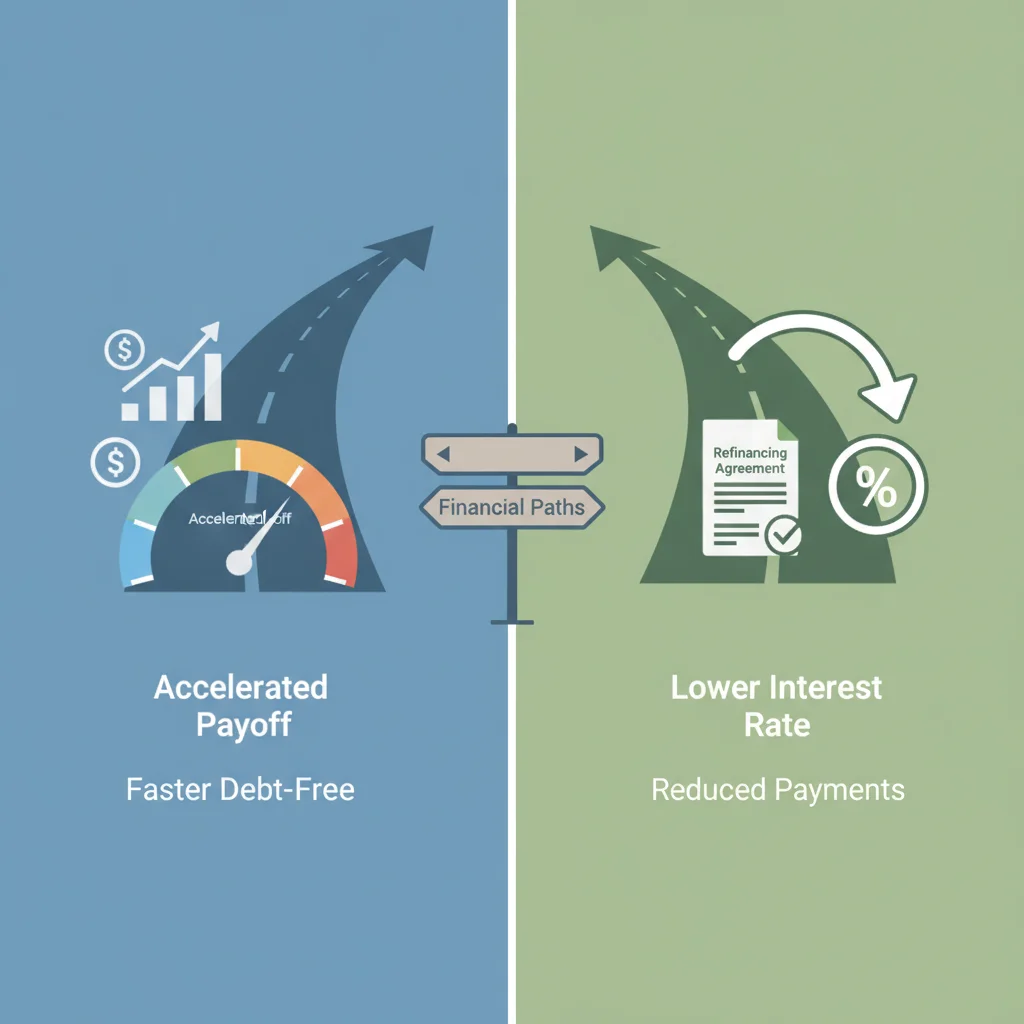
0% APR offers rarely let you out early without consequence — not in terms of penalties, but in terms of opportunity cost. If you pay off a 0% loan in 36 months instead of 60, you saved nothing extra on interest (you were already at 0%), but you missed 24 months of having that cash working elsewhere. The rebate path rewards early payoff because you're eliminating a 5–6% interest charge. Accelerated payoff strategies interact differently with each option.
Who Qualifies for 0% APR (And Why It Matters)
Manufacturers advertise 0% APR prominently but bury the credit requirement in fine print. Most offers require a FICO score of 720 or higher — some cap it at 740+. If you walk in with a 680 and expect the deal on the billboard, you'll be disappointed at the F&I desk.
Here's the irony: buyers with 720+ credit scores are exactly the people most likely to qualify for a competitive outside rate (4–5% range at credit unions). So the customers who are eligible for 0% are also the ones who have the most viable alternative. Meanwhile, buyers with 680–710 scores often don't qualify for 0% but also can't get sub-5% from a bank — they're in the worst position regardless of which incentive they chase.
Get Your Rate Quote Before the Dealership Does
Contact your credit union or bank before visiting any dealer and get a pre-approval letter with a specific rate and term. This locks in your baseline and prevents the dealer from controlling the rate conversation. Many credit unions offer rates 1–2 percentage points below dealer-sourced financing for the same credit profile — that gap can easily exceed the value of a mid-sized cash rebate over a 60-month term.
Use the Rebate to Lower Your Taxable Price
In most states, a manufacturer rebate is deducted from the vehicle's purchase price before sales tax is calculated. On a $3,000 rebate in a state with 7% sales tax, that's an additional $210 in savings that doesn't show up in the simple interest comparison. Always factor state tax treatment into your total cost calculation — it consistently favors the rebate path.
Before you let the dealer run your credit, get a pre-approval from a credit union or your bank. That quote becomes your baseline. If the dealer's 0% beats it on total cost, take the 0%. If the rebate plus outside financing comes out ahead, go that route. The dealer doesn't need to know which way you're leaning until you've run both numbers.
Don't Assume You Qualify for 0% APR
Dealer advertisements rarely mention that 0% APR requires Tier 1 credit — typically a FICO score above 720. If you don't qualify and the dealer switches you to a standard rate (which can be 8–10%), you've lost both the 0% deal and potentially the cash rebate. Know your credit score before negotiations begin, and ask explicitly which credit tier qualifies for the promotional rate.
Monthly Payment Math Will Mislead You
Comparing the two options by monthly payment alone is a trap. The rebate path may have a slightly higher monthly payment than the 0% path on a large balance, yet still cost less in total because of the lower financed amount. Always compare total dollars paid over the full loan term — not the monthly figure. Dealers know that most buyers anchor on monthly payments, and the framing almost always benefits the house.
Negotiation Dynamics: Rebate vs. Rate as Leverage
Most buyers focus on monthly payment, which is exactly what dealers want. Monthly payment negotiation obscures whether you're getting a better price, a longer term, or a lower rate — or some combination of all three. Rebates and rates are separate negotiation levers, and conflating them costs money.
When a cash rebate is on the table, it typically comes off the manufacturer's sticker price, not the dealer's negotiated price. That means you can negotiate the vehicle price down and then apply the rebate — they're not mutually exclusive. The 0% APR, by contrast, is controlled by the manufacturer's finance arm; the dealer has no ability to negotiate the rate. They can, however, still negotiate on vehicle price independently of the rate offer.
The practical move: negotiate the out-the-door price hard first, then — and only then — discuss which incentive you're taking. If a dealer tries to bundle the rate and the price into a single monthly payment conversation, pump the brakes. You can use proven dealer negotiation tactics to keep these conversations separate.
One more wrinkle: some dealers will let you apply a partial rebate alongside a non-zero promotional rate. If the manufacturer is offering $2,500 cash or 0% APR, ask whether a $1,000 rebate with a 1.9% rate is available. Sometimes it is, sometimes it isn't — but it never hurts to ask.

Quick Decision Framework
If you want a fast answer without running a full amortization table, use this decision tree:
- Get an outside rate quote first. Call your credit union or bank before visiting the dealer. Know your actual alternative rate.
- Calculate interest on the rebate path. Take the vehicle price minus the rebate, multiply by your rate and term using a loan calculator, and get a total paid figure.
- Calculate total paid on the 0% path. This is just the vehicle price. No interest.
- Compare the two totals. Whichever is lower wins — period. Don't let monthly payment fog the comparison.
- Factor in your payoff plan. If you're likely to pay off early, the rebate path usually improves; the 0% path doesn't.
The whole exercise takes about 10 minutes with a phone calculator or any online auto loan tool. There's no reason to guess — the numbers will tell you exactly which deal to take.
Common Mistakes That Cost Buyers Money
After years on the dealer side of the F&I desk, I've watched buyers make the same errors over and over. Here are the ones that consistently lead to overpaying:
Assuming 0% Is Always the Smart Choice
It sounds like free money, so it must be better, right? Not when you're leaving a $4,000 rebate on the table and you could have financed at 4.2% through your credit union. Run the math. Always.
Ignoring the Opportunity Cost of a Larger Down Payment
Some 0% offers require a larger down payment to keep payments manageable, which ties up cash that could be earning returns elsewhere. The effective cost of locking away $6,000 in a car versus keeping it liquid is real, even if it's hard to quantify precisely.
Failing to Qualify Before Getting Excited
Shoppers spend hours configuring a vehicle online around a 0% offer they don't qualify for. Check the credit tier requirements before you fall in love with a deal. Dealers will present the standard rate as a backup — often 8–9% — which makes the 0% offer look even better by contrast (a classic anchoring tactic).
Forgetting About State Tax Treatment of Rebates
In most states, a manufacturer cash rebate reduces the taxable purchase price, saving you sales tax on top of the rebate amount. If you're in a 7% sales tax state and taking a $3,000 rebate, you're also saving $210 in taxes — that's an extra $210 that should factor into your comparison. Check your state's rules, as treatment varies.
All claims are backed by peer-reviewed research. Sources on request.