Key Takeaways
Our Verdict
Neither system is objectively better — each reflects a different philosophy about how accident costs should be distributed. Tort states give injured drivers more legal recourse but slower payouts; no-fault states speed up medical claims but limit your ability to sue. The smartest move in either system is carrying coverage that exceeds your state's bare minimums.
| Best for | Recommended |
|---|---|
| Drivers who want maximum legal recourse after a serious accident | Tort (At-Fault) States |
| Drivers who prioritize fast, hassle-free medical claim payments | No-Fault States |
| Those worried about high out-of-pocket costs from catastrophic injuries | No-Fault States with high PIP limits |
| Drivers who want to hold negligent parties legally accountable | Tort (At-Fault) States |
The Core Difference: Who Pays Whom After a Crash
After a car accident, two questions hit almost immediately: Who's responsible? and Whose insurance pays? In the United States, the answer depends heavily on which state you're in — because states run two fundamentally different systems for handling auto accident liability.
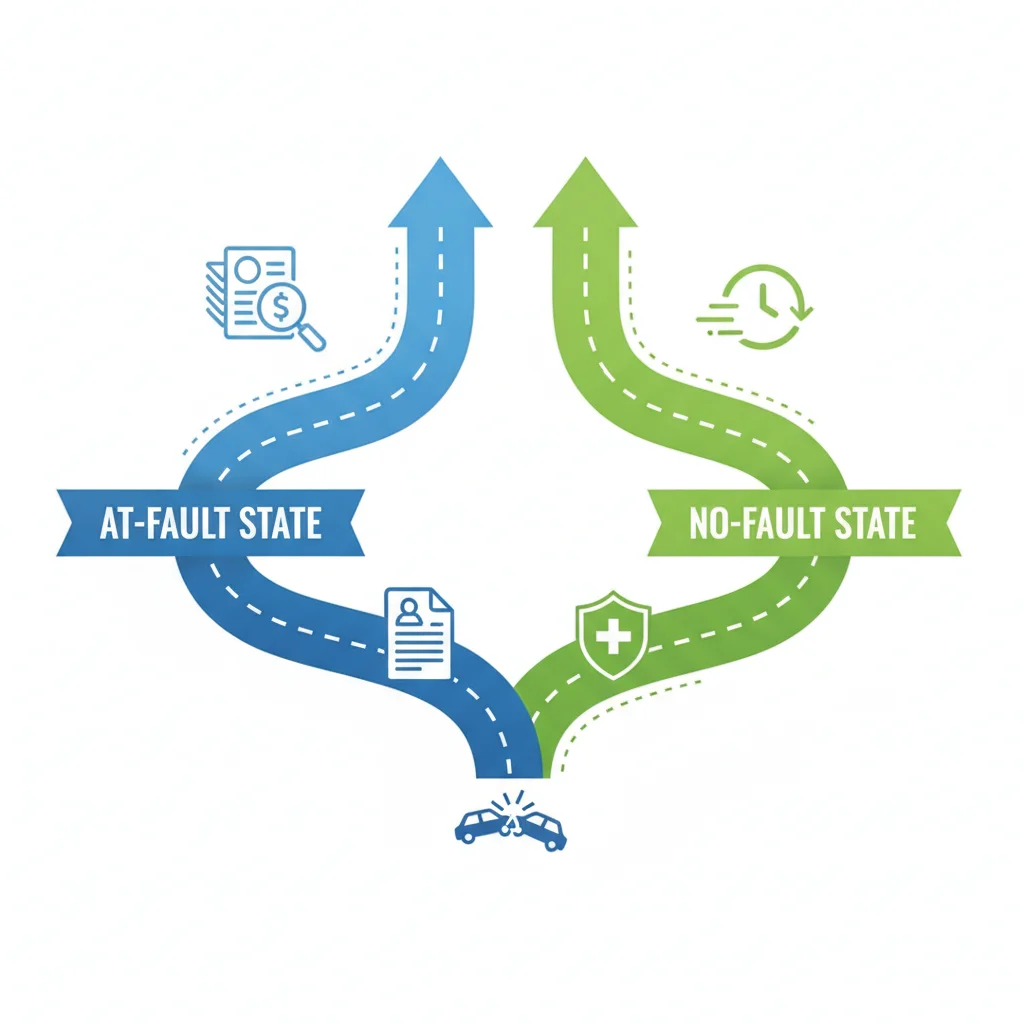
In an at-fault (tort) state, the driver who caused the accident bears financial responsibility for the damages. The injured party typically files a claim against the at-fault driver's liability insurance. If disputes arise, courts may get involved to determine who's legally responsible and for how much.
In a no-fault state, injured drivers first turn to their own insurance — specifically their Personal Injury Protection (PIP) coverage — to cover medical expenses, regardless of who caused the crash. The goal is to get people paid quickly without the friction of fault determination.
Understanding which system applies where you live isn't just academic. It directly affects what coverage you need, what you can recover after an accident, and whether you can pursue legal action against another driver. See our full breakdown of how fault and no-fault states shape the claims process for additional context on how these systems affect filing.
How Liability Coverage Works in At-Fault States
The majority of U.S. states — roughly 38 — operate under a traditional tort-based system. If you cause an accident here, your liability insurance is the primary financial backstop for the people you injured and the property you damaged.
What Liability Coverage Pays For
Standard liability coverage in a tort state breaks into two components:
- Bodily injury liability (BI): Covers medical bills, lost wages, pain and suffering, and legal fees for the other driver and their passengers.
- Property damage liability (PD): Covers repairs or replacement of vehicles, fences, guardrails, and other property you damaged.
If you're the injured party, you file a third-party claim against the at-fault driver's liability policy. This is where fault determination becomes critical — because the other driver's insurer has a financial incentive to minimize how much their policyholder owes. Disputes over fault percentages are common, and they directly affect your payout. Our guide on how liability is determined after an accident walks through this process in detail.
The Role of Negligence Laws
Tort states don't all operate identically. Many use comparative negligence rules, which means fault — and therefore compensation — can be split between multiple parties. For example, if you're found 20% at fault in a crash, your compensation may be reduced by 20%. Some states use contributory negligence, which is more restrictive: if you're found even partially at fault, you may receive nothing at all. Learn more about how comparative vs. contributory negligence affects your accident claim.
Consider MedPay in Tort States
Medical Payments (MedPay) coverage fills a practical gap in at-fault states — it pays your medical bills quickly while fault is still being sorted out. This is especially useful when the other driver's insurer is dragging its feet on a liability determination. Even modest MedPay limits ($5,000–$10,000) can relieve significant financial pressure in the immediate aftermath of a crash.
Revisit PIP Limits Annually
Medical costs rise every year, and PIP limits that felt adequate when you first purchased your policy may not keep pace. Review your PIP coverage during each renewal — especially if your income has grown, since PIP wage-loss benefits are often capped as a percentage of your policy limit. Increasing PIP coverage is usually one of the more affordable upgrades on a no-fault policy.
Because the at-fault driver's liability limits cap what you can recover, carrying uninsured/underinsured motorist (UM/UIM) coverage is especially valuable in tort states. If the at-fault driver is uninsured or carries low limits, UM/UIM steps in to fill the gap.
How Liability Coverage Works in No-Fault States
Twelve states — including Florida, Michigan, New York, New Jersey, and Kentucky — plus Washington D.C. operate under no-fault insurance systems. The idea behind no-fault is straightforward: remove the friction and delays of fault disputes so injured people get medical help paid for quickly.
The Role of PIP Coverage
In no-fault states, drivers are required to carry Personal Injury Protection (PIP), sometimes called "no-fault coverage." After an accident, you file with your own PIP coverage for medical expenses, rehabilitation, and often a portion of lost wages — regardless of who caused the crash. This happens even if the other driver was clearly at fault.
PIP requirements vary widely by state. Michigan, for example, has historically offered some of the most extensive PIP benefits in the country, while states like Florida set lower minimum thresholds that may leave gaps in serious accident scenarios.
Does Liability Insurance Still Matter in No-Fault States?
Yes — and this is a common misconception worth clearing up. Liability coverage is still legally required in no-fault states. It covers:
- Property damage you cause to another vehicle or structure (PIP doesn't cover property)
- Bodily injury claims if an injured party successfully crosses the threshold to sue you
- Serious injury lawsuits brought against you, even within a no-fault framework
The no-fault label refers specifically to how medical claims are initially processed — not to a blanket elimination of liability between drivers. Every state requires liability insurance, and no-fault states are no exception.

The Lawsuit Threshold
To control frivolous litigation — one of the criticisms of pure tort systems — no-fault states impose a lawsuit threshold that limits when injured drivers can step outside the no-fault system and sue the at-fault driver directly. Thresholds come in two types:
- Verbal threshold: Your injury must meet a qualitative definition, such as "permanent injury," "significant disfigurement," or "death." New Jersey and Florida use verbal thresholds.
- Monetary threshold: Your medical expenses must exceed a specific dollar amount before you can sue. Michigan and Minnesota have used monetary thresholds.
If your injuries don't meet the threshold, your PIP coverage is your primary — and often only — source of compensation for medical costs.
Low PIP Limits Can Leave You Exposed
In no-fault states, it's tempting to carry the state minimum PIP coverage to keep premiums low. But minimum PIP limits — some as low as $10,000 in Florida — can be exhausted quickly by a single ambulance ride and emergency visit. If your injuries require surgery or rehabilitation, you may be left covering the remainder out of pocket. Serious injury cases that don't meet the lawsuit threshold have no other recovery path.
Minimum Liability Is Rarely Enough
State-required liability minimums are a legal floor, not a financial safety net. If you cause a multi-vehicle accident or injure someone seriously, damages can reach hundreds of thousands of dollars. Anything above your liability limit can be pursued directly against your personal assets — savings, future wages, and property. Carrying limits of at least 100/300/100 is a widely recommended baseline for most drivers.
Side-by-Side Comparison: At-Fault vs. No-Fault
Here's how the two systems stack up across the criteria that matter most to drivers navigating a real accident:
| Criterion | At-Fault (Tort) States | No-Fault States | |
|---|---|---|---|
| Who pays your medical bills first | The at-fault driver's liability insurer | Your own PIP coverage | |
| Fault determination required to get paid | Yes — must establish who caused crash | No — PIP pays regardless of fault | |
| Right to sue for pain and suffering | Generally available | Only if injury meets state threshold | |
| Speed of medical claim payment | Slower — tied to fault investigation | Faster — claim goes to own insurer | |
| Required coverages | BI liability, PD liability; UM/UIM recommended | PIP required plus BI and PD liability | |
| Property damage claims | Filed against at-fault driver's insurer | Still fault-based — PIP doesn't cover property | |
| Number of U.S. states | ~38 states | 12 states + D.C. | |
| Premium impact of not-at-fault accident | Typically limited rate effect | PIP claim may still affect renewal pricing |
One area where both systems align: neither replaces the need for robust coverage on your own vehicle. Collision and comprehensive coverage handle physical damage to your car regardless of fault — a separate layer that complements whatever liability system your state uses.
States That Offer a Choice: The Optional No-Fault States
A small number of states give drivers a meaningful choice between systems. Kentucky, New Jersey, and Pennsylvania are known as choice no-fault states. When you buy a policy in these states, you elect either:
- The no-fault option: You accept PIP coverage as your primary medical recovery method and limit your right to sue.
- The tort option: You retain full right to sue but must go through fault-based claim processes for medical costs.
This choice has real financial consequences. The tort option typically costs more in premium, while the no-fault option trades lower premiums for reduced legal access. If you live in a choice state and haven't thought carefully about this election, it's worth revisiting with your insurer.
12 + D.C.
U.S. no-fault jurisdictions
As of 2024, twelve states and Washington D.C. operate under no-fault auto insurance systems requiring drivers to carry PIP coverage.
$25,000
Common minimum BI liability limit
Many states set their bodily injury liability minimum at just $25,000 per person — an amount a single emergency room visit can exceed.
3
Choice no-fault states
Kentucky, New Jersey, and Pennsylvania allow drivers to elect between tort and no-fault coverage frameworks when purchasing a policy.
~30%
Drivers with minimum coverage only
Surveys by the Insurance Research Council suggest roughly 30% of drivers carry only state-minimum liability limits, leaving significant financial exposure.
Making the wrong election — or simply defaulting without understanding what you've chosen — is one of the more common gaps drivers don't discover until after an accident. If you're uncertain about your current election status, call your insurer directly and ask.
How Your State System Affects the Coverage You Should Carry
Understanding your state's liability framework should directly influence your coverage decisions — not just what's legally required, but what's actually protective.
In At-Fault (Tort) States
- Carry liability limits well above the state minimum. State minimums are notoriously low — many set bodily injury minimums at $25,000 per person. A single hospitalization can exhaust that quickly, leaving your personal assets exposed.
- Add uninsured/underinsured motorist coverage. If the at-fault driver has no insurance or insufficient limits, this coverage bridges the gap.
- Consider MedPay. Medical Payments coverage can pay your own medical bills quickly without waiting for fault to be determined.
In No-Fault States
- Set your PIP limits thoughtfully. The minimum PIP your state requires may not cover a serious injury. Higher PIP limits cost more but provide meaningful protection for lost wages and extended rehabilitation.
- Don't skip liability. It's still required and still protects you if someone sues you after a serious accident.
- Understand your threshold. If your state uses a verbal threshold, get clarity from your insurer on what "permanent injury" means in your jurisdiction, because that definition determines whether you can pursue a lawsuit.
Rate impacts also differ across systems. How fault determination shapes your premium after a claim follows different rules in no-fault states — your own insurer handles your medical claim, which can affect your PIP experience rating even if you weren't the cause of the crash.
For drivers dealing with single-car accidents, the fault system still applies — your own coverage types determine what gets paid, and in no-fault states, PIP still covers medical expenses regardless of how the crash happened.
Consider MedPay in Tort States
Medical Payments (MedPay) coverage fills a practical gap in at-fault states — it pays your medical bills quickly while fault is still being sorted out. This is especially useful when the other driver's insurer is dragging its feet on a liability determination. Even modest MedPay limits ($5,000–$10,000) can relieve significant financial pressure in the immediate aftermath of a crash.
Revisit PIP Limits Annually
Medical costs rise every year, and PIP limits that felt adequate when you first purchased your policy may not keep pace. Review your PIP coverage during each renewal — especially if your income has grown, since PIP wage-loss benefits are often capped as a percentage of your policy limit. Increasing PIP coverage is usually one of the more affordable upgrades on a no-fault policy.
Common Misconceptions About Fault and No-Fault Systems
A few beliefs about these systems are widespread — and wrong enough to cause real problems after an accident.
"In a no-fault state, fault doesn't matter at all"
Fault still matters for property damage claims, for determining whether you've crossed the lawsuit threshold, and for how your insurer may price your next renewal. What no-fault removes is the initial requirement to establish fault before medical bills get paid.
"The at-fault driver pays for everything directly"
In a tort state, the at-fault driver's liability insurance pays — up to the policy limits. If the damages exceed those limits, the at-fault driver is personally responsible for the remainder. This is the core reason high liability limits matter.
"No-fault means I can always sue for pain and suffering"
Not without meeting your state's threshold. Pain and suffering is a non-economic damage — it falls outside what PIP covers and is typically only recoverable through a lawsuit. If your injuries don't meet the threshold, that compensation simply isn't available to you under the no-fault framework.
"My state's minimum coverage is enough"
Rarely. Minimums are set to protect other people from you — not to protect you from financial exposure. In both systems, low liability limits leave your personal finances at risk if damages exceed your policy. See our guide on traffic laws and their insurance implications for more on how legal requirements translate to real-world coverage needs.
Low PIP Limits Can Leave You Exposed
In no-fault states, it's tempting to carry the state minimum PIP coverage to keep premiums low. But minimum PIP limits — some as low as $10,000 in Florida — can be exhausted quickly by a single ambulance ride and emergency visit. If your injuries require surgery or rehabilitation, you may be left covering the remainder out of pocket. Serious injury cases that don't meet the lawsuit threshold have no other recovery path.
Minimum Liability Is Rarely Enough
State-required liability minimums are a legal floor, not a financial safety net. If you cause a multi-vehicle accident or injure someone seriously, damages can reach hundreds of thousands of dollars. Anything above your liability limit can be pursued directly against your personal assets — savings, future wages, and property. Carrying limits of at least 100/300/100 is a widely recommended baseline for most drivers.
What This Means for Drivers Moving Between States
If you're relocating, your insurance obligations may change significantly — and not always in an obvious direction. Moving from a tort state to a no-fault state typically means you'll be required to add PIP coverage that didn't exist in your prior policy. Moving the other direction may mean PIP drops off but your liability exposure increases.
Insurers are required to adjust your coverage when you change your garaging address, but you should proactively contact your insurer rather than waiting for them to catch it. Some coverage gaps open up during the transition period — particularly if you've moved but haven't updated your address with your insurer.
A few practical steps when moving:
- Notify your insurer of your new state before the move if possible.
- Ask specifically whether PIP is required in your new state and at what minimum.
- Review how your liability limits compare to the new state's requirements.
- Ask whether your current insurer is licensed in the new state — not all carriers operate in all states.
The liability system differences aren't just technicalities. They shape what gets paid, how fast, by whom, and whether you ever see the inside of a courtroom. Knowing which system you're in — and building your coverage accordingly — is one of the most practical things a driver can do before an accident ever happens.


All claims are backed by peer-reviewed research. Sources on request.