Key Takeaways
Why Self-Employment Complicates EV Credit Eligibility
The federal EV tax credit looks straightforward on paper: buy a qualifying vehicle, fall under the income threshold, claim up to $7,500. But for anyone who earns freelance income, runs a small business, works gig economy jobs, or carries any kind of variable compensation, the reality is considerably messier.
The core issue is that the credit is tied to your Modified Adjusted Gross Income (MAGI) — and MAGI behaves differently for self-employed filers than it does for W-2 employees. A salaried worker generally knows their gross income before December 31. A freelancer juggling multiple clients, a consultant who landed a big contract in Q4, or a rideshare driver whose earnings swing with demand may not know their final number until they're sitting down to file.
That uncertainty creates real risk. Claim the credit assuming you'll land under the threshold, then exceed it, and you may owe the IRS the full credit back — or face unexpected reconciliation issues if you used the point-of-sale transfer option. Undershoot your income estimate and you might miss the credit entirely when you actually qualified.
For a full primer on how the credit works and who qualifies in general terms, see our complete EV tax credit walkthrough. This article focuses specifically on the planning challenges unique to variable-income and self-employed buyers.

How MAGI Is Actually Calculated for Self-Employed Filers
MAGI for the EV credit starts with your Adjusted Gross Income (AGI) and adds back certain deductions. For most self-employed people, the number that matters most is gross business income minus allowable business deductions — reported on Schedule C — which flows into your AGI before you ever get to itemized or standard deductions.
Here's what that means in practice:
- Business expenses reduce your net profit, which reduces your Schedule C income, which reduces your AGI and MAGI. Legitimate business deductions — software, equipment, mileage, home office — do matter here.
- The self-employment tax deduction (specifically, the deduction for one-half of self-employment taxes) directly reduces your AGI, which in turn reduces MAGI.
- Retirement contributions made to a SEP-IRA, SIMPLE IRA, or solo 401(k) are above-the-line deductions that reduce AGI and MAGI dollar-for-dollar.
- Health insurance premiums paid by self-employed individuals are also an above-the-line deduction, reducing MAGI.
- HSA contributions similarly reduce your MAGI, provided you're enrolled in a qualifying high-deductible health plan.
What does not reduce MAGI for EV credit purposes? Standard deductions, itemized deductions, and qualified business income (QBI) deductions. These come after AGI is calculated and have no bearing on your MAGI for this purpose.
For a deeper breakdown of exactly how MAGI is calculated and where common confusion arises, our article on EV tax credit income limits and MAGI rules walks through the mechanics in detail.
MAGI Add-Backs to Watch For
While most self-employed deductions reduce MAGI, certain items get added back when calculating MAGI for EV credit purposes. These include excluded foreign earned income, tax-exempt interest, and non-taxable Social Security benefits. For most domestic self-employed filers, these add-backs are not relevant — but if you have foreign income or investment income, confirm with a tax professional that your MAGI calculation accounts for any required add-backs.
The Prior-Year Election: A Legitimate Planning Advantage
One of the most underused provisions in the Inflation Reduction Act is the rule that allows taxpayers to use either the current tax year or the prior tax year MAGI — whichever is lower — to determine credit eligibility. This single rule creates meaningful planning flexibility for anyone with variable income.
Consider this scenario: you had a slow year in 2023 and earned $60,000 in net self-employment income — comfortably under the $150,000 MAGI threshold for single filers. In 2024, you land a major contract and expect to earn $175,000. If you purchase a qualifying EV in 2024 and your 2024 MAGI ends up at $175,000 (over the limit), you could still potentially use your 2023 MAGI of $60,000 to establish eligibility — as long as your 2023 MAGI was under the threshold.
This isn't a loophole — it's an explicit feature of the law. But it requires you to know your prior year's MAGI before you purchase, and to document your reliance on it carefully. If you're in a high-income year following a moderate-income year, this is the first calculation you should make before visiting a dealership.
$150,000
MAGI threshold for single EV credit filers
Per IRS rules under the Inflation Reduction Act, single filers must have MAGI at or below $150,000 in either the current or prior tax year to claim the new clean vehicle credit.
$7,500
Maximum federal EV credit for new vehicles
The maximum credit available for new qualifying electric vehicles under IRC Section 30D, subject to vehicle price caps and battery sourcing requirements.
16M+
Self-employed workers in the U.S.
According to the Bureau of Labor Statistics, over 16 million Americans were self-employed as of recent years — a large group that faces disproportionate complexity in EV credit planning.
66%
Of freelancers report variable monthly income
Research from the Freelancers Union has consistently found that the majority of independent workers experience significant month-to-month income fluctuation, complicating year-end tax projections.
The inverse also applies in your favor: if you had a high-income year in the prior year but expect lower income in the current year, waiting until later in the tax year (when your income picture is clearer) and relying on the current year MAGI may be the smarter path.
Best Practices for Maximizing Your Credit
Given the complexity above, here are the most effective approaches for self-employed and variable-income buyers looking to capture the full EV credit without triggering compliance problems.
Calculate your MAGI — not just your gross revenue — before you begin shopping for an EV.
Many self-employed buyers mistakenly compare their gross revenue or even their net profit against the income thresholds, when the actual test uses MAGI, which may be higher or lower than either figure. Getting this wrong can lead to a surprise tax bill or an unnecessarily missed credit. The calculation must account for above-the-line deductions you're actually taking.
Maximize above-the-line deductions before December 31 of your purchase year to actively manage MAGI.
Unlike itemized deductions, above-the-line deductions directly reduce your AGI and MAGI. For self-employed buyers near the income threshold, strategic contributions to a SEP-IRA or solo 401(k) can be the difference between qualifying and not. These contributions also build retirement wealth, making them doubly beneficial.
Check your prior-year MAGI before purchase and determine whether it gives you a fallback eligibility position.
The IRS allows you to use either the current or prior year MAGI — whichever is lower — to establish EV credit eligibility. Knowing your prior-year number before purchase can either give you confidence to proceed in a high-income year or reveal that you should wait for a better year to establish a favorable prior-year baseline.
Time vehicle purchases to align with months when your income picture is clearest.
For variable-income earners, purchasing in October, November, or December — rather than early in the year — allows you to know your year-to-date income with much greater confidence. Purchasing in January or February when your annual income is highly uncertain creates the largest risk of credit recapture.
If using the point-of-sale transfer, treat it as an advance you must reconcile — not a guaranteed discount.
The point-of-sale credit transfer reduces your purchase price immediately, but if your final MAGI exceeds both the current and prior year thresholds, you owe the credit back at tax time. Self-employed buyers face more income uncertainty than salaried workers, making this a meaningful financial risk to model explicitly before committing.
Document your eligibility determination in writing before purchase, including which year's MAGI you're relying on.
If you're relying on the prior-year MAGI as your eligibility basis, having that documentation on file — including your filed return or official transcript showing that figure — protects you if the IRS questions your credit claim. Self-employed filers are statistically more likely to face audit scrutiny, making documentation discipline especially important.
The Point-of-Sale Transfer Option: High Upside, Real Risk
Starting in 2024, buyers can transfer the EV credit to the dealer at the point of sale, effectively receiving it as an immediate price reduction rather than waiting until tax filing. For a W-2 employee with predictable income, this is largely a convenience feature. For a self-employed buyer, it's a double-edged sword.
The upside is obvious: you get up to $7,500 off the purchase price immediately, reducing the amount you need to finance and eliminating the wait until April 15 to see your credit. For buyers who are cash-flow constrained, this can make an EV purchase meaningfully more accessible.
The risk: if your MAGI ends up above the threshold for both the current and prior year, you may have to repay the credit when you file. The IRS does not allow the dealer transfer to function as a guaranteed subsidy — it's an advance on a credit you must ultimately qualify for based on your final tax return figures.
Buy Late in the Year When Income Is Clearer
For self-employed buyers using the point-of-sale transfer, purchasing in the fourth quarter dramatically reduces the risk of credit recapture. By October or November, your year-to-date self-employment income is largely established and easy to project through December. Combine that with your prior-year MAGI as a fallback, and you can transfer the credit with far more confidence than if you purchase in January.
Don't Overlook the Used EV Credit for Variable-Income Years
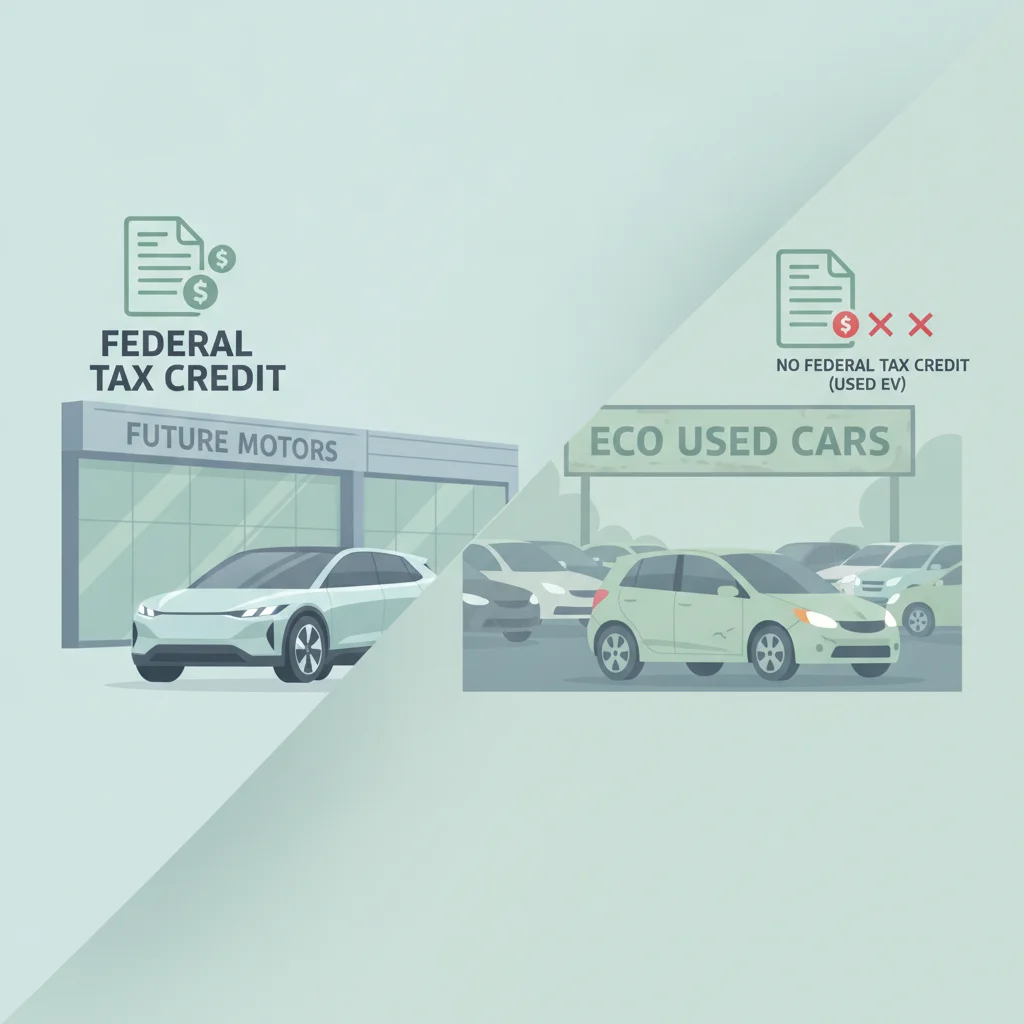
If your income fluctuates above the new-vehicle threshold in high-earning years, the used clean vehicle credit (up to $4,000) has lower income limits: $75,000 for single filers. In a year where your MAGI is elevated and you can't easily reduce it below $150,000, a qualifying used EV might allow you to capture some credit where a new vehicle purchase would leave you with nothing.
The safest approach for variable-income buyers using the point-of-sale transfer is to make the purchase only when you have high confidence in your income picture — ideally after October, when year-to-date income is largely known, and after confirming your prior-year MAGI falls under the threshold as a backup.
For context on how the new vs. used EV credit structures differ — which also affects how the transfer option works — see our breakdown of new vs. used EV tax credits.

Quick Actions You Can Take Right Now
You don't need to overhaul your financial strategy to improve your position. A few targeted moves — made before purchase — can meaningfully affect your outcome.
Working with a Tax Professional: What to Ask
For most self-employed buyers, a one-hour consultation with a CPA or enrolled agent before purchasing an EV is money extremely well spent — potentially worth thousands if it clarifies eligibility, surfaces deduction opportunities, or prevents a credit recapture situation.
When you sit down with a tax professional, the most productive questions to ask include:
- What was my actual MAGI for the prior tax year? (Not gross revenue, not net income — your actual MAGI on your filed return.)
- What is my realistic MAGI projection for this tax year? Ask for a range, not a single number, given your income variability.
- What above-the-line deductions am I currently underutilizing? Many self-employed people are not maximizing SEP-IRA or solo 401(k) contributions.
- If I use the point-of-sale transfer, what is my downside risk? Ask the professional to model the worst case if your income exceeds both the current and prior year thresholds.
- Does purchasing the vehicle through my business change the analysis? In some cases, a business-use vehicle may qualify under different rules — though this changes the nature of the deduction entirely.
“The biggest mistake self-employed taxpayers make with refundable or non-refundable credits is comparing the wrong income number to the threshold. Your net business profit and your MAGI are related but not the same — and that gap is where the planning opportunity lives.”
— Eric Bronnenkant, Head of Tax, Betterment — Certified Financial Planner and CPA
Understanding the precise vocabulary used in EV credit rules is also worth your time before that meeting. Our EV tax credit glossary covers terms like MAGI, MSRP cap, critical minerals, and assembly requirements in plain language, so you're not walking into the conversation cold.
Once you've secured the credit and taken delivery, the financial optimization work isn't done. Charging costs, rate plans, and ownership incentives all affect your total EV cost of ownership. Our year-one EV savings checklist walks through the next set of decisions, from time-of-use electricity rates to home charging equipment credits.


All claims are backed by peer-reviewed research. Sources on request.