Key Takeaways
What the Point-of-Sale Transfer Actually Is
Before 2024, the federal EV tax credit was a deferred benefit. You bought the car, paid full price, and then waited until you filed your taxes to receive a non-refundable credit worth up to $7,500. If your tax liability wasn't high enough to absorb the full credit, you lost whatever didn't fit — and you had to front the entire purchase price in the meantime.
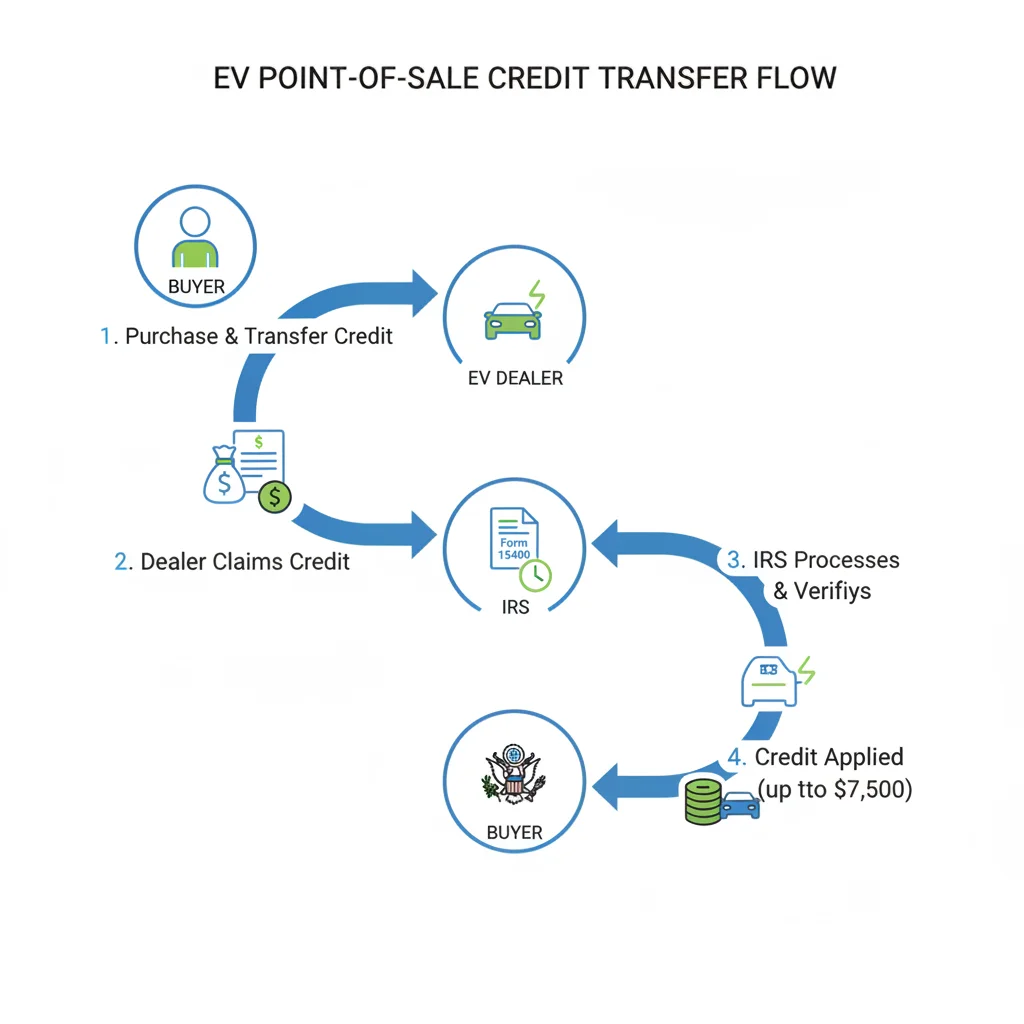
The Inflation Reduction Act changed that. Starting January 1, 2024, the IRS launched a point-of-sale transfer mechanism that lets qualified buyers assign their anticipated credit directly to the dealership at the moment of purchase. The dealer applies that amount as an immediate price reduction — effectively as cash — and then claims the credit from the IRS afterward. The IRS reimburses the dealer, typically within 72 hours of submission.
This is genuinely useful. Instead of tying up $7,500 in a tax credit you can't access for months, you walk out of the dealership having already received the benefit. For buyers financing the vehicle, that lower purchase price also reduces the loan principal, which can meaningfully cut your monthly payment and total interest paid.
For a full breakdown of how the underlying credit works — including MSRP caps, battery sourcing requirements, and manufacturer eligibility — see our federal EV tax credit explainer. This article focuses specifically on how the dealer transfer process works in practice.
What You Need Before You Set Foot in the Dealership
The point-of-sale transfer isn't automatic. It requires advance preparation on your part, and the steps must happen in the right order. Skipping any of them can result in the credit being unavailable or, worse, having to repay it later.
What you will need
fueleconomy.gov qualifying vehicle list
Verify that your specific vehicle, trim, and model year qualifies for the clean vehicle credit under current IRS rules.
IRS Energy Credits Online (ECO) portal
The platform through which you complete your buyer attestation and through which the dealer submits the credit transfer to the IRS.
IRS Form 8936
Federal tax form used to report the clean vehicle credit — required at annual filing even when the credit was transferred at point of sale.
Prior year federal tax return
Used to determine your modified adjusted gross income (MAGI) and confirm you fall within the income eligibility limits.
Tax professional or CPA
Provides income projections and guidance on whether a point-of-sale transfer creates reconciliation risk given your specific tax situation.
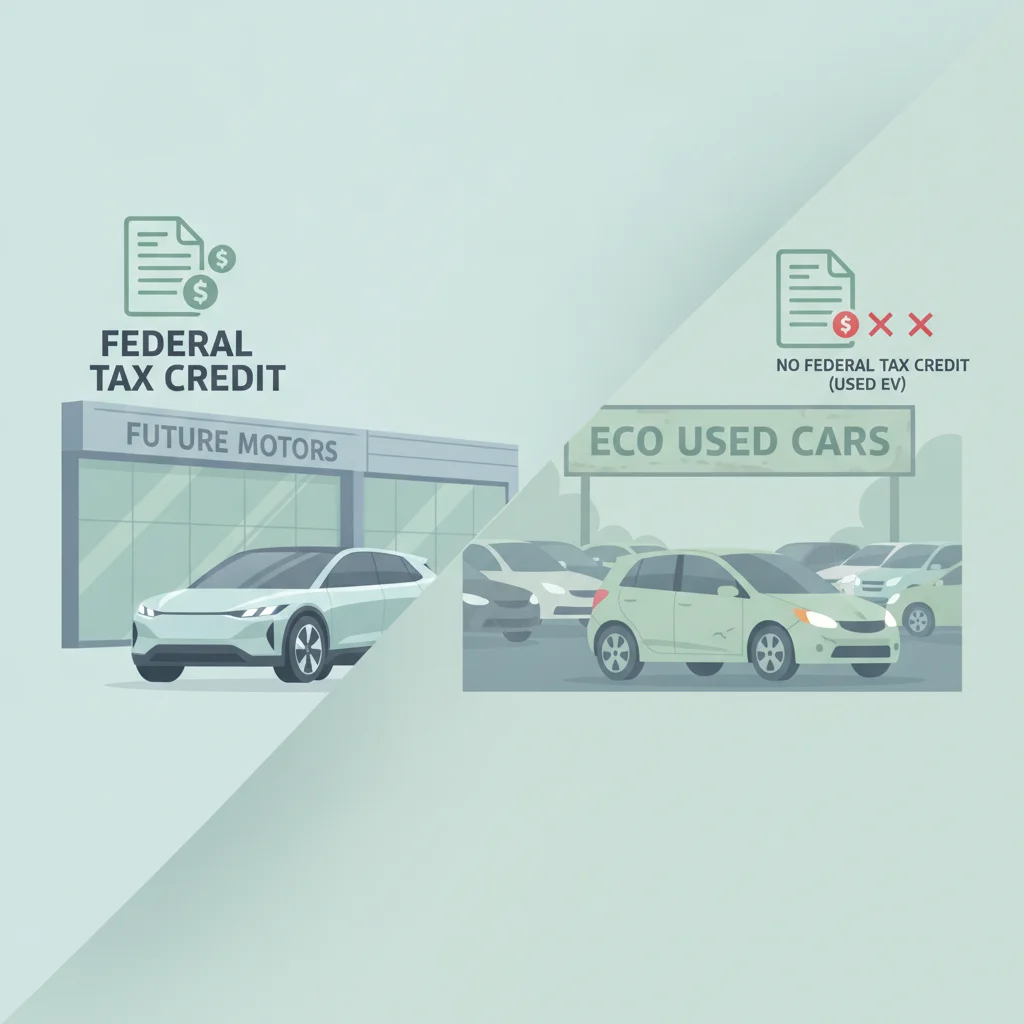
The most critical piece of preparation is verifying your income eligibility. The IRS imposes modified adjusted gross income (MAGI) limits that apply to the year you purchase the vehicle or the prior year — whichever is lower. For the new vehicle credit, those limits are $150,000 for single filers, $225,000 for heads of household, and $300,000 for married filing jointly. For the used EV credit (up to $4,000), limits are significantly lower: $75,000, $112,500, and $150,000 respectively. You can use either the prior year's return or your projected current-year income to qualify — a useful flexibility if your income varies year to year.
You also need to confirm the specific vehicle you're buying qualifies. Not every EV on a dealer's lot meets the battery sourcing and final assembly requirements under the IRA. The IRS maintains a current list of qualifying vehicles at fueleconomy.gov — check it the week you intend to buy, since vehicles can be added or removed as manufacturer data is updated.
If you're weighing new vs. used EV options, our comparison of new vs. used EV credits lays out exactly how each program differs in structure and qualification rules.
Step-by-Step: How to Execute the Transfer at the Dealership
The mechanics of the transfer involve both you and the dealer completing specific tasks through the IRS Energy Credits Online (ECO) portal. Here's what that looks like in sequence.
Confirm the vehicle qualifies before negotiating
Visit fueleconomy.gov and check the current list of vehicles eligible for the clean vehicle credit. Verify that the specific trim level and model year you intend to purchase appears on the list. Battery sourcing and assembly requirements can vary by trim — don't assume eligibility based on the brand or model name alone.
Also confirm the MSRP cap: $80,000 for SUVs, vans, and trucks; $55,000 for sedans and other passenger cars.
Verify your income eligibility using IRS guidance
Pull your most recent federal tax return and calculate your modified adjusted gross income (MAGI). Compare it to the applicable threshold for your filing status. Remember: you can use either the prior year or current year MAGI — whichever is lower — to qualify. If you expect a significant income change this year, factor that into your decision about whether to transfer now or wait to claim at filing.
Confirm the dealer is registered with IRS Energy Credits Online
Ask the dealership's finance manager directly: "Is your dealership registered with the IRS Energy Credits Online portal to process point-of-sale EV credit transfers?" A registered dealer will have an IRS-assigned dealer ID and familiarity with the ECO submission process. If they hesitate or are unfamiliar with ECO, escalate to the general sales manager or choose a different dealer.
Negotiate the vehicle price independently of the credit
Agree on an out-the-door vehicle price — including any dealer fees and add-ons — before introducing the EV credit transfer into the conversation. This prevents dealers from inflating the vehicle price by the credit amount and presenting it as a wash. Once you have a firm price commitment, then inform the finance manager you intend to use the point-of-sale credit transfer.
Complete your attestation through IRS Energy Credits Online
The buyer attestation is your legal confirmation that you meet the income requirements and that the vehicle will be used for personal (not commercial) purposes. You'll access this through the IRS ECO portal — the dealer can provide you the link or access point. You'll need to provide your Social Security Number and attest to your filing status and income eligibility. This creates a timestamped record that the IRS uses to validate the transfer.
Do not sign any attestation until you've confirmed all the information is accurate. The attestation is binding.
Review the purchase agreement for the credit line item
Before signing, locate the EV credit transfer on the purchase agreement. It should appear as a separate line item showing the full credit amount (up to $7,500 for new vehicles, up to $4,000 for used) applied as a price reduction. If the credit doesn't appear as its own line, ask the finance manager to revise the documentation so the credit is clearly itemized and traceable.
Also confirm no dealer fee has been added that offsets the credit amount — compare the pre-credit and post-credit subtotals carefully.
File IRS Form 8936 with your annual tax return
Even though you received the credit at purchase, you must still report it on your federal return using Form 8936 (Clean Vehicle Credits). The form captures your actual tax liability for the year and reconciles it against the credit transferred. If your liability equals or exceeds the credit amount, no additional action is required. If your liability was less than the credit you received, you'll owe the difference.
Keep your purchase documentation — including the dealer's attestation confirmation and your signed purchase agreement — in your tax files for the year.
Timing Your Purchase Around Income Limits
If you're borderline on the income threshold, the IRS allows you to qualify using either your prior-year MAGI or your current-year MAGI — whichever is lower. This means buying in January or February, before you've earned much of the current year's income, can be strategically useful if you had a high-income prior year and expect this year to be lower. Run the numbers before you commit.
Get the Dealer's ECO Registration in Writing
Ask the finance manager to show you the dealership's IRS dealer registration confirmation before you start the paperwork. Registered dealers will have a dealer identification number. This takes 30 seconds and confirms you're not relying on a dealer's unverified claim that they can process the transfer.
Keep All Purchase Documentation
Save a complete copy of your signed purchase agreement, the buyer attestation confirmation from IRS ECO, and any dealer-provided credit documentation. You'll need these when completing Form 8936, and they serve as your audit trail if the IRS ever questions the transfer.
Attestation Errors Can Trigger Repayment
If you attest to income eligibility at the point of sale but your final tax return shows you exceeded the MAGI limit, the IRS will require repayment of the credit amount. There is currently no penalty waiver for good-faith errors in the attestation — the repayment obligation stands. Double-check your income qualification before signing.
Not All Dealers Are Equipped to Process Transfers
Dealer ECO registration is required but not universal, especially among smaller or independent used-car dealers for the used EV credit. Confirm registration before spending time on a deal. Arriving at the signing table only to discover the dealer can't process the transfer is a frustrating and avoidable outcome.
The Credit Is Not a Guaranteed Discount
The point-of-sale transfer reduces your purchase price immediately, but it is reconciled against your actual federal tax liability when you file. If your tax liability for the year is lower than the credit you received, you will owe the IRS the difference at filing. This is not a loophole or a gray area — the IRS has made the reconciliation requirement explicit. Buyers with variable income or large deductions should model this scenario before using the transfer mechanism.
Dealers Cannot Keep Any Portion of Your Credit
Federal rules require dealers to pass the entire credit value to the buyer as a reduction in the vehicle's sale price. A dealer who absorbs any portion of the credit — or who inflates the vehicle price to offset it — is violating IRS program rules. If you suspect this is happening, document the pricing in writing and consider reporting it to the IRS or your state attorney general's consumer protection office.
What Happens After You Drive Away
Once you've completed the purchase, the dealer submits the transfer to the IRS through their registered ECO account. The IRS typically processes these payments to dealers within three business days. If the dealer's registration or submission contains an error, they may need to refile — but that's the dealer's problem to resolve, not yours, as long as your attestation was accurate.
Your responsibility post-purchase is to report the transfer correctly when you file your federal tax return. Even though you already received the credit at the point of sale, you still need to file IRS Form 8936 (Clean Vehicle Credits) with your return for that tax year. The form captures the transfer event and reconciles your actual tax liability against the credit amount you received.

This is where the one significant financial risk lives: if your actual tax liability for the year turns out to be less than the credit you received at purchase, the IRS will treat the difference as an amount owed. For example, if you transferred a $7,500 credit at purchase but your final tax liability was only $5,000, you would owe $2,500 when you file. The IRS has confirmed this reconciliation requirement — it's not a gray area.
This is also why income projection matters so much before you use the point-of-sale mechanism. If you're confident your tax liability will cover the full credit amount, the transfer is a clean and beneficial tool. If your income or deductions are unpredictable, consult a tax professional before the purchase, not after.
For buyers who find the credit rules complex to navigate on their own, our complete EV tax credit walkthrough covers eligibility, income limits, and the filing process from start to finish.
Common Dealer Problems — and How to Handle Them
The point-of-sale system is still relatively new, and dealer implementation has been uneven. Here are the friction points buyers most commonly encounter and how to navigate them.
The dealer claims they can't process the transfer
Dealers must register with the IRS Energy Credits Online portal to process transfers. Not all dealers have completed that registration, particularly smaller independent dealerships. Before you spend time negotiating a deal, ask explicitly: "Are you registered with IRS Energy Credits Online to process point-of-sale EV credit transfers?" If they say no, you have two options: choose a different dealership, or purchase the vehicle and claim the credit on your taxes the traditional way.
The dealer tries to capture the credit as profit
The IRS rules are explicit: the dealer must pass the full credit value to the buyer as a price reduction. The dealer cannot apply it as a partial reduction and pocket the rest, nor can they use it to offset a dealer fee or markup. If a dealer's out-the-door pricing doesn't reflect the full credit amount you transferred, ask them to break down every line item. The credit should appear as a separate line on the purchase agreement.

The dealer adds a markup equal to the credit amount
This is a subtler tactic. A dealer might increase the vehicle price by $7,500 before applying the credit, leaving you effectively at the same price as without the credit. Negotiation defense here is the same as for any vehicle: establish your target out-the-door price before mentioning the tax credit. Treat the credit as a separate transaction from the vehicle price negotiation.
The dealer rushes your attestation
Your attestation through IRS ECO is a legal document. You're confirming your income eligibility and your intent to use the vehicle for personal purposes. Don't let time pressure or a dealer's deal-closing urgency rush you through it. If you're not certain your income qualifies, ask for time to confirm — or walk away and return when you've verified it.
If you're trading in a vehicle as part of the deal, keep that negotiation completely separate from the credit transfer. Our dealer trade-in guide explains how to maximize trade-in value without letting it get bundled into a confusing all-in number.
Is the Point-of-Sale Transfer Right for You?
The transfer mechanism is genuinely advantageous for most buyers who qualify — but it's not the right move for everyone. Here's a straightforward framework for deciding.
Use the point-of-sale transfer if:
- Your tax liability for the current year will comfortably exceed the credit amount (e.g., you reliably owe $10,000+ in federal taxes)
- You're financing the vehicle and want to reduce your loan principal now rather than receiving a credit refund months later
- You've confirmed both your income eligibility and the specific vehicle's qualification in advance
- The dealer is registered with IRS ECO and experienced with the process
Consider claiming the credit at filing instead if:
- Your income or deductions are hard to predict for the current year
- You're near the income eligibility threshold and want to see your final MAGI before committing
- The dealer is unfamiliar with the transfer process and can't give you clear documentation
- You're paying cash and the timing of the credit doesn't affect your purchase decision
There's also a leasing angle worth knowing: if you lease an EV rather than buy it, the credit structure works differently — the leasing company claims the commercial vehicle credit and may or may not pass it to you through a lower monthly payment. Our leasing vs. buying EV credit comparison breaks down exactly how those scenarios compare.
For first-time EV buyers who want a balanced view of whether the credit is worth the complexity, see our EV tax credit pros and cons piece, which covers the real tradeoffs without the hype.

The bottom line: if you've done the homework — confirmed vehicle eligibility, verified your income, and found a dealer registered with IRS ECO — the point-of-sale transfer is one of the most straightforward ways to capture a $7,500 benefit without waiting until April. The preparation burden is real, but for a credit of this size, it's time well spent.

All claims are backed by peer-reviewed research. Sources on request.