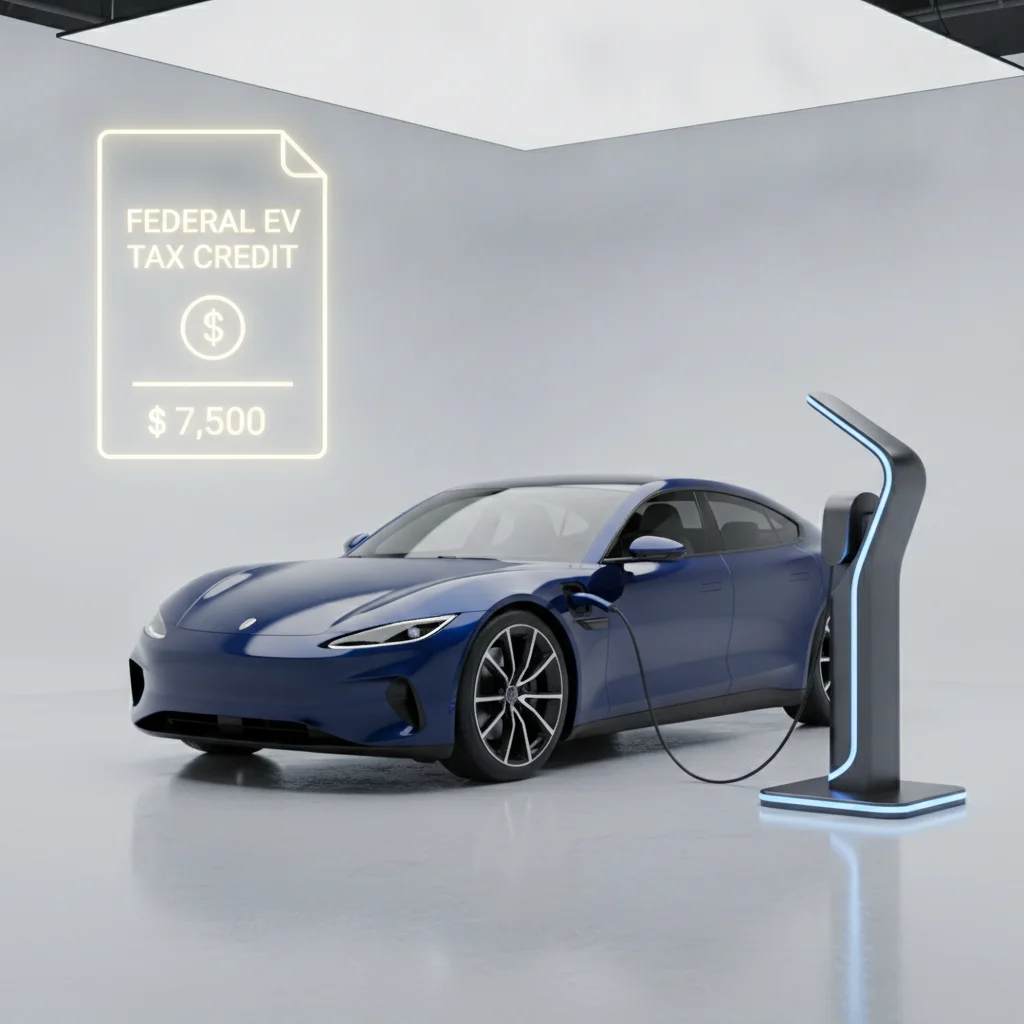
| Maximum new EV credit | $7,500 (IRS Section 30D, Inflation Reduction Act 2022) |
| Maximum used EV credit | $4,000 or 30% of sale price (IRS Section 25E, Inflation Reduction Act 2022) |
| MSRP cap — SUVs, trucks, vans | $80,000 (IRS guidance, 2024) |
| MSRP cap — sedans and other cars | $55,000 (IRS guidance, 2024) |
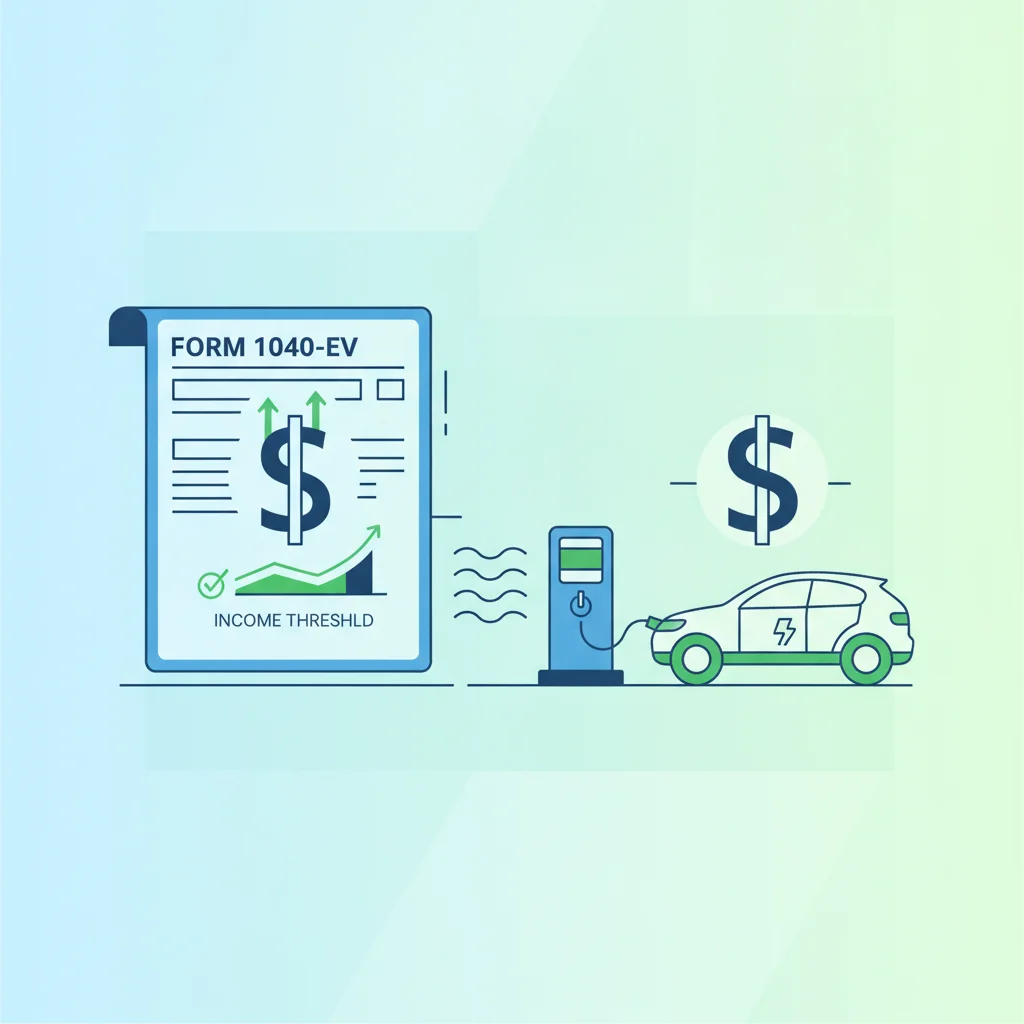
| Income limit — joint filers | $300,000 MAGI (IRS Section 30D) |
| Income limit — single filers | $150,000 MAGI (IRS Section 30D) |
| Assembly requirement | Final assembly must be in North America (U.S., Canada, or Mexico) (IRS Section 30D) |
| Point-of-sale credit available | Yes, starting January 2024 (IRS Rev. Proc. 2023-33) |
| Minimum PHEV battery for eligibility | 7 kWh (IRS Section 30D) |
| Credit type | Non-refundable tax credit (reduces tax owed, not a cash refund) (IRS Section 30D) |
How the Credit Works and Why Vehicle Eligibility Changes
The federal electric vehicle tax credit — technically Section 30D of the Internal Revenue Code, reshaped by the Inflation Reduction Act of 2022 — offers up to $7,500 off your federal tax bill when you buy a qualifying new EV. A separate program covers used EVs at up to $4,000. But "qualifying" is the operative word. The list of eligible vehicles shifts regularly as manufacturers adjust sourcing and assembly practices to meet IRS requirements.
Before looking at specific models, understand the three hard filters every vehicle must pass:
- Final assembly in North America — vehicles must be assembled in the U.S., Canada, or Mexico. This alone knocks out a large share of popular EVs from South Korea, Germany, and China.
- Battery component and critical mineral sourcing thresholds — a percentage of battery components must be manufactured or assembled in North America, and a percentage of critical minerals must be sourced from the U.S. or a free-trade-agreement partner country. These percentages step up each year.
- MSRP caps — vans, SUVs, and trucks must be priced under $80,000; cars and sedans under $55,000.
Your personal eligibility also matters. Income limits based on Modified Adjusted Gross Income (MAGI) apply: $150,000 for single filers, $225,000 for heads of household, and $300,000 for joint filers. If you exceed those thresholds in the current or prior tax year, you cannot claim the credit. See the full MAGI breakdown for details on how the IRS calculates your qualifying income.
For the complete mechanics of how the credit is structured and claimed, the Federal EV Tax Credit, Explained is the right starting point. This article focuses specifically on which vehicles currently pass the vehicle-side tests.
| Maximum new EV credit | $7,500 (IRS Section 30D, Inflation Reduction Act 2022) |
| Maximum used EV credit | $4,000 or 30% of sale price (IRS Section 25E, Inflation Reduction Act 2022) |
| MSRP cap — SUVs, trucks, vans | $80,000 (IRS guidance, 2024) |
| MSRP cap — sedans and other cars | $55,000 (IRS guidance, 2024) |
| Income limit — joint filers | $300,000 MAGI (IRS Section 30D) |
| Income limit — single filers | $150,000 MAGI (IRS Section 30D) |
| Assembly requirement | Final assembly must be in North America (U.S., Canada, or Mexico) (IRS Section 30D) |
| Point-of-sale credit available | Yes, starting January 2024 (IRS Rev. Proc. 2023-33) |
| Minimum PHEV battery for eligibility | 7 kWh (IRS Section 30D) |
| Credit type | Non-refundable tax credit (reduces tax owed, not a cash refund) (IRS Section 30D) |
Vehicles Currently Eligible for the Full $7,500 Credit
The IRS maintains a running list of qualifying vehicles at fueleconomy.gov. Based on current manufacturer attestations and IRS guidance, the following vehicles are broadly expected to qualify for the full $7,500 credit for eligible buyers in 2024–2025. Always verify at the point of purchase, as eligibility can change mid-model year when a manufacturer updates battery sourcing.
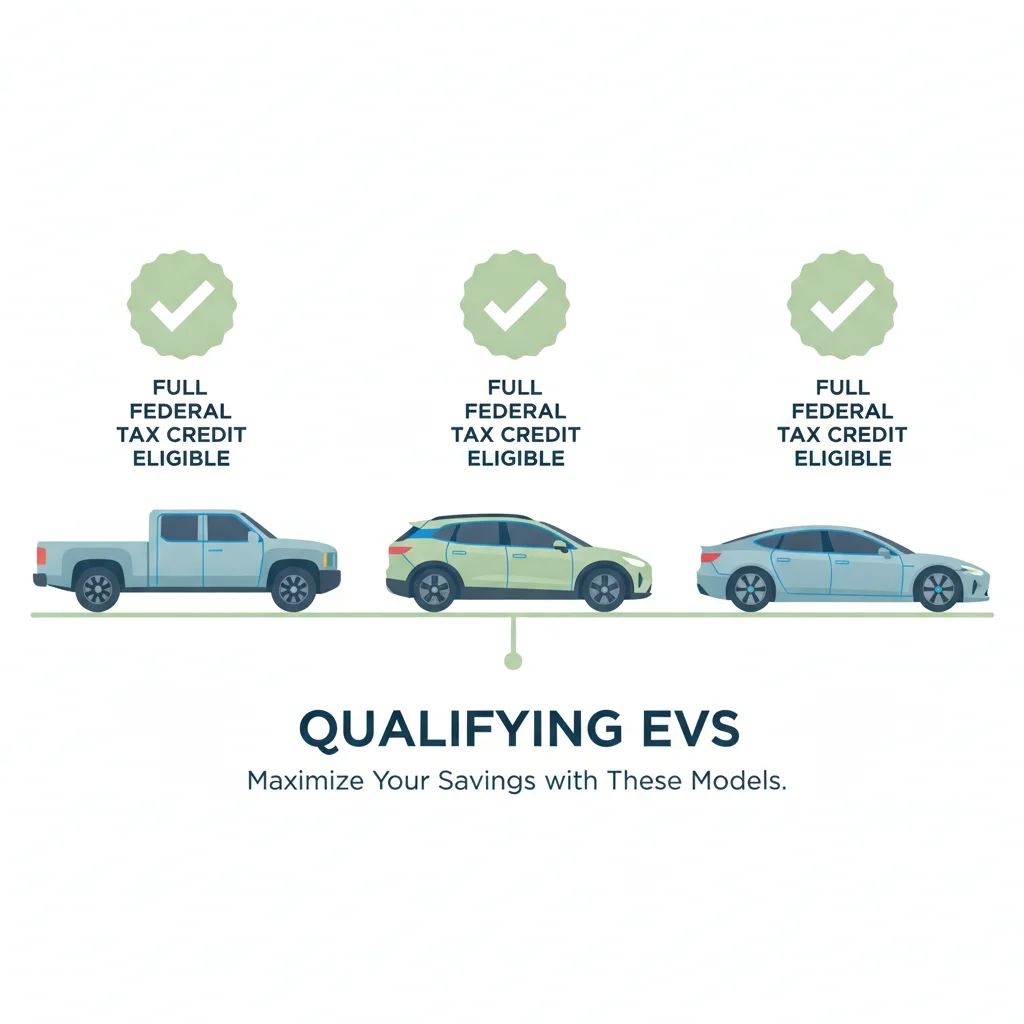
| Vehicle | Type | MSRP Cap | Credit Amount |
|---|---|---|---|
| Chevrolet Blazer EV (select trims) | BEV SUV | $80,000 | $7,500 |
| Chevrolet Equinox EV | BEV SUV | $80,000 | $7,500 |
| Chevrolet Silverado EV (select trims) | BEV Truck | $80,000 | $7,500 |
| Cadillac LYRIQ | BEV SUV | $80,000 | $7,500 |
| Ford F-150 Lightning (Standard Range) | BEV Truck | $80,000 | $7,500 |
| Tesla Model 3 (Rear-Wheel Drive & Long Range) | BEV Sedan | $55,000 | $7,500 |
| Tesla Model Y (select trims) | BEV SUV | $80,000 | $7,500 |
| Volkswagen ID.4 (U.S.-assembled trims) | BEV SUV | $80,000 | $7,500 |
| Rivian R1T (Standard Battery) | BEV Truck | $80,000 | $7,500 |
| Rivian R1S (Standard Battery) | BEV SUV | $80,000 | $7,500 |
| Ford Mustang Mach-E (select trims) | BEV SUV | $80,000 | $7,500 |
| Chrysler Pacifica Plug-in Hybrid | PHEV Van | $80,000 | $7,500 |
Note: Trim-level pricing matters. A vehicle may qualify at one trim and exceed the MSRP cap at a higher trim. Confirm the specific VIN on the IRS or fueleconomy.gov tool before signing.
Eligibility Can Change Within a Model Year
The IRS eligible vehicle list is updated as manufacturers submit updated attestations. A vehicle that qualified when you started shopping may no longer qualify by the time you purchase — or vice versa. Always verify eligibility on fueleconomy.gov using the specific VIN of the vehicle you're buying, not just the model and trim. The date of purchase, not the date of order or deposit, determines eligibility.
The Credit Is Non-Refundable — Tax Liability Matters
The Section 30D credit reduces what you owe in federal taxes — it doesn't generate a refund if it exceeds your tax bill. If your federal tax liability for the year is only $4,000, you'll capture $4,000 of the credit, not $7,500. The point-of-sale transfer option partially works around this by having the dealer apply the credit upfront, though the IRS still reconciles the amount at filing. Buyers with low tax liability should model their actual benefit before assuming the full $7,500 applies to them.
State Incentives Stack on Top of the Federal Credit
Many states offer additional rebates, tax credits, or reduced registration fees for EV buyers that are entirely separate from the federal credit. Colorado, California, New York, and several other states provide significant stacking benefits that can push total incentives well above $10,000. Check your state's energy office or the DSIRE database (dsireusa.org) for current state-level programs.
Vehicles Eligible for a Partial Credit or With Conditions
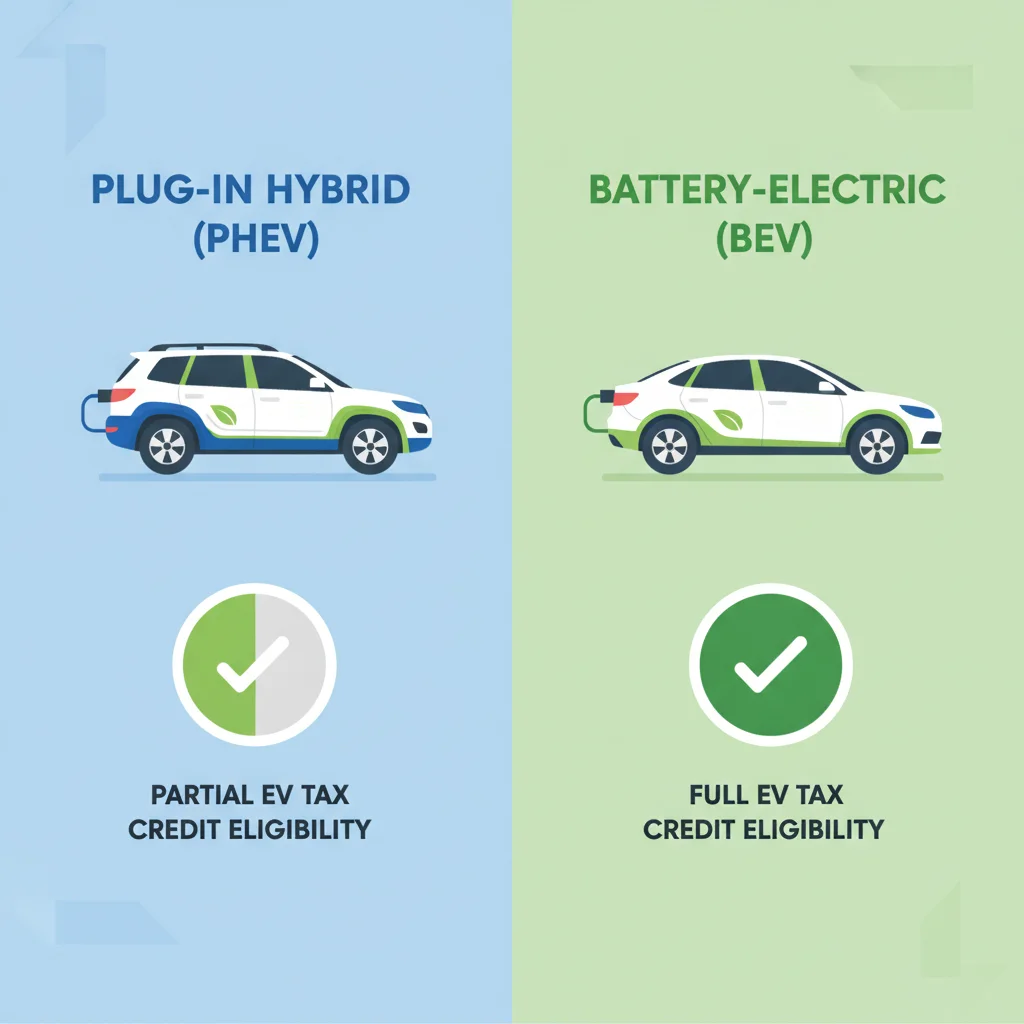
Some plug-in hybrids and battery-electric vehicles qualify for only a partial credit — typically $3,750 — because they meet only one of the two battery-sourcing tests (critical minerals or battery components, but not both). PHEVs must also meet a minimum battery capacity threshold of 7 kWh to qualify at all.
| Vehicle | Type | Credit Amount | Condition |
|---|---|---|---|
| Jeep Wrangler 4xe | PHEV | $3,750 | Meets one battery test only |
| Jeep Grand Cherokee 4xe | PHEV SUV | $3,750 | Meets one battery test only |
| Ford Escape Plug-In Hybrid | PHEV | $3,750 | Meets one battery test only |
| Lincoln Corsair Grand Touring (PHEV) | PHEV | $3,750 | Meets one battery test only |
Battery sourcing thresholds increase each calendar year, which means a vehicle that qualifies in 2024 may qualify for less — or not at all — in 2025 if its manufacturer hasn't updated its supply chain. This is exactly why you should understand what can disqualify an otherwise-eligible EV before assuming you'll get the full amount.
Not all electrified vehicles are treated equally. Standard hybrid vehicles (HEVs) with no plug receive zero federal tax credit under Section 30D. The credit structure by EV type article explains how BEVs, PHEVs, and HEVs are each treated under current law.
Vehicles That Don't Currently Qualify (and Why)
Several popular EVs fail one or more eligibility tests as of current IRS guidance. Understanding why helps you avoid surprises at tax time.
$7,500
Maximum new EV federal tax credit
Available under IRS Section 30D for qualifying vehicles purchased by income-eligible buyers.
~50%
Share of new EV models currently qualifying for full credit
Battery sourcing and assembly requirements have narrowed the eligible pool significantly since the IRA took effect in 2023.
$4,000
Maximum used EV tax credit
The Section 25E credit covers used EVs purchased from licensed dealers with stricter income limits than the new vehicle credit.
2024
Year point-of-sale credit transfer launched
Buyers can now apply the credit at the dealership to reduce purchase price directly, rather than waiting for tax season.
30%
Battery component sourcing threshold (2024)
The IRA requires an increasing share of battery components to be manufactured in North America; this threshold rises each year through 2029.
- Hyundai IONIQ 5 / IONIQ 6 / Kia EV6
- Assembled in South Korea — fail the North American assembly requirement. Hyundai's new Georgia plant began production in 2024; some U.S.-made IONIQ 5 and IONIQ 6 units have since qualified. Verify the specific VIN before purchase.
- BMW i4 / i5 / iX
- Assembled in Germany — do not meet North American assembly requirements.
- Audi Q8 e-tron
- Assembled in Belgium — fails North American assembly test.
- Volvo EX90 / Polestar 2
- Assembled outside North America — not eligible under current rules.
- Tesla Model S / Model X
- Assembled in the U.S. but exceed the $55,000/$80,000 MSRP caps for their vehicle category.
- Rivian R1T / R1S (Max Battery)
- Higher-spec configurations breach the $80,000 MSRP cap.
- Lucid Air
- Assembled in the U.S. but most trims exceed the $55,000 MSRP cap for sedans.
The assembly rule is detailed and nuanced — even vehicles built partially in the U.S. can fail if final assembly occurs elsewhere. For a deeper look, see how North American assembly rules affect EV credit eligibility.
If you're buying for a business rather than personal use, a different set of rules applies. The commercial clean vehicle credit has its own caps and eligibility criteria and can sometimes cover vehicles that don't qualify under Section 30D.
The Point-of-Sale Credit Option and Used EV Credits
Starting in 2024, eligible buyers can take the credit at the dealership rather than waiting for a tax refund. This means a dealer can reduce your purchase price by up to $7,500 on the spot, which then gets reconciled with the IRS on your behalf. You still need to meet income limits and the vehicle must qualify — transferring the credit to a dealer doesn't bypass the rules, it just changes when you see the savings.
Key conditions for the point-of-sale transfer:
- You must attest to your income eligibility at the time of purchase.
- If you later exceed the income threshold (looking at current and prior year MAGI), the IRS can claw the credit back.
- The dealer must be registered with the IRS Energy Credits Online portal to process the transfer.
For used EVs, the credit is different: up to $4,000 or 30% of the sale price, whichever is lower. Income limits are stricter ($75,000 single / $150,000 joint), the vehicle must be at least two model years old, and it must be purchased from a licensed dealer — not a private seller. Compare new and used EV credit rules side by side to see which program fits your situation.
For a complete guide to filing, income tests, and carrying credits forward, see the EV tax credit walkthrough from eligibility to filing.
Section 30D Credit
The federal tax code provision that establishes the new clean vehicle tax credit. It defines vehicle eligibility, income limits, and MSRP caps for buyers of new battery-electric and plug-in hybrid vehicles.
Modified Adjusted Gross Income (MAGI)
The income figure the IRS uses to determine EV credit eligibility. It's generally your adjusted gross income with certain deductions added back. The IRS tests both the prior year and current year MAGI — whichever year you qualify under allows the credit.
North American Assembly Requirement
A rule under the IRA mandating that a vehicle's final assembly must take place in the United States, Canada, or Mexico for it to be eligible for the Section 30D credit. Vehicles assembled elsewhere — even by U.S. brands — do not qualify.
Critical Minerals Test
One of two battery-sourcing tests under Section 30D. A specified percentage of critical minerals (lithium, nickel, cobalt, etc.) used in the EV battery must be extracted or processed in the U.S. or a free-trade-agreement partner country. Meeting only this test earns $3,750.
Battery Components Test
The second battery-sourcing test under Section 30D. A specified percentage of battery components by value must be manufactured or assembled in North America. Meeting only this test earns $3,750; meeting both tests earns the full $7,500.
Point-of-Sale Transfer
A mechanism introduced in 2024 that allows an eligible buyer to transfer their tax credit directly to a participating dealer, reducing the vehicle purchase price immediately rather than claiming the credit on a future tax return.
MSRP Cap
The maximum manufacturer's suggested retail price a vehicle may carry to qualify for the Section 30D credit. The cap is $80,000 for SUVs, trucks, and vans, and $55,000 for sedans and other passenger cars.
Non-Refundable Credit
A tax credit that can reduce your federal tax liability to zero but cannot generate a refund if the credit exceeds what you owe. The Section 30D new vehicle credit is non-refundable, meaning you must have sufficient tax liability to fully utilize it.
How to Verify Eligibility Before You Buy
The IRS and Department of Energy jointly maintain a vehicle eligibility tool at fueleconomy.gov/feg/tax2023.do. You can search by make, model, year, and trim to see current credit status. Manufacturers self-attest their compliance, and the IRS periodically updates the list — sometimes removing vehicles mid-year when sourcing data doesn't hold up.
Here's a practical checklist to run before signing anything:
- Confirm the VIN, not just the model. Assembly location is VIN-encoded. Ask the dealer to pull the full window sticker showing assembly plant location.
- Check the current IRS list at fueleconomy.gov the same week you plan to buy — not three months earlier.
- Calculate your MAGI for both the prior year and an estimate for the current year. If either year puts you over the threshold, you cannot claim the credit.
- Confirm trim-level MSRP stays under the applicable cap. Add-ons and packages that raise the sticker above the cap will disqualify you even if the base model qualifies.
- Ask the dealer if they're registered for the point-of-sale transfer if you want the savings upfront rather than at tax time.
- Consult a tax professional if your income is close to the limit or if you have a complex tax situation (self-employment income, investment income, etc.).
Owning an EV comes with other financial variables beyond the purchase credit — including ongoing charging costs vs. gasoline savings and potentially different insurance premiums for EVs compared to comparable gas vehicles. Factor those into the total cost picture, not just the upfront credit.
If you're installing a home charger, that equipment may also qualify for a separate tax credit. See our reference on federal credits and state rebates for home EV charger installation.
IRS Qualified Clean Vehicle List (fueleconomy.gov)
The official government tool for checking whether a specific make, model, year, and trim qualifies for the federal EV tax credit. Updated as manufacturers submit new attestations — use it the week you plan to buy.
IRS Form 8936
The official tax form used to claim the Section 30D clean vehicle credit on your federal return. Includes instructions for calculating partial credits and documenting vehicle eligibility.
DSIRE State Incentive Database
A comprehensive database of state-level EV rebates, tax credits, and utility incentives maintained by N.C. State University. Use it to identify what stacks on top of your federal credit.
IRS Energy Credits Online Portal
The IRS portal where dealers register to process point-of-sale credit transfers. Useful for confirming your dealer is eligible to apply the credit at purchase rather than at tax time.
EV Tax Credits: A Complete Walkthrough From Eligibility to Filing
A detailed step-by-step guide covering every aspect of the federal EV credit — from checking income eligibility to filing Form 8936 and navigating state incentives.
NHTSA VIN Decoder
Use the National Highway Traffic Safety Administration's VIN decoder to confirm a vehicle's country of final assembly — a critical data point for North American assembly eligibility verification.

All claims are backed by peer-reviewed research. Sources on request.