Key Takeaways
Option A
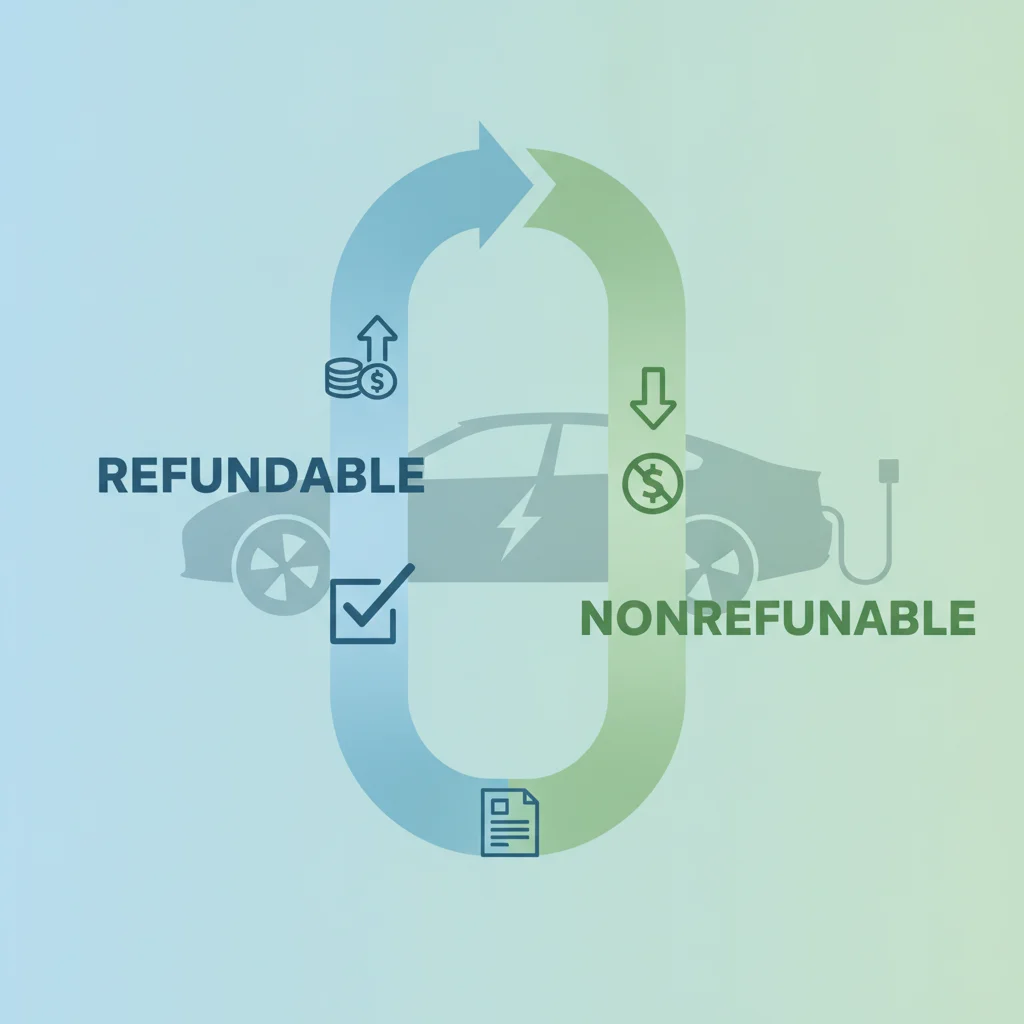
Nonrefundable Tax Credit
The most common credit type — but with a hard ceiling tied to your tax bill.
Best for: Buyers with a federal tax liability at or above the credit amount who want to offset what they owe the IRS.
Option B
Refundable Tax Credit
The more generous structure — pays out even beyond your tax liability.
Best for: Taxpayers who want to capture the full credit value regardless of how much they owe in federal taxes.
If your federal tax liability equals or exceeds $7,500
Nonrefundable Tax Credit
You'll capture the full $7,500 federal EV credit with no value left on the table, making the nonrefundable structure irrelevant to your outcome.
If your federal tax liability is below $7,500
Nonrefundable Tax Credit (via point-of-sale transfer)
Use the 2024 point-of-sale transfer option at the dealership to apply the credit as an upfront discount — transferring the IRS-liability risk to the dealer instead of losing value at filing.
If you're retired or have very low taxable income
Nonrefundable Tax Credit (with caution)
Your tax liability may be too low to use much of the credit. Explore state rebate programs instead, which often pay out regardless of tax status.
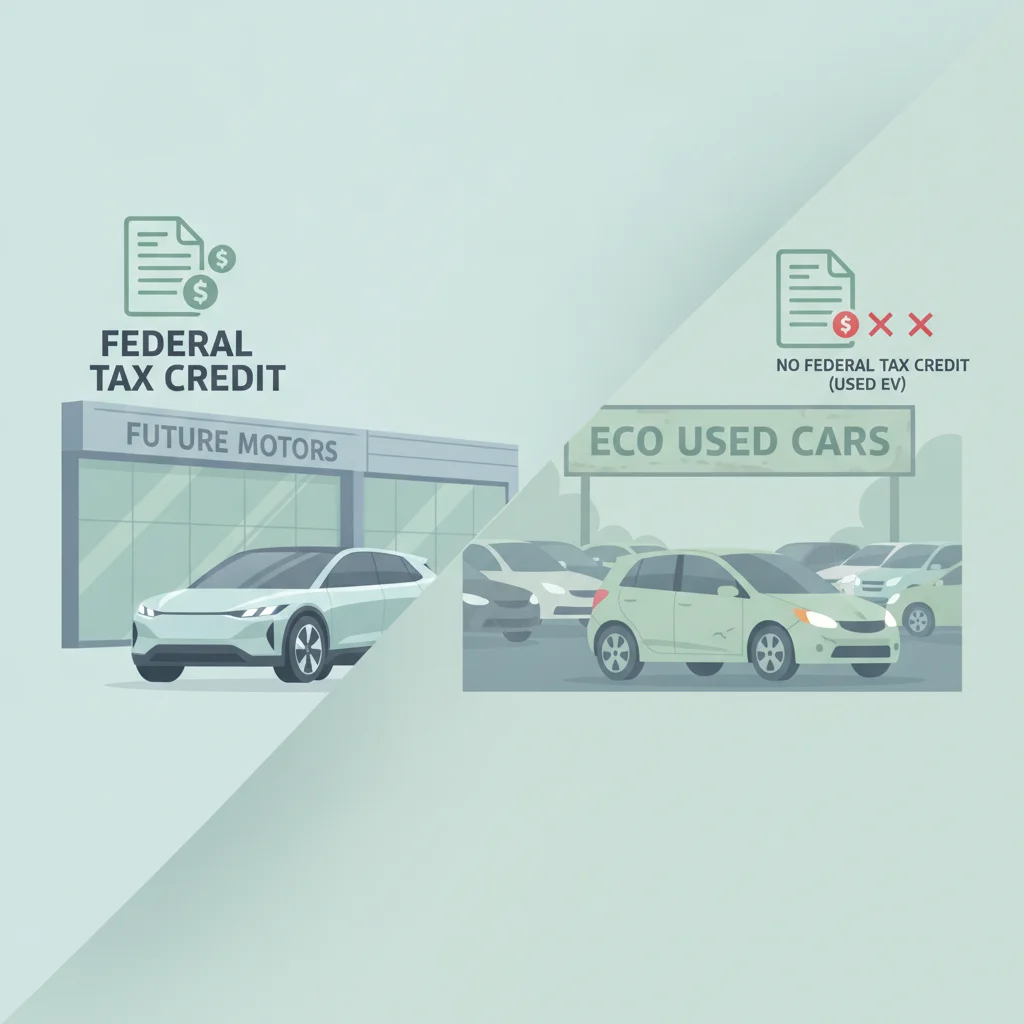
If you're buying a used EV under $25,000
Nonrefundable Tax Credit
The used EV credit tops out at $4,000 or 30% of the sale price — a lower threshold that more buyers can fully utilize given typical tax bills.
If you want maximum guaranteed savings regardless of tax situation
Refundable Tax Credit (seek state programs)
No federal refundable EV credit currently exists, but several state programs offer refundable credits or direct rebates that pay out regardless of tax liability.
Why the Refundable vs. Nonrefundable Distinction Matters for EV Buyers
When shoppers research the federal EV tax credit, most focus on the headline number — up to $7,500 for a new electric vehicle. What far fewer people think about is whether they'll actually walk away with that full amount. The answer depends almost entirely on a single structural characteristic of the credit: it's nonrefundable.
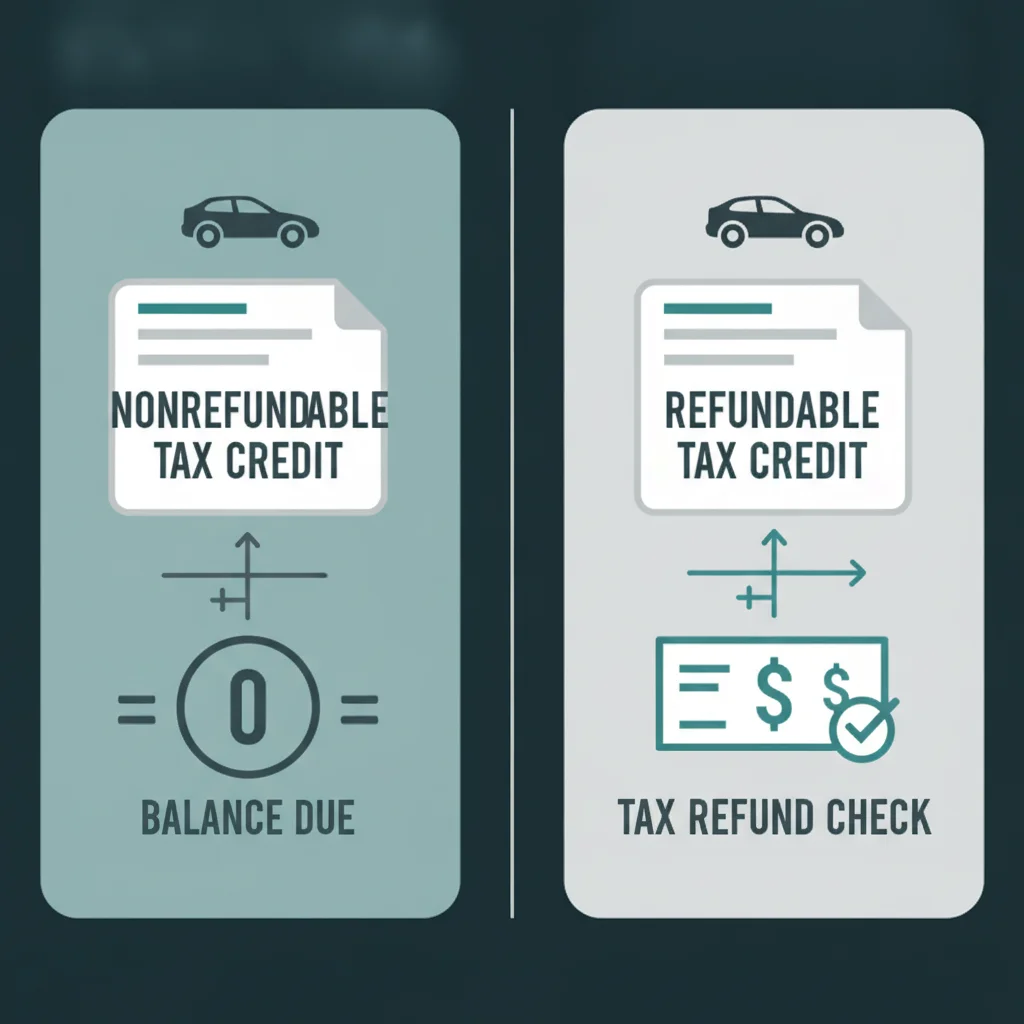
That word carries serious financial weight. A nonrefundable tax credit can reduce your federal income tax bill to zero — but it cannot go below zero. If the credit exceeds what you owe the IRS for the year, the excess simply disappears. There's no cash back, and under current law, no carryforward to future tax years. For a buyer who owes only $3,000 in federal taxes and claims the $7,500 EV credit, the effective value of that credit is $3,000 — not $7,500.
A refundable credit, by contrast, works the opposite way. If a $7,500 refundable credit exceeded your $3,000 tax liability, the IRS would send you a $4,500 refund. You'd capture the full value no matter what your tax bill looks like. The federal EV credit is not structured this way — though some state-level programs are, which is an important distinction to keep in mind as you plan your purchase.
Understanding this difference isn't just academic. It can materially change the financial case for buying an EV, determine whether you use the point-of-sale transfer option, and inform whether you look to state programs to fill in the gap. See our full federal EV tax credit explainer for the complete qualification framework.
How Each Credit Type Is Structured
Let's get concrete about how these two structures play out at tax time — because the mechanics are where most EV buyers get tripped up.
Nonrefundable Credits: The IRS Cap
With a nonrefundable credit, your tax liability — the amount you actually owe after deductions and exemptions — acts as a ceiling. The credit reduces that number dollar-for-dollar, but only down to zero. Consider a simplified example:
- Gross income: $80,000
- Federal tax liability after deductions: $6,200
- Clean Vehicle Credit claimed: $7,500
- Actual credit received: $6,200 (the unused $1,300 is forfeited)
The IRS does not issue a check for the difference. The credit is gone. This is the default structure of the Section 30D Clean Vehicle Credit for new EVs and the Section 25E Used Clean Vehicle Credit, which maxes out at $4,000.
Refundable Credits: Beyond Zero
A refundable credit works like this: if your tax liability is $2,000 and you have a $3,000 refundable credit, the IRS pays you the $1,000 difference. Common examples of refundable federal credits include the Earned Income Tax Credit (EITC) and the Additional Child Tax Credit — but the current EV credits are not in this category.
| Criterion | Nonrefundable Credit | Refundable Credit |
|---|---|---|
| Reduces tax bill below zero? | No — stops at zero | Yes — excess paid as refund |
| Federal EV credit type | Yes (Section 30D, 25E) | Not currently available for EVs |
| Unused credit carry forward | No — forfeited | N/A — full value always paid |
| Benefit for low tax liability buyers | Reduced or zero | Full credit value regardless |
| Point-of-sale transfer available | Yes (2024 onward) | N/A |
| Risk of partial benefit | High if liability < $7,500 | None by design |
| Examples (federal level) | EV credit, Child Tax Credit (partial) | EITC, Additional Child Tax Credit |
| State EV program availability | Common | Available in select states |
The practical implication: if you're a W-2 employee with a solid income, you likely owe enough in federal taxes to absorb a significant portion — or all — of the EV credit. If you're self-employed with heavy deductions, recently retired, or have a lower income, your effective credit value may be far less than advertised.
Tax Liability vs. Taxes Withheld: Don't Confuse Them
Your tax liability is what you owe the IRS based on your income and deductions — not the amount withheld from your paycheck throughout the year. If you've had too much withheld, you'll get a refund regardless of the credit. What matters for the EV credit is whether your actual calculated tax bill (before the credit) is at least $7,500. A large withholding refund doesn't mean you have $7,500 in liability to offset.
The Point-of-Sale Transfer Has an Income Lookback Rule
When you use the point-of-sale transfer to get the EV credit as an upfront discount, the IRS will verify your income eligibility when you file your return. If your income exceeds the threshold for that tax year, you may be required to repay the credit. Use your best income estimate before committing to the transfer — and consult a tax professional if your income is near the threshold.
State Incentives Often Have Separate Deadlines and Funding Caps
Unlike the federal credit, which is available as long as you and the vehicle qualify, many state rebate programs operate on a first-come, first-served basis with annual funding limits. Programs in California, Colorado, and New York have historically run out of funds mid-year. If a state rebate is part of your EV savings strategy, apply as early in the calendar year as possible and confirm current availability before you purchase.
The 2024 Point-of-Sale Transfer: A Practical Workaround
The Inflation Reduction Act created a meaningful escape hatch starting in 2024: the ability to transfer the credit to the dealer at point of sale. This is the biggest structural change to how the EV credit works in decades, and it changes the refundable-vs-nonrefundable calculus considerably.
Here's how it works: instead of waiting until you file your taxes to capture the credit, you can sign it over to a participating dealer at the time of purchase. The dealer applies it as an upfront discount on the vehicle price — effectively giving you the $7,500 off the transaction immediately. The dealer then reclaims the credit from the IRS on the back end.
The critical implication: the tax-liability risk shifts to the dealer, not you. You receive the full face value of the credit at the point of sale, regardless of whether your actual tax bill for the year turns out to be $7,500 or $2,000.
However, there are important caveats:
- You must still meet all eligibility requirements: income thresholds, vehicle MSRP caps, battery sourcing rules.
- If you later file your taxes and the IRS determines you weren't eligible, you may need to repay the advance credit.
- Not every dealer participates or processes this correctly — verify upfront.
- You still need to register on the IRS Energy Credits Online portal before the sale.
For buyers whose tax liability is uncertain or likely below $7,500, the point-of-sale transfer is often the smartest route to maximizing the credit's real value. It essentially converts a nonrefundable credit into an upfront discount that doesn't depend on your April tax bill.
For more on how the new and used EV credit structures compare, see our article on new vs. used EV tax credits.
$7,500
Maximum new EV federal credit
The Section 30D Clean Vehicle Credit tops out at $7,500 for qualifying new EVs under the Inflation Reduction Act, subject to income and vehicle price caps.
$4,000
Maximum used EV federal credit
The Section 25E Used Clean Vehicle Credit is capped at $4,000 or 30% of the sale price — whichever is lower — and is also nonrefundable.
2024
Year point-of-sale transfer began
Starting January 1, 2024, eligible buyers can transfer the EV credit to a participating dealer at purchase, receiving an upfront discount rather than a tax-filing benefit.
~50%
Buyers who may not fully utilize credit
Consumer Reports and tax analysts estimate a significant share of EV buyers have tax liabilities below $7,500, limiting how much of the credit they can actually use.
$150,000
AGI cap for single filers (new EV)
To qualify for the new EV credit, single filers must have adjusted gross income at or below $150,000; the threshold is $300,000 for joint filers.
Estimating Your Real Credit Value Before You Buy
The most important thing you can do before assuming you'll pocket $7,500 from the federal EV credit is to project your actual federal tax liability for the purchase year. This is simpler than it sounds, and a few common approaches work well:
- Check last year's tax return. Line 24 on Form 1040 shows your total tax. If it was consistently above $7,500 and your income situation hasn't changed dramatically, you're likely in good shape.
- Use the IRS withholding estimator. The IRS offers a free online tool that helps you project your current-year tax liability based on income, deductions, and filing status.
- Consult a tax professional. Especially if you're self-employed, have variable income, or anticipate significant deductions (like depreciation), a CPA can model your liability accurately and help you time your purchase for the optimal tax year.
Common scenarios where buyers discover their credit is worth less than expected:
- Retirees on Social Security and modest investment income — tax liability often falls well below $7,500.
- Self-employed individuals with heavy write-offs — deductions can reduce taxable income enough to tank the effective credit value.
- Buyers in their first year of business ownership — losses or startup costs may offset most taxable income.
- Buyers who already claim multiple large credits — other nonrefundable credits also compete for the same pool of tax liability.
This is also where the comparison between federal tax credits and state rebates becomes relevant. A state rebate — unlike a federal credit — typically isn't tied to your tax liability at all. It's either a check in the mail or a discount at purchase, available regardless of what you owe the IRS. Our piece on federal EV credit vs. state rebate breaks down exactly how those two incentive types differ structurally.
There's also a broader set of misconceptions worth clearing up before you finalize your strategy — our article on EV tax credit myths covers the most costly ones buyers frequently believe.
State Programs and the Case for Refundable Alternatives
Because the federal EV credit is nonrefundable, some buyers — particularly those with lower income or heavy deductions — end up with a significantly diminished benefit. That's where state programs can compensate, and it's worth understanding how their structures often differ from the federal model.
State Refundable Credits
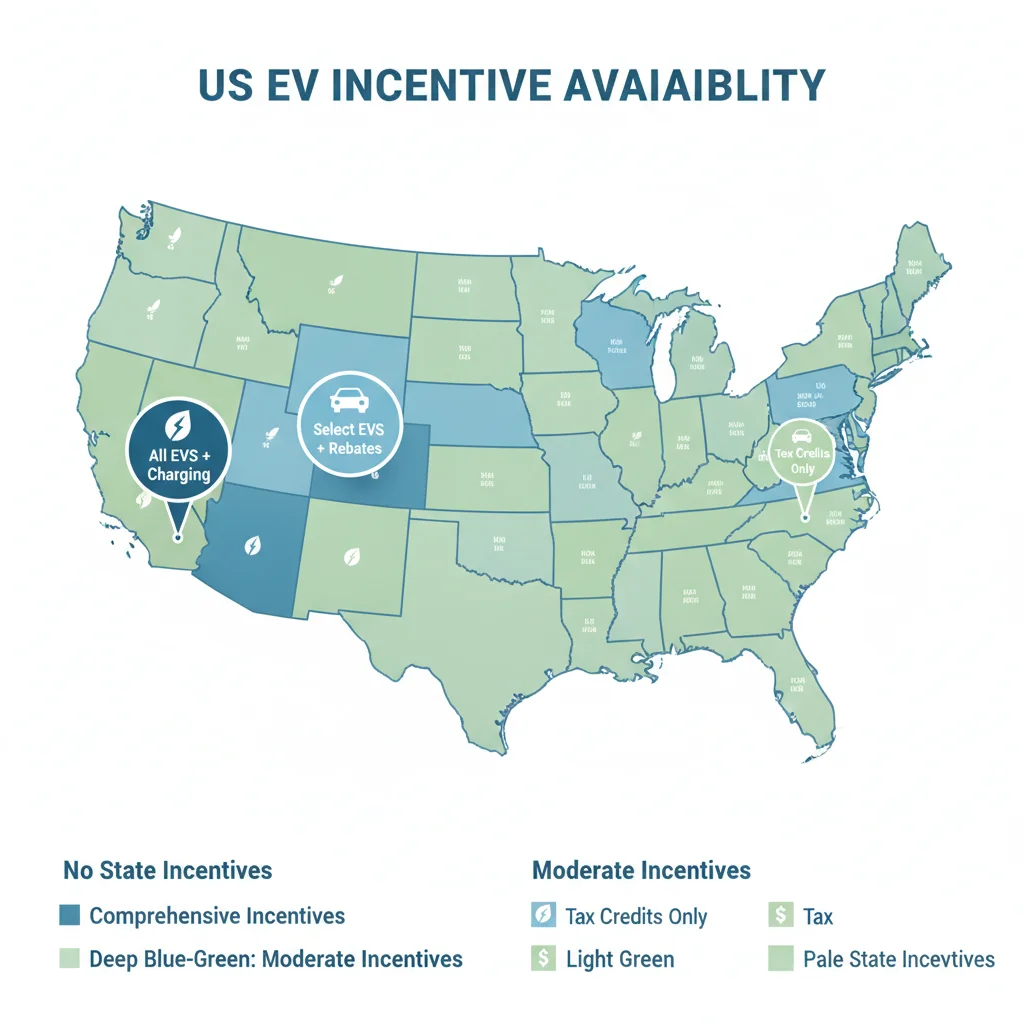
A handful of states offer refundable EV tax credits, meaning the state will issue a payment even if the credit exceeds your state income tax liability. These programs vary significantly by state and are subject to annual funding caps, so availability is not guaranteed year to year.
State and Utility Rebates
More common than refundable state credits are direct rebates — either administered through the state, through local utilities, or through clean air programs. These typically don't interact with your tax liability at all. Examples include California's Clean Vehicle Rebate Project (historically) and similar programs in Colorado, New York, and Massachusetts. These rebates can be stacked on top of any federal credit you do qualify for.
The important caveat: state programs change frequently, vary enormously by geography, and sometimes have income qualifications of their own. The IRS and the Department of Energy's Alternative Fuels Data Center both maintain current lists of available incentives by state.
If you're evaluating a plug-in hybrid rather than a full battery EV, the credit eligibility rules differ as well — see our EV types explainer for clarity on BEV vs. PHEV qualification. And once you've worked out the credit situation, don't overlook the insurance side: EV insurance costs often run higher than comparable gas vehicles, which affects the total cost of ownership picture.
The bottom line: for buyers who won't fully benefit from the federal nonrefundable credit, layering state rebates and utility incentives is often the most effective way to close the gap. A buyer in some states can still land $3,000–$5,000 in state incentives on top of whatever federal benefit they can capture — making the EV math work even when the full $7,500 isn't accessible.
For a broader view of trade-offs around the EV credit before you commit, our article on EV tax credit pros and cons for first-time buyers gives an honest accounting of both sides.
Bottom Line: Know Your Number Before You Sign
The federal EV tax credit is a genuinely valuable incentive — but only if you understand what you're actually entitled to receive. The nonrefundable structure means the advertised $7,500 is a maximum, not a guarantee. Your real-world benefit depends on your federal tax liability for the year you purchase the vehicle.
Here's a practical decision framework to take with you:
- Look at your prior-year tax liability (Form 1040, Line 24). If it's consistently above $7,500, the credit will likely work as advertised — especially if you take the point-of-sale transfer to lock in the value immediately.
- If your liability is uncertain or below $7,500, use the IRS point-of-sale transfer at a participating dealer. This shifts the timing risk and gives you the upfront discount without depending on April's filing outcome.
- Layer in state and utility incentives regardless of your federal credit situation. These often don't depend on tax liability and can meaningfully reduce your out-of-pocket cost.
- Consult a tax professional if your situation is complex — especially if you're self-employed, retiring, or expecting significant income fluctuations. A $200 CPA conversation can protect you from misjudging a $7,500 benefit.
The distinction between refundable and nonrefundable credits isn't a technicality — it's the difference between a $7,500 discount and a much smaller one, or no benefit at all. Going in with eyes open puts you in a position to maximize what's actually available to you, not just what's on the brochure.

All claims are backed by peer-reviewed research. Sources on request.