Key Takeaways
Our Verdict
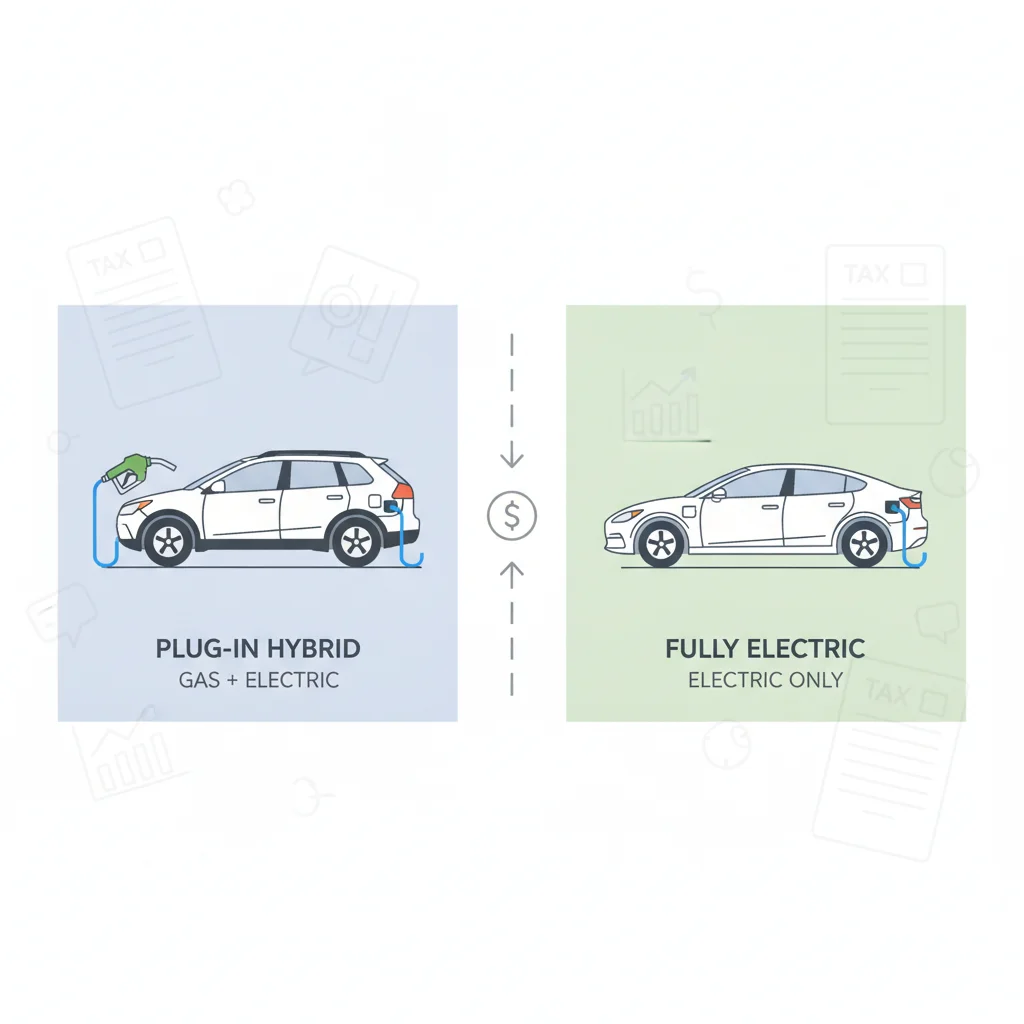
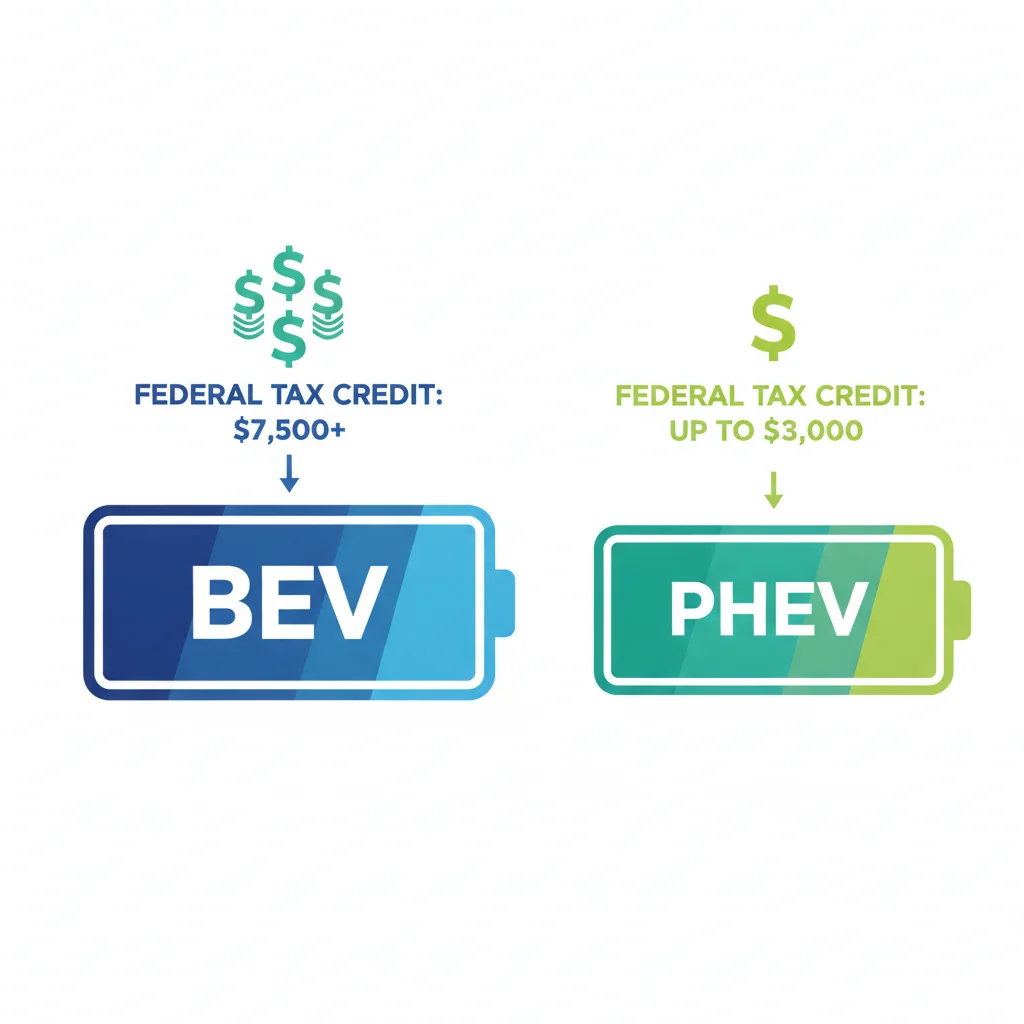
BEVs generally offer a stronger and more predictable federal tax credit than PHEVs, with most qualifying battery electrics landing at the full $7,500 tier. PHEVs add flexibility but frequently land at the $3,750 tier due to smaller battery packs, and their eligibility is more vehicle-specific. If maximizing the federal credit is a priority, a qualifying BEV is typically the cleaner path — but a well-chosen PHEV can still deliver meaningful savings, especially for buyers who aren't ready to give up the gas engine.
| Best for | Recommended |
|---|---|
| Buyers prioritizing the maximum $7,500 federal credit | Battery Electric Vehicle (BEV) |
| Buyers wanting flexibility with some credit benefit | Plug-In Hybrid (PHEV) |
| Buyers with range anxiety or limited charging access | Plug-In Hybrid (PHEV) |
| Buyers wanting simplicity in credit qualification | Battery Electric Vehicle (BEV) |
The Tax Credit Framework: What the IRA Actually Set Up
The Inflation Reduction Act (IRA), signed into law in August 2022 and significantly updated for tax year 2024 onward, restructured the federal EV tax credit — officially called the Clean Vehicle Credit under IRC Section 30D — from a single-tier structure into a two-component system worth up to $7,500 total. Each component is worth $3,750, and a vehicle earns them independently based on where its battery and other critical minerals are sourced and manufactured.
This restructured credit applies to both plug-in hybrid electric vehicles (PHEVs) and battery electric vehicles (BEVs). But the practical effect on each vehicle type differs considerably, because the rules interact with the physical realities of how each powertrain is built. Understanding that interaction is the difference between expecting $7,500 at tax time and walking away with $3,750 — or nothing at all.
For a broader look at how these credits apply across vehicle categories, see which EV types qualify for federal tax credits.
The two components of the Section 30D credit are:
- Critical minerals component ($3,750): A percentage of the battery's critical minerals must be extracted or processed in the U.S. or a country with a qualifying U.S. free trade agreement, or recycled in North America. The threshold steps up over time.
- Battery components component ($3,750): A percentage of the battery's components must be manufactured or assembled in North America. This threshold also steps up annually.
Both BEVs and PHEVs must satisfy these sourcing requirements to earn each respective half of the credit. Neither type gets an automatic pass on either component — but as we'll see, the practical implications differ.
How the Credit Applies to Battery Electric Vehicles
For a fully battery electric vehicle, the path to the full $7,500 credit is conceptually straightforward: the vehicle must satisfy both sourcing components, meet the MSRP cap, and the buyer must fall within the income limits. If both components are satisfied, the buyer gets the full $7,500. If only one is satisfied, they get $3,750.
In practice, many popular BEVs — particularly those from domestic manufacturers — have been structured to qualify for both components, making the full $7,500 credit accessible. The Tesla Model 3 (rear-wheel-drive variant), Chevrolet Equinox EV, and Ford F-150 Lightning have all landed at the full $7,500 tier at various points, though eligibility can change as sourcing agreements shift.
| Criterion | Battery Electric (BEV) | Plug-In Hybrid (PHEV) | |
|---|---|---|---|
| Maximum credit available | $7,500 | $7,500 (often $3,750 in practice) | |
| Typical credit outcome | $7,500 for domestic brands | $3,750 for most models | |
| Battery size (affects sourcing math) | 60–100+ kWh | 7–20 kWh | |
| Minimum battery requirement | Easily exceeded | Some models near the 7 kWh floor | |
| MSRP cap (SUV/truck) | $80,000 | $80,000 | |
| MSRP cap (sedan/wagon) | $55,000 | $55,000 | |
| Income limit (joint filers) | $300,000 MAGI | $300,000 MAGI | |
| Point-of-sale transfer eligible | Yes, if qualifying | Yes, if qualifying | |
| Sourcing rules complexity | Moderate | Higher (smaller battery amplifies impact) | |
| Credit predictability | More predictable for domestic brands | Highly vehicle-specific |
The MSRP caps for BEVs are:
- Sedans, wagons, hatchbacks: $55,000
- SUVs, trucks, vans: $80,000
Income limits (modified adjusted gross income) for the new vehicle credit are:
- Single filers: $150,000
- Head of household: $225,000
- Joint filers: $300,000
One important nuance: the IRS allows buyers to use their income from either the year of purchase or the prior year — whichever is lower — to qualify. That flexibility helps buyers who had a high-income year but expect lower income in the purchase year.
Starting in 2024, buyers can also transfer the credit to the dealer at point of sale, effectively receiving the credit as an upfront discount rather than waiting to file taxes. This applies to both BEVs and PHEVs that otherwise qualify. See our piece on how leasing compares to buying for credit-conscious shoppers for another angle on how timing affects the value you capture.
$7,500
Maximum federal clean vehicle credit
Under IRC Section 30D as amended by the Inflation Reduction Act, qualifying new BEVs and PHEVs can earn up to this amount.
7 kWh
Minimum battery size to qualify
The IRA requires at least 7 kWh of battery capacity for a plug-in vehicle to be eligible for the Section 30D credit at all.
$3,750
Credit earned per qualifying component
The total credit is split into two equal $3,750 components based on critical minerals and battery component sourcing rules.
$300,000
MAGI limit for joint filers
Joint tax filers with modified adjusted gross income above $300,000 are ineligible for the new clean vehicle credit regardless of vehicle type.
2024
Year point-of-sale transfer began
Starting January 1, 2024, eligible buyers can transfer the Section 30D credit to the dealer, receiving it as an immediate purchase discount.
How the Credit Applies to Plug-In Hybrids
PHEVs follow the same two-component structure, the same MSRP caps, and the same income limits as BEVs. On paper, it looks identical. In practice, PHEVs face a meaningful structural disadvantage: battery size.
The IRA requires that a qualifying vehicle have a battery capacity of at least 7 kilowatt-hours (kWh) to be eligible for the Section 30D credit at all. Most PHEVs meet this floor — but just barely. Many PHEV battery packs fall in the 8–18 kWh range, which is small compared to the 60–100+ kWh packs in most BEVs.
Why does battery size matter for the credit? It affects how the sourcing percentage thresholds play out in dollar terms. Because a PHEV battery is physically smaller, the absolute quantity of critical minerals and battery components is lower. The IRS calculates each component's eligibility based on the value of qualifying versus non-qualifying content in the battery. A smaller battery means less room to distribute cost across qualifying and non-qualifying sources — and more sensitivity to whether any single supplier or sourcing decision tips the calculation.
The result in practice: a significant number of PHEVs currently on the market qualify for only the $3,750 credit tier — either because they satisfy just one component or because their battery sourcing doesn't clear both thresholds. Examples that have landed at $3,750 include several popular crossover PHEVs from European-based automakers, where battery component assembly doesn't meet the North America requirement.
PHEVs that do reach the full $7,500 tend to be those with larger battery packs (typically 15 kWh or more) from manufacturers with more North American supply chain depth. The Chrysler Pacifica Plug-In Hybrid and certain Ford and Jeep PHEVs have qualified for the full amount at various points — but buyers should verify current eligibility on the IRS or Department of Energy websites before purchase, as eligibility can change mid-model-year.
Check the IRS List Within 30 Days of Purchase
Vehicle eligibility under Section 30D can change mid-model-year when manufacturers adjust their supply chains. A PHEV that qualified in the spring may not qualify by fall. Pull the current IRS-approved vehicle list within 30 days of your intended purchase date — not at the start of your search. The DOE AFDC tool at afdc.energy.gov is also reliable and easier to navigate.
Use Prior-Year Income If It Helps You Qualify
The IRS allows you to use the lower of your current-year or prior-year modified adjusted gross income (MAGI) when determining eligibility. If you had a lower-income year recently and expect higher earnings this year, that prior-year figure may keep you under the threshold. Confirm this with a tax professional before transferring the credit at the dealership, since errors can require repayment.
For a deeper look at what PHEVs actually are and who they suit best, see our guide to PHEVs demystified.
The Battery Capacity Floor and Why It Matters More for PHEVs
The 7 kWh minimum battery requirement is straightforward in theory — but it has different implications for BEVs and PHEVs. Nearly every BEV sold in the U.S. today exceeds this threshold by a wide margin. The smallest BEV batteries on the market (such as those in entry-level urban EVs) still tend to land well above 20 kWh.
PHEVs, by contrast, are much closer to the 7 kWh floor. A few older PHEV models — particularly those designed primarily as hybrids with minimal electric-only range — have historically fallen below or near the threshold. If a PHEV's usable battery capacity doesn't meet the minimum, it qualifies for no federal credit at all, regardless of how it sources its materials.
This is worth flagging because shoppers sometimes assume that any vehicle with a charging port qualifies. That assumption is wrong. Full hybrids (HEVs) that never plug in don't qualify at all under Section 30D. And PHEVs that technically plug in but carry undersized batteries may also miss the cutoff.
Don't Assume a Charging Port Means a Credit
Not every vehicle with a charging port qualifies for Section 30D. Full hybrids (HEVs) that never plug in are categorically excluded. Some PHEVs with smaller batteries may fall below the 7 kWh minimum. And even qualifying vehicles may only earn $3,750 rather than the full $7,500. Verify the specific trim and model year against current IRS guidance — never rely solely on what the dealer or manufacturer website states.
The practical takeaway: before assuming a PHEV qualifies, verify its battery capacity against the 7 kWh minimum and check its current IRS eligibility status. The Department of Energy's AFDC (Alternative Fuels & Advanced Vehicles Data Center) maintains an up-to-date list of qualifying vehicles that is far more reliable than dealer representations.
MSRP Caps, Income Limits, and the Point-of-Sale Transfer
The structural rules that apply equally to both PHEVs and BEVs deserve a focused look, because buyers sometimes conflate the sourcing requirements with eligibility overall. The MSRP caps and income thresholds are hard limits — failing either one disqualifies a purchase entirely, regardless of how well the vehicle scores on sourcing.
MSRP Caps
The caps are vehicle-class-based, not powertrain-based. A PHEV SUV and a BEV SUV both face the same $80,000 MSRP limit. A PHEV sedan and a BEV sedan both face the $55,000 limit. This is the one area where the rules treat both vehicle types with perfect symmetry.
That said, BEVs are more likely to run into this cap at the high end of the market — luxury BEV sedans from premium manufacturers frequently exceed $55,000. PHEVs tend to be priced lower overall, so MSRP caps are less commonly the disqualifying factor for that group.
Income Limits
The modified adjusted gross income (MAGI) limits are identical for both vehicle types: $150,000 for single filers, $225,000 for heads of household, and $300,000 for joint filers. These apply at the time of purchase or in the prior tax year, whichever is lower.
Point-of-Sale Transfer
Since January 1, 2024, buyers can transfer the credit to a registered dealer at point of sale and receive it as an immediate price reduction. This is available for both PHEVs and BEVs that meet all eligibility requirements. The practical benefit is significant: rather than waiting until you file your taxes the following spring, you can reduce the out-of-pocket purchase price immediately.
However, the transfer works differently from a loan or lease. The dealer receives the credit from the IRS on your behalf — but you are still responsible for confirming your own income eligibility. If you transfer the credit and later find your income exceeded the threshold, you may need to repay it. Read our breakdown of new vs. used EV tax credits for more on how eligibility works at the point of filing.

Side-by-Side: Where PHEVs and BEVs Diverge on Credit Value
Putting it all together: when you line up a PHEV and a BEV that both technically qualify for the Section 30D credit, the most common outcome is that the BEV earns more. This isn't a bias in the law toward BEVs per se — it's a downstream effect of the sourcing requirements interacting with battery size.
A BEV with a 75 kWh pack has a much larger absolute value of battery materials to evaluate against the sourcing thresholds. A PHEV with a 12 kWh pack has far less. When a single component in the supply chain doesn't qualify, it represents a much larger percentage of the total for the smaller battery — making it harder to clear both thresholds and easier to lose one of the two $3,750 components.
That said, the gap isn't universal. PHEVs with larger batteries and North American supply chains do reach $7,500. And a BEV from a manufacturer with a less-established domestic supply chain may land at $3,750 just as easily as a PHEV.
The honest framing: assume a PHEV lands at $3,750 and verify upward. Assume a BEV from a domestic manufacturer lands at $7,500 and verify that it hasn't changed. Don't assume either way without checking current IRS guidance.
For a fuller comparison of PHEV ownership trade-offs beyond just the credit, see the case for and against a plug-in hybrid.
How to Verify Eligibility Before You Buy
The single biggest mistake buyers make with EV tax credits is relying on the dealership — or on a manufacturer's website — to confirm eligibility. Dealers have a financial interest in closing the sale. Manufacturer sites are not always updated in real time when sourcing changes affect credit eligibility.
The most reliable sources are:
- IRS.gov — Clean Vehicle Credits: The IRS maintains a running list of qualifying vehicles under Section 30D, updated when eligibility changes. This is the authoritative source.
- Department of Energy AFDC vehicle search: The Alternative Fuels & Advanced Vehicles Data Center (afdc.energy.gov) aggregates federal and state incentives by vehicle and ZIP code.
- Your tax professional: If your income is near the threshold or your filing situation is complex (business use, partial-year purchase, etc.), get a professional opinion before transferring the credit at point of sale.
Check the IRS List Within 30 Days of Purchase
Vehicle eligibility under Section 30D can change mid-model-year when manufacturers adjust their supply chains. A PHEV that qualified in the spring may not qualify by fall. Pull the current IRS-approved vehicle list within 30 days of your intended purchase date — not at the start of your search. The DOE AFDC tool at afdc.energy.gov is also reliable and easier to navigate.
Use Prior-Year Income If It Helps You Qualify
The IRS allows you to use the lower of your current-year or prior-year modified adjusted gross income (MAGI) when determining eligibility. If you had a lower-income year recently and expect higher earnings this year, that prior-year figure may keep you under the threshold. Confirm this with a tax professional before transferring the credit at the dealership, since errors can require repayment.
Also worth noting: eligibility can change within a model year. A vehicle that qualified in January may not qualify by September if the manufacturer changes a supplier. Always verify within 30 days of your intended purchase date, not at the start of your research process.
If you're weighing whether insurance costs also differ between the two vehicle types — which they do — see our piece on how insurers calculate risk differently for BEVs vs. PHEVs. The total cost of ownership picture goes well beyond the credit.


All claims are backed by peer-reviewed research. Sources on request.