Key Takeaways
Option A
Leasing an EV
The loophole-friendly path to capturing the credit regardless of your tax situation.
Best for: Shoppers who don't meet income or tax liability requirements, or who want the credit baked into a lower monthly payment.
Option B
Buying an EV
The ownership route that keeps long-term value — but comes with more credit strings attached.
Best for: Buyers who meet IRS eligibility criteria and want to build equity while maximizing the full $7,500 federal credit directly.
If you don't meet the income thresholds or owe little in federal taxes
Leasing an EV
The commercial vehicle credit used for leases has no income cap, so even high earners who exceed purchase thresholds — or low earners who owe too little — can still benefit from the incentive.
If you want to own your vehicle long-term and build equity
Buying an EV
Ownership lets you capture the full $7,500 credit (if you qualify), avoid mileage restrictions, and keep the vehicle's residual value rather than returning it at lease end.
If the specific EV you want doesn't meet MSRP or assembly rules for the consumer credit
Leasing an EV
Many popular EVs that fail the consumer credit's vehicle eligibility tests — including MSRP caps and North American assembly requirements — still qualify under the commercial lease pathway.
If you want the simplest, most predictable way to reduce upfront costs
Leasing an EV
Dealers can factor the lease credit into the capitalized cost or monthly payment without requiring you to file anything with the IRS or track your own tax liability.
If you drive more than 15,000 miles per year and plan to keep the car five or more years
Buying an EV
Lease mileage penalties erode any credit-based savings quickly for high-mileage drivers, and long-term ownership builds equity that leasing never provides.
Two Credits, One Goal — But Very Different Rules
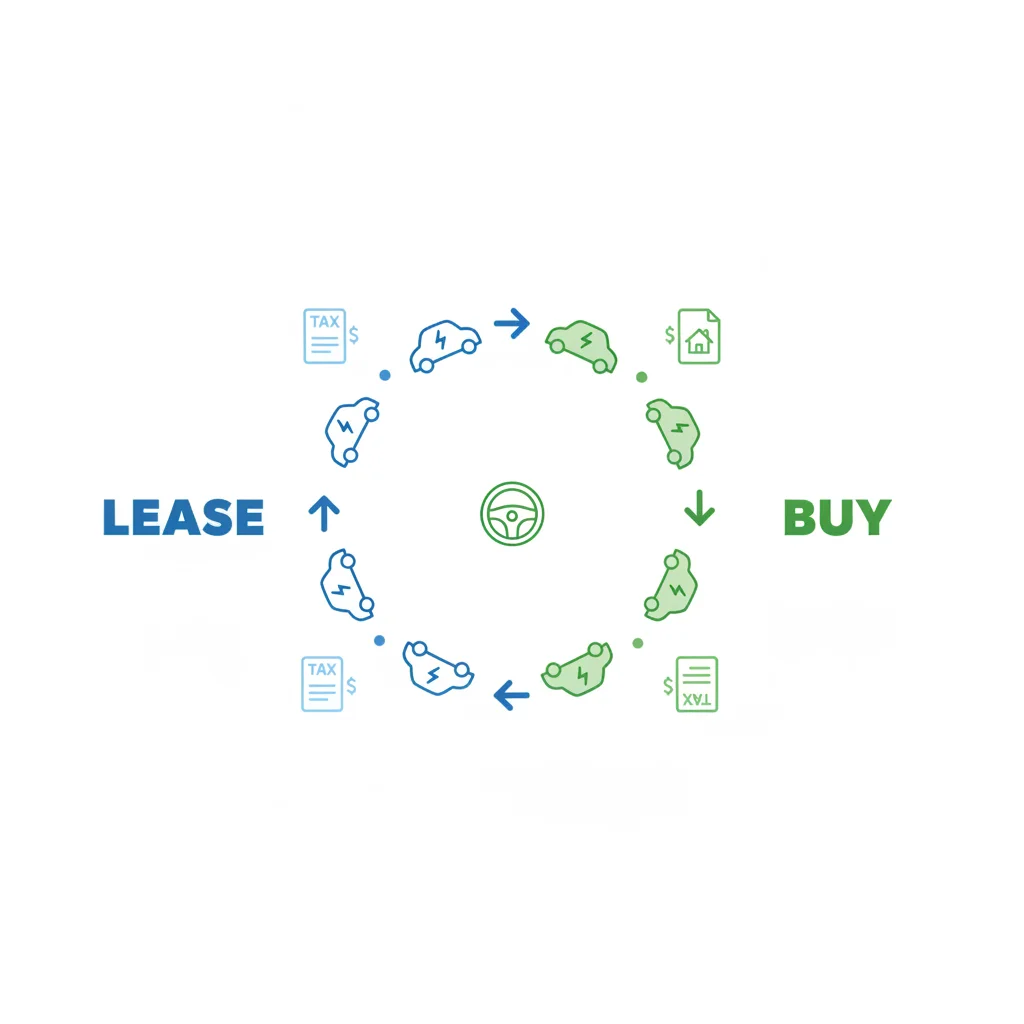
The federal government offers two distinct tax credit pathways for EVs, and the one that applies to you depends entirely on whether you're leasing or buying. Most consumers think of the EV tax credit as a single $7,500 incentive — but the IRS actually administers it under two separate sections of the Inflation Reduction Act, each with its own eligibility framework.
When you buy a qualifying new EV, you're tapping the Section 30D Clean Vehicle Credit — the consumer-facing credit capped at $7,500. It comes with income limits, vehicle MSRP caps, and battery component sourcing requirements that disqualify a large swath of available EVs.
When you lease an EV, the transaction is structured differently from the IRS's perspective. The leasing company (typically the automaker's captive finance arm) is the legal owner of the vehicle, not you. That makes the vehicle eligible for the Section 45W Commercial Clean Vehicle Credit — the same credit available to businesses purchasing EVs for commercial use. This credit carries almost none of the consumer-side restrictions: no income cap, no MSRP ceiling, and no requirement that the battery meet domestic sourcing thresholds.
The practical result is that leasing can unlock incentive savings on vehicles that would be completely ineligible if purchased outright — and it can do so for consumers who would otherwise be disqualified by their income or tax liability. See our breakdown of which EV types qualify for federal credits for more context on how BEVs and PHEVs are treated differently under each pathway.
The Consumer Purchase Credit: What Buying Gets You
The Section 30D credit offers up to $7,500 for new qualifying EVs — but earning it requires clearing a multi-part checklist that many buyers and many vehicles fail.
Income Limits
Your modified adjusted gross income (MAGI) must fall under these thresholds, or you forfeit the credit entirely:
- $150,000 for single filers
- $225,000 for heads of household
- $300,000 for married filing jointly
The IRS checks your income against the lower of your current or prior tax year MAGI — so a recent raise or a one-time capital gain can disqualify you even if your typical earnings are below the threshold.
Vehicle MSRP Caps
- Sedans, hatchbacks, and wagons: $55,000
- SUVs, trucks, and vans: $80,000
A number of popular EVs — including several Tesla and Rivian configurations — exceed these limits, making them ineligible for the consumer purchase credit regardless of your income.
Battery and Assembly Requirements
This is where the rules get particularly granular. The vehicle must be assembled in North America, and the credit is split into two $3,750 halves based on battery component sourcing:
- Half is contingent on a percentage of battery components being manufactured or assembled in North America
- The other half depends on a percentage of critical minerals being sourced from the U.S. or a country with a qualifying free trade agreement
These thresholds ratchet upward through 2029, meaning vehicles that qualify today may lose eligibility in future model years. The IRS and Department of Energy maintain a list of qualifying vehicles, which changes periodically.
The Point-of-Sale Transfer Option
Starting in 2024, eligible buyers can transfer the credit directly to a dealer at the point of sale — essentially receiving an instant price reduction rather than waiting to claim it on next year's taxes. This is a significant change for buyers who qualify but don't want to wait. Our guide to the point-of-sale EV credit transfer explains how the dealer process works in practice.
| Criterion | Leasing an EV | Buying an EV |
|---|---|---|
| Applicable tax credit | Section 45W Commercial Credit | Section 30D Consumer Credit |
| Maximum credit amount | Up to $7,500 | Up to $7,500 |
| Income limit | None | $150K / $225K / $300K (filing status) |
| MSRP cap | None | $55K sedans / $80K SUVs & trucks |
| Battery sourcing requirement | None | Yes — split $3,750 / $3,750 tiers |
| North American assembly required | No | Yes |
| Who receives the credit | Leasing company (may pass through) | Buyer (or dealer via point-of-sale transfer) |
| Credit pass-through guaranteed | No — negotiation required | Yes — it's your credit directly |
| Mileage restrictions | Yes — typically 10K–15K/year | None |
| Builds equity | No | Yes |
The Lease Loophole: Why the Commercial Credit Changes Everything
The term "loophole" gets overused, but this one is genuine — and it's entirely intentional in the law's structure. Congress designed the Inflation Reduction Act so that leased vehicles fall under the commercial vehicle credit framework because the legal owner (the lessor, not the consumer) is treated as the vehicle purchaser for tax purposes.
Here's what that means practically for leased EVs under Section 45W:
- No income limit — Neither you nor the leasing company needs to meet a MAGI threshold
- No MSRP cap — A $90,000 electric SUV that's ineligible to buy can be leased with the credit applied
- No battery sourcing requirement — Vehicles assembled outside North America, or with non-qualifying battery materials, can still generate the credit
- Credit amount — Up to $7,500 for vehicles weighing under 14,000 lbs (which covers virtually all consumer EVs)
$7,500
Maximum commercial lease credit (Section 45W)
The IRS allows up to $7,500 for leased EVs under 14,000 lbs — matching the consumer purchase credit ceiling with far fewer restrictions.
0
Income limit for leased EV credit
Unlike the Section 30D consumer credit, the commercial vehicle credit applied to leases carries no MAGI threshold for either the lessee or the lessor.
~50%
New EV sales via lease in recent quarters
According to industry tracking data, lease share of new EV transactions has climbed sharply since the Inflation Reduction Act's stricter consumer purchase rules took effect in 2023.
$55,000
MSRP cap for sedan/hatchback EV purchase credit
Many popular electric sedans and crossovers priced above this threshold are ineligible for the consumer purchase credit but may still qualify under the lease commercial credit pathway.
The critical caveat: the credit goes to the lessor, not to you. There is no legal requirement that automakers or their finance arms pass this savings through to consumers. In practice, competitive market pressure and consumer expectations have led most major automakers to factor the credit into lease pricing — typically through a reduced capitalized cost or a lower monthly payment. But the amount and structure vary significantly by brand and model.
Before signing a lease, ask the finance manager directly: Is the $7,500 commercial credit reflected in this deal? Request to see the lease disclosure form (often called the "money factor" sheet) and verify where the credit appears. If the dealer can't show you where the credit is applied, negotiate or walk away.
For a broader look at how this commercial credit applies to business fleet buyers, see our overview of the commercial clean vehicle credit for business owners.
Not All Leases Automatically Pass the Credit Through
The IRS does not require leasing companies to share the commercial vehicle credit with consumers. While most major automakers' captive finance arms — such as Tesla Financial Services, GM Financial, and Ford Motor Credit — do incorporate the credit into lease pricing, the exact amount and method varies. Some luxury brands have been slower to reflect the full $7,500. Always ask for written confirmation of how the credit is factored into your specific lease before signing.
The Rules Can Change — And Have
The Inflation Reduction Act's EV credit provisions have already seen Treasury guidance updates since the law passed in August 2022. Vehicle eligibility lists are updated periodically, and battery sourcing thresholds increase over time. Before finalizing any purchase or lease decision, verify the current qualifying vehicle list at fueleconomy.gov or the IRS's dedicated clean vehicle credit page.
Side-by-Side: How the Numbers Actually Play Out
Let's ground this in a realistic scenario. Assume you're considering a popular midsize electric SUV with an MSRP of $58,000 — which would exceed the $55,000 sedan cap but fall under the $80,000 SUV cap. Your household MAGI is $310,000 (just over the married filing jointly income limit of $300,000). The vehicle meets assembly and battery sourcing requirements.
If You Buy
Because your income exceeds the threshold by $10,000, you receive zero federal tax credit. You pay the full $58,000 (before state incentives, if any). You own the vehicle and will benefit from its residual value, but you've left $7,500 on the table due to the income cap.
If You Lease
The leasing company claims the Section 45W commercial credit. If they pass it through (and most major automakers currently do for competitive reasons), your capitalized cost effectively drops by $7,500. On a 36-month lease, that translates to roughly $200–$210/month in savings before interest. You don't own the vehicle at lease end, but you captured the full incentive despite being over the income limit.
Now consider a second scenario: same buyer income, but the vehicle is a $75,000 luxury electric sedan — which would exceed the $55,000 sedan MSRP cap entirely, disqualifying it from the consumer purchase credit for any buyer regardless of income. Under a lease, the commercial credit still applies and can be passed through to reduce your payment.
These scenarios illustrate why the lease pathway is particularly powerful for higher-income buyers and for vehicles that don't clear the consumer credit's vehicle tests. Compare this to how the used EV credit works if you're also weighing a certified pre-owned option — that path has its own separate income and price constraints.
Factors Beyond the Credit: What Else Shapes the Decision
The tax credit is a major factor, but it shouldn't be the only one driving your lease-vs-buy decision. Several other dimensions affect the true cost of each path.
Mileage and Usage
Standard leases typically cap annual mileage at 10,000–15,000 miles. Excess mileage fees of $0.15–$0.30 per mile are common. If you drive 20,000 miles a year, a 15,000-mile lease quickly erodes any credit-based savings. Buyers have no such constraint.
Depreciation Risk
EVs have faced steeper and less predictable depreciation than comparable gas vehicles, partly due to rapid technology cycles and changing incentive structures. Leasing transfers residual value risk back to the automaker — if the vehicle is worth less than projected at lease end, that's their problem, not yours. Buyers absorb that risk directly.
Long-Term Cost of Ownership
Our full leasing vs. buying comparison covers the broader financial trade-offs in detail. In general, buying builds equity; leasing provides flexibility. For EVs specifically, leasing can be especially attractive during a period of rapid model evolution — you avoid being locked into today's battery range or charging technology for seven or more years.
Insurance Costs
Leased vehicles typically require higher liability and comprehensive coverage minimums as stipulated by the leasing company. This can raise your insurance premium modestly compared to a purchased vehicle where coverage levels are your own choice. See our EV insurance guide for a sense of what EV coverage typically costs and how to shop it effectively.
State Incentives
Some state EV rebates and credits apply only to purchased vehicles, not leases. Others apply to both or have separate lease-specific programs. Stacking a federal lease credit with a state purchase rebate may not always be possible — check your state's program rules carefully before assuming both apply. Our comparison of federal credits vs. state rebates explains the structural differences between these two incentive types.

Making the Call: A Practical Framework
Given everything above, here's a straightforward way to think through which path makes sense for your situation:
- Check whether the specific vehicle qualifies for the consumer purchase credit. Use the IRS's or the Department of Energy's qualifying vehicle list. If it doesn't qualify — due to MSRP, assembly, or battery sourcing — leasing immediately becomes the stronger incentive path.
- Run your MAGI against the income thresholds. If you're over the limit or close to the edge (a bonus or investment gain could push you over), the lease pathway avoids that exposure entirely.
- Estimate your annual mileage honestly. If you're consistently above 15,000 miles per year, factor in overage fees before assuming the lease saves you money.
- Ask the dealer to document how the commercial credit is applied in the lease. Get it in writing. A legitimate dealer offering a lease with the credit factored in should be able to show you exactly where it appears in the deal structure.
- Compare total cost of ownership, not just monthly payments. A lower lease payment funded partly by a credit you'd capture anyway as a buyer isn't a win — it's a wash at best.
The credit rules for PHEVs add another layer of complexity worth understanding. Our comparison of how the tax credit treats PHEVs vs. full EVs breaks down where the rules diverge for plug-in hybrids specifically. And if you're still deciding which type of electric vehicle suits your lifestyle, our EV types guide covers the BEV, PHEV, and HEV landscape clearly.
Bottom line: the lease pathway is not a gimmick — it's a structurally different credit mechanism that genuinely expands access to EV incentives for shoppers who'd otherwise be locked out. But like any financial tool, it only works in your favor if you verify it's actually being applied and if the total deal structure holds up under scrutiny.

All claims are backed by peer-reviewed research. Sources on request.