| Average annual EV maintenance cost | ~$900 (Consumer Reports, 2023) |
| Average annual gas car maintenance cost | ~$1,300 (Consumer Reports, 2023) |
| Tire rotation interval (most EVs) | 7,500–10,000 miles (Manufacturer guidelines, varies by model) |
| Brake fluid replacement interval | Every 2 years or 25,000 miles (Standard manufacturer guidance) |
| Cabin air filter replacement | Every 15,000–20,000 miles (Typical EV manufacturer interval) |
| 12V auxiliary battery lifespan | 3–5 years (General industry norm; varies by chemistry) |
| Battery coolant flush interval | 100,000–150,000+ miles (Varies significantly by manufacturer) |
| EV brake pad lifespan vs. gas car | 2–3× longer (Due to regenerative braking reducing friction use) |
Why EV Maintenance Is Different — But Not Optional
Electric vehicles eliminate a significant chunk of traditional car upkeep. No oil changes. No spark plugs. No timing belt. No transmission fluid. If you're coming from a gas-powered vehicle, the maintenance list looks almost suspiciously short. But short is not the same as empty.
EVs still depend on tires, brakes, cabin air filters, coolant systems, and windshield wipers. They carry 12-volt auxiliary batteries that can die without warning. Their battery thermal management systems use coolant that needs periodic inspection. Brake fluid absorbs moisture over time, which raises its boiling point and compromises stopping performance — regenerative braking delays brake pad wear, but doesn't make the hydraulic system immune to degradation.
The point isn't to alarm you — it's to set accurate expectations. EVs skip oil changes, but they're not maintenance-free. The tasks that remain carry real consequences if skipped. This guide gives you a practical interval-based schedule so you know exactly what to check and when.
| Average annual EV maintenance cost | ~$900 (Consumer Reports, 2023) |
| Average annual gas car maintenance cost | ~$1,300 (Consumer Reports, 2023) |
| Tire rotation interval (most EVs) | 7,500–10,000 miles (Manufacturer guidelines, varies by model) |
| Brake fluid replacement interval | Every 2 years or 25,000 miles (Standard manufacturer guidance) |
| Cabin air filter replacement | Every 15,000–20,000 miles (Typical EV manufacturer interval) |
| 12V auxiliary battery lifespan | 3–5 years (General industry norm; varies by chemistry) |
| Battery coolant flush interval | 100,000–150,000+ miles (Varies significantly by manufacturer) |
| EV brake pad lifespan vs. gas car | 2–3× longer (Due to regenerative braking reducing friction use) |
EV Maintenance Intervals at a Glance
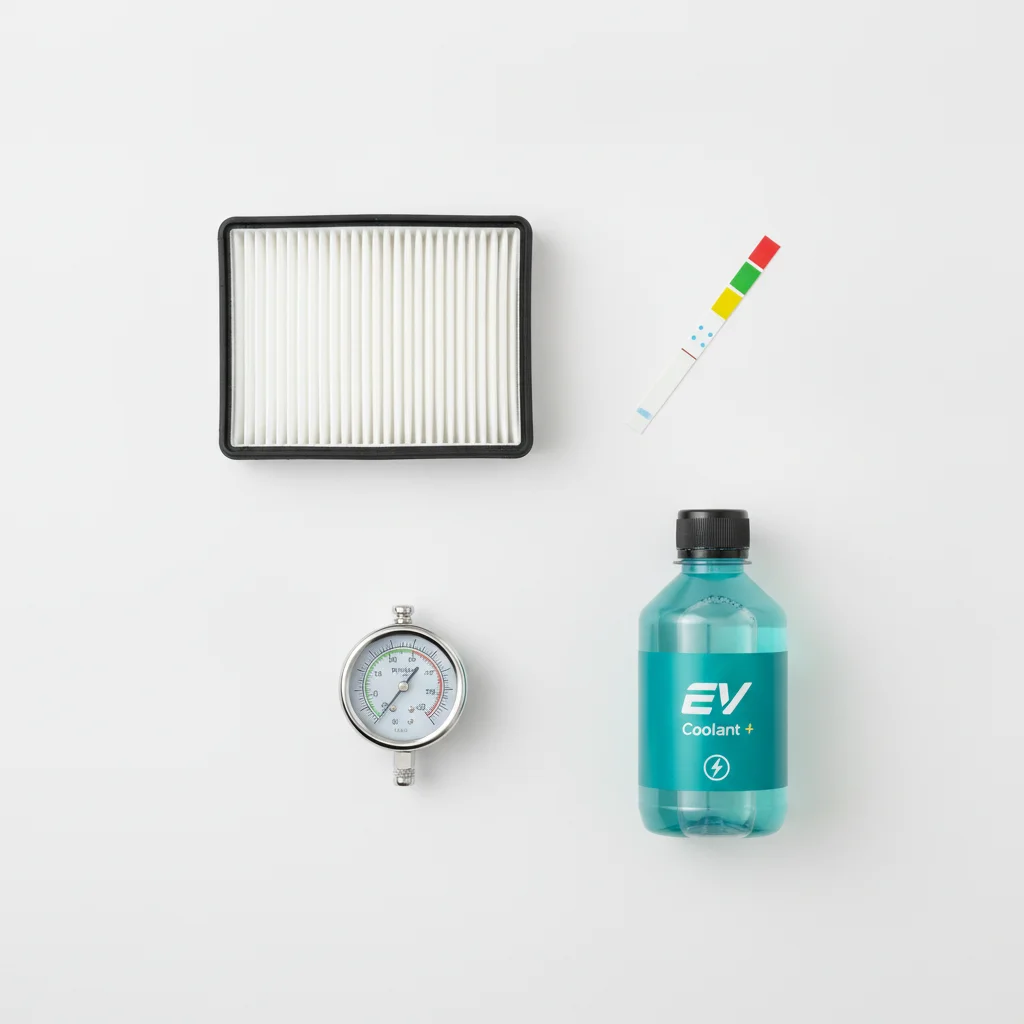
The table below summarizes the most common EV maintenance tasks by interval. Note that manufacturer schedules vary — always cross-reference your owner's manual. If you're not sure how to read your manual's service section, see our guide on how to navigate your owner's manual maintenance section.
| Interval | Task | Notes |
|---|---|---|
| Monthly | Tire pressure check | Including spare if applicable. Cold inflation pressure per door placard. |
| Monthly | Windshield washer fluid | Top off as needed. Use diluted concentrate in winter climates. |
| Every 7,500–10,000 miles | Tire rotation | Many EVs wear rear tires faster due to torque delivery. Check your manual. |
| Every 12,500–15,000 miles | Cabin air filter inspection | Replace sooner in dusty or high-pollen environments. |
| Every 25,000 miles | Brake fluid test/inspection | Test moisture content; replace if boiling point has degraded. |
| Every 36,000–50,000 miles | Battery coolant inspection | Interval varies widely by manufacturer. Some require flushing at 100K+. |
| Every 2 years | Brake fluid replacement | Time-based recommendation regardless of mileage for many manufacturers. |
| Every 3–5 years | Wiper blade replacement | Replace sooner if streaking or skipping occurs. |
| As needed / annually | 12V auxiliary battery check | Most EVs flag this via dashboard; proactively test after 3–4 years. |
| As pushed OTA | Software updates | Accept promptly; updates affect range, charging behavior, and safety systems. |
This schedule covers the tasks that apply to most battery-electric vehicles sold in the United States. Plug-in hybrids (PHEVs) add engine-related maintenance on top of this list — consult a separate schedule for those.
40%
Lower maintenance cost vs. gas vehicles
EVs cost roughly 40% less to maintain annually than internal combustion engine vehicles, according to a 2023 Consumer Reports analysis.
2–3×
Longer brake pad life in EVs
Regenerative braking handles most deceleration, reducing friction brake use and extending pad life significantly compared to gas cars.
$400–$1,000
Extra curb weight from EV battery packs
The added mass of lithium-ion battery packs accelerates tire wear, making rotation intervals more important than in lighter gas vehicles.
3–4 years
When to proactively test your 12V battery
Most EV owners can avoid an unexpected no-start situation by testing the auxiliary 12V battery after three to four years of ownership.
Task-by-Task Breakdown
Tires: Your Most Frequent EV Maintenance Task
Tires are the single most active maintenance item on any EV. The combination of heavier curb weight (battery packs add 400–1,000 lbs over comparable gas vehicles) and instant torque delivery accelerates tread wear. Many performance and all-wheel-drive EVs are biased toward rear tire wear. Check pressure monthly — low pressure increases rolling resistance, which cuts range directly.
Rotate every 7,500–10,000 miles, or sooner if you notice uneven wear. Some EV owners rotate as frequently as every 5,000 miles to equalize wear across all four corners. Check tread depth with a gauge or the quarter-coin test. Most manufacturers recommend replacement at 2/32" of remaining tread, though 4/32" is a safer threshold in wet climates.
Cabin Air Filter
The cabin air filter cleans the air entering your vehicle's interior — important for HVAC efficiency and air quality. EVs are particularly dependent on their HVAC systems for battery thermal management in some architectures, making a clogged filter a practical concern beyond just comfort. Inspect every 12,500–15,000 miles; replace when visibly dirty or at least every 15,000–20,000 miles. This is one of the easiest DIY EV maintenance tasks any owner can handle — most require only a panel removal behind the glove box.
Brake Fluid
Regenerative braking dramatically reduces how often your friction brakes engage, which means brake pads last far longer in an EV. However, the hydraulic brake fluid doesn't benefit from this reduction — it still absorbs moisture from the air over time. Moisture lowers the fluid's boiling point, which can cause brake fade under hard use. Most manufacturers recommend testing brake fluid condition every 25,000 miles and replacing it on a two-year cycle regardless of mileage. For a deeper look at this and other EV fluids, see our explainer on the fluids your EV still uses.
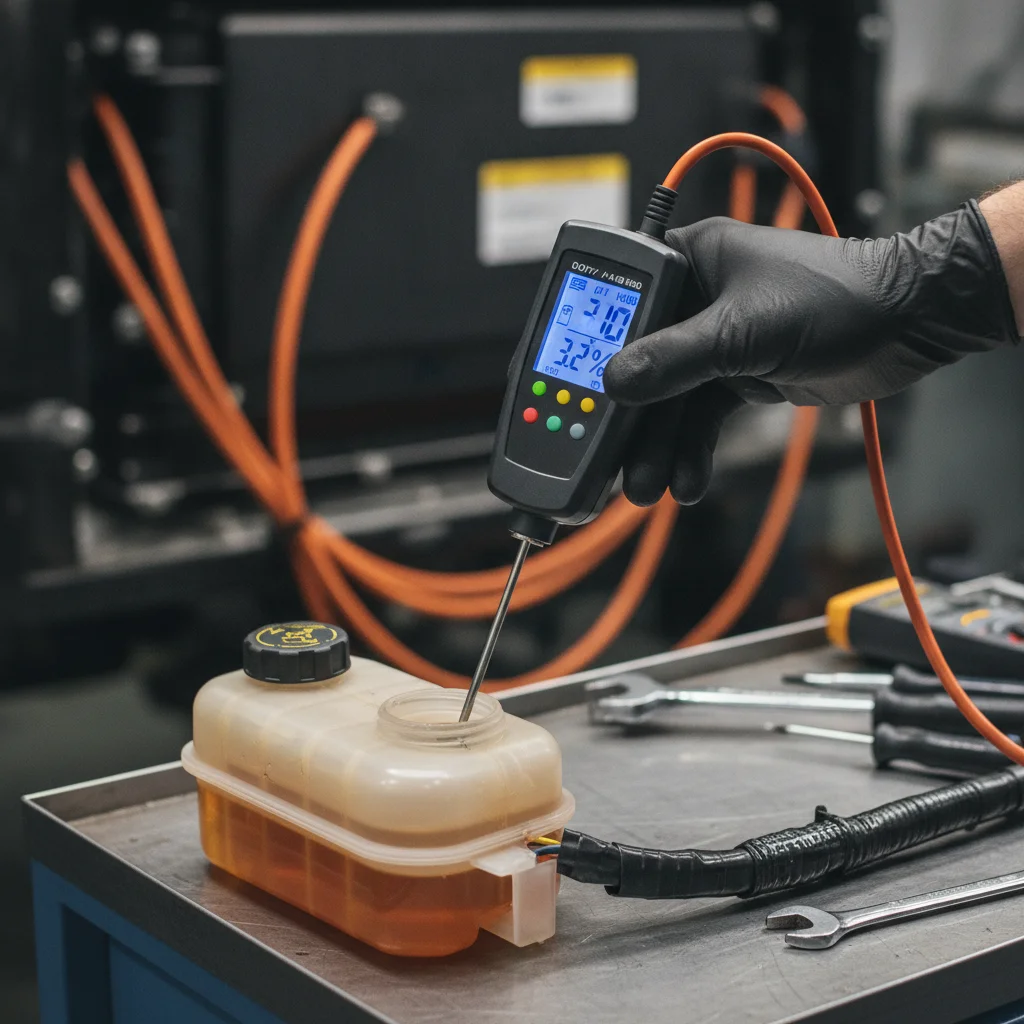
Battery Thermal Management Coolant
Most modern EVs use a liquid-cooled battery pack. That cooling loop circulates a glycol-based coolant that can degrade over time — it becomes more acidic and loses its corrosion-inhibiting properties. Inspect at 36,000–50,000 miles and follow the manufacturer's flush schedule, which ranges from 100,000 miles (Tesla, GM Ultium platform) to 150,000+ miles for some vehicles. Never open a battery cooling system without understanding your specific vehicle's architecture — this is a technician task.
12-Volt Auxiliary Battery
Every EV still carries a 12-volt lead-acid or lithium auxiliary battery that powers door locks, windows, the infotainment system, and the contactors that connect the high-voltage pack to the drivetrain. If this battery dies, the car may not power on at all — even with a full high-voltage pack. Most EVs will display a warning before failure, but proactively test the auxiliary battery after three to four years of ownership. Replacement costs $100–$250 depending on the vehicle.
Software Updates
OTA (over-the-air) software updates are a maintenance category unique to EVs. These updates can improve range estimates, adjust charging curves, fix safety issues, and update driver-assistance features. Keeping your EV's software current is as important as any physical service. Learn what EV software updates actually fix and why they matter. Accept updates promptly unless a specific update has a documented issue — in which case wait for the corrected release.
PHEV Owners: Your Schedule Is Different
Plug-in hybrid vehicles (PHEVs) retain an internal combustion engine, which means you still need oil changes, spark plug replacements, and other engine-related service on top of the EV-specific tasks listed here. The intervals in this guide apply to battery-electric vehicles (BEVs) only. Consult your PHEV owner's manual for the combined schedule.
Always Check Your Specific Owner's Manual
The intervals in this article represent typical ranges across the EV market. Individual manufacturer schedules vary — sometimes significantly. Tesla, Ford, GM, Hyundai, and others each publish their own service intervals. Your owner's manual or the manufacturer's app is always the authoritative source for your specific vehicle.
Choosing Where to Get Your EV Serviced
Not all service centers are equally equipped for electric vehicles. Dealers with certified EV technicians have access to proprietary diagnostic software, manufacturer service bulletins, and high-voltage safety equipment. Independent shops are increasingly capable for wear items — tires, cabin filters, wiper blades, brake pads — but may lack the tools for battery-system diagnostics.
For routine wear items like tires and cabin filters, a qualified independent shop or tire chain can handle the work at competitive prices. For anything touching the high-voltage system — battery diagnostics, thermal management, coolant flushes — stick with a certified EV technician. Our guide on dealer servicing vs. independent shops for EV maintenance walks through how to evaluate your options.
If you're just starting out with EV ownership and want a broader orientation on what the first year of ownership looks like, the EV maintenance from day one guide is a good companion to this schedule. And for a seasonal lens on these same tasks, the annual EV ownership checklist by season offers a month-by-month view.
Regenerative braking
A system that captures kinetic energy during deceleration and converts it back into electricity to recharge the battery. It significantly reduces wear on friction brake pads and rotors.
Battery thermal management system
The hardware and software that regulates the temperature of an EV's high-voltage battery pack. Most systems use liquid coolant to keep the pack within an optimal temperature range for performance and longevity.
12V auxiliary battery
A conventional low-voltage battery (lead-acid or lithium) that powers a vehicle's accessory systems — lights, locks, infotainment — independent of the main high-voltage traction pack.
Over-the-air (OTA) update
A software update delivered wirelessly to the vehicle's onboard computers, similar to a smartphone update. OTA updates can modify vehicle performance, range estimates, charging behavior, and safety features.
Brake fluid hygroscopy
The tendency of brake fluid to absorb moisture from the surrounding air over time. As moisture content increases, the fluid's boiling point drops, which can reduce braking performance under heavy use.
Tread depth
The measurement of remaining rubber between the top of a tire's tread blocks and the bottom of its grooves. Most safety thresholds are 2/32" minimum, though 4/32" is recommended for wet-weather safety.
For a comprehensive lifetime view of EV upkeep — from purchase through resale — see everything that goes into maintaining an electric vehicle over its lifetime.
EV Maintenance from Day One: What Every New Owner Should Know
A clear breakdown of what maintenance tasks new EV owners actually need to stay on top of, from the moment they drive off the lot.
Annual EV Ownership Checklist: Maintenance Tasks by Season
A seasonal checklist that maps EV maintenance tasks to the right time of year — useful for avoiding missed service through changing conditions.
DIY EV Maintenance: What You Can Do Yourself
Identifies which EV maintenance tasks are safe for owners to handle at home and which require a certified technician with specialized tools.
Coolant, Brake Fluid, and Windshield Washer: The Fluids Your EV Still Uses
A fluid-by-fluid breakdown of what's still in your EV, what it does, and how often it needs to be serviced or replaced.
Dealer Servicing vs. Independent Shops for EV Maintenance
Helps EV owners decide when to use a dealership versus an independent shop, with practical considerations for cost, capability, and warranty protection.

All claims are backed by peer-reviewed research. Sources on request.