Key Takeaways
Our Verdict
For most routine EV maintenance — tire rotations, cabin air filters, brake fluid, and wiper blades — a qualified independent shop offers comparable quality at meaningfully lower cost. Dealers are the right call for warranty repairs, software updates, high-voltage system issues, and battery diagnostics. The smartest approach is to split your service based on what the job actually requires, not brand loyalty.
| Best for | Recommended |
|---|---|
| Routine maintenance on any EV regardless of age | Independent Shop |
| Battery diagnostics, recall work, and warranty repairs | Dealership |
| Newer EVs still under the factory powertrain warranty | Dealership (for powertrain-related work) |
| Budget-conscious owners with an out-of-warranty EV | Independent Shop |
Why EV Maintenance Still Matters
One of the most common misconceptions among new EV owners is that electric vehicles are essentially maintenance-free. Skip the oil changes, sure — but the rest of the service schedule is more robust than most people expect. As covered in our guide to why EVs still need regular maintenance, electric cars still have tires that wear, brake fluid that absorbs moisture, cabin air filters that clog, and cooling systems for the battery and power electronics that need periodic attention.
What changes is where you take the car for that work. With a traditional gas-powered vehicle, almost any decent independent shop can handle routine service. With an EV, the calculus is more nuanced — and getting it wrong can cost you money, void coverage, or leave you with a car that isn't performing at its best.
The decision between a franchised dealership and an independent repair shop isn't binary. Understanding what each option actually covers — and where each falls short — is the starting point for making a smart choice.
What Dealerships Bring to the Table
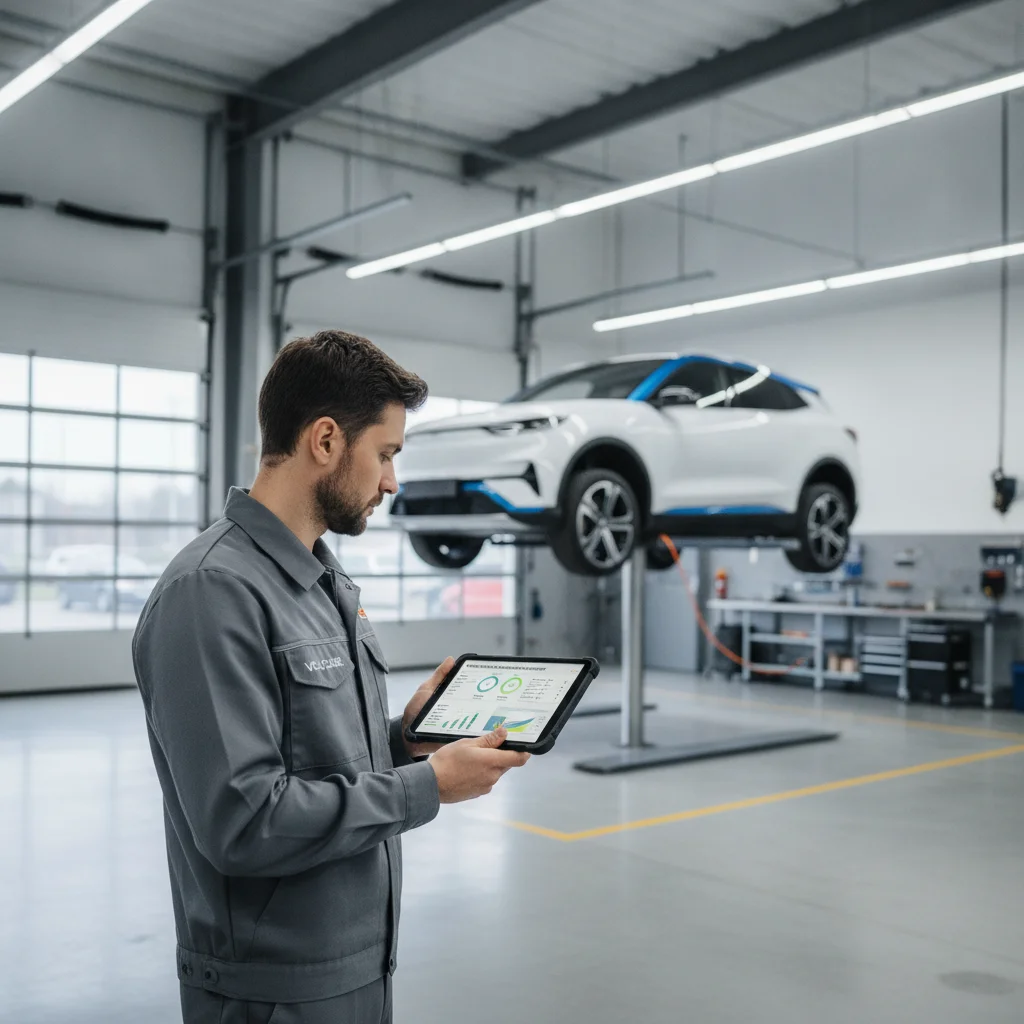
Authorized dealerships have real advantages when it comes to EV servicing, but they're not evenly distributed across all types of work. Here's where dealers genuinely earn their premium:
Proprietary Diagnostic Access
Most EV manufacturers — Tesla, GM, Rivian, Hyundai, and others — use proprietary software platforms that are not fully accessible to third-party shops. Dealers have manufacturer-licensed diagnostic tools that can read every fault code, check battery cell-level health data, and push over-the-air (OTA) firmware updates when a physical service visit is required. If your battery management system throws a warning light, the dealer's equipment will give a more complete picture than what any aftermarket scan tool can provide.
OEM Parts and Recall Compliance
Dealers stock and install original equipment manufacturer (OEM) parts, which matters for components like high-voltage contactors, thermal management hardware, and drive unit assemblies. They're also the mandated channel for safety recalls and technical service bulletins (TSBs), which are free of charge and cannot be performed anywhere else.
Warranty Integrity
Federal law (the Magnuson-Moss Warranty Act) generally prevents manufacturers from voiding your warranty simply because you use an independent shop for routine service. However, if a repair — or misrepair — at an independent shop causes a covered component to fail, the manufacturer can argue the warranty claim. For high-stakes items like the battery pack (typically warranted for 8 years / 100,000 miles federally), keeping dealer service records for any battery-adjacent work provides a cleaner paper trail.
Never Let an Unqualified Shop Near High-Voltage Systems
EV battery packs and drive units operate at 400–800 volts — enough to cause lethal electrocution without proper safety equipment and training. An independent shop that lacks high-voltage-rated PPE and lockout/tagout procedures should not be touching anything connected to the high-voltage system. Routine maintenance tasks are low-risk; high-voltage component work is not. Verify credentials before authorizing any work near the drivetrain.
Don't Assume Your Warranty Is Protected Without Records
The Magnuson-Moss Act protects you legally, but a manufacturer can still challenge a warranty claim if independent shop work is implicated in a failure and you lack documentation. The burden of proof in a dispute often falls on the vehicle owner. Keep every service receipt, and if you're ever unsure whether a repair should go to the dealer, err on the side of caution while the battery warranty is active.
Software Updates
Some OTA updates are pushed wirelessly to your car at home. But certain updates — particularly those tied to safety recalls or hardware-dependent firmware — require a dealer visit. Staying current on these is not optional; they can affect range, charging speed, regenerative braking calibration, and safety system performance.
Where Independent Shops Have the Edge
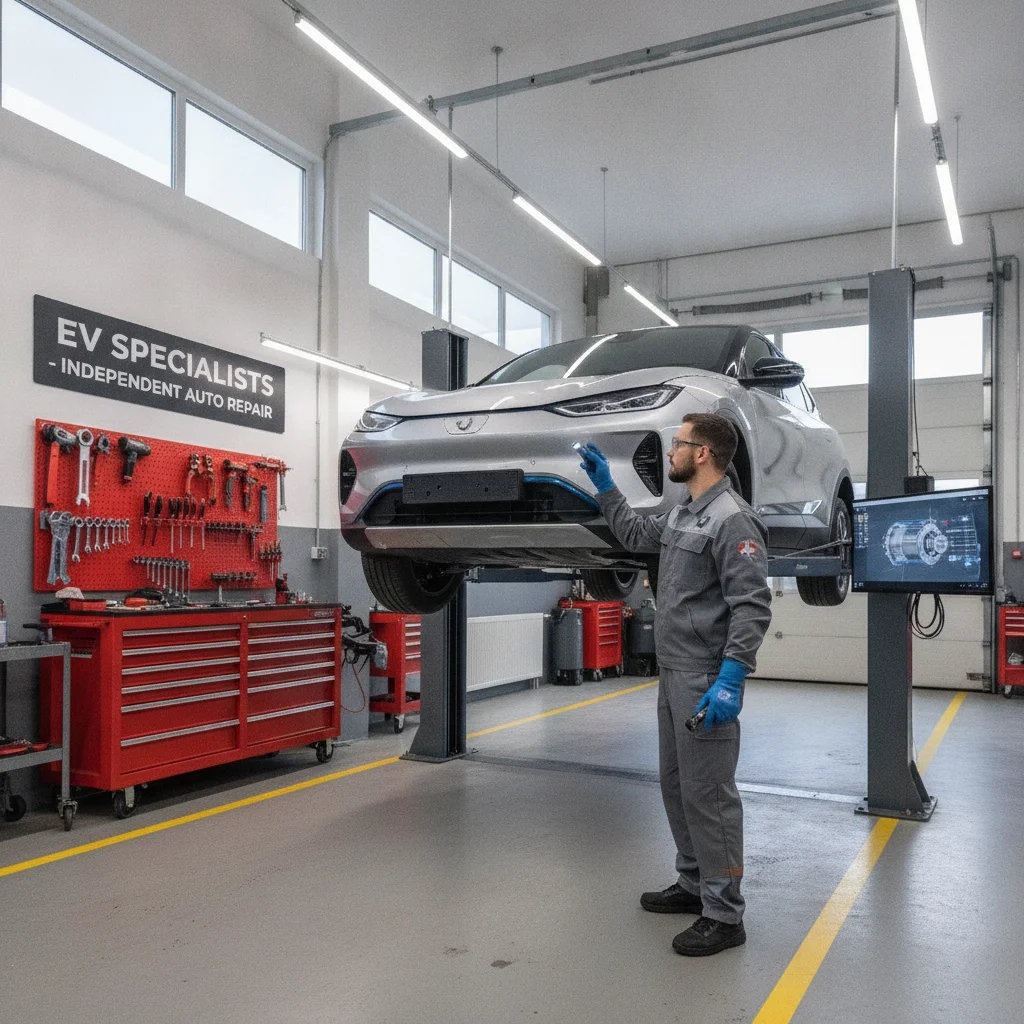
Independent shops aren't second-tier — they're simply a different tool for a different job. For the bulk of EV maintenance that doesn't involve the high-voltage drivetrain, they often make more financial sense.
Cost Savings on Routine Work
Labor rates at franchised dealerships typically run $150–$200 per hour in major metro markets, compared to $90–$130 at most independent shops. For straightforward jobs — tire rotation, cabin air filter replacement, brake fluid flush, or wiper blade swap — that rate difference adds up quickly. Over the life of a vehicle, owners who use independent shops for routine service often save hundreds to over a thousand dollars.
~40%
Typical labor cost savings at independent shops
Industry labor rate comparisons consistently show independent shop rates running 30–45% below franchised dealership service departments in most U.S. metro markets.
8 yrs / 100K mi
Federal minimum EV battery warranty
U.S. federal law requires all EV manufacturers to warrant the battery pack for at least 8 years or 100,000 miles, whichever comes first — a key factor in service routing decisions.
35%+
Of ASE-certified shops now offer EV service
ASE reports growing adoption of hybrid and EV specialty certifications among independent repair shops, expanding consumer options outside the dealer network.
Flexibility and Availability
Many EV owners report multi-week wait times for dealer service appointments, particularly at high-volume Tesla service centers or newly launched EV brand locations that haven't scaled capacity. Independent shops typically have faster scheduling windows, and for non-urgent maintenance, that flexibility is genuinely valuable.
EV-Trained Technicians Are Increasingly Common
The landscape has shifted. Organizations like ASE (Automotive Service Excellence) now offer EV-specific certifications, and a growing number of independent shops have invested in high-voltage training and safety equipment. Shops certified under programs like ASE L3 (Light Duty Hybrid/EV) have technicians equipped to handle most non-drivetrain EV work safely and competently. The key is vetting the shop before assuming capability — more on that below.
For a broader look at which tasks lend themselves to non-dealer service, see our breakdown of DIY vs. technician-required EV maintenance.
No Upselling Pressure
Dealership service departments operate under significant revenue pressure, and service advisors are often incentivized to recommend additional services. A well-chosen independent shop with a flat-rate business model may offer a less upsell-heavy experience for owners who already know what they need done.
Head-to-Head: Dealer vs. Independent Shop
Here's how the two service options compare across the factors that matter most to EV owners:
| Criterion | Dealership | Independent Shop | |
|---|---|---|---|
| Average labor rate | $150–$200/hr | $90–$130/hr | |
| Proprietary diagnostic tools | Yes — full manufacturer access | Limited — aftermarket tools only | |
| OEM parts availability | Yes — stocked on-site | Usually via ordering, may take longer | |
| Recall and TSB capability | Yes — required channel | No — cannot perform recall work | |
| EV-certified technicians | Yes — manufacturer-trained | Varies — ASE L3 increasingly common | |
| Appointment availability | Often 2–4 weeks out | Typically faster scheduling | |
| Routine maintenance cost | Higher — premium labor rate | Lower — significant savings possible | |
| Battery warranty work | Yes — covered and required | No — cannot honor OEM warranty | |
| Software/firmware updates | Yes — manufacturer-licensed | Not available | |
| Best for | Warranty, battery, HV systems | Routine maintenance, cost savings |
The table makes the split strategy clear: neither option dominates across every dimension. For a parallel comparison in the context of conventional vehicles, see our full dealer vs. independent shop trade-off guide.
Which Services Belong at the Dealer — and Which Don't
The most practical way to approach this decision is task-by-task, not as an all-or-nothing choice. A full EV maintenance schedule will tell you what's due and when — here's how to route each task to the right provider:
Go to the Dealer For:
- Battery diagnostic and health checks — requires manufacturer-licensed software
- High-voltage system repairs — inverters, drive units, onboard charger hardware
- Safety recalls and technical service bulletins — mandatory and free
- Firmware updates that require a physical visit
- Warranty claims — any repair covered under the factory or powertrain warranty
- Charging port hardware issues — particularly brand-specific fast-charging systems
Independent Shops Can Handle:
- Tire rotation and replacement — no EV-specific complexity, though EVs use tires faster due to torque
- Cabin air filter replacement
- Wiper blade replacement
- Brake fluid flush — EVs use regenerative braking heavily, so brake fluid lasts longer but still absorbs moisture over time
- 12V auxiliary battery replacement — EVs still use a small 12V battery for accessories and control systems
- Wheel alignment
- Suspension and steering components (on non-high-voltage systems)
- Air conditioning service — though EV A/C uses an electric compressor, the refrigerant service is similar to ICE vehicles
Ask Your Shop One Simple Question
Before booking EV service at any independent shop, ask: 'Do you have an ASE L3-certified technician on staff?' If they don't know what ASE L3 means, that tells you everything. A certified EV tech understands high-voltage safety protocols and has passed standardized competency testing — it's the baseline credential worth requiring for anything beyond the most basic maintenance tasks.
Document Every Independent Service Visit
Whenever you use an independent shop, get an itemized receipt showing the date, mileage, work performed, and parts installed (including part numbers if possible). Store these digitally. If you ever face a warranty dispute, this paper trail demonstrates that the service was performed correctly and doesn't implicate the manufacturer's covered components.
As your EV ages out of its primary warranty coverage, the calculus shifts further toward independent shops for a wider range of work. The critical caveat: always confirm the shop has EV-trained staff before authorizing anything near the high-voltage system.
How to Vet an Independent Shop for EV Work
Not all independent shops are created equal when it comes to electric vehicles. A shop that's excellent with conventional vehicles may lack the safety training or tools to work responsibly on high-voltage systems. Here's what to look for:
Ask About EV Certifications
Look for ASE L3 certification (Hybrid/EV specialist) or manufacturer-specific training programs. Some shops have technicians who completed OEM training courses offered by brands like GM, BMW, or Nissan as part of dealer training programs before moving to the independent sector.
Confirm They Have Proper Safety Equipment
High-voltage EV systems require insulated tools, high-voltage gloves rated for at least 1,000V, and specific lockout/tagout procedures. Ask directly — a shop that doesn't know what you're talking about is not equipped for EV work near the drivetrain.
Check for EV Experience With Your Brand
A shop that regularly services Teslas may have less experience with a Hyundai Ioniq 5 or a Chevrolet Equinox EV. Brand-specific quirks — particularly around software and charging hardware — vary, and experience matters.
Read Recent Reviews Specifically for EV Work
Search for mentions of EV service at any shop you're considering. General five-star reviews for oil changes don't tell you much. Look for EV owners describing their experience.

It's also worth noting that your insurer may have opinions about where your car gets repaired — particularly after a collision. See what your insurer recommends vs. your right to choose a repair shop for a clear breakdown of those rights.
Warranty Implications: The Magnuson-Moss Reality
One of the most persistent myths in EV ownership is that using an independent shop for any service will void the warranty. This is not accurate under U.S. federal law. The Magnuson-Moss Warranty Act (15 U.S.C. § 2302) prohibits manufacturers from conditioning a warranty on the use of any brand of service unless they provide that service free of charge.
In practice, this means:
- Using a certified independent shop for a tire rotation or brake fluid flush cannot legally void your drivetrain warranty
- Manufacturers can deny warranty claims if they demonstrate that an independent shop's work directly caused the failure in question
- Keeping detailed service records — receipts, part numbers, dates — protects you if a warranty dispute ever arises
Never Let an Unqualified Shop Near High-Voltage Systems
EV battery packs and drive units operate at 400–800 volts — enough to cause lethal electrocution without proper safety equipment and training. An independent shop that lacks high-voltage-rated PPE and lockout/tagout procedures should not be touching anything connected to the high-voltage system. Routine maintenance tasks are low-risk; high-voltage component work is not. Verify credentials before authorizing any work near the drivetrain.
Don't Assume Your Warranty Is Protected Without Records
The Magnuson-Moss Act protects you legally, but a manufacturer can still challenge a warranty claim if independent shop work is implicated in a failure and you lack documentation. The burden of proof in a dispute often falls on the vehicle owner. Keep every service receipt, and if you're ever unsure whether a repair should go to the dealer, err on the side of caution while the battery warranty is active.
The safest approach for high-stakes components: keep the dealer in the loop for anything touching the battery pack or high-voltage system while the battery warranty is active, and use independent shops freely for everything else with proper documentation.
Building a Smart EV Service Strategy
The most cost-effective approach for most EV owners isn't picking a side — it's building a service strategy that matches the right provider to each job.
Year 1–3 (Under Full Warranty)
Use the dealer for any work covered under the bumper-to-bumper warranty. For routine items not likely to touch warranty coverage — tire rotations, wiper blades, cabin filters — you can use an independent shop without risk, provided you keep records. Establish a relationship with a good independent shop now so you have options when warranty coverage expires.
Year 4–8 (Powertrain Warranty Active, Bumper-to-Bumper Expired)
This is where the split strategy pays off most clearly. Route battery-related diagnostics and any drivetrain concerns to the dealer to protect your 8-year/100,000-mile federal battery warranty. Everything else — tires, brakes, 12V battery, HVAC — can go to a qualified independent shop at lower cost.
Year 9 and Beyond (Out of Warranty)
At this stage, a well-equipped independent shop is often the better primary service provider. Dealer labor rates become harder to justify without warranty protection as the backstop, and an experienced independent shop that knows your vehicle can often diagnose and repair it more efficiently. The exception remains software and proprietary diagnostic work that requires manufacturer tools.
Ask Your Shop One Simple Question
Before booking EV service at any independent shop, ask: 'Do you have an ASE L3-certified technician on staff?' If they don't know what ASE L3 means, that tells you everything. A certified EV tech understands high-voltage safety protocols and has passed standardized competency testing — it's the baseline credential worth requiring for anything beyond the most basic maintenance tasks.
Document Every Independent Service Visit
Whenever you use an independent shop, get an itemized receipt showing the date, mileage, work performed, and parts installed (including part numbers if possible). Store these digitally. If you ever face a warranty dispute, this paper trail demonstrates that the service was performed correctly and doesn't implicate the manufacturer's covered components.
For a comprehensive look at every maintenance task across an EV's entire ownership arc, our guide to lifetime EV maintenance costs and tasks is worth bookmarking.

All claims are backed by peer-reviewed research. Sources on request.