Key Takeaways
Option A
Short Auto Loan Term (24–48 months)
The pay-it-off-fast, interest-minimizing approach.
Best for: Buyers with strong cash flow who want to minimize total interest paid and build equity faster.
Option B
Long Auto Loan Term (60–84 months)
The lower-monthly-payment, budget-friendly structure.
Best for: Buyers who need to keep monthly expenses manageable, even at the cost of paying more overall.
If you want to pay the least amount of interest overall
Short Auto Loan Term (24–48 months)
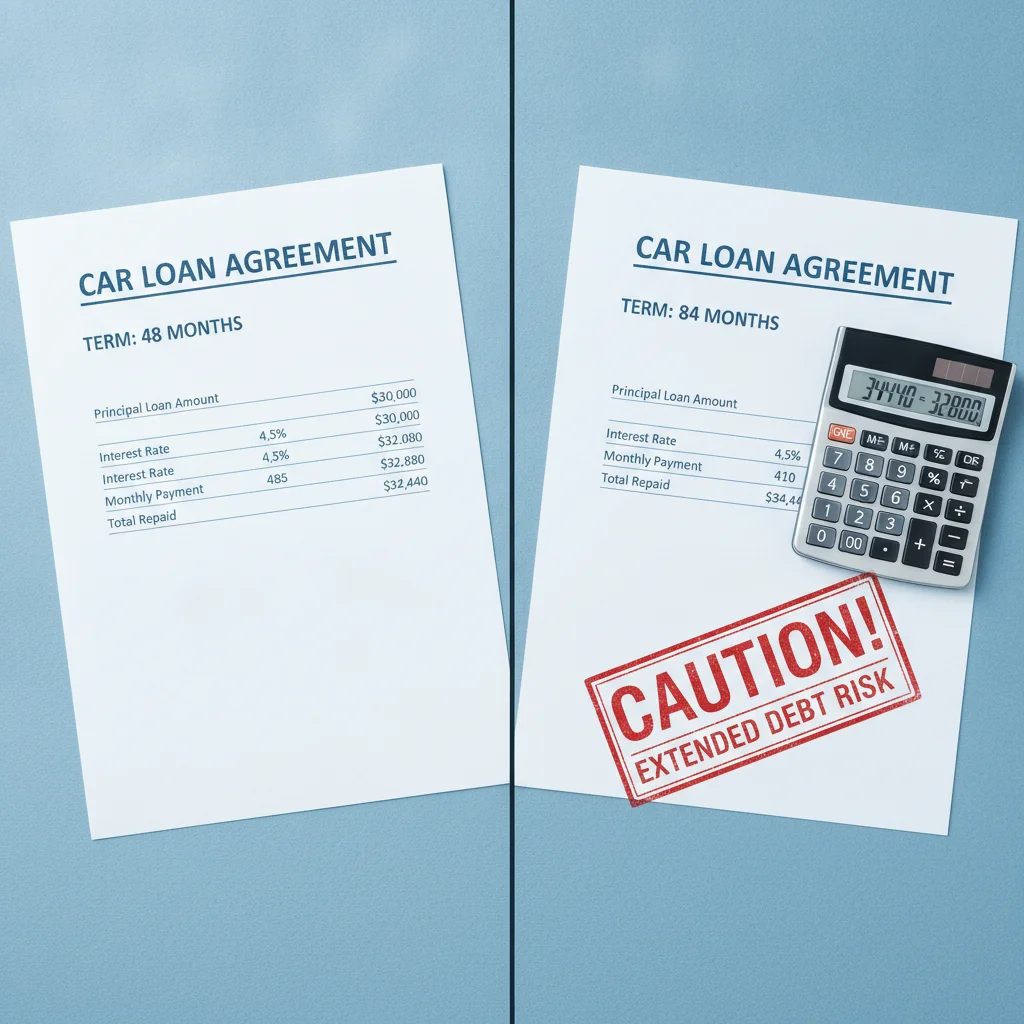
A shorter term means fewer months of interest accrual and often a lower APR, which together can save thousands of dollars compared to a 72- or 84-month loan.
If your monthly budget is tight and you need breathing room
Long Auto Loan Term (60–84 months)
Spreading payments over more months lowers the monthly obligation, which can prevent missed payments — though you should plan for the higher total cost.
If you're buying a used car and concerned about vehicle reliability
Short Auto Loan Term (24–48 months)
Older vehicles depreciate quickly and may need costly repairs. A shorter term gets the loan paid off before the car's reliability becomes a liability.
If you're financing a new car and want a low payment with room to invest elsewhere
Long Auto Loan Term (60–84 months)
On a newer vehicle with a manufacturer warranty, a longer term can free up monthly cash for savings or investments — provided the APR difference is small.
If you have bad credit and are working to rebuild
Short Auto Loan Term (24–48 months)
Bad-credit borrowers already face elevated APRs; a longer term amplifies that cost substantially. Paying off quickly limits exposure to high interest and rebuilds your credit profile faster.
What Loan Term Length Actually Means
Your auto loan term is the number of months you have to repay what you borrowed. Common terms run from 24 months (two years) on the short end to 84 months (seven years) on the long end, with 60 months (five years) being the most widely chosen option in the U.S.
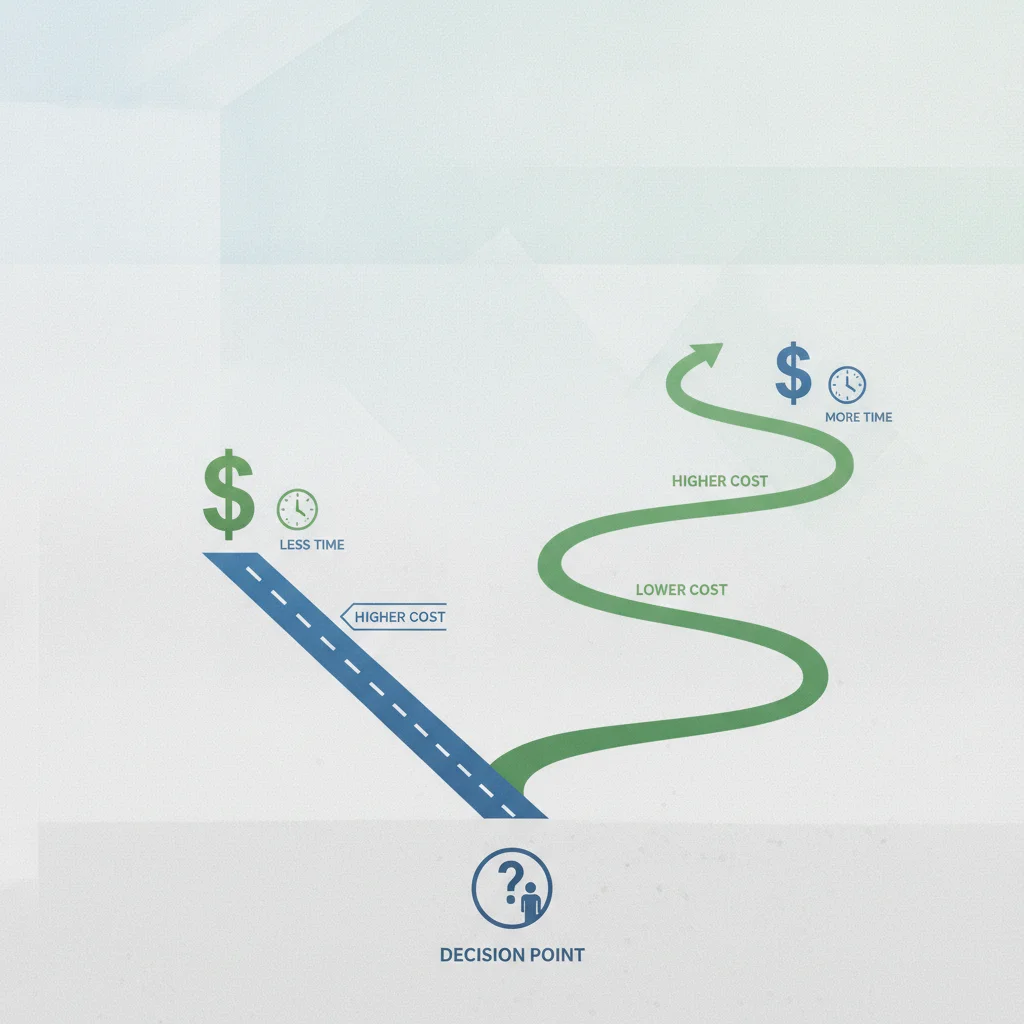
The term length does two things simultaneously: it determines how large each monthly payment will be, and it determines how many months interest has to accumulate on your outstanding balance. These two effects pull in opposite directions — a longer term gives you smaller payments but lets interest pile up longer. A shorter term compresses the payment schedule, which hurts your monthly budget but limits the lender's total cut.
Most buyers focus almost entirely on the monthly payment when shopping for a loan. That's understandable — it's the number that shows up in your bank account every month. But the monthly figure is only half the story. The total cost of the loan — principal plus every dollar of interest — is the number that actually measures how much the car cost you to finance. Understanding how term length shapes both figures is the foundation of any smart borrowing decision.
For a deeper look at how each standard interval compares, see this breakdown of 36, 48, 60, 72, and 84-month loan terms.
The Core Trade-Off: Monthly Payment vs. Total Cost
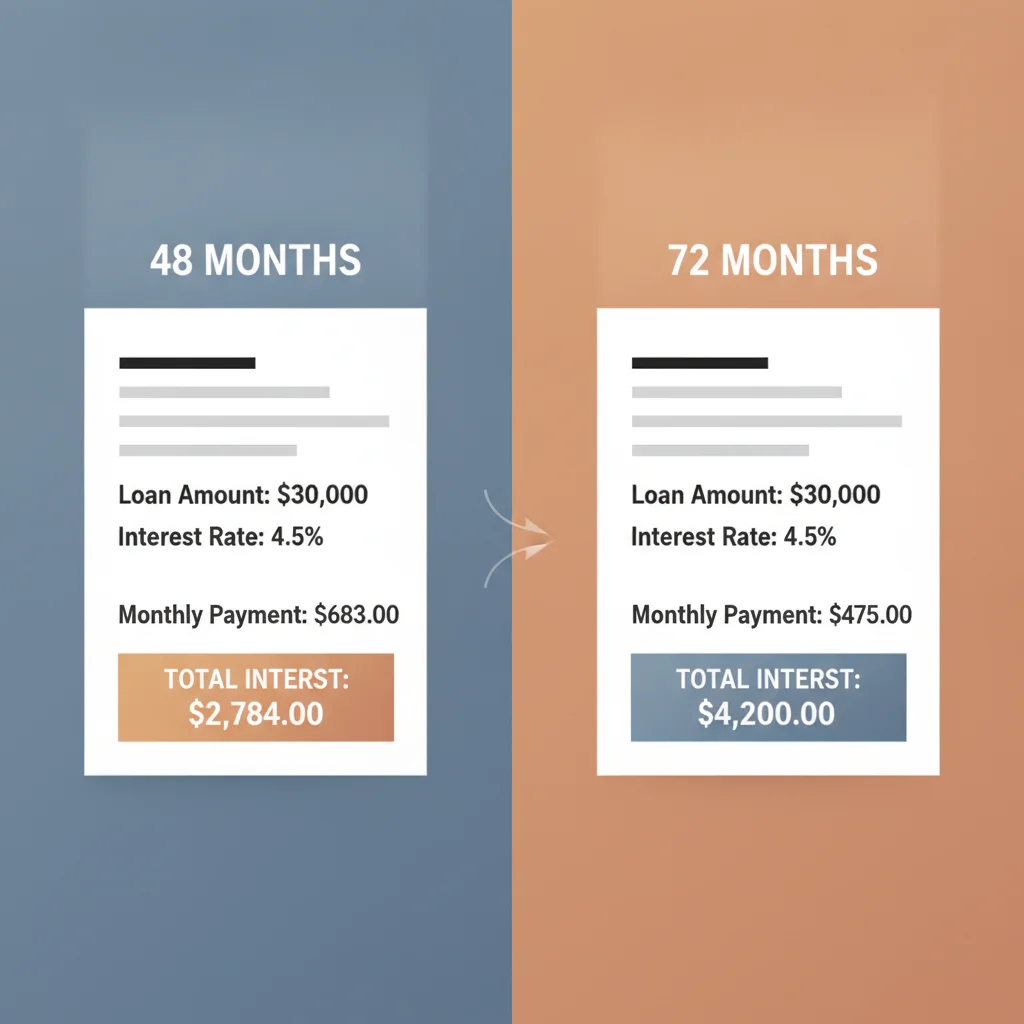
Here's the central tension in plain numbers. Suppose you're financing $28,000 at a 7% APR. Watch what happens as the term extends:
- 36 months: ~$864/month — total interest paid: ~$3,100
- 48 months: ~$670/month — total interest paid: ~$4,160
- 60 months: ~$554/month — total interest paid: ~$5,240
- 72 months: ~$478/month — total interest paid: ~$6,420
- 84 months: ~$424/month — total interest paid: ~$7,616
Going from a 36-month term to an 84-month term saves you $440 per month on paper. But it costs you an additional $4,500 in interest over the life of the loan. That's not a small rounding error — it's the price of spreading out the payments.
And that calculation assumes the same APR across every term, which lenders rarely offer. In practice, longer-term loans carry higher interest rates because they represent greater risk for the lender. That APR gap adds another layer of cost that the simple monthly-payment comparison conceals. See how term length and APR interact across realistic scenarios to understand the full picture.
| Criterion | Short Term (24–48 months) | Long Term (60–84 months) |
|---|---|---|
| Monthly payment | Higher | Lower |
| Total interest paid | Significantly lower | Significantly higher |
| Typical APR offered | Lower rate | Higher rate |
| Equity buildup speed | Fast — positive equity sooner | Slow — underwater risk longer |
| Depreciation risk | Lower — loan paid off faster | Higher — car value may fall below balance |
| Cash flow flexibility | Less month-to-month | More month-to-month |
| Best vehicle type | Used cars, older vehicles | New cars with warranties |
| Debt-to-income impact | Higher monthly DTI pressure | Lower monthly DTI pressure |
| Ideal buyer profile | Strong income, low existing debt | Tight budget, higher debt load |
72 months
Most common new car loan term in the U.S.
According to Experian's State of the Automotive Finance Market report (2024), the average new vehicle loan term reached approximately 68–72 months, reflecting a long-term trend toward stretched repayment windows.
~$4,500
Extra interest on 84-month vs. 36-month loan
On a $28,000 loan at 7% APR, extending from 36 to 84 months costs approximately $4,500 more in interest charges over the life of the loan.
Over 30%
New car buyers who are underwater on their loan
Edmunds reported that more than 30% of consumers trading in a vehicle for a new one in recent years carried negative equity — largely tied to long-term financing on depreciating assets.
0.5–1.5%
Typical APR premium for 84-month vs. 48-month terms
Lenders routinely charge higher APRs on longer terms to offset increased default and depreciation risk; the spread between short and long-term rates varies by credit tier and lender.
The Depreciation Problem With Long Terms
There's a third variable that gets almost no attention in loan comparisons: vehicle depreciation. Cars lose value every year they're driven — typically 15–25% in the first year and another 10–15% annually after that. Loan amortization, however, is front-loaded with interest. In the early months of a loan, most of your payment goes toward interest, not principal.
The result: in the first two or three years of a long-term loan, your loan balance drops slowly while the car's value drops quickly. You can end up in a situation called being "underwater" or "upside-down" — owing more on the loan than the vehicle is worth. If the car is totaled or you need to sell, you'll still owe the lender the difference.
Short-term loans reduce this window of vulnerability. By paying off principal faster, you build equity more quickly and reach positive equity — where the car's value exceeds the loan balance — much sooner. For buyers with bad credit who may already face higher loan amounts relative to vehicle value, this risk is especially serious. Learn why longer terms and bad credit can be a costly combination.

Gap Insurance and Long Loan Terms
If you choose a long loan term, seriously consider purchasing Guaranteed Asset Protection (GAP) insurance. This coverage pays the difference between what your car is worth and what you still owe if the vehicle is totaled or stolen while you're underwater. It's especially relevant in the first two to three years of a 72- or 84-month loan, when the depreciation-to-payoff gap is widest. Many lenders and dealerships offer it; credit unions often have the lowest rates.
Head-to-Head: Short vs. Long Loan Terms
The comparison below summarizes the key differences across practical dimensions buyers should evaluate before choosing a term. Use it as a quick reference, but remember that your specific loan amount, APR, and financial situation will shift the numbers.
| Criterion | Short Term (24–48 months) | Long Term (60–84 months) |
|---|---|---|
| Monthly payment | Higher | Lower |
| Total interest paid | Significantly lower | Significantly higher |
| Typical APR offered | Lower rate | Higher rate |
| Equity buildup speed | Fast — positive equity sooner | Slow — underwater risk longer |
| Depreciation risk | Lower — loan paid off faster | Higher — car value may fall below balance |
| Cash flow flexibility | Less month-to-month | More month-to-month |
| Best vehicle type | Used cars, older vehicles | New cars with warranties |
| Debt-to-income impact | Higher monthly DTI pressure | Lower monthly DTI pressure |
| Ideal buyer profile | Strong income, low existing debt | Tight budget, higher debt load |
One dimension that doesn't appear in any table but matters enormously is psychological: a shorter loan has a definite, near-term end date. That finite obligation can be motivating and financially liberating once it's done. A longer loan extends a monthly expense into years of your life where your circumstances — income, housing, family — may change significantly. That uncertainty is a risk too, even if it doesn't show up in an interest calculator.
Your down payment size also interacts directly with your term decision. A larger down payment reduces the principal you're borrowing, which makes a shorter term more affordable by lowering what each monthly payment has to cover.
When Long Terms Can Be Justified — and When They Can't
Longer loan terms aren't automatically the wrong choice. There are specific circumstances where extending your term reflects sound financial thinking rather than avoidance of the full cost. When a longer loan term actually makes financial sense explores those scenarios in detail, but a few principles are worth naming here.
A long term can be defensible when:
- You're buying a new vehicle with a full factory warranty, which reduces the repair-cost risk that older cars carry into later loan years.
- The APR difference between a 60-month and 72-month loan is minimal (under 0.5 percentage points), making the added interest cost modest.
- Your freed-up monthly cash flow will be directed toward a higher-returning purpose — an emergency fund, retirement contributions, or paying off higher-interest debt.
- You have a documented plan to make extra principal payments that will effectively shorten the loan without locking in a high minimum payment.
A long term is hard to justify when:
- You're financing a high-mileage or older used vehicle that will depreciate aggressively. Used car loan terms differ from new car deals for this exact reason.
- You're already carrying significant debt and adding a long-term payment strains your debt-to-income ratio. See how loan term length affects your DTI for context lenders use.
- The lower payment is the only way to make the purchase work — a sign the vehicle may simply be more than your budget supports.

How to Make the Right Call for Your Situation
The right loan term is the one that balances your immediate cash-flow constraints against your long-term financial goals — without pushing either to a breaking point. Here's a straightforward process for reaching that decision:
- Calculate your true maximum monthly payment. Don't start with a payment target provided by a dealer. Look at your take-home income, subtract fixed expenses, and identify how much you can genuinely afford without cutting into savings or creating financial stress.
- Price out both short and long terms on your target loan amount. Use an online auto loan calculator to see actual payment differences and total interest costs. Understand why a lower monthly payment can cost you more in the end before finalizing your comparison.
- Check the APR difference, not just the payment difference. Ask lenders to quote APRs for multiple term options. The interest rate and APR on a 72-month loan is almost always higher than on a 48-month loan from the same lender.
- Consider the vehicle's expected lifespan. If you're buying a vehicle you plan to keep for ten years, a 60-month term that leaves you payment-free for years four through ten is genuinely appealing. If you expect to trade in after three years, a long term is almost always a mistake.
- Explore a middle path through payment frequency. Switching to biweekly payments can effectively shorten your loan term without changing your official loan structure — a useful strategy if you take a longer term but want to pay it off faster.
- Know that refinancing is an option later. If you start with a longer term because cash flow is tight today, refinancing to a shorter term later can cut your remaining interest if your income improves. It's not a perfect solution, but it preserves flexibility.
For a comprehensive framework tailored to your financial profile, picking a loan term that matches your financial situation walks through the full decision process step by step.


All claims are backed by peer-reviewed research. Sources on request.