
Key Takeaways
Why Loan Term Is One of the Most Consequential Choices You'll Make
When most people shop for a car loan, they fixate on the interest rate. That instinct makes sense — a lower rate feels like a win. But the loan term, meaning the number of months you have to repay the loan, shapes your financial outcome just as powerfully. In some cases, it shapes it more.
Here's the core tension: a shorter term means higher monthly payments, but you pay far less in total interest. A longer term brings lower monthly payments, but you pay that interest for more months, and the total cost climbs. Neither is automatically right or wrong. The right answer depends on your specific financial picture.
This article walks you through a structured process for evaluating that picture and landing on a term that genuinely fits — not just one that gets you into the car you want today.
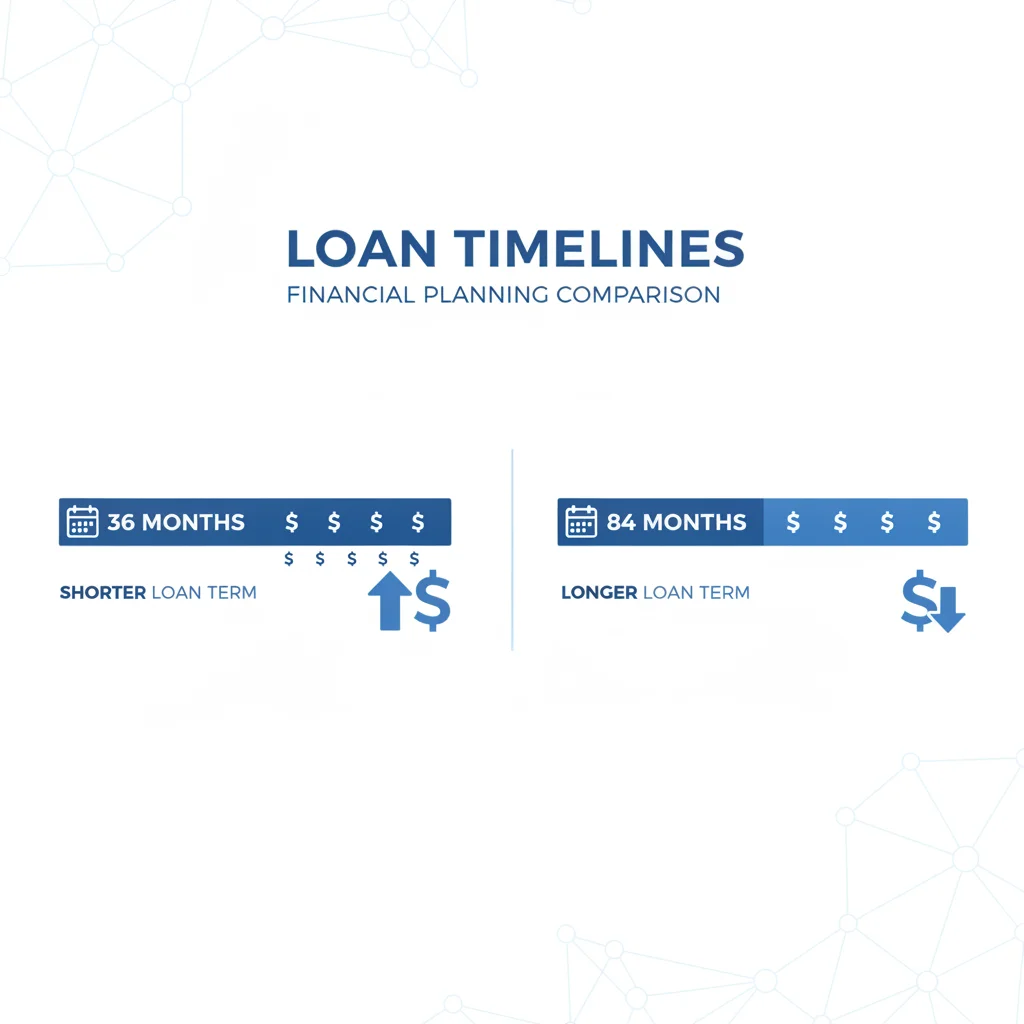
For a broader look at how loan length affects your overall borrowing strategy, see the complete auto loan term decision framework. But if you're ready to work through your own situation step by step, start here.
What You'll Need Before You Start
Before working through the steps below, gather a few pieces of information. Having these numbers in front of you will make the process faster and the results far more accurate.
What you will need
If you haven't yet received a preapproval offer, that's a useful first move. A preapproval letter tells you what rate you qualify for at different term lengths, which gives you real numbers to compare rather than estimates. Learn more about how auto loan preapproval works and why it matters.
Auto Loan Calculator
Calculate monthly payments and total interest at different term lengths using your actual loan amount and interest rate.
Monthly Budget Spreadsheet or App
Map out all fixed and variable expenses to determine how much room exists for a car payment.
Vehicle Depreciation Guide (e.g., Edmunds or Kelley Blue Book)
Estimate how quickly the vehicle you're considering will lose value relative to your loan balance.
Preapproval Letter From a Bank or Credit Union
Provides your actual interest rate at different term lengths so you can compare real costs rather than estimates.
Step-by-Step: Matching Your Loan Term to Your Financial Reality
Follow these steps in order. Each one builds on the last, and skipping ahead tends to produce a decision based on incomplete information.
Calculate Your True Monthly Budget Ceiling
Start with your take-home pay — the amount that actually lands in your bank account each month. Subtract every fixed monthly obligation: rent or mortgage, utilities, existing loan payments, insurance premiums, subscriptions, and minimum debt payments. What remains is your discretionary income.
Financial planners commonly suggest keeping total vehicle costs — payment, insurance, fuel, and maintenance — under 20% of take-home pay. Auto insurance and fuel alone often run $250–$400 per month, so if your take-home pay is $4,000, your maximum safe car payment is probably in the $400–$550 range, not $800.
Write down your ceiling number. This single figure will anchor every term comparison that follows.
Determine Your Loan Amount After Down Payment
Subtract your down payment from the vehicle's out-the-door price. Out-the-door price includes the negotiated purchase price plus taxes, title fees, and documentation charges. Do not use the sticker price — it consistently understates the true financed amount.
If the dealer is offering to roll in an extended warranty or gap insurance, add those costs to your loan amount for this calculation. They increase what you're financing, which affects every term comparison.
Example: A $32,000 vehicle with $2,500 in fees and a $5,000 down payment produces a loan amount of $29,500.
Run Payment Estimates at Each Term Length
Use an auto loan calculator to generate monthly payment and total interest figures for your loan amount at 36, 48, 60, 72, and 84 months. Use the interest rate from your preapproval offer if you have one. If you don't have a rate yet, use 7–8% as a conservative placeholder for a buyer with average credit.
Record the results in a simple table:
- 36 months: payment / total interest
- 48 months: payment / total interest
- 60 months: payment / total interest
- 72 months: payment / total interest
- 84 months: payment / total interest
Having all five rows in front of you at once makes the trade-off visible in a way that abstract descriptions never can.
Compare Each Payment Against Your Budget Ceiling
Cross-reference your payment estimates from Step 3 against the budget ceiling you set in Step 1. Identify which term lengths produce a monthly payment at or below your ceiling. Those are your viable options.
If only the 72- or 84-month terms fall within your ceiling, that's an important signal. It means the vehicle may be priced beyond what your current income can comfortably support — and extending the term is a workaround that will cost you significantly more over time. Consider whether a less expensive vehicle or a larger down payment would open up shorter-term options.
Assess Your Depreciation Risk
Every vehicle loses value over time — but the rate varies considerably by make, model, age, and mileage. Your loan balance follows a different curve: early payments are mostly interest, so the balance drops slowly at first. If your loan balance drops slower than the car's value, you can end up underwater — owing more than the car is worth.
To check your exposure, look up the vehicle's projected resale value at one, two, and three years using Kelley Blue Book or Edmunds. Compare those values to your projected loan balance at the same intervals using an amortization calculator.
If your loan balance exceeds the projected vehicle value at any point by more than 10–15%, you're carrying meaningful depreciation risk. A shorter term, a larger down payment, or gap insurance (which covers the difference if the car is totaled while you're underwater) can all reduce that exposure.
Factor In Your Income Stability and Future Plans
Ask yourself: how confident are you that your income will remain stable — or grow — over the loan period? If you're in a secure salaried position with predictable raises, a shorter term with higher payments is a manageable commitment. If your income fluctuates, you're planning a major life change (a move, a career shift, starting a family), or you're early in a new job, a longer term gives you a lower required minimum payment, which protects you if income dips.
Also consider: will you need to sell or trade this vehicle before the loan is paid off? If so, a shorter term reduces the chance you'll be underwater at the point of sale, which simplifies the transaction considerably.
Choose the Shortest Term Your Budget Can Honestly Sustain
With all the information above in hand, select the shortest loan term whose monthly payment falls within your budget ceiling and still leaves you a financial cushion. This is your target term.
"Honestly sustain" is the operative phrase. Not the shortest term that technically fits if everything goes perfectly — the shortest term that works even in a rough month. If 48 months works comfortably and 36 months would require cutting other essentials, 48 months is the right call. If 60 months is the only safe option given your income variability, choose 60 months and pay extra when you can.
Bring this target term to your lender conversations and ask them to quote rates specifically at that term length, as well as one term shorter and one term longer, so you can make a fully informed comparison before signing.
Common Situations and the Terms That Tend to Fit Them
Every financial situation is different, but certain patterns repeat often enough that it's worth naming them directly.

You Have a Strong Credit Score and a Stable Income
If your credit score is 720 or higher and your income is predictable month to month, you're in the best position to take advantage of a shorter term. Lenders will offer you their best rates, and a 36- or 48-month loan won't feel punishing on a budget you can accurately forecast. The interest savings over a 60- or 72-month loan can easily exceed $1,500 to $3,000 on a typical vehicle purchase.
You're Buying a New Car With a Large Down Payment
A down payment of 20% or more shrinks the financed amount enough that a shorter term becomes significantly more accessible. It also insulates you against depreciation risk — even on a longer term — because you're less likely to go underwater. Learn how down payment size shapes your loan structure before you settle on a term.
Your Income Varies Month to Month
Freelancers, commission-based workers, and anyone with irregular income should lean toward a longer term — not because it's cheaper, but because the lower required payment gives you room to breathe during slow months. The key discipline here: make larger payments during strong months to offset the extra interest you're accumulating. Most auto loans allow this without prepayment penalties, but confirm before signing.
You're Buying a Used Vehicle With High Mileage
Older vehicles depreciate faster and carry more mechanical risk. A 72- or 84-month loan on a car with 80,000 miles already on it means you could be making payments on a vehicle that's broken down or worth next to nothing well before you finish paying it off. In this scenario, a shorter term — or a larger down payment to shorten the effective loan period — is strongly advisable. See how common loan-term mistakes play out in practice.
Don't Let Mileage and Age Guide You Toward a Long Term
A lower purchase price on a high-mileage used vehicle can make a longer term feel safe because the monthly payment looks small. But the vehicle's useful life may not outlast the loan. A car that needs a $3,000 transmission repair in month 40 of an 84-month loan is a car you're still paying for long after it may no longer be worth repairing.
You're Refinancing an Existing Loan
If you're already mid-loan and considering a refinance, the term decision works slightly differently. Extending your term can lower your payment, but it resets your interest clock. Shortening it pays you out faster but increases your monthly obligation. Compare the real cost of shorter versus longer refinancing terms before making that call.
Paying Extra Is Almost Always Allowed
Most auto loans don't carry prepayment penalties, which means you can pay more than the minimum any month without penalty. This makes a longer term less risky than it might seem — you get the lower required payment as a safety net, but you can accelerate payoff whenever your budget allows. Always confirm the absence of a prepayment penalty before relying on this strategy.
Rate Shop Before You Commit to a Term
Your credit union or bank may offer a meaningfully better rate than the dealership's finance department — especially on shorter terms. Get at least two quotes from outside lenders before signing anything at the dealer. A half-point rate difference on a $28,000 loan over 60 months saves roughly $400 in interest.
The Numbers Behind Each Standard Term
To make this concrete, consider a $28,000 loan at a 7% annual interest rate across the most common term lengths. The numbers below are approximate but illustrative.
| Term | Monthly Payment | Total Interest Paid | Total Cost |
|---|---|---|---|
| 36 months | $865 | $1,140 | $29,140 |
| 48 months | $670 | $1,160 more than 36-mo. | $32,160 |
| 60 months | $554 | $5,240 | $33,240 |
| 72 months | $476 | $6,272 | $34,272 |
| 84 months | $423 | $7,532 | $35,532 |
The monthly payment difference between 36 and 84 months is about $442. But the total interest difference is roughly $6,400. That's not a rounding error — it's a meaningful financial outcome. See a full breakdown of how each standard loan term compares across all the key dimensions.
Total Cost, Not Monthly Payment, Is the Real Number
Lenders and dealerships often present loans in terms of monthly payment because a lower number feels more manageable. But monthly payment is a cash flow metric — it tells you what you'll spend each month, not what the car actually costs you. Always compare the total amount paid (principal plus all interest) across term options before making a final decision. That's the number that reflects the true cost of the loan.
Longer Terms Often Carry Higher Rates
Lenders view longer loan terms as riskier because more can go wrong over a greater period of time. As a result, they frequently charge higher interest rates on 72- and 84-month loans than on 36- or 48-month loans. This means the total cost gap between a short and long term is often larger in practice than a simple payment comparison suggests. Always ask your lender for the rate at each term length, not just the payment.
Rate also interacts with term in ways that amplify these differences. A longer-term loan often comes with a slightly higher interest rate from the lender's perspective, because more time means more risk. So the gap between a 36-month and 84-month loan can be even larger than the table above suggests once you factor in the rate differential. For more on how rate type interacts with your repayment period, see fixed vs. variable rate auto loans explained.
Making the Final Call and Moving Forward
After working through the steps and reviewing how your situation maps to the scenarios above, you should have a clear target range — something like "48 to 60 months" or "no longer than 60 months." That target range is what you bring into lender negotiations.
When you request loan quotes, ask for rate and payment breakdowns at each term within your range. Don't let a lender anchor you to a single term before you've seen the comparison. A side-by-side quote at 48 months and 60 months takes the lender about two minutes to produce and gives you much better information to work with.
Also ask explicitly: does this loan carry any prepayment penalty? If not, you can always choose a longer term for payment flexibility and pay it down faster on your own schedule — capturing the lower payment safety net without necessarily paying all the extra interest. That flexibility has real value, especially if your income is uncertain.

Once you've chosen a term, revisit the math one more time before signing. Confirm the monthly payment, total interest, and payoff date are consistent with what you calculated. Dealership finance offices move quickly, and errors in favor of the lender are not unheard of.
For a side-by-side comparison of how short and long terms trade off in plain language, this overview of short vs. long auto loan terms is a useful final check before you commit.

All claims are backed by peer-reviewed research. Sources on request.