

Key Takeaways
Why This Fear Stops Buyers From Saving Thousands
Every week, buyers walk into dealerships having contacted exactly one lender. When I ask why, the answer is almost always the same: "I didn't want to hurt my credit score." That fear costs them real money — sometimes thousands of dollars over the life of a loan — because they never found out what a competing lender would have charged.
The anxiety makes intuitive sense. You've probably heard that applying for credit triggers a hard inquiry, and hard inquiries ding your score. Apply five times, and you've dinged it five times. That's the logic, anyway. The reality is more nuanced — and more buyer-friendly — than the fear suggests.
This article dismantles the most common myths about credit inquiries and rate shopping so you can walk into the market knowing exactly what's at stake and what isn't. For a deeper look at how the two types of credit checks work before you even apply, see Soft Pull vs. Hard Pull: What Happens to Your Credit When You Apply for an Auto Loan.

The Myths, Debunked
Let's go myth by myth. These are the beliefs I heard most often from buyers sitting across the desk from me — and from lenders who sometimes had every incentive to let the myths stand.
Myth
Every auto loan application you submit creates a separate hard inquiry that hurts your credit score.
Fact
Credit scoring models cluster multiple auto loan inquiries within a defined window and count them as one inquiry.
This is the big one. FICO and VantageScore both recognize that shopping for a loan is fundamentally different behavior from opening five new credit cards. When you apply to multiple auto lenders within a specific timeframe — 14 to 45 days depending on the scoring model version — those inquiries are deduplicated during score calculation.
In practice, this means applying to four lenders on the same weekend has the same score impact as applying to one. The fear of "stacking" inquiries is built on a misunderstanding of how the deduplication logic works.
For the full comparison of how inquiry types are treated differently, see How Rate Shopping for Auto Loans Affects Your Credit Score.
Myth
Even one hard inquiry will significantly lower your credit score and could cost you a better rate.
Fact
A single hard inquiry typically moves a score by fewer than 5 points — often less — and the impact fades within 3–6 months.
FICO's own published data confirms that a new hard inquiry drops most people's scores by fewer than 5 points. For someone with a long, clean credit history, the impact can be 1–2 points or effectively zero. The inquiry only remains on your report for two years, and its influence on your score diminishes sharply after 6–12 months.
Context matters here: a 4-point dip on a 740 score still leaves you firmly in the prime rate tier. It is not going to change the rate a lender quotes you. The only time this becomes consequential is if your score is right on the boundary between two lender tiers — and even then, the answer is to improve the score before applying, not to avoid shopping.
Myth
Getting preapproved by multiple lenders before visiting a dealership will wreck your credit before you even step on the lot.
Fact
Preapprovals clustered within the rate-shopping window are treated as one inquiry — and having them gives you negotiating leverage that far outweighs any score concern.
Preapproval requires a hard pull, yes. But if you gather preapprovals from your bank, a credit union, and an online lender in the same week, the score impact is the same as getting one preapproval. Meanwhile, you walk into the dealership holding real offers — specific rates and amounts — rather than guessing what you qualify for.
Dealers know that a buyer with a preapproval from a credit union at 6.5% is not going to accept their finance office's offer of 9.9%. That competitive pressure is exactly how you get the financing department to sharpen their pencil. The preapproval doesn't just protect your score; it resets the entire negotiation dynamic.
Myth
Checking your own credit score before shopping for a loan will trigger a hard inquiry.
Fact
Checking your own credit is always a soft inquiry — it has zero effect on your credit score, regardless of how often you do it.
This myth causes buyers to walk into the loan process blind. Checking your own credit through AnnualCreditReport.com, your bank's free monitoring tool, Credit Karma, or any similar service is a soft inquiry. Soft inquiries are invisible to lenders and have no impact on any credit score.
You should pull your own credit before you ever let a lender look at it. Know your score, review your report for errors (which affect roughly 1 in 5 reports according to FTC research), and dispute anything inaccurate before you apply. Going in with accurate self-knowledge is not a risk — it's a basic preparation step.
Myth
The interest rate and APR on an auto loan are the same thing — shopping for the lowest number is all that matters.
Fact
APR includes fees and other costs beyond the base interest rate, making it the accurate comparison metric when evaluating loan offers.
This misconception is common and expensive. The interest rate tells you what you're paying to borrow the principal. The APR — Annual Percentage Rate — wraps in origination fees, documentation fees, and other finance charges, giving you the true cost of the loan expressed as an annual rate.
A loan advertised at 5.9% interest with $800 in fees will have a higher APR than a loan at 6.1% with no fees. If you compare only the nominal rate, you might choose the more expensive product. Always ask for the APR and use it as your apples-to-apples comparison across lenders. This is especially important when the dealer's finance office is presenting numbers — they can manipulate monthly payment figures more easily than APR.
Myth
If you have bad credit, shopping around will make things worse — you should just take the first offer you can get.
Fact
Buyers with lower credit scores have even more to gain from rate shopping, since rate spreads across lenders in the subprime market are wider.
The rate-shopping deduplication window applies regardless of your credit score. A buyer with a 580 score gets the same inquiry protection as a buyer with a 750 score. What changes is the stakes: in the subprime market, the spread between the best and worst lender offers can be 4–6 percentage points, compared to 1–2 points in the prime tier.
On a $25,000 loan over 60 months, the difference between 14% and 19% APR is more than $4,000 in total interest. The buyer with poor credit is the one who most needs to shop — not the one who should surrender to the first approval out of gratitude. Specialty subprime lenders, credit unions with open membership policies, and buy-here-pay-here alternatives all have different risk appetites and pricing structures worth comparing.
<5 pts
Typical score drop from one hard inquiry
FICO's published guidance indicates most consumers see a score reduction of fewer than 5 points from a single new hard inquiry.
45 days
Rate-shopping window under FICO 8+
FICO Score versions 8 and newer deduplicate auto loan inquiries made within a 45-day window, counting them as a single inquiry.
~$1,600
Interest saved by finding 1.5% lower APR
On a $35,000, 60-month auto loan, a 1.5 percentage point rate reduction saves approximately $1,600 in total interest over the loan term.
1 in 5
Credit reports contain errors
A Federal Trade Commission study found that approximately one in five consumers had an error on at least one of their three credit reports.
3–6 months
Time for inquiry impact to fade
Hard inquiry effects on credit scores diminish significantly within 3–6 months and disappear entirely from score calculations after 12 months.
How the Rate-Shopping Window Actually Works
The rate-shopping window is the single most important concept in this entire conversation, and it's the one almost nobody explains clearly. Here's the mechanics:
- FICO Score versions 8 and newer use a 45-day window. Any auto loan hard inquiries that occur within 45 days of each other are deduplicated — they count as a single inquiry when calculating your score.
- Older FICO models (used by some lenders) use a 14-day window. Same concept, shorter timeframe.
- VantageScore uses a rolling 14-day window for all installment loan inquiries.
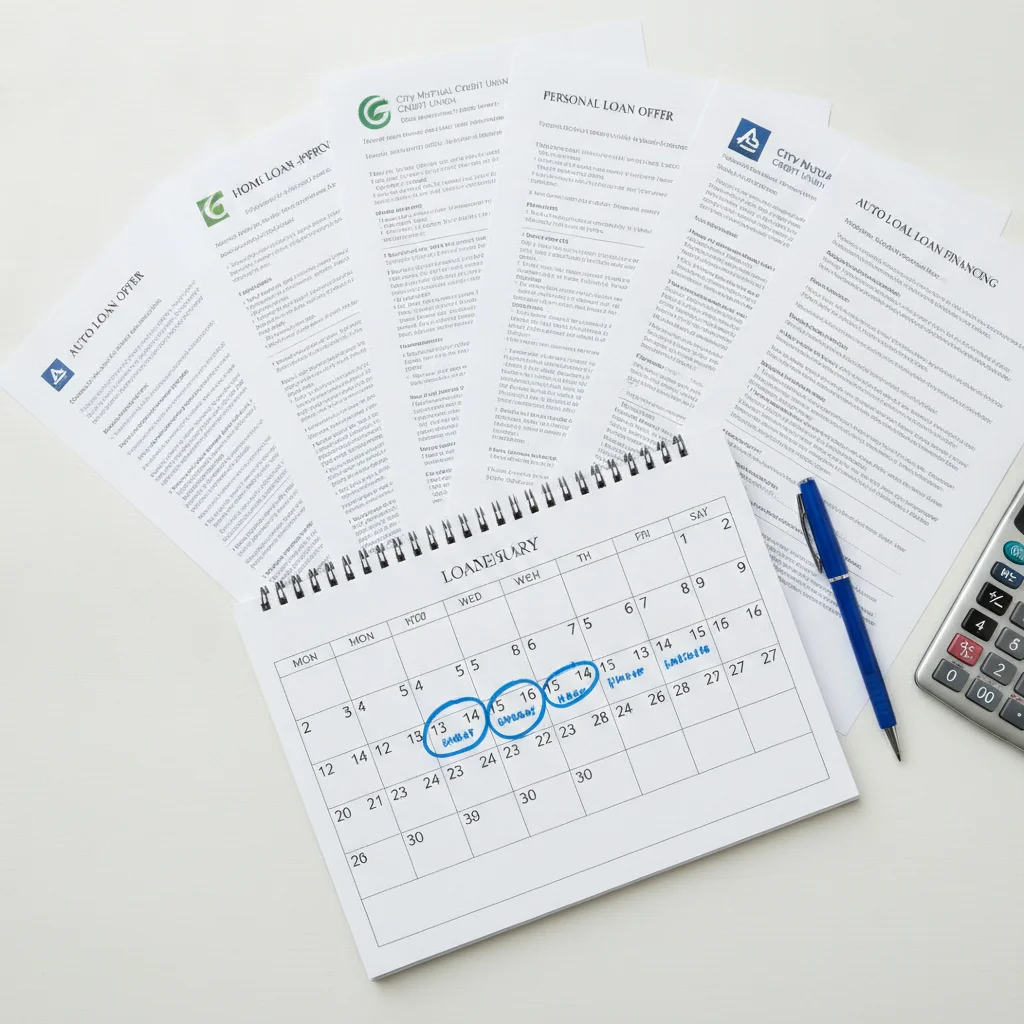
The practical implication: if you apply to six lenders over the course of one Saturday afternoon, your score sees one inquiry, not six. Even if you spread it out over three or four weeks, you're almost certainly within the protection window.
Don't Let Shopping Drag Past 45 Days
The 45-day deduplication window under FICO 8 is generous, but it does have a limit. If your rate shopping stretches across two months — say, you apply in early October and then again in late November — the later inquiries may be treated separately. Compress your applications into one focused two-to-three-week period to ensure all inquiries fall within the window.
Watch for Dealers Running Multiple Bureau Pulls
Some dealership finance offices route your application to multiple lenders simultaneously without informing you — a practice called "shotgunning." Each of those lender pulls is a hard inquiry. While they'll likely cluster within the rate-shopping window, you lose control over which lenders see your information. Ask the F&I office exactly which lenders they plan to submit your application to before you sign the credit authorization form.
To understand which specific scoring model your target lender uses — because it matters — read FICO Score vs. VantageScore: Which One Do Auto Lenders Actually Use?}. The short answer: most auto lenders use FICO Auto Scores, which are industry-specific versions of FICO with their own weighting — but the rate-shopping deduplication rules still apply.
What Actually Happens to Your Score — In Real Numbers
Let's be concrete. A single new hard inquiry typically reduces a FICO score by fewer than 5 points. For most buyers with scores above 680, this is meaningless — you stay in the same rate tier. For buyers near a credit score threshold (say, right at 620 or 660, where lenders draw rate-tier lines), even 3–4 points can theoretically matter.
But here's what does matter, in numbers that dwarf any inquiry impact:
| Credit Score Range | Typical Auto Loan APR (60-month, new car) | Monthly Payment ($35,000 loan) | Total Interest Paid |
|---|---|---|---|
| 781–850 (Super Prime) | ~5.2% | ~$667 | ~$5,020 |
| 661–780 (Prime) | ~7.1% | ~$693 | ~$6,580 |
| 601–660 (Near Prime) | ~11.4% | ~$763 | ~$10,780 |
| 501–600 (Subprime) | ~17.9% | ~$887 | ~$18,220 |
The gap between getting one offer versus shopping four lenders and finding a rate 1.5 percentage points lower? On a $35,000 loan over 60 months, that's roughly $1,600 out of your pocket. A temporary 3-point score dip that recovers in 3–6 months is not the trade-off most people think it is.
If you've already got a loan and are thinking about refinancing — where the same inquiry logic applies — What a Hard Inquiry Does to Your Credit When You Refinance walks through that scenario specifically.
Don't Let the Dealer Be Your Only Lender
Dealer financing can be competitive, but the finance office earns a markup — called "dealer reserve" — on loans they originate through their lending partners. This markup is legal, disclosed in the contract, and can add hundreds to thousands of dollars to your total cost. The only reliable defense is arriving with a preapproval from an outside lender. Without that benchmark, you have no way to know whether the dealer's rate is the best available to you.
How to Shop Rates Without Damaging Your Credit
The strategy is straightforward once you understand the rules:
- Pull your own credit first. Use AnnualCreditReport.com or a free monitoring service. A self-check is always a soft pull — no score impact. Know your numbers before lenders see them.
- Get preapproved, not just pre-qualified. Prequalification is usually a soft pull that gives you an estimated range. Preapproval is a hard pull with a real rate commitment. Do your preapprovals in a cluster, within 14 days to be safe across all scoring models. Explore the full process at Loan Preapproval.
- Target 3–5 lenders minimum. Include your bank or credit union, at least one online lender (LightStream, Consumers Credit Union, PenFed are common benchmarks), and the dealership's finance department. Never let the dealer be your only option.
- Apply to all of them within the same week. You don't need to be paranoid about the exact hour — just don't let the process drag across two calendar months.
- Bring your best preapproval to the dealer. This is your leverage. If the dealer's financing department can beat it, let them. If they can't, you have your lender ready to go.
For a detailed playbook on executing this without credit damage, Rate Shopping Without Wrecking Your Credit Score lays it out step by step. And if you're wondering how multiple preapproval applications interact with your score in practice, How Multiple Preapproval Applications Affect Your Credit Score covers that ground directly.

The Bottom Line: Fear of Inquiries Is the Real Credit Risk
After years in dealership finance, I've seen one pattern repeat itself endlessly: the buyers most worried about protecting their credit score end up with the worst loan terms. They accept the first offer out of caution. They skip the credit union because they don't want "another inquiry." They sign at 11% when they qualified for 7%.
The credit scoring system, for all its complexity, specifically protects consumers who shop responsibly for loans. The rate-shopping window exists precisely because the bureaus understand that a person who gets five auto loan quotes in two weeks is being a smart consumer, not a credit risk.
Use that protection. The cost of not shopping — measured in real dollars over 48 to 72 months — is far greater than the cost of a temporary, minor score fluctuation that the system is already designed to minimize.
To see the full picture of how your credit score affects the rates lenders will offer, the Credit Score Impact hub is the right next stop. And if you want to understand in more detail how multiple applications get handled by credit bureaus, How Multiple Loan Applications Affect Your Credit When Shopping Lenders provides the bureau-level mechanics.
All claims are backed by peer-reviewed research. Sources on request.