Key Takeaways
Option A
Biweekly Auto Loan Payments
The accelerated payoff strategy hiding in plain sight.
Best for: Borrowers who want to reduce total interest and shorten their loan term without refinancing or making large lump-sum payments.
Option B
Monthly Auto Loan Payments
The familiar default — straightforward but slower to pay off.
Best for: Borrowers who prioritize payment simplicity and predictability and are comfortable with the standard loan timeline.
If you want to minimize total interest paid without refinancing
Biweekly Auto Loan Payments
The extra annual payment chips away at principal sooner, reducing the balance on which interest accrues and shortening your repayment timeline.
If you prefer one predictable payment per month tied to a monthly budget
Monthly Auto Loan Payments
Monthly payments align naturally with rent, utilities, and other fixed monthly expenses, making budgeting straightforward.
If you're paid biweekly and want your loan payment to match your paycheck
Biweekly Auto Loan Payments
Syncing loan payments to your paycheck cycle reduces the risk of cash flow mismatches and makes the extra payment feel effortless.
If your lender doesn't offer a true biweekly billing option
Monthly Auto Loan Payments
Without a lender-supported biweekly program, you'll need to manage the split manually — monthly payments remain the reliable, friction-free default.
If you're in the final 12–18 months of your loan and want to accelerate payoff
Biweekly Auto Loan Payments
Even late in the loan term, the extra annual payment can shave off weeks of remaining payments and reduce residual interest.
What Actually Changes When You Pay Biweekly
At first glance, biweekly payments sound like a scheduling preference — you pay every two weeks instead of once a month. But there's a meaningful mathematical consequence hiding inside that shift.
Here's the arithmetic: a year has 52 weeks. Pay every two weeks and you make 26 half-payments, which equals 13 full payments — not 12. That 13th payment goes directly toward your principal. It isn't split across interest. It doesn't pad any fee. It reduces the balance you owe.
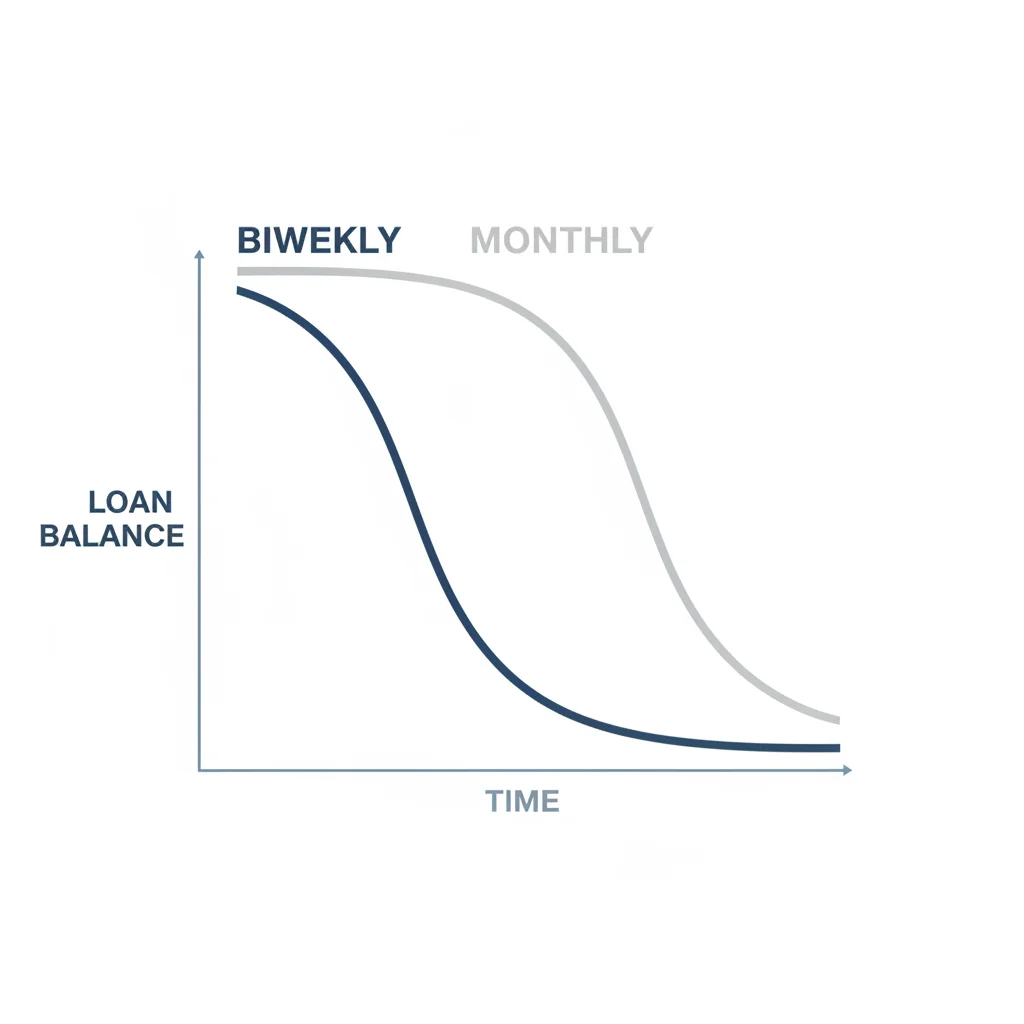
Why does that matter? Auto loan interest is calculated on your remaining principal balance. Every dollar you knock off that balance earlier means less interest accrues on every subsequent billing cycle. The biweekly structure essentially creates a compounding benefit: faster principal reduction → lower balance → less daily interest → faster payoff.
Monthly payments, by contrast, follow a 12-payment-per-year rhythm. Each month you pay interest on a balance that shrinks only 12 times annually. The slower that balance falls, the longer interest has to grow.
This is why biweekly payments aren't just a budgeting trick — they're a structural change to how quickly your loan amortizes. And unlike refinancing, they don't require a credit check, an application, or a lender's approval to implement on your own.
The Numbers: A Side-by-Side Interest Comparison
Let's put a real loan scenario behind these concepts. Assume you borrow $30,000 at a 7% APR for 60 months. Here's how the two payment strategies compare:
| Criterion | Biweekly Payments | Monthly Payments |
|---|---|---|
| Payments per year | 26 half-payments (= 13 full) | 12 full payments |
| Extra principal payments annually | 1 full payment | None |
| Total interest on $30K / 7% / 60 mo. | ~$4,650 | ~$5,060 |
| Estimated interest savings | ~$400–$450 | Baseline |
| Loan term impact | Shortens by several weeks | Full contracted term |
| Lender support required | Yes — verify before starting | No — standard billing |
| Budgeting complexity | Moderate — matches biweekly pay | Low — one due date monthly |
| Best loan term match | 60, 72, or 84 months | Any term |
The monthly payment on this loan is approximately $594. Under a biweekly plan, you'd pay roughly $297 every two weeks. The difference feels negligible per period — but over 60 months, it adds up to meaningful savings.
~$410
Estimated interest saved on a $30K / 7% / 60-month loan
Based on standard amortization modeling comparing 12 monthly payments vs. 26 biweekly half-payments per year.
1 extra
Full loan payments made per year under biweekly schedule
52 weeks ÷ 2 = 26 half-payments, equaling 13 full payments versus the standard 12 in a monthly schedule.
4–6 weeks
Typical loan term reduction on a 60-month biweekly loan
Exact term shortening varies by loan balance, APR, and when biweekly payments begin.
7%
Average new vehicle loan APR used in comparison scenarios
Reflects approximate average auto loan rates for borrowers with good credit per Experian's State of the Automotive Finance Market report.
The interest savings on a 60-month loan are moderate but real. On longer loans — 72 or 84 months — the effect compounds further because the principal balance stays elevated for more years, and biweekly payments have more time to accelerate the paydown. If you're exploring how loan length affects your total cost, see our breakdown of loan terms from 36 to 84 months.
One nuance worth noting: the savings from biweekly payments are less dramatic than, say, refinancing to a lower rate. But they're also free to implement and require no lender interaction if your contract allows early principal payments without penalty.
Biweekly ≠ Semi-Monthly
Biweekly means every two weeks — 26 payment periods per year. Semi-monthly means twice a month — only 24 payment periods per year. That difference of two half-payments per year is exactly what generates the 13th full payment and the associated interest savings. If your lender offers a semi-monthly option, it does not produce the same payoff acceleration as a true biweekly schedule.
Check for Prepayment Penalties First
Before making any extra payments, review your loan contract for prepayment penalty clauses. While uncommon in consumer auto loans, some agreements — particularly older contracts or those from buy-here-pay-here dealers — may include fees for paying off ahead of schedule. A quick call to your lender's customer service line can confirm whether additional principal payments are penalty-free.
How Monthly Payments Are Structured — and Why That Slows Payoff
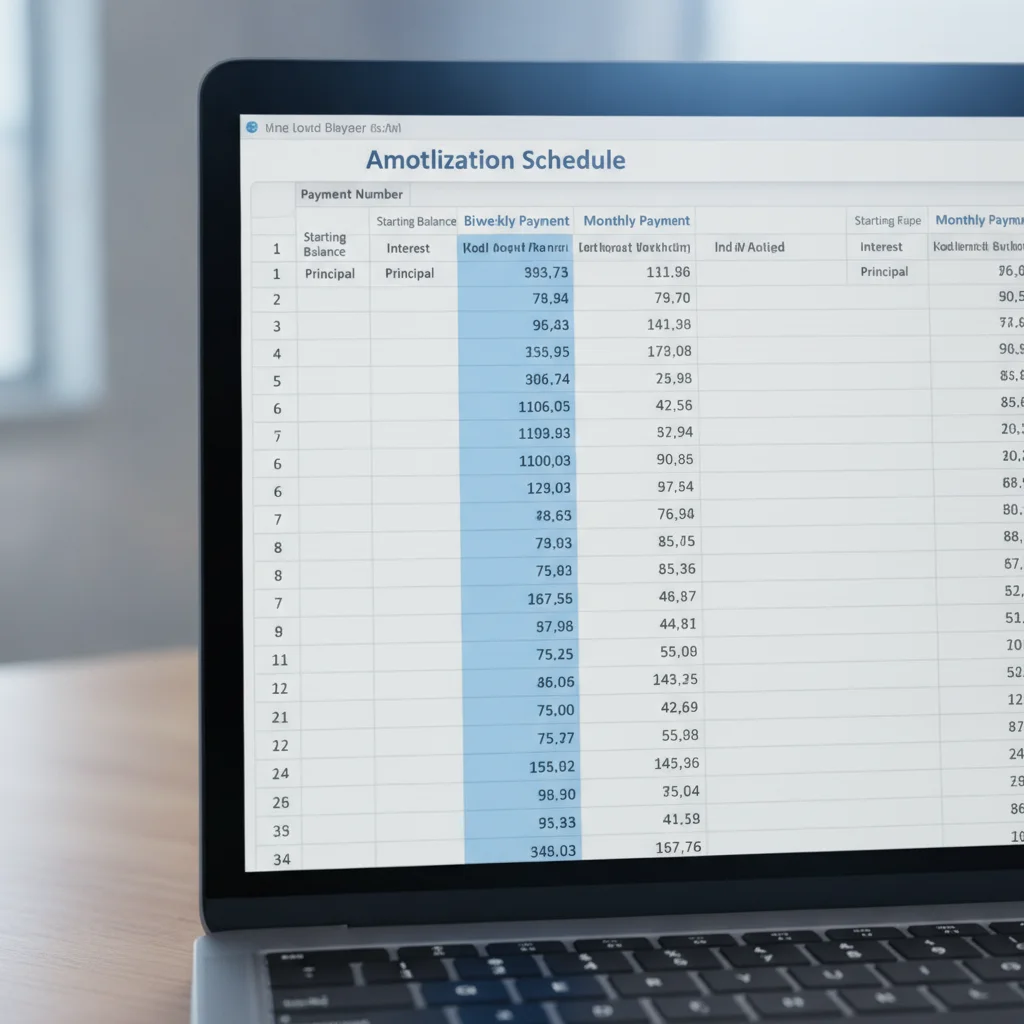
To understand why monthly payments are slower, you need to understand how auto loan amortization works. On a standard amortizing auto loan, each monthly payment covers two things: interest owed on the current balance and a portion of principal.
Early in the loan, the interest portion of your payment is at its highest — because your balance is at its highest. As you pay down principal, the interest portion gradually shrinks and more of each payment goes toward the balance. This is the amortization curve at work.
With monthly payments, you hit each stage of this curve exactly 12 times per year. The balance drops at a steady, predictable pace — but no faster. If you'd like to understand more about how stretched timelines affect what you actually pay, our article on why lower monthly payments can cost more in the long run explains the math clearly.
Monthly payments aren't a bad choice. For most borrowers, they're the path of least resistance: one due date, easy to automate, easy to budget around. The trade-off is simply that you're moving through the amortization curve at the standard pace — no slower, but no faster either.
Borrowers who prefer monthly payments but still want to save interest have options: rounding up each payment is one. Our piece on rounding up your car payment shows how a few extra dollars per month adds up over a loan's life. It's a softer version of the same principle driving biweekly savings.
Biweekly Payments vs. Monthly in Practice: What Your Lender Actually Allows
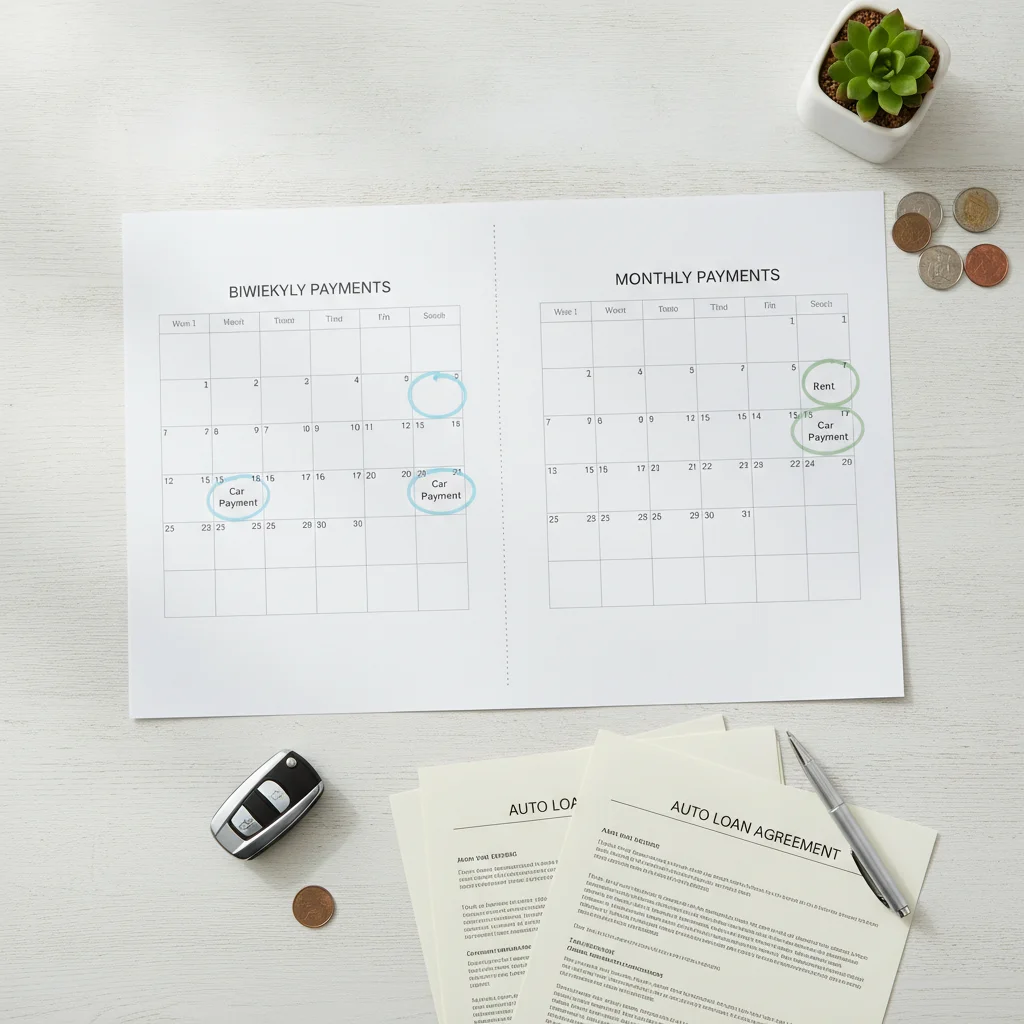
Here's where many borrowers run into friction: most auto lenders don't offer a native biweekly billing option. Your loan contract was written around 12 monthly payments per year. If you start sending half-payments every two weeks, the lender may hold the funds until a full payment amount accumulates — which defeats the entire purpose of early principal reduction.
Before you switch strategies, confirm the following with your lender or servicer:
- Will half-payments be applied immediately or held? If held, the timing advantage disappears.
- Does your loan have a prepayment penalty? Most consumer auto loans do not, but verify this in your contract before making extra payments.
- Can you designate extra payments specifically toward principal? Some lenders apply overpayments to future interest first unless you explicitly request otherwise.
If your lender doesn't support biweekly billing, there's a manual workaround: keep making your regular monthly payment, but once a year — ideally in January or at mid-year — make one additional principal-only payment equal to one month's payment. This replicates the mathematical effect of the 13th biweekly payment. It's less automatic, but it achieves the same structural outcome.
A second workaround: divide your monthly payment by 12 and add that amount to each monthly payment. For a $594/month payment, that's about $49.50 extra per month — which, by year's end, equals one full additional payment applied to principal.
For borrowers thinking about whether to restructure their loan more formally, the trade-off between lowering your monthly payment and reducing total interest is worth reading before deciding between refinancing and accelerated payments.
Which Strategy Fits Your Situation
Both payment structures can work well — the right choice depends on your cash flow, your lender's policies, and how much friction you're willing to manage. Here's a practical framework for deciding:
- Choose biweekly if:
- You're paid on a biweekly cycle and want your loan payment to sync with your paycheck. The 13th payment happens naturally and doesn't feel like a sacrifice because the money is already arriving on a two-week schedule.
- Choose monthly if:
- Your budget runs on a monthly cadence and you prefer one automated payment with no manual tracking. The predictability of monthly payments makes them easier to maintain over multi-year loan terms without payment errors.
- Consider a hybrid if:
- Your lender doesn't support true biweekly billing but you still want to accelerate payoff. Use the manual workaround above — one extra principal-only payment per year — or explore lump-sum payoff vs. extra monthly payments to see whether a one-time larger payment might outperform incremental extras.
One additional factor: loan term length interacts with payment frequency. On a 36-month loan, you have limited runway for biweekly savings to accumulate. On a 72- or 84-month loan, the compounding effect of earlier principal reduction is substantially larger. Our guide on short vs. long auto loan terms lays out how term length shapes total cost — a useful read before you decide how aggressively to accelerate payoff.

Finally, don't overlook the role your original loan structure plays. A larger down payment reduces the principal you're financing, which narrows the gap between biweekly and monthly strategies from the start. If you're still in the planning phase, the down payments hub covers how upfront cash shapes your total loan cost.
Quick-Reference Summary
If you're still deciding, here's the core distinction in plain terms: biweekly payments save you money by making you pay more — specifically, one additional full payment per year applied directly to principal. Monthly payments are simpler and perfectly adequate, but they let interest accrue on a higher balance for longer.
The decision doesn't have to be permanent. You can start with monthly payments, confirm your lender's prepayment policies, and shift to a biweekly schedule or manual extra-payment approach at any point in the loan term. The interest savings are available as long as there's a balance left to reduce.
What matters most is that you understand the lever you're pulling. Payment frequency isn't just a convenience preference — it's a direct input into how much your loan ultimately costs.

All claims are backed by peer-reviewed research. Sources on request.