Key Takeaways
Loan Term vs. Total Cost
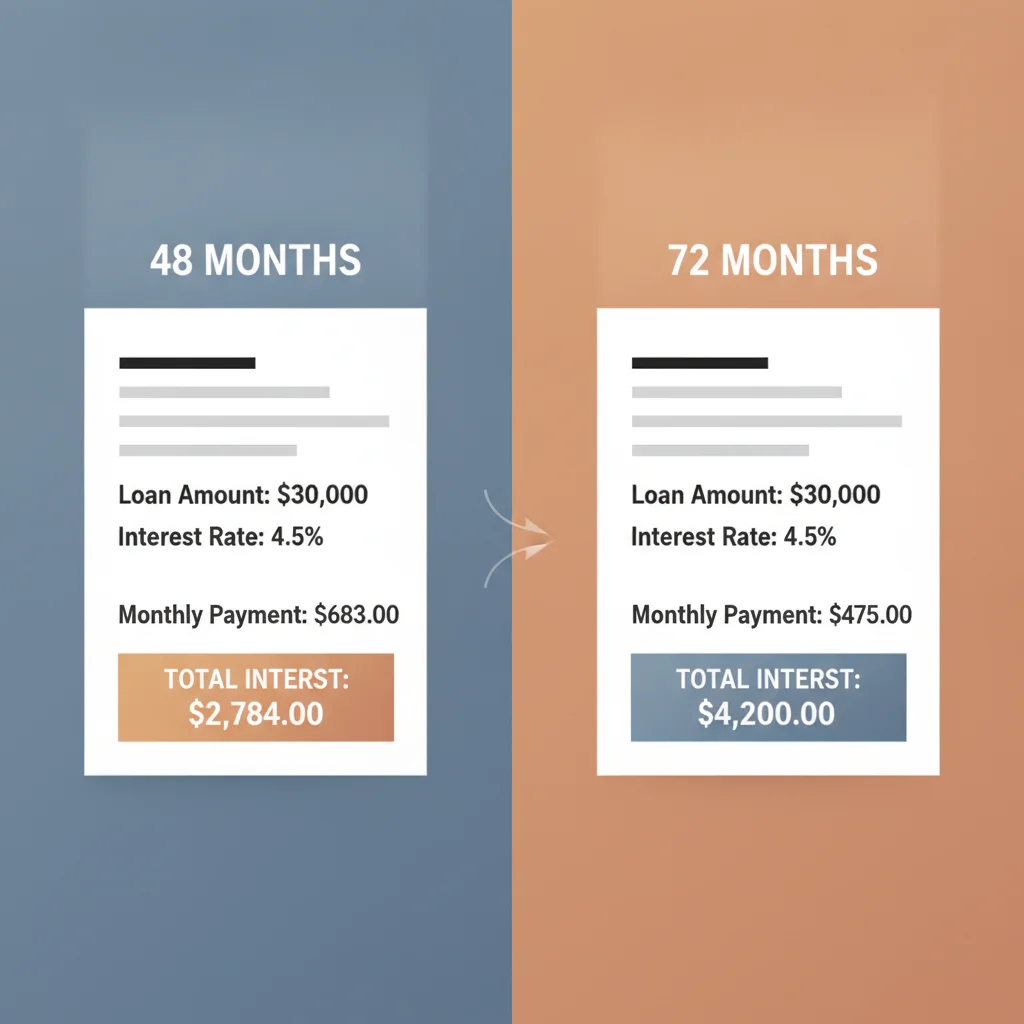
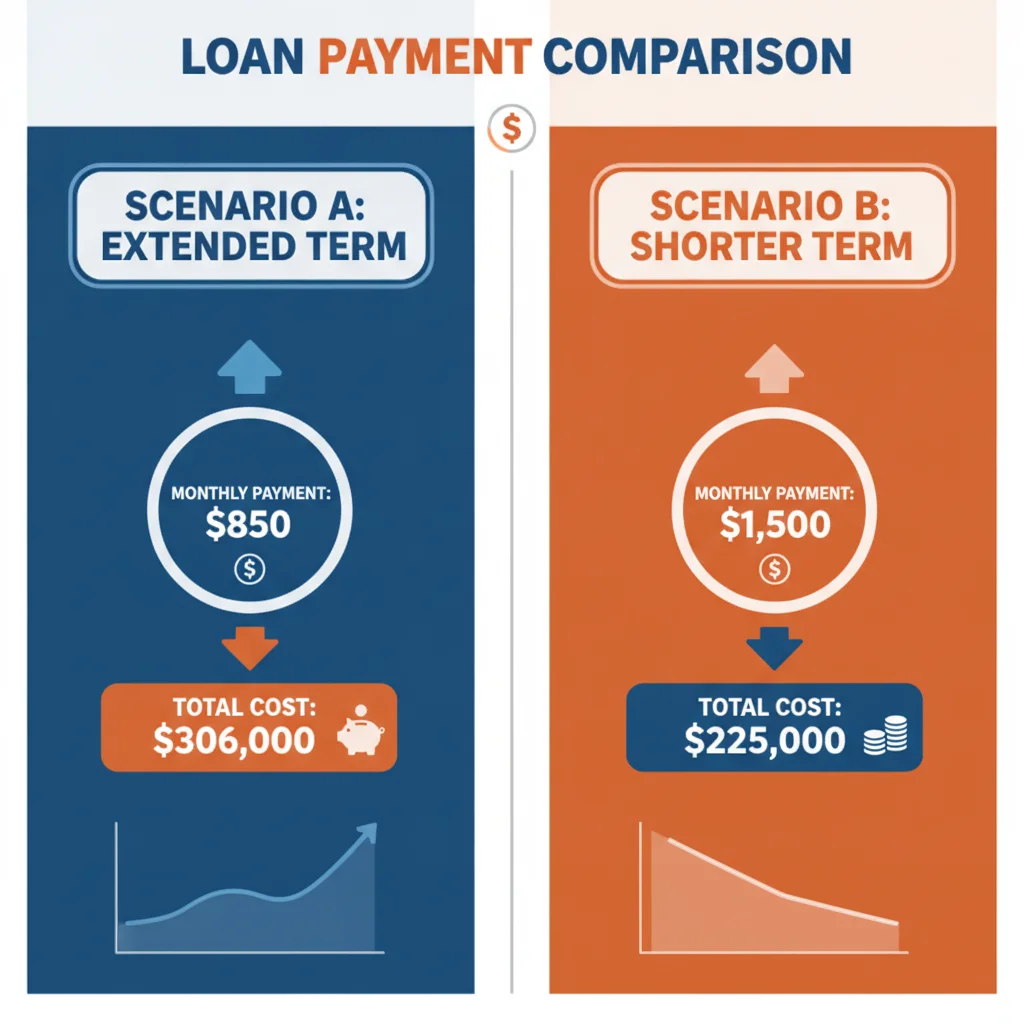
Your loan term is the length of time you have to repay your auto loan — typically 24 to 84 months. A longer term lowers your monthly payment by spreading the debt over more time, but it also means the lender charges you interest for longer. The result: you pay less each month but significantly more overall by the time the loan is paid off.
Because auto loans use simple interest calculated on the remaining principal balance, a longer amortization schedule front-loads interest charges and slows equity-building, increasing your total interest paid even when the APR stays the same.
The Monthly Payment Trap
Walk onto any car lot or open any dealer website and you'll notice something: the conversation almost always pivots to monthly payment. "What can you afford per month?" It sounds like the dealer is trying to help you stay within budget. Often, they're doing something else entirely.
Monthly payment is the easiest number to manipulate. A dealer or lender can make virtually any car appear affordable by simply stretching out how long you have to pay for it. A $35,000 vehicle can look like a $499/month decision when the loan runs 84 months — but the math behind that number tells a very different story.
The core problem is this: when you extend a loan term, you're not reducing what you owe — you're reducing how much you owe each month. The total debt, plus everything interest adds to it, stays large. It just gets sliced more thinly. And because interest accrues over every month you're in the loan, a longer term means the lender has more time to charge you for the privilege of borrowing.
Negotiating around monthly payment instead of total price is one of the most expensive mistakes buyers make. This article explains the underlying math so you can see the real cost before you sign.

How Loan Term Length Actually Works
An auto loan has three primary variables that determine your monthly payment: the principal (the amount you borrow), the interest rate (APR), and the term (how many months you have to repay it). Change any one of these and your monthly payment changes.
Most buyers understand that a higher interest rate means more expensive borrowing. Fewer realize that a longer term functions almost the same way — it increases your total cost even when the rate stays identical.
Here's why: auto loans use simple interest amortization. Each month, your lender calculates interest on your remaining balance. In the early months of a loan, most of your payment goes toward interest; only a smaller portion chips away at the principal. As the balance shrinks, more of each payment goes to principal. The longer you stay in the loan, the more of those early high-interest months you experience.
How Amortization Front-Loads Interest
In the early months of an auto loan, a larger share of each payment goes toward interest rather than principal. This is by design — it's how amortization schedules work. On a 72-month loan, you spend far more months in that interest-heavy early phase than on a 36-month loan, even if the rate is identical. This is why switching to a shorter term mid-loan through refinancing can produce meaningful savings even when the rate change is modest.
APR Isn't Always the Same Across Term Lengths
Many buyers assume they'll be offered the same interest rate regardless of how long they want to borrow. That's rarely true. Lenders view longer-term loans as riskier — the borrower could default, or the collateral (the car) could depreciate below the loan balance. As a result, they often charge higher APRs for 72- and 84-month loans. This means the total cost of a longer term is typically even higher than the simple term extension math suggests.
Because of how amortization works, two borrowers with the same loan amount and APR can pay dramatically different total amounts simply by choosing different term lengths. The one with the 72-month loan pays interest for 36 more months than the one with the 36-month loan — and that gap adds up fast.
For a detailed look at how term length interacts with your APR across different scenarios, see how loan term length and APR interact.
The Numbers Side by Side
Abstract explanations only go so far. Let's put real numbers to this.
Assume a loan of $30,000 at a fixed APR of 7%. Here's how three common term lengths compare:
| Term | Monthly Payment | Total Paid | Total Interest |
|---|---|---|---|
| 36 months | $926 | $33,336 | $3,336 |
| 60 months | $594 | $35,640 | $5,640 |
| 72 months | $513 | $36,936 | $6,936 |
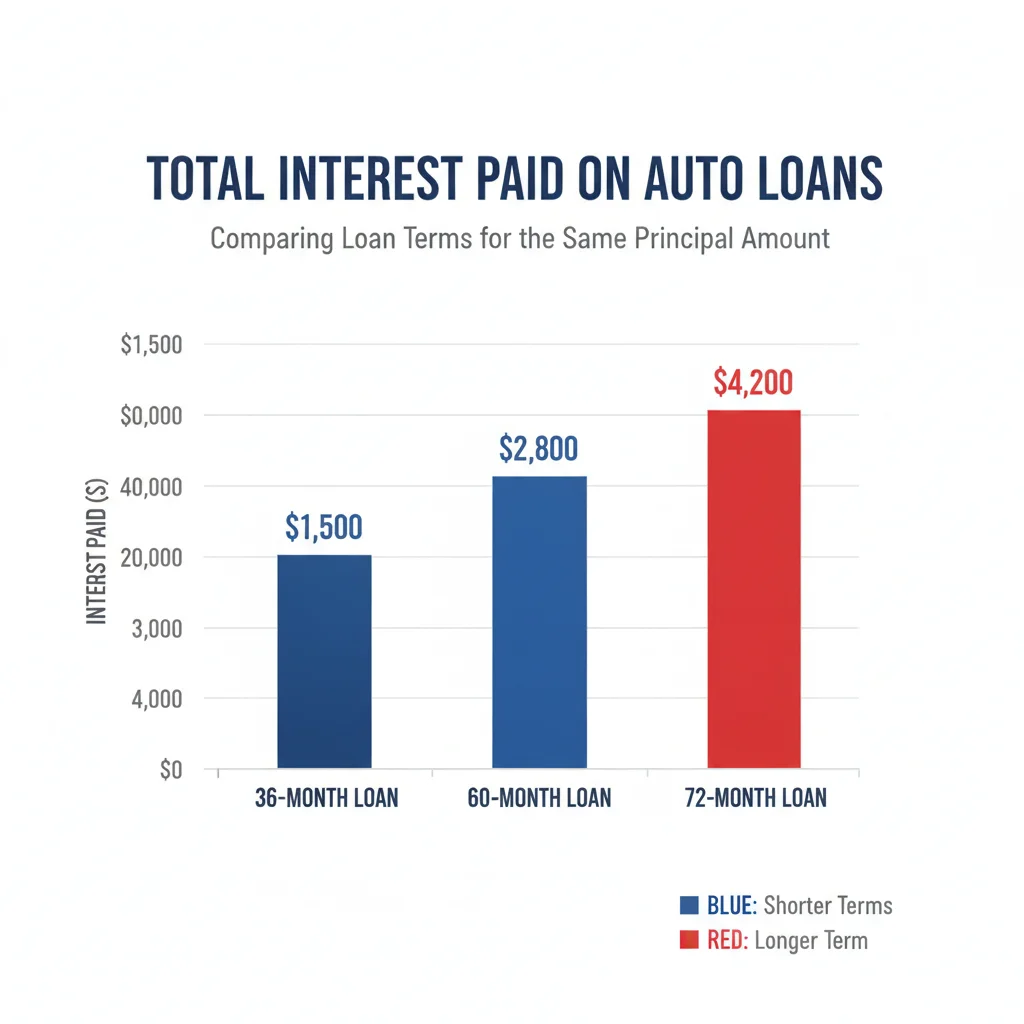
The difference between a 36-month and 72-month loan is $413 per month — a substantial drop that can feel like significant savings. But over the life of each loan, the 72-month borrower pays $3,600 more in interest for the exact same vehicle at the exact same rate.
That's not a rounding error. That's real money — enough for several car insurance payments, a set of new tires, or a meaningful chunk of an emergency fund.
$3,600+
Extra interest on 72-month vs. 36-month loan
Based on a $30,000 loan at 7% APR — same vehicle, same rate, different term length.
72 months
Most common new-car loan term in the U.S.
According to Experian's State of the Automotive Finance Market, the average new-car loan term has been around 69–72 months in recent years.
25%
Typical new car depreciation in year one
Most new vehicles lose 15–25% of their value within the first 12 months of ownership, according to industry depreciation data.
~$130
Monthly payment difference: 36 vs. 72 months
On a $30,000 loan at 7% APR, the monthly savings of choosing a 72-month term over 36 months is approximately $413 — but the total cost rises by over $3,600.
Now layer in a real-world wrinkle: lenders often charge higher APRs on longer-term loans. A buyer who qualifies for 6.5% on a 36-month loan might be offered 7.5% or 8% on a 72-month loan. Run the same $30,000 through a 72-month term at 8% and total interest climbs above $8,000. The monthly payment still looks modest on paper. The true cost does not.
For a full cost breakdown of what running a loan to term actually costs, see the full cost of a car loan over time.
The Depreciation Problem
There's an additional cost that the interest math alone doesn't capture: depreciation.
New cars lose value quickly — often 15–25% in the first year alone. If you finance a $35,000 car with a small down payment over 72 or 84 months, your loan balance will almost certainly exceed the car's market value for much of the early loan period. This is called being underwater or having negative equity.
Watch for Negative Equity Before It Happens
Before signing a long-term loan, run a quick depreciation estimate on the vehicle you're buying. Compare the projected value at 12, 24, and 36 months against your estimated loan balance at those same points. If the balance consistently exceeds the car's value, consider a larger down payment, a shorter term, or gap insurance to protect yourself.
Always Ask for the Total Repayment Figure
Before signing any loan agreement, ask your lender or dealer to show you the total repayment amount — what you'll pay in full from the first payment to the last. This number is legally required in your loan disclosure documents. Comparing this figure, not the monthly payment, is the most reliable way to evaluate competing loan offers.
Being underwater isn't just a theoretical problem. It becomes very real the moment you need to sell the car, trade it in, or make an insurance claim after a total loss. If your car is worth $18,000 and you still owe $22,000, you're stuck bridging a $4,000 gap out of pocket — or rolling that negative equity into your next loan, which restarts the cycle.
Shorter loan terms reduce the time you spend underwater because your principal balance drops faster. The trade-off between short and long loan terms is ultimately a choice between monthly affordability and long-term financial flexibility.
Real-World Scenarios Where This Plays Out
Understanding this concept in the abstract is one thing. Seeing it in recognizable situations makes the stakes clearer.
In each of these situations, the buyer who focuses on monthly payment alone misses the larger financial picture. The better question isn't "can I afford this per month?" — it's "can I afford what this will cost me in total?"
What You Can Do About It
Understanding the problem is the first step. Here are concrete ways to manage or offset the cost of a longer loan term:
- Put more money down upfront. A larger down payment reduces the principal you borrow, which reduces both your monthly payment and total interest paid. Even an extra $2,000 down can make a meaningful difference. See how down payments shape your loan structure for the full picture.
- Choose the shortest term you can genuinely afford. "Can afford" means the monthly payment fits your budget without strain — not that it's technically possible to pay it while sacrificing other financial priorities. Loan term, down payment, and monthly cost interact in predictable ways you can model before you buy.
- Make extra payments when possible. If you have a longer-term loan but make additional principal payments periodically, you shorten the effective loan duration and reduce total interest. Making extra payments on a car loan explains what actually changes when you do this.
- Switch to biweekly payments. Paying half your monthly amount every two weeks results in 13 full payments per year instead of 12. That one extra payment per year can shave months off your loan and reduce interest substantially. See biweekly vs. monthly payment savings for the breakdown.
- Refinance to a shorter term. If you're already in a long-term loan, refinancing may allow you to reduce your rate, shorten your term, or both. Refinancing to a shorter loan term walks through what changes and what doesn't.
Watch for Negative Equity Before It Happens
Before signing a long-term loan, run a quick depreciation estimate on the vehicle you're buying. Compare the projected value at 12, 24, and 36 months against your estimated loan balance at those same points. If the balance consistently exceeds the car's value, consider a larger down payment, a shorter term, or gap insurance to protect yourself.
Always Ask for the Total Repayment Figure
Before signing any loan agreement, ask your lender or dealer to show you the total repayment amount — what you'll pay in full from the first payment to the last. This number is legally required in your loan disclosure documents. Comparing this figure, not the monthly payment, is the most reliable way to evaluate competing loan offers.
When evaluating any loan offer, always ask for — or calculate — the total repayment amount. That single number, more than the monthly payment, tells you what the loan actually costs.

When a Lower Monthly Payment Is a Reasonable Choice
It's worth being honest here: there are situations where a longer loan term is the more practical decision, even knowing the total cost is higher.
If your monthly budget is genuinely constrained — if the difference between a 48-month and 72-month payment determines whether you can keep up with rent, utilities, or medical expenses — then the longer term may be the right call for your current circumstances. Financial decisions don't happen in a vacuum, and cash flow matters.
Similarly, if you're taking a longer term specifically to preserve liquidity for investments or higher-priority debt, the math might still work in your favor depending on your returns and rates.
“The monthly payment is the price of entry. The total cost is the price of the car. Too many buyers confuse the two — and lenders know it.”
— Melinda Zabritski, Senior Director of Automotive Financial Solutions, Experian
The key is going in with full information. Choosing a longer term because the dealer made the monthly number look attractive is very different from choosing it because you've compared the total costs and made a deliberate trade-off. The first is a trap. The second is a strategy.
For a fair look at when extending makes genuine sense, see when a longer loan term actually makes financial sense. And if you're weighing a refinance decision specifically, lowering monthly payment vs. reducing total interest can help you frame the choice clearly.

All claims are backed by peer-reviewed research. Sources on request.