Key Takeaways
Loan Term vs. APR Trade-Off
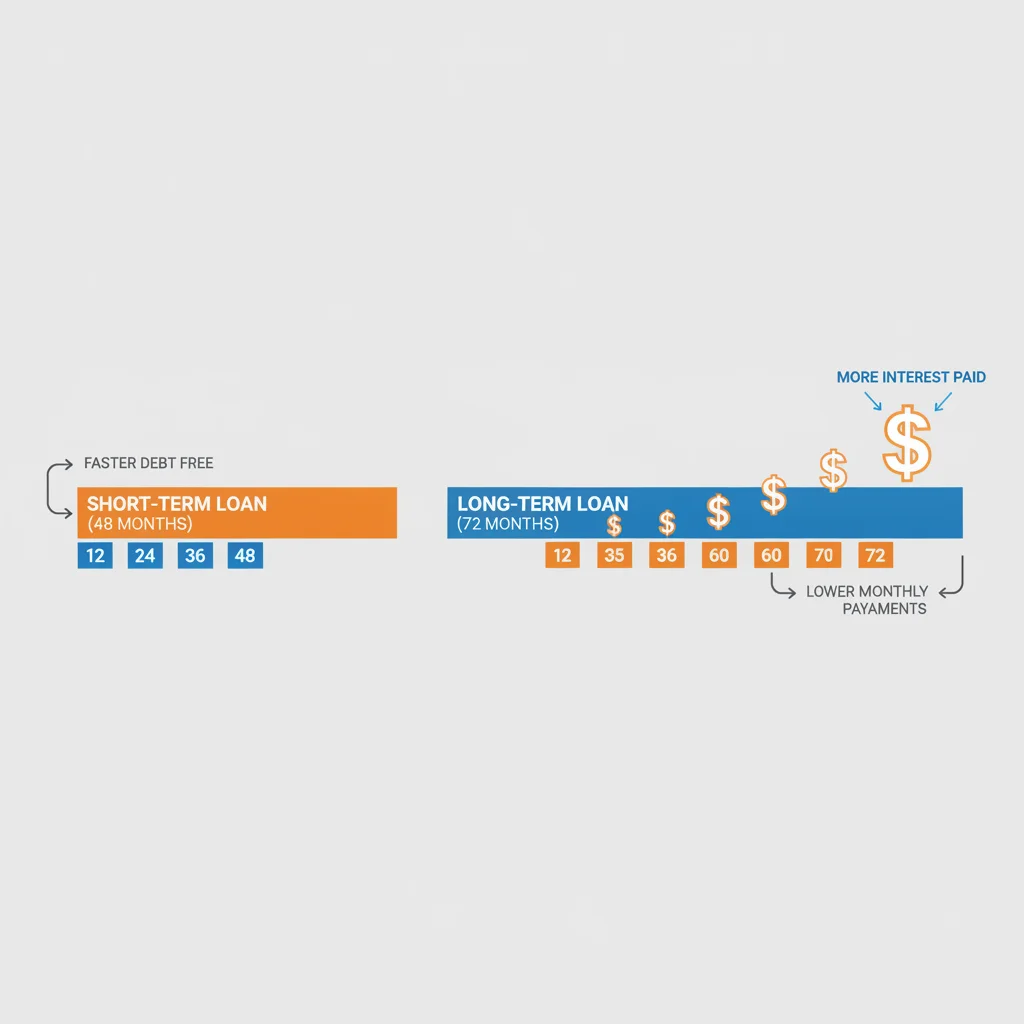
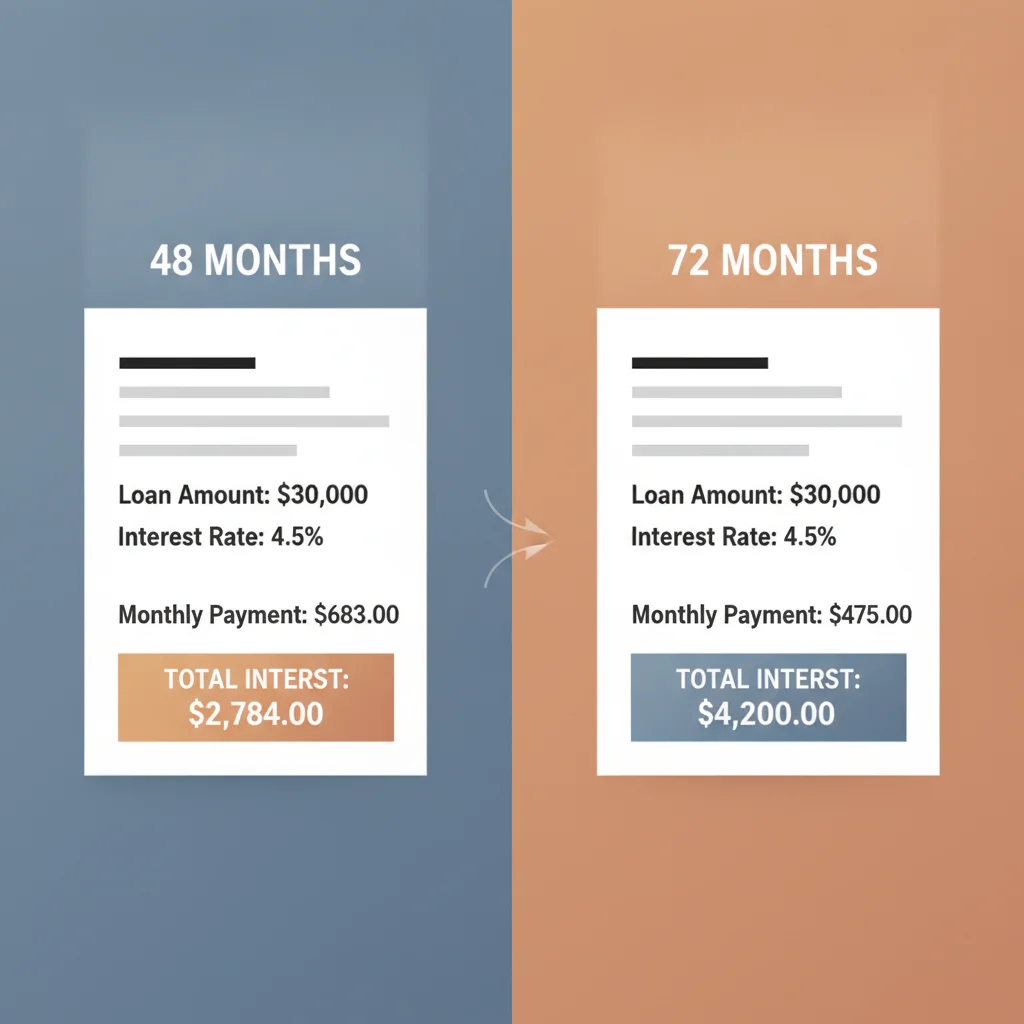
When you take out an auto loan, two numbers drive what you actually pay: the APR (Annual Percentage Rate) and the loan term (how many months you take to repay). A longer term lowers your monthly payment, but because interest accumulates over more months, you end up paying significantly more in total. A shorter term means higher monthly payments but far less interest paid overall. The trade-off is real, measurable, and frequently underestimated.
APR compounds monthly on the remaining principal balance via an amortization schedule, so extending the term doesn't just add months — it reshapes the entire interest curve, front-loading interest charges and slowing equity buildup.
Why Monthly Payment Is the Wrong Scoreboard
Walk into any dealership finance office and the conversation will almost immediately shift to one number: your monthly payment. "What can you comfortably afford per month?" It's a reasonable-sounding question, but it's also how buyers get steered into longer loans that cost far more over time.
The monthly payment tells you whether you can make rent this month. It tells you almost nothing about whether you're getting a good deal. Total interest paid is what actually measures the cost of your loan — and that figure is determined by two variables working together: your APR and your loan term.
Most buyers treat these as separate knobs. They're not. They interact. A high APR on a short loan can cost less than a moderate APR on a long one. A low APR stretched across 84 months can still drain thousands of extra dollars from your pocket. Understanding how term and rate compound together is the fundamental financial literacy move in auto lending.
Monthly Payment vs. Total Cost: Not the Same Thing
A monthly payment tells you whether you can afford the loan right now. Total interest paid tells you what the loan actually costs. These two figures often point in opposite directions — a lower monthly payment almost always means higher total interest. Make sure you're tracking both numbers before signing.
Manufacturer APR Promotions Have Fine Print
Subsidized rates like 0.9% or 1.9% APR from automaker financing arms often apply only to specific term lengths — typically shorter ones. If you need a 72-month loan to hit your payment target, you may not qualify for the promotional rate. Always confirm which terms the special APR actually applies to before assuming you can get both the rate and the term you want.
Negotiating around a monthly payment figure instead of total cost is one of the most documented ways buyers overpay at the dealership. Always anchor your comparison to APR and total interest, not the monthly number.
How APR and Term Length Multiply Each Other
Here's the core mechanic you need to understand: interest on an auto loan is calculated monthly on your remaining principal balance. Every month you haven't paid off the loan, the lender charges interest on whatever you still owe. Extend the term, and you're paying interest on that balance for more months — even if the rate stays identical.
This is why the same APR costs materially more on a long loan than a short one. It's not just that you're paying for longer. It's that the amortization schedule front-loads interest, so in the early months of any loan, most of your payment goes to interest rather than reducing what you owe. Stretch those early months further and you're in the most expensive part of the loan for longer.
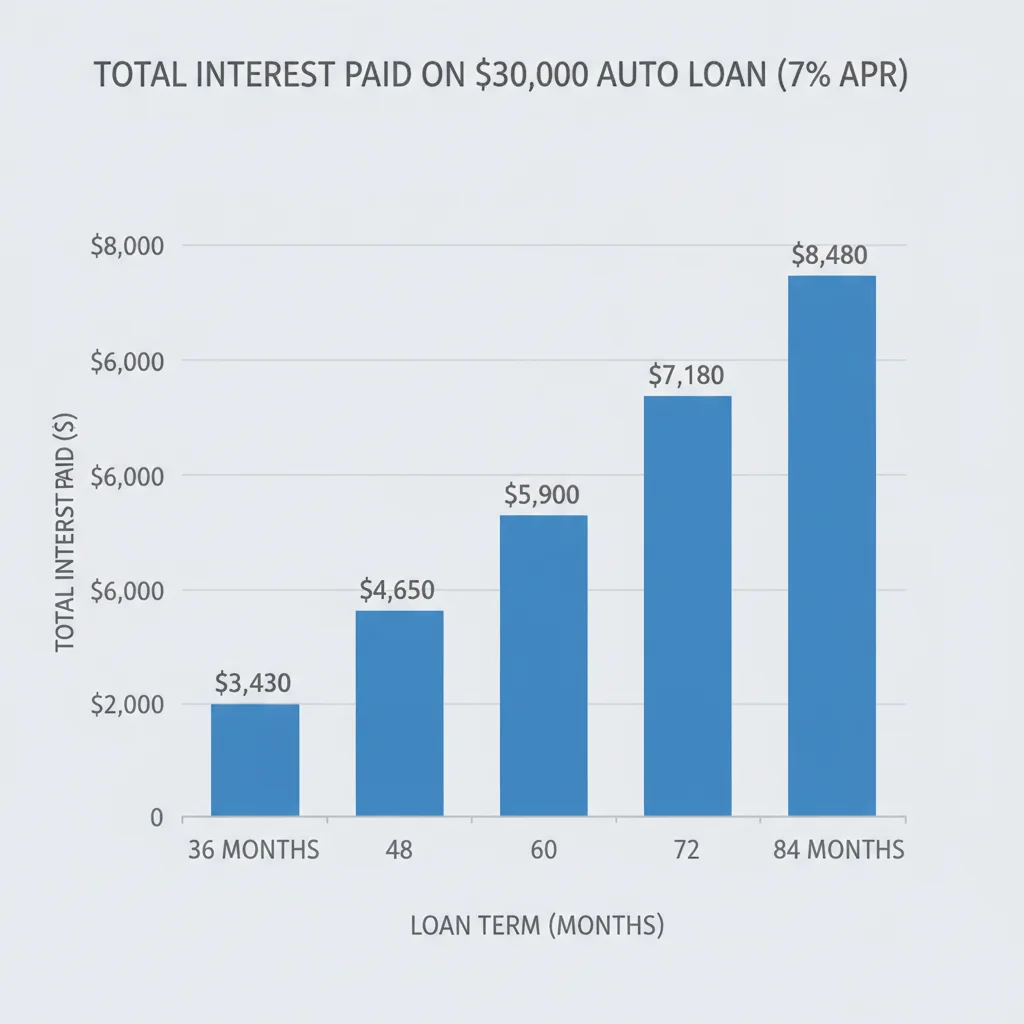
Here's a concrete look at what this means on a $30,000 loan at a fixed 7% APR across different term lengths:
| Term | Monthly Payment | Total Interest Paid | Total Cost |
|---|---|---|---|
| 36 months | $927 | $1,356 | $31,356 |
| 48 months | $718 | $3,380 (approx.) | $34,478 (approx.) |
| 60 months | $594 | $5,640 (approx.) | $35,640 (approx.) |
| 72 months | $513 | $6,936 (approx.) | $36,936 (approx.) |
| 84 months | $454 | $8,136 (approx.) | $38,136 (approx.) |
Going from 36 to 84 months saves you $473 per month. But it costs you an additional $6,780 in interest. That's money paid purely for the privilege of spreading out payments — and you get nothing in return for it.
For a more comprehensive lookup across different loan amounts and APRs, see the total interest paid reference table.
$6,780
Extra interest: 36 vs. 84 months at 7% on $30K
Based on standard amortization calculations for a $30,000 loan at 7% APR across 36- and 84-month terms.
72+ months
Share of new car loans exceeding 60 months
According to Experian's State of the Automotive Finance Market, loans with terms of 73–84 months have grown steadily and now represent a significant portion of new vehicle financing.
$1,392
Interest saved by choosing 48 months over 72 months despite higher APR
Calculated on a $28,000 loan comparing 5.9% APR / 72 months versus 6.5% APR / 48 months using standard amortization.
$480+
Extra interest from a 0.5% APR gap on $35K over 60 months
Calculated by comparing 6.0% and 6.5% APR on a $35,000, 60-month loan using standard amortization.
~44%
Portion of early payments going to interest on a 72-month loan
On a typical 7% APR, 72-month auto loan, roughly 44% of each early-stage payment is interest rather than principal reduction, based on standard amortization math.
The APR Interaction: When a Lower Rate Doesn't Mean a Lower Cost
Here's where it gets counterintuitive. Buyers often accept a longer loan from one lender because it came with a slightly lower APR. But a lower rate on a longer term frequently costs more than a higher rate on a shorter one.
Example: compare a $28,000 loan at 5.9% APR for 72 months versus 6.5% APR for 48 months.
| Scenario | APR | Term | Monthly Payment | Total Interest |
|---|---|---|---|---|
| Option A | 5.9% | 72 months | $462 | ~$5,264 |
| Option B | 6.5% | 48 months | $664 | ~$3,872 |
Option A looks cheaper per month — by $202. But over the life of the loan, Option B saves you approximately $1,392 in interest despite carrying the higher APR. The shorter term wins on total cost, even though it loses on the monthly payment comparison.
This is the exact dynamic dealers exploit when they quote different lenders with different term structures side by side. The same APR costs far more on a longer loan — time is the hidden multiplier, and it works against you every month.
Always Request the Total Interest Figure
Before agreeing to any loan, ask the lender or dealer to show you the total interest you will pay over the full term. This single number makes it easy to compare offers on equal terms, regardless of how their monthly payments differ. Most lenders are required to disclose this — don't sign without seeing it.
Get Pre-Approved Before You Shop
Walk into any dealership with a pre-approval letter from a bank or credit union. This gives you a real APR benchmark and shifts the power dynamic. The dealer must either match or beat your rate in total cost terms — not just monthly payment — to earn your financing. Pre-approvals are typically free and take less than 30 minutes online.
When comparing loan offers, ask each lender for the total amount of interest you will pay over the life of the loan. That single number cuts through the noise of monthly payment comparisons and lets you evaluate deals on equal footing.
Real-World Scenarios: How This Plays Out for Buyers
The math above is clean and controlled. Real buying situations are messier. Here's how the term-APR trade-off shows up in actual scenarios buyers face.
Notice what these scenarios have in common: in each case, the longer term felt safer in the short run but carried a real financial cost. The buyer who stretched to 72 months on a depreciating vehicle faces not only higher total interest but also the equity problem — slower principal paydown means the loan balance drops more slowly than the car's value. That's how buyers end up underwater.
For a full breakdown of how this equity erosion works, see what happens to your equity when you choose a longer loan term.
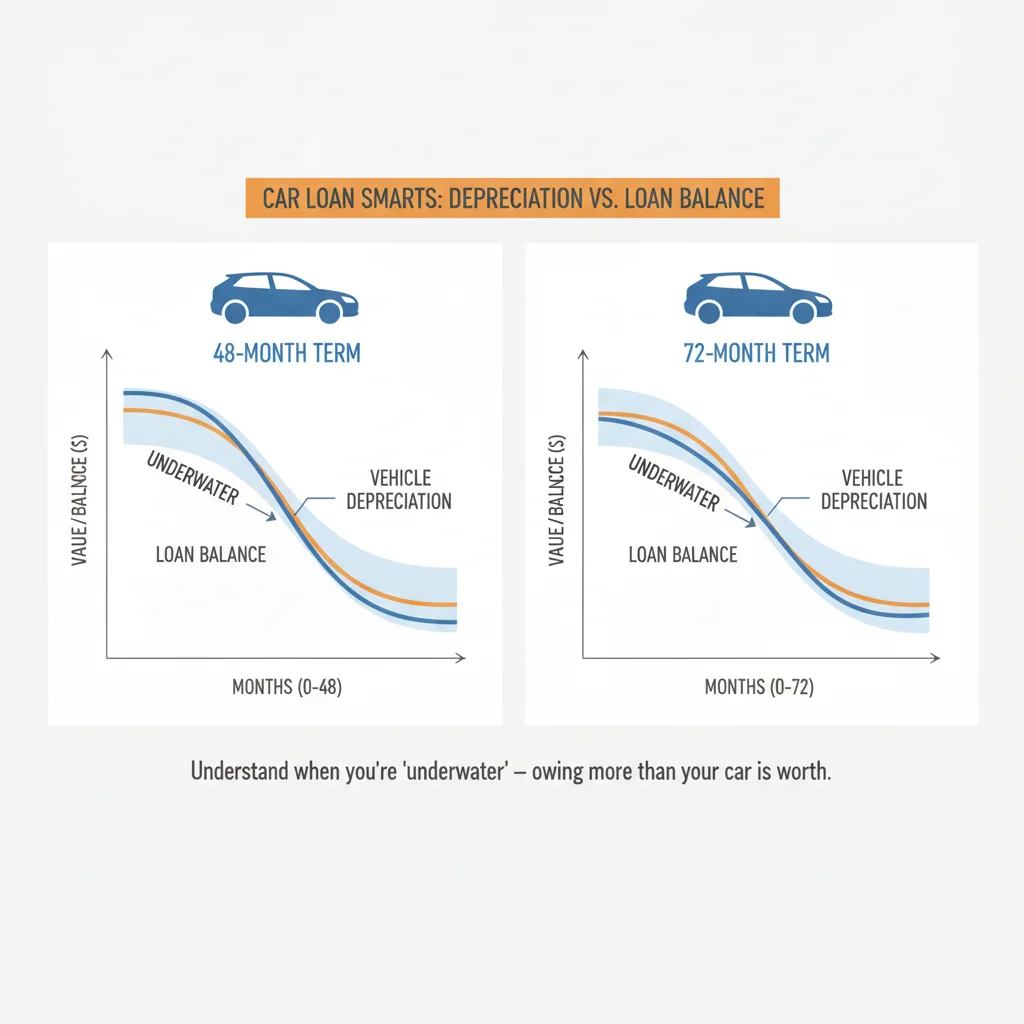
The Half-Point Problem: Small APR Differences Add Up
A lot of buyers treat a 0.5% APR difference as rounding noise. It isn't — especially on longer terms. On a $35,000 loan, the gap between 6.0% and 6.5% APR over 60 months is roughly $480 in extra interest. Stretch that to 72 months and it climbs past $590. These aren't dramatic sums on their own, but they compound with term length in ways that matter.
More importantly, small APR differences between competing lenders are often negotiable. If your credit union is quoting 6.25% and the dealer's financing arm is offering 6.75%, that half-point difference on a $30,000, 60-month loan costs you around $420 more in interest. That's worth a five-minute phone call to your credit union before you sign.
“The most expensive word in auto finance is 'affordable.' A payment can be affordable and still be a bad deal. The question isn't whether you can make the payment — it's whether the loan is worth what it actually costs.”
— Jordan Delray, Former dealership finance professional and auto lending analyst
For a precise breakdown of what even a modest rate gap means in dollars, the half-point APR impact calculator makes the case more clearly than any general rule of thumb.
The practical takeaway: always get at least one pre-approval from a bank or credit union before going to the dealership. That gives you a real APR benchmark, which is a far stronger negotiating position than arriving with no external offer.
How to Actually Use This at the Dealership
Knowing the theory is step one. Using it in a live negotiation is different. Here's a practical framework for applying the term-APR trade-off when you're sitting across from a finance manager.
- Anchor on total interest, not monthly payment. Before any back-and-forth, calculate or request the total interest figure for any loan you're considering. If the finance manager can't or won't give it, that's a red flag.
- Set your term ceiling before you walk in. Decide in advance the longest term you're willing to accept — ideally 60 months or less for most used vehicles, 48 months for anything depreciating fast. Don't let payment pressure push you past your ceiling.
- Use your pre-approval as a floor. If you've been pre-approved at 6.0% for 60 months by your credit union, the dealer needs to beat that offer in total cost — not just monthly payment — to earn your financing business.
- Resist the payment shuffle. If a finance manager adjusts your term to make a higher-rate loan look affordable monthly, you're being steered. Keep your comparison anchored to total interest at a fixed term.
- Ask about rate buydowns. Some manufacturers offer subsidized APR on specific terms (e.g., 1.9% for 36 months but not 60 months). These can genuinely change the math in your favor, but only if the vehicle price isn't inflated to compensate.
Always Request the Total Interest Figure
Before agreeing to any loan, ask the lender or dealer to show you the total interest you will pay over the full term. This single number makes it easy to compare offers on equal terms, regardless of how their monthly payments differ. Most lenders are required to disclose this — don't sign without seeing it.
Get Pre-Approved Before You Shop
Walk into any dealership with a pre-approval letter from a bank or credit union. This gives you a real APR benchmark and shifts the power dynamic. The dealer must either match or beat your rate in total cost terms — not just monthly payment — to earn your financing. Pre-approvals are typically free and take less than 30 minutes online.
The auto loan term strategy decision framework walks through every angle of this decision — from amortization basics to how your down payment shifts the math. Worth reading before any major purchase.
Also keep in mind that your down payment size directly affects how much you're financing — and therefore how much the APR-term interaction hurts or helps you. A larger down payment on a shorter term is the most cost-efficient structure available to most buyers. See how down payment size shapes your loan structure for more on that interaction.
The Bottom Line: Total Cost Is the Only Number That Matters
The monthly payment is a cash flow question. Total interest paid is a wealth question. Both matter, but only one tells you whether you're getting a fair deal.
The trade-off between loan term and APR isn't complicated in theory — longer terms cost more in total interest, and higher APRs accelerate that cost. What makes it genuinely tricky is that the dealership finance process is designed to keep your attention on the monthly payment, where the math is less visible and the margin for the lender is highest.
Going in with a clear term ceiling, a pre-approved rate, and the habit of asking for total interest paid changes the conversation. It shifts the negotiation from "can you afford the payment?" to "is this loan actually good value?" — which is the right question.
If you're weighing whether to refinance an existing loan with a longer or shorter term, the same logic applies. The monthly payment vs. total interest refinance trade-off breaks down exactly when each goal should drive the decision.
And if you want to see how each standard term — 36, 48, 60, 72, and 84 months — compares on payment, interest, and flexibility, the term-by-term comparison guide gives you a clean side-by-side view.
Monthly Payment vs. Total Cost: Not the Same Thing
A monthly payment tells you whether you can afford the loan right now. Total interest paid tells you what the loan actually costs. These two figures often point in opposite directions — a lower monthly payment almost always means higher total interest. Make sure you're tracking both numbers before signing.
Manufacturer APR Promotions Have Fine Print
Subsidized rates like 0.9% or 1.9% APR from automaker financing arms often apply only to specific term lengths — typically shorter ones. If you need a 72-month loan to hit your payment target, you may not qualify for the promotional rate. Always confirm which terms the special APR actually applies to before assuming you can get both the rate and the term you want.
All claims are backed by peer-reviewed research. Sources on request.