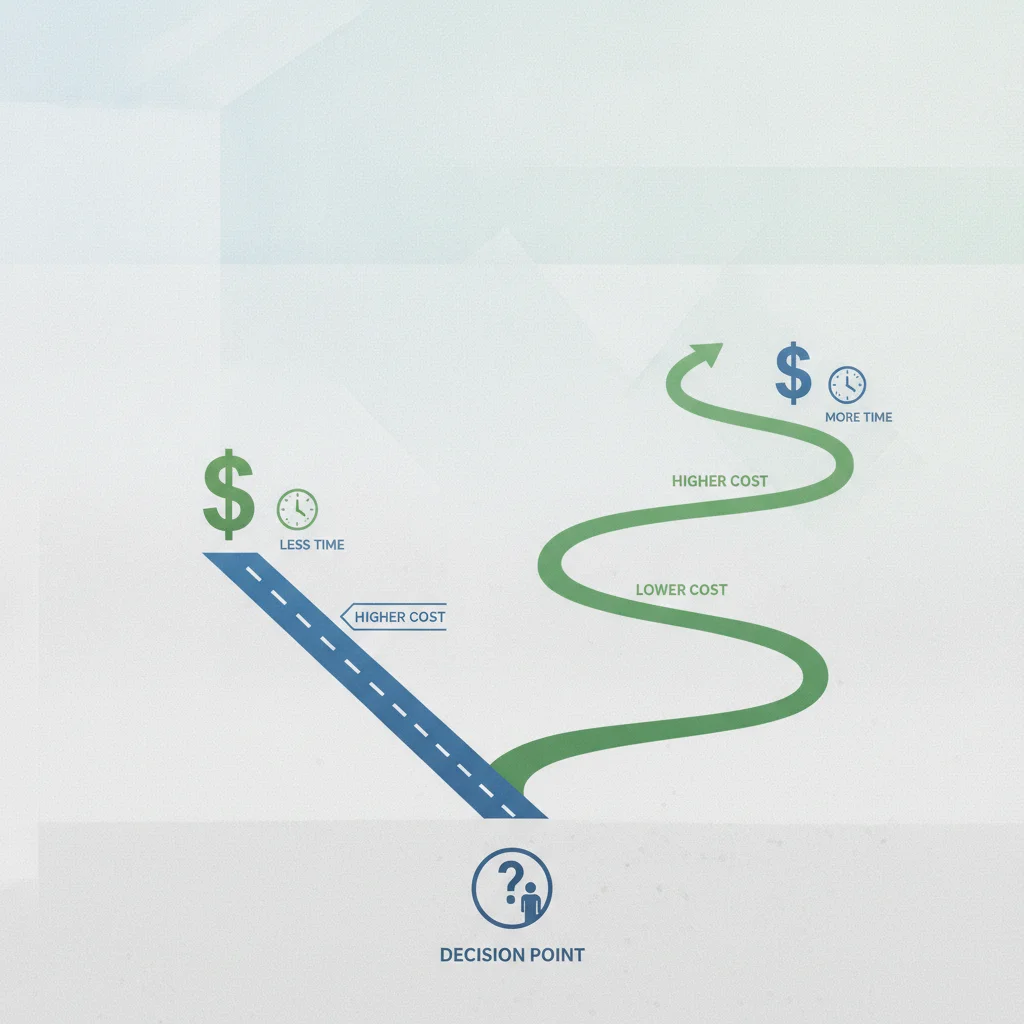
Key Takeaways
Our Verdict
For most buyers who can manage the payment, a 36- or 48-month loan delivers the lowest total cost and the least financial risk. A 60-month term is a reasonable middle ground for buyers who need some payment relief without going to extremes. Terms of 72 or 84 months should be approached with caution — they lower the monthly payment but substantially raise what you actually spend on the car.
| Best for | Recommended |
|---|---|
| Budget-conscious buyers who prioritize minimizing total interest | 36-month loan |
| Buyers who want a balance between manageable payments and reasonable total cost | 48- or 60-month loan |
| Buyers with tight monthly cash flow who understand the long-term trade-off | 72-month loan |
| Buyers financing a large vehicle with a strong down payment and stable income | 84-month loan (with caution) |
Why Loan Term Length Is the Number That Changes Everything
When most people shop for a car loan, they fixate on one number: the monthly payment. That's understandable — it's the figure that hits your bank account every 30 days. But the monthly payment is actually a product of two variables working against each other: the loan term (how long you have to repay) and the interest rate (how much the lender charges you to borrow). Pull one lever and the other moves.
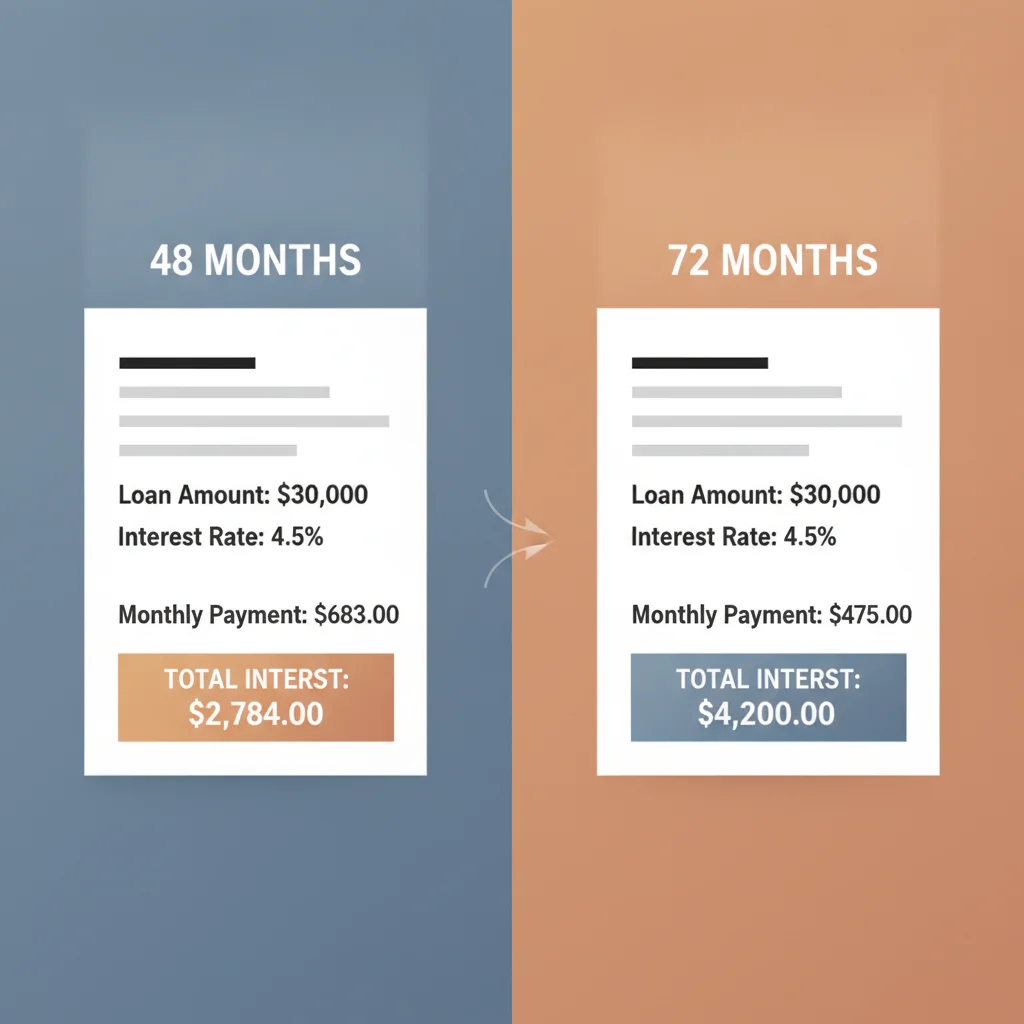
Stretch your loan from 36 months to 84 months on the same car at the same interest rate, and your monthly payment drops significantly — sometimes by hundreds of dollars. But your total interest paid can more than double. That's the trade-off every buyer faces, and it's one that doesn't get nearly enough attention at the dealership.
This guide walks through each standard loan term — 36, 48, 60, 72, and 84 months — and shows you exactly what each one costs, who it makes sense for, and what risks come with it. To understand the foundational mechanics first, see our overview of short vs. long auto loan terms.
The Numbers Side by Side: What Each Term Actually Costs
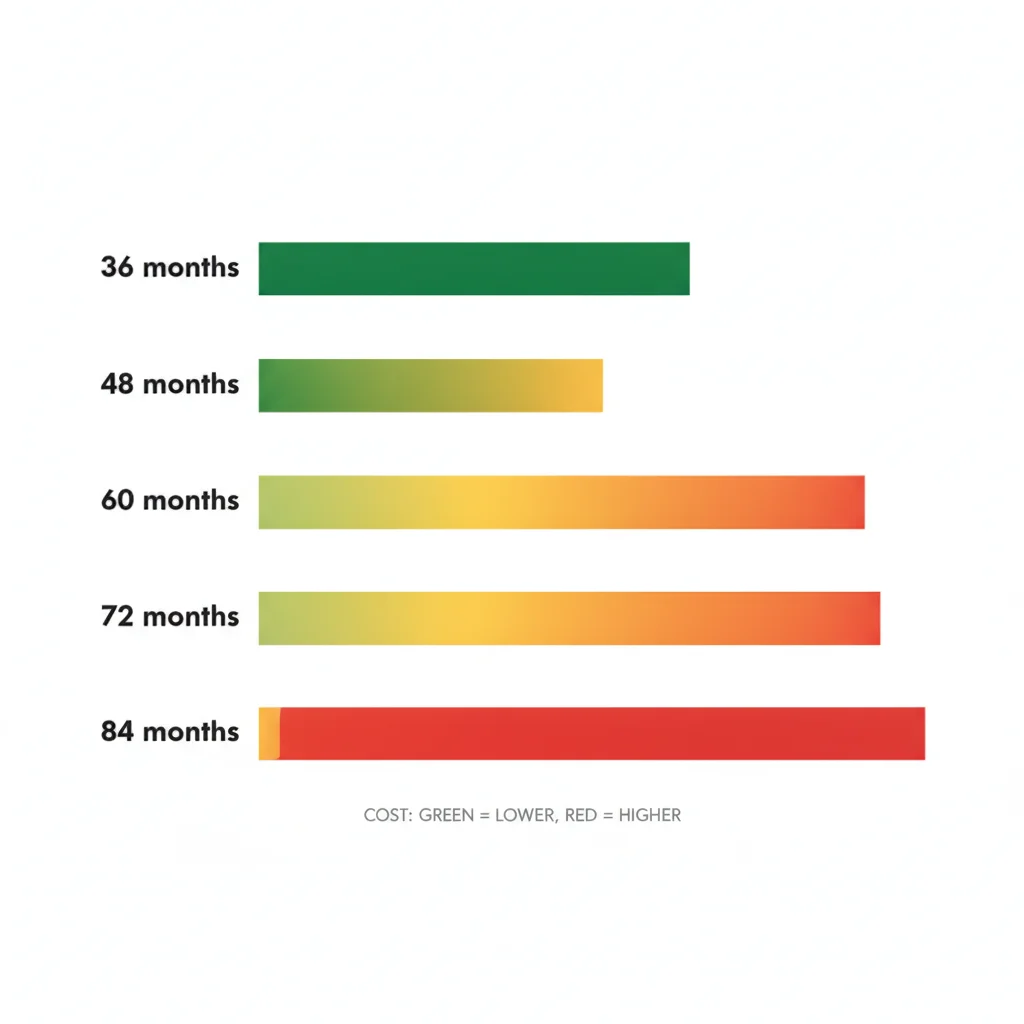
To make this concrete, consider a $30,000 auto loan at a 7% APR — a realistic scenario for a buyer with good but not exceptional credit in the current market. Here's what the math produces across each standard term:
| 36 Months | 48 Months | 60 Months | 72 Months | 84 Months | |
|---|---|---|---|---|---|
| Monthly Payment | ~$927 | ~$718 | ~$594 | ~$513 | ~$453 |
| Total Interest Paid | ~$3,370 | ~$4,464 | ~$5,640 | ~$6,936 | ~$8,052 |
| Total Amount Paid | ~$33,370 | ~$34,464 | ~$35,640 | ~$36,936 | ~$38,052 |
| Equity Build Speed | Fastest | Fast | Moderate | Slow | Slowest |
| Underwater Risk | Very low | Low | Moderate | High | Very high |
| Typical APR Premium | None | None | Baseline | +0.25–0.5% | +0.5–1.5% |
| Best For | Minimizing cost | Balanced buyers | Most buyers | Cash-flow constrained | Large vehicle, big down payment |
The monthly payment difference between a 36-month and an 84-month loan on this example is roughly $350. That's real money — but so is the $6,000+ gap in total interest. Before choosing based solely on the lower payment, ask yourself: would you rather have $350/month more in breathing room now, or $6,000 more in your pocket over the life of the loan?
For a deeper look at how APR and term interact across more loan amounts, see the total interest paid reference table — it covers side-by-side totals at common rates.
72+ months
Most common loan term for new cars
According to Experian's State of the Auto Finance Market (2023), loans of 73–84 months now account for nearly 33% of all new vehicle financing.
2x+
Interest cost: 84-month vs. 36-month loan
On a $30,000 loan at 7% APR, an 84-month term generates more than twice the total interest of a 36-month term.
$8,000+
Average interest paid on 84-month loans
Consumer Financial Protection Bureau data shows buyers on ultra-long terms frequently pay $7,000–$10,000 in total interest on mid-range vehicle loans.
36-Month Loans: Maximum Savings, Maximum Payment
A 36-month loan is the shortest standard term most lenders offer, and it's the most financially efficient by a wide margin. You pay the least total interest, build equity in the car fastest, and eliminate the loan in three years — well before most vehicles need major repairs.
Who this works for
- Buyers financing a used car with a lower sticker price
- Buyers who can comfortably afford the higher monthly payment
- Those who dislike carrying long-term debt
- Buyers planning to sell or trade the car within a few years
The catch
The monthly payment on a 36-month loan is the highest of any standard term. On a $30,000 loan at 7%, you're looking at roughly $927/month. For many buyers — especially those financing newer vehicles — that's a stretch. Don't force a 36-month term if it means straining your monthly budget to the point of financial fragility. A missed payment hurts your credit and can trigger costly penalties.
Try the 20/4/10 Rule as a Starting Point
A common guideline for auto financing: put at least 20% down, finance for no more than 4 years (48 months), and keep total vehicle expenses — including insurance — below 10% of gross monthly income. This won't work for every buyer or every market, but it provides a useful starting framework before you start negotiating terms.
Ask Your Lender to Show You Multiple Term Options
Many lenders will default to the term that produces the monthly payment you mentioned as your target — which is often a longer term. Before signing, ask to see a payment schedule for at least two other term lengths. Seeing the total interest line on each option often changes how buyers think about the decision. You have every right to request this comparison in writing.
48-Month Loans: A Strong Middle Ground Many Buyers Overlook
The 48-month term tends to fly under the radar. Most conversations about auto loans jump straight from 36 months to 60 months, skipping what is often the sweet spot for buyers who want meaningful payment relief without the long-tail interest costs of a 60- or 72-month loan.
On that same $30,000 at 7%, a 48-month loan brings your payment down to around $718/month — roughly $200 less than the 36-month option — while keeping total interest well under $4,500. You own the car free and clear in four years, and you're unlikely to be significantly underwater on the loan at any point during repayment.
Who this works for
- Buyers who want lower payments than a 36-month term without committing to five or six years
- Those buying certified pre-owned vehicles or late-model used cars
- Buyers who expect to keep the car for at least four years
If your lender quotes you a 60-month term as the default, it's worth explicitly asking about 48 months. The difference in total interest is often $1,000 or more, and lenders don't always volunteer the shorter option.
60-Month Loans: The Most Common Term — With Good Reason
The 60-month (five-year) auto loan is the most popular term in the U.S., and for many buyers it genuinely is the right fit. It lowers monthly payments to an accessible level without extending the loan so long that interest costs become punishing.
On our $30,000/7% example, a 60-month loan produces a monthly payment of about $594 and total interest around $5,640. Compare that to the 36-month term's roughly $3,340 in interest, and you're paying about $2,300 more — but your monthly outlay is $333 less. For buyers who need that monthly breathing room, that's often a reasonable trade.
Where to watch out
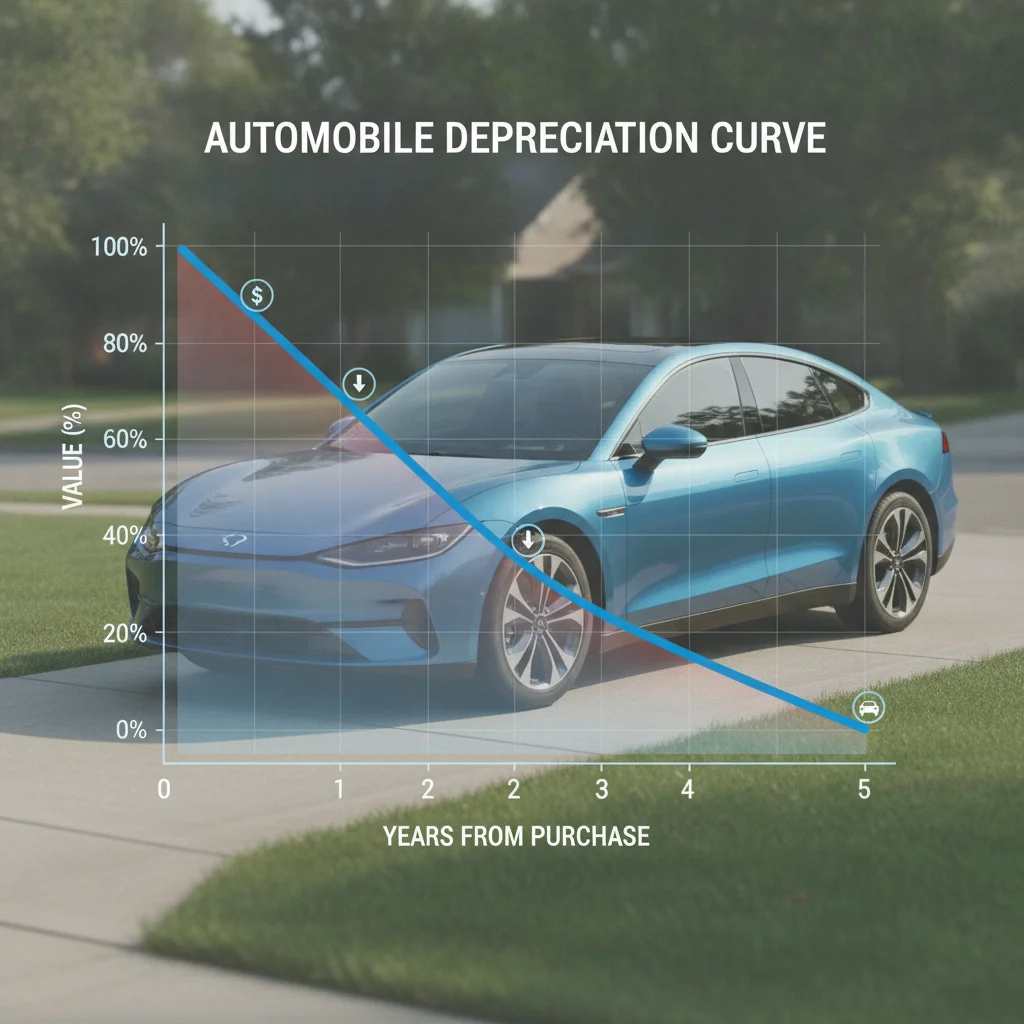
Cars depreciate fastest in the first two years. On a 60-month loan, you'll still owe a significant portion of the principal during that high-depreciation window. If you put little or no money down, you may be underwater on the loan — meaning you owe more than the car is worth — for the first two to three years. That becomes a real problem if you need to sell or the car is totaled.
A larger down payment is one of the most effective ways to offset this risk. The down payments hub walks through how down payment size shapes your loan structure and equity position from day one.
72-Month Loans: Tempting Payments, Serious Long-Term Costs
The 72-month loan has grown dramatically in popularity over the past decade, largely because it allows buyers to finance more expensive vehicles with payments that look manageable. It's now one of the most common terms offered by dealership finance offices.
The monthly payment on a 72-month/$30,000/7% loan is around $513 — only about $80 less per month than the 60-month option. But look at total interest: you're now paying roughly $6,936. That's nearly $1,300 more than the 60-month loan and more than double the 36-month total.
The underwater risk is real
On a 72-month loan with a small or no down payment, you can remain underwater on the vehicle for three years or more. During that time, if you total the car, your insurance payout may not cover what you owe — leaving you writing a check to the lender while you have no car. GAP insurance can protect you here, but it's an added cost.
Lenders also tend to charge slightly higher APRs on longer terms, compounding the cost further. This is a dynamic most buyers don't anticipate — our article on how loan term length interacts with APR explains exactly why that happens.
Don't Let the Monthly Payment Anchor Your Decision
Dealership finance offices are trained to sell on monthly payment, not total cost. A buyer who says 'I need to stay under $500/month' will often be steered toward a 72- or 84-month loan without a clear picture of what that means in total interest. Always ask for the total amount paid over the life of the loan before agreeing to any term.
84-Month Loans: When Seven Years Is Too Long
The 84-month auto loan — seven full years of payments — is the longest term most mainstream lenders offer. It exists because it makes expensive vehicles appear affordable, and dealerships often use it as a closing tool when a buyer balks at the monthly payment on a shorter term.
On a $30,000 loan at 7%, an 84-month term brings your monthly payment to about $453. That's $474 less per month than the 36-month option. But your total interest climbs to approximately $8,052 — more than twice what you'd pay over 36 months.
The math against 84 months
- Depreciation outpaces equity: Most vehicles lose 50–60% of their value in the first five years. At 84 months, you're still making payments well into the vehicle's high-depreciation period.
- Reliability risk grows: By months 60–84, many vehicles begin requiring more significant maintenance. You'll be making loan payments while also potentially covering repair bills.
- Higher APR is common: Many lenders charge 0.5% to 1.5% higher rates on 84-month terms compared to 60-month terms, adding further to the total cost.
If you're considering an 84-month loan because the payment on a shorter term feels too high, that's usually a signal the vehicle is outside your budget — not that 84 months is the right solution. See our article on loan-term decisions borrowers tend to regret for more on this pattern.
That said, 84 months isn't always wrong. Buyers financing a large truck or SUV with a substantial down payment, stable long-term income, and a plan to keep the vehicle for its entire lifespan may find it workable — provided they understand the full cost picture.
For buyers with credit challenges, longer terms carry additional risk worth understanding. Our piece on loan term length and bad credit explains why stretching to 72 or 84 months can trap subprime borrowers.
How to Choose: A Practical Framework
Once you understand what each term costs, the question becomes: which one fits your situation? Here's a step-by-step way to think through it.
Step 1: Start with the total cost, not the monthly payment
Calculate what you'll pay in total — principal plus interest — for each term option your lender offers. This number is your true cost of financing the vehicle. The monthly payment is just how that cost is distributed over time.
Step 2: Stress-test the shorter term
Before accepting a longer term, run the math on the 36- or 48-month option and ask: can I make this payment work? If the answer is yes — even with some adjustment elsewhere — the shorter term is almost always the better financial decision.
Step 3: Evaluate your equity position
For whichever term you're considering, estimate when you'll break even on equity — the point at which what you owe is less than what the car is worth. The faster you reach that point, the safer you are if the car is totaled, stolen, or needs to be sold.
Step 4: Consider what a larger down payment changes
A down payment of 10–20% changes the math on any loan term by reducing principal, cutting total interest, and accelerating your equity build-up. If a longer term feels necessary, a larger down payment can partially offset its downsides. The down payments hub covers how to think about down payment sizing in detail.
Step 5: Think about accelerated payoff strategies
If you choose a 60- or 72-month term for the payment flexibility but want to reduce interest costs, consider making biweekly payments or adding extra principal with each payment. This effectively shortens your loan term without locking you into a higher required payment. Our breakdown of biweekly vs. monthly payment strategies shows exactly how much that can save.
For a more personalized approach to this decision, picking a loan term that matches your financial situation walks through the factors that should guide your specific choice.
Try the 20/4/10 Rule as a Starting Point
A common guideline for auto financing: put at least 20% down, finance for no more than 4 years (48 months), and keep total vehicle expenses — including insurance — below 10% of gross monthly income. This won't work for every buyer or every market, but it provides a useful starting framework before you start negotiating terms.
Ask Your Lender to Show You Multiple Term Options
Many lenders will default to the term that produces the monthly payment you mentioned as your target — which is often a longer term. Before signing, ask to see a payment schedule for at least two other term lengths. Seeing the total interest line on each option often changes how buyers think about the decision. You have every right to request this comparison in writing.

All claims are backed by peer-reviewed research. Sources on request.