Key Takeaways
Debt-to-Income Ratio (DTI)
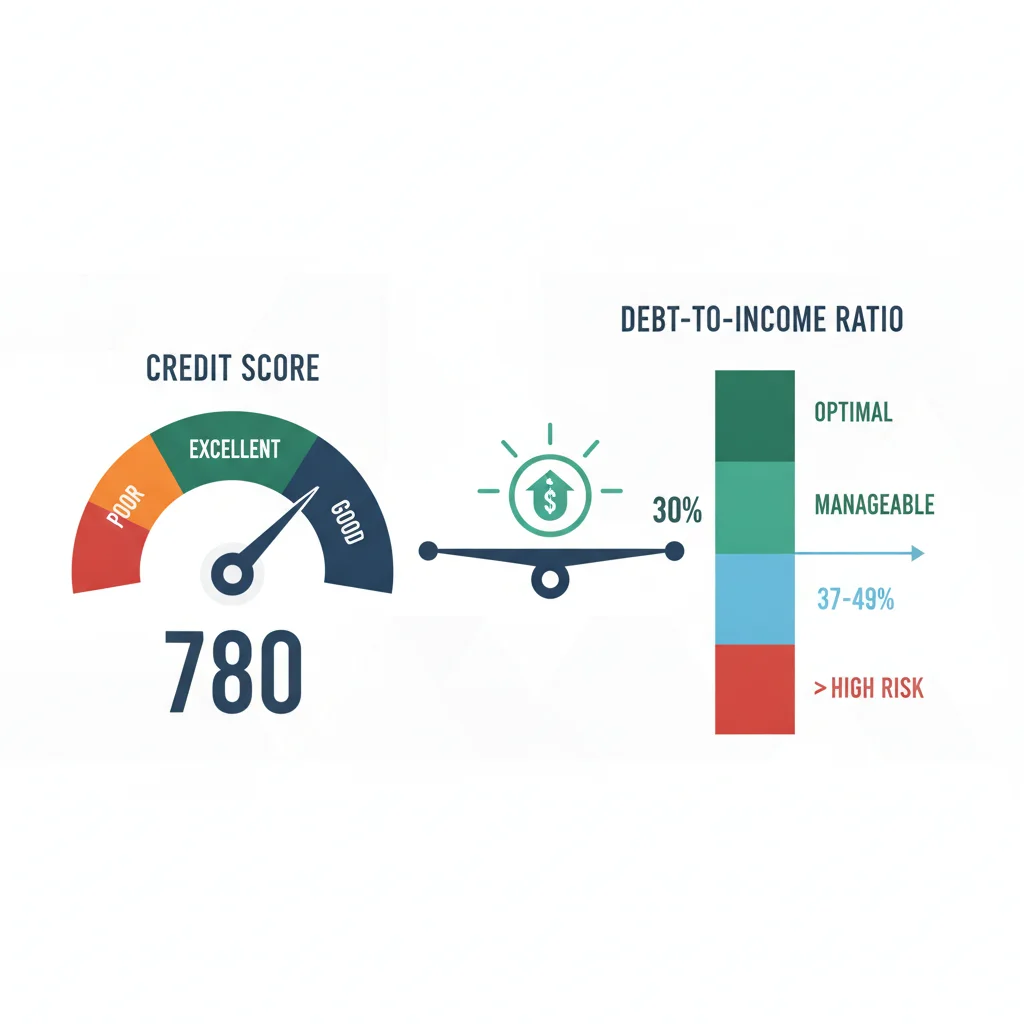
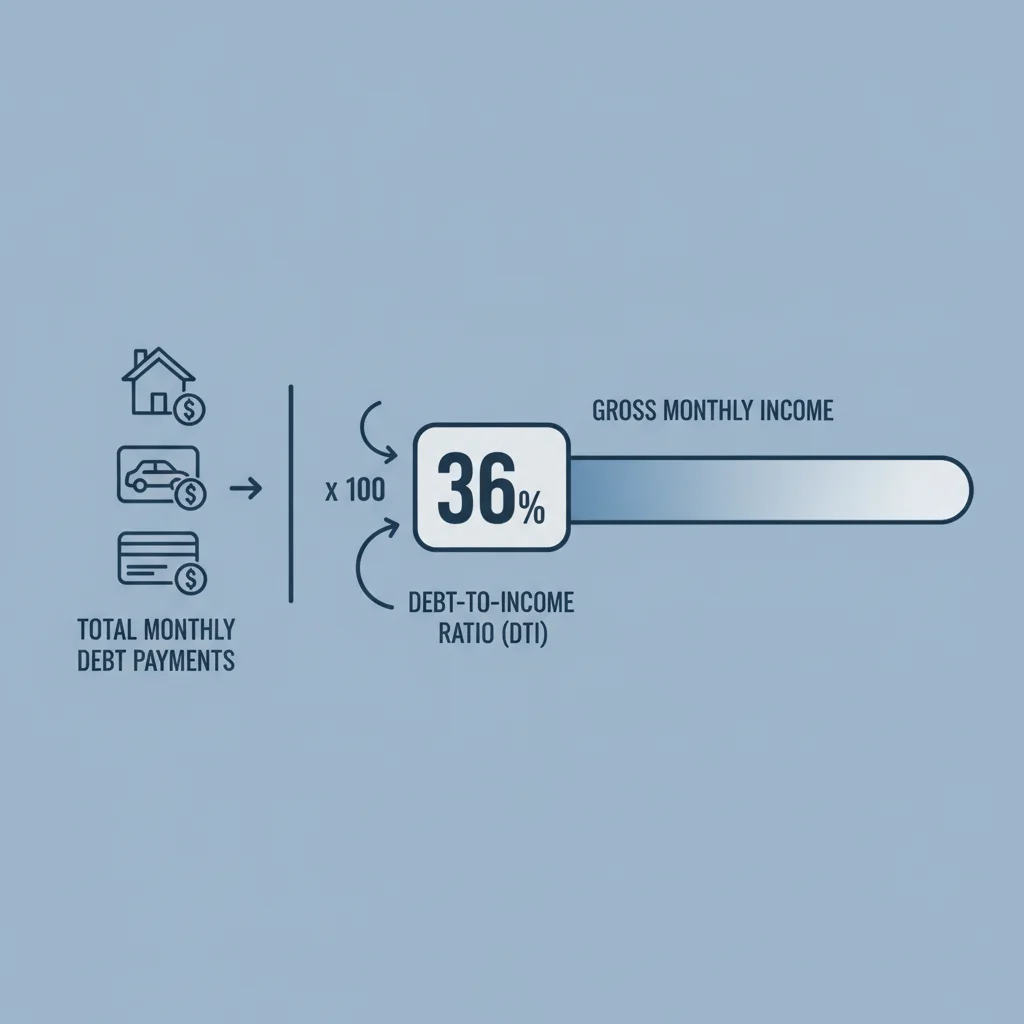
Your debt-to-income ratio is the percentage of your gross monthly income that goes toward paying debts. Lenders calculate it by dividing your total monthly debt payments — including the proposed car loan — by your gross monthly income. A lower DTI tells lenders you have enough breathing room to handle a new obligation. Most auto lenders prefer a DTI at or below 45–50%.
Lenders typically look at your back-end DTI, which includes all recurring debt obligations (mortgage or rent, student loans, credit cards, existing car payments) plus the new loan payment — not just the car loan in isolation.
Why DTI Is the Number Lenders Actually Care About
Most car buyers focus almost entirely on their credit score before applying for a loan. Credit score matters — but it is not the only filter lenders use. Your debt-to-income ratio is often the harder ceiling to move past, because it tells a lender something your credit score cannot: whether you actually have enough monthly cash flow to absorb a new payment.
Think of DTI as a snapshot of financial stress. A 720 credit score with a 58% DTI raises real concerns for a lender. A 680 credit score with a 32% DTI can look much more manageable. Lenders want to see that your income is large enough — relative to what you already owe — to comfortably handle the loan they are being asked to approve.
Here is the basic formula:
- Step 1: Add up all monthly minimum debt payments (rent/mortgage, credit cards, student loans, existing car payments, personal loans).
- Step 2: Add your estimated new car loan payment to that total.
- Step 3: Divide the sum by your gross monthly income (before taxes).
- Step 4: Multiply by 100. The result is your back-end DTI percentage.
For more detail on how lenders weigh this number against your credit profile, see how lenders use DTI alongside your credit score.
How Loan Term Length Changes the DTI Equation
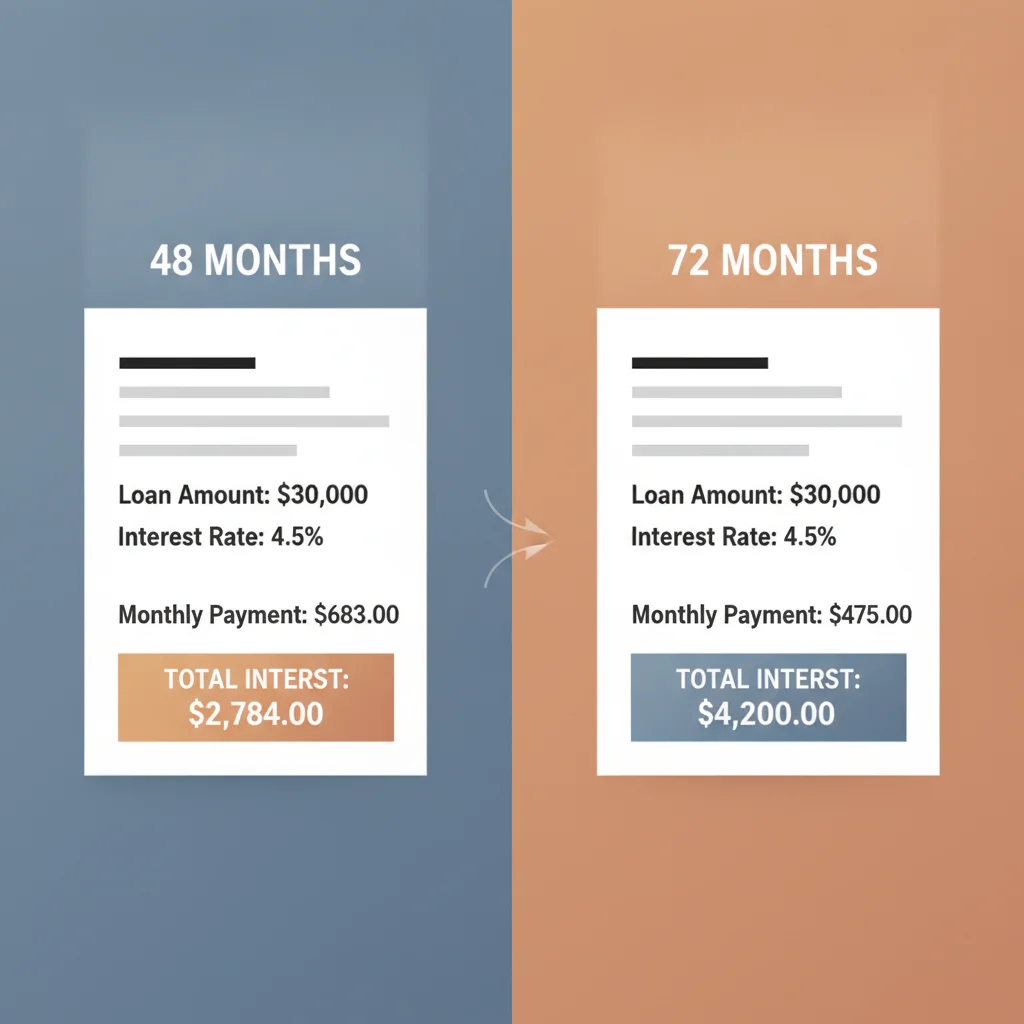
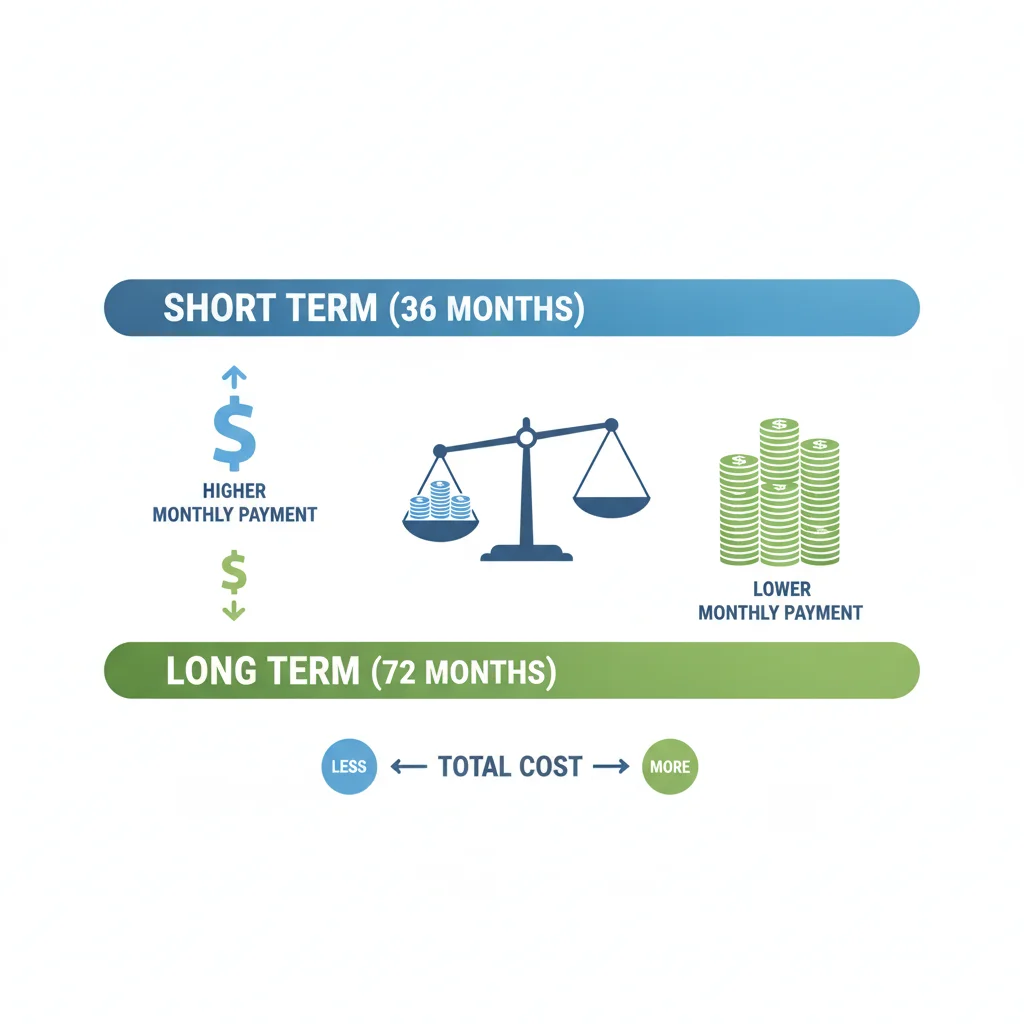
Your loan term — whether it is 36, 48, 60, 72, or 84 months — directly sets the size of your monthly payment. The longer the term, the smaller each individual payment. And since your monthly payment is the only part of the car loan that factors into your DTI calculation (not the total loan balance), stretching the term is a mechanical way to shrink that DTI number.
Here is a concrete illustration. Assume you are borrowing $32,000 at 7.5% APR:
| Loan Term | Monthly Payment | Total Interest Paid |
|---|---|---|
| 36 months | $994 | $3,784 |
| 48 months | $775 | $5,200 |
| 60 months | $641 | $6,460 |
| 72 months | $551 | $7,672 |
| 84 months | $490 | $9,160 |
If your gross monthly income is $5,000 and your existing monthly debt payments total $900, your DTI before the car loan is already 18%. Now add each of the payments above:
- 36-month loan: ($900 + $994) ÷ $5,000 = 37.9% DTI
- 60-month loan: ($900 + $641) ÷ $5,000 = 30.8% DTI
- 84-month loan: ($900 + $490) ÷ $5,000 = 27.8% DTI
That is a 10-point DTI swing between the shortest and longest terms — a difference that could determine whether a lender approves your application or declines it.
45%
Maximum DTI most auto lenders allow
Industry benchmarks from Experian and Consumer Financial Protection Bureau data show most conventional auto lenders cap back-end DTI at 45–50%.
$5,376
Extra interest: 84-month vs. 36-month on $32,000 at 7.5% APR
Based on standard amortization calculations for a $32,000 loan at 7.5% APR across 36- and 84-month terms.
40%
DTI threshold preferred by prime lenders
According to Experian's State of the Automotive Finance Market, prime and super-prime lenders typically target borrowers with a DTI below 40%.
72 months
Most common new-car loan term in the U.S.
Experian's Q1 2024 automotive finance data shows 72-month terms have become the plurality choice for new vehicle financing.
20%
Typical first-year vehicle depreciation
Automotive valuation research from Edmunds and iSeeCars consistently shows new vehicles lose approximately 15–20% of value in year one.
Calculate Your DTI Before You Shop
Before visiting a dealership or applying for preapproval, run the DTI numbers yourself using a simple calculator. Know your target monthly payment range — the one that keeps your DTI at or below 40% — and use that to set your vehicle budget ceiling. This prevents you from being steered into a longer term just to hit a payment number the dealership presents.
A Down Payment Does Double Duty
Increasing your down payment lowers both your monthly payment and your loan-to-value ratio. A better LTV can qualify you for a lower APR, which reduces your payment further. It is one of the highest-leverage moves available when your DTI is too high for approval at your preferred term length.
The Hidden Trade-Off: What You Pay for a Lower DTI
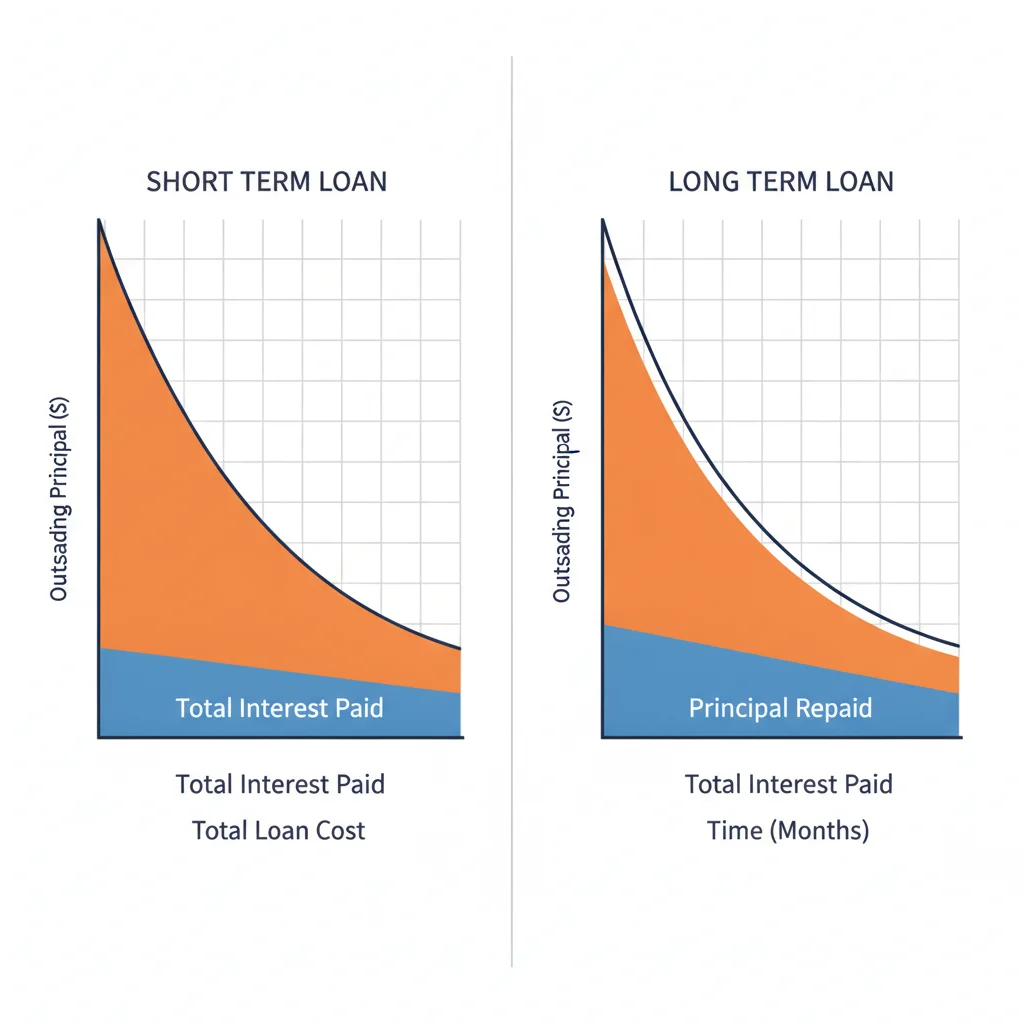
Lowering your DTI by extending your loan term is not free. Every additional month you carry the loan, you are paying interest on the remaining balance. The table above makes this stark: an 84-month loan on $32,000 costs you roughly $5,376 more in interest than a 36-month loan. That is money that does not build any equity in the vehicle and does not benefit you in any financial way.
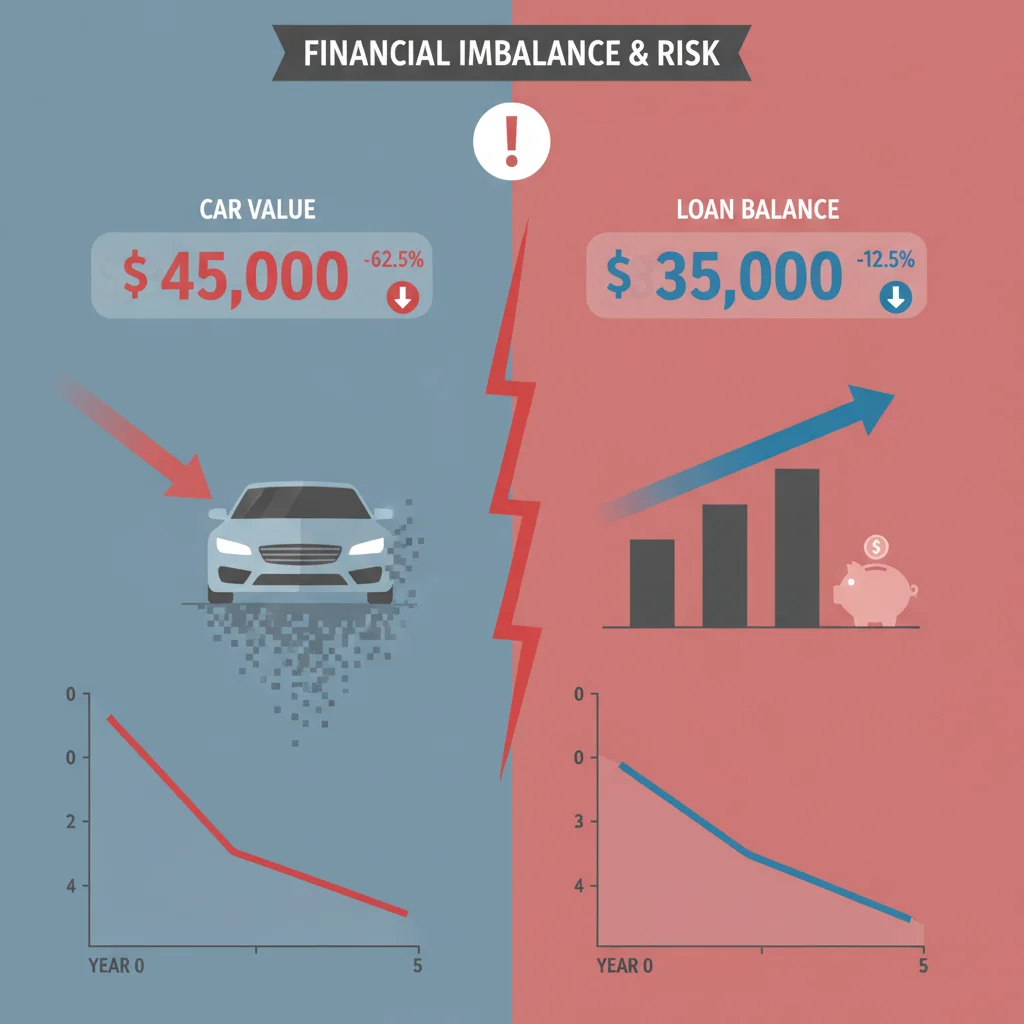
There is also an equity problem. Vehicles depreciate fastest in their early years — often losing 15–20% of value in year one alone. On a long loan, your principal paydown is spread so thin that your loan balance can exceed the vehicle's market value for the first several years. This is called being underwater or upside-down on your loan, and it creates real problems if you need to sell the car, trade it in, or deal with a total-loss insurance claim.
For a deeper look at this dynamic, see what happens to your equity with a longer loan term and how term length interacts with APR.
DTI Calculation Uses Gross Income, Not Take-Home Pay
This trips up many first-time applicants. Lenders calculate DTI using your gross monthly income — before taxes, health insurance deductions, or retirement contributions come out. If you earn $60,000 per year, your gross monthly income for DTI purposes is $5,000, not whatever hits your bank account each month. Using your net (take-home) pay will make your DTI look worse than lenders actually calculate it.
Your Existing Debts Matter More Than the Car Payment
Many buyers focus only on getting the car payment as low as possible, without considering that the bigger DTI problem is often their existing debt load. If you carry high credit card balances or have multiple installment loans, even a modest car payment may push you over a lender's DTI threshold. Addressing existing debts before applying is often more effective than choosing a longer car loan term.
Pre-Application Doesn't Lock You Into Anything
Getting preapproved by a bank or credit union before visiting the dealership is informational, not binding. It shows you exactly what DTI and payment range you are working with, and it gives you leverage when the dealer's finance office presents their financing. You are not obligated to use the preapproval — but having it means you will never be surprised by a term length that only works because of an inflated rate or extended timeline.
How Lenders Evaluate DTI in Context — Not in Isolation
Understanding that lenders do not read your DTI as a single number in a vacuum is important. They look at it as part of a risk picture that includes your credit score, loan-to-value ratio, income stability, and the term length itself.
Here is why term length matters to the lender's risk model — not just your monthly payment math:
- Longer terms signal tighter budgets. If you need an 84-month term to get to an acceptable DTI, a lender knows you have little financial cushion. That increases the probability of default if your income drops or an unexpected expense hits.
- Longer terms increase collateral risk. As the vehicle depreciates and your equity builds slowly, the lender holds a loan backed by an asset worth less than it was at origination. This is a risk they price into your rate.
- Some lenders restrict term lengths by credit tier. If your credit score is below a certain threshold, a lender may not offer you a 72- or 84-month term at all — even if it would help your DTI. See loan term length and bad credit for how this plays out in practice.
“Lenders are not just looking at whether you can make the payment today. They are asking whether you can make it in month 47 when something unexpected happens. A DTI that is only acceptable because of an 84-month term tells them the answer might be no.”
— Melinda Brock, Former auto lending underwriter and consumer finance consultant
For borrowers with challenged credit, the DTI hurdle is even higher. Subprime lenders often impose stricter caps. You can review the DTI thresholds subprime lenders use to understand where those hard limits typically fall.
Smarter Ways to Lower Your DTI Before Applying
If your DTI is too high for approval and you want to avoid simply defaulting to a very long loan term, there are more effective strategies to bring that number down.
1. Increase Your Down Payment
A larger down payment reduces the loan principal, which directly lowers the monthly payment. Unlike extending the term, this approach also reduces total interest paid and helps you avoid going underwater. Even an extra $1,500–$2,000 at signing can meaningfully move your DTI.
2. Pay Down Existing Debts First
Because DTI includes all monthly debt obligations, eliminating or reducing a credit card balance or a small personal loan before applying for a car loan can drop your DTI by several percentage points. This is one of the cleanest, most effective moves available.
3. Consider a Less Expensive Vehicle
The simplest lever of all: borrow less. A $28,000 loan generates a noticeably lower monthly payment than a $36,000 loan at the same term and rate. Matching the vehicle to your actual budget — not the maximum you can qualify for — keeps your DTI healthy without tradeoffs.
4. Add a Creditworthy Co-Borrower
If a co-borrower's income can be included in the DTI calculation, a higher combined income shrinks the ratio significantly. This is particularly useful when one borrower has strong credit but limited personal income.
Calculate Your DTI Before You Shop
Before visiting a dealership or applying for preapproval, run the DTI numbers yourself using a simple calculator. Know your target monthly payment range — the one that keeps your DTI at or below 40% — and use that to set your vehicle budget ceiling. This prevents you from being steered into a longer term just to hit a payment number the dealership presents.
A Down Payment Does Double Duty
Increasing your down payment lowers both your monthly payment and your loan-to-value ratio. A better LTV can qualify you for a lower APR, which reduces your payment further. It is one of the highest-leverage moves available when your DTI is too high for approval at your preferred term length.
To think through these decisions alongside term length more comprehensively, see picking a loan term that matches your financial situation.
Getting to Preapproval With a DTI-Aware Strategy
The best time to think about DTI is before you walk into a dealership or apply for financing. When you arrive at a lender preapproval stage already knowing your DTI, you can make intentional choices about term length rather than accepting whatever the dealer's finance office offers.
Here is a practical pre-application checklist:
- Pull your credit report and note all recurring monthly obligations.
- Calculate your gross monthly income (before taxes, before deductions).
- Add up total monthly debt payments.
- Use an auto loan calculator to estimate monthly payments at different term lengths for your target vehicle price.
- Test each scenario: which term keeps your DTI under 45% — or ideally under 40%?
- Identify whether a down payment increase or debt paydown could let you choose a shorter term while still meeting the DTI threshold.
Going through this exercise before applying puts you in control of the conversation. Instead of reacting to whatever payment the dealer presents, you arrive knowing the term lengths that work for your financial picture — and the ones that do not.
For a more detailed walkthrough of the preapproval process itself, see how DTI shapes auto loan preapproval. And if you want to understand how your credit score interacts with all of this, the credit score impact hub is a useful starting point.
DTI Calculation Uses Gross Income, Not Take-Home Pay
This trips up many first-time applicants. Lenders calculate DTI using your gross monthly income — before taxes, health insurance deductions, or retirement contributions come out. If you earn $60,000 per year, your gross monthly income for DTI purposes is $5,000, not whatever hits your bank account each month. Using your net (take-home) pay will make your DTI look worse than lenders actually calculate it.
Your Existing Debts Matter More Than the Car Payment
Many buyers focus only on getting the car payment as low as possible, without considering that the bigger DTI problem is often their existing debt load. If you carry high credit card balances or have multiple installment loans, even a modest car payment may push you over a lender's DTI threshold. Addressing existing debts before applying is often more effective than choosing a longer car loan term.
Pre-Application Doesn't Lock You Into Anything
Getting preapproved by a bank or credit union before visiting the dealership is informational, not binding. It shows you exactly what DTI and payment range you are working with, and it gives you leverage when the dealer's finance office presents their financing. You are not obligated to use the preapproval — but having it means you will never be surprised by a term length that only works because of an inflated rate or extended timeline.


All claims are backed by peer-reviewed research. Sources on request.