Key Takeaways
Why APR Myths Are So Expensive
Auto loan APR is one of those topics where a little misinformation does a lot of damage. I spent years on the finance side of dealerships, and I watched buyers make the same costly mistakes over and over — not because they were careless, but because they were working from bad information. A misconception about APR versus interest rate, or about where to get the best rate, can easily add $1,500 to $4,000 to the total cost of a car purchase without the buyer ever realizing it.
The myths below are the ones that showed up most often at the finance desk. Each one has a real dollar cost attached to it. Understanding where the confusion comes from — and what the accurate picture actually looks like — is the fastest way to protect yourself at the table.
For a deeper primer on how rate and APR relate to each other mathematically, see our full breakdown of interest rate vs. APR on car loans. And if you're already wondering whether preapproval changes the equation — it does, and our preapproval myth-busting guide explains exactly how.
Myth
APR and interest rate are the same thing — they're two different words for the same number.
Fact
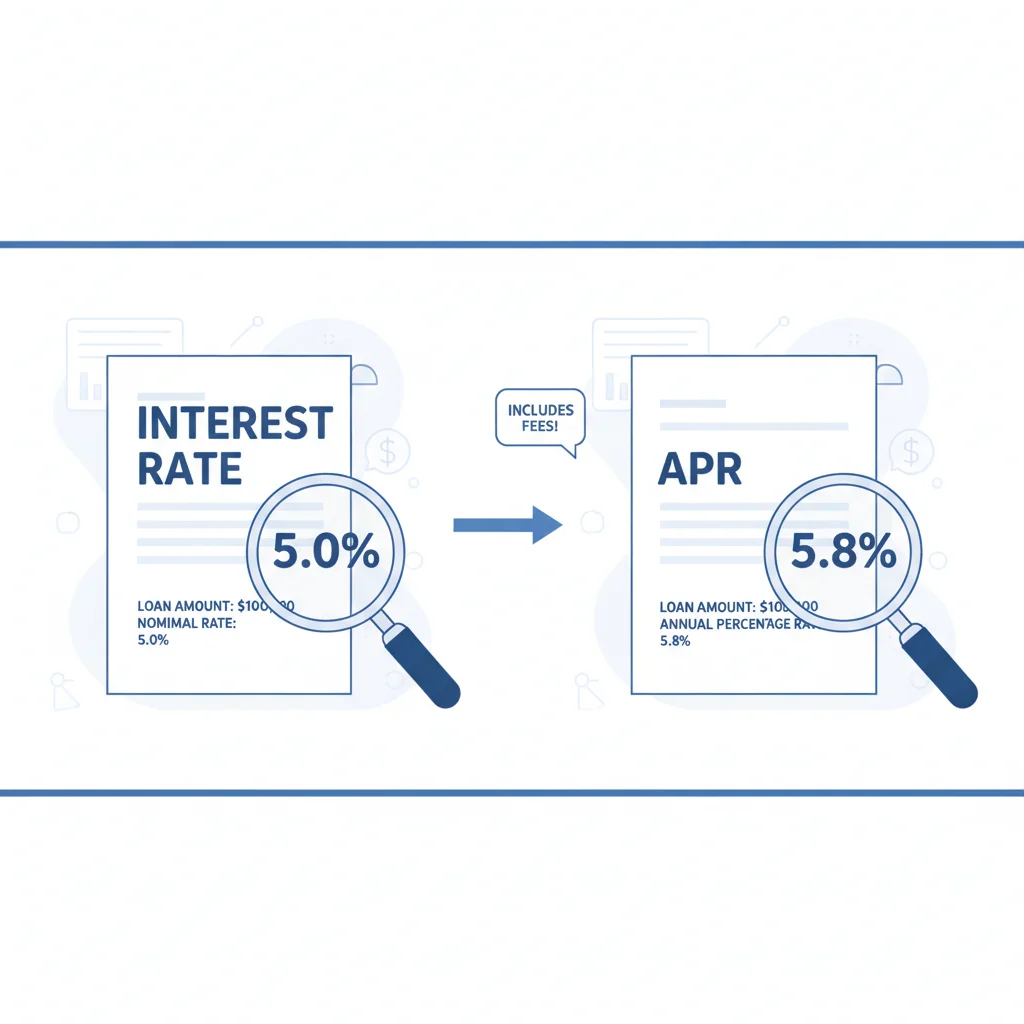
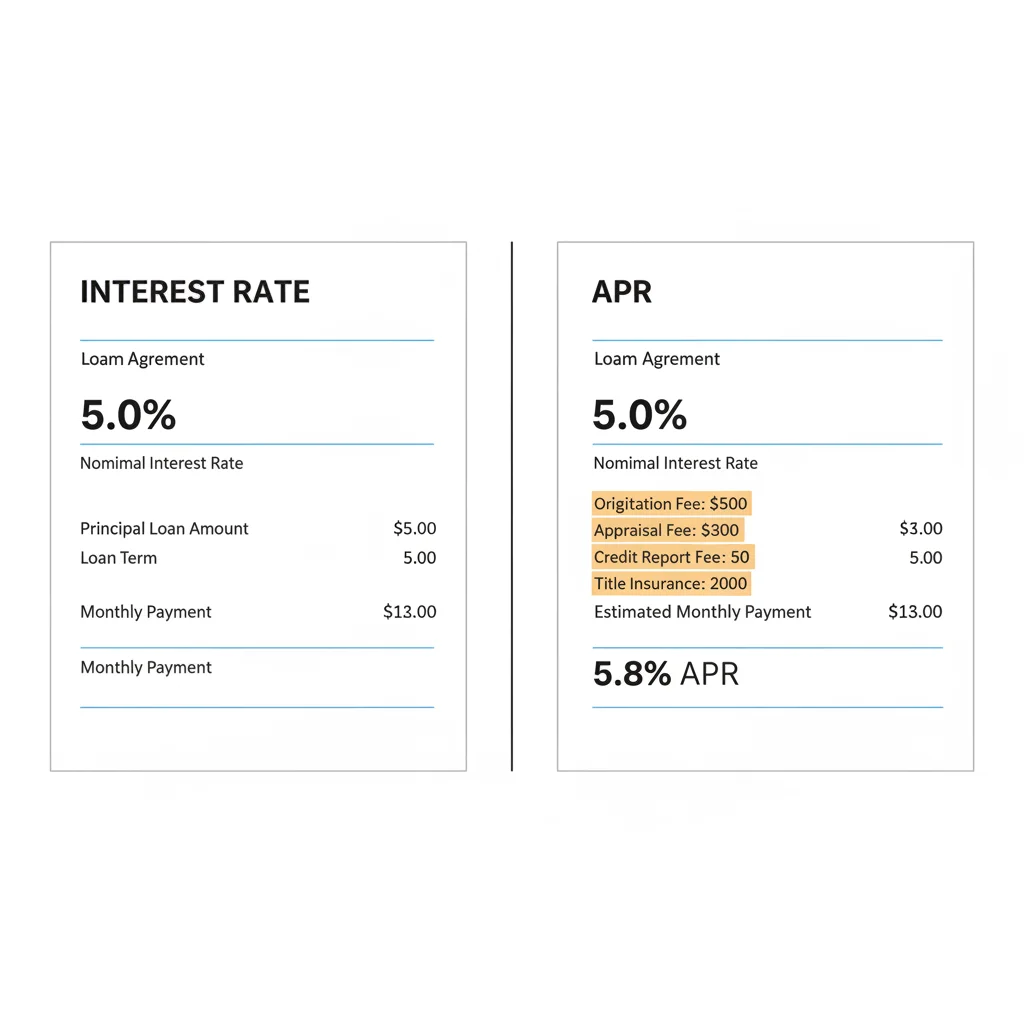
APR (Annual Percentage Rate) includes the interest rate plus most lender fees, making it the true cost of borrowing. The interest rate alone understates what you'll actually pay.
The interest rate is just the cost of borrowing the principal — it tells you what percentage of the loan balance you'll pay in interest each year. APR wraps that rate together with most fees the lender charges, including origination fees, documentation fees, and certain other closing costs. By law, lenders must disclose APR, which is why it's the more useful comparison tool.
Here's a concrete example. A dealer offers you a 6.9% interest rate with $800 in documentation and origination fees on a $25,000 loan over 60 months. The APR works out to approximately 7.4%. A competing lender offers 7.1% with no fees — APR of 7.1%. The first offer looks cheaper on the rate alone, but the second offer is actually less expensive once fees are included. Comparing interest rates without accounting for fees is comparing incomplete information.
This gap matters most on shorter-term loans. If you're financing for 36 months, fees get amortized over fewer payments, making the APR diverge more sharply from the stated rate. On a 72-month loan, the same fees spread across more payments create a smaller rate-to-APR gap — but the longer term creates its own costs. See how loan terms affect total cost for that calculation.
Myth
The dealership always offers the best financing rate because they have relationships with multiple lenders.
Fact
Dealers markup the rate approved by the lender — sometimes by 1–3 percentage points — and keep the difference as profit. Your bank or credit union will typically offer a better or equivalent rate with no markup.
Dealer financing works like this: the lender (a bank, captive finance arm, or credit union) approves you at a base rate called the buy rate. The dealer is then contractually allowed to present you with a higher rate — the sell rate — and the spread between the two is dealer reserve, which is paid back to the dealer by the lender. The dealer did not find you a better deal. They found you a more expensive one and profited from the difference.
A 2-point markup on a $30,000, 60-month loan adds approximately $1,590 in extra interest. On a larger or longer loan it's worse. The dealer's real advantage is convenience and speed — they can get you financed in one sitting across many lenders simultaneously, which does have value. But that convenience doesn't justify paying a higher rate if you could qualify for a better one elsewhere.
Credit unions consistently offer among the lowest auto loan rates available to the public. If you're a member of a credit union, get their rate first. Then let the dealer try to beat it. If they can, great. If not, use the credit union loan. For more on how advertised rates differ from what most buyers actually receive, see why the interest rate on the sticker isn't the rate you'll get.
Myth
A lower monthly payment means I'm getting a better deal on my loan.
Fact
A lower monthly payment almost always means a longer loan term, not a lower rate. Longer terms mean you pay more total interest — often thousands of dollars more.
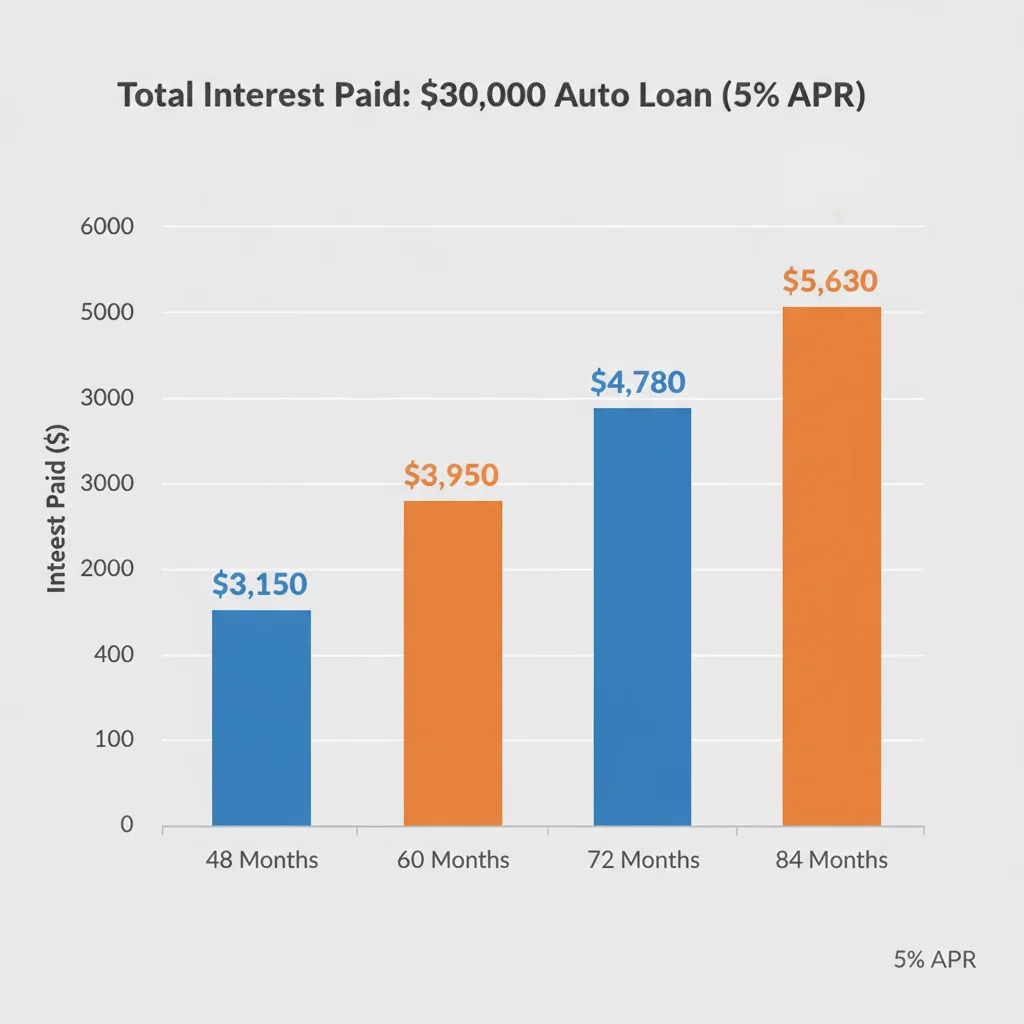
Monthly payment is easy to manipulate without changing the actual cost of the loan. Extend the term from 60 to 72 months on a $30,000 loan at 7% APR and the monthly payment drops from $594 to $513 — a $81 reduction that looks appealing. But total interest paid jumps from $5,640 to $6,936 — you pay $1,296 more for the privilege of the lower payment.
Stretch to 84 months and the payment drops to $453. Total interest: $8,052. You've nearly doubled the interest cost compared to a 60-month loan, all while feeling like you got a bargain because the payment fit your budget.
Dealers know this. Payment negotiation is the most common technique used in F&I offices to absorb fee-heavy add-ons — extended warranties, paint protection, gap insurance — without triggering sticker shock. Each product gets folded into the loan balance, the term stretches slightly to keep the payment palatable, and the buyer walks out having financed products they didn't price-shop. Focus on APR and loan term first. The payment is an output, not a negotiating variable.
Myth
Shopping around for auto loans will hurt my credit score because each application creates a hard inquiry.
Fact
Credit scoring models treat multiple auto loan inquiries within a 14-day window as a single inquiry. Shopping around costs you nothing in credit score terms.
The credit bureaus and FICO designed rate-shopping protections specifically to encourage consumers to compare lenders — which benefits both borrowers and competition. Under FICO 8 and newer models, all auto loan hard inquiries within a 14-day period are deduplicated into a single inquiry for scoring purposes. Some older FICO versions extend that window to 30 days.
A single hard inquiry typically reduces a credit score by 5 points or fewer. That's a small, temporary impact that reverses within 12 months. But the difference between accepting the first rate you're offered and finding a rate one point lower on a $30,000 loan can be $900 or more in total interest. The fear of a minor, temporary credit score dip is costing buyers real money by discouraging comparison shopping.
Apply to your bank or credit union, at least one online lender, and optionally the dealer — all within the same 14-day window. Compare APRs. Pick the lowest. This is exactly what the inquiry deduplication rule was designed to enable. For a deeper look at how your score affects what rate you'll receive, see how credit scores directly impact auto loan rates and credit score myths that trip up car buyers.
Myth
0% APR financing is always the best deal if you can qualify for it.
Fact
0% APR offers often require you to forgo a cash rebate. Depending on your available rate and the rebate amount, taking the cash back and financing at a low rate can save more total money.
Automakers structure 0% deals as an alternative to cash rebates — you usually can't take both. The math comes down to: what is the rebate worth, and what rate can you get on your own?
Example: A $38,000 vehicle is offered with either 0% for 36 months or a $3,500 cash rebate. You can secure a 3.9% loan independently. On the 0% deal: 36 payments of $1,056 — total cost $38,000. On the rebate deal: you finance $34,500 at 3.9% for 60 months — total interest $3,490, total cost $37,990. You end up $10 ahead taking the rebate and the longer loan, while also having a lower monthly payment.
Change the independent rate to 6% and the 0% deal wins by about $2,000. The rebate-vs.-financing comparison is arithmetic. Run the numbers with your actual offered rate before assuming 0% is automatically the better choice. Our detailed article on what 0% APR car loan offers really mean covers several scenarios with the complete calculations.
Myth
Once you've signed the loan contract at the dealership, that's the rate you're stuck with.
Fact
You can refinance an auto loan at any point, often within weeks of purchase, if you find a lower rate.
There is no lock-in period on auto loans from a borrower's perspective. If you signed a dealer loan at 9.4% and a week later you discover your credit union would have given you 6.8%, you can refinance immediately — most lenders will process an auto refinance within a few days. Some lenders charge no origination fee on refinances, making the break-even point very short.
On a $28,000 loan over 60 months, refinancing from 9.4% to 6.8% saves approximately $2,180 in total interest. Even if refinancing costs $200 in fees, the math is obvious. The primary constraint is that a small number of lenders apply prepayment penalties — check your existing loan contract for that language before refinancing.
Refinancing is especially worth considering if your credit score has improved since you took out the original loan, or if market rates have dropped. For common errors borrowers make during the payoff and refinance stage, see auto loan payoff myths that cost borrowers money.
How Dealer Rate Markups Actually Work
One of the most profitable — and least understood — parts of the dealership business is the finance and insurance (F&I) office. The core mechanism is simple: a lender approves you at what's called the buy rate, say 6.5%. The dealer then presents you with a rate of 8.9% and pockets the difference as what's officially called a dealer reserve. On a $32,000 loan over 60 months, that 2.4-point markup costs you roughly $2,100 extra in interest.
This isn't illegal. It's disclosed in the fine print of your contract. But most buyers never connect the dots because the conversation stays focused on monthly payment rather than rate. That's not accidental.

The defense is straightforward: walk in with a preapproval from a bank or credit union. Now you have a real competing offer, and the dealer knows it. They either beat it or they don't. If they can't beat 6.5%, you use your preapproval. See how advertised APRs differ from what you'll actually be offered for more on how lender rate sheets and markups interact.
1–3%
Typical dealer rate markup above buy rate
Industry analysis of F&I practices consistently finds dealers marking up lender-approved rates by 1 to 3 percentage points on average, according to consumer advocacy research.
$1,590
Extra interest from a 2-point rate markup
On a $30,000, 60-month auto loan, a 2-percentage-point dealer markup above the base approved rate adds approximately $1,590 in total interest cost.
14 days
Rate-shopping window for single hard inquiry
Under FICO 8, all auto loan hard inquiries within a 14-day period count as a single inquiry, per FICO's published rate-shopping guidelines.
720+
Typical minimum FICO for 0% APR offers
Most manufacturer 0% APR promotions require a FICO score of at least 720, and some captive lenders require 740 or higher, based on lender qualification disclosures.
$2,300+
Interest cost of a 60-point credit score gap
The difference between a 680 and 740 FICO score can translate to a 2–3 point rate difference, costing over $2,300 more in total interest on a $28,000, 60-month loan.
Never Negotiate Around Monthly Payment Alone
If you walk into a finance office focused on hitting a specific monthly payment number, the F&I manager has everything they need to structure a deal that costs you far more than necessary. Fees, add-on products, and extended terms can all be hidden inside a payment that looks fine on the surface. Always lock in the purchase price and APR first — calculate the payment yourself from there.
Watch for Yo-Yo Financing After You Drive Home
Some dealers let buyers take the car home before financing is finalized, then call days later claiming the original deal fell through and the rate is now higher. This practice — sometimes called yo-yo or spot-delivery fraud — is predatory. Do not sign any contract that states financing is conditional or subject to change. If the deal isn't fully funded, the car stays at the dealership until it is.
The Monthly Payment Trap and Other Negotiation Mistakes
The single most reliable way to overpay on a car loan is to negotiate the monthly payment instead of the APR and purchase price. Here's why: monthly payment is a function of three variables — price, rate, and loan term. A dealer who controls all three can make almost any payment number work while quietly increasing the total cost of the loan.
A buyer who says "I need to stay under $450 a month" has just handed the F&I manager enormous flexibility. Stretch the term from 60 to 72 months and that $450 target becomes easy to hit — while the buyer pays an extra $1,800 to $2,500 in total interest. Add paint protection and a gap waiver into the loan balance, and the monthly payment barely moves, but thousands of dollars in profit just got buried in the deal.
The right approach is to negotiate price first, then rate, then term — in that order. Only after those three numbers are locked down should you calculate what the payment will be. Our article on why focusing on monthly payment instead of APR costs you shows the exact math across several scenarios. For readers wondering how loan term myths feed into this problem, the auto loan term myths article covers that in detail.
APR Is the Number That Actually Matters
When comparing loan offers, always compare APRs — not interest rates, not monthly payments. APR is the standardized, fee-inclusive cost of borrowing and is the only apples-to-apples comparison across lenders. A loan with a lower stated rate but higher fees can cost more than a loan with a slightly higher rate and no fees. Federal law requires lenders to disclose APR precisely for this reason — use it.
Get Preapproved Before You Set Foot in a Dealership
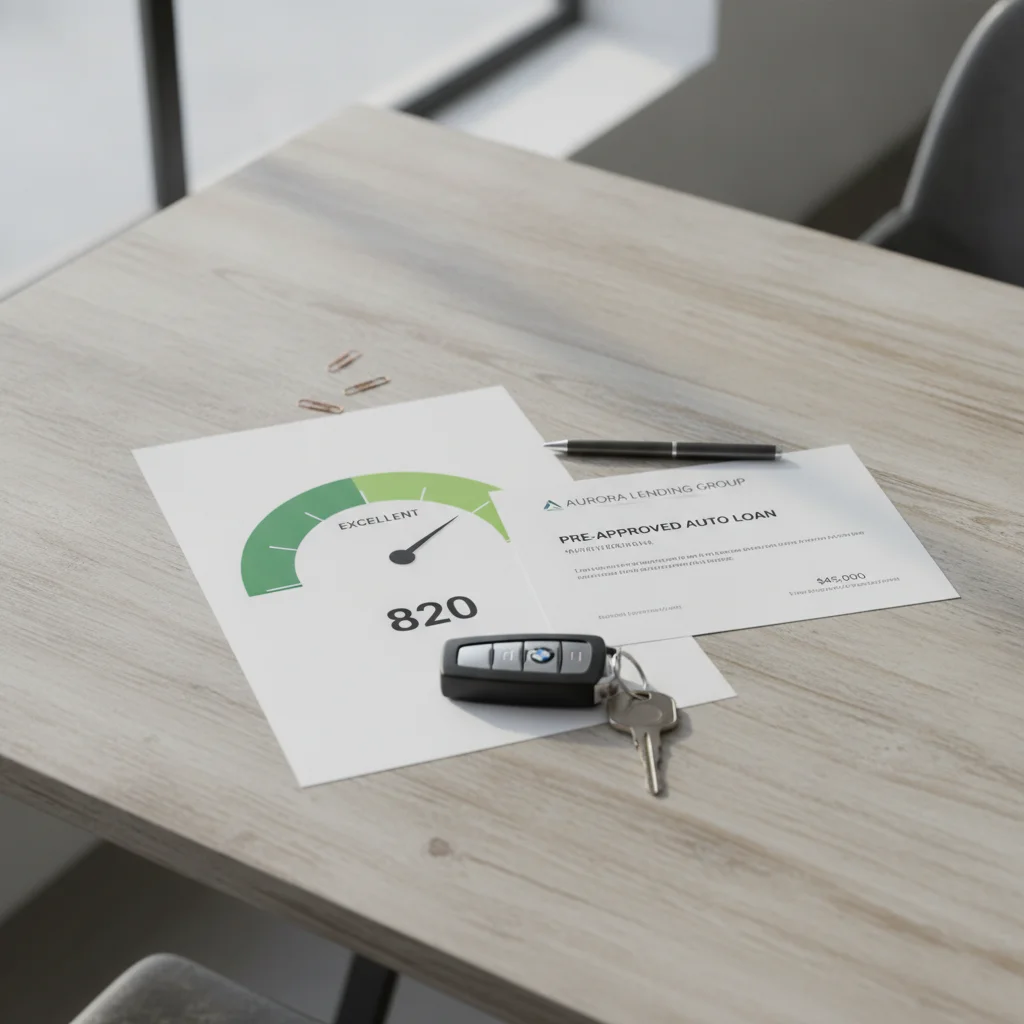
Walking into a dealership without a preapproval from an outside lender puts you at a structural disadvantage in the financing conversation. With a preapproval in hand, you have a real competing rate that the dealer must beat or match. Without one, you're accepting whatever the F&I office presents without a meaningful benchmark to compare it against. Preapproval takes 15 to 30 minutes with most banks and credit unions and costs you nothing.
Special Cases: 0% APR and Credit Score Realities
Manufacturer 0% APR promotions are real — they're offered through the automaker's captive finance arm as a sales incentive on specific models, in specific trim levels, for a limited time. But they come with conditions that eliminate most buyers from eligibility.
First, the credit bar. Most 0% offers require a FICO score of 720 or higher — some require 740 or better. Roughly 40% of U.S. auto loan applicants fall below that threshold. Second, the model constraint. The promotion applies to specific vehicles the manufacturer needs to move. If you want a different trim or color, you may not qualify. Third, the term limit. 0% financing often comes attached to a 36- or 48-month term. A lower term means a higher monthly payment. If you were comparing a 0% 36-month offer against a 3.9% 60-month loan on a $35,000 vehicle, the 0% deal saves you about $3,600 — but your monthly payment is roughly $460 higher.
Fourth, and most importantly: choosing 0% financing usually means forfeiting the cash rebate. On a $35,000 vehicle with a $3,000 rebate available, taking the 0% deal instead means giving up $3,000 upfront. If you can get a 3.9% loan and apply that $3,000 rebate to the principal, you may come out ahead. The math depends on your specific rate and term — our article explaining what 0% APR car loan offers really mean walks through the rebate-versus-financing comparison step by step.
On credit scores: your score has a larger impact on your auto loan rate than most buyers realize. The difference between a 680 and a 740 FICO score can easily translate to a 2–3 percentage point difference in your offered rate. On a $28,000 loan over 60 months, that's a difference of roughly $2,300 in total interest paid. See how your credit score directly affects loan rates and credit score myths that cost car buyers money for the full picture.
What to Do Before You Walk Into Any Dealership
Armed with accurate information, the checklist before you buy is actually short:
- Pull your own credit report at least 30 days before shopping. Dispute any errors before lenders see them. Check your FICO Auto Score specifically — it's a version of FICO optimized for auto lending and may differ from the score you see in consumer apps.
- Get preapproved from at least two sources — your bank or credit union and one online lender. Rate-shopping within a 14-day window counts as a single hard inquiry. Do this before setting foot in a showroom.
- Know the APR, not just the rate. Ask every lender for the APR, which includes fees. Compare APRs across offers, not just the stated interest rates.
- Negotiate price before financing. Get the out-the-door price agreed upon in writing before the conversation moves to the F&I office.
- Read the loan contract before signing. Confirm the APR, loan amount, term, and total interest paid match what you agreed to. Errors — accidental or otherwise — do happen.
The dealers who give fair deals exist. But the system is structured to reward buyers who come in unprepared. These steps close that gap. For readers who want to apply the same skepticism to the used car side of the purchase, used car myths that cost buyers real money and new car buying myths that cost people real money cover the purchase-side mistakes that compound financing mistakes. And once you have the loan, auto loan payoff myths ensures you don't make costly errors on the back end either.
All claims are backed by peer-reviewed research. Sources on request.