
Key Takeaways
Significantly reduces total interest paid over loan life
Fewer months of accruing interest means the lender earns less from you. On a $20,000 balance, shaving 24 months off the term at the same rate can save $1,500–$2,500 in interest depending on APR.
Builds vehicle equity faster
A shorter term front-loads principal reduction, so your loan balance drops closer in line with the vehicle's depreciating value. This reduces the risk of owing more than the car is worth if you need to sell early.
Eliminates the monthly payment obligation sooner
Freeing up that payment earlier gives you more cash flow for other financial goals — whether that's saving for another vehicle, paying down other debt, or building an emergency fund.
Can lock in a lower rate if credit has improved
If your credit score has risen since the original loan, you may qualify for a meaningfully lower APR. Combining a better rate with a shorter term maximizes total savings.
Psychological benefit of a clear, near-term payoff date
Knowing you'll own the car outright in 24 or 36 months rather than 60 provides a concrete financial milestone and reduces the open-ended feeling of long-term debt.
Monthly payment increases, sometimes significantly
Compressing the remaining balance into fewer months raises your required monthly payment regardless of the rate. Borrowers on tight budgets may find this unworkable even if the total savings look attractive.
Requires stable, sufficient income to sustain higher payments
If your income is variable or you've recently experienced financial disruption, committing to a higher payment adds risk. Missing payments on the new loan damages your credit and could trigger repossession.
May not pencil out if the interest rate rises
If your credit hasn't improved or market rates have increased since origination, the new rate could be higher than your current one. A higher rate on a shorter term may not save as much as expected — or could cost more.
Loan fees can erode projected interest savings
Origination fees, title transfer costs, and state registration fees add to the total cost of refinancing. Small savings margins can be wiped out entirely by fees if you don't account for them upfront.
Negative equity can block approval
If you owe more than the car is currently worth, many lenders won't approve the refinance — especially for a shorter term that increases the required monthly payment. You may need to pay down the balance first.
Reduced financial flexibility month to month
A higher fixed payment leaves less room in your budget for unexpected expenses. If your financial situation changes after refinancing, you can't simply switch back to the lower payment without refinancing again.
Our Verdict
Refinancing to a shorter loan term is a smart move when your financial footing is solid, you've improved your credit score since origination, and paying off the vehicle quickly matters to you. The trade-off is real: your monthly payment will go up, often significantly. But the payoff — less interest, faster equity, and a debt-free timeline you can see — is equally real for the right borrower.
Best for borrowers with stable income who originally took a long loan to manage cash flow, have since improved their credit, and now want to reduce total interest and exit the loan faster.
Why Borrowers Refinance to a Shorter Term
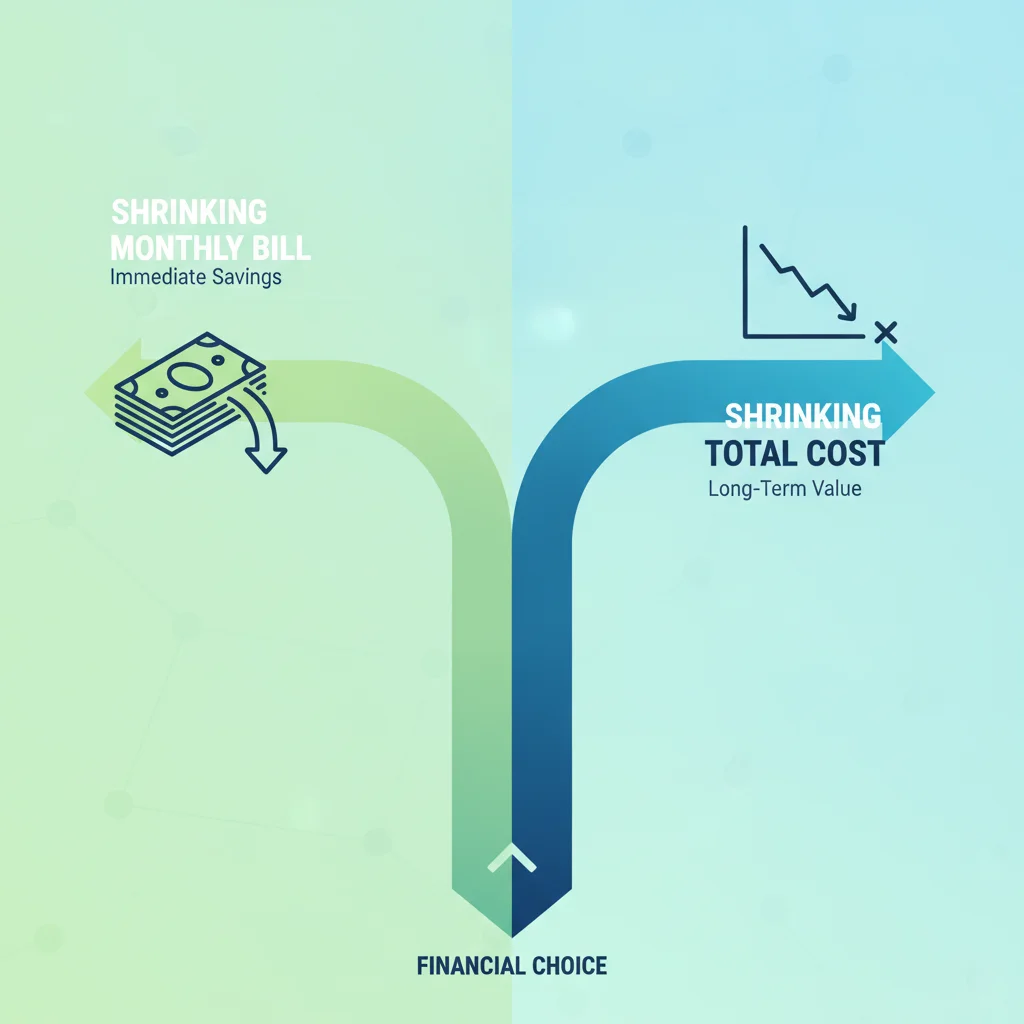
Most people refinance an auto loan for one of two reasons: to lower their monthly payment or to reduce the total cost of the loan. These goals pull in opposite directions, and which one you chase determines whether you should shorten or lengthen your remaining term.
Shortening the term is the less intuitive move. You're voluntarily agreeing to pay more each month. But there's a clear logic behind it: a shorter loan term means the lender earns interest over fewer months, so your total interest expense drops — sometimes dramatically.
Borrowers who do this typically fall into one of these situations:
- They took out a 72- or 84-month loan to keep payments manageable and their income has since grown.
- Their credit score has improved, qualifying them for a lower rate that offsets the higher payment.
- They want to build equity in the vehicle faster to avoid being underwater if they need to sell or trade in.
- They want to eliminate the monthly payment sooner — especially if they're planning another major financial commitment.
Understanding why you're considering this move is important because it shapes whether the math actually works in your favor. See our guide to when refinancing makes sense for a broader look at the right timing signals.

What Actually Changes When You Shorten the Term
Let's walk through the mechanics so there are no surprises.
Your Monthly Payment Goes Up
This is the immediate and unavoidable change. When you compress the same remaining balance into fewer months, each payment covers a larger slice of principal. Even if your new interest rate is lower, the payment almost always rises when you meaningfully shorten the term.
Example: Suppose you have $18,000 remaining on a 72-month loan at 7.9% APR with 48 months left. Your current payment is roughly $440/month. If you refinance that $18,000 into a new 36-month loan at 6.5% APR, your payment jumps to approximately $553/month — an increase of about $113.
Your Total Interest Paid Drops
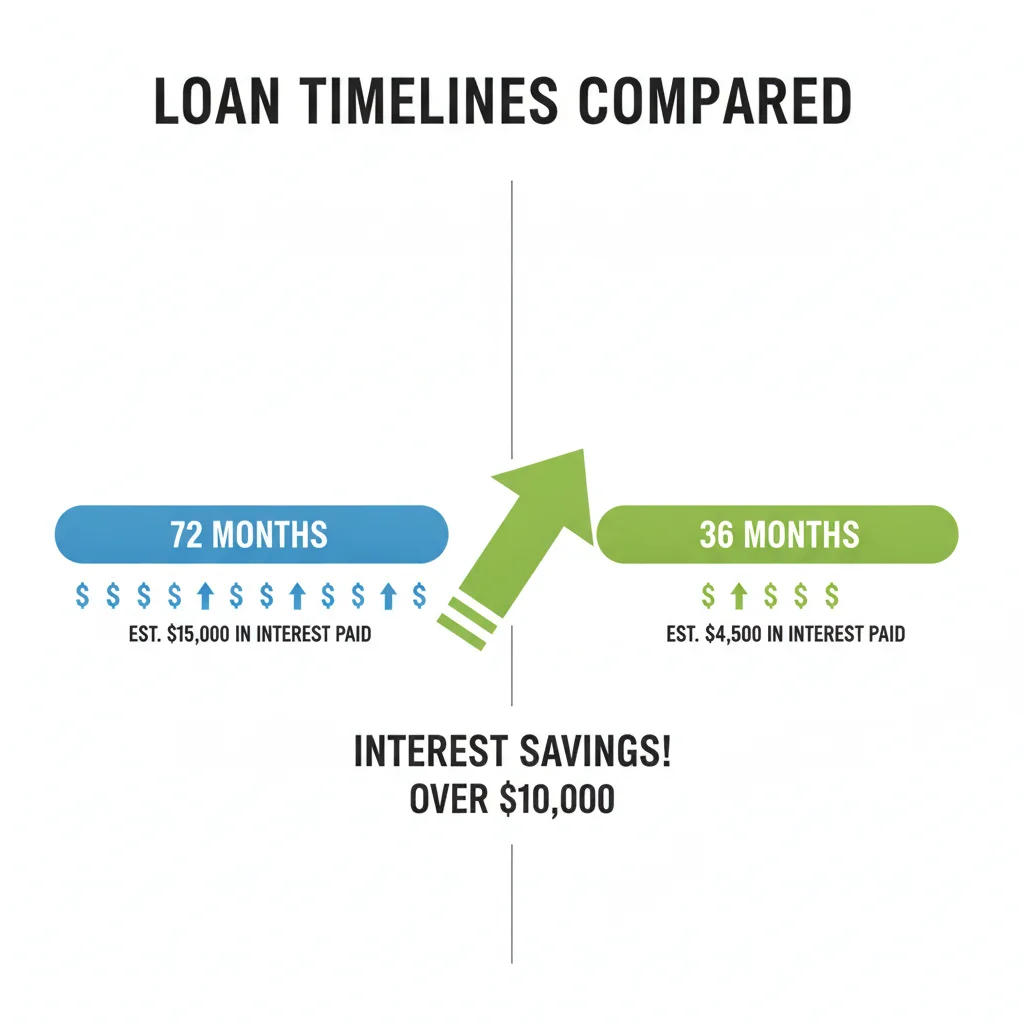
Here's where the trade-off pays off. In the scenario above, 48 remaining payments at $440 = $21,120 total, meaning you'd pay about $3,120 in interest. With the shorter 36-month refi, 36 payments at $553 = $19,908 total, and interest paid drops to roughly $1,908. You save over $1,200 in interest and get out of the loan a full year earlier.
~$1,200
Typical interest saved by shortening 48 months to 36
Based on a $18,000 balance refinanced from 7.9% APR over 48 months to 6.5% APR over 36 months — illustrative calculation.
15–20%
New car value lost in the first year
Industry estimates from Edmunds and Carfax suggest new vehicles lose this share of value within 12 months of purchase, outpacing slow principal paydown on long loans.
45 days
Rate-shopping window for a single credit inquiry
Under FICO's newer scoring models, multiple auto loan inquiries within a 45-day window are typically treated as a single hard inquiry, allowing borrowers to compare lenders freely.
72–84 months
Most common new-car loan terms in recent years
Experian's State of the Automotive Finance Market reports show a growing share of new-vehicle loans extending to 72 and 84 months, leaving many borrowers paying interest far longer than necessary.
Your Equity Position Improves Faster
On a longer loan, the early months are heavily weighted toward interest. A shorter term accelerates principal paydown from month one, meaning your loan balance falls faster than the car depreciates — which helps you stay above water on the vehicle's value.
This is especially relevant if you financed a new car. New vehicles lose roughly 15–20% of value in the first year. A shorter loan term closes the gap between what you owe and what the car is worth.
What Doesn't Change
Refinancing changes the structure of your loan — not every dimension of it. Here's what stays the same or carries over:
Your Current Principal Balance
The refinanced loan starts from your existing payoff amount (plus any fees rolled in). You are not resetting to the original loan amount. Whatever principal you've paid down already stays paid down.
The Vehicle's Depreciation Clock
The car continues to age and depreciate on its own schedule regardless of what you do with the loan. Refinancing doesn't change the vehicle's value — it only changes how quickly your loan balance tracks (or lags behind) that value.
Prepayment Rights
Most auto loans — before and after refinancing — allow you to make extra payments toward principal at any time. If your new lender's terms permit it, you could still pay down the loan faster than the scheduled term by adding to your monthly payment. Always confirm there's no prepayment penalty before signing.
Check for Prepayment Penalties First
Some auto loan agreements include a prepayment penalty clause — a fee charged when you pay off the loan early. Before initiating a refinance, review your current loan contract or call your lender and ask directly. If a penalty applies, calculate whether your projected interest savings from the shorter term still exceed that fee. In many cases they will, but it's a number you must include in your comparison.
Refinancing Resets Your Loan Start Date
When you refinance, the new loan begins from day one regardless of how long you've been paying on the original. This is relevant for gap insurance, which is typically tied to the loan period. If you carry gap coverage, check whether it transfers or needs to be reissued under the new loan. Some dealers and lenders auto-cancel gap when a loan is paid off, so you may need to purchase new coverage.
Your Responsibility for the Debt
The refinance pays off the old loan and opens a new one in its place. You're still responsible for the full remaining balance. Refinancing is not debt forgiveness — it's debt restructuring.
If you're thinking about other ways to exit a long loan without going through a formal refinance, see our article on getting out of a long auto loan term without refinancing.
Pros of Refinancing to a Shorter Term
Here's the full case for shortening your term:
Significantly reduces total interest paid over loan life
Fewer months of accruing interest means the lender earns less from you. On a $20,000 balance, shaving 24 months off the term at the same rate can save $1,500–$2,500 in interest depending on APR.
Builds vehicle equity faster
A shorter term front-loads principal reduction, so your loan balance drops closer in line with the vehicle's depreciating value. This reduces the risk of owing more than the car is worth if you need to sell early.
Eliminates the monthly payment obligation sooner
Freeing up that payment earlier gives you more cash flow for other financial goals — whether that's saving for another vehicle, paying down other debt, or building an emergency fund.
Can lock in a lower rate if credit has improved
If your credit score has risen since the original loan, you may qualify for a meaningfully lower APR. Combining a better rate with a shorter term maximizes total savings.
Psychological benefit of a clear, near-term payoff date
Knowing you'll own the car outright in 24 or 36 months rather than 60 provides a concrete financial milestone and reduces the open-ended feeling of long-term debt.
Cons of Refinancing to a Shorter Term
The shorter-term refi isn't right for everyone. Here's where it can hurt you:
Monthly payment increases, sometimes significantly
Compressing the remaining balance into fewer months raises your required monthly payment regardless of the rate. Borrowers on tight budgets may find this unworkable even if the total savings look attractive.
Requires stable, sufficient income to sustain higher payments
If your income is variable or you've recently experienced financial disruption, committing to a higher payment adds risk. Missing payments on the new loan damages your credit and could trigger repossession.
May not pencil out if the interest rate rises
If your credit hasn't improved or market rates have increased since origination, the new rate could be higher than your current one. A higher rate on a shorter term may not save as much as expected — or could cost more.
Loan fees can erode projected interest savings
Origination fees, title transfer costs, and state registration fees add to the total cost of refinancing. Small savings margins can be wiped out entirely by fees if you don't account for them upfront.
Negative equity can block approval
If you owe more than the car is currently worth, many lenders won't approve the refinance — especially for a shorter term that increases the required monthly payment. You may need to pay down the balance first.
Reduced financial flexibility month to month
A higher fixed payment leaves less room in your budget for unexpected expenses. If your financial situation changes after refinancing, you can't simply switch back to the lower payment without refinancing again.
How to Know If the Numbers Actually Work
The most common mistake borrowers make is looking only at the monthly payment change. You need to compare the total cost of both scenarios — not just the monthly difference.
Here's a simple framework:
- Get your current payoff quote. Call your lender and ask for the exact payoff amount, which includes any interest that has accrued since your last statement.
- Request rate quotes from at least three lenders. Credit unions are often the most competitive for auto refinances. Get quotes for the term you're considering.
- Calculate total interest for each scenario. Multiply your current monthly payment by the remaining months to get the total remaining cost. Then multiply the proposed new payment by the new term. Subtract the principal balance from each result to isolate interest paid.
- Factor in any fees. Some lenders charge origination fees or state title transfer fees when you refinance. These costs erode your interest savings — add them to the total cost of the new loan before comparing.
- Check for prepayment penalties on your current loan. Some original dealers or finance companies include prepayment penalties. If paying off your current loan early triggers a fee, subtract that from your projected savings.
The APR vs. interest rate distinction matters here too — make sure you're comparing APRs across lenders, not just advertised rates, since APR folds in fees.
For a deeper look at how these two competing goals interact, see our piece on lowering your monthly payment vs. reducing total interest.

When to Consider Extending Instead
Not every refinance situation calls for a shorter term. If your current financial picture is strained — a job change, unexpected expenses, rising debt-to-income ratio — extending the term might be the smarter near-term choice even though it costs more in total interest.
The key is to treat an extended term as a temporary relief valve, not a permanent plan. If you extend now, build in a concrete trigger to revisit the loan — say, in 12 months — and either make extra payments or refinance again to a shorter term once cash flow stabilizes.
Our article on extending your loan term during a refinance walks through the other side of this decision. And if you want a side-by-side comparison of both directions, short-term vs. long-term refinancing covers the full decision framework.
The right term isn't always the shortest one you can qualify for — it's the one that fits your cash flow without sacrificing more total cost than necessary.

Steps to Take Before You Apply
If the numbers support a shorter-term refinance, here's what to do before submitting any application:
- Pull your credit report. Check for errors that could lower your score and dispute them before applying. A higher score means a lower rate, which amplifies the savings from shortening the term.
- Know your vehicle's current market value. Use sources like Kelley Blue Book or Edmunds to get an estimate. Most lenders will only refinance up to a certain loan-to-value ratio (often 100–125% of the car's value). If you're underwater, you may need to bring cash to the table.
- Gather your documents. You'll typically need your current loan statement, proof of income, proof of insurance, vehicle identification number (VIN), and a government-issued ID.
- Apply within a short window. Multiple hard credit inquiries for the same loan type are typically treated as a single inquiry by the credit bureaus if submitted within a 14–45 day window depending on the scoring model. Rate-shop aggressively but do it quickly.
- Read the new loan agreement carefully. Confirm the rate, term, monthly payment, and whether there's a prepayment penalty before signing anything.
For more on how original loan structure shapes what you're working with now, short vs. long auto loan terms is a useful foundation. And if the monthly payment increase concerns you, why a lower monthly payment can cost you more in the end explains the long-term math from the other direction.

All claims are backed by peer-reviewed research. Sources on request.