
| Most common auto loan interest method | Simple interest (Consumer Financial Protection Bureau (CFPB)) |
| Average new car loan APR (2024) | ~7.1% (Experian State of the Automotive Finance Market, Q1 2024) |
| Average used car loan APR (2024) | ~11.6% (Experian State of the Automotive Finance Market, Q1 2024) |
| Maximum dealer rate markup (typical) | 2–2.5 percentage points above buy rate (CFPB Supervisory Highlights, Auto Finance) |
| TILA disclosure required before signing | Yes — federal law (Truth in Lending Act (Regulation Z)) |
| Money factor to APR conversion | Multiply money factor × 2,400 (Standard lease industry convention) |
Why the Vocabulary on Your Loan Offer Actually Matters
Most car buyers focus on the monthly payment. That's exactly what dealership finance offices count on. The monthly payment is the easiest number to manipulate — stretch the term, bury fees, mark up the rate — and the payment can look reasonable right up until you do the math on what you're actually paying over five or six years.
The vocabulary on your loan contract isn't there to confuse you. But if you don't know what each term means, you can't spot when something is wrong. A dealer can quote you a 5.9% rate while the real APR on your contract is 7.4%, and if you don't know the difference, you'll sign. That gap on a $35,000 loan over 60 months is roughly $1,600 in extra interest.
This glossary covers every key interest-related term you're likely to see on a loan offer, preapproval letter, or dealership contract. For a broader look at contract figures — principal, term length, and monthly payment math — see Auto Loan Terms, Decoded, which walks through every number on a standard agreement.
| Most common auto loan interest method | Simple interest (Consumer Financial Protection Bureau (CFPB)) |
| Average new car loan APR (2024) | ~7.1% (Experian State of the Automotive Finance Market, Q1 2024) |
| Average used car loan APR (2024) | ~11.6% (Experian State of the Automotive Finance Market, Q1 2024) |
| Maximum dealer rate markup (typical) | 2–2.5 percentage points above buy rate (CFPB Supervisory Highlights, Auto Finance) |
| TILA disclosure required before signing | Yes — federal law (Truth in Lending Act (Regulation Z)) |
| Money factor to APR conversion | Multiply money factor × 2,400 (Standard lease industry convention) |
Interest Rate vs. APR: The Most Important Distinction
These two terms are not the same, and conflating them is the single most expensive mistake borrowers make. Here's the clean version:
- Interest rate — also called the nominal rate or contract rate — is the percentage used to calculate how much interest accrues on the principal. It does not include fees.
- APR (Annual Percentage Rate) — is the interest rate plus most required fees, expressed as a single annualized percentage. It is always higher than or equal to the interest rate, never lower.
Why does the gap matter? Imagine two lenders both offering you a 6.9% interest rate. Lender A charges a $500 origination fee. Lender B charges nothing. The APR from Lender A will be noticeably higher than 6.9% because that fee is folded into the calculation. Lender B's APR stays at 6.9%. Same stated rate, different actual cost.
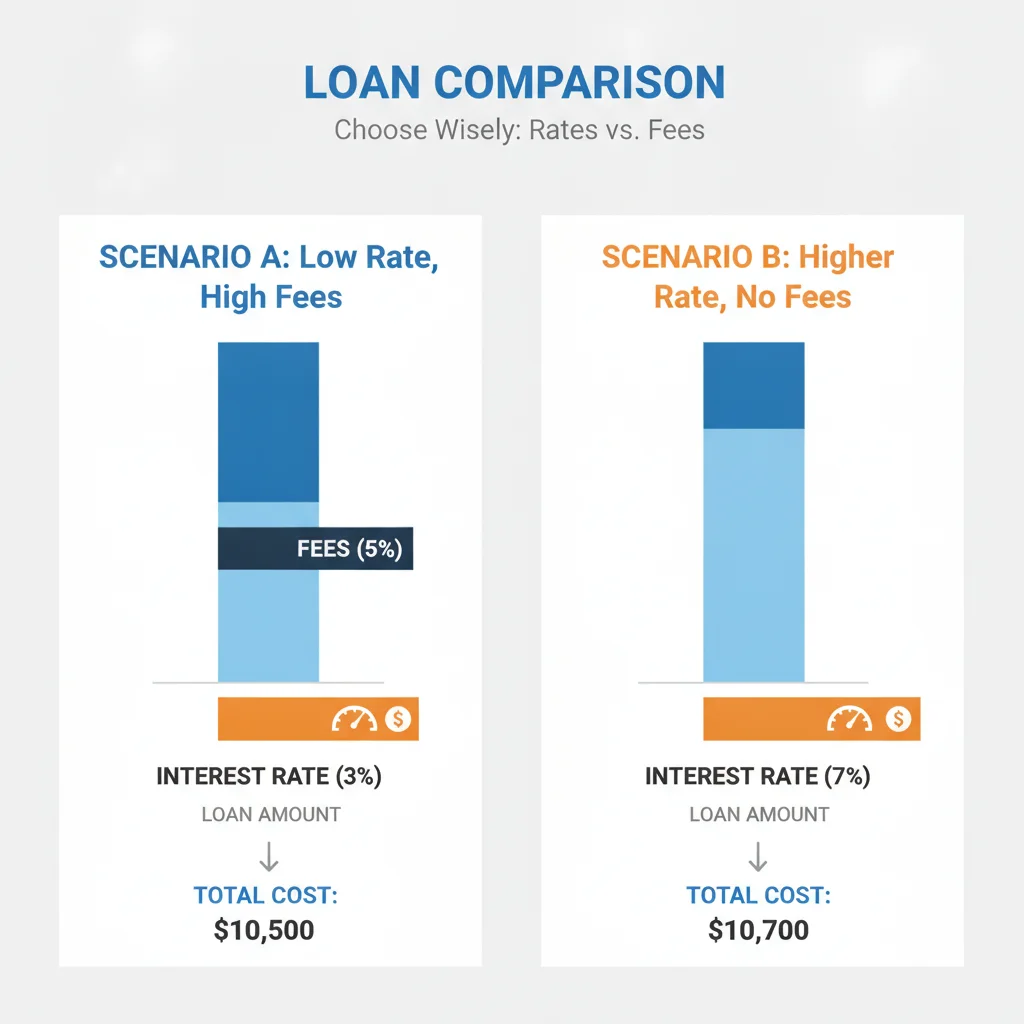
Federal law — specifically the Truth in Lending Act — requires lenders to show you the APR in writing before you sign. Always compare APRs across offers, not interest rates. If a dealer quotes you only an interest rate, ask for the APR in writing. If they resist, that's a red flag.
For a deeper dive on how APR is constructed and what it includes for first-time buyers, see Auto Loan Interest and APR: A Complete Guide for First-Time Car Buyers.
Federal Law Requires APR Disclosure
Under the Truth in Lending Act (TILA), lenders must disclose the APR and total finance charge in writing before you sign. This disclosure is called the TILA box or Regulation Z disclosure. Always find it and read it before agreeing to any loan terms.
Lease vs. Loan: Different Math, Same Caution
If you're comparing a lease to a loan, be aware that the money factor used in leases is not directly comparable to an APR without conversion. Multiply the money factor by 2,400 to get an approximate APR. A dealer quoting a money factor of 0.00250 is effectively charging around 6% — make sure you ask for it upfront.
Precomputed Interest Loans Are Less Common but Still Around
Most bank and credit union auto loans use simple interest. However, some subprime lenders and buy-here-pay-here dealerships still use precomputed interest. If you plan to pay your loan off early, confirm the interest method in writing — the difference can be hundreds of dollars.
How Simple Interest Works on Your Loan
The vast majority of auto loans — from banks, credit unions, and most captive lenders — use simple interest. Understanding this method is worth a few minutes of your time, because it directly affects how much you pay if you make extra payments or pay off early.
With simple interest, your charge is calculated daily on the remaining principal balance using this formula:
Daily interest = (Principal × Annual rate) ÷ 365
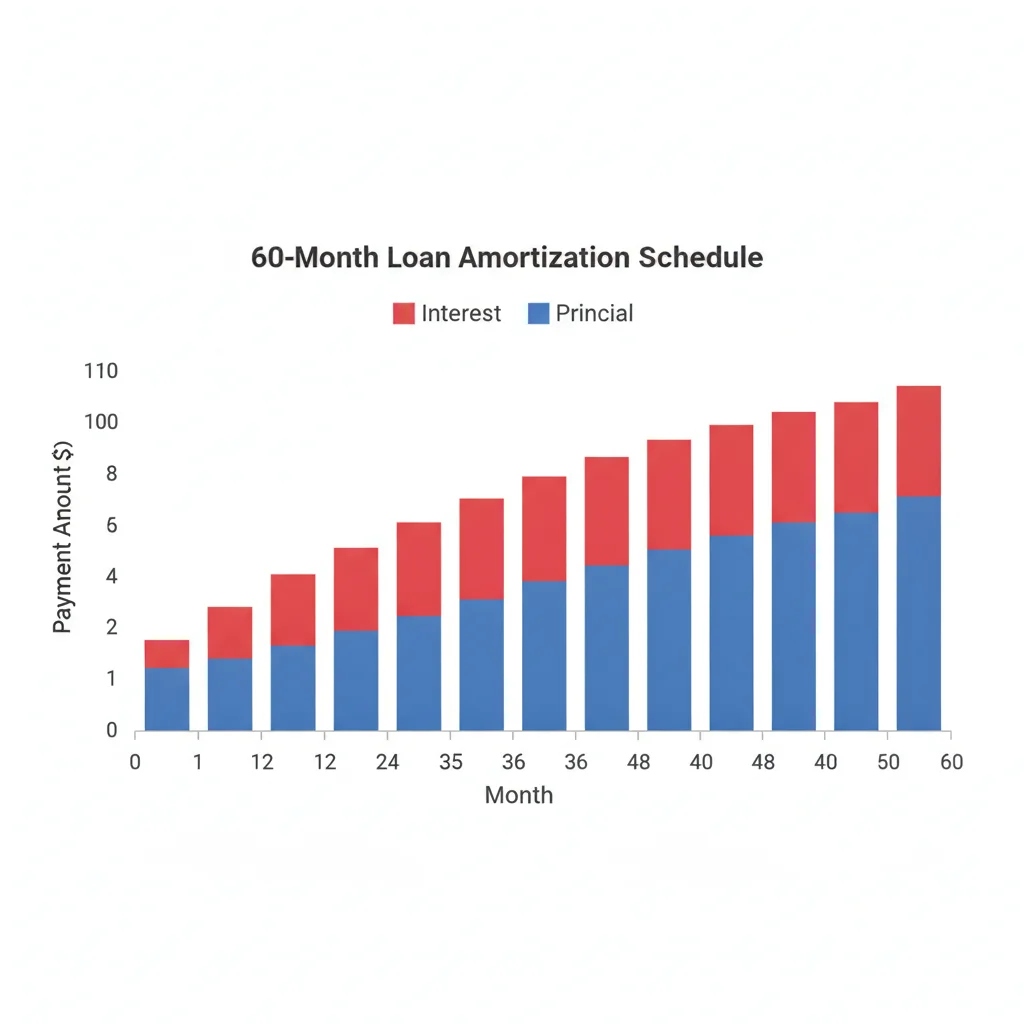
Each time you make a payment, it first covers the interest that has accrued since your last payment. Whatever's left reduces the principal. On your next payment cycle, interest is recalculated on that lower balance — so it's slightly less.
This creates two practical outcomes:
- Paying early saves you money. If your payment is due on the 15th and you pay on the 10th, five fewer days of interest accrue before the payment lands. Over 60 months of consistent early payments, that adds up.
- Paying late costs you money. Every day past your due date, more interest accrues. A pattern of late payments means a larger share of each payment goes to interest rather than principal — you pay down the loan more slowly.
Compare this with precomputed interest, where the total interest charge is locked in at origination and added to your balance upfront. In that structure, paying early may not reduce your interest cost unless the loan contract includes a rebate clause (often calculated using the Rule of 78s, a method that front-loads interest and is consumer-unfavorable). Always confirm which method your loan uses before you sign — and especially before you plan to pay it off early.
For a full breakdown of early payoff mechanics, see Auto Loan Early Payoff: Terms and Concepts Every Borrower Should Know.
Federal Law Requires APR Disclosure
Under the Truth in Lending Act (TILA), lenders must disclose the APR and total finance charge in writing before you sign. This disclosure is called the TILA box or Regulation Z disclosure. Always find it and read it before agreeing to any loan terms.
Lease vs. Loan: Different Math, Same Caution
If you're comparing a lease to a loan, be aware that the money factor used in leases is not directly comparable to an APR without conversion. Multiply the money factor by 2,400 to get an approximate APR. A dealer quoting a money factor of 0.00250 is effectively charging around 6% — make sure you ask for it upfront.
Precomputed Interest Loans Are Less Common but Still Around
Most bank and credit union auto loans use simple interest. However, some subprime lenders and buy-here-pay-here dealerships still use precomputed interest. If you plan to pay your loan off early, confirm the interest method in writing — the difference can be hundreds of dollars.
Amortization and the Finance Charge Explained
Amortization is the repayment schedule that converts your loan balance into equal monthly payments over a fixed term. It sounds mechanical — and it is — but there's an important pattern buried inside every amortization table that borrowers routinely miss.
In the early months of your loan, the vast majority of each payment is interest. As the loan matures, that ratio flips. By month 48 of a 60-month loan at 7%, most of your payment is reducing principal. This matters for one key reason: if you sell or trade in the car during the first two years, you'll have paid down very little of the principal, which means you may owe more than the car is worth — a condition known as being underwater or upside-down on your loan.
Here's an approximate breakdown for a $30,000 loan at 7% APR over 60 months (monthly payment: ~$594):
| Payment # | Interest Paid | Principal Paid | Remaining Balance |
|---|---|---|---|
| 1 | $175 | $419 | $29,581 |
| 12 | $148 | $446 | $24,975 |
| 30 | $103 | $491 | $17,226 |
| 48 | $50 | $544 | $8,138 |
| 60 | $3 | $591 | $0 |
The finance charge is the total dollar cost of all that interest across the life of the loan — in this example, roughly $5,640. You'll see this figure on your federal Truth in Lending disclosure. It's the clearest single number to compare across competing loan offers: the lower the finance charge, the less you're paying to borrow the money.
To understand how loan terms affect the total finance charge — and why a longer term almost always costs more even with the same rate — see Loan Terms Explained.
Dealer Rate Markups, Buy Rates, and What You're Not Always Told
This is where things get uncomfortable — but it's also where borrowers can recover the most money by knowing the terminology.
When a dealership submits your loan application to a lender, the lender responds with a buy rate — the lowest rate they'll accept for your credit profile. The dealer isn't required to pass that rate on to you. In most states, they're allowed to mark it up — typically by 1 to 2.5 percentage points — and pocket the difference as dealer reserve.
Here's what that looks like in real numbers:
- Lender approves you at a buy rate of 6.0%
- Dealer quotes you 7.9%
- On a $28,000 loan over 60 months, that 1.9-point markup costs you roughly $1,450 in extra interest
- The dealer keeps most or all of that as profit from the lender
You will never see the buy rate unless you ask — and the dealer is under no obligation to tell you. The best defense is arriving with a preapproval from a bank or credit union. When you already have a competing rate in hand, the dealer's financing has to beat it or match it — or you walk.
For a full glossary of preapproval offer terms, see Preapproval Terms Defined: APR, Loan Term, Principal, and More.
$1,400+
Extra cost from a 2-point dealer rate markup on a $30K loan
Calculated over a 60-month loan at 7% vs. 9% — illustrating the real dollar impact of dealer reserve markups.
43%
Of borrowers who don't know their loan's APR before signing
According to a 2022 Consumer Reports survey on auto financing transparency and borrower awareness.
72 months
Average new car loan term length in 2024
Experian State of the Automotive Finance Market Q1 2024 — longer terms mean more total interest even at the same rate.
120%+
LTV ratio common in longer-term used car loans
Loans exceeding the car's value are increasingly common, raising lender risk and often triggering higher interest rates.
Federal Law Requires APR Disclosure
Under the Truth in Lending Act (TILA), lenders must disclose the APR and total finance charge in writing before you sign. This disclosure is called the TILA box or Regulation Z disclosure. Always find it and read it before agreeing to any loan terms.
Lease vs. Loan: Different Math, Same Caution
If you're comparing a lease to a loan, be aware that the money factor used in leases is not directly comparable to an APR without conversion. Multiply the money factor by 2,400 to get an approximate APR. A dealer quoting a money factor of 0.00250 is effectively charging around 6% — make sure you ask for it upfront.
Precomputed Interest Loans Are Less Common but Still Around
Most bank and credit union auto loans use simple interest. However, some subprime lenders and buy-here-pay-here dealerships still use precomputed interest. If you plan to pay your loan off early, confirm the interest method in writing — the difference can be hundreds of dollars.
Full Glossary Reference: Interest Terms at a Glance
Use this reference whenever you encounter a term on a loan document, dealership worksheet, or lender disclosure. These are the definitions that matter in practice — not the textbook versions.
APR (Annual Percentage Rate)
The true yearly cost of borrowing, expressed as a percentage. Unlike the interest rate alone, APR folds in most fees — like origination charges — so it's the number you should compare across lenders.
Simple Interest
An interest calculation method where your charge is based on the outstanding principal balance each day. Most auto loans use simple interest, which means paying early reduces what you owe in interest.
Amortization
The process of paying off a loan through scheduled payments over time. Each payment covers some interest and some principal, with the interest share shrinking and the principal share growing as the loan matures.
Finance Charge
The total dollar amount you pay to borrow money — interest plus any included fees — expressed as a lump sum rather than a percentage. You'll find this figure on your federal Truth in Lending disclosure.
Principal
The original amount borrowed, or the remaining unpaid balance. Interest is calculated on the principal, so a larger principal means more interest costs, all else being equal.
Money Factor
A lease-specific decimal figure (e.g., 0.00125) that represents the financing cost of a lease. Multiply it by 2,400 to convert it to a rough APR equivalent for comparison purposes.
Precomputed Interest
An interest method where the total interest is calculated upfront and added to the loan balance at origination. Unlike simple interest loans, paying early may not reduce the interest you owe unless the contract includes a rebate provision.
Buy Rate
The lowest interest rate a lender will approve for a borrower — the rate quoted directly to the dealer. Dealers are often allowed to mark this rate up and keep the difference as profit, which is called the dealer reserve.
Dealer Reserve (Rate Markup)
The additional percentage points a dealer adds on top of the buy rate before quoting you a final rate. This markup can add thousands to your total finance charge without your knowledge.
Capitalized Cost Reduction
In a lease, any upfront payment — down payment, trade-in equity, or rebate — that reduces the amount being financed. A lower capitalized cost directly reduces your monthly lease payment.
Loan-to-Value (LTV)
The ratio of the loan amount to the vehicle's market value. A high LTV (e.g., 120%) means you owe more than the car is worth, which increases lender risk and often results in a higher interest rate.
Effective Interest Rate
The real return on a loan when compounding is taken into account, as opposed to the stated nominal rate. For most simple-interest auto loans, the effective rate closely tracks the nominal rate.
If you want the broader picture of auto loan vocabulary — including LTV, gap insurance, and trade-in terms — the Auto Loan Glossary: 25 Terms Every Borrower Should Know covers all 25 most common contract terms in plain language.
CFPB Auto Loan Toolkit
The Consumer Financial Protection Bureau's official guide walks through auto financing disclosures, your rights under TILA, and how to spot unfair lending practices.
Auto Loan Calculator
Plug in your loan amount, term, and APR to see exactly how much interest you'll pay over the life of the loan and how payments break down each month.
Experian Automotive Finance Report
Quarterly industry data on average APRs, loan terms, and credit tier breakdowns — useful for benchmarking the rate you're being offered against what borrowers like you typically receive.
Preapproval Terms Defined
A quick-reference companion glossary covering APR, principal, loan term, and other key terms you'll see in a preapproval offer — before you ever walk into a dealership.
The bottom line: every term on your loan offer exists for a reason, and the ones tied to interest are the ones with the most direct impact on what you pay. Spend five minutes with this glossary before you sit down at any finance desk, and you'll walk out knowing whether the numbers you're seeing make sense — or whether you should be asking harder questions.
All claims are backed by peer-reviewed research. Sources on request.