Key Takeaways
Lower monthly payment improves short-term cash flow
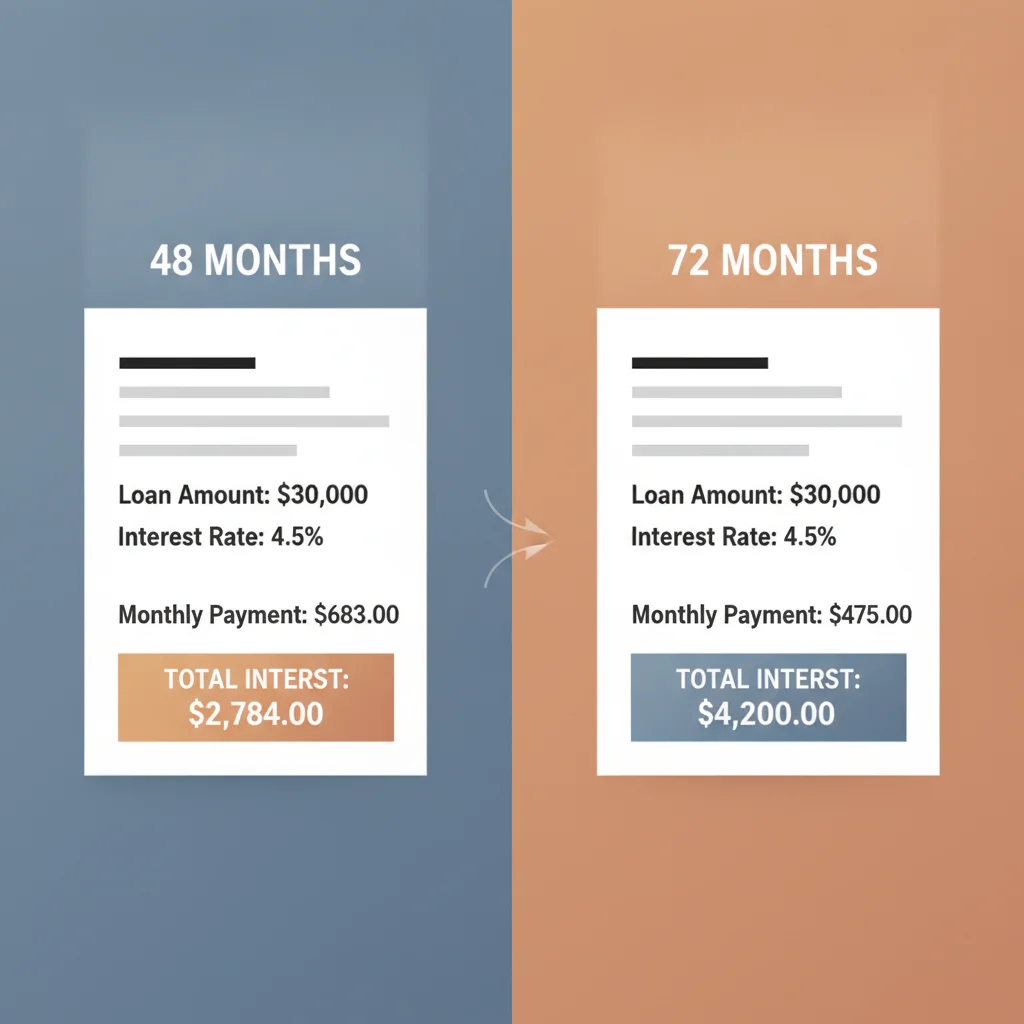
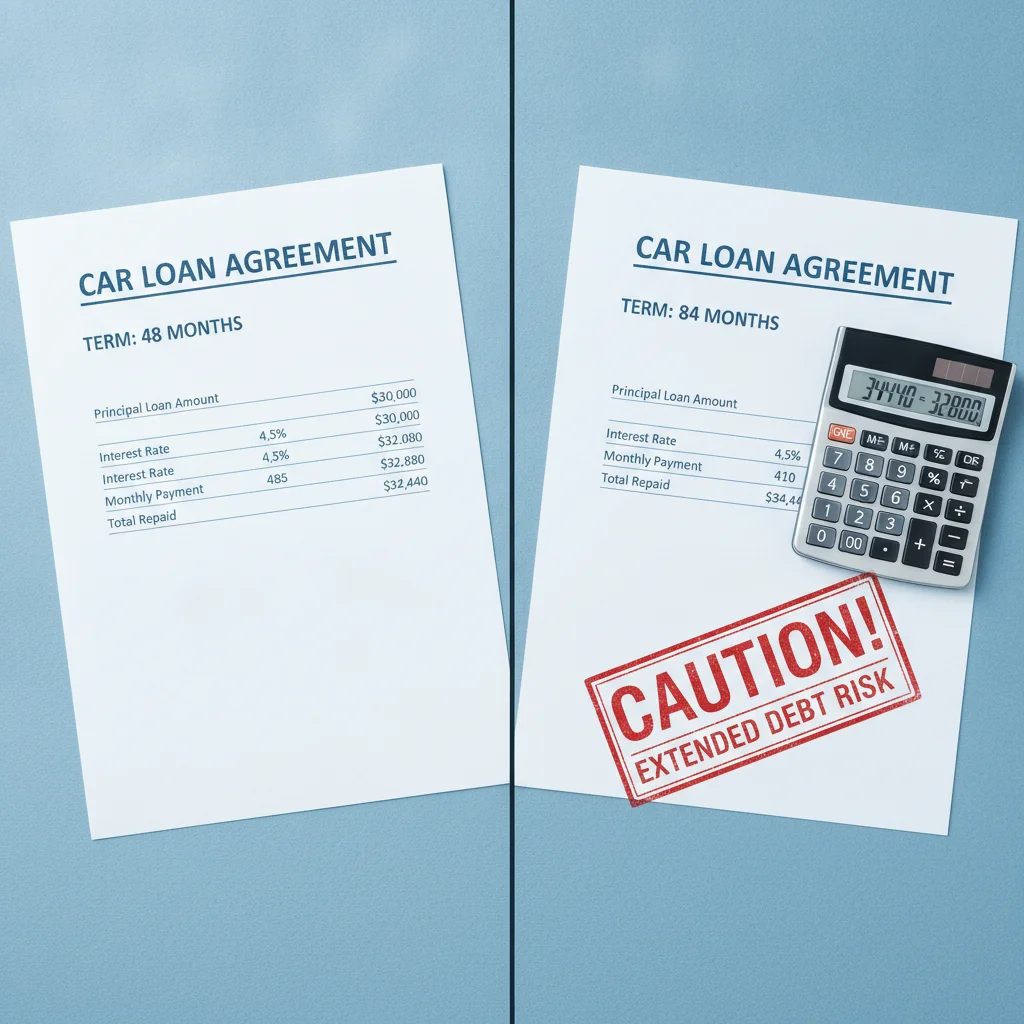
Stretching a loan from 48 to 72 months can reduce your monthly obligation by $100–$150 or more, which may be the difference between making payments consistently and falling behind.
Makes vehicle ownership accessible when options are limited
For subprime borrowers who don't qualify for lower-rate shorter-term loans, a longer term may be the only path to financing reliable transportation for work or family needs.
Reduces debt-to-income pressure on monthly budget
A lower monthly auto payment leaves more room in your budget for other obligations, reducing the risk of missed payments across all your accounts — which matters if you're rebuilding credit.
Can serve as a bridge while credit score improves
If you plan to refinance after 12–18 months of on-time payments, a longer-term loan at a higher rate can function as a temporary structure rather than a long-term commitment.
Preserves cash for emergency fund or down payment savings
Keeping monthly payments lower can allow you to maintain or build a savings buffer, which reduces the risk of a single financial setback cascading into missed loan payments.
Total interest paid is dramatically higher
At a subprime APR of 18%, extending from 48 to 84 months on a $20,000 loan adds over $7,000 in interest charges — nearly 37% of the original loan amount paid purely in financing costs.
High APR compounds every extra month exponentially
Unlike prime borrowers at 5–6% APR, subprime borrowers face rates where even a 12-month term extension can add thousands in interest that a lower-rate borrower would never encounter.
Greater risk of going underwater on the loan
Depreciation outpaces early principal paydown on long loans, meaning you can owe significantly more than the car is worth for the first three or more years of an 84-month term.
Extended financial exposure to a depreciating asset
Committing to seven years of payments on a vehicle that may require significant repairs by year five or six creates a collision between rising ownership costs and ongoing loan obligations.
Locks you into a vehicle longer than may be practical
Life changes — a growing family, a new job across the country, an unexpected disability — may require a different vehicle, but negative equity can make selling or trading in the car very costly.
Difficult to refinance out of if credit doesn't improve
Many borrowers take long terms intending to refinance but never qualify for a better rate, leaving them stuck in the original high-cost structure for the full term.
Encourages buying more car than is financially appropriate
Long terms can make an expensive vehicle appear affordable based on monthly payment alone, leading borrowers to overextend on price rather than addressing the real affordability question.
Our Verdict
A longer auto loan term is a tool, not a lifeline — and for borrowers with bad credit, it's a particularly sharp one. The payment relief is real, but so is the added interest, the equity trap, and the years of financial exposure. Used carefully and with a clear exit strategy, a 72-month loan can be manageable. An 84-month term, however, rarely makes mathematical sense for subprime borrowers when the full cost is laid out.
A longer loan term is best suited for borrowers who have exhausted other options, have a concrete plan to pay extra each month or refinance once their credit improves, and are buying a reliable vehicle that won't depreciate faster than they can build equity.
Why Lenders Push Longer Terms on Bad Credit Borrowers
If you've walked into a dealership with a credit score below 620, you've probably heard a version of this pitch: "We can get you into something today — just go with the 84-month option and your payments are manageable." It sounds like they're doing you a favor. They're not — at least not entirely.
Subprime lenders and dealership finance offices often default to longer loan terms because they solve an immediate problem: affordability. Stretching a $22,000 loan over 84 months instead of 48 months can drop the monthly payment by $150 or more. That makes the deal work on paper and keeps the sale moving forward.
But there's a structural reason this works so well for the lender too. A longer term means more months of interest charges accumulating on a balance that's already carrying a high APR. For a borrower with poor credit, interest rates of 15%, 18%, or even 22% aren't unusual. At those rates, an extended term doesn't just delay payoff — it multiplies the lender's return significantly.

Understanding this dynamic isn't about demonizing lenders. It's about recognizing that the term length offered to you isn't neutral advice — it's a financial product with costs that fall almost entirely on your side of the table. That's why it pays to go in knowing exactly what you're agreeing to. See our full guide to loan terms for a grounding overview of how these mechanics work before you sit down to negotiate.
The Real Cost of Stretching Your Loan: A Concrete Example
Numbers clarify what general warnings can't. Let's look at a realistic scenario for a subprime borrower financing a used car.
Assume you're borrowing $20,000 at an APR of 18% — a rate that's within normal range for someone with a credit score in the low-to-mid 500s.
| Loan Term | Monthly Payment | Total Interest Paid | Total Cost |
|---|---|---|---|
| 48 months | $588 | $8,224 | $28,224 |
| 60 months | $508 | $10,480 | $30,480 |
| 72 months | $456 | $12,832 | $32,832 |
| 84 months | $424 | $15,616 | $35,616 |
Going from 48 to 84 months saves you $164 per month — but costs you an additional $7,392 in interest over the life of the loan. That's nearly 37% of the original loan amount paid purely in interest charges above what the 48-month borrower pays.
This is the core trade-off. Monthly payment relief is real and sometimes necessary. But it comes at a price that's easy to underestimate when you're focused on making next month's budget work. For a deeper look at how APR and term length interact across scenarios, see how term length interacts with APR.
$7,392
Extra interest: 48 vs. 84 months at 18% APR
Based on a $20,000 loan at 18% APR — a typical subprime rate — the difference in total interest between a 48-month and 84-month term.
32%
Share of new auto loans with terms over 72 months
According to Experian's State of the Automotive Finance Market report, approximately one in three auto loans in recent years has carried a term longer than six years.
23%
Average first-year vehicle depreciation
Most vehicles lose roughly 15–25% of their value within the first 12 months of ownership, according to data from Carfax and various automotive valuation services.
18–22%
Typical APR range for subprime auto borrowers
Borrowers with credit scores below 620 commonly face interest rates in this range from direct lenders and dealership finance offices, per Experian and CFPB lending data.
Pros of a Longer Loan Term for Bad Credit Borrowers
It would be misleading to treat all long-term loans as automatically wrong. There are real, legitimate reasons a subprime borrower might choose 72 or even 84 months. Here's an honest accounting of the advantages.
Lower monthly payment improves short-term cash flow
Stretching a loan from 48 to 72 months can reduce your monthly obligation by $100–$150 or more, which may be the difference between making payments consistently and falling behind.
Makes vehicle ownership accessible when options are limited
For subprime borrowers who don't qualify for lower-rate shorter-term loans, a longer term may be the only path to financing reliable transportation for work or family needs.
Reduces debt-to-income pressure on monthly budget
A lower monthly auto payment leaves more room in your budget for other obligations, reducing the risk of missed payments across all your accounts — which matters if you're rebuilding credit.
Can serve as a bridge while credit score improves
If you plan to refinance after 12–18 months of on-time payments, a longer-term loan at a higher rate can function as a temporary structure rather than a long-term commitment.
Preserves cash for emergency fund or down payment savings
Keeping monthly payments lower can allow you to maintain or build a savings buffer, which reduces the risk of a single financial setback cascading into missed loan payments.
The key is that these pros are situational. They represent breathing room, not a free lunch. If you're leaning on a longer term to make an expensive car fit your budget, that's a warning sign — not a solution. But if you're using it strategically while building toward better credit or a higher income, it can be a rational tool. See when a longer term actually makes financial sense for a breakdown of those specific circumstances.
Cons of a Longer Loan Term for Bad Credit Borrowers
Now for the harder conversation. The disadvantages of extended loan terms hit subprime borrowers harder than they hit prime borrowers, because high interest rates amplify every negative effect.
Total interest paid is dramatically higher
At a subprime APR of 18%, extending from 48 to 84 months on a $20,000 loan adds over $7,000 in interest charges — nearly 37% of the original loan amount paid purely in financing costs.
High APR compounds every extra month exponentially
Unlike prime borrowers at 5–6% APR, subprime borrowers face rates where even a 12-month term extension can add thousands in interest that a lower-rate borrower would never encounter.
Greater risk of going underwater on the loan
Depreciation outpaces early principal paydown on long loans, meaning you can owe significantly more than the car is worth for the first three or more years of an 84-month term.
Extended financial exposure to a depreciating asset
Committing to seven years of payments on a vehicle that may require significant repairs by year five or six creates a collision between rising ownership costs and ongoing loan obligations.
Locks you into a vehicle longer than may be practical
Life changes — a growing family, a new job across the country, an unexpected disability — may require a different vehicle, but negative equity can make selling or trading in the car very costly.
Difficult to refinance out of if credit doesn't improve
Many borrowers take long terms intending to refinance but never qualify for a better rate, leaving them stuck in the original high-cost structure for the full term.
Encourages buying more car than is financially appropriate
Long terms can make an expensive vehicle appear affordable based on monthly payment alone, leading borrowers to overextend on price rather than addressing the real affordability question.
The combination of high APR and long term is what makes this particularly punishing for subprime borrowers. A prime borrower at 5% APR can afford to stretch a term without catastrophic consequences. At 18% or 20%, every extra month is materially expensive. The case against always picking the longest term available covers this logic in detail if you want to pressure-test your thinking.
Going Underwater: The Equity Risk Unique to Long Terms
One of the most serious risks of long loan terms is one that doesn't show up on a monthly budget at all: negative equity, also called being "underwater" on your loan. This means you owe more on the car than it's currently worth.
Here's why this happens. Cars depreciate — most new vehicles lose 15–25% of their value in the first year alone, and used vehicles continue to decline. At the same time, in the early months of a long-term loan, your payments are weighted heavily toward interest rather than principal. You're paying a lot to the lender, but your actual loan balance is dropping slowly.
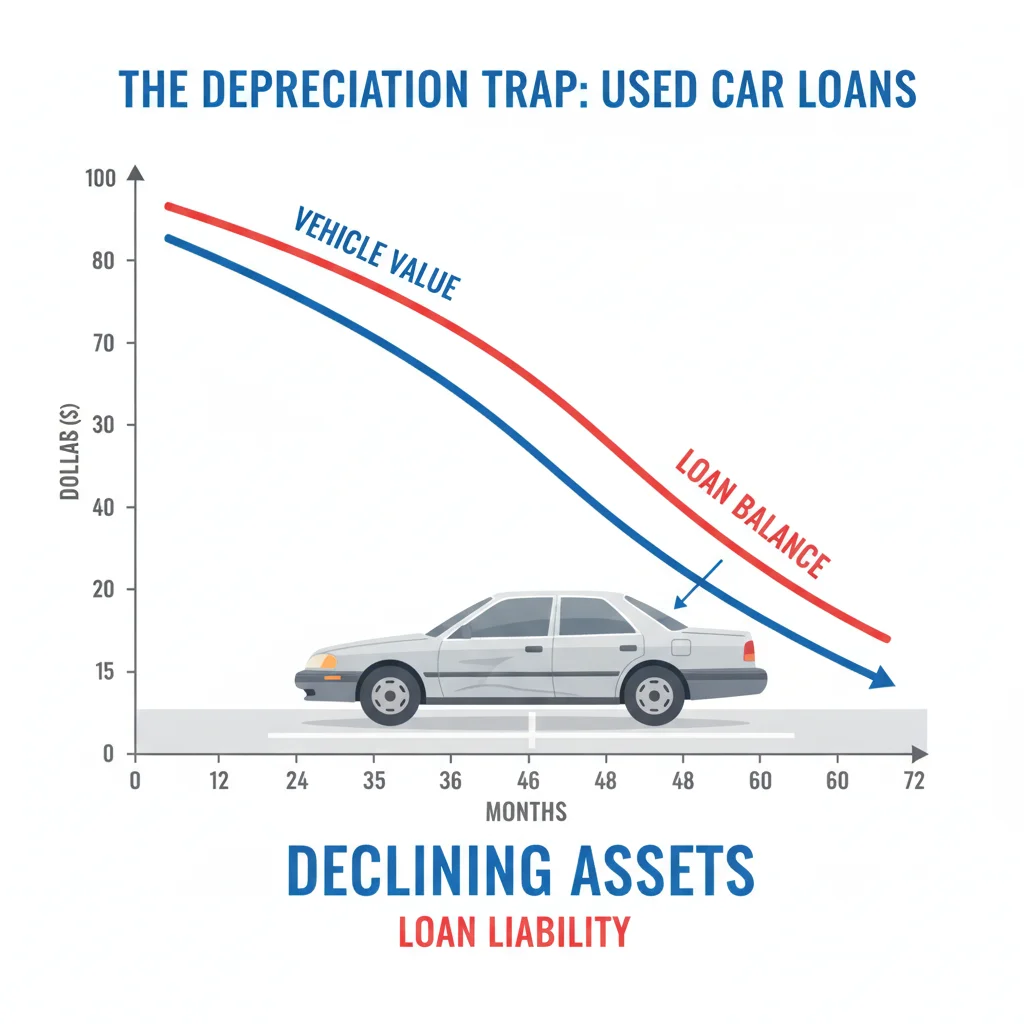
The result: the gap between what you owe and what the car is worth can widen for the first two to three years of an 84-month loan. If you need to sell the car, get into an accident where the car is totaled, or need to trade in during that period, you may owe thousands more than the vehicle is worth — money you'll have to pay out of pocket or roll into a new loan (which compounds the problem).
This risk is especially acute for bad credit borrowers because they often have less financial cushion to absorb a sudden gap. Understanding how depreciation and term length interact is critical — what happens to your equity when you choose a longer loan term walks through this in detail.
What Is GAP Insurance and When Does It Help?
Guaranteed Asset Protection (GAP) insurance covers the difference between what you owe on your loan and what your car is worth if it's totaled or stolen. For borrowers choosing long loan terms who are at risk of going underwater, GAP insurance can provide meaningful protection — but it has a cost, typically $200–$900 depending on the policy and lender. It's worth considering if you're putting little or nothing down and taking a 72- or 84-month term. However, GAP insurance doesn't eliminate the underlying equity problem; it just limits the financial fallout if the worst happens.
Smarter Alternatives to Simply Extending the Term
If your goal is an affordable monthly payment, extending the loan term is just one lever — and often not the best one. Here are strategies that can achieve a similar result with less long-term cost.
Increase Your Down Payment
Every dollar you put down up front is a dollar you don't pay interest on. A $2,000 larger down payment at 18% APR over 72 months saves you more than $1,000 in interest charges alone. If you can scrape together additional cash — through savings, selling personal items, or delaying the purchase — a larger down payment has compounding benefits. It also reduces your loan-to-value ratio, which can make you a more attractive borrower and occasionally unlock a slightly better rate. Why down payment size matters covers these mechanics thoroughly.
Buy a Less Expensive Vehicle
This one's obvious but often resisted. Choosing a car that's $3,000–$5,000 less expensive can lower your payment more meaningfully than stretching from 60 to 84 months — and it does it without adding years of interest. If you're genuinely at the edge of affordability, the vehicle price is often the real variable that needs adjusting, not the term length.
Plan to Pay Extra Each Month
If you do take a longer term, commit to paying more than the minimum when your budget allows. Even $50–$100 extra per month applied to principal can meaningfully reduce your total interest paid and shorten your effective loan duration. Most auto loans don't have prepayment penalties, so this flexibility is already available to you. Check strategies for getting out of a long loan without refinancing for practical approaches.
Refinance Once Your Credit Improves
A longer term can serve as a bridge strategy if you're actively working on your credit score. After 12–18 months of on-time payments, your credit may have improved enough to qualify for a lower rate — at which point refinancing to a shorter term could save you thousands. The key is having this plan in place before you sign, not as an afterthought. Factor in whether your lender allows refinancing and what fees might apply.
When you're weighing these trade-offs holistically, it also helps to understand how your loan structure affects your broader financial picture. How loan term length affects your debt-to-income ratio explains why lenders look beyond the monthly payment when evaluating your application.
How to Evaluate Whether a Longer Term Is Right for Your Situation
There's no universal rule that 84-month loans are always wrong or that 48-month loans are always right. What matters is whether the decision is deliberate and informed. Ask yourself these questions before signing.
- What is the total cost of the loan, not just the monthly payment? Get the full interest figure from the lender and make sure you understand it.
- Am I extending the term because I need the car or because I want more car than I can afford? There's a meaningful difference between those two situations.
- What is the vehicle's likely value at the midpoint of the loan? If you're 36 months into an 84-month term, will you still owe more than the car is worth?
- Do I have a plan if my financial situation changes? Job loss, medical expenses, or life changes can make an already-stretched payment impossible.
- Can I realistically make additional principal payments? If yes, a longer term with self-imposed discipline can work. If no, be honest about that.
Also consider the vehicle itself. A longer loan on a reliable, lower-mileage vehicle is less risky than an 84-month commitment on a high-mileage car with an uncertain service history. Repair costs in years five through seven on an aging vehicle can collide painfully with loan payments that haven't yet ended.
For a side-by-side comparison of how different term lengths play out across all these dimensions, short vs. long auto loan terms is worth reviewing, as is the specific breakdown of 36, 48, 60, 72, and 84-month loans.

All claims are backed by peer-reviewed research. Sources on request.