| Recommended minimum down payment (new car) | 20% (Commonly cited by consumer finance advisors) |
| Recommended minimum down payment (used car) | 10% (Commonly cited by consumer finance advisors) |
| Average new car loan amount (2024) | ~$40,800 (Experian State of the Automotive Finance Market, 2024) |
| Average new car loan APR (2024) | ~7.1% (Experian State of the Automotive Finance Market, 2024) |
| Average loan term (new car) | 68.6 months (Experian State of the Automotive Finance Market, 2024) |
| Typical first-year new car depreciation | 15–25% (Edmunds depreciation research) |
| LTV threshold lenders generally prefer | ≤ 80% |
| Interest saved: 5% vs. 20% down (on $35K at 7%, 60 mo.) | $930 (Calculated example — see article tables) |
Why Down Payment Math Matters More Than Most Buyers Realize
Most car buyers think about the down payment as a hurdle — a chunk of cash they need to hand over before driving off the lot. What they miss is that this single number reshapes nearly every financial outcome of the purchase: the loan amount, the interest paid over time, the monthly obligation, and even the risk of going underwater on the loan.
This article walks through the actual arithmetic so you can see, in concrete terms, what happens when you put 5%, 10%, or 20% down on the same vehicle. The differences are larger than most people expect, and understanding them puts you in a much stronger negotiating and planning position.
What a car down payment actually does to your loan covers the conceptual mechanics in depth — here, we focus on the numbers themselves.
| Recommended minimum down payment (new car) | 20% (Commonly cited by consumer finance advisors) |
| Recommended minimum down payment (used car) | 10% (Commonly cited by consumer finance advisors) |
| Average new car loan amount (2024) | ~$40,800 (Experian State of the Automotive Finance Market, 2024) |
| Average new car loan APR (2024) | ~7.1% (Experian State of the Automotive Finance Market, 2024) |
| Average loan term (new car) | 68.6 months (Experian State of the Automotive Finance Market, 2024) |
| Typical first-year new car depreciation | 15–25% (Edmunds depreciation research) |
| LTV threshold lenders generally prefer | ≤ 80% |
| Interest saved: 5% vs. 20% down (on $35K at 7%, 60 mo.) | $930 (Calculated example — see article tables) |
The Core Formula: Loan Amount, LTV, and What They Drive
Every calculation in auto financing starts with the loan amount — the vehicle price minus your down payment. From that one number, two critical metrics flow:
- Loan-to-Value (LTV) ratio: Your loan amount divided by the car's value, expressed as a percentage.
- Total interest cost: Determined by loan amount × interest rate × loan term length.
Here's a simple baseline scenario to anchor all the comparisons that follow:
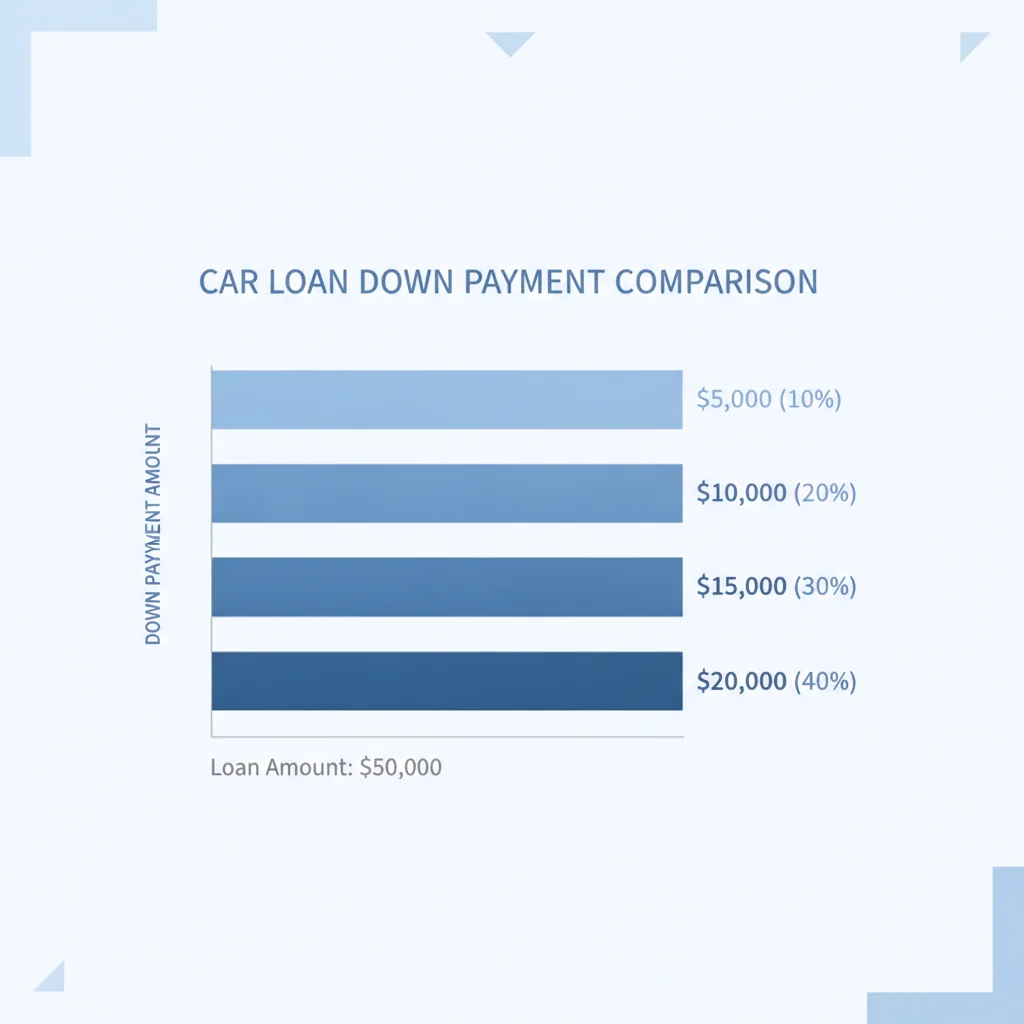
| Scenario | Vehicle Price | Down Payment | Down % | Loan Amount | LTV Ratio |
|---|---|---|---|---|---|
| Minimal | $35,000 | $1,750 | 5% | $33,250 | 95% |
| Moderate | $35,000 | $3,500 | 10% | $31,500 | 90% |
| Standard | $35,000 | $7,000 | 20% | $28,000 | 80% |
| Strong | $35,000 | $10,500 | 30% | $24,500 | 70% |
Notice that going from 5% to 20% down cuts the loan amount by $5,250 — that's $5,250 that never accumulates interest. The LTV drop from 95% to 80% also matters to lenders: it signals lower default risk, which is one reason borrowers with larger down payments sometimes qualify for better rates. See how lenders evaluate your down payment for the full picture on risk signaling.
Loan-to-Value (LTV) Ratio
The loan amount divided by the vehicle's market value, expressed as a percentage. A lower LTV means less lender risk; lenders typically prefer LTVs at or below 80%.
Principal
The original loan amount you borrow — essentially the vehicle price minus your down payment. Interest is calculated on this balance, so reducing principal reduces total interest paid.
Amortization
The process of paying off a loan through regular installment payments. Early payments go mostly toward interest; later payments go mostly toward principal, following a fixed schedule.
Upside-Down (Underwater)
A condition where you owe more on a loan than the vehicle is currently worth. Common when down payments are small and depreciation is steep, especially in the first two years.
APR (Annual Percentage Rate)
The annualized cost of borrowing, expressed as a percentage. For auto loans, APR includes the interest rate and, in some cases, lender fees folded into the cost.
Depreciation
The decline in a vehicle's market value over time. New cars typically lose 15–25% of their value in year one, making early loan equity especially important.
The Interest Math: Running the Real Numbers
Let's apply a 7% APR and a 60-month (5-year) loan term to each scenario above. These are realistic numbers for a buyer with average-to-good credit in today's market.
The monthly payment formula for a standard amortized loan is:
M = P × / Where P = principal (loan amount), r = monthly interest rate (APR ÷ 12), and n = number of payments.
| Down % | Loan Amount | Monthly Payment | Total Paid | Total Interest | Interest Saved vs. 5% Down |
|---|---|---|---|---|---|
| 5% | $33,250 | $657 | $39,420 | $6,170 | — |
| 10% | $31,500 | $623 | $37,380 | $5,880 | $290 |
| 20% | $28,000 | $554 | $33,240 | $5,240 | $930 |
| 30% | $24,500 | $485 | $29,100 | $4,600 | $1,570 |
The $1,570 in interest savings between 5% and 30% down is real money — but notice that those savings don't account for any rate improvement you might earn from a lower LTV ratio. If a 20% down payment nudges your rate from 7% to 6.5%, the savings compound further.
$930
Interest saved going from 5% to 20% down
Based on a $35,000 vehicle financed at 7% APR over 60 months — a realistic scenario for average-credit buyers.
25%
Value a new car can lose in year one
According to Edmunds depreciation research, some new models shed 20–25% of their value within 12 months of purchase.
$103/month
Monthly payment difference: 5% vs. 20% down
Calculated on a $35,000 vehicle at 7% APR over 60 months — a $657 vs. $554 monthly payment.
68.6 months
Average new car loan term in 2024
According to Experian's State of the Automotive Finance Market report, loan terms have grown steadily longer over the past decade.
80%
LTV ratio most lenders target as their ceiling
Lenders generally view LTV ratios above 80% as elevated risk, which can affect approval, rate, and required loan terms.
For a side-by-side look at the most extreme comparison, no down payment vs. 20% down lays out the full cost difference with detailed numbers.
LTV and the Underwater Loan Problem
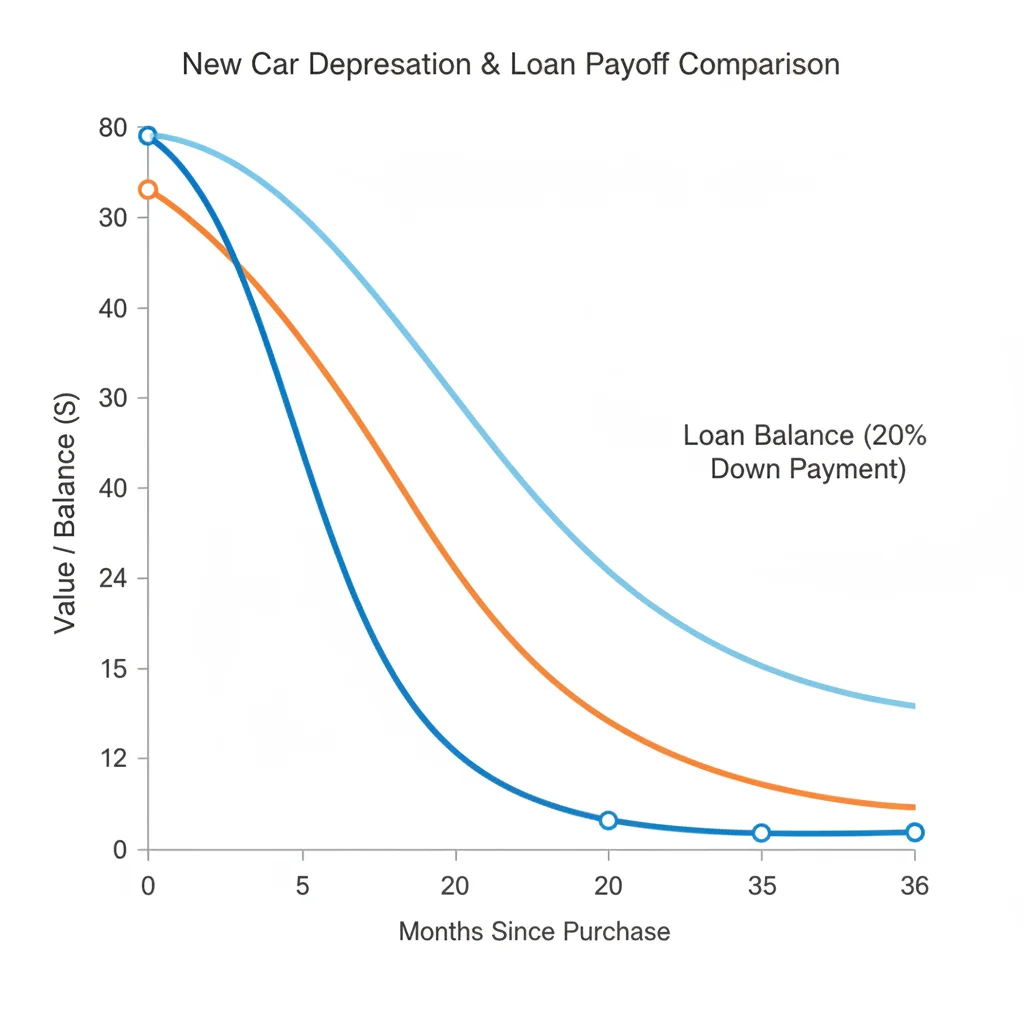
Here's where the math gets particularly important for new car buyers: depreciation. A new vehicle loses roughly 15–20% of its value the moment it leaves the lot, and another 10–15% by the end of year one. That means a $35,000 car might be worth $28,000 to $29,750 after just 12 months of ownership.
Now look at what that does to your loan balance depending on your down payment:
| Down % | Loan Balance at 12 Months | Estimated Car Value at 12 Months | Equity / (Deficit) |
|---|---|---|---|
| 5% | $28,560 | $28,700 | +$140 (barely above water) |
| 10% | $27,060 | $28,700 | +$1,640 |
| 20% | $24,065 | $28,700 | +$4,635 |
| 30% | $21,065 | $28,700 | +$7,635 |
At just 5% down, you start year two with almost zero cushion. If you need to sell or trade the car, you might owe more than it's worth — a condition called being upside-down or underwater on the loan. With 20% down, you have meaningful equity from the start.
This equity gap also matters for insurance purposes. If a totaled car is worth $28,700 but you owe $28,560, a standard insurance payout may not fully cover your loan balance. Putting too little down quietly inflates your total cost in ways that go beyond interest — the equity deficit is one of them.
GAP Insurance Covers the Underwater Gap
If you're putting a small amount down on a new car and concerned about going underwater, Guaranteed Asset Protection (GAP) insurance can cover the difference between what you owe and what your car is worth if it's totaled or stolen. It's typically most cost-effective to purchase GAP from an insurer rather than rolling it into the loan, where it would itself accrue interest.
Rate Tiers Often Shift at LTV Thresholds
Many lenders set rate tiers at specific LTV levels — commonly 80%, 90%, and 100%. If your down payment puts you just above one of these thresholds, adding a relatively small additional amount to your down payment may unlock a lower rate and produce outsized savings. Always ask your lender what their LTV cutoffs are before finalizing your down payment amount.
Trade-In Value Counts as a Down Payment
If you have a vehicle to trade in, its equity (trade-in value minus any remaining loan balance) typically applies directly to your down payment. A $5,000 trade-in equity has the same mathematical effect as $5,000 in cash toward your down payment — reducing your loan principal and LTV ratio in exactly the same way.
How Down Payment Interacts With Loan Term
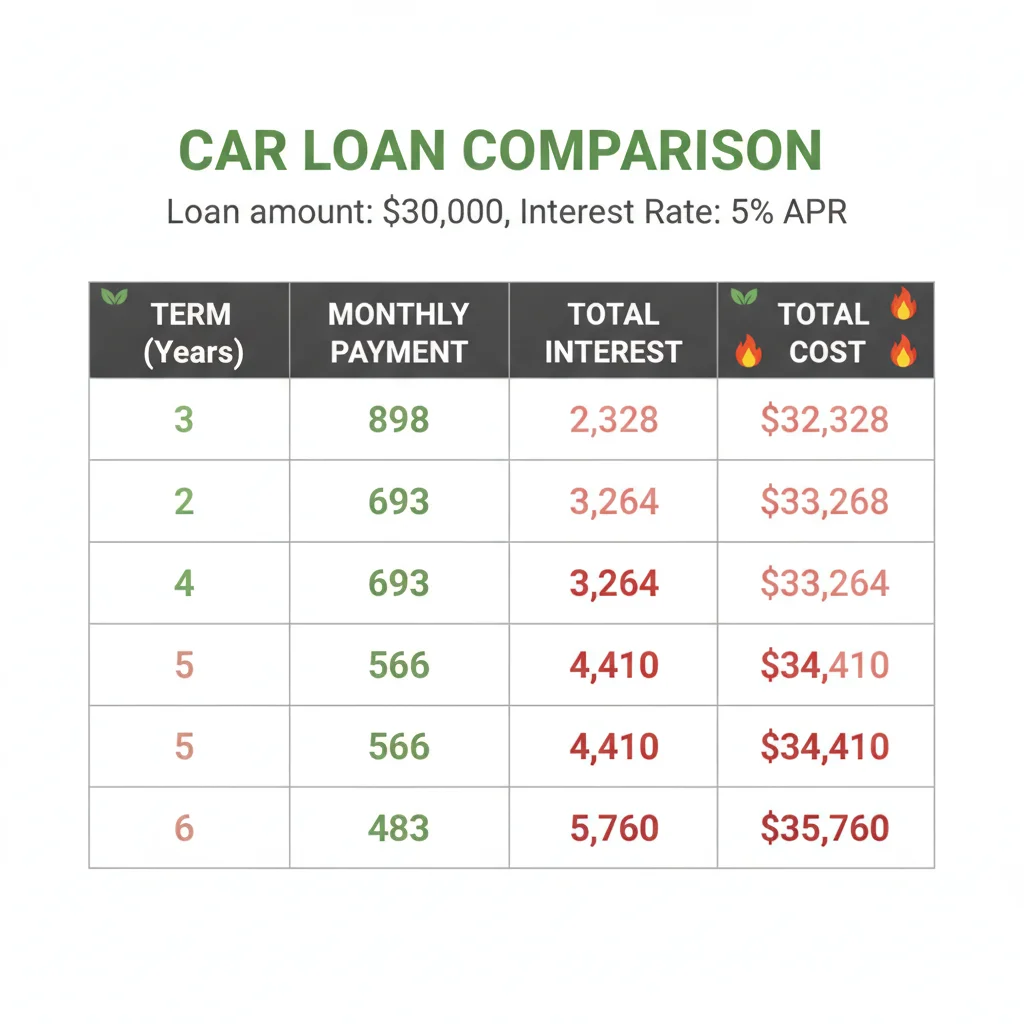
Loan term and down payment are the two levers that most directly control your monthly payment — and they interact with each other in ways that aren't always obvious. Stretching a loan from 48 months to 72 months lowers the monthly payment, but it also means interest accumulates for two more years. A larger down payment can offset the need to stretch the term.
Using the 20% down scenario ($28,000 loan at 7% APR), here's how term length changes the math:
| Loan Term | Monthly Payment | Total Interest Paid |
|---|---|---|
| 36 months | $865 | $3,140 |
| 48 months | $670 | $4,160 |
| 60 months | $554 | $5,240 |
| 72 months | $477 | $6,344 |
Moving from a 60-month to a 72-month term saves $77/month but costs an extra $1,104 in interest. Now consider the same math with only 5% down — the interest penalty for a long term on a larger principal is significantly worse. The combination of a small down payment and a long loan term is where buyers get into the most financial trouble.
How loan term and down payment work together explores this dynamic in full detail. And for a look at just the monthly payment side of the equation, the relationship between down payment size and monthly payment provides a focused breakdown.
Before finalizing either number, it's worth reading what to know before deciding how much to put down — especially if you're balancing your down payment against other financial priorities like an emergency fund.
When More Down Pays Off Most — and When It Matters Less
The math above shows a consistent pattern: more down equals less total cost. But the magnitude of that benefit depends on several variables.
More Down Pays Off Most When:
- Your interest rate is high. At 10% or 12% APR — common for buyers with challenged credit — a $5,000 larger down payment saves dramatically more interest than the same $5,000 at 4% APR. The rate multiplies every dollar of principal.
- Your loan term is long. A 72-month loan gives interest 72 months to compound on your principal. Reducing that principal through a higher down payment amplifies savings over time.
- You're buying new. New cars depreciate faster in the first two years. A bigger down payment keeps you from going underwater during that high-depreciation window. Down payments on new vs. used cars explains why the rules shift depending on vehicle age.
- You have bad credit. A large down payment can directly improve your approval odds and in some cases unlock a lower rate tier. How a large down payment affects approval odds with bad credit walks through those scenarios specifically.
The Benefit Is Smaller When:
- Your rate is already low (manufacturer incentive rates at 0–2% APR make the interest savings from a larger down payment modest).
- You're choosing between paying down the loan and keeping an emergency fund — liquidity has its own value. Why putting more down doesn't always make financial sense covers this trade-off in detail.
- You could earn a higher return on that cash elsewhere (opportunity cost matters when savings account or investment yields are competitive).
To work through your own numbers step by step, how to calculate the right down payment for any car purchase gives you a practical framework. And if you're weighing the decision to spend savings vs. borrow more, tapping savings vs. financing more is worth reviewing before you decide.
Auto Loan Amortization Calculator
Plug in your loan amount, interest rate, and term to see the full amortization schedule — including how much of each payment goes to interest vs. principal.
Down Payment vs. Monthly Payment Guide
A step-by-step guide explaining how each additional dollar put down translates to lower monthly payments and total financing costs.
LTV Ratio Explainer
Understand how lenders use the loan-to-value ratio to assess risk, set rates, and determine approval — and how your down payment directly controls this number.
Car Depreciation Tracker
Look up historical depreciation curves for specific makes and models to estimate how quickly your vehicle will lose value — critical data for down payment planning.
Credit Score Impact on Auto Loans
See how your credit score affects the APR lenders offer, and how that rate multiplies the financial impact of your down payment size.

All claims are backed by peer-reviewed research. Sources on request.