
Key Takeaways
Down Payment as Credit Offset
When a borrower has a low credit score, a large down payment can partially compensate by reducing the lender's financial risk. Because the lender is financing less of the car's value, there is less money at stake if the borrower defaults. This makes approval more likely and often results in better loan terms than credit alone would produce.
Lenders evaluate the loan-to-value (LTV) ratio — the loan amount divided by the vehicle's value. A large down payment lowers LTV, which is a direct risk metric underwriters use alongside credit scores during the approval process.
Why Lenders Care So Much About Your Down Payment
When a lender looks at a loan application from someone with a low credit score, they face a fundamental question: How much will we lose if this borrower can't make payments? Your credit score tells them how likely you are to default. Your down payment tells them how much money is actually at risk if you do.
That distinction matters enormously. A borrower with a 560 credit score who puts $5,000 down on a $20,000 car is asking to borrow $15,000 — and a lender who has to repossess and resell that car is likely to recoup most of that. A borrower with the same credit score who puts nothing down is asking to borrow the full $20,000, and the lender's exposure is much higher.
This is why underwriters look at the loan-to-value (LTV) ratio alongside your credit score. LTV is calculated as:
LTV = Loan Amount ÷ Vehicle Value × 100
A $15,000 loan on a $20,000 car = 75% LTV. A $20,000 loan on the same car = 100% LTV. Lenders generally feel much safer at 75–80% LTV, and a large down payment is the most direct lever you control to get there.
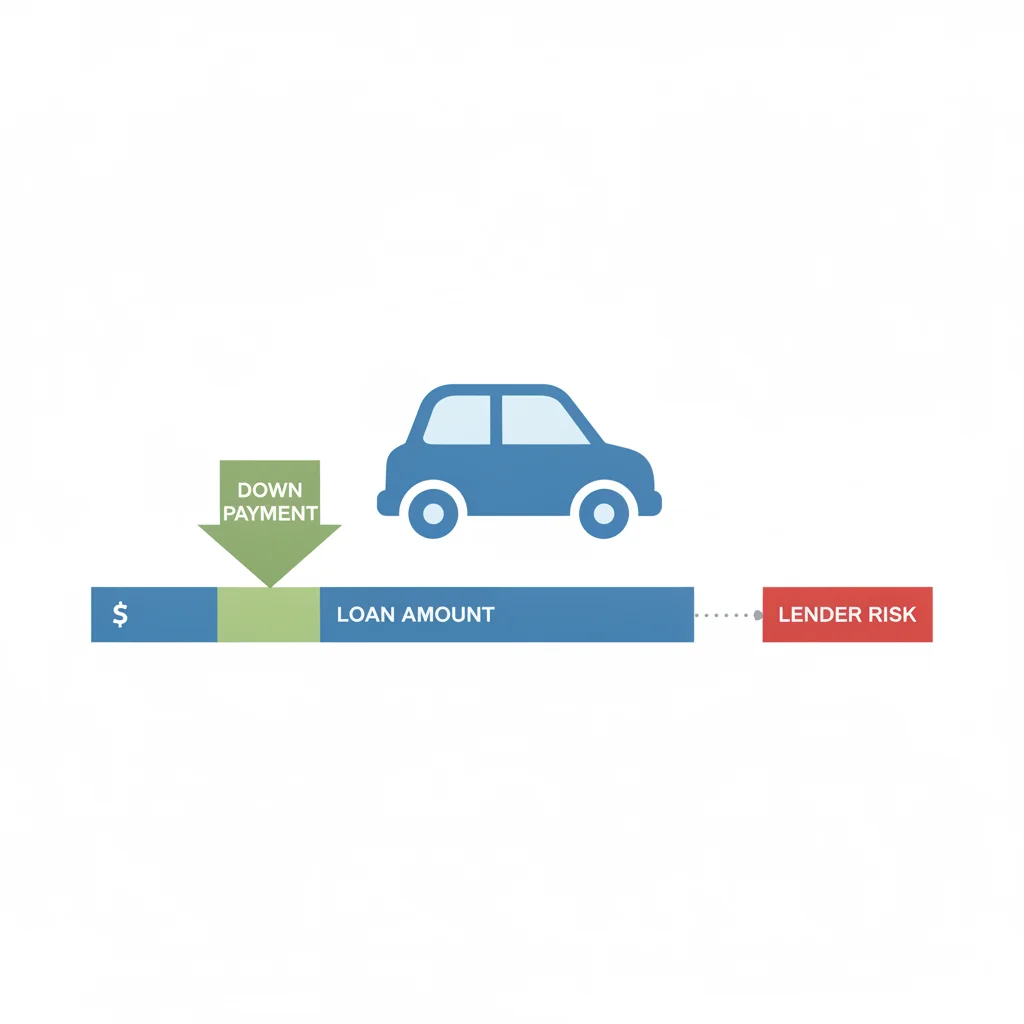
For borrowers with strong credit, LTV is still relevant but rarely a gating factor. For borrowers with bad credit, it can be the difference between approval and rejection. Understanding this dynamic is the first step toward using your down payment strategically.
What 'Bad Credit' Means in the Context of Auto Loans
Auto lenders typically segment borrowers by credit tier. While exact cutoffs vary, a common framework looks like this:
| Credit Tier | Score Range | Typical APR Range (New Car) |
|---|---|---|
| Super Prime | 781–850 | 5–7% |
| Prime | 661–780 | 7–10% |
| Near Prime | 601–660 | 10–15% |
| Subprime | 501–600 | 15–22% |
| Deep Subprime | 300–500 | 22–29%+ |
If your score falls in the subprime or deep subprime range, you're not automatically disqualified from getting a loan — but the terms get significantly harsher, and many traditional lenders will decline you outright without additional mitigating factors. A large down payment is one of the most powerful mitigating factors available to you.
~69%
Subprime borrowers who make a down payment
According to Experian's State of the Automotive Finance Market report, the majority of subprime auto borrowers provide some form of down payment, reflecting lender requirements in this tier.
20%+
Typical down payment required for deep subprime borrowers
Industry data from lenders specializing in non-prime auto finance indicates borrowers with scores below 500 are commonly required to put down 20–25% to secure financing.
15–29%
Typical APR range for subprime auto loans
Experian's Q1 2024 automotive finance report shows average interest rates for subprime and deep subprime borrowers ranging from 15% to over 29% APR depending on credit tier.
$2,450
Interest saved by putting 20% down vs. zero (example)
In the illustrative $22,000 vehicle example at 19% APR over 60 months, a 20% down payment reduces total interest paid by approximately this amount compared to zero down.
It's also worth noting that "bad credit" isn't just about score. Lenders also weigh recent derogatory marks (a repossession two years ago is more alarming than a late payment five years ago), open collections, and your overall debt load relative to income. A down payment helps with the risk math but doesn't erase negative history — it just reframes the conversation.
For a broader look at your options as a bad-credit borrower, the Bad Credit Loans hub covers the full range of lenders and programs available to you.
The Math: How a Down Payment Changes Your Numbers
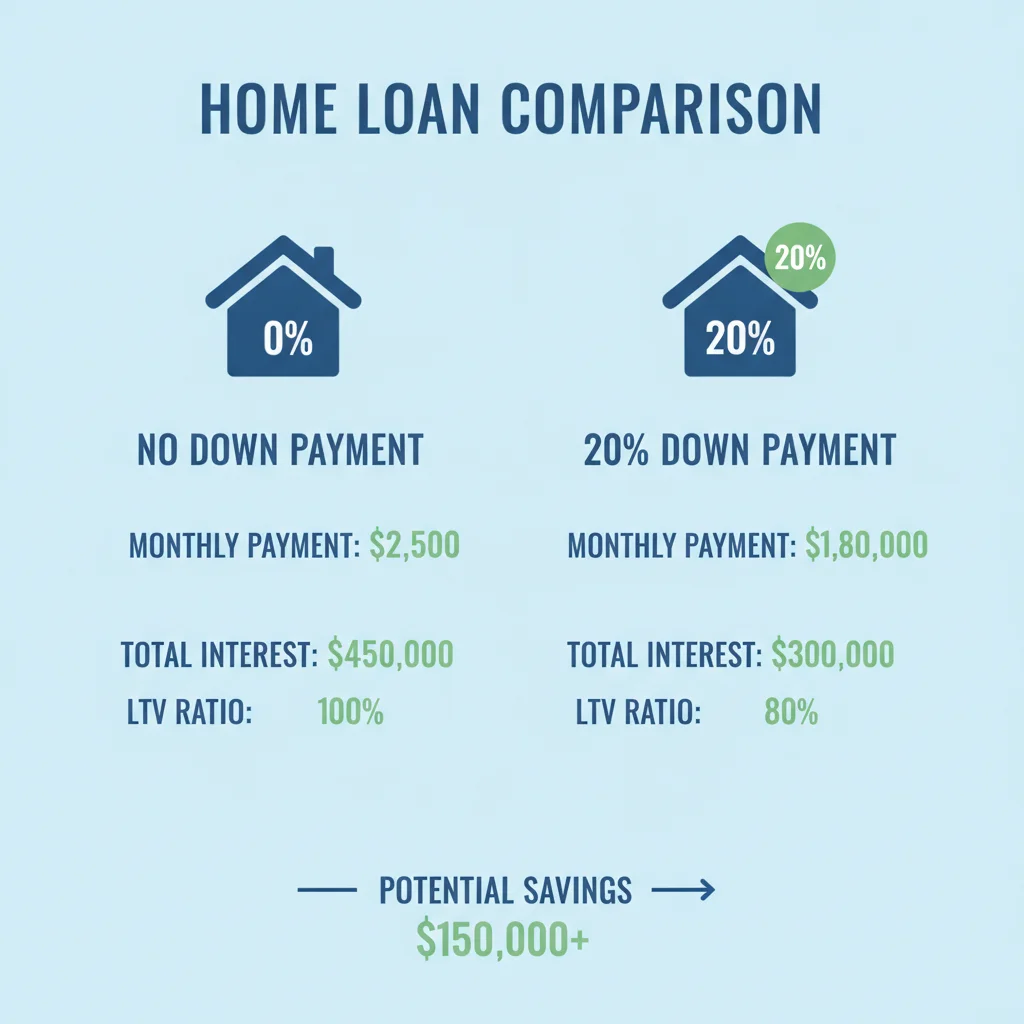
Let's run a concrete example. Say you're buying a used SUV priced at $22,000 and your credit score is 570. A lender quotes you 19% APR on a 60-month loan.
Scenario A: No Down Payment
- Loan amount: $22,000
- Monthly payment: approximately $571
- Total interest paid: approximately $12,270
- LTV: 100%
Scenario B: $4,400 Down (20%)
- Loan amount: $17,600
- Monthly payment: approximately $457
- Total interest paid: approximately $9,820
- LTV: 80%
That $4,400 upfront saves you roughly $2,450 in interest and drops your monthly payment by about $114. More importantly, that 80% LTV is a number many subprime lenders are comfortable with — whereas the 100% LTV in Scenario A might get the application declined or trigger a requirement for a co-signer.
The savings compound further when you consider negative equity risk. Cars depreciate fastest in the first two years. If you finance 100% of the purchase price, there's a good chance you owe more than the car is worth within months of driving off the lot. A meaningful down payment creates a cushion that keeps you above water longer — which matters if you need to sell or if the car is totaled.
For a deeper dive into these numbers, The Math Behind Putting More Money Down on a Car walks through how down payment size shifts your LTV, monthly payment, and total financing cost step by step.
Run the Numbers Before You Commit
Before finalizing your down payment amount, plug different figures into a free auto loan calculator using your expected interest rate. Look at how each scenario changes your monthly payment, your total interest cost, and your LTV ratio. Even a difference of $1,000–$2,000 in your down payment can shift your LTV enough to change a lender's decision or rate tier.
Get Preapproved With Multiple Lenders
Don't rely on a single lender's rate quote. Apply for preapproval with two or three lenders — including a credit union if you're eligible — before going to a dealership. Lenders compete for your business even with bad credit, and having competing offers gives you leverage. Specify your planned down payment amount in each application so the quotes are comparable.
How Much Down Is Actually Required With Bad Credit?
There's no universal minimum, but there are widely observed patterns. Most subprime auto lenders — banks, credit unions, and finance companies that specialize in non-prime borrowers — have informal or formal guidelines that look something like this:
- Credit score 580–619 (Near Subprime)
- Many lenders want to see 10% down, or approximately $1,500–$2,500 on a typical used car purchase.
- Credit score 500–579 (Subprime)
- Expect requirements of 15–20% down. On a $15,000 vehicle, that's $2,250–$3,000.
- Credit score below 500 (Deep Subprime)
- Some lenders require 20–25% down, and many conventional lenders won't lend at all — buy-here-pay-here dealerships become more common at this tier.
Keep in mind that these are minimums, not targets. Putting more down than the minimum — say, 25% instead of 20% — can open the door to slightly better terms or a wider pool of willing lenders.
Down Payment Minimums Vary by Lender
The percentage ranges cited here are industry patterns, not universal rules. A credit union where you have a long-standing relationship may be more flexible than a national subprime finance company. Dealership-affiliated lenders (captive finance arms) often have their own tiers that differ from banks. Always confirm minimum requirements directly with the lender during the application process.
Don't Sacrifice Your Emergency Fund Entirely
Depleting your savings to maximize a car down payment can create a dangerous financial situation. If you have no liquid savings and an unexpected expense arises, you may struggle to make loan payments — which compounds the credit damage you were working to overcome. Aim to keep at least one month of essential expenses accessible even after making your down payment.
Trade-in equity counts. If your current vehicle is worth $4,000 and you owe nothing on it, that equity functions exactly like $4,000 in cash for down payment purposes. Many borrowers underestimate their trade-in value — always get a quote from a third-party source like a dealership appraisal or online valuation tool before accepting a dealer's first offer.
To understand exactly what the minimum actually should be for your specific credit profile, Down Payments on Bad Credit Car Loans: How Much Is Enough? explores the point of diminishing returns in detail.
Other Factors Lenders Weigh Alongside Your Down Payment
A large down payment is powerful, but it doesn't operate in a vacuum. Lenders combine multiple data points when making an approval decision. Here are the factors that matter most alongside LTV:
Income and Employment Stability
Most auto lenders require verifiable income of at least $1,500–$2,000 per month net for subprime borrowers. They want to see consistent employment — ideally two or more years with the same employer, or in the same field. If you recently changed jobs, even a large down payment may not overcome underwriting concerns about income stability.
Debt-to-Income (DTI) Ratio
DTI compares your monthly debt obligations to your gross monthly income. Lenders typically want your total monthly debt payments — including the new car payment — to be no more than 45–50% of gross income. If your DTI is already stretched, a larger down payment helps by making the new monthly payment smaller, which directly improves your DTI calculation.
Vehicle Age and Mileage
Lenders collateralize auto loans with the vehicle itself. Older cars with high mileage depreciate faster and are harder to resell after repossession. Many subprime lenders won't finance vehicles older than 8–10 years or with more than 100,000–120,000 miles, regardless of your down payment size. A newer vehicle can itself improve your approval odds.
“When we look at a subprime application, the credit score tells us the borrower's history — but the down payment tells us how much skin they have in the game. A borrower who puts 20% down is far less likely to walk away from the loan, and far less costly to us if they do.”
— Greg Larson, Former auto lending underwriter and consumer finance consultant
Recent Derogatory Marks
A repossession or bankruptcy in the last 12–24 months is a serious red flag that a down payment alone may not overcome. Some specialized lenders will still approve you — often at very high rates — but you should be prepared for more rejections and may need to work with a dealer who has relationships with those specific lenders.
If you want to address these underlying factors before applying, Strategies That Actually Improve Your Approval Odds Before Applying covers concrete moves that genuinely shift the needle.
The Trade-Off: How Much Is Too Much to Put Down?
It's tempting to think that more is always better when it comes to a down payment. The approval math supports that instinct — but personal finance does not always. There are real risks to draining your savings for a car purchase.
The core tension is between credit risk (the lender's problem) and liquidity risk (your problem). Putting 30% down on a car might make the lender very comfortable, but if you have no emergency fund left and your transmission fails two months later, you could end up missing car payments — which compounds the credit damage you were trying to offset.
A reasonable approach for most bad-credit borrowers:
- Determine what the lender minimum is for your credit tier.
- Add a small buffer above that minimum — typically an additional 5% — to strengthen your application without exhausting reserves.
- Keep at least one month of living expenses in a liquid account as a safety net.
For situations where a large down payment might actually work against you financially, Why Putting More Down Doesn't Always Make Financial Sense lays out specific scenarios worth knowing before you commit your savings.
Down Payment Minimums Vary by Lender
The percentage ranges cited here are industry patterns, not universal rules. A credit union where you have a long-standing relationship may be more flexible than a national subprime finance company. Dealership-affiliated lenders (captive finance arms) often have their own tiers that differ from banks. Always confirm minimum requirements directly with the lender during the application process.
Don't Sacrifice Your Emergency Fund Entirely
Depleting your savings to maximize a car down payment can create a dangerous financial situation. If you have no liquid savings and an unexpected expense arises, you may struggle to make loan payments — which compounds the credit damage you were working to overcome. Aim to keep at least one month of essential expenses accessible even after making your down payment.
Using Preapproval to Test the Impact of Your Down Payment
One of the smartest moves a bad-credit borrower can make before shopping is to seek preapproval — and to deliberately test different down payment amounts during that process. Many lenders and online platforms will let you run scenarios: what rate and terms do you get with $2,000 down versus $4,000 down?
Preapproval gives you three specific advantages:
- You know your real budget before setting foot in a dealership, which prevents you from falling in love with a car you can't finance.
- You can compare rate offers from multiple lenders without a hard pull for each one (some lenders use soft pulls for prequalification).
- You negotiate from a position of strength — dealers know you have financing lined up and can't pad the rate to earn finance reserve income.
When you go through preapproval, be explicit about your planned down payment amount. Some lenders will tell you directly that bumping your down payment from 10% to 20% changes your offered rate by a specific number of percentage points. That's real, actionable information.
Down Payments and Preapproval: How One Affects the Other explains this relationship in detail, including how to use preapproval as a rate-shopping tool even when your credit isn't strong.
For a full walkthrough of the preapproval process itself, the Loan Preapproval hub covers what it means, how to get it, and why it strengthens your negotiating position significantly.
Run the Numbers Before You Commit
Before finalizing your down payment amount, plug different figures into a free auto loan calculator using your expected interest rate. Look at how each scenario changes your monthly payment, your total interest cost, and your LTV ratio. Even a difference of $1,000–$2,000 in your down payment can shift your LTV enough to change a lender's decision or rate tier.
Get Preapproved With Multiple Lenders
Don't rely on a single lender's rate quote. Apply for preapproval with two or three lenders — including a credit union if you're eligible — before going to a dealership. Lenders compete for your business even with bad credit, and having competing offers gives you leverage. Specify your planned down payment amount in each application so the quotes are comparable.
The bottom line: a large down payment is one of the most reliable tools a bad-credit borrower has. It reduces lender risk directly, it lowers your monthly payment, it decreases your total interest cost, and it protects you from negative equity. Used alongside smart vehicle selection, verified income documentation, and a preapproval strategy, it can turn what looks like a long-shot application into a real approval — often with terms that are genuinely manageable.

All claims are backed by peer-reviewed research. Sources on request.