Key Takeaways
Down Payment (Auto Loan)
A down payment is the upfront cash you pay toward a vehicle's purchase price before financing the rest. It directly reduces the amount you borrow, which lowers the lender's exposure if you stop making payments. From a lender's perspective, a larger down payment is one of the clearest signals that a borrower is financially prepared and committed to the loan.
Lenders quantify down payment risk using the loan-to-value (LTV) ratio — the loan amount divided by the vehicle's value. A higher down payment lowers LTV, which directly affects rate tiers and approval thresholds in most lender credit models.
The Lender's Fundamental Problem: Cars Lose Value Immediately
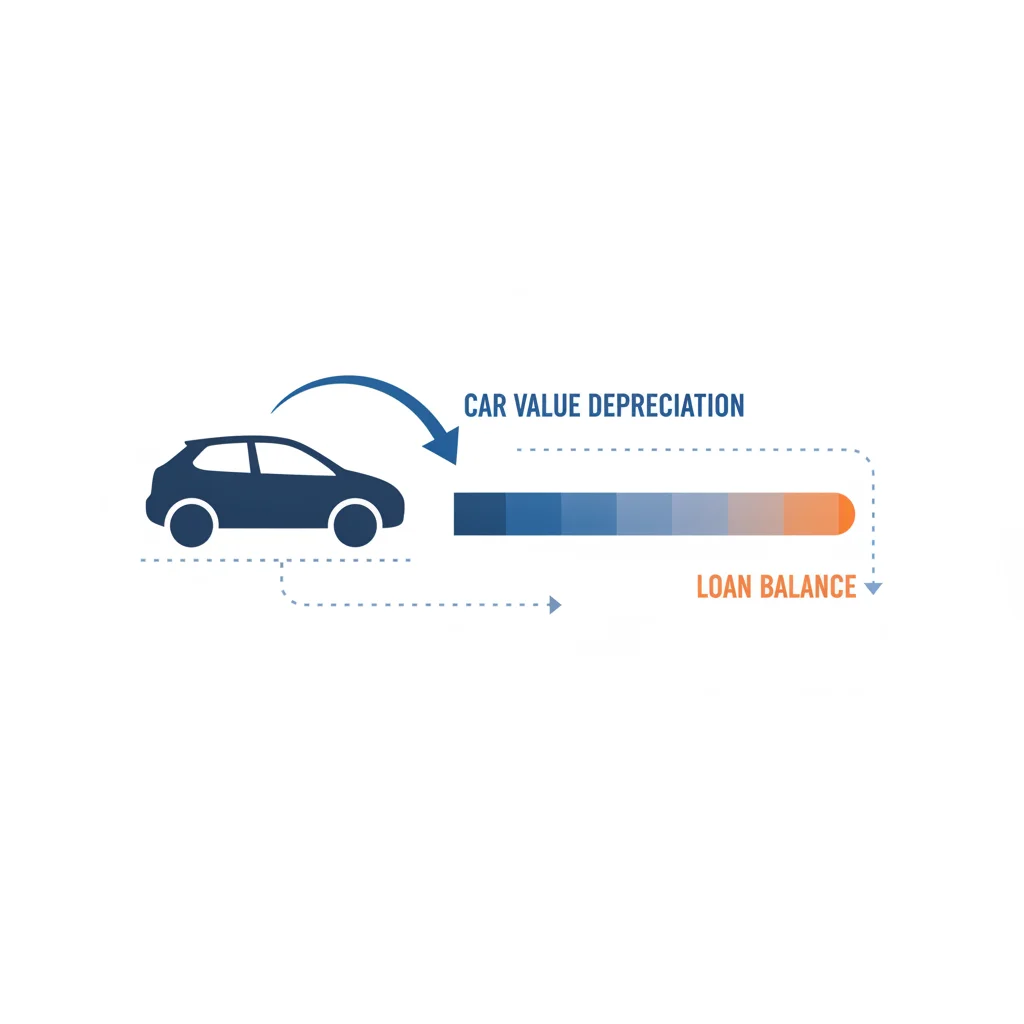
When a bank or credit union lends you money to buy a car, they're taking on a specific kind of risk that doesn't exist with, say, a mortgage. Unlike a house, which typically holds or gains value over time, a car starts losing value the moment you drive it off the lot. A new vehicle can depreciate 15–25% in its first year alone.
This creates a dangerous window for lenders. If you borrow $35,000 on a $35,000 car and then can't make payments six months in, that car might only be worth $28,000 on the open market. The lender repossesses and sells it — but now they've recovered far less than they loaned. That gap is a direct financial loss.
Your down payment is the simplest, most direct solution to this problem. It shrinks the loan amount from the start, creating a buffer between what you owe and what the car is worth. For a lender, that buffer is everything.
This is why understanding how lenders think about down payments matters so much. It's not arbitrary policy — it's a calculated response to the financial reality of lending against a depreciating asset. The more you put down, the safer the lender's position, and the more willing they are to offer you favorable terms.
Loan-to-Value Ratio: The Number Lenders Actually Watch
Lenders don't just eyeball your down payment amount and make a gut call. They convert it into a precise metric called the loan-to-value ratio, or LTV. Understanding this number explains almost everything about how your down payment affects your loan offer.
The formula is simple:
LTV = Loan Amount ÷ Vehicle Value × 100
So if you're buying a $30,000 car and putting $6,000 down (20%), your loan amount is $24,000 and your LTV is 80%. If you put nothing down, your LTV is 100% — or even higher if dealer fees get rolled into the loan.
20%
Recommended minimum down payment on a new car
Most auto finance experts and lenders recommend at least 20% down on a new vehicle to offset first-year depreciation.
15–25%
Average new car depreciation in year one
According to Carfax and Edmunds data, new cars typically lose 15–25% of their value within the first 12 months of ownership.
33%
U.S. auto loans that are underwater at origination
Experian's State of the Automotive Finance Market reports have consistently shown a significant share of new loans start with LTVs above 100%.
1–3%
Typical APR improvement from strong down payment
Borrowers who move from minimal to 20%+ down payment can often see APR reductions of 1–3 percentage points depending on lender rate tiers.
$3,000+
Average interest savings from 20% vs. 0% down
On a typical $28,000–$35,000 auto loan over 60 months, moving from zero to 20% down can save $3,000–$5,000 in total interest depending on rate.
Lenders set internal rate tiers based on LTV thresholds. A loan at 80% LTV might qualify for a rate of, say, 5.9%. The same borrower with the same credit score at 110% LTV might be offered 8.4% — or denied entirely. These thresholds vary by lender, but the principle is universal: lower LTV means lower risk, and lower risk earns better pricing.
For a deeper breakdown of how this ratio is calculated and what ranges lenders consider safe, see our article on loan-to-value ratio and how your down payment controls it.
LTV Thresholds Vary by Lender
Not every lender uses the same LTV cutoffs for rate tiers. Banks, credit unions, and captive lenders (like manufacturer financing arms) all have different models. Shopping multiple lenders and getting preapproved from at least two or three sources lets you see which institution gives your specific down payment the most credit. See our hub on <a href="/auto-loans/credit-and-approval/credit-score-impact">credit score impact on loan rates</a> to understand how your score interacts with these thresholds.
Gap Insurance Fills the Underwater Risk Gap
If you're financing with a smaller down payment and concerned about being underwater, GAP (Guaranteed Asset Protection) insurance can cover the difference between your loan balance and the car's value if it's totaled or stolen. It's not a substitute for a solid down payment, but it does protect you from the worst-case financial outcome of negative equity. Ask your lender or insurer about GAP coverage costs before signing.
The Behavioral Signal Lenders Read Into Your Down Payment
Here's something most car buyers don't realize: lenders aren't just looking at your down payment as a financial cushion. They're reading it as a behavioral signal about who you are as a borrower.
Saving up a meaningful down payment takes time and discipline. It tells a lender that you plan ahead, manage your money responsibly, and take large financial commitments seriously. That behavior pattern strongly correlates with reliable loan repayment — and lenders know it from decades of default data.
“A down payment is one of the few things a borrower can directly control before walking into a lender's office. Everything else — the car's value, the market rate, the credit score — is partly outside your hands. The down payment is where preparation becomes power.”
— Melinda Gross, Auto lending analyst and consumer finance educator
Conversely, a borrower who arrives with zero down and asks to roll all fees into the loan sends a different signal: they may be stretching their finances to the limit just to get into the vehicle. That doesn't necessarily mean they'll default, but statistically, it's a higher-risk profile.
This behavioral dimension is also why lenders look at your down payment alongside your credit history. A borrower with excellent credit and a 20% down payment is the lowest-risk profile a lender can encounter. A borrower with poor credit and no down payment is the highest risk. Most real-world applicants fall somewhere in between — and your down payment is one of the levers you can pull to shift your profile toward the favorable end.
If you want to understand how these two factors interact in practice, our article on how down payments interact with your credit score walks through the mechanics in detail.
Raise Your Down Payment Before You Apply
Even a few extra months of saving before applying can move you into a better LTV tier and improve your rate offer. On a $30,000 car, going from $4,500 to $6,000 down might seem small, but it could cross a lender's threshold from 85% LTV to 80% LTV — unlocking meaningfully better pricing. If timing allows, save first and shop second.
Combine a Good Down Payment With Preapproval
Getting preapproved before visiting a dealer lets you see exactly what rate your down payment and credit profile earn you in the open market. It also gives you leverage at the dealership — you're no longer dependent on their financing desk to tell you what you qualify for. See our hub on <a href="/auto-loans/credit-and-approval/loan-preapproval">auto loan preapproval</a> to get started.
How Down Payment Size Translates Into Concrete Loan Terms
Let's move from theory to numbers. Suppose you're financing a $28,000 used car over 60 months. Here's how three different down payment scenarios play out with a hypothetical lender rate schedule:
| Down Payment | Loan Amount | LTV | Est. APR | Monthly Payment | Total Interest Paid |
|---|---|---|---|---|---|
| $0 (0%) | $28,000 | 100% | 9.5% | $587 | $7,220 |
| $4,200 (15%) | $23,800 | 85% | 7.2% | $472 | $4,520 |
| $5,600 (20%) | $22,400 | 80% | 6.1% | $433 | $3,580 |
The difference between putting nothing down and putting 20% down in this example is $154 per month and $3,640 in total interest over the life of the loan. That's real money — and it doesn't even account for the added financial stress of being underwater on the loan during the early years.
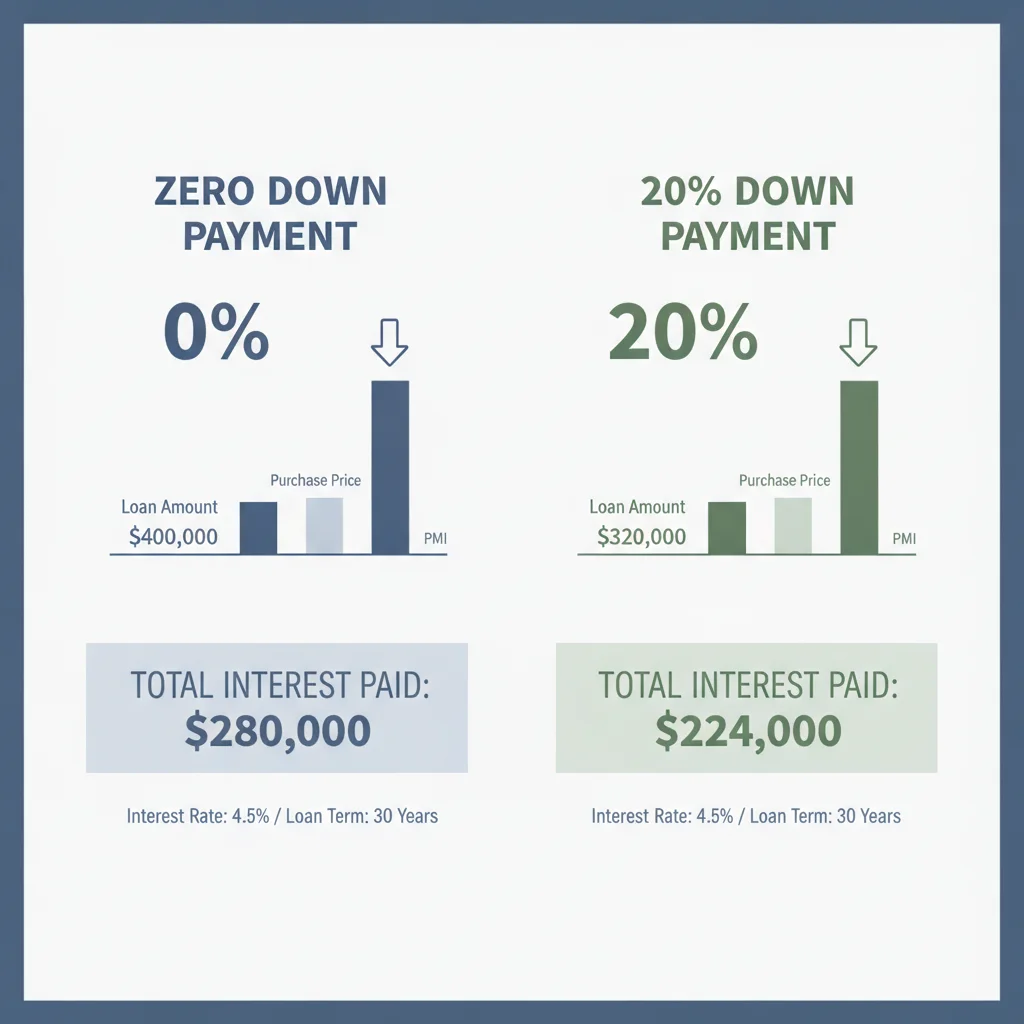
These numbers also illustrate why a down payment is one of the highest-return places to put cash before buying a car. For every dollar you put down, you're not just reducing the principal — you may also be buying yourself a lower rate on every remaining dollar you borrow.
For a full walk-through of how this math works across different scenarios, see the math behind putting more money down on a car.
Protection Against Going Underwater: Why It Matters to Both Parties
Being "underwater" on a car loan means you owe more than the vehicle is currently worth. It's surprisingly common — and it matters to both you and your lender.
For the lender, an underwater borrower is a problem waiting to happen. If the borrower defaults, the lender can't recover the full loan balance by selling the car. The loss is baked in from the start.
For you as the borrower, being underwater creates its own traps. If your car is totaled, your insurance pays market value — not what you owe on the loan. If you want to sell or trade in before the loan ends, you'll have to pay the difference out of pocket or roll it into your next loan, compounding the problem.
LTV Thresholds Vary by Lender
Not every lender uses the same LTV cutoffs for rate tiers. Banks, credit unions, and captive lenders (like manufacturer financing arms) all have different models. Shopping multiple lenders and getting preapproved from at least two or three sources lets you see which institution gives your specific down payment the most credit. See our hub on <a href="/auto-loans/credit-and-approval/credit-score-impact">credit score impact on loan rates</a> to understand how your score interacts with these thresholds.
Gap Insurance Fills the Underwater Risk Gap
If you're financing with a smaller down payment and concerned about being underwater, GAP (Guaranteed Asset Protection) insurance can cover the difference between your loan balance and the car's value if it's totaled or stolen. It's not a substitute for a solid down payment, but it does protect you from the worst-case financial outcome of negative equity. Ask your lender or insurer about GAP coverage costs before signing.
A solid down payment is the most direct way to avoid this scenario from day one. By reducing the loan amount upfront, you give the vehicle's natural depreciation curve room to work without immediately plunging you into negative equity territory. On a new car that might drop $5,000–$7,000 in value in its first year, a 20% down payment creates a meaningful cushion against that drop.
Lenders are acutely aware of this dynamic. It's one reason they're willing to reward larger down payments with better rates — and why some lenders won't touch a loan above a certain LTV threshold at all, regardless of the borrower's credit score.
When a Down Payment Can Offset a Weaker Credit Profile
Credit scores aren't the only thing lenders evaluate — they're one input in a broader risk equation. A borrower with a 620 credit score and a 25% down payment may actually receive a better loan offer than a 650-score borrower with nothing down, because the lower LTV partially compensates for the higher credit risk.
This isn't guaranteed, and it doesn't work for every lender or every credit situation. But it's a real dynamic, especially at credit unions and community banks that do more manual underwriting. Those institutions often have more flexibility to weigh compensating factors than large banks running fully automated approval models.
The practical implication: if your credit score isn't where you'd like it to be, an above-average down payment is one of the most effective tools available to improve your loan terms. It won't fix a severely damaged credit history, but in the moderate credit range (roughly 580–680), it can meaningfully shift the outcome.
For a detailed look at how lenders weigh these two factors together, our article on how down payments interact with your credit score on an auto loan covers the mechanics. And if you're preparing to apply, getting preapproved for your auto loan before visiting a dealer gives you a clearer picture of where you stand.
Raise Your Down Payment Before You Apply
Even a few extra months of saving before applying can move you into a better LTV tier and improve your rate offer. On a $30,000 car, going from $4,500 to $6,000 down might seem small, but it could cross a lender's threshold from 85% LTV to 80% LTV — unlocking meaningfully better pricing. If timing allows, save first and shop second.
Combine a Good Down Payment With Preapproval
Getting preapproved before visiting a dealer lets you see exactly what rate your down payment and credit profile earn you in the open market. It also gives you leverage at the dealership — you're no longer dependent on their financing desk to tell you what you qualify for. See our hub on <a href="/auto-loans/credit-and-approval/loan-preapproval">auto loan preapproval</a> to get started.
How to Think About the Right Down Payment for Your Situation
Knowing that lenders love large down payments doesn't automatically tell you how much to put down. The right number depends on your full financial picture, not just what will get you approved.
Start with these questions:
- Do you have an emergency fund? Draining your savings to maximize a down payment can leave you exposed if the car needs repairs or your income changes. Aim to keep 3–6 months of expenses in reserve no matter what you put down.
- What's the interest rate spread? If putting an extra $2,000 down drops your APR from 7.5% to 6.9%, that's a meaningful gain. If it doesn't move your rate tier at all, the math may favor keeping the cash.
- How long are you planning to keep the car? If you're financing for 72 months, a strong down payment protects you from years of potential negative equity. If you're planning to pay off quickly, the LTV risk window is shorter.
- Are you trading in a vehicle? Trade-in equity counts as a down payment in the lender's eyes. Know your trade-in value accurately before factoring it in.
Our guide on things to know before deciding how much to put down on a car walks through each of these factors in depth. And for a broader view of how a down payment reshapes your entire loan, see what a car down payment actually does to your loan.
One final note: dealers and lenders don't always want the same thing from your down payment. Understanding those different motivations can help you navigate the transaction more effectively. Our piece on how dealers and lenders view your down payment differently explains exactly where their interests diverge.

All claims are backed by peer-reviewed research. Sources on request.