
Key Takeaways
Summary
18 items · 20–40 minutes
Why Your Down Payment Decision Deserves More Than a Gut Check
Most car buyers pick a down payment number based on what feels comfortable in the moment — sometimes it's what the dealer suggests, sometimes it's just whatever's sitting in checking. That approach leaves money on the table and, in some cases, puts buyers in a precarious financial position the moment they drive off the lot.
The down payment is one of the most powerful levers you control in a car purchase. It sets your loan balance, influences your interest rate, determines how quickly you build equity, and directly affects whether you end up underwater on the loan. See exactly how down payment size changes your loan-to-value ratio, interest paid, and total cost of financing.
The checklist below walks through every financial factor you should audit before settling on an amount. Work through each item honestly, and you'll arrive at a number grounded in your actual situation — not a guess.
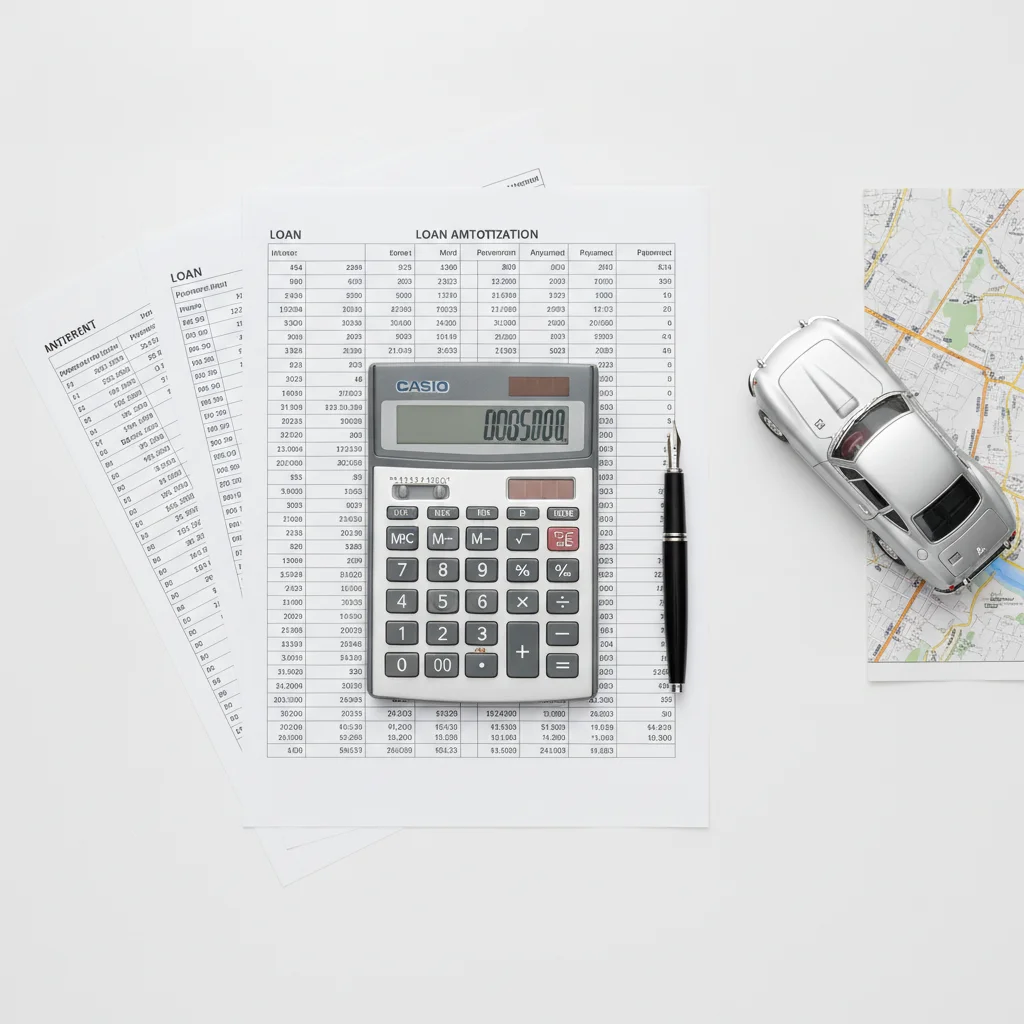
Tools You'll Need to Work Through This Checklist
Before you start, gather a few pieces of information so you can answer each checkpoint with real numbers rather than estimates.
Recent pay stubs or monthly income figure
Needed to calculate what monthly payment fits your budget and how much cash you can realistically set aside.
Bank or savings account balance
Required to determine how much is actually available for a down payment without depleting your emergency fund.
Current loan payoff quote
If you have a vehicle to trade in or pay off, you need the exact payoff amount to calculate your equity position.
Credit score from all three bureaus
Your score determines which interest rate tier you qualify for, which directly affects how much a down payment saves you.
Auto loan calculator (online)
Used to compare monthly payments and total interest across different down payment amounts and loan terms.
Vehicle valuation tool (KBB or Edmunds)
Needed to determine trade-in value and verify that the car you're buying is priced fairly relative to market.
Depreciation data for the target model
Helps you project when your loan balance will drop below the car's market value, informing how much equity protection you need upfront.
Pre-approval letter from a bank or credit union
Gives you a rate benchmark so you can evaluate whether dealer financing offers a better or worse deal.
The Down Payment Readiness Checklist
Work through each group in order. Items marked must are non-negotiable factors that directly shape your decision. Items marked should are strongly recommended checks that refine your number. Nice-to-have items help you optimize further once the essentials are covered.
Emergency Fund & Liquidity Check
Current Equity & Trade-In Position
Credit Score & Interest Rate Tiers
Loan Term & Depreciation Alignment
Purchase Price Negotiation
Total Cost of Ownership Projection
Don't Let the Dealer Set Your Down Payment
Finance managers are trained to frame the conversation around monthly payments, not total cost. A common tactic is to ask how much you can put down and use that number to structure a longer loan that maximizes interest income. Always decide your down payment before you walk in, based on your own financial analysis — not a figure the dealership suggests.
Rolling Negative Equity Compounds Your Risk
If you're trading in a car you owe more on than it's worth, and you roll that gap into the new loan, you're starting day one already underwater — sometimes by $3,000–$5,000. This dramatically increases how much you should put down on the replacement vehicle. Never ignore a negative equity balance and hope the math works out over time.
Once you've completed every group, you'll have a clear picture of the minimum down payment your situation requires, the amount that makes financial sense given your loan terms, and the ceiling you should not exceed without risking liquidity. For a step-by-step method to turn those findings into a single target figure, see How to Calculate the Right Down Payment for Any Car Purchase.
Understanding the Numbers Behind Your Decision
Running through a checklist is more useful when you understand why each item matters. Here are the core financial mechanics at play.
Depreciation and Equity
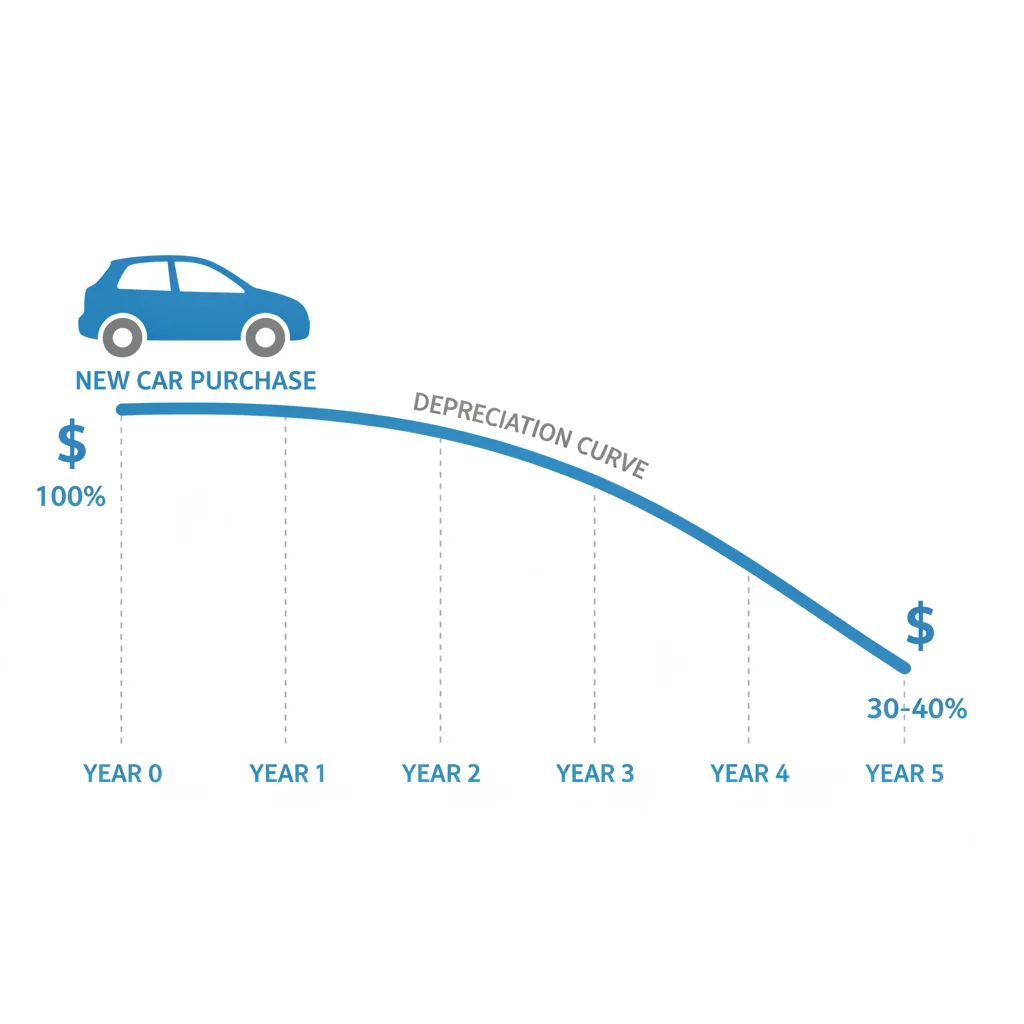
A new car loses roughly 15–25% of its value in the first year alone. On a $35,000 vehicle, that's as much as $8,750 in lost value before you've made a dozen payments. If your down payment is only $2,000, your loan balance after one year could still be $28,000+ while the car is worth $26,000 — putting you $2,000 underwater. A down payment of 15–20% ($5,250–$7,000) largely closes that gap from day one.
Interest Rate and Loan-to-Value Ratio
Lenders price risk. When you borrow $30,000 on a $32,000 car, the lender has little cushion if you default — the collateral barely covers the loan. That risk is reflected in a higher interest rate. Put $7,000 down on the same car and your loan-to-value (LTV) ratio drops from 94% to about 72%. Many lenders offer their best rates at 80% LTV or below. On a 60-month loan at 7% vs. 5.5%, the difference on $25,000 is roughly $1,050 in extra interest paid.
Monthly Payment vs. Total Cost
It's tempting to optimize for the lowest monthly payment, but stretching a loan to 72 or 84 months to achieve that goal increases total interest dramatically. A larger down payment is a more efficient way to reduce your monthly obligation because it cuts the principal — which reduces both payment and total interest — rather than just spreading payments thinner over more time. Everything a first-time car buyer needs to understand about down payments.
The 20% Benchmark Is a Starting Point, Not a Rule
You'll often hear that 20% down on a new car is the gold standard, and for most buyers it's a sound target. But it's derived from a specific assumption: that you need to stay ahead of first-year depreciation to avoid negative equity. If you're buying a vehicle that holds its value exceptionally well, financing for a shorter term, or getting a significantly below-market price, a lower down payment may carry the same risk protection. Run the numbers for your specific deal rather than applying a blanket percentage.
When More Down Isn't Better
There are genuine scenarios where putting more money down works against you. If you'd be draining an emergency fund, passing up a 401(k) match, or tying up cash you need in the next 12 months, a smaller down payment combined with a competitive rate may be the smarter move. Explore the scenarios where maximizing your down payment can work against you.
What to Do If You Can't Hit the Ideal Number Yet
If this checklist reveals that your current savings fall short of where you'd like to be, that's valuable information — not a dead end. The right response is usually to delay the purchase slightly and build up the difference rather than proceed with a thin down payment that leaves you exposed.
Practical ways to close the gap include selling your current vehicle privately instead of trading it in (typically nets $1,000–$3,000 more), redirecting a tax refund or annual bonus, or reducing discretionary spending for 60–90 days before the purchase. Practical options for boosting your upfront contribution — from selling assets to timing your purchase around a bonus.
If you're buying new and timing is flexible, purchasing at the end of a model year (August–October) or end of a calendar quarter often means larger dealer incentives, effectively lowering the vehicle price and reducing how much down payment you need to hit a healthy LTV. What to know before purchasing a brand-new vehicle from a dealership.

The goal isn't perfection — it's making a decision with clear eyes. Knowing your emergency fund status, your current equity position, your credit score tier, and your loan term going in puts you in control of the negotiation rather than reacting to whatever the finance office presents.

All claims are backed by peer-reviewed research. Sources on request.