
Key Takeaways
Why Your Down Payment Amount Is a Financial Decision, Not a Gut Call
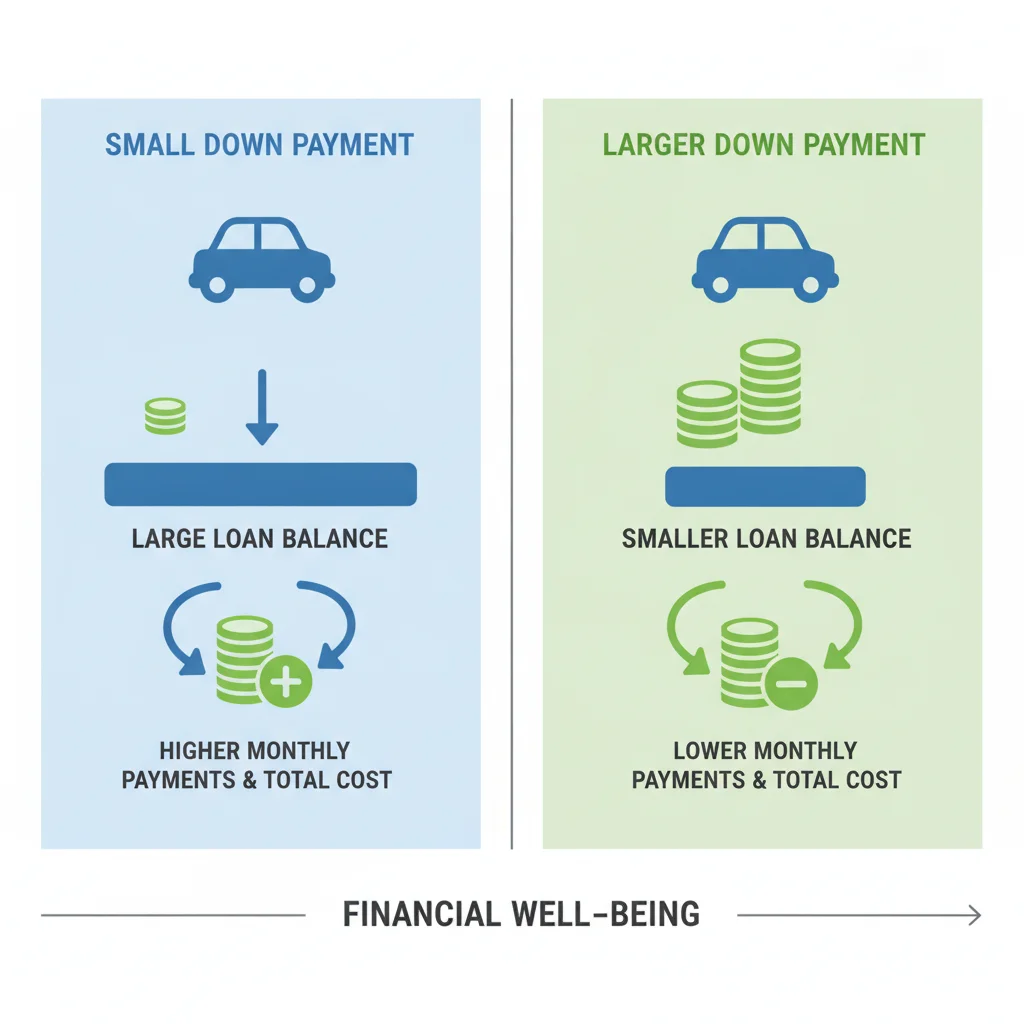
Most car buyers treat the down payment as whatever cash happens to be available on signing day. That's a costly mistake. The amount you put down is one of the most powerful levers you control in the entire car-buying transaction — it directly shapes your loan-to-value ratio, your monthly payment, and how much total interest you'll pay over the life of the loan.
To understand why this matters so much, consider two buyers who both purchase a $32,000 sedan:
- Buyer A puts down $3,200 (10%), financing $28,800 at 7% over 60 months — total interest paid: approximately $5,457.
- Buyer B puts down $6,400 (20%), financing $25,600 at 7% over 60 months — total interest paid: approximately $4,851.
Buyer B saves roughly $606 in interest just by doubling the down payment. But the story goes deeper: Buyer A is also at much greater risk of being underwater — owing more than the car is worth — during the first 18 to 24 months of the loan, when depreciation hits hardest. If the car is totaled or needs to be sold, Buyer A could owe the lender money even after the insurance check clears.
For a deeper look at how these numbers interact, see The Math Behind Putting More Money Down on a Car, which walks through loan-to-value ratios and total financing cost side by side.
The steps below give you a systematic method for calculating exactly how much to put down — not a generic rule of thumb, but a number grounded in your vehicle choice, loan terms, and personal financial situation.
What you will need
What You Need Before You Start the Calculation
Accurate inputs produce an accurate down payment target. Before working through the steps, pull together the following information. You don't need precise figures for every item — reasonable estimates are fine at this stage — but the closer you are to the real numbers, the more useful your result will be.
Auto loan amortization calculator
Used to model monthly payments and total interest at different down payment amounts and loan terms.
Vehicle valuation tool (e.g., Kelley Blue Book, Edmunds, NADA Guides)
Used to confirm the fair market value of the vehicle you're buying and any trade-in vehicle.
State DMV fee estimator
Used to get accurate registration, title, and tax cost estimates for your specific state and vehicle.
Credit report and score
Used to determine which APR tier you're likely to qualify for, which affects how much down payment protection you need.
Trade-in appraisal from a third-party buyer
Used to establish the true market value of your trade-in vehicle independently of the selling dealer.
Spreadsheet or notepad
Used to track each variable and calculation step so you can adjust inputs and compare scenarios.
If you're trading in a vehicle, get a written appraisal from at least two sources — your dealership and an independent buyer like CarMax or a comparable service. Trade-in value directly reduces the cash you need to bring to the table, but only if you apply it correctly (Step 3 covers this). For guidance on what other financial factors should inform this decision before you start, Things to Know Before Deciding How Much to Put Down on a Car is a useful companion read.
Step-by-Step: Calculating Your Right Down Payment
Follow these steps in order. Each builds on the previous one. By Step 7, you'll have a specific down payment target — not a range, but an actual number you can plan around.
Find the True Out-of-Pocket Vehicle Cost
Start with the vehicle's out-the-door price, not the sticker or advertised price. The out-the-door price includes:
- Negotiated purchase price (after any dealer discounts or manufacturer incentives)
- State and local sales tax (typically 5–10% of the purchase price)
- Registration and title fees (varies by state, often $150–$400)
- Dealer documentation fee (commonly $100–$500, often negotiable)
Example: A car listed at $28,000, with a negotiated price of $26,500, in a state with 8.5% sales tax and $300 in fees, has an out-the-door cost of approximately $29,053. That's your real starting number.
Do not calculate your down payment as a percentage of the sticker price. Taxes and fees are financed too if you don't account for them, quietly inflating your loan balance from day one.
Establish Your Baseline Down Payment Using the 20% Rule
Apply 20% to the negotiated purchase price (before taxes and fees). This is the standard starting benchmark for new vehicles and a reasonable floor for used vehicles with fewer than 30,000 miles.
Using the example above: 20% of $26,500 = $5,300.
Why 20%? A new vehicle loses approximately 15–20% of its value in the first year. If you put down less than that, your loan balance will exceed the car's market value almost immediately — putting you underwater. From that position, you can't sell the car or trade it in without paying the lender the difference out of pocket.
For used vehicles (3+ years old), a 10–15% baseline is more defensible because the steepest depreciation has already occurred. If you're buying used, use 10% as your floor and 15% as your target.
Calculate and Apply Your Trade-In Equity
If you're trading in a vehicle, determine its net trade-in equity: the trade-in value minus any remaining loan balance on that vehicle.
- Trade-in appraised value: $7,500
- Remaining loan balance on trade: $4,200
- Net trade-in equity: $3,300
This $3,300 functions as a down payment contribution. Subtract it from your baseline down payment target to find the remaining cash you need to bring.
From the example: $5,300 baseline − $3,300 trade-in equity = $2,000 additional cash needed.
Important: if your trade-in has negative equity — you owe more than it's worth — that shortfall typically gets rolled into your new loan. This increases your loan balance and makes an adequate cash down payment even more critical. Rolling negative equity into a new loan is one of the fastest paths to being deeply underwater.
Adjust for Taxes and Fees
Taxes and fees are often overlooked in down payment planning. You have two choices for handling them:
- Pay them upfront in cash — this keeps your loan amount lower and is the better financial move if you can manage it.
- Finance them — they get rolled into your loan, increasing the principal you're paying interest on.
If you're paying taxes and fees upfront, add them to your cash requirement. In the running example: $2,000 (remaining down payment after trade-in) + $2,553 (taxes and fees) = $4,553 total cash at signing.
If you're financing taxes and fees, your loan balance is higher: $26,500 − $5,300 (down payment) − $3,300 (trade-in) + $2,553 (financed taxes/fees) = $20,453 loan amount.
Run both scenarios through a loan calculator and compare the total interest paid. In most cases, paying taxes and fees upfront saves meaningful money over a 60-month loan.
Pressure-Test Against Your Loan Term
Your loan term changes how quickly you build equity, which affects how much down payment protection you actually need. Here's the relationship:
- Longer term (72–84 months): Slower principal paydown means you stay underwater longer. You need a larger down payment to offset the slower equity build.
- Shorter term (36–48 months): Faster principal paydown. A smaller down payment provides adequate protection sooner.
If you're planning a 72-month loan, add 5 percentage points to your baseline down payment target. For an 84-month loan, add 8–10 percentage points. These adjustments roughly counterbalance the slower amortization.
Revised example with 72-month loan: 20% + 5% = 25% baseline target, or $6,625 on a $26,500 vehicle.
This is why financing a car over 72 or 84 months with minimal money down is so financially dangerous — you're combining slow equity build with maximum depreciation exposure. If you need a 72-month term to make the payment affordable, that's a strong signal the vehicle is more expensive than your budget supports.
Factor In Your Credit Score
Your credit score affects your APR, which affects how much interest compounds on the principal — which in turn affects how aggressively you need to reduce that principal through a larger down payment.
Here's a simplified APR-by-credit-score reference for new car loans (60-month term, approximate values):
| Credit Score Range | Approximate APR |
|---|---|
| 781–850 (Super Prime) | 5.0–6.0% |
| 661–780 (Prime) | 6.5–8.0% |
| 601–660 (Near Prime) | 9.0–12.0% |
| 501–600 (Subprime) | 13.0–18.0% |
| 300–500 (Deep Subprime) | 18.0–25.0%+ |
If your score puts you in the near-prime or subprime range, a larger down payment serves double duty: it lowers the principal subject to a high interest rate, and it may help you qualify for better terms altogether (some lenders offer rate discounts for LTV below 80%).
Rule of thumb: for every credit tier below prime, add 3–5 percentage points to your down payment target. A near-prime buyer should target 25% down on a new car; a subprime buyer should target 30% or more — or wait, rebuild credit, and buy later.
Set Your Final Down Payment Target and Check Affordability
Combine all the inputs from the previous steps to set your final target:
- Start with your baseline percentage (20% for new, 10–15% for used)
- Add the loan-term adjustment if applicable (+5% for 72-month, +8–10% for 84-month)
- Add the credit score adjustment if applicable (+3–5% per tier below prime)
- Convert the adjusted percentage to a dollar amount based on the vehicle purchase price
- Subtract your net trade-in equity
- Add taxes and fees if you're paying them upfront
- That total is your cash-at-signing target
Example final calculation (near-prime buyer, 60-month loan, new car at $26,500, $3,300 trade-in equity, taxes/fees paid upfront):
- Baseline: 20% + 5% (credit adjustment) = 25% of $26,500 = $6,625
- Minus trade-in: $6,625 − $3,300 = $3,325
- Plus taxes/fees: $3,325 + $2,553 = $5,878 cash at signing
Now verify this is affordable without depleting your emergency fund (see the section below on protecting your savings). If it isn't, adjust either the vehicle price or your timeline — not your emergency fund.
Common Scenarios and What the Math Looks Like
Abstract steps are easier to follow when you see them applied. Here are three realistic buyer profiles and how the down payment calculation plays out for each.

Scenario 1: First-Time Buyer, New Economy Car
| Variable | Value |
|---|---|
| Vehicle price | $26,500 |
| State tax + fees (9%) | $2,385 |
| Total financed baseline | $28,885 |
| Trade-in equity | $0 |
| Depreciation risk (new car, year 1) | ~18% = $4,770 |
| Minimum target down payment | $5,777 (20%) |
| Adjusted target (equity buffer added) | $6,500 |
A first-time buyer with a credit score around 680 will likely see an APR in the 8–10% range from most lenders. Every extra dollar down reduces the principal on which that higher rate compounds. Getting to 20% here is especially important.
Scenario 2: Experienced Buyer, 3-Year-Old Used Sedan
| Variable | Value |
|---|---|
| Vehicle price | $19,000 |
| State tax + fees (8%) | $1,520 |
| Total financed baseline | $20,520 |
| Trade-in equity | $4,000 |
| Net amount to finance | $16,520 |
| Depreciation risk (used, slower curve) | ~8% = $1,520 |
| Minimum target down payment | $1,900 (10% of $19,000, after trade-in) |
Used vehicles depreciate more slowly than new ones, so the underwater risk is lower. With strong trade-in equity, this buyer may only need minimal additional cash down. For context on how this buyer's situation compares to standard benchmarks, Down Payment Benchmarks by Vehicle Price Range offers a useful reference point.
Scenario 3: High-Credit Buyer, Near-Luxury SUV
| Variable | Value |
|---|---|
| Vehicle price | $48,000 |
| State tax + fees (9%) | $4,320 |
| Total financed baseline | $52,320 |
| Trade-in equity | $8,000 |
| Net amount to finance | $44,320 |
| Down payment at 20% | $9,600 |
| Monthly payment (5.5% APR, 60 months) | ~$848 |
Even with excellent credit and a substantial trade-in, luxury vehicles carry high absolute depreciation in dollar terms — often $8,000–$12,000 in year one. A 20% down payment barely keeps pace. This buyer should consider whether a shorter loan term (48 months) or a higher down payment makes more sense given their cash reserves.
Buying Used? Your Down Payment Target Shifts
Used vehicles have already absorbed the steepest portion of their depreciation curve, which reduces your underwater risk. For a vehicle 3–5 years old with under 60,000 miles, targeting 10–15% down is typically sufficient. For older vehicles or those with higher mileage, stick closer to 15% — used cars can carry higher repair risk, and equity protection matters if you need to exit the loan early. For broader guidance on evaluating used vehicle purchases, see <a href="/buying-a-car/new-vs-used-cars/buying-used-cars">Buying Used Cars</a>.
Pre-Approval Gives You a Sharper Down Payment Target
Your down payment calculation depends partly on your APR, which you won't know precisely until a lender reviews your application. Getting pre-approved before you shop locks in an actual rate — not an estimate — so your final down payment math is based on real numbers. It also strengthens your negotiating position significantly, because dealers know you're a serious, financed buyer rather than someone whose deal depends on their financing department.
Small Increases in Down Payment Yield Outsized Savings
On a $25,000 loan at 8% APR over 60 months, adding just $1,000 to your down payment saves approximately $157 in interest and lowers your monthly payment by about $20. That's a 15.7% return on that extra $1,000 — better than most savings accounts. The math gets even more favorable at higher interest rates, which is exactly why subprime borrowers benefit most from maximizing their down payment.
Protecting Your Emergency Fund While Maximizing Your Down Payment
One of the most common mistakes buyers make is treating the down payment calculation as a simple optimization problem: put down as much as possible to minimize interest. That's directionally correct, but it ignores liquidity risk.
Here's the core tension: if you drain your savings to make a large down payment, you're left without a financial buffer for the unexpected — a job disruption, a medical bill, a major home repair. Ironically, the same month you're stretching to cover a big car payment, you may need emergency cash that's now locked up in your vehicle's equity, which you can't easily access without selling or refinancing.
Don't Drain Your Emergency Fund for a Down Payment
A larger down payment lowers your loan cost, but arriving at your first month of car ownership with no financial cushion is a dangerous trade-off. If an unexpected expense hits — and statistically, one will within the first year — you may fall behind on car payments, damaging the credit score you just used to qualify for the loan. Keep a minimum of three months of essential expenses in liquid savings, untouched, before calculating how much you can put toward a down payment.
A practical framework: calculate your minimum three-month emergency fund based on your essential monthly expenses (housing, utilities, food, insurance). Keep that amount fully intact and separate from your car savings. Your down payment comes only from funds above that floor.
For example, if your essential expenses run $3,500 per month, your emergency fund floor is $10,500. If you have $18,000 in liquid savings, your maximum available down payment is $7,500 — not $18,000. Run your down payment calculation using that $7,500 as your ceiling, not your total savings balance.
If that figure falls short of your target down payment, you have options: extend your savings timeline, choose a less expensive vehicle, or explore ways to increase your contribution before purchase. Ways to Increase Your Down Payment Before Buying a Car covers practical strategies for closing that gap without disrupting your finances, and Saving for a Car Down Payment Without Derailing Your Budget offers a structured approach to building that fund over time.

Also worth considering: Timing Your Purchase can help you identify windows — end of quarter, model year changeovers — when dealers are more negotiable on price, which effectively reduces the amount you need to finance and may let a smaller down payment achieve the same loan-to-value outcome.
After the Calculation: What to Do With Your Number
Once you've worked through the steps and arrived at your target down payment, you're not done — you need to stress-test the result before you walk into a dealership.
Verify Against the Monthly Payment You Can Actually Afford
Use a basic loan amortization formula or an online auto loan calculator. Plug in your financed amount (vehicle price + fees − down payment − trade-in equity), your anticipated APR, and your desired loan term. Confirm the resulting monthly payment fits within 15% of your gross monthly income — or 10% if you have other significant debt obligations. If the payment is too high, you either need a larger down payment or a less expensive car.
The Relationship Between Down Payment Size and Monthly Payment shows exactly how each additional dollar down translates into monthly savings across common loan terms — a useful reality check before finalizing your number.
Check Your Loan-to-Value Ratio
Divide your loan amount by the vehicle's actual market value (not the purchase price, which may include negotiated markup). Lenders prefer an LTV at or below 100%. An LTV above 110% often triggers either a loan denial or a significantly higher interest rate. If your calculation puts you above 100% LTV, your down payment is too low regardless of what the monthly payment looks like.
Never Finance Negative Trade-In Equity Silently
If your trade-in has negative equity — meaning you owe more on it than it's worth — that shortfall does not disappear. Dealers routinely roll it into your new loan without explicitly calling it out. This can add $3,000–$8,000 to your loan balance before the new car even leaves the lot. Always ask for a written breakdown showing exactly how your trade-in is being applied, and confirm the net amount being financed on the new vehicle.
A Low LTV Protects You in More Ways Than One
A loan-to-value ratio above 100% doesn't just mean you're underwater — it can affect the terms you receive. Some lenders charge higher rates for high-LTV loans, and many gap insurance products become essential (and more expensive) when your LTV exceeds 110%. Keeping your financed amount below the vehicle's actual market value from day one is the single most effective way to reduce financial risk across the entire ownership period.
Get Pre-Approved Before You Shop
Knowing your down payment target is only half the equation. Pre-approval from a bank or credit union tells you your actual APR — which feeds directly back into whether your down payment achieves the LTV and monthly payment you calculated. Don't rely on dealer financing estimates during the planning phase; they can vary significantly from what you'll actually qualify for.
For a comprehensive overview of how all these pieces — down payment size, lender expectations, total loan cost — fit together, Auto Loan Down Payments: The Complete Breakdown is the most thorough single reference available on this topic.
Once your number is set and your financing is pre-approved, you're in a strong negotiating position. You know exactly what vehicle price range keeps you on target, and you're not susceptible to the common dealer tactic of anchoring the conversation to monthly payment rather than total price.

All claims are backed by peer-reviewed research. Sources on request.