Key Takeaways
Car Down Payment
A car down payment is the upfront sum of money you pay toward a vehicle's purchase price before financing begins. It directly reduces the amount you need to borrow, which shrinks both your monthly payment and the total interest you pay over the life of the loan. Think of it as the portion of the car's cost you own outright from day one.
Lenders express the relationship between your loan amount and the car's value as a loan-to-value (LTV) ratio. A higher down payment lowers your LTV, which reduces lender risk and often earns you a better interest rate.
The Mechanical Effect: How a Down Payment Changes Your Loan Math
When you put money down on a car, you are doing one fundamental thing: reducing the principal — the amount the lender actually needs to loan you. Everything else that improves about your loan flows from that single reduction. Let's walk through a concrete example so the numbers are real, not abstract.
Suppose you are buying a $35,000 car and the lender offers a 7% annual interest rate on a 60-month loan.
| Down Payment | Loan Principal | Monthly Payment | Total Interest Paid |
|---|---|---|---|
| $0 (0%) | $35,000 | $693 | $6,580 |
| $3,500 (10%) | $31,500 | $624 | $5,922 |
| $7,000 (20%) | $28,000 | $554 | $5,264 |
| $10,500 (30%) | $24,500 | $485 | $4,606 |
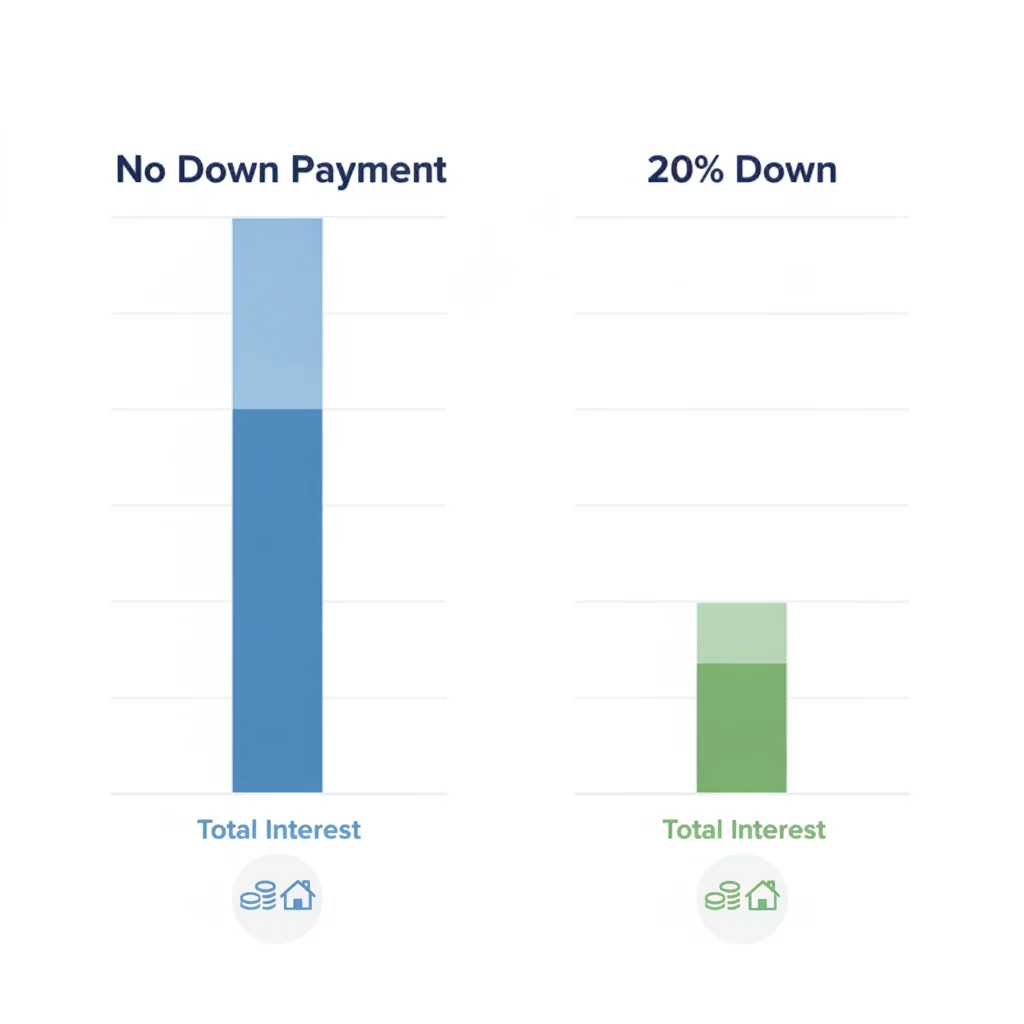
Going from zero down to just 20% down saves you $139 per month and $1,316 in total interest — without changing the rate at all. That's the mechanical impact of a smaller principal running through the same amortization schedule.
For a deeper look at how these numbers shift at different down payment percentages, see the full down payment math breakdown.
15–20%
Typical first-year new car depreciation
According to Edmunds and Kelley Blue Book data, most new vehicles lose 15–20% of their value within the first 12 months of ownership.
$1,316
Interest saved going from 0% to 20% down
Based on a $35,000 vehicle financed at 7% APR over 60 months — illustrating the direct savings from a larger upfront payment.
80%
LTV threshold preferred by most prime lenders
Most traditional auto lenders target an 80–90% loan-to-value ratio as the upper boundary for their best interest rate tiers.
$139
Monthly payment reduction at 20% down
On a $35,000 loan at 7% over 60 months, a 20% down payment reduces the monthly obligation by approximately $139 compared to zero down.
38%
U.S. car buyers who put zero down
According to Experian's State of the Automotive Finance Market report, a significant share of borrowers finance the full vehicle purchase price.
The Risk Signal: Why Lenders Care What You Put Down
A down payment is not just a financial transaction — it is a signal. When you hand over $5,000 or $7,000 upfront, you are demonstrating to the lender that you have savings discipline, you have skin in the game, and you are less likely to walk away from the loan when times get tough.
Lenders formalize this signal using a metric called the loan-to-value (LTV) ratio. LTV is simply your loan amount divided by the car's market value, expressed as a percentage.
- $35,000 car, $0 down: LTV = 100%
- $35,000 car, $7,000 down: LTV = 80%
- $35,000 car, $10,500 down: LTV = 70%
From the lender's perspective, an LTV above 100% means that if you default and they repossess the vehicle, the sale proceeds won't cover the outstanding balance. That is their worst-case scenario. A lower LTV provides a financial buffer that protects the lender — and they reward that protection with better loan terms.
“Loan-to-value is one of the most powerful levers in auto lending. A borrower who puts 20% down on a vehicle is statistically a very different risk profile than one who finances the full amount — and the pricing should reflect that.”
— Melinda Fortner, Senior Auto Lending Analyst, consumer finance research organization
Most traditional lenders prefer LTV ratios at or below 80–90% for new cars. Subprime lenders will go higher, but they compensate with elevated interest rates. To understand how your credit profile interacts with this dynamic, see how down payments interact with your credit score.
Why lenders care so much about your down payment covers the underwriting side of this equation in detail, including how different lenders weigh LTV against other risk factors.
Depreciation and Negative Equity: The Underwater Loan Problem
Cars lose value the moment you drive them off the lot. A new vehicle typically drops 15–20% in value in its first year alone. If you financed 100% of a $35,000 car and it's worth $28,000 twelve months later, you are already underwater — you owe more than the asset is worth.
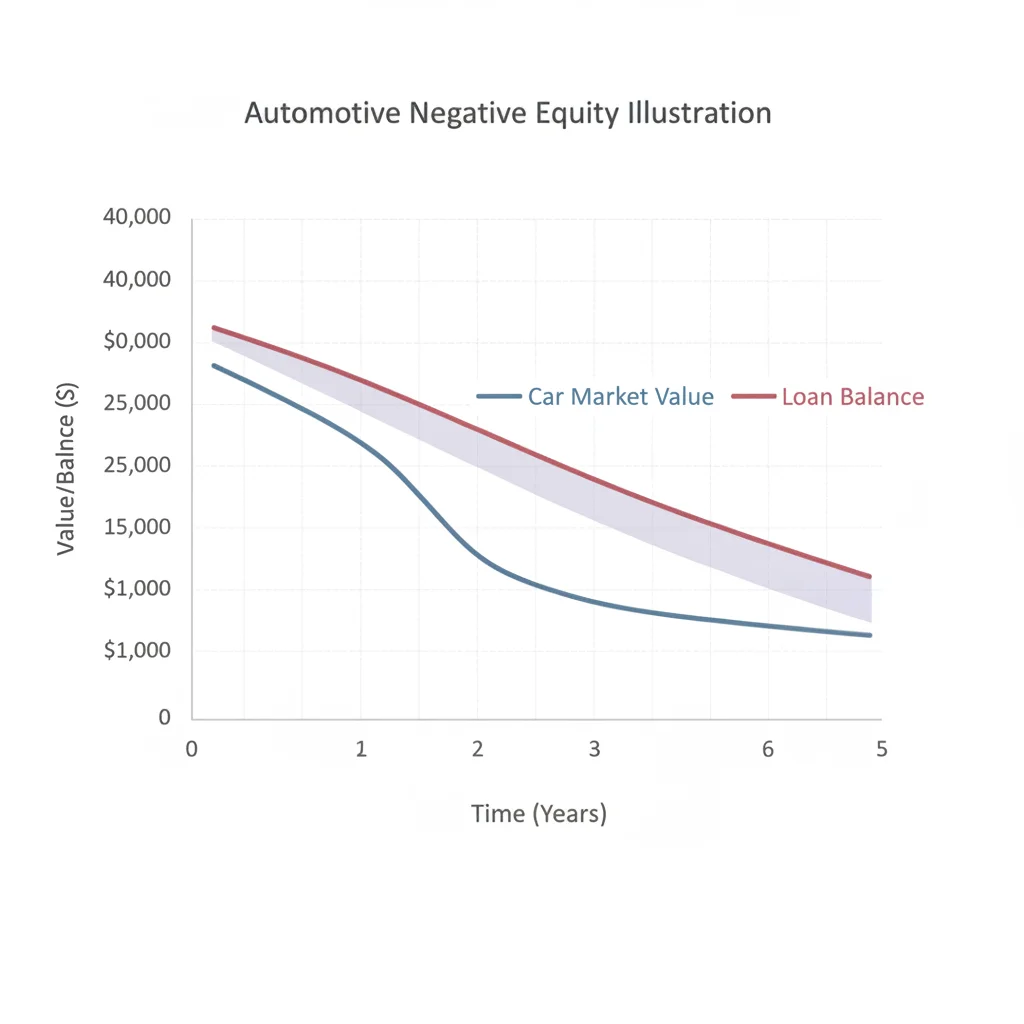
This is not just a theoretical problem. Being underwater on a loan creates real-world consequences:
- If you sell the car early, the buyer's payment won't cover your remaining balance. You'd need to bring cash to the closing to zero out the loan.
- If the car is totaled in an accident, your insurance company pays the car's current market value — not what you owe. Without gap insurance, you're on the hook for the difference.
- If you want to trade in, the negative equity typically rolls into your new loan, inflating what you borrow on the next vehicle.
A down payment of 15–20% creates an equity cushion that keeps pace with early depreciation. When your loan principal falls at roughly the same rate as the car's value, you stay close to break-even — or better.
Get Pre-Approved Before You Negotiate
Knowing your approved loan amount and rate before you walk into the dealership puts you in a stronger position. Once you know your rate, you can calculate exactly how much your down payment reduces your monthly payment — and use that as a negotiating anchor on the purchase price, not just the monthly figure.
The 20/4/10 Rule Is a Useful Starting Point
A widely cited budgeting guideline suggests: put at least 20% down, finance for no more than 4 years, and keep total vehicle costs (payment + insurance) at or below 10% of gross monthly income. It's not a hard rule, but it keeps buyers well within sustainable financial territory and avoids the negative equity trap.
Understanding how your monthly payments are applied to interest versus principal over time — called amortization — is key to grasping why you build equity slowly at first. See how auto loan amortization actually works for a complete explanation.
How a Down Payment Affects Your Monthly Budget
Monthly cash flow is where most buyers feel the impact of a down payment most directly. A lower principal translates dollar-for-dollar into a lower monthly obligation — and that breathing room matters when you factor in insurance, fuel, and maintenance.
Using the same $35,000 car at 7% over 60 months:
- Zero down: $693/month
- 10% down ($3,500): $624/month — saves $69/month
- 20% down ($7,000): $554/month — saves $139/month
That $139 monthly difference at 20% down amounts to $1,668 per year that stays in your pocket. Over five years, the compounded opportunity cost of that cash — if invested — is meaningful. But the more immediate benefit is that a lower payment gives you more flexibility to handle life's unpredictability without missing a loan payment.
Down Payments on Used Cars Work Differently
Used vehicles have already absorbed the steepest portion of their depreciation curve, so the negative-equity risk from a small down payment is lower than on a new car. Most lenders still prefer 10% down on used vehicles, but the urgency of hitting 20% is reduced. That said, interest rates on used car loans are typically higher, so the interest-savings argument for a larger down payment remains strong.
Manufacturer Incentives Can Change the Calculus
When a manufacturer offers 0% or sub-2% APR financing, the financial logic of making a large down payment shifts. At very low rates, the opportunity cost of tying up cash in the car increases relative to the interest you'd save. In these cases, putting the minimum acceptable down payment and keeping cash liquid can be the smarter move. Always run both scenarios with actual numbers before deciding.
Keep in mind that a larger down payment also gives you the option to choose a shorter loan term while keeping monthly payments in a comfortable range. Shorter terms carry lower interest rates in most lending environments and reduce total interest paid dramatically. Review the loan terms explained hub to understand how term length interacts with rate and total cost.
Down Payment vs. Trade-In: Not the Same Thing, But Similar Math
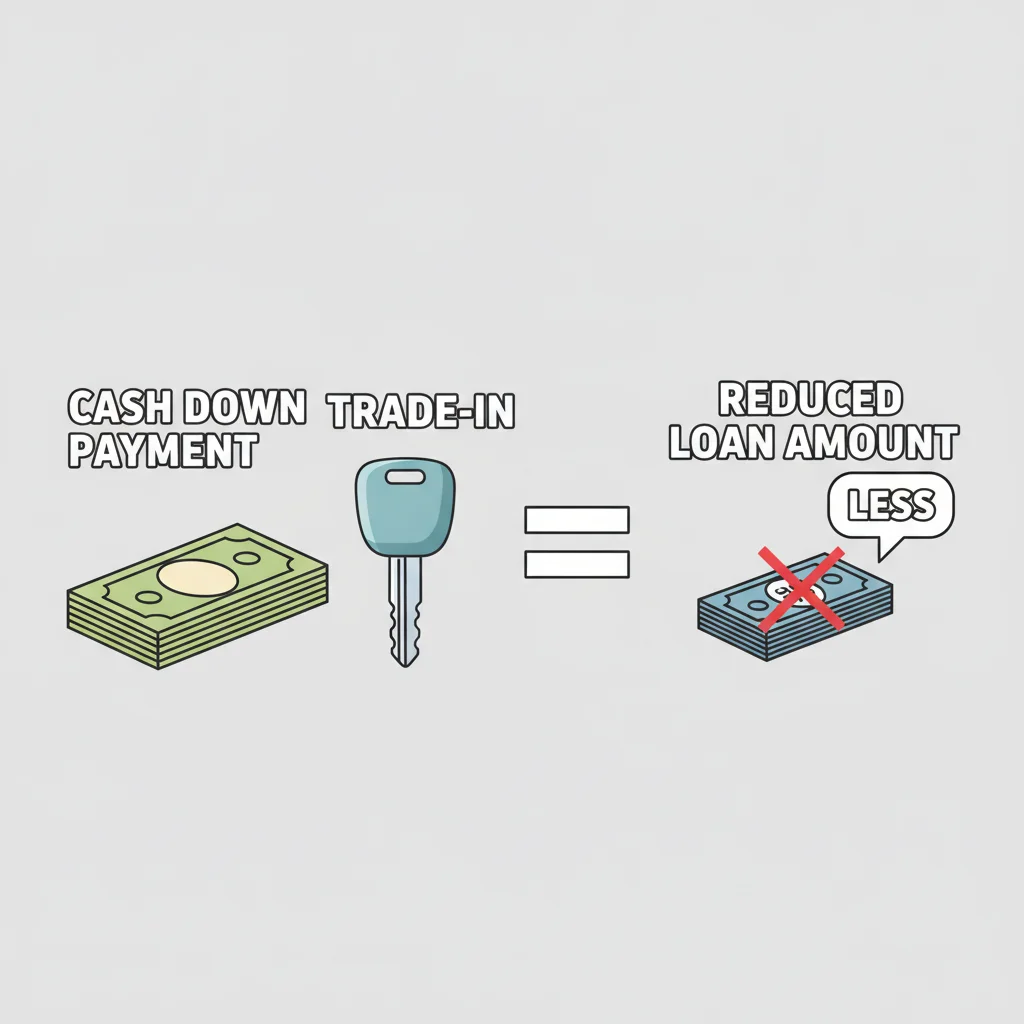
Many buyers ask whether a trade-in vehicle counts the same as a cash down payment. Mechanically, yes — both reduce the amount you finance. If your trade-in is worth $6,000 and the dealer credits that against your purchase, your loan principal drops by $6,000, just as if you had written a check for $6,000.
The practical difference is in execution:
- Cash down payment
- You control the amount precisely. You know exactly what you're contributing. There's no negotiation over valuation.
- Trade-in value
- The credit you receive depends on the dealer's appraisal, which is often below private-party market value. You may get $5,500 on a car worth $7,000 elsewhere — effectively reducing your down payment's real value.
The cleanest approach is to get a firm trade-in offer from a third-party service before visiting the dealership, so you can treat the trade-in as a known quantity. For a side-by-side comparison of how these two methods affect your financing, see down payment vs. trade-in value: which reduces your loan more.
Putting It All Together: Building a Down Payment Strategy
Now that you understand what a down payment does mechanically, how do you decide what's right for your situation? Here's a practical framework:
- Set a floor based on depreciation. For new cars, aim for at least 20% to avoid going underwater in year one. For used vehicles — which have already absorbed the steepest depreciation — 10% is often sufficient.
- Check your LTV against lender tiers. Ask lenders what LTV thresholds trigger better interest rates. Crossing from 90% LTV to 80% LTV might save you 0.5–1.0 percentage points — which is worth calculating before you finalize your down payment amount.
- Protect your emergency fund first. Don't drain your savings to maximize your down payment. Keeping three to six months of expenses liquid is more important than squeezing the last dollar out of interest costs.
- Consider the opportunity cost honestly. Money tied up in a depreciating asset earns you no return. If your auto loan rate is low — say 4% or below — there's a reasonable argument for putting less down and keeping cash available for higher-yield uses.
- Use your credit score as a guide. If your credit is excellent (720+), your rate will be competitive regardless of LTV, so a smaller down payment may be acceptable. If your credit is below 650, a larger down payment can help offset the higher rate you'd otherwise receive. The credit score impact hub explains exactly how your score shapes the rates lenders offer.
For a comprehensive end-to-end resource on down payment strategy — including common pitfalls and lender expectations — see auto loan down payments: the complete breakdown.
Get Pre-Approved Before You Negotiate
Knowing your approved loan amount and rate before you walk into the dealership puts you in a stronger position. Once you know your rate, you can calculate exactly how much your down payment reduces your monthly payment — and use that as a negotiating anchor on the purchase price, not just the monthly figure.
The 20/4/10 Rule Is a Useful Starting Point
A widely cited budgeting guideline suggests: put at least 20% down, finance for no more than 4 years, and keep total vehicle costs (payment + insurance) at or below 10% of gross monthly income. It's not a hard rule, but it keeps buyers well within sustainable financial territory and avoids the negative equity trap.
Down Payments on Used Cars Work Differently
Used vehicles have already absorbed the steepest portion of their depreciation curve, so the negative-equity risk from a small down payment is lower than on a new car. Most lenders still prefer 10% down on used vehicles, but the urgency of hitting 20% is reduced. That said, interest rates on used car loans are typically higher, so the interest-savings argument for a larger down payment remains strong.
Manufacturer Incentives Can Change the Calculus
When a manufacturer offers 0% or sub-2% APR financing, the financial logic of making a large down payment shifts. At very low rates, the opportunity cost of tying up cash in the car increases relative to the interest you'd save. In these cases, putting the minimum acceptable down payment and keeping cash liquid can be the smarter move. Always run both scenarios with actual numbers before deciding.

All claims are backed by peer-reviewed research. Sources on request.