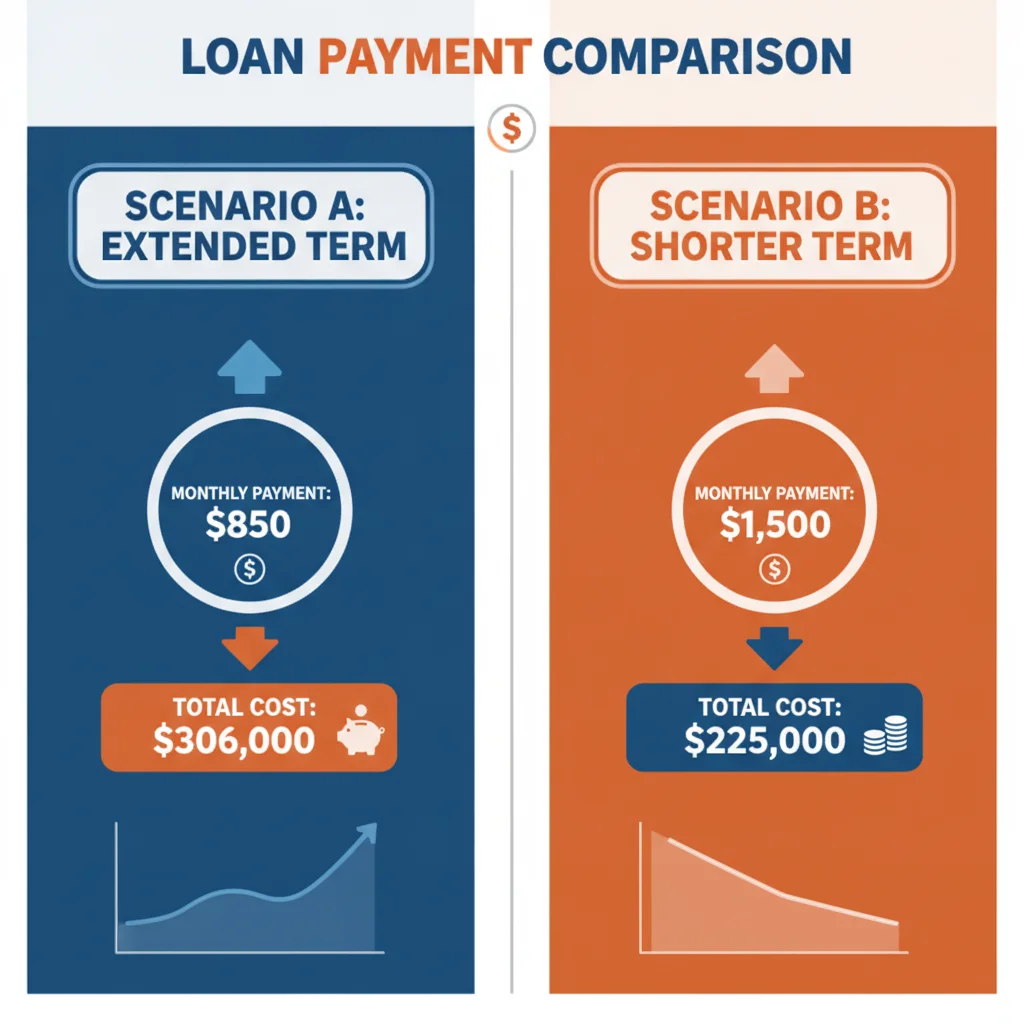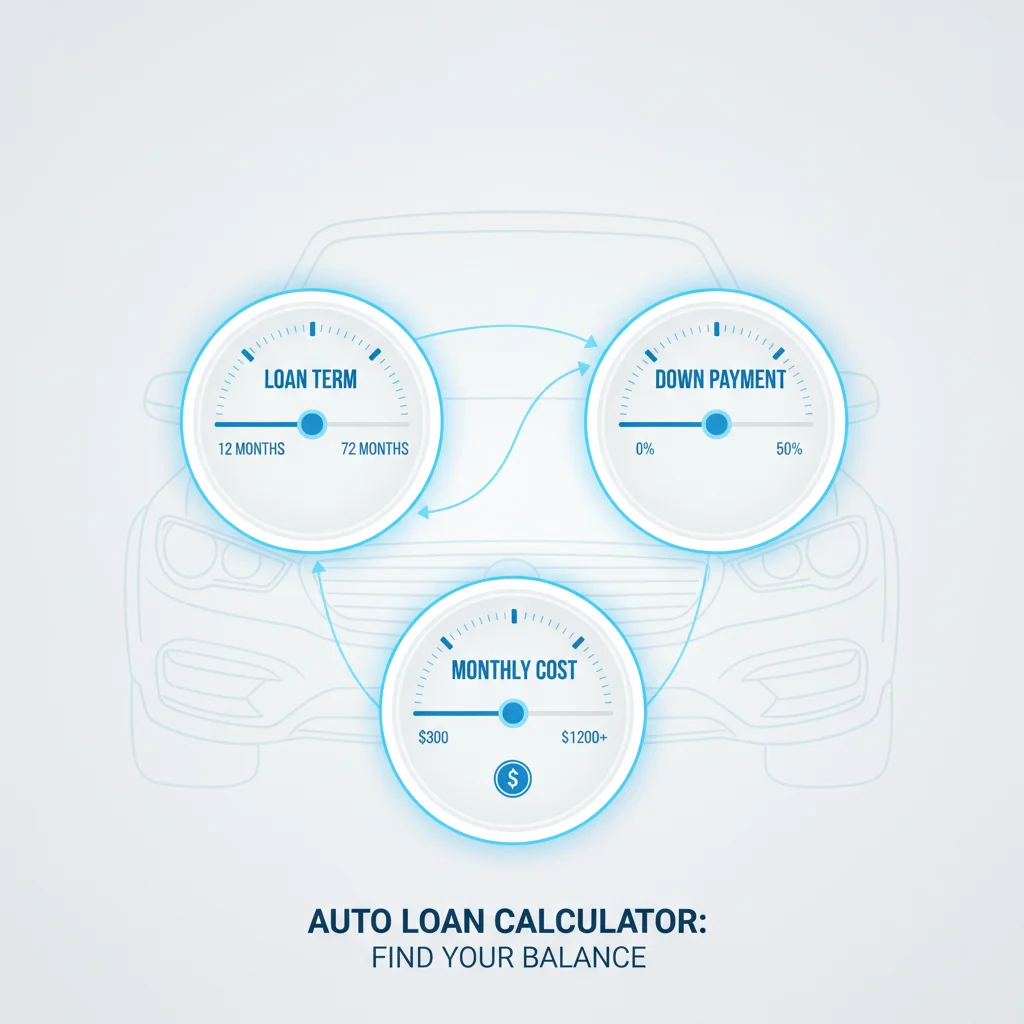
Key Takeaways
Loan Term, Down Payment & Monthly Cost
When you finance a car, three numbers are always connected: how long you borrow (the loan term), how much you pay upfront (the down payment), and what you owe each month (the monthly payment). Changing any one of these figures automatically shifts the others. A longer term shrinks your monthly bill but stretches how long interest accumulates. A bigger down payment reduces what you borrow and can shorten a comfortable term.
Lenders calculate monthly payments using an amortization formula that factors in principal, annual percentage rate (APR), and the number of payment periods. Because interest compounds over each period, extending the term disproportionately increases total interest paid even when the rate stays constant.
Why These Three Variables Are Inseparable
Think of your auto loan as a three-legged stool. The legs are your loan term, your down payment, and your monthly payment. Shorten one leg and the whole structure tilts. Lengthen another and something else has to compensate. No single variable moves in isolation — every adjustment you make ripples through the others.
This is the core concept most car buyers miss. They walk into a dealership focused on one question: Can I afford this monthly payment? But that question leaves two critical levers on the table. Dealers know this, which is why financing conversations often get steered toward term length as the primary adjustment tool. A longer term makes almost any monthly payment look manageable — and that's precisely when buyers should slow down and do the math.
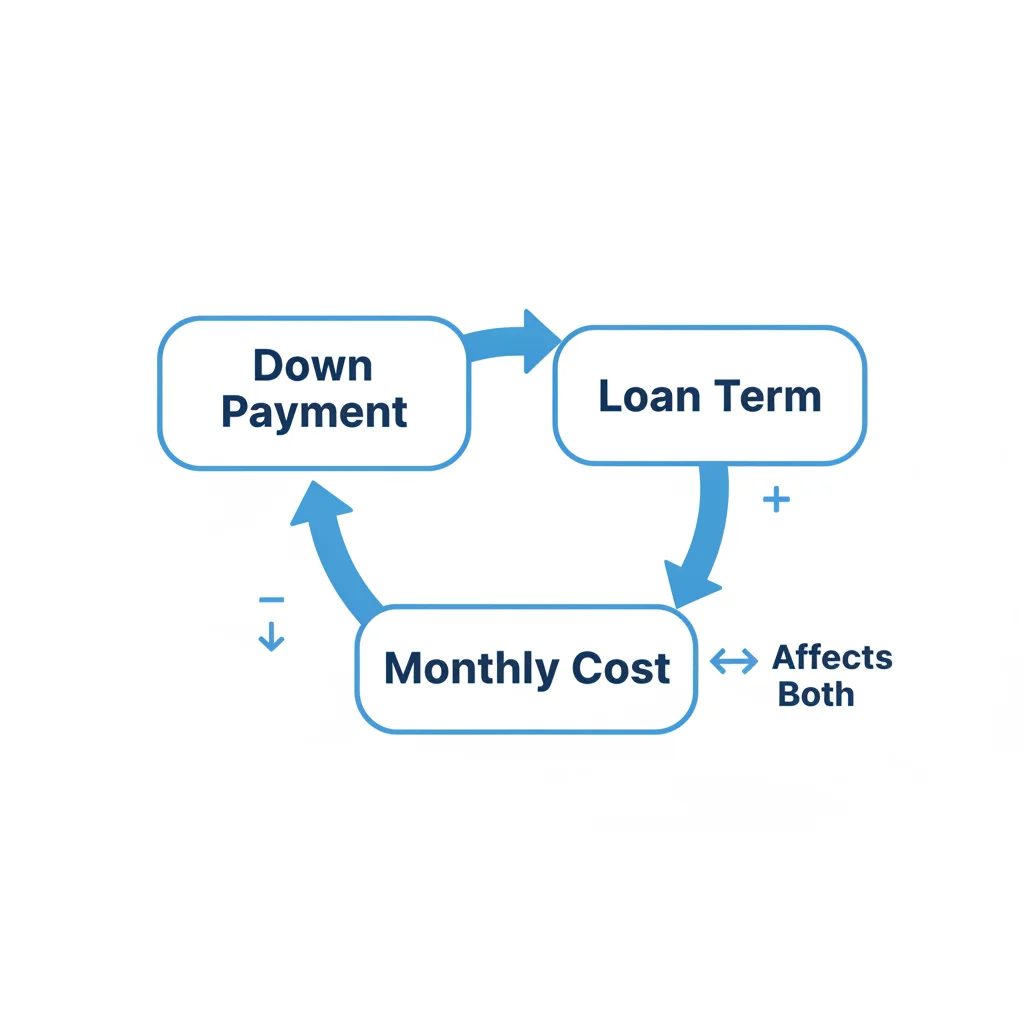
Understanding how the three variables interact gives you genuine negotiating power. Instead of reacting to whatever payment structure a lender proposes, you can walk in knowing exactly which combination of term and down payment produces the outcome you actually want — whether that's the lowest monthly cost, the lowest total cost, or the fastest path out of debt.
See our full breakdown of what a car loan costs over time to understand how these numbers stack up from start to finish.
How Loan Term Shapes Monthly Cost and Total Interest
The loan term is the number of months you agree to repay the loan — typically 36, 48, 60, 72, or 84 months. On paper, a longer term seems like a straightforward win: same car, lower payment. In practice, you're trading monthly comfort for long-term cost.
Here's why. Interest doesn't just stack on top of what you owe — it compounds across every payment period. Each additional month you carry a balance is another month the lender charges interest on the remaining principal. Stretch a loan from 48 to 72 months and you add 24 more months of that process.
72 months
Most common new-car loan term in the U.S.
According to Experian's State of the Automotive Finance Market report, the average new vehicle loan term has hovered near 72 months in recent years.
$1,200+
Extra interest from extending 48 to 72 months
On a typical $28,000 loan at 7.5% APR, moving from a 48-month to a 72-month term adds over $2,200 in total interest paid.
20%
Recommended minimum down payment on new cars
Financial advisors widely recommend at least 20% down on a new vehicle to offset first-year depreciation and avoid negative equity.
38%
Share of new car buyers with negative equity trade-ins
Edmunds data has shown that roughly one in three buyers trading in a vehicle carries negative equity — often a result of long-term loans with minimal down payments.
$140/month
Monthly savings from a 20% vs. 0% down payment
On a $35,000 vehicle financed over 60 months at 7.5% APR, a 20% down payment reduces the monthly payment by approximately $140 compared to no money down.
The table below illustrates the effect clearly. Assume a $28,000 loan at 7.5% APR:
| Loan Term | Monthly Payment | Total Interest Paid | Total Cost |
|---|---|---|---|
| 36 months | $869 | $3,284 | $31,284 |
| 48 months | $678 | $4,534 | $32,534 |
| 60 months | $561 | $5,660 | $33,660 |
| 72 months | $483 | $6,776 | $34,776 |
| 84 months | $427 | $7,868 | $35,868 |
Notice that going from a 36-month to an 84-month term reduces the monthly payment by $442 — but adds nearly $4,600 in interest. That's real money leaving your pocket for the benefit of a lower bill each month.
For a deeper look at this trade-off, see how extending your loan term inflates total cost.
Longer Terms Often Carry Higher APRs
Many buyers assume that loan term and APR are independent — that they can choose any term and get the same interest rate. In practice, lenders often charge higher APRs for longer loan terms because extended repayment periods carry more risk. Always ask for APR quotes at multiple term lengths before assuming the same rate applies across all options.
Trade-In Equity Works Like a Down Payment
If you're trading in a vehicle with positive equity (the car is worth more than you owe), that equity reduces the principal of your new loan just like cash does. Negative equity — owing more than the trade-in is worth — works in reverse: it gets rolled into the new loan, increasing the principal you'll pay interest on. Know your trade-in's net equity before calculating your effective down payment.
How Down Payment Changes the Equation
Your down payment does something the loan term can't: it reduces the principal. When you put more money down, the lender has less to finance, which means less interest accumulates regardless of what term you choose. It's one of the few moves in car buying that improves your position on both the monthly payment and the total cost simultaneously.
Here's a practical comparison. Same $35,000 vehicle, same 7.5% APR, same 60-month term — but different down payment amounts:
| Down Payment | Amount Financed | Monthly Payment | Total Interest |
|---|---|---|---|
| $0 (0%) | $35,000 | $701 | $7,060 |
| $3,500 (10%) | $31,500 | $631 | $6,354 |
| $7,000 (20%) | $28,000 | $561 | $5,648 |
| $10,500 (30%) | $24,500 | $490 | $4,942 |
A 20% down payment saves you $140 per month and more than $1,400 in total interest compared to financing the full amount — at the exact same term and rate. That's the power of reducing principal before the loan even starts.
Down payments also protect you against being upside-down on your loan — a situation where you owe more than the car is worth. New cars can lose 15–20% of their value in the first year. With little or no money down on a long-term loan, depreciation outpaces your principal paydown, leaving you financially stuck if you need to sell or trade early.
For a detailed look at how down payment size affects your loan-to-value ratio and overall financing cost, see the full math behind putting more money down.
The Interaction Effect: Using Both Levers Together
Here's where it gets genuinely useful. Most buyers treat term and down payment as separate decisions — they set a down payment based on savings and then pick whatever term makes the payment fit their budget. But when you treat them as an integrated system, you can engineer a loan structure that achieves multiple goals at once.
“Buyers often think of the down payment and the loan term as two separate decisions. They're not — they're two sides of the same equation. The best outcomes come from optimizing both at once, not choosing one and accepting whatever the other happens to be.”
— Greg McBride, Chief Financial Analyst, Bankrate
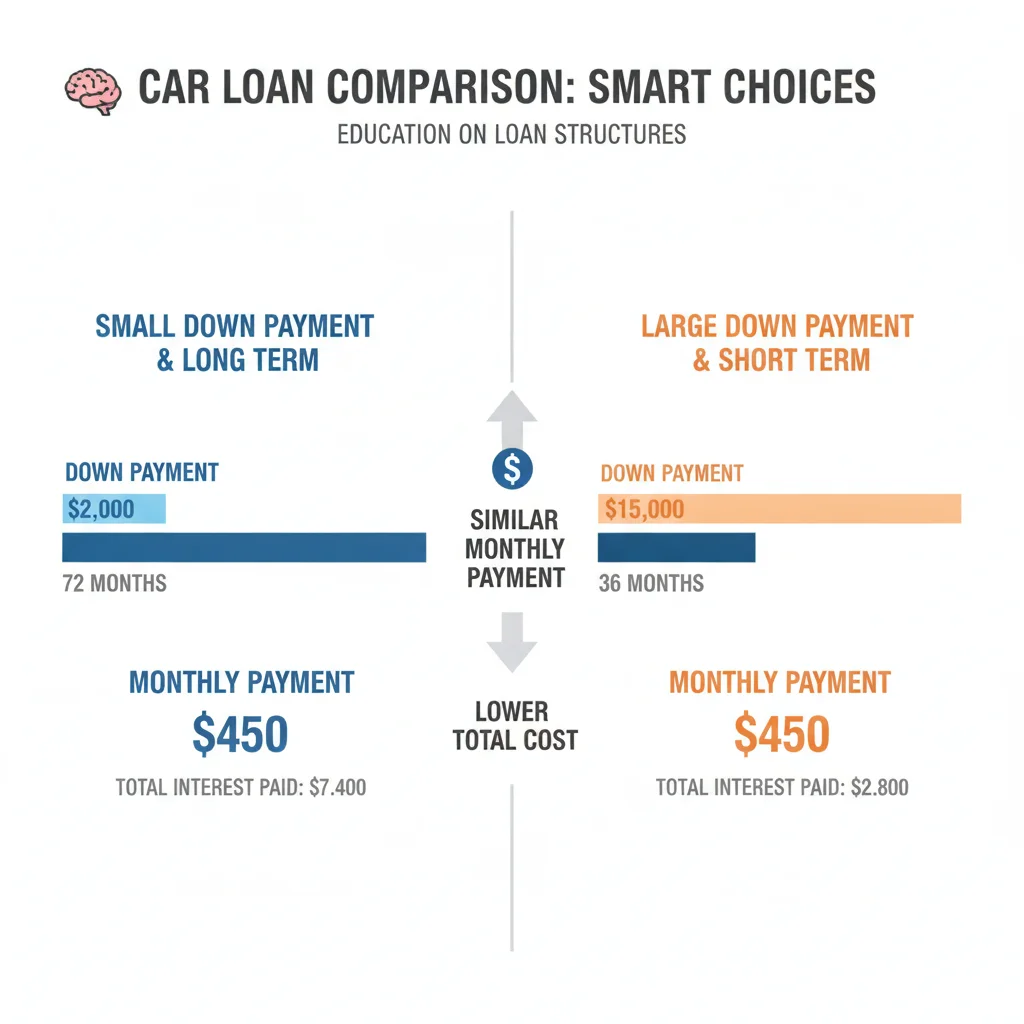
Consider this strategy: instead of putting $3,500 down on a 72-month loan to hit a $500/month target, what if you put $7,000 down on a 60-month loan? The monthly payment on the shorter, lower-principal loan might be nearly identical — but you'd be debt-free a year earlier and pay thousands less in interest.
Use an Online Loan Calculator Before You Shop
Before visiting any dealership or lender, spend 15 minutes with an auto loan calculator testing different combinations of principal, down payment, term, and APR. This gives you a clear mental map of your options so you can evaluate any financing offer on the spot rather than relying on the dealer's framing. Most bank and credit union websites offer free calculators.
Target Total Cost, Not Just Monthly Payment
When comparing loan offers, create a single 'total cost' number for each: multiply the monthly payment by the number of months and add any fees. This makes it easy to compare a 48-month offer at a higher monthly payment against a 72-month offer at a lower one — and the true winner usually becomes obvious quickly.
This is why running multiple side-by-side scenarios before you walk into a dealership is so valuable. The goal isn't to find one answer — it's to understand the range of outcomes available to you so you can make a deliberate choice.
Variables to test in your scenarios:
- Principal: What does the vehicle cost after any negotiation or trade-in credit?
- Down payment: What can you realistically put down today — and what could you put down if you waited 60–90 days?
- Term: What's the monthly payment at 48, 60, and 72 months for each down payment scenario?
- APR: Does a better credit score or a shorter term qualify you for a lower rate? Understanding APR matters here.
For guidance on which term actually fits your financial picture, see how to pick a loan term that matches your situation.
The APR Factor: Why Rate Matters Across Term Lengths
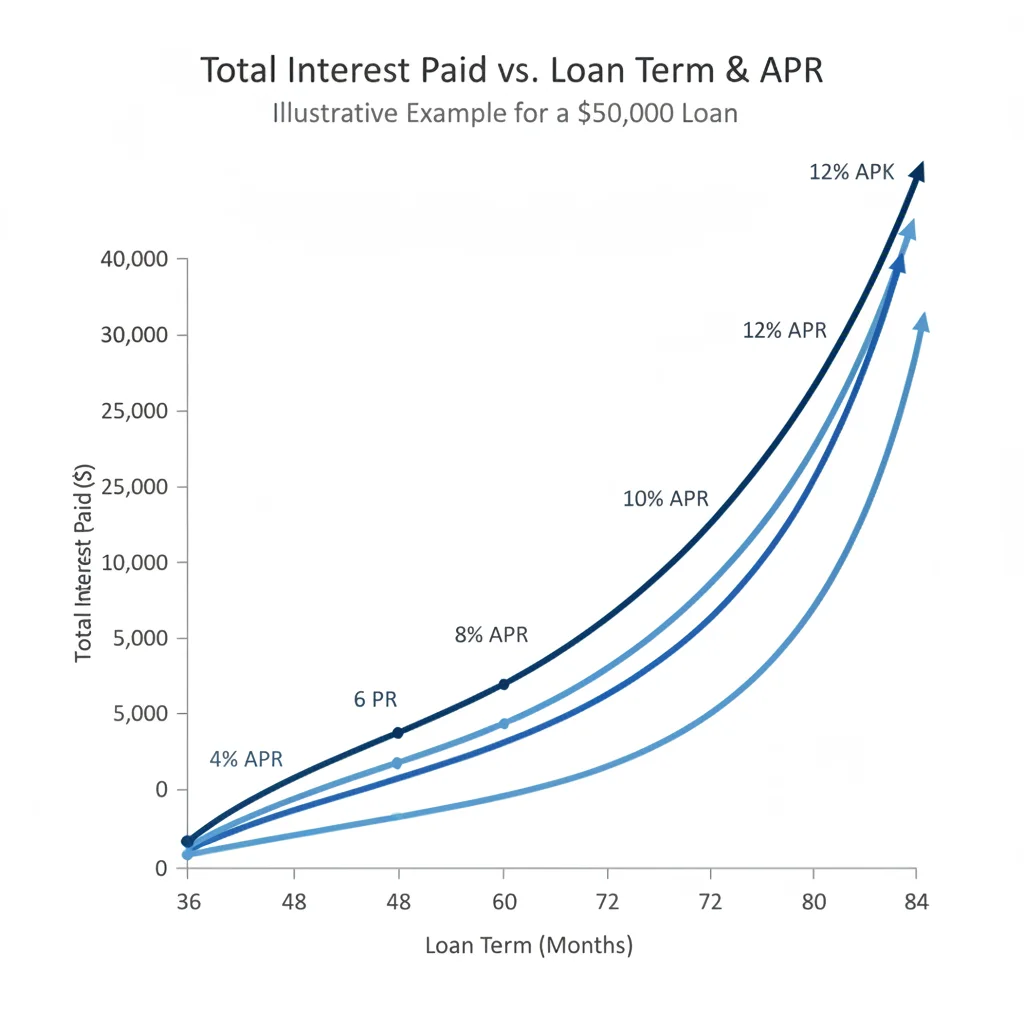
Loan term and down payment get most of the attention, but APR — your annual percentage rate — is the multiplier that makes everything else bigger or smaller. The same term length produces dramatically different total costs depending on the rate you're offered.
Longer loan terms often come with higher APRs. Lenders view extended repayment periods as riskier, and some lenders build additional cost into the rate itself. So not only are you paying interest for more months — you may be paying interest at a higher rate per month.
Here's how APR interacts with term on a $25,000 loan:
| Term | APR | Monthly Payment | Total Interest |
|---|---|---|---|
| 48 months | 6.0% | $587 | $3,176 |
| 60 months | 6.5% | $489 | $4,340 |
| 72 months | 7.5% | $432 | $6,104 |
| 84 months | 8.5% | $402 | $8,768 |
Moving from 48 to 84 months drops your monthly payment by $185, but adds over $5,500 in interest — and that gap is amplified because the longer terms come with higher rates in this scenario. This is the trade-off most buyers underestimate until they see the numbers side by side.
See how loan term length and APR interact across real scenarios to understand just how much rate variation can affect your outcome.
Practical Strategies to Optimize All Three Variables
Knowing how the variables interact is useful. Knowing what to do about it is better. Here are concrete steps you can take before and during the financing process to improve your loan structure.
1. Calculate your target principal before negotiating the rate or term
Your loan principal is the vehicle price minus your down payment and any trade-in equity. Nail this number down first. Lenders and dealers can't meaningfully quote you a payment until the principal is set — and keeping your eye on the principal prevents low-payment tactics from obscuring the true cost of a more expensive vehicle.
2. Get pre-approved before visiting the dealership
Pre-approval from a bank or credit union gives you a benchmark APR and a maximum loan amount. It also tells you what term the lender is comfortable offering at that rate. You can then compare that offer directly against whatever financing the dealership proposes.
3. Run the 20/4/10 guideline as a quick sanity check
A commonly cited rule of thumb: put at least 20% down, finance for no more than 4 years, and keep total vehicle expenses (payment plus insurance) under 10% of monthly gross income. This won't be achievable for every buyer or every vehicle, but it's a useful starting point for identifying when a loan structure is becoming financially risky.
Use an Online Loan Calculator Before You Shop
Before visiting any dealership or lender, spend 15 minutes with an auto loan calculator testing different combinations of principal, down payment, term, and APR. This gives you a clear mental map of your options so you can evaluate any financing offer on the spot rather than relying on the dealer's framing. Most bank and credit union websites offer free calculators.
Target Total Cost, Not Just Monthly Payment
When comparing loan offers, create a single 'total cost' number for each: multiply the monthly payment by the number of months and add any fees. This makes it easy to compare a 48-month offer at a higher monthly payment against a 72-month offer at a lower one — and the true winner usually becomes obvious quickly.
4. Ask specifically about prepayment penalties
If your loan allows extra principal payments without penalty, you have a built-in way to shorten your effective term after signing. Even one extra payment per year on a 60-month loan can meaningfully reduce total interest paid and cut months off your repayment schedule.
5. Revisit the down payment if the term is pushing toward 72+ months
If the only way to afford a vehicle is a 72- or 84-month term, treat that as a signal to either increase your down payment, reconsider the vehicle's price point, or both. Ultra-long terms almost always indicate a mismatch between the vehicle price and the buyer's budget — and they leave you financially exposed to depreciation for years.
For a comprehensive look at how all these factors compound into a true lifetime loan cost, see the full cost of a car loan over time. And if you want to understand the mechanics of the down payment side in more detail, explore the down payments hub for more resources.

All claims are backed by peer-reviewed research. Sources on request.