| Monthly savings per $1,000 less financed (60-mo, 7% APR) | ~$19.80 (Standard amortization calculation) |
| Monthly savings per $1,000 less financed (72-mo, 7% APR) | ~$17.05 (Standard amortization calculation) |
| Typical new-car depreciation in Year 1 | 15%–20% (Edmunds, iSeeCars depreciation studies) |
| Recommended minimum down payment (new car) | 10%–20% (Consumer finance industry guidance) |
| LTV threshold for best lender rates | 80% or below (General lending industry standard) |
| Interest saved going from 0% to 20% down ($30K, 60-mo, 7.5%) | ~$1,200 (Based on standard amortization model) |
| APR difference for high vs. low LTV loans | 0.5%–1.5% (Varies by lender and credit profile) |
| Total payment reduction over 5 years ($60/mo savings) | $3,600 (60 months × $60) |
How Down Payment Size Moves the Monthly Payment Needle
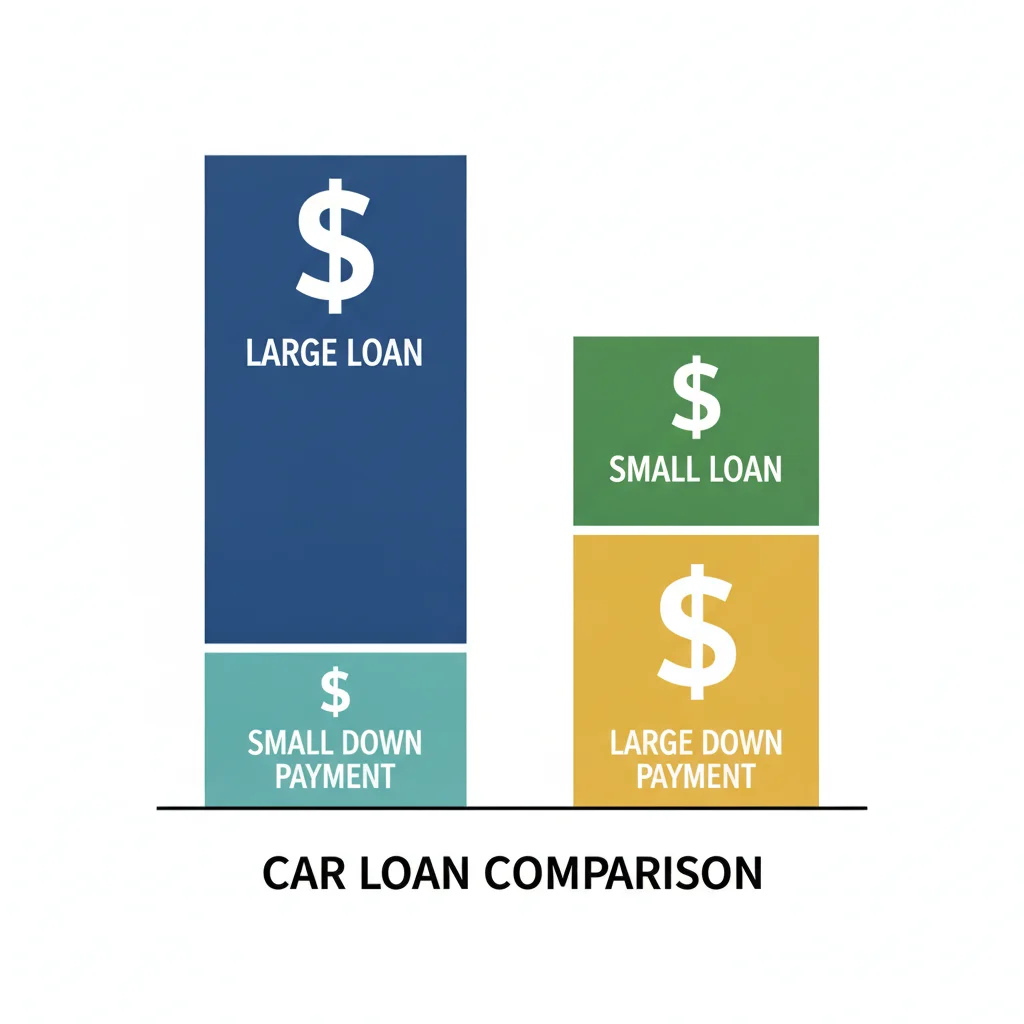
When you put money down on a car, you are doing one simple thing: shrinking the amount the lender needs to finance. A smaller loan balance means lower monthly payments, less interest paid over the life of the loan, and less risk for the lender. The relationship is direct and predictable — and once you see the math in action, the logic becomes hard to ignore.
Think of it this way. If you are buying a $32,000 vehicle and you finance the entire price, you are borrowing $32,000. Put $5,000 down and you are only borrowing $27,000. That $5,000 reduction in principal flows through every single monthly payment for the entire loan term.
| Monthly savings per $1,000 less financed (60-mo, 7% APR) | ~$19.80 (Standard amortization calculation) |
| Monthly savings per $1,000 less financed (72-mo, 7% APR) | ~$17.05 (Standard amortization calculation) |
| Typical new-car depreciation in Year 1 | 15%–20% (Edmunds, iSeeCars depreciation studies) |
| Recommended minimum down payment (new car) | 10%–20% (Consumer finance industry guidance) |
| LTV threshold for best lender rates | 80% or below (General lending industry standard) |
| Interest saved going from 0% to 20% down ($30K, 60-mo, 7.5%) | ~$1,200 (Based on standard amortization model) |
| APR difference for high vs. low LTV loans | 0.5%–1.5% (Varies by lender and credit profile) |
| Total payment reduction over 5 years ($60/mo savings) | $3,600 (60 months × $60) |
To understand exactly how each additional dollar of down payment translates to monthly savings, you need to look at a concept called the monthly payment factor — essentially, how much your payment drops per $1,000 less you borrow. On a 60-month loan at 7% APR, every $1,000 less you finance saves roughly $19.80 per month. On a 72-month loan at the same rate, that same $1,000 saves about $17.05 per month.
So a $3,000 down payment on a 60-month, 7% loan saves you approximately $59 per month — or $3,540 in total payments across the loan term. You put in $3,000 and avoid $3,540 in future payments. That is a net gain of $540 before even accounting for the interest you would have paid on that $3,000.
For a deeper look at how the entire loan structure shifts when you change your upfront amount, see what a car down payment actually does to your loan. It covers lender risk, interest costs, and the full mechanics in one place.
A Side-by-Side Breakdown: Same Car, Different Down Payments
Numbers make this concrete. The table below uses a $30,000 vehicle price, a 60-month loan term, and a 7.5% APR — a realistic scenario for a buyer with average credit in today's market.
Loan-to-Value Ratio (LTV)
The percentage of a vehicle's value that is being financed. A $24,000 loan on a $30,000 car is an 80% LTV. Lenders use LTV to measure their exposure — lower LTV generally means better loan terms for the borrower.
Principal
The original amount of money borrowed, not counting interest. Your down payment directly reduces the principal, which is the base on which all interest charges are calculated.
Amortization
The process of paying off a loan through scheduled equal payments over time. Early payments are weighted toward interest; later payments pay down more principal.
Negative Equity (Underwater)
When you owe more on a loan than the asset is currently worth. Common early in auto loans due to rapid depreciation, and more likely when little or no down payment was made.
APR (Annual Percentage Rate)
The yearly cost of borrowing money expressed as a percentage, including interest and certain fees. A lower APR means less total interest paid over the loan term.
GAP Insurance
A product that covers the difference between what you owe on a loan and what your vehicle is worth if it is totaled or stolen. Particularly relevant when LTV is high.
| Down Payment | Amount Financed | Monthly Payment | Total Interest Paid | Total Cost of Loan |
|---|---|---|---|---|
| $0 (0%) | $30,000 | $601 | $6,060 | $36,060 |
| $3,000 (10%) | $27,000 | $541 | $5,460 | $32,460 |
| $6,000 (20%) | $24,000 | $481 | $4,860 | $28,860 |
| $9,000 (30%) | $21,000 | $421 | $4,260 | $25,260 |
Every 10% step up in down payment cuts the monthly bill by roughly $60 and trims total interest by about $600. The cumulative effect of going from 0% to 20% down is a $120 monthly reduction and $1,200 in avoided interest. That is real money — two extra car payments saved per year just by putting more down at signing.
$3,600
Total 5-year payment reduction from $60/mo savings
A $60 monthly payment difference on a 60-month loan adds up to $3,600 in real cash kept in your pocket.
20%
Typical new-car value lost in year one
According to Edmunds and iSeeCars research, new vehicles often shed 15–20% of their value within the first 12 months.
$850
Interest added by a 1% higher APR ($30K, 60 months)
A 1% rate difference due to high LTV costs roughly $850 more in total interest on a typical 5-year auto loan.
~$19.80
Monthly savings per $1,000 less financed
On a 60-month loan at 7% APR, each $1,000 reduction in financed amount saves approximately $19.80 per month.
80%
LTV ratio that typically qualifies for best rates
Most lenders reserve their most competitive APR tiers for borrowers whose loan-to-value ratio is at or below 80%.
Notice also how the total cost of the loan column tells a fuller story than the monthly payment alone. A buyer focused only on the monthly figure might shrug at a $60 difference. But over five years, $60 per month becomes $3,600 in real cash leaving your bank account. The down payment is not a sunk cost — it is prepaid interest avoidance.
For a precise, formula-level breakdown of what changes inside the loan math when you adjust your down payment, see the math behind putting more money down on a car — including how loan-to-value ratio shifts with each dollar you contribute upfront.
The Rate Effect: Why Bigger Down Payments Sometimes Unlock Better APRs
Monthly payment reduction from a lower principal is just part of the picture. A larger down payment can also reduce the interest rate you receive — which compresses your monthly payment even further through a second, separate mechanism.
Lenders price loans based on risk. One of the most direct measures of risk they use is the loan-to-value ratio (LTV) — the percentage of the vehicle's value they are financing. A buyer who puts 20% down creates an LTV of 80%. A buyer who puts nothing down has an LTV of 100% or higher once taxes and fees are rolled in. Higher LTV means the lender is more exposed if you default and the car has to be repossessed and resold.
In practice, lenders respond to high LTV ratios by charging a higher APR to compensate for that added risk. The difference may be small — perhaps 0.5% to 1.5% — but on a $30,000 loan over 60 months, a 1% APR difference changes your monthly payment by roughly $14 and your total interest paid by nearly $850.
So putting more down does double duty: it lowers the principal you are financing and may lower the rate you pay on whatever remains. The monthly payment benefits from both levers simultaneously.
This connection between upfront money and credit-risk pricing is explored in detail in how down payments interact with your credit score on an auto loan. If your credit score is not perfect, a larger down payment can partially compensate and pull your rate closer to prime territory.
Rate Improvements Are Not Guaranteed
Not every lender automatically offers a lower APR when you put more down. Some lenders set rates primarily by credit score and do not formally tier by LTV. Always ask your lender explicitly how your down payment amount affects your offered rate — and get quotes with multiple down payment scenarios before committing.
Beware of the Underwater Risk on Long Loans
On 72- and 84-month loans, the risk of going underwater is highest because you pay down principal very slowly in the early months while depreciation moves fast. If you are choosing a long term, a larger down payment becomes even more important as a buffer. Some financial advisors suggest putting at least 20% down on any loan longer than 60 months.
Keep an Emergency Fund Intact
It can be tempting to put every available dollar down to minimize your monthly payment, but financial planners generally recommend keeping 3–6 months of living expenses accessible. A larger down payment that leaves you cash-strapped can be counterproductive if an unexpected expense forces you to take on high-interest debt to cover it.
Loan Term Length Changes the Math — But Not the Logic
Most car shoppers choose between 48-, 60-, 72-, and 84-month loan terms. The term length directly affects how much monthly relief you get from each dollar put down.
Here is the key insight: the longer the loan term, the smaller the monthly savings from each additional down payment dollar — but the larger the total interest savings over the life of the loan.
On a $1,000 reduction in loan principal:
- 48-month loan at 7.5% APR: saves approximately $24.20 per month
- 60-month loan at 7.5% APR: saves approximately $20.00 per month
- 72-month loan at 7.5% APR: saves approximately $17.30 per month
- 84-month loan at 7.5% APR: saves approximately $15.30 per month
Spreading the same loan over more months means each payment absorbs less of your down payment's impact on a per-month basis. However, a longer term also means more months of interest accruing on a higher balance — which is exactly why financing less (via a larger down payment) saves so much more in total on long-term loans than short ones.
Put $5,000 down on a 48-month loan and you save roughly $121 per month. Put that same $5,000 down on an 84-month loan and you save only $77 per month — but the total interest avoided on the 84-month loan is actually greater because interest compounds across a much longer runway.
To see how term length and down payment work together as a pair of adjustable levers, read about the relationship between loan term, down payment, and monthly cost. Adjusting one almost always requires recalibrating the other to hit your target payment.
The Hidden Cost of Putting Too Little Down
A small or zero down payment does not just raise your monthly bill — it exposes you to a specific financial trap called being underwater on your loan. This happens when you owe more on the car than it is currently worth.
New cars depreciate rapidly in the first year — often losing 15% to 20% of their value within 12 months of purchase. If you financed 100% of a $30,000 vehicle, you might owe $26,000 after your first year of payments while the car is only worth $24,000. You are now $2,000 underwater. If you need to sell, trade in, or the car is totaled in an accident, you still owe that gap out of pocket — unless you carry gap insurance.
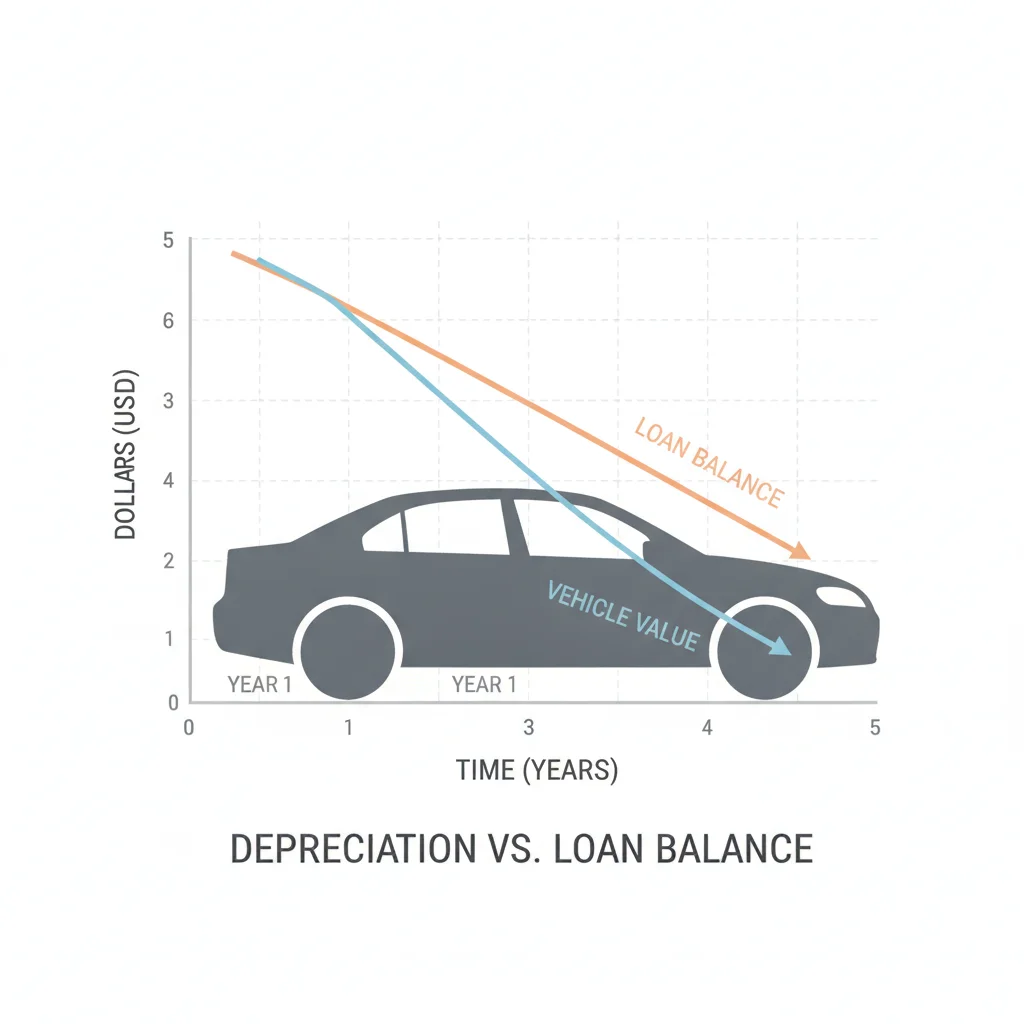
A 10–20% down payment at the start buffers you against this depreciation gap. It means your loan balance stays closer to — or below — the car's actual market value throughout the loan, protecting you from the negative equity trap.
Putting down too little quietly inflates the cost of your car in ways that go beyond just the monthly payment — including more interest charges and longer exposure to negative equity.
For a stark side-by-side comparison of the real-world costs at both extremes, compare no down payment versus 20% down with actual numbers across the full loan timeline.
Rate Improvements Are Not Guaranteed
Not every lender automatically offers a lower APR when you put more down. Some lenders set rates primarily by credit score and do not formally tier by LTV. Always ask your lender explicitly how your down payment amount affects your offered rate — and get quotes with multiple down payment scenarios before committing.
Beware of the Underwater Risk on Long Loans
On 72- and 84-month loans, the risk of going underwater is highest because you pay down principal very slowly in the early months while depreciation moves fast. If you are choosing a long term, a larger down payment becomes even more important as a buffer. Some financial advisors suggest putting at least 20% down on any loan longer than 60 months.
Keep an Emergency Fund Intact
It can be tempting to put every available dollar down to minimize your monthly payment, but financial planners generally recommend keeping 3–6 months of living expenses accessible. A larger down payment that leaves you cash-strapped can be counterproductive if an unexpected expense forces you to take on high-interest debt to cover it.
Down payment size also factors into your preapproval results before you even walk into a dealership. A larger intended down payment can increase the loan amount you qualify for or reduce the rate a lender offers in preapproval. Learn how down payments and preapproval interact so you can plan your upfront contribution strategically before shopping.
Quick Reference: How to Use This Information
Whether you are in early planning or days away from signing, here is a practical framework for using the down payment–monthly payment relationship to your advantage:
- Start with your target monthly payment. Decide what you can comfortably afford each month. Work backward from that number to figure out how much loan principal that payment supports at current rates.
- Calculate the gap. If the vehicle price minus your target loan principal is more than you have saved, you know exactly how much more to save before buying — or how much to negotiate off the price.
- Test the rate effect. Ask your lender or use an online calculator to model two scenarios: your current planned down payment versus a 20% down payment. Compare the APRs offered. If 20% down unlocks a meaningfully lower rate, the monthly savings may be larger than the principal reduction alone suggests.
- Account for depreciation timing. If you are buying a new car, budget for at least 10–15% down to stay above water during the high-depreciation first year. On a used car that has already taken its biggest depreciation hit, you may have more flexibility.
- Do not over-deplete savings. A larger down payment helps — but not if it leaves you without an emergency fund. Lenders generally want to see 3–6 months of expenses in reserve. Draining savings to hit 20% down and then facing a repair bill on month two can create a worse financial outcome than a slightly higher payment would have.
Auto Loan Payment Calculator
Plug in your vehicle price, down payment, rate, and term to instantly see how each down payment scenario changes your monthly obligation and total interest paid.
Loan Terms Explained Hub
A comprehensive reference covering how term length, monthly payments, and total financing cost interact — essential reading before finalizing any auto loan decision.
Edmunds True Cost to Own Tool
Estimates the 5-year ownership cost of any vehicle including depreciation, helping you model how much LTV protection your down payment actually buys.
GAP Insurance Explainer
If you are financing with a small down payment, GAP coverage can protect you from owing money after a total loss. This guide explains when it makes sense to buy it.
Down Payment Strategy Template
A simple worksheet that helps you calculate your target down payment based on your monthly budget, desired term, and current APR estimates from lenders.
For a broader understanding of how all the loan variables connect, explore the Loan Terms Explained hub — it covers what term length, monthly payments, and total cost actually mean together for a borrower. And if you want to understand how your credit score shapes the rates you receive on top of whatever down payment you bring, the Credit Score Impact hub is the right next stop.
Rate Improvements Are Not Guaranteed
Not every lender automatically offers a lower APR when you put more down. Some lenders set rates primarily by credit score and do not formally tier by LTV. Always ask your lender explicitly how your down payment amount affects your offered rate — and get quotes with multiple down payment scenarios before committing.
Beware of the Underwater Risk on Long Loans
On 72- and 84-month loans, the risk of going underwater is highest because you pay down principal very slowly in the early months while depreciation moves fast. If you are choosing a long term, a larger down payment becomes even more important as a buffer. Some financial advisors suggest putting at least 20% down on any loan longer than 60 months.
Keep an Emergency Fund Intact
It can be tempting to put every available dollar down to minimize your monthly payment, but financial planners generally recommend keeping 3–6 months of living expenses accessible. A larger down payment that leaves you cash-strapped can be counterproductive if an unexpected expense forces you to take on high-interest debt to cover it.

All claims are backed by peer-reviewed research. Sources on request.