Key Takeaways
Car Valuation Discrepancy
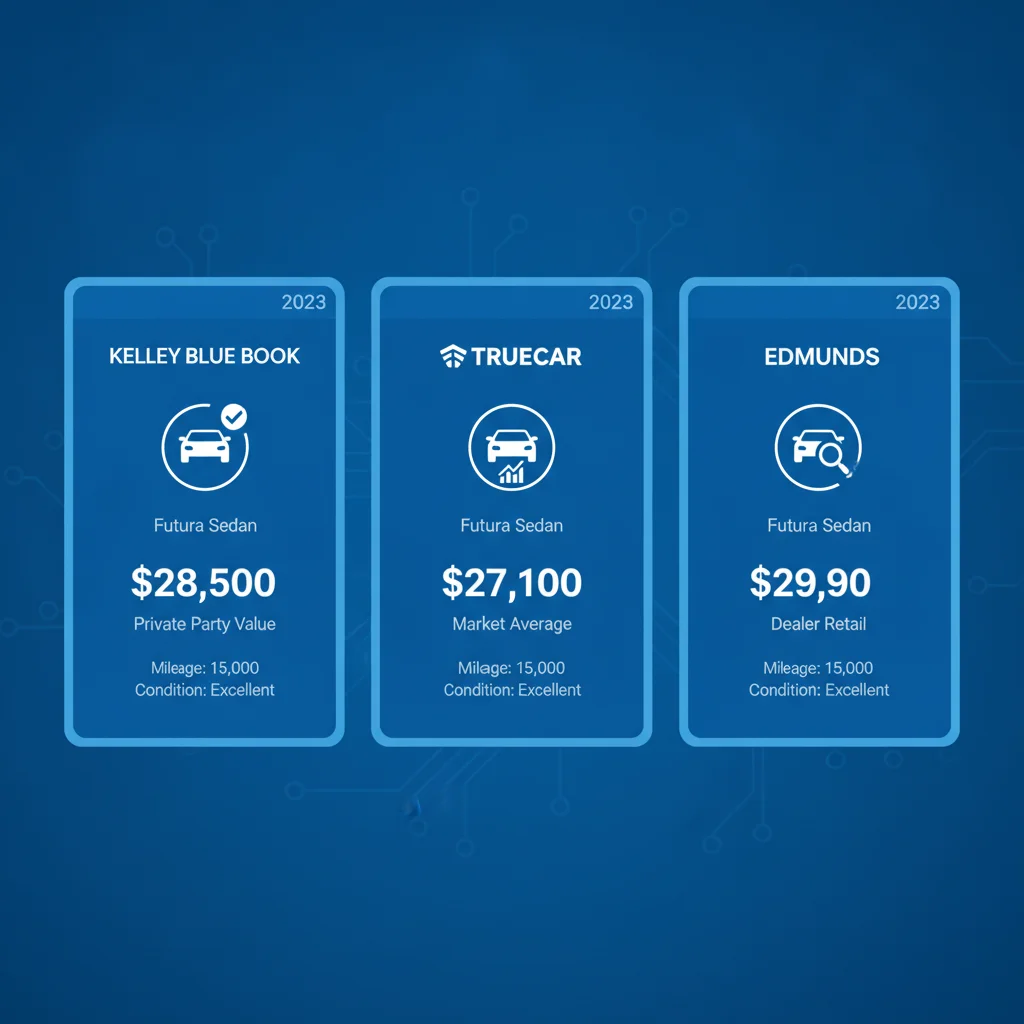
A car valuation discrepancy occurs when different pricing tools — such as KBB, Edmunds, or NADA — return meaningfully different dollar estimates for the same vehicle. Each tool uses its own data sources, methodologies, and market assumptions, which is why a single car can show a $2,000 or even $5,000 spread across platforms. These gaps are structural, not errors.
Valuation algorithms weight auction transaction data, dealer listing prices, consumer-to-consumer sales, and proprietary depreciation curves differently — producing legitimately different outputs even from identical inputs.
The Three-Tool Problem Every Seller Hits
You enter your car's year, make, model, mileage, and ZIP code into KBB. Then you do the same on Edmunds. Then maybe NADA or CarGurus. By the end, you have three or four numbers sitting in front of you — and they don't agree. Maybe the spread is $800. Maybe it's $4,500. Either way, you're now less confident about your car's value than when you started.
This is one of the most common frustrations sellers face, and it has a specific cause: these tools are not measuring the same thing. They look similar on the surface — enter your details, get a dollar figure — but underneath, each platform is pulling from different data, applying different depreciation models, and targeting different market segments. The number you see is a product of those choices, not a universal truth.
Understanding why the gaps exist is the first step to using these tools correctly. Once you know what each one is actually calculating, you can stop searching for the "right" answer and start building a pricing strategy that works for your specific situation and selling channel.
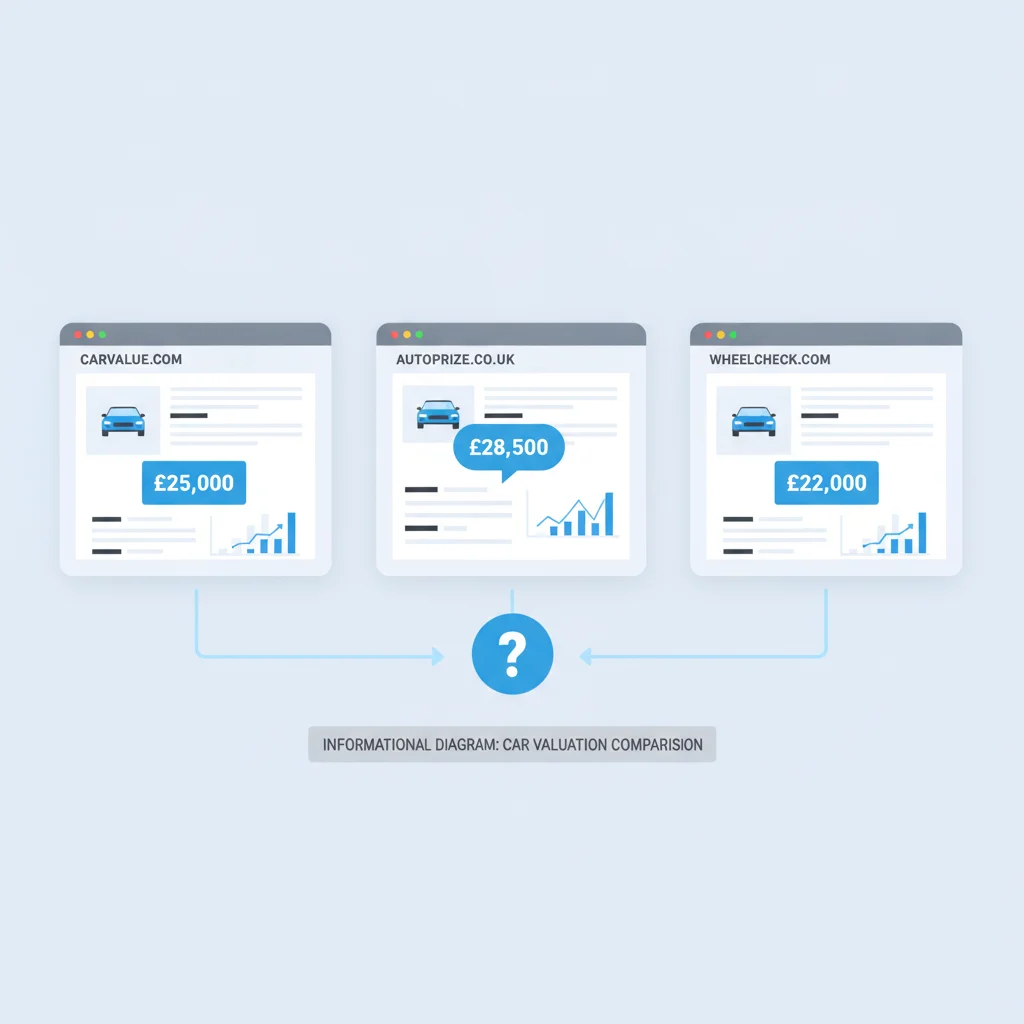
KBB, Edmunds, and NADA each use different data sources and methods — knowing those differences is the foundation for reading their outputs correctly.
What Each Major Tool Is Actually Built On
The reason estimates diverge starts with data sourcing. Each platform aggregates prices from different corners of the market, and those corners don't all agree with each other.
Kelley Blue Book (KBB)
KBB pulls from dealer transactions, auction results, and its own proprietary database of private party sales. It has historically produced estimates on the higher end of the spectrum — partly because of its consumer-facing brand identity, and partly because it weights dealer retail prices heavily. KBB also leans on what sellers are asking, not always what buyers are paying. The result is an estimate that tends to flatter sellers, which is why buyers sometimes push back on KBB numbers at the table.
Edmunds
Edmunds has built its reputation on being closer to actual transaction prices. Its True Market Value (TMV) methodology incorporates real sales data, not just listings. For private party estimates, Edmunds generally runs lower than KBB — often by $500 to $2,000 depending on the vehicle — because it's modeling what cars are actually trading hands for, not what they're listed at. That makes it a more grounded benchmark, particularly for buyers trying to assess fairness.
NADA (J.D. Power)
NADA is the tool the dealer industry has traditionally relied on for wholesale and trade-in benchmarking. Its data leans heavily on auction results and dealer-reported transactions, which skews estimates toward what the wholesale market bears. NADA's trade-in values are often the lowest of the major platforms — a feature, not a bug, from a dealer's perspective. If a dealer quotes you NADA on a trade-in, they're quoting you the wholesale floor.
“No single guide or algorithm can perfectly capture local supply and demand. The best pricing decisions combine published benchmarks with real-time market data — actual listings in your area are often more accurate than any national estimate.”
— Ivan Drury, Director of Insights, Edmunds
See how all the major valuation tools compare side by side, including CarGurus and other market-based platforms that weight active listings differently.
The Four Core Reasons Numbers Diverge
Even when you enter identical information into every tool, the outputs will differ. Here are the specific mechanisms driving those gaps:
1. Data Source Mix
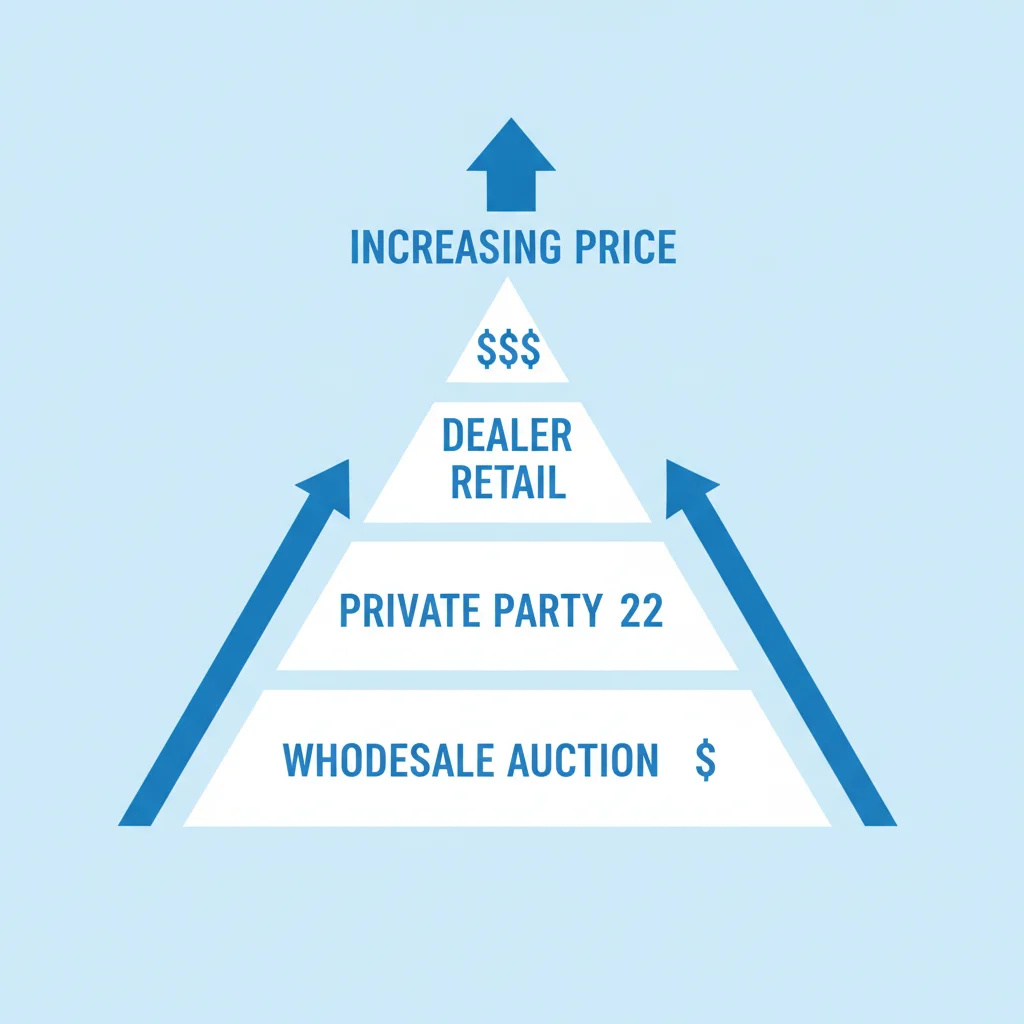
Some tools prioritize auction data (what dealers pay wholesale). Others weight retail dealer listings (what dealers charge consumers). Others attempt to capture consumer-to-consumer transactions. Each of these price layers sits at a different level — wholesale sits lowest, retail sits highest, and private party sits in between. Any tool that mixes these data streams differently will produce a different number.
2. Depreciation Curve Modeling
Every platform applies its own proprietary depreciation formula — how much value a car loses per year, per mile, and by condition tier. These formulas are not published, and they don't agree. A 6-year-old vehicle with 75,000 miles might be treated very differently by two tools using different age-mileage depreciation curves, even if both tools drew from the same underlying transaction database.
3. Condition Rating Calibration
Every tool lets you self-report condition as Excellent, Good, Fair, or Poor — but the definitions of those tiers vary significantly across platforms. KBB's "Good" condition is not the same as Edmunds' "Good" condition. The dollar spread between condition tiers also differs: on some tools, the jump from Fair to Good is $600; on others, it's $1,800. If you rate your car "Good" on both platforms, you may actually be describing two different vehicles.
Most sellers rate their car's condition too generously — here's how to calibrate that honestly before you set a price.
4. Regional Market Weighting
Some tools apply national averages and then apply a regional adjustment. Others pull from a tighter ZIP-code radius. A truck in rural Montana and the same truck in suburban New Jersey may carry meaningfully different values in the real market — but tools vary in how well they capture that local signal. A platform relying heavily on national auction data may flatten regional premiums that are very real to buyers in your market.
$1,500–$4,000
Typical private party vs. trade-in value gap
Industry data consistently shows this spread across vehicle segments, reflecting dealer reconditioning costs and profit margin requirements.
~$2,000
Average KBB vs. Edmunds private party spread
Analysis of consumer vehicles across multiple segments shows KBB private party values running roughly $1,000–$2,500 higher than comparable Edmunds estimates.
8–12%
Recommended negotiation buffer above target price
Private party sellers who price 8–12% above their actual target retain room to negotiate while remaining competitive with comparable listings.
Monthly
NADA data refresh frequency
NADA guides update on a monthly cycle, meaning fast-moving market segments like trucks and EVs can see real-world prices diverge significantly from published values mid-cycle.
Why Your Selling Channel Should Determine Which Tool You Trust
One of the biggest mistakes sellers make is treating all valuation tools as interchangeable. They're not — and the right tool depends entirely on how you plan to sell.
Instant Offers Expire Quickly
CarMax, Carvana, and similar platforms typically hold their offers for 7 days. Used car markets can shift meaningfully in that window, particularly during periods of high volatility. If you're comparing multiple offers, get them as close together in time as possible to ensure you're comparing apples to apples.
Tools May Not Know Your Car's Full History
Valuation algorithms typically don't pull your car's Carfax or AutoCheck report automatically. A vehicle with a clean title but a disclosed minor accident may be rated identically to an accident-free car — yet buyers will pay less for the accident history once they see it. If your car has a spotless history, that's a selling point to document and advertise explicitly.
Tax Assessments Use a Different Valuation System Entirely
The value your state assigns your car for registration and property tax purposes has nothing to do with KBB, Edmunds, or NADA. States apply their own depreciation schedules. <a href="/maintenance-and-ownership/ownership-costs/registration-taxes/why-your-cars-assessed-value-doesnt-match-what-you-paid-for-it">Your tax bill may be based on a number you've never seen before</a> — don't confuse it with what your car is actually worth on the market.
Selling Privately
For a private party sale on Marketplace, Craigslist, or AutoTrader, focus on KBB Private Party Value and Edmunds Private Party Value as your anchor range. Then cross-check against actual listings for comparable vehicles in your ZIP code. Active listing prices — not sold prices — are what you're competing against in the private market. Aim for the middle to lower end of the KBB-Edmunds range if you want a fast sale; price toward the top if you can afford to wait.
Trading In at a Dealer
Expect the dealer to reference NADA or their own internal appraisal tools. The trade-in process works differently from a private sale — dealers need margin to recondition and resell the car, so their offer will always land below private party value. Walk in knowing your NADA trade-in figure, your KBB trade-in figure, and what a competing instant offer (CarMax, Carvana) looks like. That range gives you a floor to negotiate from.
Instant Cash Offer Platforms
CarMax, Carvana, and similar platforms run their own proprietary valuation models, which often lean on live auction data and current retail inventory levels. Their offers can sometimes exceed dealer trade-in values during periods of high used-car demand — and fall well below during slow cycles. Use them as a real-world data point, not the definitive answer.
Maximize your trade-in value by getting competing offers before you step into any dealer's finance office.
Get a CarMax or Carvana Offer Before Any Dealer Visit
Instant cash offers from CarMax and Carvana are real, binding quotes (usually valid for 7 days) that give you a legitimate floor number. Walk into any trade-in negotiation with that number in hand. Dealers know these platforms exist and will often sharpen their offer rather than lose the deal to a competitor.
Check How Long Comparable Cars Sit Before Selling
On CarGurus, cars flagged as 'Good Deal' or 'Fair Deal' are typically priced at or near market — and they move faster. If multiple comparable vehicles in your area show 60+ days on market, that's a clear signal the market price is lower than what sellers are asking. Price accordingly from the start rather than chasing the market down with repeated reductions.
The Trim and Options Problem Tools Don't Fully Solve
Here's a gap most sellers don't think about: valuation tools do ask for your trim level, but their handling of factory options and aftermarket modifications varies widely — and often undersells well-equipped cars.
Consider two 2020 trucks with the same base trim designation. One has a tow package, bed liner, and heated seats added from the factory. The other is a base stripper. Both may return the same valuation if the tool doesn't granularly account for those option codes. The real-world market will value them differently.
Trim-level differences can represent $10,000 or more in value — and the gap between similarly-named trims from different model years adds another layer of complexity that algorithms often flatten.
Aftermarket modifications are an even bigger problem. A $3,000 lift kit rarely adds $3,000 to your valuation — and most tools won't account for it at all. Specialty buyers may pay a premium for that lift kit; general market buyers may discount the car because it deviates from stock. Tools can't model that nuance, so sellers with modified vehicles need to lean heavily on market listings rather than algorithm-generated estimates.
Valuation algorithms can't see everything — condition quirks, service history, and regional demand often fall outside what any model captures.
How to Use Multiple Tools Without Getting Paralyzed
The practical answer to the multi-tool problem is not to pick one winner and ignore the rest — it's to build a range and position your price within it intelligently.
- Pull estimates from at least three sources: KBB, Edmunds, and one instant-offer platform like CarMax or Carvana. Note which estimate is highest, which is lowest, and where the midpoint falls.
- Identify your selling channel: Decide upfront whether you're selling privately or trading in. That choice determines which estimates are most relevant to your situation.
- Check live market listings: Search your ZIP code on CarGurus or AutoTrader for cars matching your year, make, model, trim, and approximate mileage. What are sellers asking? Are those cars sitting or moving? This is your real competitive data.
- Adjust for condition honestly: Re-read each tool's condition tier definitions carefully before you select one. Most sellers rate one tier too high. A realistic condition rating will save you from overpricing and the frustration of a car that won't sell.
- Set your asking price with built-in negotiation room: In a private sale, price 8–12% above your target to allow for haggling. Don't price so high you scare off legitimate buyers.
Instant Offers Expire Quickly
CarMax, Carvana, and similar platforms typically hold their offers for 7 days. Used car markets can shift meaningfully in that window, particularly during periods of high volatility. If you're comparing multiple offers, get them as close together in time as possible to ensure you're comparing apples to apples.
Tools May Not Know Your Car's Full History
Valuation algorithms typically don't pull your car's Carfax or AutoCheck report automatically. A vehicle with a clean title but a disclosed minor accident may be rated identically to an accident-free car — yet buyers will pay less for the accident history once they see it. If your car has a spotless history, that's a selling point to document and advertise explicitly.
Tax Assessments Use a Different Valuation System Entirely
The value your state assigns your car for registration and property tax purposes has nothing to do with KBB, Edmunds, or NADA. States apply their own depreciation schedules. <a href="/maintenance-and-ownership/ownership-costs/registration-taxes/why-your-cars-assessed-value-doesnt-match-what-you-paid-for-it">Your tax bill may be based on a number you've never seen before</a> — don't confuse it with what your car is actually worth on the market.
Using multiple tools together to build a confident asking price is a more reliable method than relying on any single platform's output.

Sellers who cherry-pick the highest estimate almost always end up with a car that sits on the market too long — driving price cuts that put them below where they would have started with a realistic number.
When the Gap Between Tools Is Telling You Something
A small spread between tools — say, $600 to $1,200 — is normal and expected. But when KBB and Edmunds diverge by $3,000 or more on the same vehicle, that gap is usually a signal worth investigating rather than ignoring.
Large divergences often happen with:
- Older or less-common vehicles where transaction data is thin and tools are extrapolating more than measuring
- Fast-moving market segments like trucks and SUVs, where regional demand spikes can outpace algorithm updates
- High-mileage vehicles where different mileage penalty formulas produce compounding differences at the extremes
- Recently refreshed models where the prior-gen depreciation curve may not reflect actual buyer behavior yet
In these cases, lean harder on real market listings and instant offers — they reflect current buyer behavior, not a model's historical assumptions.
A large spread between KBB and Edmunds isn't random — there are specific reasons tools diverge on certain makes, ages, and market conditions.
Geography is another factor. A four-wheel-drive SUV in the Mountain West commands a real premium that national-average tools may understate. A convertible in the Pacific Northwest will struggle to hit book value in November. Regional price differences can swing value by thousands of dollars — knowing your local market matters more than any national estimate.
Get a CarMax or Carvana Offer Before Any Dealer Visit
Instant cash offers from CarMax and Carvana are real, binding quotes (usually valid for 7 days) that give you a legitimate floor number. Walk into any trade-in negotiation with that number in hand. Dealers know these platforms exist and will often sharpen their offer rather than lose the deal to a competitor.
Check How Long Comparable Cars Sit Before Selling
On CarGurus, cars flagged as 'Good Deal' or 'Fair Deal' are typically priced at or near market — and they move faster. If multiple comparable vehicles in your area show 60+ days on market, that's a clear signal the market price is lower than what sellers are asking. Price accordingly from the start rather than chasing the market down with repeated reductions.
The Bottom Line on Valuation Tool Disagreement
There is no single correct value for your car. There is a range — shaped by your market, your selling channel, your vehicle's actual condition, and the current appetite of buyers in your area. Valuation tools give you estimates, not verdicts.
The sellers who get the best outcomes are the ones who understand what each tool is measuring, use multiple data points to bracket a realistic range, check that range against real market activity, and price with enough room to negotiate without starting so high that buyers scroll past. That process takes an extra hour. It's worth it.
Several common beliefs about valuation tools are simply wrong — including the idea that any single platform has the authoritative answer. Treat all of them as inputs, not oracles.
And if you're heading into a dealer trade-in, walk in with three numbers: your best private party estimate, your best trade-in estimate, and a real offer from an instant-cash platform. That combination tells a dealer you've done your homework — and it's the fastest way to get a fair number without leaving money on the table.
Instant Offers Expire Quickly
CarMax, Carvana, and similar platforms typically hold their offers for 7 days. Used car markets can shift meaningfully in that window, particularly during periods of high volatility. If you're comparing multiple offers, get them as close together in time as possible to ensure you're comparing apples to apples.
Tools May Not Know Your Car's Full History
Valuation algorithms typically don't pull your car's Carfax or AutoCheck report automatically. A vehicle with a clean title but a disclosed minor accident may be rated identically to an accident-free car — yet buyers will pay less for the accident history once they see it. If your car has a spotless history, that's a selling point to document and advertise explicitly.
Tax Assessments Use a Different Valuation System Entirely
The value your state assigns your car for registration and property tax purposes has nothing to do with KBB, Edmunds, or NADA. States apply their own depreciation schedules. <a href="/maintenance-and-ownership/ownership-costs/registration-taxes/why-your-cars-assessed-value-doesnt-match-what-you-paid-for-it">Your tax bill may be based on a number you've never seen before</a> — don't confuse it with what your car is actually worth on the market.

All claims are backed by peer-reviewed research. Sources on request.