Key Takeaways
Car Valuation Tool
A car valuation tool is an online service that estimates what a specific vehicle is worth based on its year, make, model, trim, mileage, condition, and location. These tools pull from different data sources — including dealer transactions, auction results, and live listings — to calculate their estimates. Because each tool uses its own methodology, the same car can produce meaningfully different values across platforms.
Valuations are statistical estimates, not appraisals. They reflect aggregate market data, not a specific buyer's willingness to pay or a lender's collateral assessment.
Why Three Tools Give You Three Different Numbers
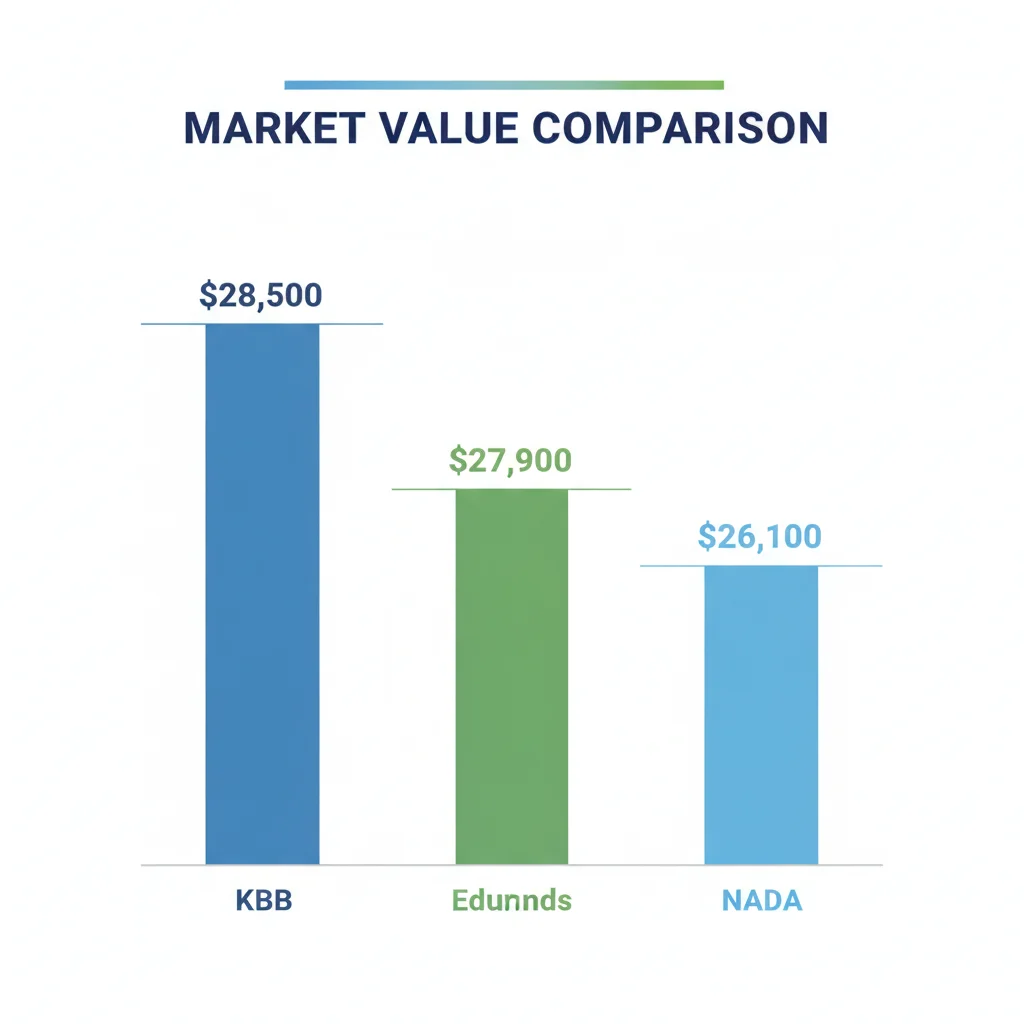
You plug your car into KBB, then Edmunds, then NADA. You get back three distinct numbers — sometimes separated by thousands of dollars. That's not a glitch. It's a feature of how each platform defines "value" in the first place.
Each tool is answering a slightly different question. KBB asks: What would a private buyer reasonably pay for this car? Edmunds asks: What have buyers in this area actually paid recently? NADA asks: What would a dealer or lender assign to this vehicle as collateral or trade-in? Those are three separate financial questions with three legitimately different answers.
Understanding the distinction isn't just trivia — it directly affects how you price a car for sale, how you counter a dealer's trade-in offer, and how a lender thinks about your loan-to-value ratio. Let's break down what each tool is actually measuring.
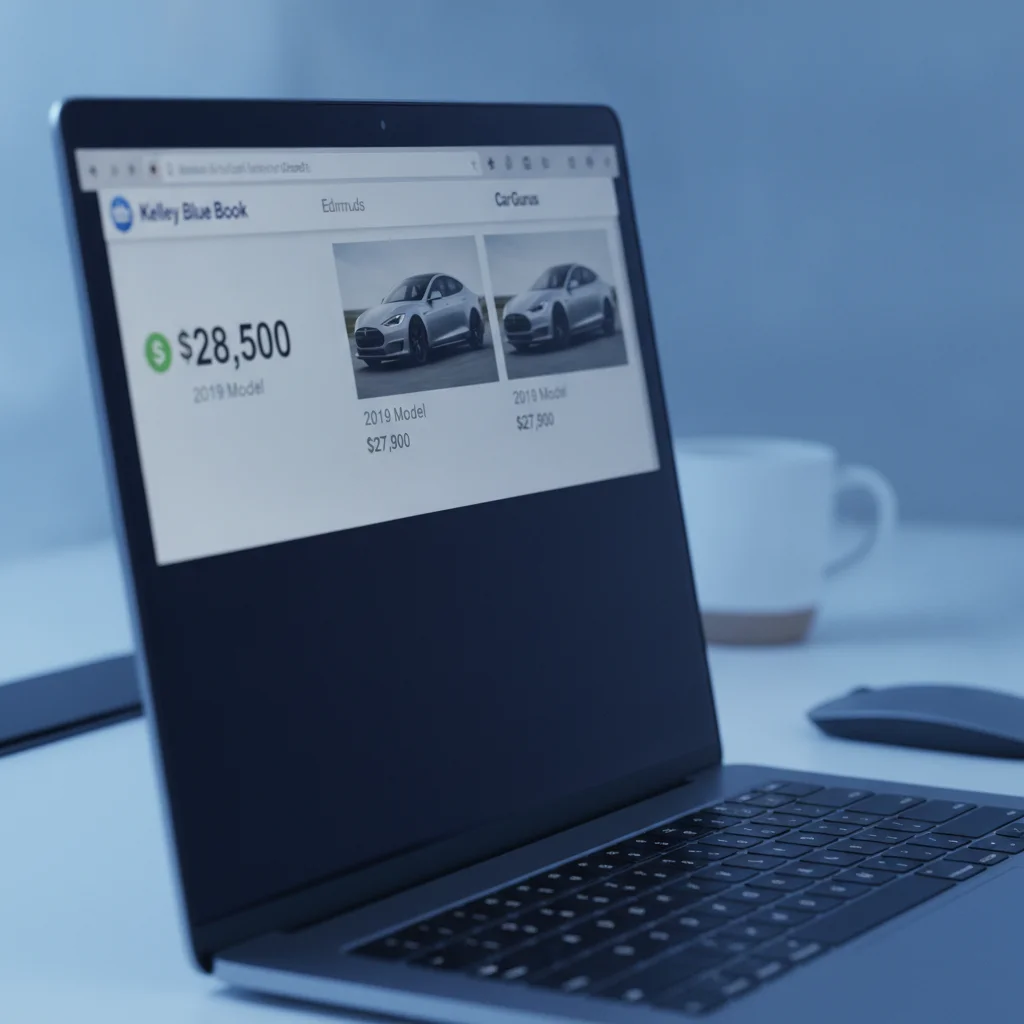
For a broader side-by-side breakdown of all the major valuation platforms, see The Major Car Valuation Tools Compared Side by Side.
Kelley Blue Book: The Consumer Brand With a Cox Automotive Engine
KBB is the most name-recognized valuation brand in the U.S. by a wide margin. When someone says "Blue Book value," they're invoking decades of brand equity — and that name recognition actually shapes how sellers and buyers anchor their expectations in negotiation.
Cox Automotive acquired KBB in 2010, and since then KBB has had access to one of the largest pools of wholesale transaction data in the country (Cox also owns Manheim, the biggest auto auction network in North America). But here's the nuance: the consumer-facing KBB estimates are deliberately positioned toward the optimistic end of the range. KBB's stated goal is to represent a fair price that a willing buyer would pay a willing seller — and their survey methodology historically skews toward what sellers hope to receive, not necessarily what transactions close at.
What KBB measures, specifically
- Private Party Value: The estimated price for a sale between two private individuals. KBB's private party values tend to run higher than real transaction comps in most markets.
- Trade-In Range: A range (Typical to Excellent) that estimates what a dealer might offer. This is often lower than the private party value by 10–20%.
- Dealer Retail Price: What a dealer might list the car for on their lot — useful as a ceiling reference, not a selling target for private sellers.
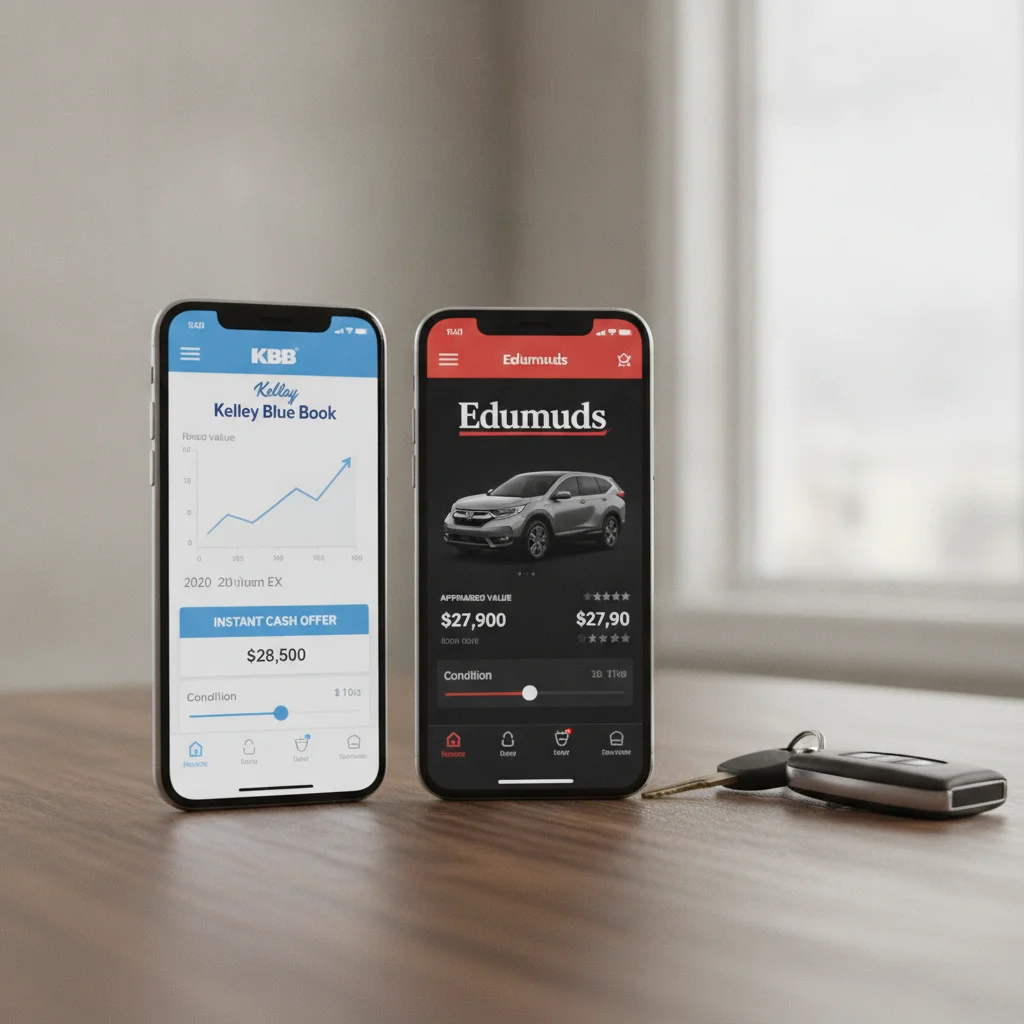
KBB also offers an "Instant Cash Offer" through dealers in its network, which converts the tool from an estimate to an actual bid. That offer is real money, but it typically lands at or below the low end of their trade-in range.
“Consumers consistently overestimate the condition of their vehicle by one full grade. That single mistake accounts for a large share of the gap between what sellers expect and what the market will pay.”
— Ivan Drury, Director of Insights, Edmunds
One important caveat: KBB adjusts for condition using five categories (Poor, Fair, Good, Very Good, Excellent), and most sellers rate their car one category higher than buyers do. That gap alone can add $800–$2,000 to the number a seller walks in with.
For a balanced assessment of KBB's accuracy, see The Honest Pros and Cons of Relying on KBB to Price Your Car.
Edmunds: Transaction-Based and Closer to Ground Truth
Edmunds operates differently from KBB in one critical way: its estimates are anchored more heavily to actual completed transactions rather than surveyed price expectations. Edmunds tracks real dealer sales data, adjusts for regional supply and demand, and produces what it calls the "True Market Value" (TMV) — a number that tries to answer what buyers are actually paying, not what sellers are hoping for.
In practice, Edmunds TMV tends to run 3–8% lower than KBB's private party value for the same vehicle in the same condition. That gap exists because Edmunds is less influenced by seller optimism and more grounded in what's closing at dealerships and in private sales.
What Edmunds measures, specifically
- True Market Value (TMV): Edmunds' flagship estimate. It's based on regional transaction data and is often the most accurate predictor of what a buyer will actually pay.
- Private Party Price: A separate estimate for non-dealer transactions, derived from the TMV methodology applied to peer-to-peer sales.
- Trade-In Value: Edmunds also produces trade-in estimates, which tend to be slightly more conservative than KBB's equivalent.
Edmunds also shows a price distribution — a visual range of what similar cars have sold for in your region — which is more useful than a single number for understanding where your car actually fits in the market.
One limitation: Edmunds' transaction data is weighted toward franchised dealerships. If you're valuing a high-mileage economy car that rarely passes through franchise lots, its data pool gets thinner and estimates less reliable.
When Edmunds and KBB diverge significantly, it's worth digging into why. See Kelley Blue Book vs. Edmunds: Which Number Should Sellers Trust? for a deeper look at how to interpret that gap.
NADA Guides: Built for Dealers and Lenders, Not You
NADA (National Automobile Dealers Association) guides exist for a fundamentally different audience. They were built to give dealers, banks, and credit unions a standardized way to assess vehicle collateral value — not to help private sellers set an asking price. J.D. Power acquired NADA guides in 2015 and has continued to market them primarily to automotive professionals and financial institutions.
NADA values are calculated primarily from auction data — specifically wholesale prices at dealer auctions — adjusted for regional market conditions. This makes NADA's numbers the closest approximation to what a dealer would actually pay for your car at auction, which is why lenders use NADA as a loan collateral benchmark.
What NADA measures, specifically
- Rough/Average/Clean Trade-In: NADA's trade-in categories (Rough, Average, Clean, Clean Retail) are anchored to wholesale auction prices. A "Clean" trade-in in NADA terms is a car that would wholesale at or above the market average — not just a car that looks nice.
- Clean Retail: The expected dealer retail price for a vehicle in clean condition. This is the number dealers sometimes cite when they want to justify a list price.
- Loan Value: A figure used by lenders when calculating how much they'll finance. Usually sits below trade-in value.
10–20%
Typical gap between private party and trade-in value
KBB data consistently shows dealers offer 10–20% less than private party value for the same vehicle in equivalent condition.
3–8%
Edmunds TMV discount vs. KBB private party
Industry analysis comparing KBB and Edmunds estimates for identical vehicles shows Edmunds typically runs 3–8% lower due to its transaction-based methodology.
12,000–15,000
Annual miles used as average baseline
KBB, Edmunds, and NADA all use approximately 12,000–15,000 miles per year as the mileage baseline for depreciation adjustments.
$800–$2,000
Cost of one condition grade overestimate
Misjudging your car's condition by one grade on KBB can inflate your estimated value by $800–$2,000 depending on the vehicle.
The practical consequence for private sellers: NADA values are almost always lower than KBB private party values, and lower than Edmunds TMV. If a dealer quotes you NADA during a trade-in negotiation, they're using the most favorable number for their position. For context on how dealers actually use these tools, see NADA Guides vs. KBB: Which Valuation Is Dealers Actually Using?.
The Data Inputs That Drive Every Estimate
Regardless of which tool you use, every valuation estimate is a function of the same core inputs — and understanding how each platform weights those inputs explains most of the variation you'll see.
Condition
This is the biggest source of seller error. All three tools ask you to self-report condition, and all three define their condition categories differently. KBB's "Very Good" is roughly equivalent to Edmunds' "Clean" and NADA's "Average" — but sellers often don't read the fine print. Rate your car honestly using the tool's own definitions, not your gut feeling.
Mileage
All three platforms penalize above-average mileage and reward below-average mileage. The current average annual mileage baseline used by most tools is around 12,000–15,000 miles per year. A car with 80,000 miles on a 5-year-old vehicle is right at average; one with 110,000 is significantly above average and will be adjusted down accordingly.
Zip Code
Regional supply and demand affects value more than most sellers realize. A diesel pickup in Montana commands a meaningful premium over the same truck in Miami. A convertible in Minneapolis is worth less than the same car in Phoenix. All three tools attempt to localize results, but Edmunds' transaction-based approach tends to reflect regional dynamics more precisely. See Everything That Goes Into a Car's Estimated Value, From VIN to Zip Code for a full breakdown of every data input that affects your estimate.
Trim Level and Options
All three tools allow for trim selection, but they differ in how granularly they handle individual option packages. KBB tends to have the most detailed options list. Edmunds rolls some options into base trim assumptions. NADA applies general adjustments based on package groupings. If your car has significant factory-installed options (sunroof, premium audio, towing package), manually check how each tool accounts for them.
For a deeper look at how depreciation underlies all of these estimates, the Depreciation Basics hub explains the core mechanics of how age and mileage erode vehicle value over time.
Which Tool to Use — and When
The right valuation tool depends entirely on what transaction you're navigating.
For private-party sales
Start with Edmunds TMV as your baseline — it's the most grounded in real transaction data. Cross-reference with KBB private party value to understand the ceiling of what an optimistic buyer might expect to pay. Price your car between Edmunds TMV and KBB private party, leaning toward Edmunds if your car has above-average mileage or condition issues.
For dealer trade-ins
Use KBB's trade-in range as your walk-in number and Edmunds' trade-in estimate as your floor. Don't accept anything below Edmunds' trade-in value without understanding exactly why the dealer is going lower. For context on how dealers actually use these tools during appraisal, see Dealer Trade-Ins and KBB, Edmunds, and CarGurus: Which Trade-In Tool Actually Gives You the Best Estimate?.
For financing conversations
Lenders care about NADA loan value. If you're financing a purchase and want to understand your loan-to-value exposure, pull the NADA number. If you're selling and the buyer needs financing, their lender's collateral cap is likely derived from NADA — meaning they can't borrow more than NADA says the car is worth, regardless of what you're asking.

If you want to understand why the numbers diverge across even more platforms, see Why Your Car's Valuation Differs Across Every Tool You Check.
The Bottom Line: No Single Tool Wins
KBB, Edmunds, and NADA aren't competing for accuracy — they're measuring different things for different audiences. KBB is calibrated for consumer expectations and negotiation leverage. Edmunds is calibrated for real-market transaction truth. NADA is calibrated for wholesale and lending decisions.
The smartest approach is triangulation: pull all three numbers, understand what each one represents, and position your price based on where your specific transaction sits in the market. A private-party seller in a hot regional market can justify pricing near KBB. A seller with a high-mileage car in a slow market should anchor to Edmunds TMV or below.
What you shouldn't do is pick the highest number and defend it without understanding why it's high. Buyers who know how these tools work will push back — and they'll be right to do it.

All claims are backed by peer-reviewed research. Sources on request.