Key Takeaways
Option A
CPO Pricing
The premium-adjusted, program-backed valuation approach.
Best for: Buyers and sellers who need to accurately price or evaluate a certified pre-owned vehicle with warranty and inspection value baked in.
Option B
Standard Used Car Valuations
The baseline market estimate for non-certified pre-owned vehicles.
Best for: Anyone pricing, shopping, or appraising a conventional used car without manufacturer certification or extended warranty coverage.
If you're buying a CPO car and want a fair starting point
CPO Pricing
Use the CPO-specific valuation on KBB or Edmunds as your anchor, then factor in the remaining warranty length and brand program strength to determine how much of the premium is actually justified.
If you're selling a non-certified used car privately
Standard Used Car Valuations
Standard tools like KBB Private Party or NADA Clean Retail give you the most accurate market baseline — CPO pricing doesn't apply and will mislead both you and your buyer.
If you're trading in a CPO-eligible vehicle at a dealer
Standard Used Car Valuations
Dealers appraise trade-ins as used cars regardless of CPO status — know the standard used value so you can spot a low-ball offer before agreeing to anything.
If you're comparing a CPO offer against a private-party used car
CPO Pricing
Run both valuations simultaneously to calculate the real cost delta, then measure that gap against the warranty and inspection value the CPO program actually provides.
If you're financing a used car and comparing loan options
CPO Pricing
CPO vehicles sometimes qualify for manufacturer-sponsored financing rates; knowing the CPO-specific value helps you assess whether the financed amount is reasonable relative to market.
Why Valuation Tools Don't Treat CPO Cars the Same Way
When you pull up a used car estimate on Kelley Blue Book or Edmunds, the tool is calculating based on a set of condition variables: mileage, trim, color, accident history, and local market demand. What those base estimates don't automatically account for is whether the car carries a manufacturer-backed certification — and that omission matters more than most buyers realize.
A CPO designation is not just a sticker. It represents a documented inspection, a refurbishment to manufacturer standards, and an extended warranty that typically layers on top of whatever factory coverage remains. That bundle has real dollar value. The problem is that standard valuation tools were built around the used car market at large, where the vast majority of vehicles are non-certified. CPO cars are a subset, and a relatively small one — so the default outputs from these tools tend to reflect the broader, uncertified market baseline.
The practical result: if you're a buyer using a standard used car estimate to evaluate a CPO-priced vehicle, you're likely looking at numbers that make the CPO price look inflated when it may actually be fair. If you're a seller trying to price a CPO-eligible car, relying on generic used car values will often cause you to leave money on the table.

Understanding how to use these tools correctly — and when to switch between CPO-specific and standard valuation modes — is the core skill this article is designed to give you. For a broader look at what the CPO label actually buys you, see what's actually different between CPO and standard used cars.
How the Major Tools Handle CPO vs. Standard Used
The three dominant valuation resources — Kelley Blue Book, Edmunds, and NADA Guides — each approach CPO pricing differently, and knowing those differences helps you use them accurately.
Kelley Blue Book (KBB)
KBB offers a dedicated CPO valuation pathway. When you select a vehicle and indicate it's certified, the tool adjusts the output to reflect CPO market pricing rather than standard used retail. The adjustment varies by brand — luxury makes (BMW, Mercedes-Benz, Lexus) show larger CPO premiums than mainstream brands because their certified programs are more comprehensive and their buyer pools more premium-sensitive. KBB CPO estimates tend to be well-calibrated for dealers but can run slightly high for private transactions since private sellers generally can't transfer CPO status.
Edmunds
Edmunds takes a similar approach but leans more heavily on actual transaction data from its dealer network. Its True Market Value (TMV) for CPO vehicles reflects recent sale prices on certified inventory, which makes it arguably the most grounded real-world estimate available. Edmunds also breaks out its estimates by condition more granularly than KBB, which matters because CPO cars are by definition in the upper condition tiers.
NADA Guides
NADA is the tool most commonly used by lenders and dealers for wholesale and retail benchmarks. NADA does include a CPO adjustment, but it's less prominent in the consumer-facing interface. If you're financing a CPO purchase, your lender is likely pulling a NADA value — it's worth running that estimate yourself so you know what loan-to-value ratio you're working with before you sit down at the finance desk.
| Criterion | CPO Pricing | Standard Used Car Valuation |
|---|---|---|
| Typical price premium | $1,000–$3,500 above base used | Market baseline, no adjustment |
| Warranty value included | Yes — extended coverage bundled | No — buyer takes on full risk |
| Inspection documentation | Manufacturer-verified multi-point inspection | No required inspection standard |
| KBB/Edmunds support | CPO-specific estimate available | Default output for all used car queries |
| Applies to private party sales | No — certification doesn't transfer | Yes — standard private party value applies |
| Used for trade-in appraisals | No — dealers appraise as standard used | Yes — trade-in values are standard used |
| Financing rate access | May qualify for manufacturer CPO rates | Standard used car loan rates apply |
| Insurance ACV basis | Not factored — ACV uses standard market value | Directly reflects insurance settlement basis |
The key takeaway: all three tools can generate CPO-adjusted estimates, but you have to explicitly select the CPO option. If you skip that step — or if the tool's CPO data is thin for your specific market — the output defaults toward standard used pricing, which can be $1,000 to $3,500 lower on a typical mid-range vehicle.
$1,500–$3,500
Typical CPO premium over standard used
Based on Edmunds and KBB side-by-side CPO vs. non-certified estimates for comparable late-model vehicles across popular segments.
2–3 years
Typical CPO extended warranty length
Most manufacturer CPO programs add 2–3 years of powertrain coverage beyond the remaining factory warranty, per manufacturer program disclosures.
$1,200–$2,500
Third-party equivalent warranty cost
The approximate retail cost of a comparable aftermarket extended warranty, illustrating the embedded value in a CPO program's pricing premium.
80,000–100,000
CPO mileage eligibility ceiling (miles)
Most manufacturer CPO programs cap eligibility between 80,000 and 100,000 miles; vehicles near this threshold carry significantly reduced certification value.
1–2%
Potential APR advantage on CPO financing
Manufacturer-sponsored CPO financing programs sometimes offer rates 1–2 percentage points below standard used car loan rates at participating dealers.
The Real Dollar Gap Between CPO and Standard Used Valuations
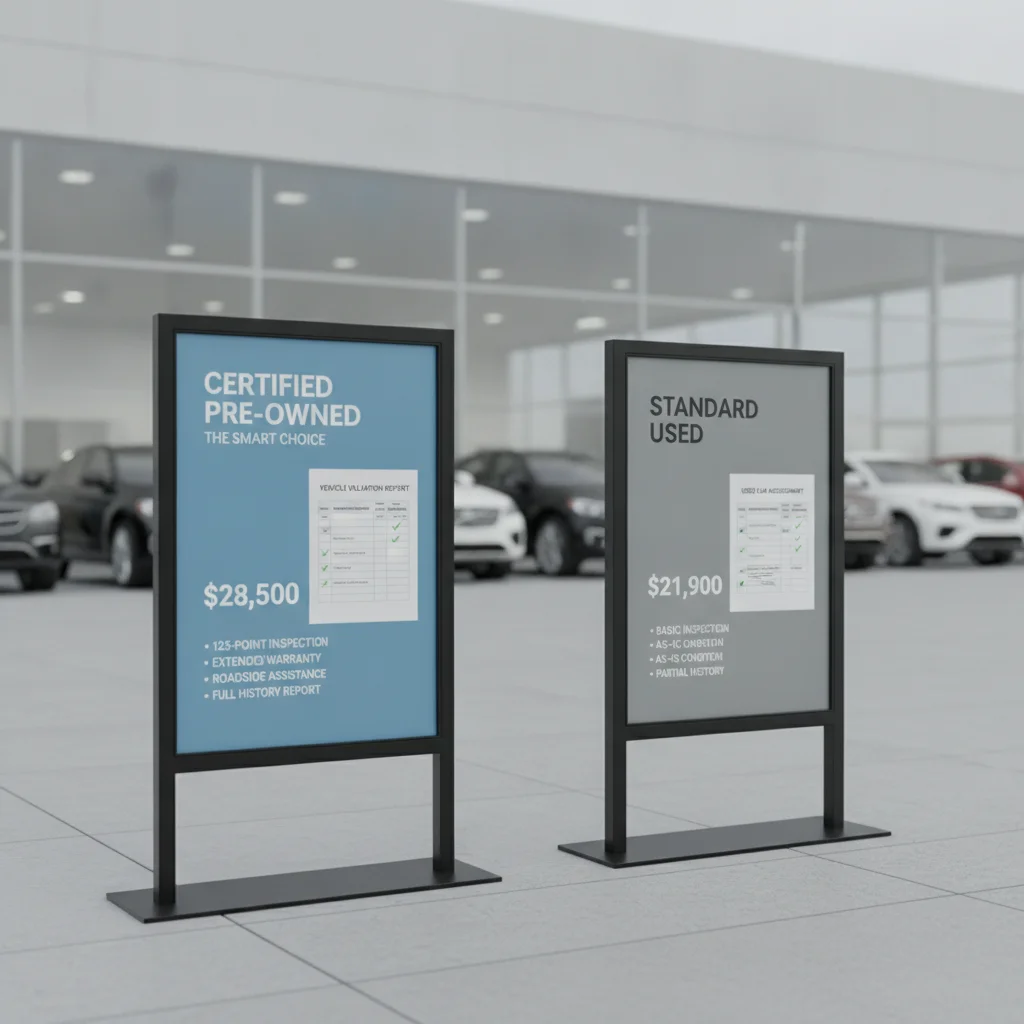
Let's make this concrete. Take a three-year-old midsize sedan — say, a 2022 model with 28,000 miles in clean condition. The standard used retail estimate on KBB might come in at $22,500. The CPO estimate for the same vehicle, certified by the manufacturer with two or three years of powertrain coverage added, might show $24,200 to $25,000. That's a $1,700 to $2,500 premium purely from certification status.
That gap isn't arbitrary. It reflects several real components of value:
- Inspection and reconditioning costs: Manufacturers typically spend $500–$1,500 preparing a vehicle for CPO certification, and that cost is passed through to the retail price.
- Extended warranty value: A third-party extended warranty covering similar terms as a CPO program costs $1,200–$2,500 depending on the vehicle and coverage length. CPO bundles this in.
- Financing rate advantages: Some manufacturer CPO programs offer below-market interest rates. On a $24,000 loan, even a 1% rate reduction saves several hundred dollars over a 60-month term. See how those rates stack up in our breakdown of CPO financing vs. used car financing.
- Reduced buyer risk: The vehicle has been vetted, which commands a risk premium from buyers — especially first-time used car purchasers.
The premium is most defensible when significant warranty time remains and when the brand's CPO program is genuinely robust. It's least defensible on vehicles approaching the mileage ceiling for CPO eligibility (often 80,000–100,000 miles depending on the brand) or where only a few months of extended coverage remain. For a detailed look at how mileage thresholds affect this calculus, see how mileage limits shape a CPO car's real value.
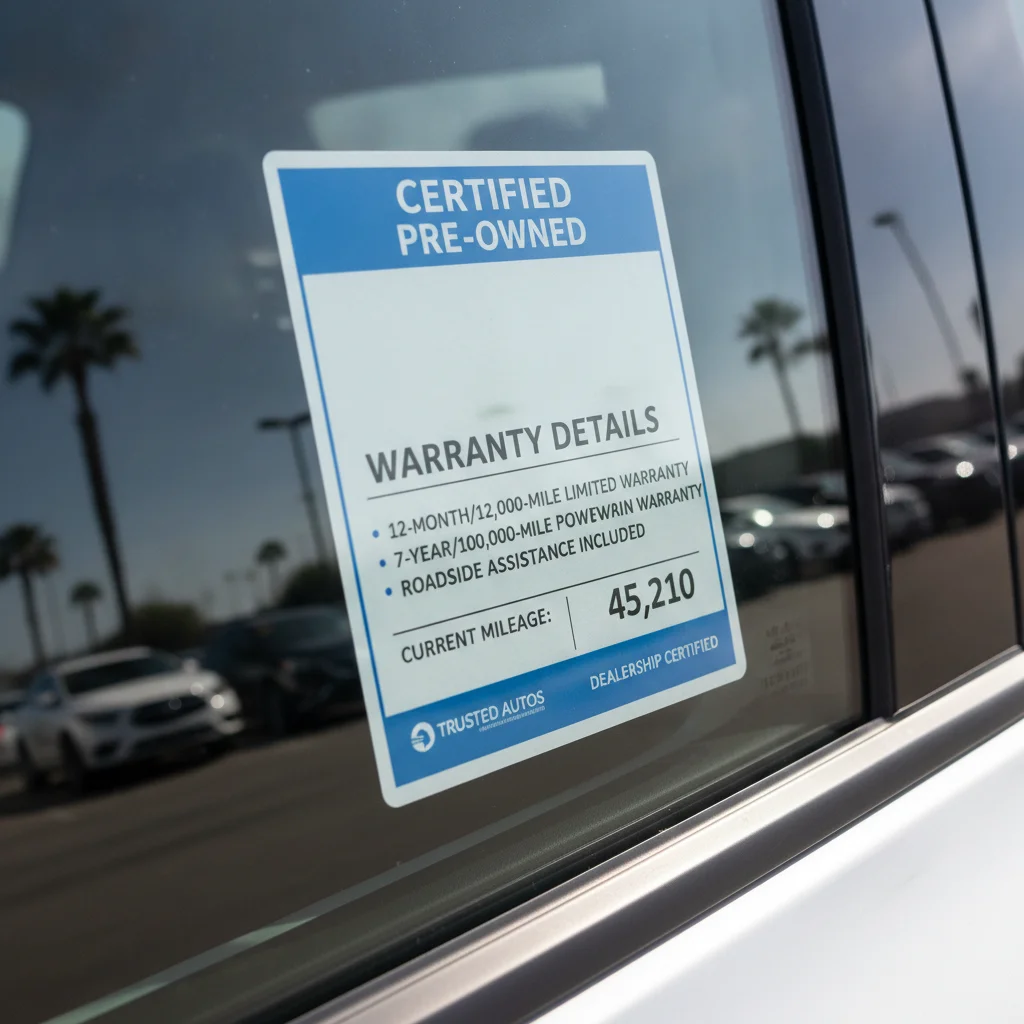
Before deciding whether the premium is worth it, also check our analysis of when the CPO premium actually pays off.
Where Standard Used Valuations Still Apply — Even for CPO Cars
There are specific contexts where you should ignore CPO pricing entirely and use the standard used car valuation, even if the vehicle you're dealing with is certified:
Trade-In Appraisals
This is the most important one. When you hand your keys to a dealer for an appraisal, they are not valuing your CPO car as a CPO car — they're pricing it as a used unit they'll add to their inventory. The certification doesn't transfer in the appraisal process. Expect the trade-in offer to track the standard used wholesale or trade-in value, not the CPO retail estimate. Knowing the gap between those two numbers helps you recognize whether an offer is reasonable or low.
Private Party Sales
Private sellers cannot transfer CPO status. If you're selling your certified vehicle to another individual, the buyer is buying a used car — the certification effectively ends at the point of private transfer. Price accordingly using standard private-party valuations, and don't expect buyers to pay a CPO premium in that channel. That said, a clean vehicle history report and documentation of the original CPO inspection can still support a modest price advantage over a comparable non-documented used car.
Insurance Valuations
Your insurer values your car at actual cash value (ACV) in the event of a total loss, which is based on standard market pricing for comparable vehicles. CPO status is generally not factored into ACV calculations. If you paid a CPO premium and your car is totaled, you may find the settlement doesn't fully cover your payoff balance — a gap coverage policy is worth considering. For more on this, see how CPO status affects your insurance decisions.
CPO Status and Gap Insurance
Because insurers base total-loss settlements on standard used car market values rather than CPO pricing, buyers who paid a CPO premium may find a gap between what their insurer pays and what they owe on their loan. This is especially relevant if you financed a CPO vehicle with a small down payment. Ask your insurer about gap coverage before finalizing a CPO purchase — the cost is typically modest relative to the protection it provides.
Not All CPO Programs Are Equal
The word 'certified' doesn't guarantee a consistent standard across brands. Luxury manufacturer programs (Lexus, BMW, Mercedes-Benz) tend to be more stringent — longer warranty terms, stricter inspection checklists, and lower mileage caps. Some independent dealers use the term loosely without manufacturer backing. Always verify whether the certification is manufacturer-issued or dealer-issued, as only manufacturer programs carry enforceable warranty terms through the brand's service network.
Using Both Valuations as a Negotiation Framework
The most practical use of CPO vs. standard used valuations isn't choosing one or the other — it's running both simultaneously to build a negotiation framework. Here's how that works in practice:
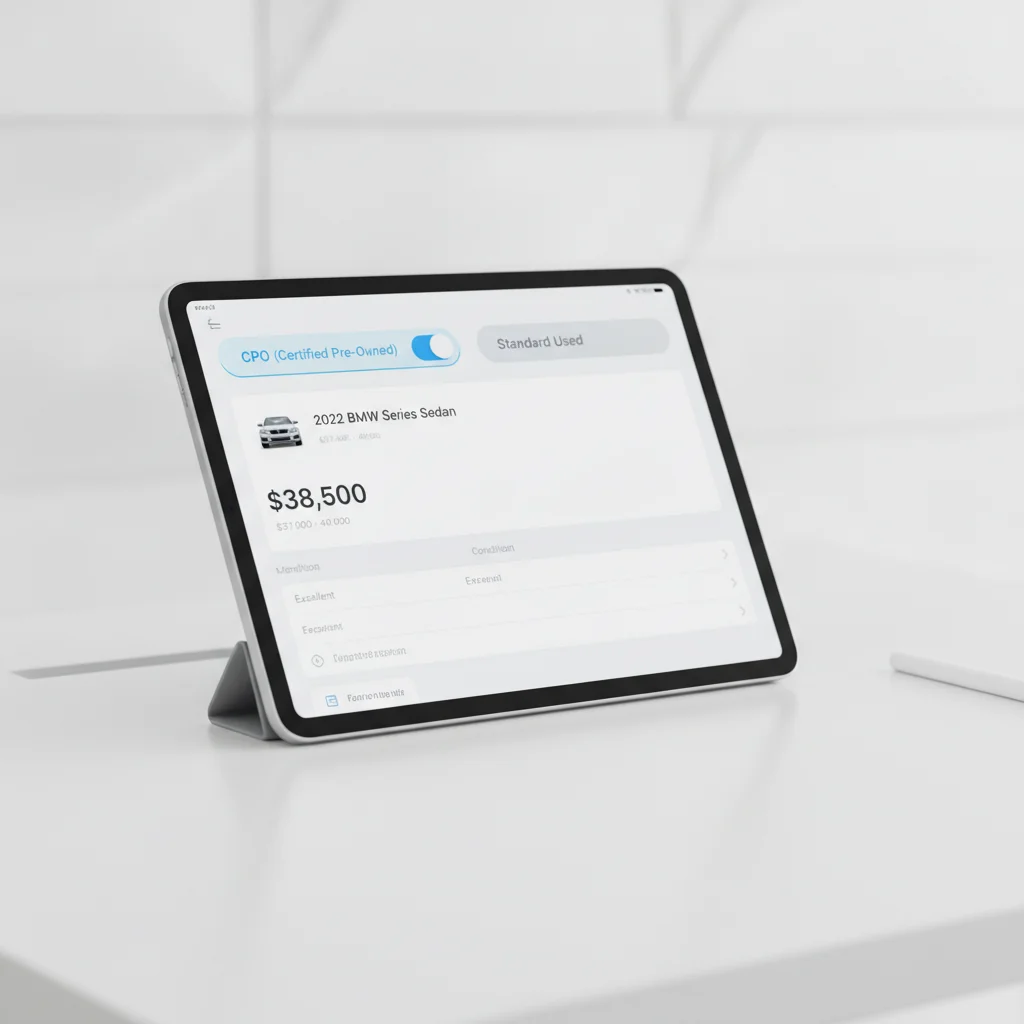
- Pull the standard used retail estimate for the vehicle on KBB or Edmunds in the highest applicable condition tier (typically Excellent or Very Good for CPO cars). This gives you your floor — the baseline value without any certification premium.
- Pull the CPO-specific estimate using the same tool with the CPO option selected. This gives you the ceiling the market will support for a certified version of that vehicle.
- Calculate the implied CPO premium — the difference between the two numbers. On a typical late-model sedan, this might be $1,500 to $2,500.
- Evaluate whether that premium is justified for this specific vehicle. How much warranty time remains? Is the brand's CPO program genuinely rigorous or just a marketing label? What would a comparable third-party warranty cost?
- Determine your target price — usually somewhere between the standard used estimate and the full CPO estimate, depending on your answers above.
This framework prevents two common mistakes: paying the full CPO premium without interrogating whether it's warranted, and insulting a seller by anchoring to standard used values on a legitimately certified vehicle.
For a tactical breakdown of how CPO negotiation differs from new car negotiation, see how the leverage points change. And when you're ready to make your move at the dealership, our guide to negotiating the price of a CPO car will walk you through the conversation step by step.
One more angle worth considering: CPO cars and private-party used cars sit at genuinely different points on the depreciation curve. If you're still weighing which route to go, see which depreciation sweet spot makes more sense for your situation.
Which Valuation to Trust — and When
The short answer: match the tool to the transaction type. Using the wrong valuation in the wrong context is how buyers overpay and sellers underprice.
Use CPO Pricing When:
- You're buying from a franchised dealer and the vehicle carries an active manufacturer CPO designation
- You're comparing a CPO offer to a non-certified alternative and need to calculate the real cost difference
- You're assessing whether a CPO asking price is within the reasonable market range before negotiating
- You're evaluating CPO financing rates against the vehicle's market value
Use Standard Used Car Valuations When:
- You're getting a trade-in appraisal, regardless of whether your vehicle is CPO
- You're selling privately — CPO status doesn't transfer
- You're checking what your insurer might pay in a total loss scenario
- You're buying from a non-franchised independent dealer who cannot certify the vehicle
The underlying principle is simple: CPO pricing reflects what the market will pay for the bundle of car plus certification. The moment the certification is no longer transferable or relevant to the transaction, you're pricing a plain used car and standard valuations apply.
For a comprehensive look at how CPO and standard used cars compare across all the dimensions that matter to buyers, see what the CPO label actually gets you. And if you're still deciding whether to buy CPO at all, the certified pre-owned hub covers every angle of that decision in one place.

All claims are backed by peer-reviewed research. Sources on request.