| Private Party vs. Trade-In Gap | 10–20% higher (private party) (Industry average across major valuation tools) |
| Primary Wholesale Auction Sources | Manheim, ADESA, Black Book |
| Major Consumer Valuation Tools | KBB, Edmunds, NADA, CarGurus |
| Typical ICO Validity Window | 7 days (CarMax, Carvana, KBB ICO standard terms) |
| First-Year Depreciation (Average) | 15–25% of purchase price (Edmunds depreciation research) |
| Condition Grades (Standard) | Excellent, Good, Fair, Poor (KBB and Edmunds condition framework) |
| NADA Primary Use Case | Bank and lender loan underwriting |
| Recommended Valuation Sources Before Listing | Minimum 3 (KBB, Edmunds + 1 ICO) |
Why Valuation Vocabulary Actually Matters
Most sellers walk into a trade-in or private sale knowing roughly what they paid and roughly what they hope to get. That's not enough. The gap between what you think your car is worth and what a buyer or dealer will pay often comes down to one thing: using the wrong term to describe the wrong price in the wrong context.
Dealers, valuation tools, and buyers all use precise language. When a Kelley Blue Book estimate says "Fair Purchase Price," it means something different from the "Trade-In Value" listed two lines below it — and both of those are different from what the dealer's system actually spits out when they run your VIN. If you don't know the difference, you can't negotiate effectively, and you'll leave money on the table.
This guide defines every major term you'll encounter when pricing a vehicle for sale, explains where each number comes from, and tells you which figure actually applies to your situation. Keep it open when you're checking valuations on KBB, Edmunds, NADA, or any other tool.
| Private Party vs. Trade-In Gap | 10–20% higher (private party) (Industry average across major valuation tools) |
| Primary Wholesale Auction Sources | Manheim, ADESA, Black Book |
| Major Consumer Valuation Tools | KBB, Edmunds, NADA, CarGurus |
| Typical ICO Validity Window | 7 days (CarMax, Carvana, KBB ICO standard terms) |
| First-Year Depreciation (Average) | 15–25% of purchase price (Edmunds depreciation research) |
| Condition Grades (Standard) | Excellent, Good, Fair, Poor (KBB and Edmunds condition framework) |
| NADA Primary Use Case | Bank and lender loan underwriting |
| Recommended Valuation Sources Before Listing | Minimum 3 (KBB, Edmunds + 1 ICO) |
Core Price Types: The Foundation Terms
Every valuation tool reports multiple price types simultaneously. Knowing what each one represents is the most important literacy skill you can have as a seller.
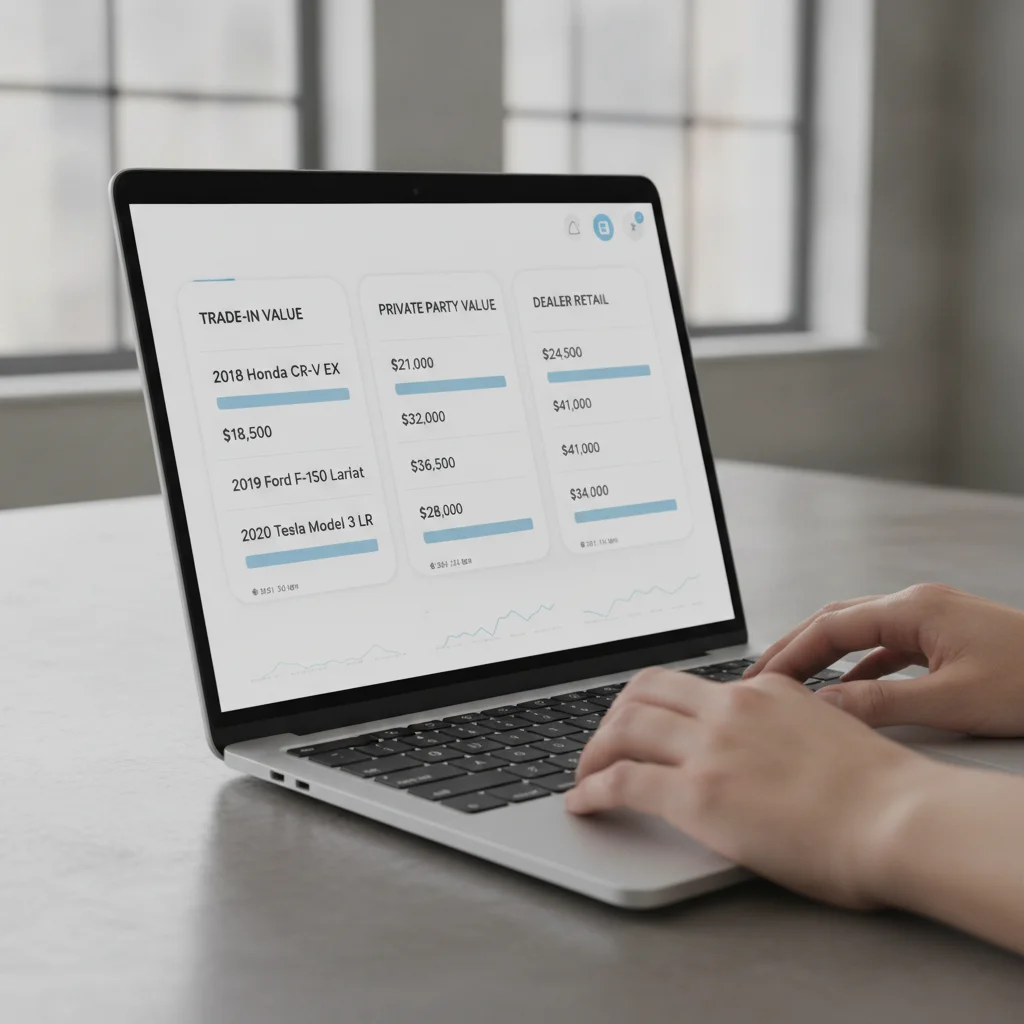
Trade-In Value
The amount a dealership is likely to pay for your vehicle as part of a new or used car purchase transaction. Always lower than private party value due to dealer reconditioning costs and resale risk.
Private Party Value
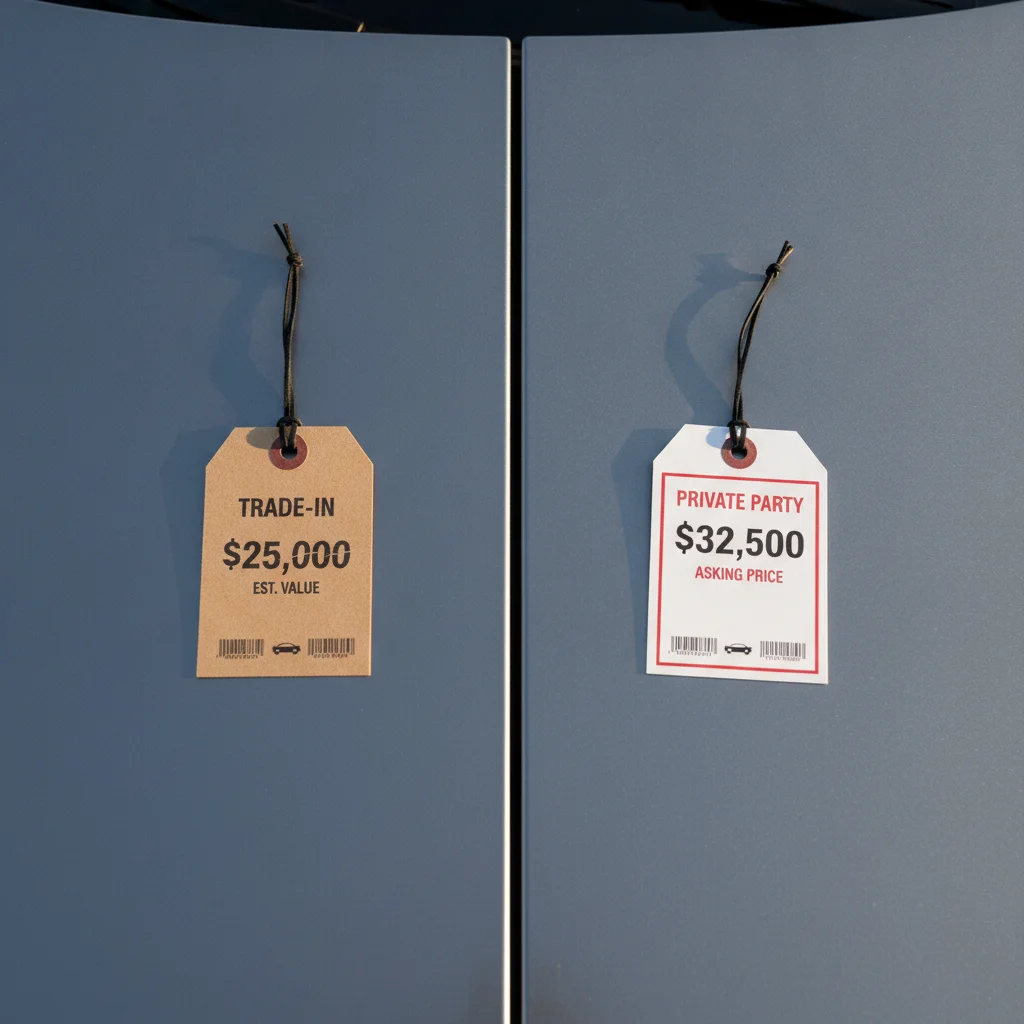
The price a seller can reasonably expect when selling directly to another individual, with no dealer involved. Typically 10–20% higher than trade-in value on most vehicles.
Dealer Retail Value
The price a dealership lists a used vehicle for on its lot after reconditioning. Includes dealer margin, overhead, and warranty costs — not an appropriate benchmark for private sellers.
Wholesale / Auction Value
What dealers pay for vehicles at physical or digital auctions like Manheim. This is the floor that anchors dealer trade-in offers and is not typically visible to consumers.
Instant Cash Offer (ICO)
A real, time-limited purchase bid from a dealer or car-buying service like CarMax or Carvana. Not an estimate — an actual offer you can accept, usually valid for 7 days.
Actual Cash Value (ACV)
The true market value of a vehicle at a specific point in time, as determined by a dealer's appraisal. ACV is what a dealer is willing to pay, which may differ from published book values.
True Market Value (TMV)
Edmunds' proprietary term for the price vehicles are actually transacting at, based on real sales data. Generally considered more accurate than static guide estimates.
Book Value
A generic term for whatever a valuation guide reports as a vehicle's worth. There is no single authoritative book value — KBB, NADA, and Edmunds all produce different numbers using different methodologies.
Residual Value
In leasing, the projected value of a vehicle at lease end, set by the leasing company upfront. Relevant for sellers considering buying out a lease to resell the vehicle.
Condition Grade
A standardized rating (Excellent, Good, Fair, Poor) applied by valuation tools to adjust price estimates based on a vehicle's cosmetic and mechanical state. Most sellers overestimate their vehicle's condition grade.
Depreciation Rate
The rate at which a vehicle loses value over time. New cars typically lose 15–25% of value in year one and approximately 50% over five years, though rates vary by brand and market conditions.
Market Adjustment
A geographic or seasonal price correction applied by valuation tools to reflect local supply and demand. A tool without ZIP code input may produce estimates that are materially off for your specific market.
Trade-In Value
Trade-in value is what a franchised dealership is likely to pay you when you bring in your car as part of a new or used vehicle purchase. This figure is always lower than private party value because the dealer takes on all reconditioning costs, floorplan risk, and resale uncertainty. Expect trade-in value to run 10–20% below private party value on most vehicles, though the gap widens on high-mileage or older cars.
Dealers report trade-in offers through their own auction and wholesale data — particularly Manheim Auction and Black Book — not necessarily the retail-facing tools consumers use. That's why a KBB trade-in estimate and a dealer's actual offer can diverge. See our full breakdown in the dealer trade-in hub and the companion trade-in terminology glossary for the specific terms dealers use at the appraisal desk.
Private Party Value
Private party value is what a seller can realistically expect when selling directly to another individual — no dealer intermediary. This is the highest price most sellers can achieve because there's no middleman margin built in. The buyer benefits too, paying less than they would at a dealer lot.
Private party transactions require more work: you handle listings, screening buyers, test drives, and paperwork. But the payoff is real. On a $20,000 vehicle, the private party premium over trade-in can easily be $2,000–$4,000. That differential is exactly what private party vs. trade-in value explores in detail.
Dealer Retail Value
Dealer retail value — sometimes called "Suggested Retail" or "Certified Pre-Owned Price" — is what a dealership lists a vehicle for on its lot after reconditioning. This is not a number a private seller should use to price their own car. It already includes dealer profit margin, reconditioning, warranty costs, and overhead. Using dealer retail as your asking price will make your listing uncompetitive.
The practical rule: your private party asking price should typically sit below dealer retail but above or at trade-in value. That's the sweet spot where buyers see a deal and you maximize your return.
Wholesale Value / Auction Value
Wholesale value is what dealers pay when they buy cars from each other — primarily at physical and digital auctions like Manheim, ADESA, and OVE. Consumers rarely see this number directly, but it's the floor that anchors a dealer's trade-in offer. If your car wholesales for $12,000, a dealer won't pay you $13,000 in trade — they need margin above wholesale to make any profit on the transaction.
Black Book and Manheim Market Report (MMR) are the dominant wholesale pricing sources. They're subscription-based and dealer-facing, but understanding that they exist explains why dealer offers often feel low relative to consumer-facing tools.
Condition Grades: How Valuation Tools Adjust the Numbers
Every valuation tool applies condition modifiers that can shift a quoted price by hundreds or thousands of dollars. Most sellers overestimate their vehicle's condition — a well-documented industry reality. Here's what each grade actually means.
10–20%
Private Party Premium Over Trade-In
On a $20,000 vehicle, this gap represents $2,000–$4,000 in additional proceeds for private sellers willing to handle the transaction themselves.
Top 5–10%
Vehicles That Qualify as Excellent Condition
Most sellers overestimate their vehicle's condition — fewer than 1 in 10 used cars genuinely meet the Excellent/Outstanding threshold on major valuation tools.
~50%
Average Value Lost Over 5 Years
According to Edmunds depreciation research, the average vehicle retains roughly half its original purchase price after five years of ownership.
3+
Valuation Sources Sellers Should Check
Using at least three independent sources — including one real instant cash offer — gives sellers a reliable price range and genuine negotiating leverage.
15–25%
First-Year Depreciation Rate
New vehicles lose a significant portion of their value in year one, making the timing of a sale particularly impactful for recent buyers.
Excellent / Outstanding Condition
A vehicle that looks and runs like new. No mechanical issues, no paint defects, no interior wear. Typically fewer than 30,000 miles and free from accident history. This is the top 5–10% of all used cars. If you're applying this grade to a daily driver with 60,000 miles and minor door dings, you're pricing yourself wrong.
Good / Clean Condition
Minor cosmetic issues — small scratches, light interior wear — but mechanically sound and accident-free (or with minor, fully disclosed repairs). This is the most common condition grade for well-maintained private seller vehicles. Most valuation tools' middle estimate corresponds to this grade.
Fair Condition
Some mechanical issues or cosmetic damage that a buyer would notice. Could be surface rust, a repaired fender, worn tires, or a dashboard light that comes and goes. Vehicles in fair condition should be priced at or below the tool's "fair" estimate. Trying to hide fair-condition problems in a private sale creates legal and ethical risk.
Poor / Rough Condition
Significant mechanical defects, structural damage, or heavy wear. Typically headed toward wholesale or salvage channels rather than private party sale. If this is your vehicle, a dealer trade-in, instant cash offer service, or junk/salvage buyer is usually the right channel.
Condition Self-Assessment Bias Is Real
Industry studies consistently show that most private sellers rate their vehicle one condition tier higher than a trained appraiser would. Before pricing your car, do a brutally honest walk-around: check for paint chips, interior wear, tire tread depth, and any dashboard warning lights. Then consider going one grade lower than your instinct suggests. You'll price more accurately and avoid renegotiation at the finish line.
"Book Value" Is Not a Single Number
When someone says they'll give you "book value," that phrase has no standard meaning. KBB, NADA, and Edmunds all publish different values for the same vehicle using different data sources and methodologies. Always ask which specific guide and which specific price type. A dealer saying they're offering "book" could mean anything from wholesale to clean retail — and the difference matters enormously.
Valuation Tools Are Estimates, Not Guarantees
KBB, Edmunds, and NADA publish market-based estimates informed by aggregated data — they are not appraisals. Actual transaction prices depend on your specific vehicle's history, local market conditions, and buyer demand at the moment of sale. Treat these tools as benchmarks for negotiation, not as fixed prices you're entitled to receive.
Valuation Tools and Their Terminology
Not all valuation tools use the same vocabulary. Here's a cheat sheet for the major resources and what their specific labels actually mean.
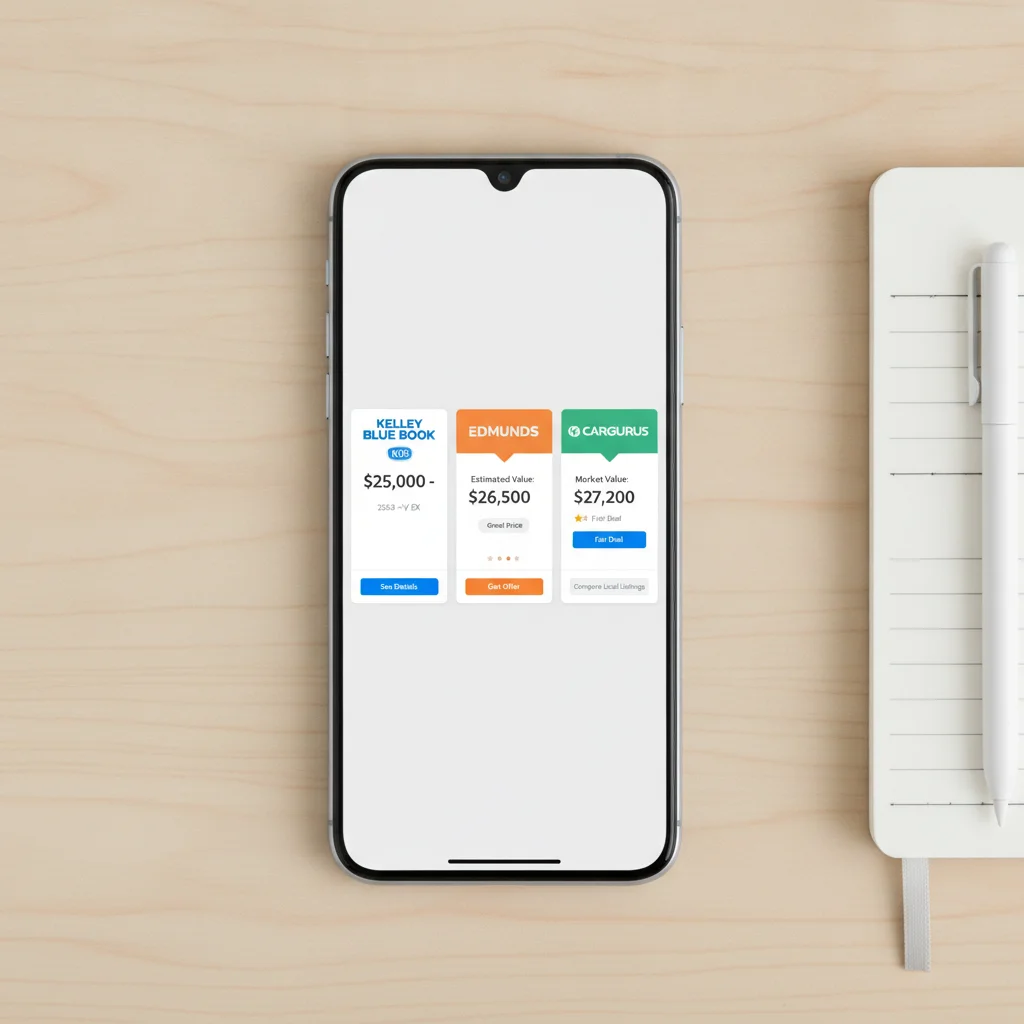
Kelley Blue Book (KBB)
KBB uses the terms Trade-In Range, Private Party Value, and Dealer Retail. Their "Instant Cash Offer" is a separate product — a real bid from participating dealers, not a market estimate. KBB's consumer tool is well-known but skews toward the optimistic side for trade-in values compared to what dealers actually pay. Use it as a starting benchmark, not a final number.
Edmunds
Edmunds reports Trade-In Value, Private Party Value, and Dealer Retail, but also publishes a "True Market Value" (TMV) — their term for what vehicles are actually transacting at, based on real sales data. TMV tends to be more granular than KBB's estimates and is often closer to actual transaction prices. Edmunds also distinguishes between "Rough," "Average," "Clean," and "Outstanding" condition tiers.
NADA Guides
NADA (now part of J.D. Power) is the traditional reference for banks and lenders. Their terminology: Trade-In Value, Clean Trade-In, Clean Loan Value, and Clean Retail Value. The word "clean" in NADA terminology means a vehicle in good condition with no significant issues — not the highest-tier condition grade. NADA tends to run slightly higher than KBB and Edmunds on some vehicles, which is why lenders often use it for loan underwriting.
CarGurus
CarGurus uses a market-based approach, pulling active listing prices and labeling them as "Great Deal," "Good Deal," "Fair Deal," "High Price," or "Overpriced." They're comparing your listing to actual asking prices in your market — not auction data. This makes CarGurus useful for seeing what buyers are actually paying attention to in your ZIP code, but less useful for anchoring a trade-in negotiation.
Instant Cash Offers (ICO)
An instant cash offer is a real, time-limited purchase bid from a dealer or car-buying service like CarMax, Carvana, Vroom, or KBB's ICO network. These are not estimates — they're offers you can accept. ICOs typically come in below private party value but at or above dealer trade-in, and they're worth getting as a floor price before you negotiate anything. See how all these tools stack up in the major valuation tools compared side by side.
Market Adjustments and Depreciation Terms
Valuation isn't static. Several factors shift what your car is worth at any given moment, and understanding the terminology around those factors helps you time your sale and price it accurately.
Market Adjustment / Regional Adjustment
Most modern valuation tools apply geographic adjustments based on local supply and demand. A pickup truck in rural Texas sells for more than the same truck in Manhattan. A convertible in Minnesota is worth less in January than in June. If the tool you're using doesn't allow ZIP code input, its estimate may be materially wrong for your market.
Depreciation Rate
Depreciation is the rate at which a vehicle loses value over time. The average new car loses roughly 15–25% of its value in the first year and around 50% over five years, though this varies sharply by brand, model, and market conditions. Sellers should be aware of their vehicle's expected depreciation curve when deciding whether to sell now or hold.
Residual Value
Residual value is a lease-specific term that describes what the leasing company expects the car to be worth at the end of the lease term. If you're buying out a leased vehicle to resell it, knowing whether the residual is above or below market value determines whether the buyout is profitable. This is a more advanced seller scenario but increasingly common as lease-end buyouts have become a viable arbitrage opportunity in tight used-car markets.
Above Market / Below Market
These relative terms describe how a specific vehicle's asking price compares to comparable listings in the same market. CarGurus and similar platforms compute this automatically. As a seller, your goal is to list at a price that CarGurus or similar tools label as "Good Deal" or better — overpriced listings see dramatically lower inquiry rates.
Book Value
"Book value" is a generic term often used loosely to mean "what the valuation guide says." Be careful — different guides produce different book values. When a dealer says "I'll give you book," ask which book. There's no single authoritative "book value" in the U.S. auto market. For a full breakdown of how these terms interact in trade-in negotiations, the trade-in terminology guide covers ACV, book value, and reconditioning deductions in depth.
Condition Self-Assessment Bias Is Real
Industry studies consistently show that most private sellers rate their vehicle one condition tier higher than a trained appraiser would. Before pricing your car, do a brutally honest walk-around: check for paint chips, interior wear, tire tread depth, and any dashboard warning lights. Then consider going one grade lower than your instinct suggests. You'll price more accurately and avoid renegotiation at the finish line.
"Book Value" Is Not a Single Number
When someone says they'll give you "book value," that phrase has no standard meaning. KBB, NADA, and Edmunds all publish different values for the same vehicle using different data sources and methodologies. Always ask which specific guide and which specific price type. A dealer saying they're offering "book" could mean anything from wholesale to clean retail — and the difference matters enormously.
Valuation Tools Are Estimates, Not Guarantees
KBB, Edmunds, and NADA publish market-based estimates informed by aggregated data — they are not appraisals. Actual transaction prices depend on your specific vehicle's history, local market conditions, and buyer demand at the moment of sale. Treat these tools as benchmarks for negotiation, not as fixed prices you're entitled to receive.
Putting It All Together: Which Number Should You Use?
Here's the decision framework. Match your selling channel to the right valuation type, and you'll price your car correctly from the start.
| Selling Channel | Reference Price Type | Primary Source |
|---|---|---|
| Dealer trade-in | Trade-In Value (ACV range) | KBB Trade-In, Edmunds Trade-In, NADA Trade-In |
| Private party (listing) | Private Party Value | KBB Private Party, Edmunds Private Party |
| Instant cash offer service | ICO / Instant Offer | CarMax, Carvana, KBB ICO |
| Setting a floor before negotiating | Wholesale / Auction Value | Manheim MMR (dealer-facing) |
| Checking loan payoff feasibility | Clean Loan Value | NADA, lender's guide |
The most common seller mistake is using dealer retail as their asking price in a private party listing. Buyers compare your price to other private party listings — not to dealer lots. Price against your competition, not against the dealership down the street.
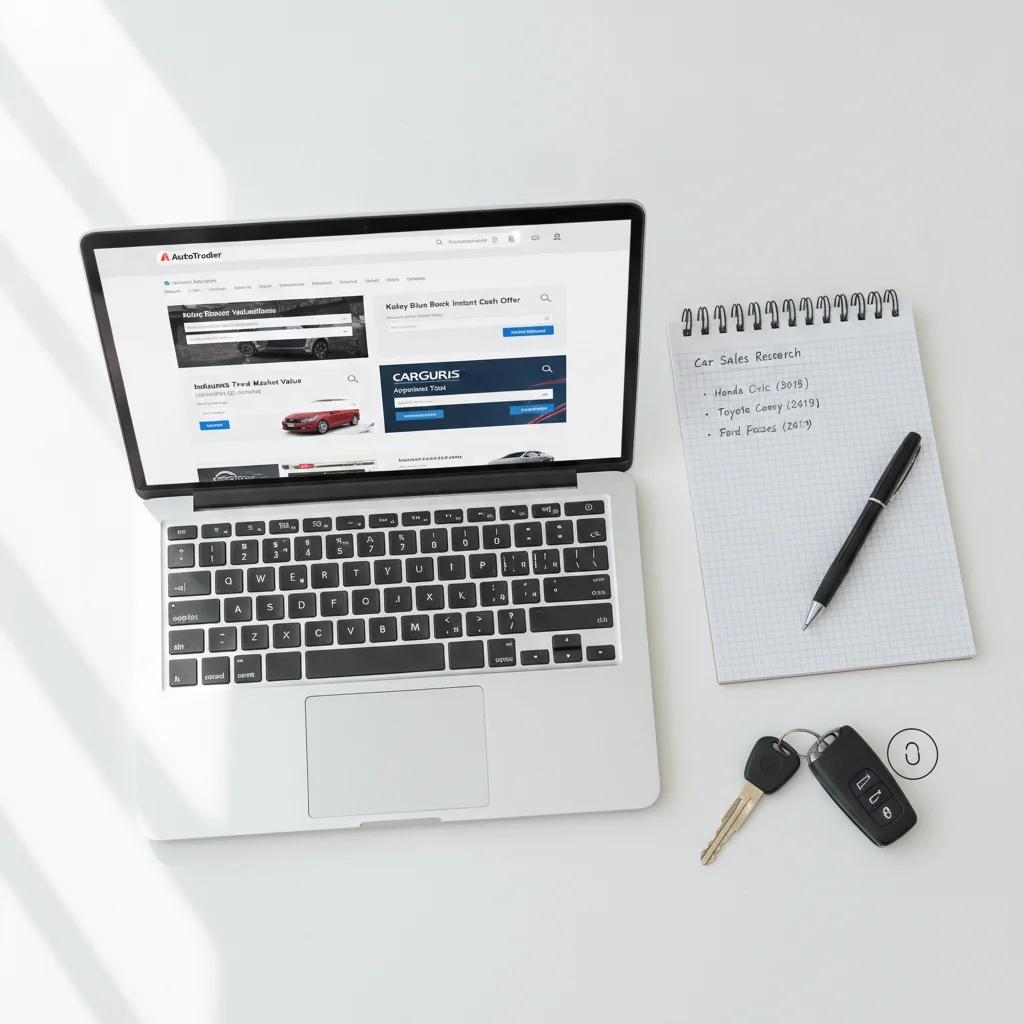
Get at least three valuation data points before you commit to a price: one from KBB, one from Edmunds, and one real ICO. The ICO is your no-excuses floor. If a buyer won't beat that number, you have a standing offer to fall back on. That's leverage.
For deeper context on why different tools produce different numbers — and what those methodological gaps mean for your selling strategy — see why your car's valuation differs across tools. And if you're financing your next purchase alongside selling your current car, understanding loan terminology is equally critical — the auto loan glossary covers the 25 terms that matter most.
Kelley Blue Book (KBB)
The most widely recognized consumer valuation tool. Enter your VIN or year/make/model to get trade-in, private party, and dealer retail estimates segmented by condition grade.
Edmunds True Market Value
Edmunds' TMV tool uses real transaction data to produce condition-adjusted estimates for trade-in and private party scenarios, often closer to actual sale prices than guide-based tools.
CarMax Instant Offer
Get a real, no-obligation purchase offer from CarMax valid for 7 days. Use this as your hard floor before entering any trade-in or private sale negotiation.
NADA Guides
The preferred valuation source for banks and lenders. Useful for understanding loan-to-value calculations and for vehicles where KBB data is thin, such as older or specialty models.
Private Party Value vs. Trade-In: The Full Breakdown
A deep-dive comparison of private party and trade-in value gaps, with real examples of how channel choice affects your net proceeds.
Major Valuation Tools Compared Side by Side
A methodology comparison of KBB, Edmunds, NADA, and CarGurus — explaining how each tool's data sources and formulas produce different results for the same vehicle.

All claims are backed by peer-reviewed research. Sources on request.