Key Takeaways
Modified Adjusted Gross Income (MAGI)
Modified Adjusted Gross Income, or MAGI, is the income figure the IRS uses to determine whether you qualify for the federal EV tax credit. It starts with your Adjusted Gross Income (AGI) — the number on your tax return after certain deductions — and then adds back specific items like excluded foreign income or tax-exempt interest. If your MAGI exceeds the threshold for your filing status, you lose the EV credit entirely, regardless of how eligible the vehicle is.
For most W-2 earners without foreign income or tax-exempt interest, MAGI equals AGI exactly. The distinction matters mainly for taxpayers with foreign income exclusions, student loan interest deductions, or IRA contributions.
Why Income Limits Exist for the EV Tax Credit
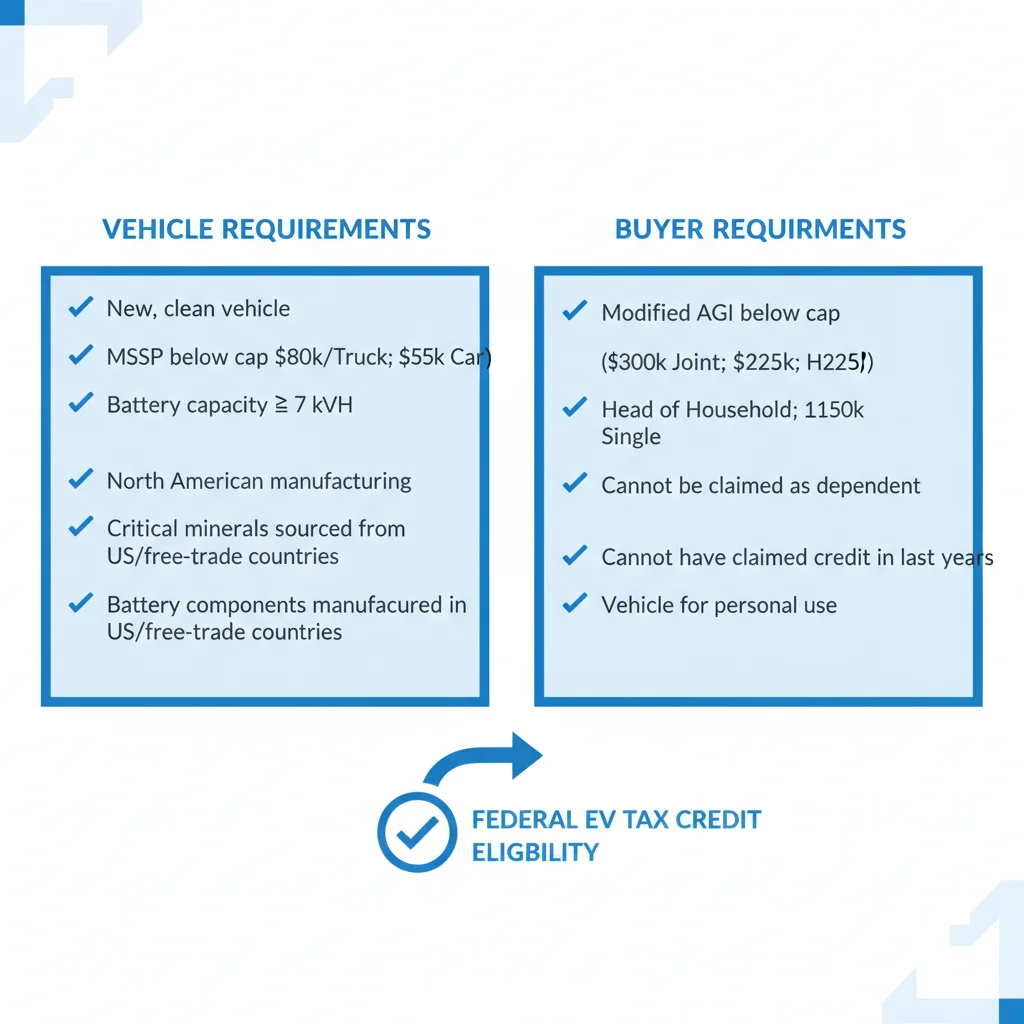
When Congress redesigned the federal EV tax credit under the Inflation Reduction Act of 2022, it added income caps for the first time. The rationale was straightforward: lawmakers wanted to target the incentive at middle-income buyers rather than subsidize luxury purchases by high earners who could afford an EV without federal help.
The result is a credit structure where both the vehicle and the buyer have to clear separate eligibility hurdles. A car can meet every battery sourcing requirement and MSRP cap, but if your income is too high, you walk away with nothing. That makes the income calculation one of the most consequential pieces of EV credit planning — and one of the most misunderstood.
See our complete EV tax credit walkthrough for how income limits fit into the broader eligibility picture.
How MAGI Is Calculated: A Step-by-Step Breakdown
Most tax software handles this calculation automatically, but understanding the steps helps you plan proactively.
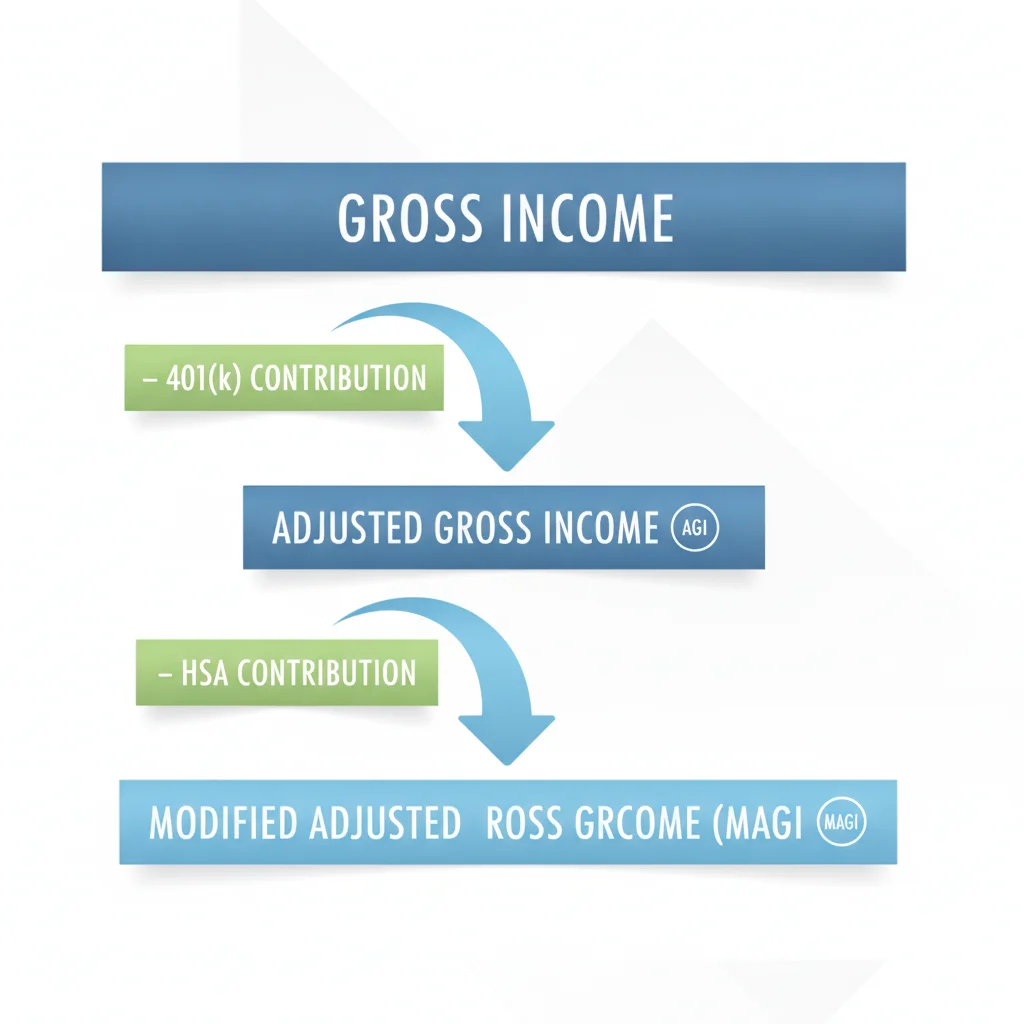
- Start with gross income. This is all wages, salaries, business income, capital gains, rental income, dividends, and other taxable income before any deductions.
- Subtract above-the-line deductions to get AGI. These include traditional 401(k) and IRA contributions, student loan interest, HSA contributions, alimony paid (for pre-2019 agreements), and self-employment taxes paid.
- Add back specific items to get MAGI. For EV credit purposes, the IRS adds back: excluded foreign earned income and housing costs (Form 2555), tax-exempt interest income, and excluded employer-provided adoption benefits.
For the overwhelming majority of American workers — W-2 employees without foreign income or tax-exempt bond interest — MAGI equals AGI exactly. You can find your AGI on Line 11 of Form 1040.
MAGI vs. AGI: When They Differ
For most salaried employees, MAGI and AGI are the same number. The add-backs that create a difference — foreign earned income exclusion, tax-exempt interest, excluded employer adoption benefits — apply to a minority of taxpayers. If none of these apply to you, simply use the AGI from Line 11 of your Form 1040 as your MAGI for EV credit purposes.
Point-of-Sale Transfer: Know Your Risk
Transferring the EV credit to the dealer at the point of sale gives you an immediate discount, but you certify your income eligibility in the process. If your actual MAGI turns out to be too high in both the purchase year and the prior year, the IRS can require you to repay the credit when you file. Variable-income earners should weigh this carefully before choosing the transfer option.
State Credits Are Separate — and Don't Share These Limits
Many states offer their own EV incentives with different income rules, vehicle requirements, and credit amounts. California, Colorado, New York, and others have independent programs that may be more or less generous than the federal credit. Check your state's energy or revenue department website for current rules, as these programs change frequently.
If you receive municipal bond interest or have foreign income exclusions, your MAGI will be higher than your AGI. A tax professional can calculate your exact MAGI before you finalize a vehicle purchase.
“The income limits on the EV credit are a hard cliff, not a slope. Taxpayers need to understand that a dollar over the threshold means zero credit — there's no gradual phase-out the way there is with some other tax provisions.”
— Mark Luscombe, Principal Federal Tax Analyst, Wolters Kluwer Tax & Accounting
The Exact Income Thresholds for New and Used EVs
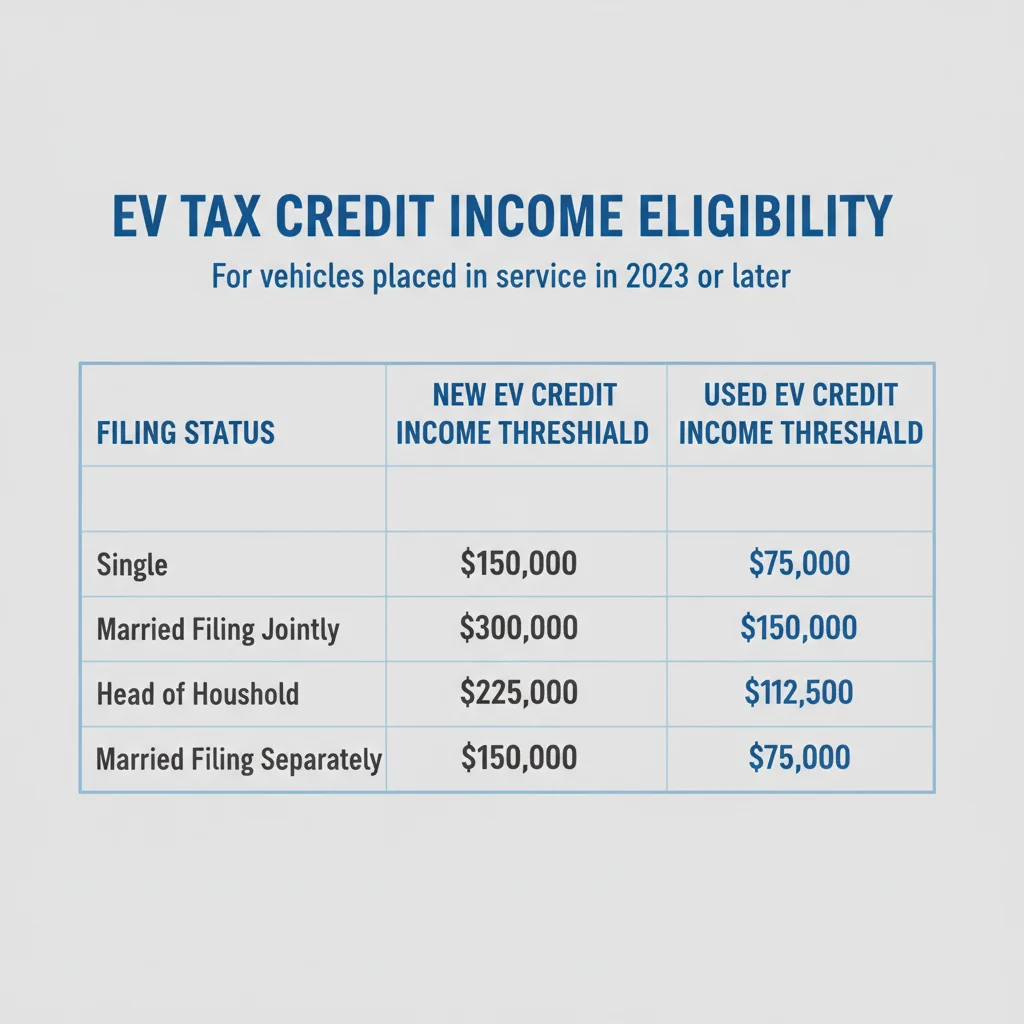
The IRS sets different income caps depending on whether you're buying a new or used EV, and on your filing status. Here's the complete breakdown:
| Filing Status | New EV Credit (up to $7,500) | Used EV Credit (up to $4,000) |
|---|---|---|
| Single / Married Filing Separately | $150,000 | $75,000 |
| Head of Household | $225,000 | $112,500 |
| Married Filing Jointly / Qualifying Surviving Spouse | $300,000 | $150,000 |
These thresholds are a hard cutoff — there is no gradual phase-out. One dollar over the limit means zero credit. That's a meaningful distinction from some other tax benefits that fade gradually as income rises.
The used EV credit thresholds are exactly half those for new vehicles, reflecting Congress's intent to focus that benefit even more tightly on lower-to-middle-income households. If you're shopping the used market, check the details in our article on claiming the used EV credit.
$7,500
Maximum federal EV tax credit for new vehicles
Under the Inflation Reduction Act, qualifying new clean vehicles can receive up to $7,500 — but only if both the vehicle and buyer meet all eligibility requirements.
$300,000
MAGI limit for married joint filers (new EV)
The IRS sets the highest income threshold at $300,000 for married couples filing jointly purchasing a new qualifying electric vehicle.
$150,000
MAGI limit for single filers (new EV)
Single taxpayers and married couples filing separately face a $150,000 MAGI cap to claim the new clean vehicle credit.
$4,000
Maximum credit for used EV purchases
The used clean vehicle credit offers up to $4,000 but carries stricter income limits — half those that apply to new vehicle purchases.
2 years
Income lookback window for EV credit
The IRS allows buyers to qualify using either the current or prior tax year MAGI, giving buyers with fluctuating incomes a meaningful advantage.
The Prior-Year Lookback: A Critical Rule Most Buyers Miss
One of the most buyer-friendly provisions in the current EV credit rules is the prior-year lookback. Under IRS guidance, you qualify if your MAGI is below the threshold in either the year you claim the credit or the preceding tax year. The IRS uses whichever year produces the lower MAGI.
In practice, this means:
- If your 2024 MAGI is $160,000 (over the $150,000 single-filer limit) but your 2023 MAGI was $140,000, you can still claim the 2024 credit.
- If you expect a high-income year due to a bonus, stock vesting, or asset sale, buying the EV in a prior lower-income year — or making the purchase early in the new year before income spikes — can preserve eligibility.
This lookback also protects buyers who can't predict their exact annual income at the point of purchase. You don't have to know your final 2024 MAGI when you buy the car in March 2024 — the IRS will compare both years when you file.
Use the Lookback Before You Buy
Before purchasing, pull your prior-year tax return and check your AGI on Line 11. If your prior-year MAGI was under the threshold — even if your current income is higher — you may already qualify without any additional planning. This takes two minutes and could confirm a $7,500 benefit.
Run the Numbers on Retirement Contributions First
If your MAGI is within $20,000–$25,000 of the income limit, model your contribution headroom before assuming you don't qualify. A maxed traditional 401(k) contribution alone can move $23,000 off your MAGI. Combined with HSA contributions, many buyers who initially appear over the limit can get below it with contributions they would benefit from making anyway.
Consider Waiting to Claim at Filing
If your income is close to the threshold and variable, it may be smarter to claim the credit on your tax return rather than transferring it at the dealership. This gives you visibility into your full-year MAGI before committing to the credit, reducing the risk of a repayment surprise at filing time.
Strategies to Reduce MAGI Before Year-End
If you're close to the income threshold, targeted tax planning can move your MAGI below the cutoff. These aren't loopholes — they're standard above-the-line deductions that reduce your AGI and therefore your MAGI.
Maximize Pre-Tax Retirement Contributions
Contributing to a traditional 401(k), 403(b), or 457 plan reduces your W-2 taxable wages. For 2024, the employee contribution limit is $23,000 (or $30,500 if you're 50 or older). Every dollar contributed pre-tax lowers your AGI dollar-for-dollar.
Fund a Health Savings Account (HSA)
If you have a high-deductible health plan, HSA contributions are deductible above the line. In 2024, you can contribute up to $4,150 as an individual or $8,300 for family coverage. These come straight off your AGI.
Self-Employed Deductions
If you're self-employed, deductions for the self-employment tax deduction, self-employed health insurance, and SEP-IRA or Solo 401(k) contributions all reduce AGI. A sole proprietor with significant income who maxes a SEP-IRA (up to 25% of net self-employment income) can see substantial MAGI reductions.
Traditional IRA Contributions
Depending on your income and whether you or your spouse have a workplace retirement plan, traditional IRA contributions may be fully or partially deductible, further lowering your AGI.
Use the Lookback Before You Buy
Before purchasing, pull your prior-year tax return and check your AGI on Line 11. If your prior-year MAGI was under the threshold — even if your current income is higher — you may already qualify without any additional planning. This takes two minutes and could confirm a $7,500 benefit.
Run the Numbers on Retirement Contributions First
If your MAGI is within $20,000–$25,000 of the income limit, model your contribution headroom before assuming you don't qualify. A maxed traditional 401(k) contribution alone can move $23,000 off your MAGI. Combined with HSA contributions, many buyers who initially appear over the limit can get below it with contributions they would benefit from making anyway.
Consider Waiting to Claim at Filing
If your income is close to the threshold and variable, it may be smarter to claim the credit on your tax return rather than transferring it at the dealership. This gives you visibility into your full-year MAGI before committing to the credit, reducing the risk of a repayment surprise at filing time.
Timing matters: all of these contributions generally need to be made by December 31 of the tax year (except IRA contributions, which can be made until the April filing deadline). If you're buying a car in Q4, run the numbers on your contribution headroom immediately.
The Point-of-Sale Transfer Option Changes the Calculation
Starting in 2024, the IRS introduced a significant structural change: buyers can transfer the EV tax credit directly to a participating dealer at the point of sale, effectively receiving an immediate price reduction rather than waiting to file taxes. This is called the clean vehicle credit transfer.
The income limit still applies — you must certify that your MAGI meets the threshold. But here's the nuance: if you transfer the credit at the dealer and it later turns out your income was too high (in both the purchase year and the prior year), you may have to repay the credit when you file your taxes. The IRS has issued guidance that recapture applies in this situation.
This creates an important risk for buyers whose income is variable or unpredictable. If your income fluctuates significantly year to year, consult a tax advisor before transferring the credit at the point of sale. A modest error in income projection could turn a $7,500 benefit into a $7,500 tax bill.
MAGI vs. AGI: When They Differ
For most salaried employees, MAGI and AGI are the same number. The add-backs that create a difference — foreign earned income exclusion, tax-exempt interest, excluded employer adoption benefits — apply to a minority of taxpayers. If none of these apply to you, simply use the AGI from Line 11 of your Form 1040 as your MAGI for EV credit purposes.
Point-of-Sale Transfer: Know Your Risk
Transferring the EV credit to the dealer at the point of sale gives you an immediate discount, but you certify your income eligibility in the process. If your actual MAGI turns out to be too high in both the purchase year and the prior year, the IRS can require you to repay the credit when you file. Variable-income earners should weigh this carefully before choosing the transfer option.
State Credits Are Separate — and Don't Share These Limits
Many states offer their own EV incentives with different income rules, vehicle requirements, and credit amounts. California, Colorado, New York, and others have independent programs that may be more or less generous than the federal credit. Check your state's energy or revenue department website for current rules, as these programs change frequently.
To understand which vehicles are currently eligible for the point-of-sale transfer and full credit amount, see which EVs qualify for the federal tax credit right now.
Common MAGI Misconceptions Worth Clearing Up
Given how often buyers get tripped up by the income rules, it's worth directly addressing the most frequent misunderstandings.
"My salary is under the limit, so I'm fine."
Not necessarily. Your gross salary is not your MAGI. Capital gains, rental income, business profits, dividend income, and other sources all add to your gross income before deductions. A single filer earning $130,000 in salary who also realized $30,000 in stock gains has $160,000 in gross income — above the threshold — even before calculating AGI and MAGI.
"The credit phases out gradually near the limit."
No. It's a binary cutoff. One dollar over the threshold means no credit. There is no partial credit for high earners who just miss the limit — this is fundamentally different from how some other tax benefits work.
"Filing jointly always helps my situation."
For the EV credit, the joint filing threshold ($300,000) is double the single threshold ($150,000). So if two moderate-income earners combine for $280,000 jointly, they qualify — but each individually would be under $150,000 anyway. The benefit of joint filing applies mainly to households with one high earner and one lower earner, where combining incomes stays under $300,000 but the high earner alone would exceed $150,000.
For a full glossary of EV credit terms including how MAGI relates to other key eligibility concepts, see the EV tax credit glossary.
Putting It All Together: Checking Your Eligibility Before You Buy
Before you sign a purchase agreement or authorize a credit transfer at the dealership, run through this quick checklist:
- Pull your prior-year AGI. Find it on Line 11 of your most recent Form 1040. For most people, this equals your MAGI. Note any foreign income or tax-exempt interest that would require an add-back.
- Estimate your current-year MAGI. Add up all income sources year-to-date, project through year-end, and subtract expected above-the-line deductions. Tax software or a CPA can do this quickly.
- Compare both years to the threshold for your filing status. Remember: you only need to qualify in one of the two years.
- Identify contribution opportunities. If you're close, calculate how much more you can contribute to a 401(k), HSA, or IRA before year-end to drop below the limit.
- Decide on credit transfer vs. tax filing. If your income is borderline or variable, waiting to claim the credit at filing — rather than transferring it at the dealer — reduces the risk of having to repay it.
The EV credit income rules aren't designed to trap buyers — they're designed to target the benefit at the right income range. With a bit of planning, many buyers who initially think they're over the limit find they're not, or can get there with straightforward pre-tax contributions.
For the full picture of how all the EV credit rules fit together — vehicle sourcing requirements, MSRP caps, dealer registration requirements, and the filing process — see our complete EV tax credit guide.
MAGI vs. AGI: When They Differ
For most salaried employees, MAGI and AGI are the same number. The add-backs that create a difference — foreign earned income exclusion, tax-exempt interest, excluded employer adoption benefits — apply to a minority of taxpayers. If none of these apply to you, simply use the AGI from Line 11 of your Form 1040 as your MAGI for EV credit purposes.
Point-of-Sale Transfer: Know Your Risk
Transferring the EV credit to the dealer at the point of sale gives you an immediate discount, but you certify your income eligibility in the process. If your actual MAGI turns out to be too high in both the purchase year and the prior year, the IRS can require you to repay the credit when you file. Variable-income earners should weigh this carefully before choosing the transfer option.
State Credits Are Separate — and Don't Share These Limits
Many states offer their own EV incentives with different income rules, vehicle requirements, and credit amounts. California, Colorado, New York, and others have independent programs that may be more or less generous than the federal credit. Check your state's energy or revenue department website for current rules, as these programs change frequently.

All claims are backed by peer-reviewed research. Sources on request.