Key Takeaways
No oil changes, ever
Battery electric vehicles have no internal combustion engine and require no motor oil. That's typically 3–5 service visits per year eliminated for the average driver, saving $150–$300 annually before accounting for your time.
Brake pads last dramatically longer
Regenerative braking handles most deceleration, reducing friction brake use significantly. Many EV owners report 80,000–100,000 miles before their first brake pad replacement, versus 30,000–50,000 miles on a comparable gas vehicle.
No exhaust, spark plugs, or timing belt
Entire categories of gas vehicle maintenance simply don't exist on a BEV — no exhaust system corrosion, no spark plug fouling, no timing belt replacement at 60,000–100,000 miles. These are real cost eliminations, not hypothetical savings.
Simpler drivetrain reduces overall failure points
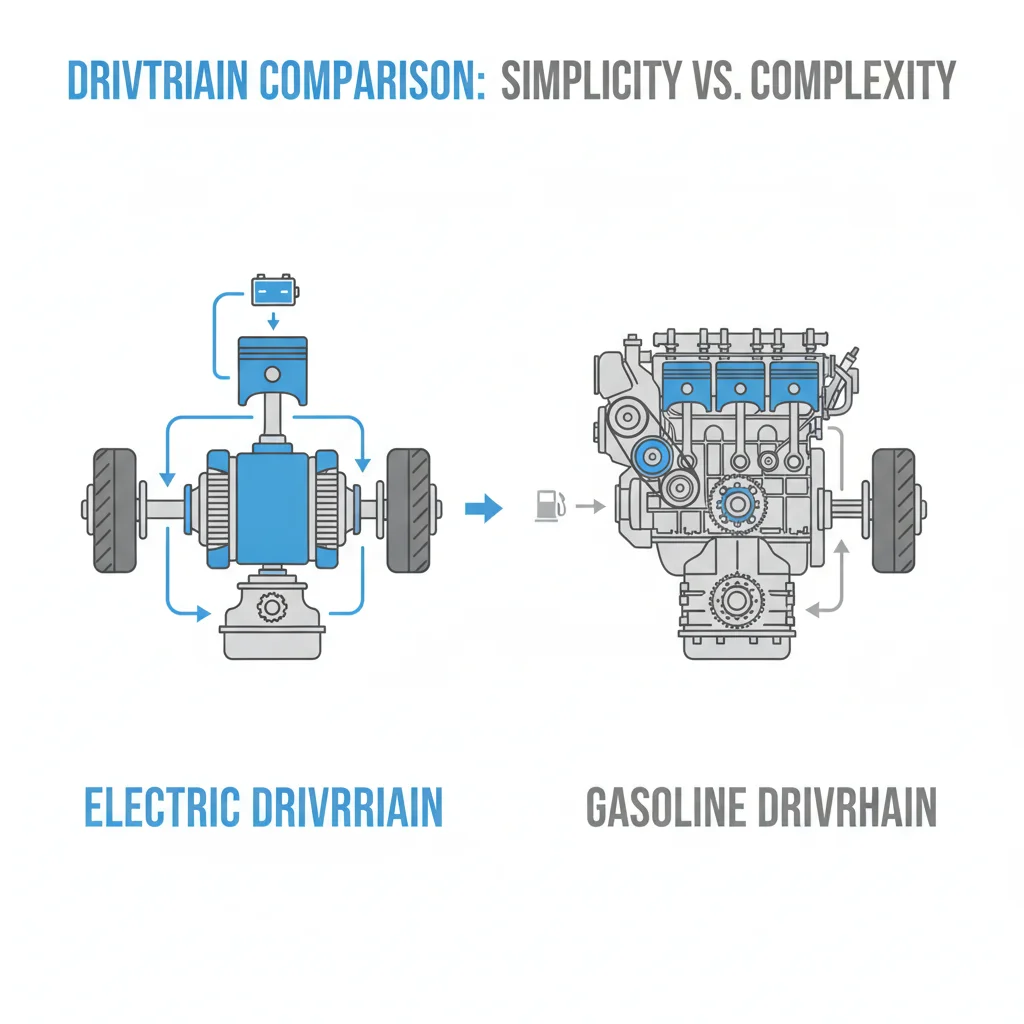
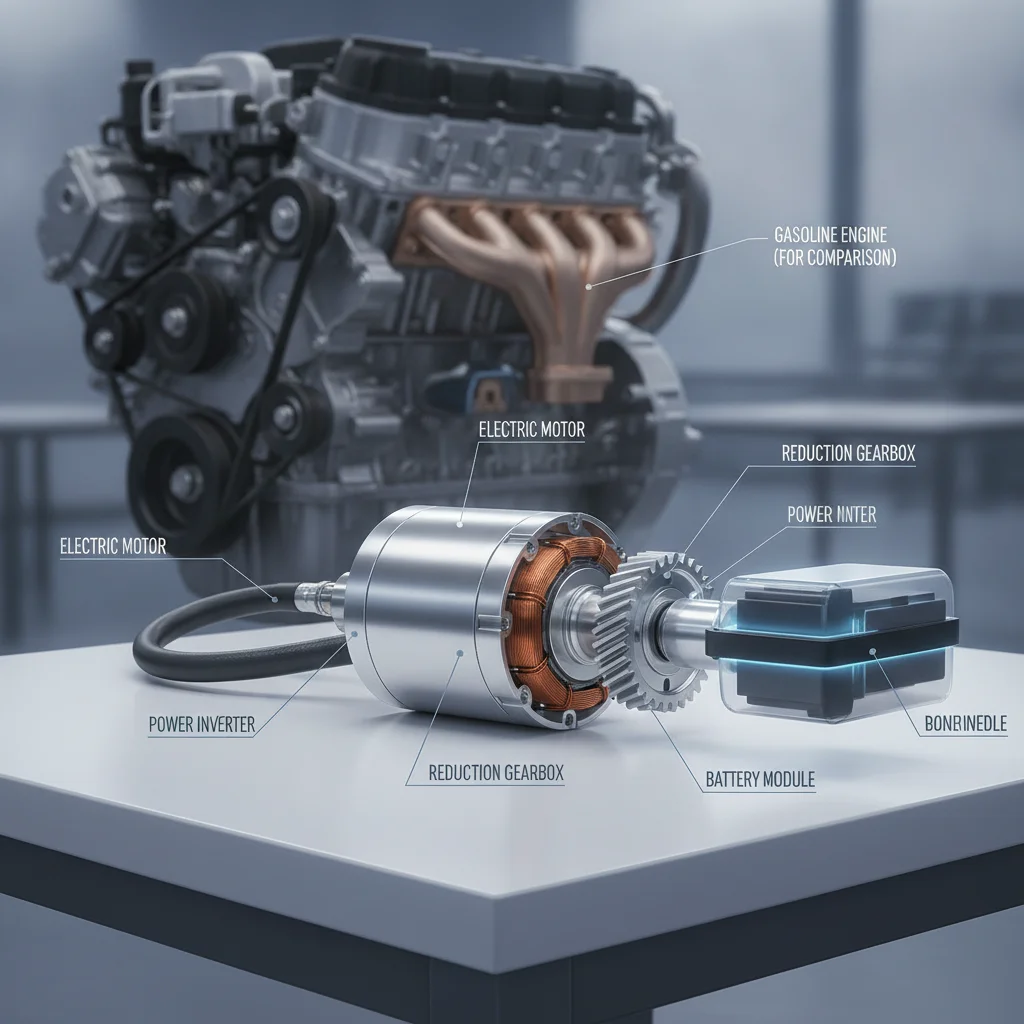
A typical EV motor has a fraction of the moving parts of an internal combustion engine. Fewer components means fewer things that can wear, break, or require adjustment over time.
Lower average annual maintenance cost
Consumer Reports data indicates EV owners spend roughly half what gas vehicle owners spend on maintenance and repairs over the vehicle's lifetime — a meaningful financial advantage that compounds over years of ownership.
Reduced fluid management complexity
No engine oil, no transmission fluid on most BEVs, no coolant for an engine block. The fluids that remain (battery coolant, brake fluid, windshield washer) are simpler to monitor and change less frequently.
Battery degradation requires active management
Lithium-ion battery packs lose capacity over time, and charging habits significantly influence the rate of degradation. Habitually charging to 100% or letting the battery sit near empty accelerates capacity loss in ways most gas car owners aren't accustomed to managing.
Tires wear faster and need more frequent rotation
EV weight and instant torque delivery both increase tire wear rates compared to similarly-sized gas vehicles. Rotation every 5,000–7,500 miles is advisable, and full tire replacement comes sooner for owners who skip this step.
Battery thermal system coolant is easy to overlook
The liquid cooling system that manages battery temperature requires periodic inspection and eventual replacement — a maintenance task many EV owners don't discover until a service center flags it, sometimes after damage has begun.
Brake corrosion is a real risk from underuse
Because regenerative braking handles most stopping duties, friction brakes can go long periods without use — allowing rotors and calipers to corrode. Periodic hard stops and regular brake fluid checks are necessary preventive steps.
Software updates are a new maintenance category
OTA updates affect range, charging behavior, safety systems, and drivetrain calibration. Treating these as optional creates real-world performance gaps and occasionally leaves known issues unpatched longer than necessary.
Battery replacement is a high-cost tail risk
While modern EV batteries are showing good longevity, out-of-warranty pack replacement can run $5,000–$20,000 depending on the vehicle. Owners who don't practice good battery management increase their exposure to this cost.
Fewer independent service options
EV-specific repair and diagnostics require specialized equipment and training that many independent shops don't yet have. This limits competitive pricing on service and can extend wait times at authorized dealerships.
Our Verdict
EVs genuinely reduce the frequency and cost of routine maintenance — no oil changes, fewer brake jobs, and a simpler drivetrain all add up to real savings over time. But owners who treat 'low maintenance' as 'no maintenance' can run into avoidable costs, particularly around tires, battery care, and cooling systems. Go in with accurate expectations and the ownership experience delivers on its promise.
Best for drivers who can charge at home, keep annual mileage above 8,000 miles to recoup savings, and are willing to stay engaged with a slightly different maintenance checklist.
Why EV Maintenance Is Different — Not Just Lighter
The sales pitch is simple: EVs have fewer moving parts, so they cost less to maintain. That's broadly true, but the framing invites a passive attitude that can hurt you. Electric vehicles don't simplify every aspect of ownership — they restructure it. Some tasks disappear entirely. Others become more critical. And a few new categories emerge that gas car owners never had to think about.
Understanding exactly where EV maintenance is lighter — and where it quietly demands attention — is the difference between a satisfying decade of ownership and an unpleasant surprise at the service center. This article gives you that honest accounting. For a comprehensive schedule covering every task across an EV's lifetime, see our full EV maintenance overview.
We'll run through the genuine advantages first, then the tasks owners consistently underestimate, with a clear-eyed look at what each means for your wallet and schedule.
The Real Upkeep Advantages of Electric Vehicles
Start with what you actually gain. These are not marketing claims dressed up as facts — they are concrete reductions in maintenance tasks backed by how EV drivetrains work.
No oil changes, ever
Battery electric vehicles have no internal combustion engine and require no motor oil. That's typically 3–5 service visits per year eliminated for the average driver, saving $150–$300 annually before accounting for your time.
Brake pads last dramatically longer
Regenerative braking handles most deceleration, reducing friction brake use significantly. Many EV owners report 80,000–100,000 miles before their first brake pad replacement, versus 30,000–50,000 miles on a comparable gas vehicle.
No exhaust, spark plugs, or timing belt
Entire categories of gas vehicle maintenance simply don't exist on a BEV — no exhaust system corrosion, no spark plug fouling, no timing belt replacement at 60,000–100,000 miles. These are real cost eliminations, not hypothetical savings.
Simpler drivetrain reduces overall failure points
A typical EV motor has a fraction of the moving parts of an internal combustion engine. Fewer components means fewer things that can wear, break, or require adjustment over time.
Lower average annual maintenance cost
Consumer Reports data indicates EV owners spend roughly half what gas vehicle owners spend on maintenance and repairs over the vehicle's lifetime — a meaningful financial advantage that compounds over years of ownership.
Reduced fluid management complexity
No engine oil, no transmission fluid on most BEVs, no coolant for an engine block. The fluids that remain (battery coolant, brake fluid, windshield washer) are simpler to monitor and change less frequently.
~40%
Lower EV maintenance cost vs. gas vehicles
Consumer Reports analysis found EV owners spend roughly 40% less on maintenance and repairs over the vehicle's life compared to gas vehicle owners.
$900/yr
Average annual EV maintenance spend
AAA's 2023 Your Driving Costs study estimated average annual maintenance costs for electric vehicles at approximately $900, compared to $1,279 for gas-powered vehicles.
80,000–100,000 mi
Typical EV brake pad lifespan
Due to regenerative braking reducing friction brake use, many EV owners report first brake pad replacements at 80,000 to 100,000 miles — roughly double the interval of a comparable gas vehicle.
20%–80%
Recommended daily battery charge range
Most EV manufacturers recommend keeping the battery between 20% and 80% state of charge for routine daily use to minimize long-term capacity degradation.
800–1,200 lbs
Extra weight of EVs vs. gas equivalents
Battery packs add significant mass — typically 800 to 1,200 pounds over comparable gas models — which is the primary driver of accelerated tire wear in electric vehicles.
The savings stack up most visibly in the first 50,000 miles, when gas vehicle owners are typically dealing with multiple oil changes, spark plug replacements, and often a timing belt or chain service. EV owners sidestep all of that. For a detailed side-by-side of exactly which tasks disappear and which remain, this breakdown of EV moving parts lays it out clearly.
Brake longevity deserves special mention. Regenerative braking — where the motor acts as a generator to slow the car and recover energy — handles the majority of deceleration in everyday driving. Many EV owners report going 80,000 to 100,000 miles before needing brake pad replacement. On a comparable gas vehicle, pads typically need attention every 30,000 to 50,000 miles depending on driving style. That's a meaningful real-world saving.
The Tasks EV Owners Consistently Underestimate
Here's where the 'EVs are maintenance-free' myth creates real problems. Several upkeep categories either become more important for EVs or are entirely new to the ownership experience. Skipping them doesn't just reduce comfort — it can accelerate costly component degradation.
Battery degradation requires active management
Lithium-ion battery packs lose capacity over time, and charging habits significantly influence the rate of degradation. Habitually charging to 100% or letting the battery sit near empty accelerates capacity loss in ways most gas car owners aren't accustomed to managing.
Tires wear faster and need more frequent rotation
EV weight and instant torque delivery both increase tire wear rates compared to similarly-sized gas vehicles. Rotation every 5,000–7,500 miles is advisable, and full tire replacement comes sooner for owners who skip this step.
Battery thermal system coolant is easy to overlook
The liquid cooling system that manages battery temperature requires periodic inspection and eventual replacement — a maintenance task many EV owners don't discover until a service center flags it, sometimes after damage has begun.
Brake corrosion is a real risk from underuse
Because regenerative braking handles most stopping duties, friction brakes can go long periods without use — allowing rotors and calipers to corrode. Periodic hard stops and regular brake fluid checks are necessary preventive steps.
Software updates are a new maintenance category
OTA updates affect range, charging behavior, safety systems, and drivetrain calibration. Treating these as optional creates real-world performance gaps and occasionally leaves known issues unpatched longer than necessary.
Battery replacement is a high-cost tail risk
While modern EV batteries are showing good longevity, out-of-warranty pack replacement can run $5,000–$20,000 depending on the vehicle. Owners who don't practice good battery management increase their exposure to this cost.
Fewer independent service options
EV-specific repair and diagnostics require specialized equipment and training that many independent shops don't yet have. This limits competitive pricing on service and can extend wait times at authorized dealerships.
PHEVs and HEVs: A Different Calculus
This article focuses primarily on battery electric vehicles (BEVs). Plug-in hybrids (PHEVs) and standard hybrids (HEVs) retain internal combustion engines, which means oil changes and related maintenance still apply. They do benefit from regenerative braking advantages on brake wear, but the overall maintenance profile is closer to a gas vehicle than a BEV. If you're still deciding which type fits your situation, <a href="/electric-vehicles/ev-basics/ev-types-explained">our EV types hub</a> breaks down the distinctions.
Check Your Manufacturer's Actual Schedule
General maintenance intervals in this article are industry averages, not universal specs. Tesla, Ford, Hyundai, GM, and other manufacturers publish specific maintenance schedules in owner portals and manuals that should take precedence over general guidance. Schedules vary meaningfully by model — confirm yours before establishing a routine.
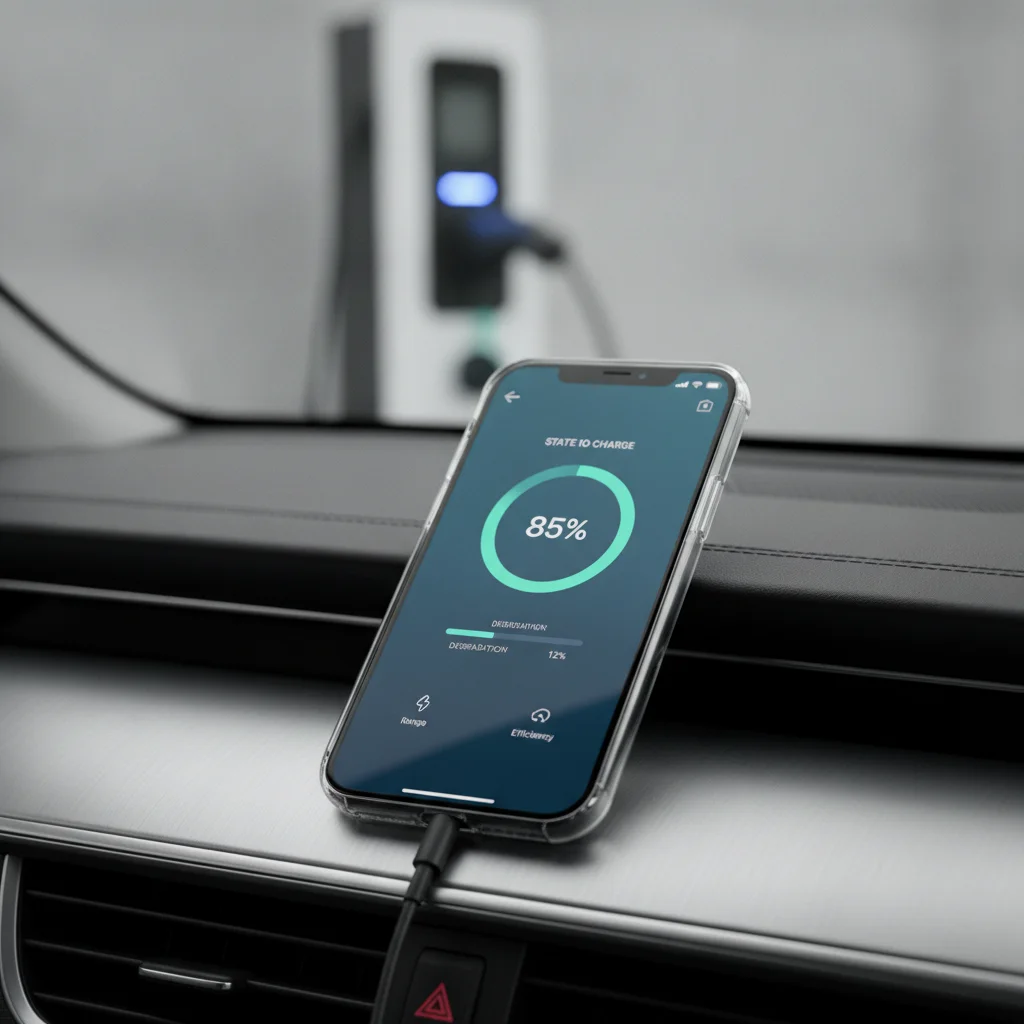
The single most underestimated area is battery health. Unlike a gas tank you fill and empty, a lithium-ion battery pack degrades over time based on how you use and charge it. Charging habits — specifically, habitually charging to 100% and letting the pack sit fully charged or deeply depleted — measurably accelerate capacity loss. Most manufacturers recommend keeping daily charging between 20% and 80% for routine use. This isn't optional fine print; it's the primary variable you control that affects the battery's long-term health. Common EV maintenance myths covers this and several other misconceptions that lead owners astray.
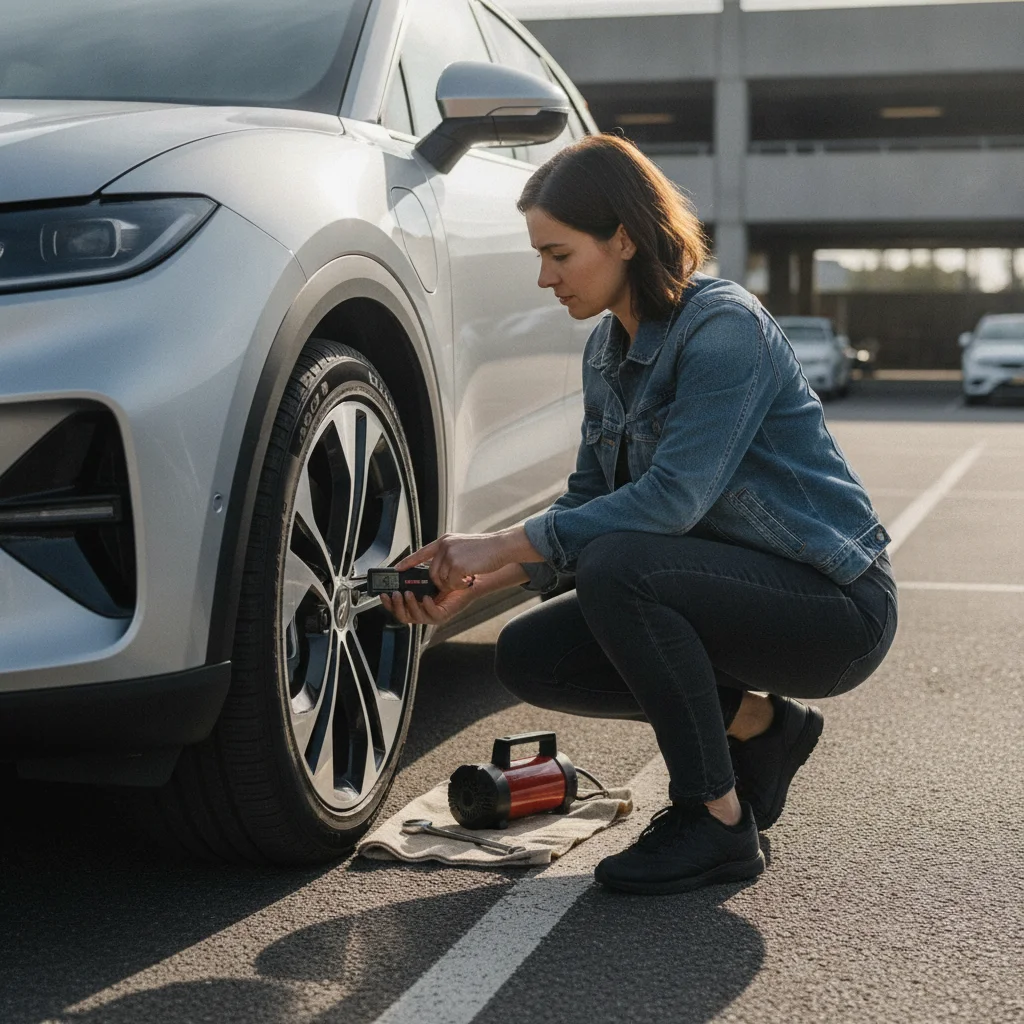
Tires are the second underestimated category. EVs are heavier than comparable gas vehicles — often by 800 to 1,200 pounds — and deliver torque instantly from a stop. Both factors accelerate tire wear. Many EV owners are surprised to find their tires wearing out noticeably faster than on previous vehicles. Rotation every 5,000 to 7,500 miles (rather than the 7,500 to 10,000 miles typical for lighter gas cars) is a reasonable standard. Ignoring this rotation interval leads to uneven wear patterns that require premature full-set replacement.
Cooling system maintenance is another gap. The battery thermal management system uses liquid coolant — just like an engine cooling system — that requires periodic inspection and replacement. This isn't a monthly task, but it is a real one that many owners don't discover until a service center flags it. Cabin air filters, wiper blades, and brake fluid are conventional items that apply equally to EVs and frequently get overlooked under the assumption that 'EVs don't need that stuff.'
Finally, software. Over-the-air updates are now standard on most EVs, and they affect everything from range estimates to charging behavior to safety systems. Treating these as optional background tasks is a mistake. Some updates patch real-world issues; others improve efficiency. Staying current with your vehicle's software is a legitimate part of EV upkeep. Why EVs still need regular maintenance covers the full picture of tasks that don't go away with electrification.
Cost Reality: What the Numbers Actually Show
Consumer Reports and AAA data consistently show EVs cost less to maintain annually than gas vehicles. Consumer Reports found EV owners spend roughly half what gas car owners spend on maintenance and repairs over the life of the vehicle — but 'half' still means something. It's not zero.
~40%
Lower EV maintenance cost vs. gas vehicles
Consumer Reports analysis found EV owners spend roughly 40% less on maintenance and repairs over the vehicle's life compared to gas vehicle owners.
$900/yr
Average annual EV maintenance spend
AAA's 2023 Your Driving Costs study estimated average annual maintenance costs for electric vehicles at approximately $900, compared to $1,279 for gas-powered vehicles.
80,000–100,000 mi
Typical EV brake pad lifespan
Due to regenerative braking reducing friction brake use, many EV owners report first brake pad replacements at 80,000 to 100,000 miles — roughly double the interval of a comparable gas vehicle.
20%–80%
Recommended daily battery charge range
Most EV manufacturers recommend keeping the battery between 20% and 80% state of charge for routine daily use to minimize long-term capacity degradation.
800–1,200 lbs
Extra weight of EVs vs. gas equivalents
Battery packs add significant mass — typically 800 to 1,200 pounds over comparable gas models — which is the primary driver of accelerated tire wear in electric vehicles.
The costs that do apply to EVs tend to be concentrated in two areas: tires and, eventually, battery replacement or reconditioning. Tire costs are manageable with proper rotation habits. Battery replacement is genuinely expensive — often $5,000 to $20,000 depending on the vehicle — but most modern EV batteries carry 8-year/100,000-mile warranties and are showing better real-world longevity than early pessimists predicted.
For a full cost and task comparison against a typical gas vehicle, our EV vs. gas maintenance breakdown runs the numbers across common vehicle categories. And if you're still weighing whether a fully battery-electric vehicle fits your situation, the BEV pros and cons article addresses the full ownership picture beyond just maintenance.
One practical note: charging costs are a significant part of the EV ownership equation that most maintenance comparisons don't fully account for. Your total fueling savings depend heavily on local electricity rates, charging habits, and whether you have home charging access. Our charging costs and savings hub walks through how to estimate what you'll actually spend.
Building a Practical EV Maintenance Schedule
The cleanest way to approach EV upkeep is to replace the old oil-change-interval mental model with a simple tiered schedule: monthly checks, annual checks, and milestone checks.
Monthly (Takes 10 Minutes)
- Tire pressure: EV tires lose pressure like any other tire, and underinflation worsens range and accelerates wear. Check monthly.
- Charging system visual: Look for fraying on the charge cable, debris in the port, and confirm the charge session completed as expected.
- Brake response feel: Because you use brakes less, it's worth periodically confirming they feel responsive. Brake fluid can absorb moisture even when pads are barely worn.
Annually (At Service or Self-Inspection)
- Tire rotation (or every 5,000–7,500 miles, whichever comes first)
- Cabin air filter inspection and replacement if needed
- Wiper blade replacement
- Brake fluid test for moisture content
- Battery thermal management coolant inspection
- Software update status verification
By Mileage Milestone
- 30,000–40,000 miles: Full brake inspection including calipers (corrosion is a real issue when brakes are used infrequently)
- 60,000–75,000 miles: Coolant replacement if not already performed per manufacturer spec
- Battery capacity check: Many manufacturers and third-party apps let you monitor state of health — worth running at each major milestone to establish a baseline
PHEVs and HEVs: A Different Calculus
This article focuses primarily on battery electric vehicles (BEVs). Plug-in hybrids (PHEVs) and standard hybrids (HEVs) retain internal combustion engines, which means oil changes and related maintenance still apply. They do benefit from regenerative braking advantages on brake wear, but the overall maintenance profile is closer to a gas vehicle than a BEV. If you're still deciding which type fits your situation, <a href="/electric-vehicles/ev-basics/ev-types-explained">our EV types hub</a> breaks down the distinctions.
Check Your Manufacturer's Actual Schedule
General maintenance intervals in this article are industry averages, not universal specs. Tesla, Ford, Hyundai, GM, and other manufacturers publish specific maintenance schedules in owner portals and manuals that should take precedence over general guidance. Schedules vary meaningfully by model — confirm yours before establishing a routine.
New EV owners especially benefit from getting this framework established early. What every new EV owner should know about maintenance is a useful companion read if you're in the first year of ownership. And if you're unsure which type of EV best fits your driving situation to begin with, our EV types hub clarifies the BEV, PHEV, and HEV distinctions.
The Bottom Line on EV Upkeep
EVs deliver on the promise of lower maintenance burden — fewer appointments, fewer consumables, and a simpler drivetrain. But 'lower' isn't 'none,' and the specific tasks that remain are different enough from gas car ownership that owners can slip into a false sense of security. The owners who get the best long-term value from their EVs are the ones who understand where the maintenance actually sits, not the ones who simply assume it doesn't exist.
Battery care, tire management, and staying current on software are the three areas where EV owners can most meaningfully influence their vehicle's long-term condition and cost trajectory. Everything else is conventional maintenance with an adjusted schedule. That's a genuinely favorable deal — just go in with your eyes open. For a clear-eyed assessment of what 'low maintenance' actually means in practice, this article on EV maintenance reality is worth reading before your next service decision.

All claims are backed by peer-reviewed research. Sources on request.