Key Takeaways
Our Verdict
Gas engines and electric drivetrains are not competing versions of the same idea — they are fundamentally different machines. The ICE powertrain is a marvel of refined complexity; the EV drivetrain is a study in elegant simplicity. For most buyers who drive predictable daily routes and have access to charging, the electric drivetrain wins on long-term operating costs and driving smoothness. For buyers with range anxiety, long rural drives, or limited charging infrastructure, the ICE still holds practical advantages.
| Best for | Recommended |
|---|---|
| Daily commuters and urban drivers with home charging | Electric Drivetrain |
| Long-haul drivers or those in areas with sparse charging networks | Gas Engine |
| Buyers prioritizing lowest possible maintenance costs | Electric Drivetrain |
| Buyers needing maximum refueling flexibility today | Gas Engine |
Why This Comparison Matters Before You Buy
When most people compare a gas car to an EV, they compare range, price, and charging time. Those are valid factors — but they miss something foundational: these two vehicles barely share any mechanical DNA. Understanding what's actually under the hood (or under the floor) changes how you think about reliability, maintenance bills, performance, and long-term value.
This isn't an engineering lecture. It's a buyer's guide to the mechanical differences that will affect your wallet, your schedule, and your daily driving experience for the life of the vehicle. We'll go component by component — engine versus motor, transmission versus single-speed reducer, fuel system versus battery pack — and explain exactly what each swap means in practical terms.
If you're new to how EVs work mechanically, the all-electric powertrain introduction covers the full system overview. This article digs deeper into the head-to-head component differences.
The Power Source: Internal Combustion Engine vs. Electric Motor
This is the core of the comparison, and the contrast is stark.
Internal Combustion Engine (ICE)
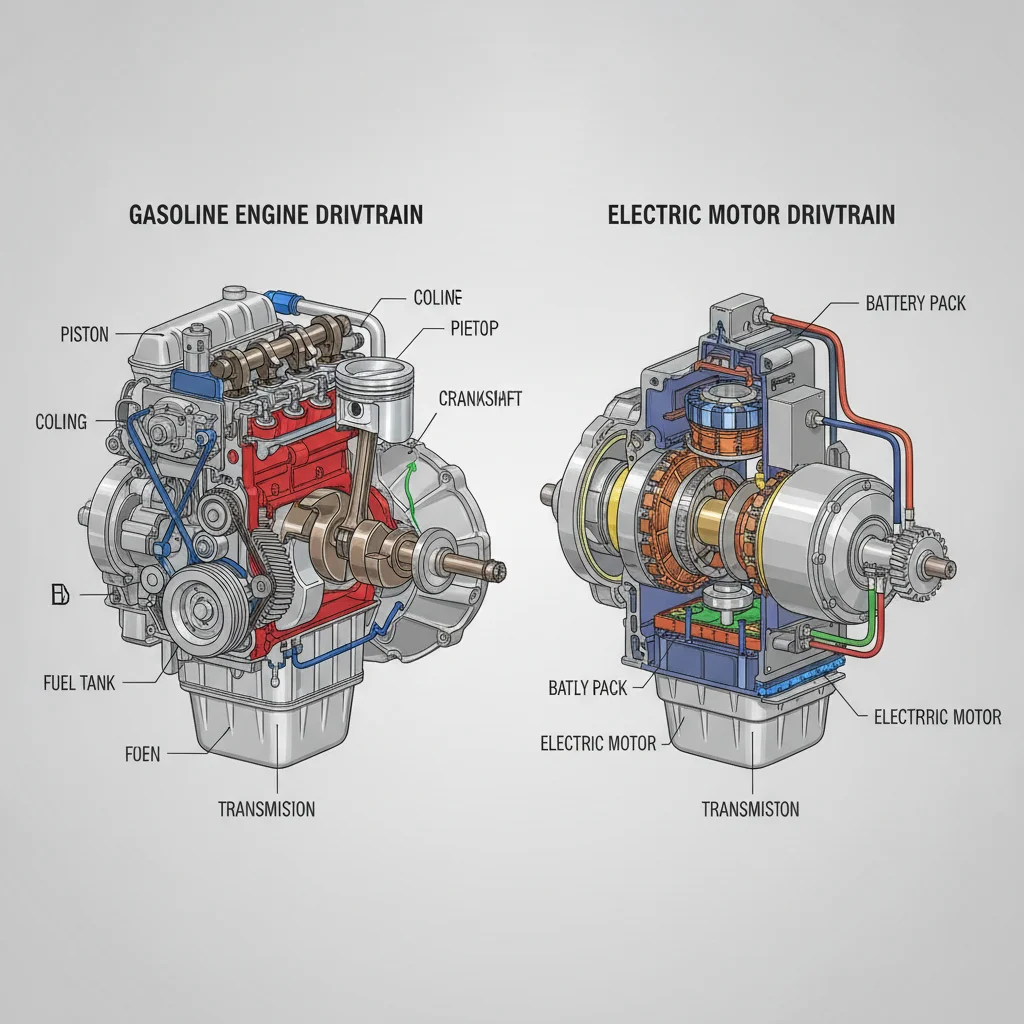
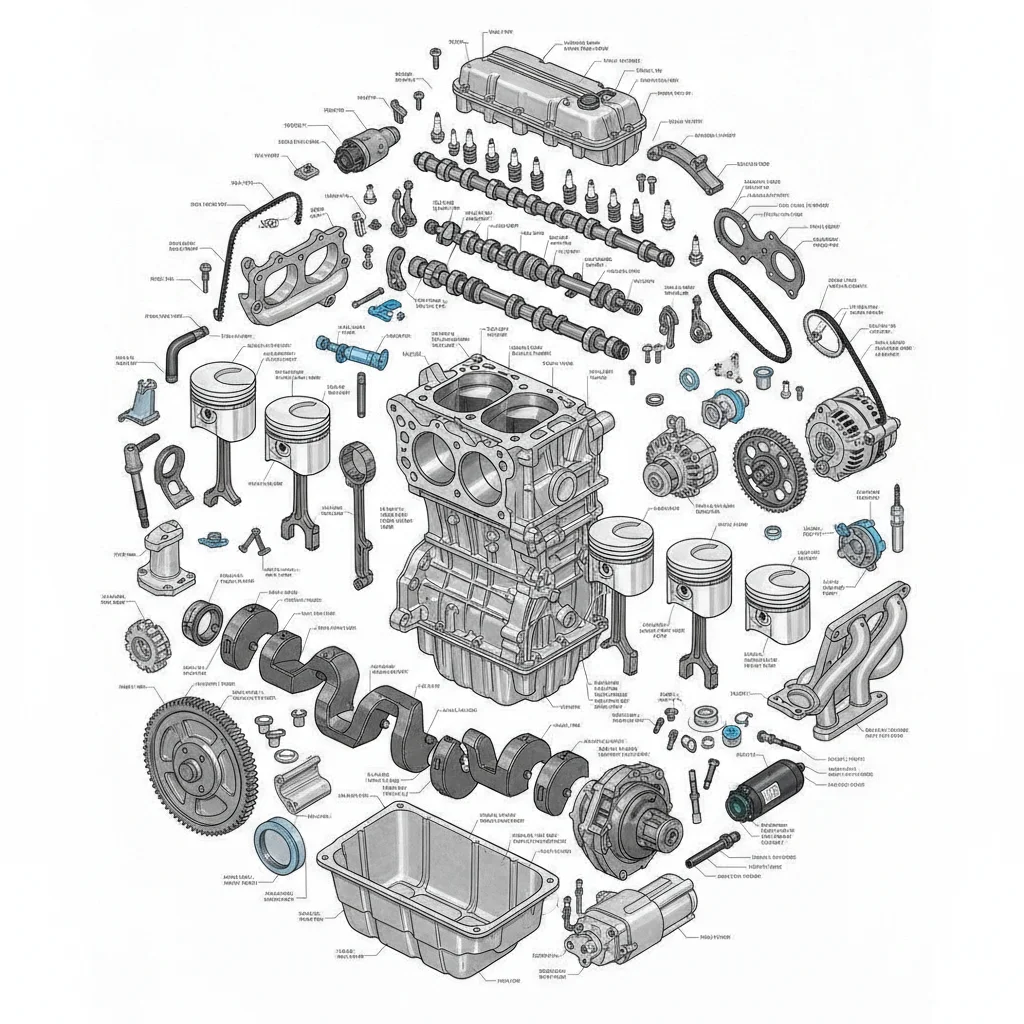
A gasoline engine converts fuel into motion through a controlled series of explosions. Pistons move up and down inside cylinders, connecting rods translate that motion to a crankshaft, and the crankshaft turns the wheels — eventually, through a chain of other components. A typical 4-cylinder engine has hundreds of moving parts: valves, lifters, camshafts, timing chains or belts, pistons, rings, rods, and more. Every one of those parts wears, requires lubrication, and can fail.
Gas engines also only produce peak torque within a specific RPM range. That's why transmissions exist — to keep the engine operating in its efficient power band as vehicle speed changes. Below that band, the engine feels sluggish. Above it, it's just burning fuel.
Electric Motor
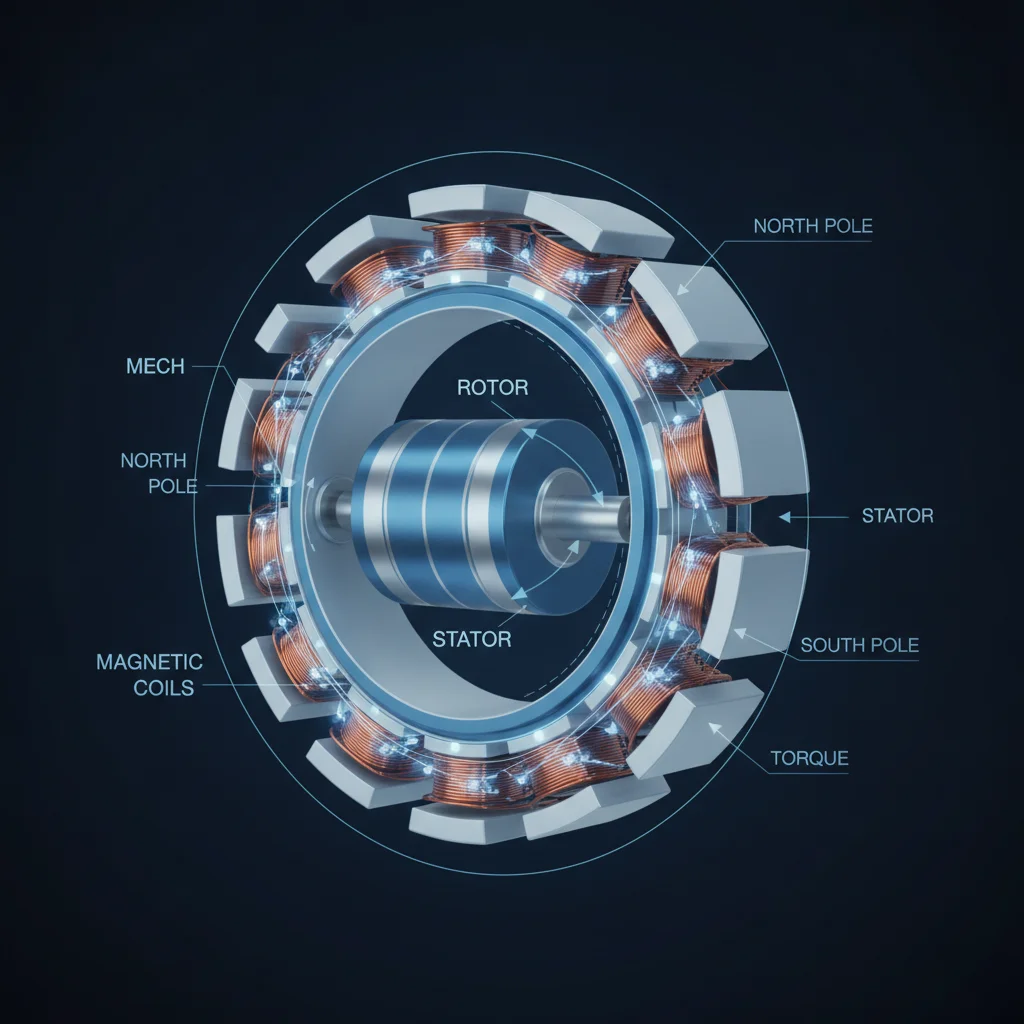
An electric motor converts electrical energy into rotational force using electromagnetism. There is no combustion, no explosion, and no pistons. The motor's rotor spins when current passes through coils in a magnetic field. That's essentially the entire mechanism. Most EV motors have one moving part: the rotor itself.
Critically, electric motors produce maximum torque at zero RPM — the instant you press the accelerator. There's no waiting for the engine to rev up. This is why a Tesla Model 3 Performance can feel quicker off the line than cars with twice its horsepower on paper.
For a deeper look at how motors work, see how electric motors convert battery power into motion.
~20
Moving parts in a typical EV drivetrain
Compared to roughly 200 moving parts in a conventional internal combustion engine, per engineering industry estimates.
~60%
Lower per-mile fuel cost for EVs vs. gas
Based on average US electricity rates (~$0.16/kWh) versus gasoline at $3.50/gallon at 30 MPG efficiency.
8 yr / 100k mi
Federal minimum EV battery warranty
US federal law mandates all BEV and PHEV battery packs be warranted for at least 8 years or 100,000 miles.
~50%
Lower repair and maintenance spending for EV owners
Consumer Reports surveys consistently find BEV owners spend roughly half what ICE owners spend on maintenance and unscheduled repairs.
80–90%
Typical battery capacity retention at 100k miles
Real-world data from high-mileage EV fleets, including Tesla and Nissan Leaf studies, shows most packs retain this range of original capacity.
Transmission vs. Single-Speed Reducer
After the power source, this is the most dramatic difference between the two drivetrains.
ICE Transmission
A conventional automatic transmission is one of the most mechanically complex assemblies in any vehicle. It contains planetary gear sets, torque converters, hydraulic circuits, clutch packs, and sophisticated electronic controls — all working together to match engine output to wheel speed across dozens of operating conditions. Automatic transmissions can have 6, 8, 9, or even 10 speeds. Each added gear ratio improves fuel efficiency and performance, but also adds complexity and potential failure points.
Transmission fluid must be changed periodically. Torque converters wear. Shift solenoids fail. A full transmission rebuild can run $2,000–$5,000 or more.
EV Single-Speed Reducer
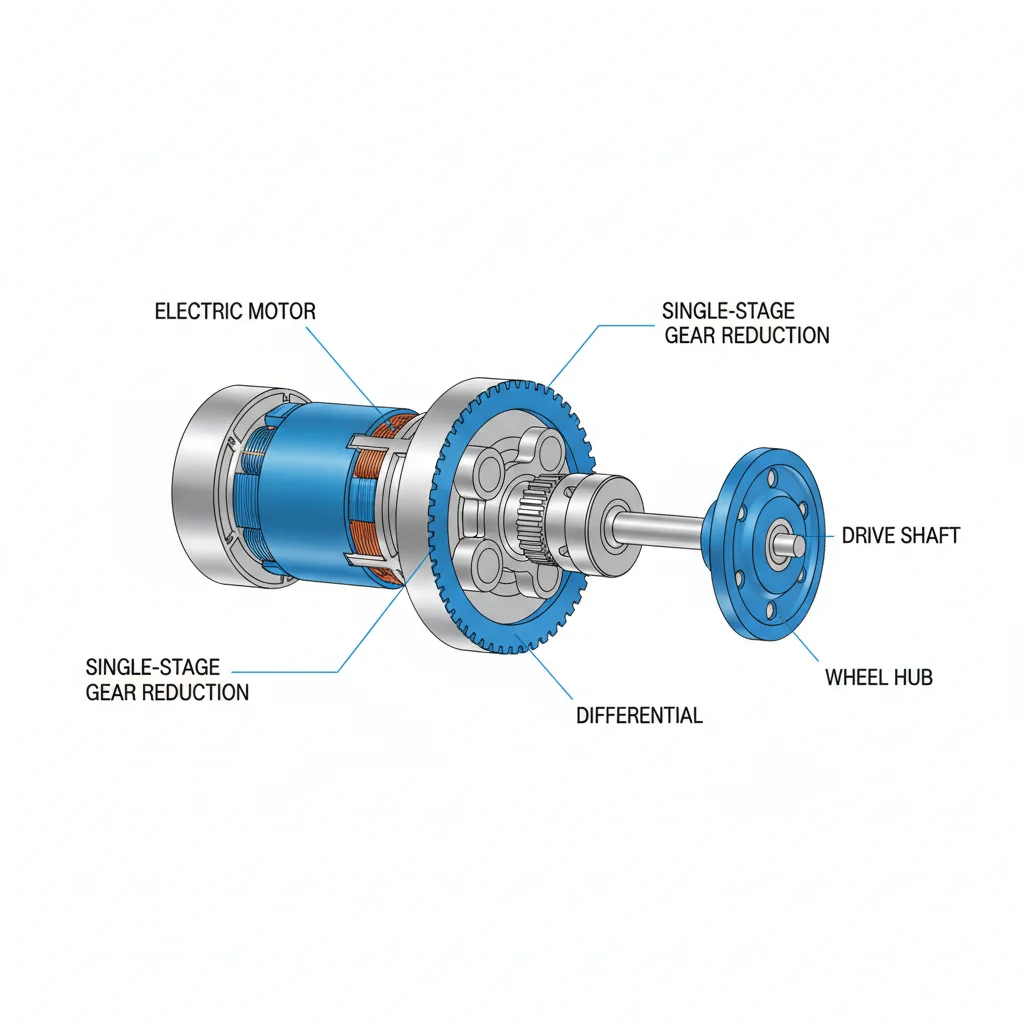
Most battery electric vehicles use a single fixed-ratio reduction gear — sometimes called a gearbox, but it's nothing like a traditional transmission. Because the electric motor produces useful torque across its entire RPM range, there's no need to swap gear ratios. The reducer simply steps down the motor's rotational speed to an appropriate wheel speed. It has a small amount of gear oil, rarely needs service, and almost never fails.
A handful of performance EVs experiment with two-speed transmissions for optimized top-end acceleration, but these are the exception. Why most EVs skip the gearbox — and when multiple speeds actually make sense explores that nuance further. For maintenance implications, the single-speed gearbox service breakdown shows what this means for your ownership costs.
| Component / System | Gas Engine (ICE) | Electric Drivetrain (BEV) | |
|---|---|---|---|
| Primary power source | Internal combustion engine (hundreds of moving parts) | Electric motor (one moving part: rotor) | |
| Transmission | 6–10 speed automatic or manual | Single-speed fixed reducer (no shifts) | |
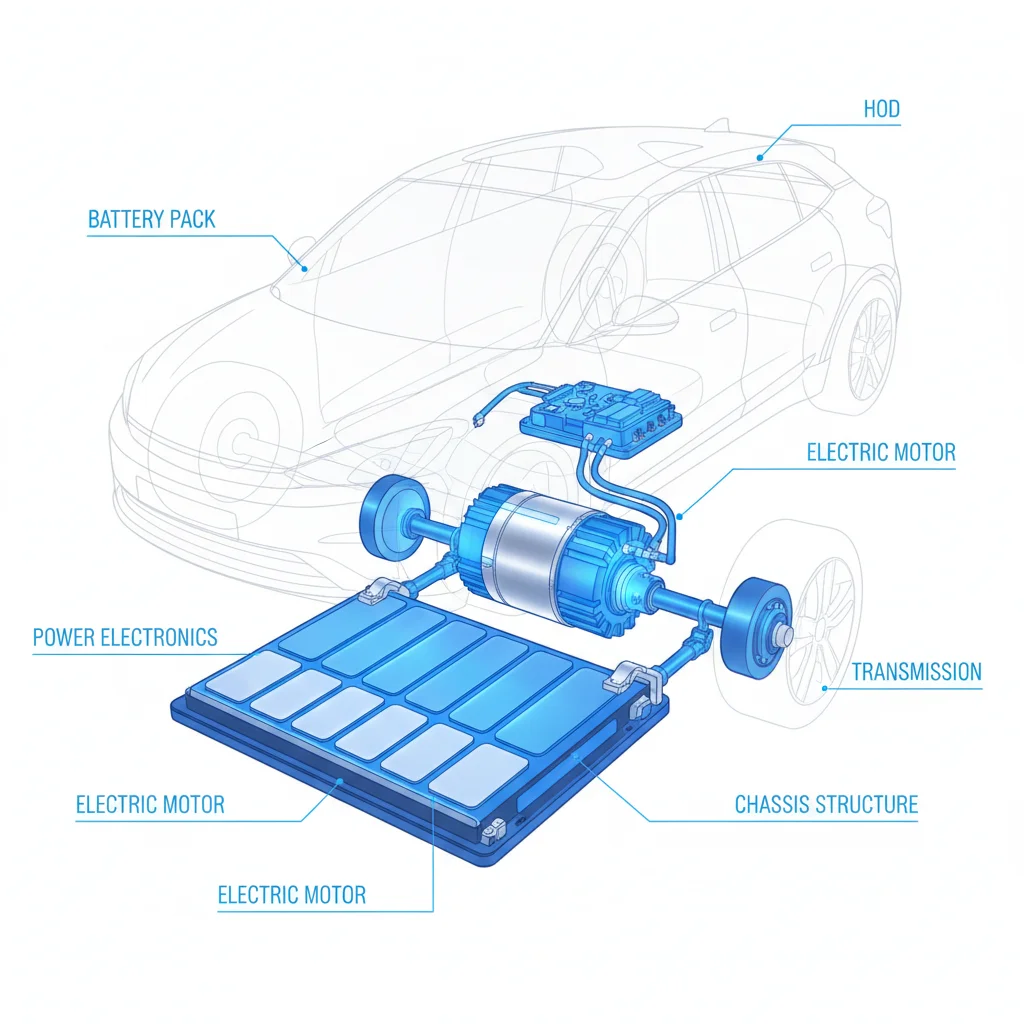
| Energy storage | Fuel tank + fuel pump system | Lithium-ion battery pack (floor-mounted) | |
| Torque delivery | Peak torque at mid-RPM range | Full torque from zero RPM instantly | |
| Exhaust system | Catalytic converter, muffler, tailpipe | None — zero tailpipe emissions | |
| Braking system | Friction brakes only | Regenerative + friction brakes | |
| Oil changes required | Every 5,000–10,000 miles | No engine oil — not applicable | |
| AWD complexity | Transfer case, center diff, driveshaft | Two motors, one per axle — no driveshaft | |
| Spark / ignition system | Spark plugs, coils, starter motor | None required | |
| Typical maintenance cost (150k miles) | $6,000–$12,000+ | $3,000–$6,000 (est.) |
Energy Storage: Fuel Tank vs. Battery Pack
Both systems store the energy that powers the vehicle — and beyond that similarity, they have almost nothing in common.
Fuel Tank and Fuel System
A gas vehicle's fuel system includes the tank, fuel pump, fuel injectors, fuel lines, pressure regulators, and evaporative emissions controls. Fuel pumps are a known maintenance item — they typically last 100,000 miles but fail unpredictably, and replacement runs $400–$900 including labor. Fuel injectors can clog or fail. The entire system is designed around a highly flammable liquid that must be replenished roughly every 300–400 miles.
Battery Pack
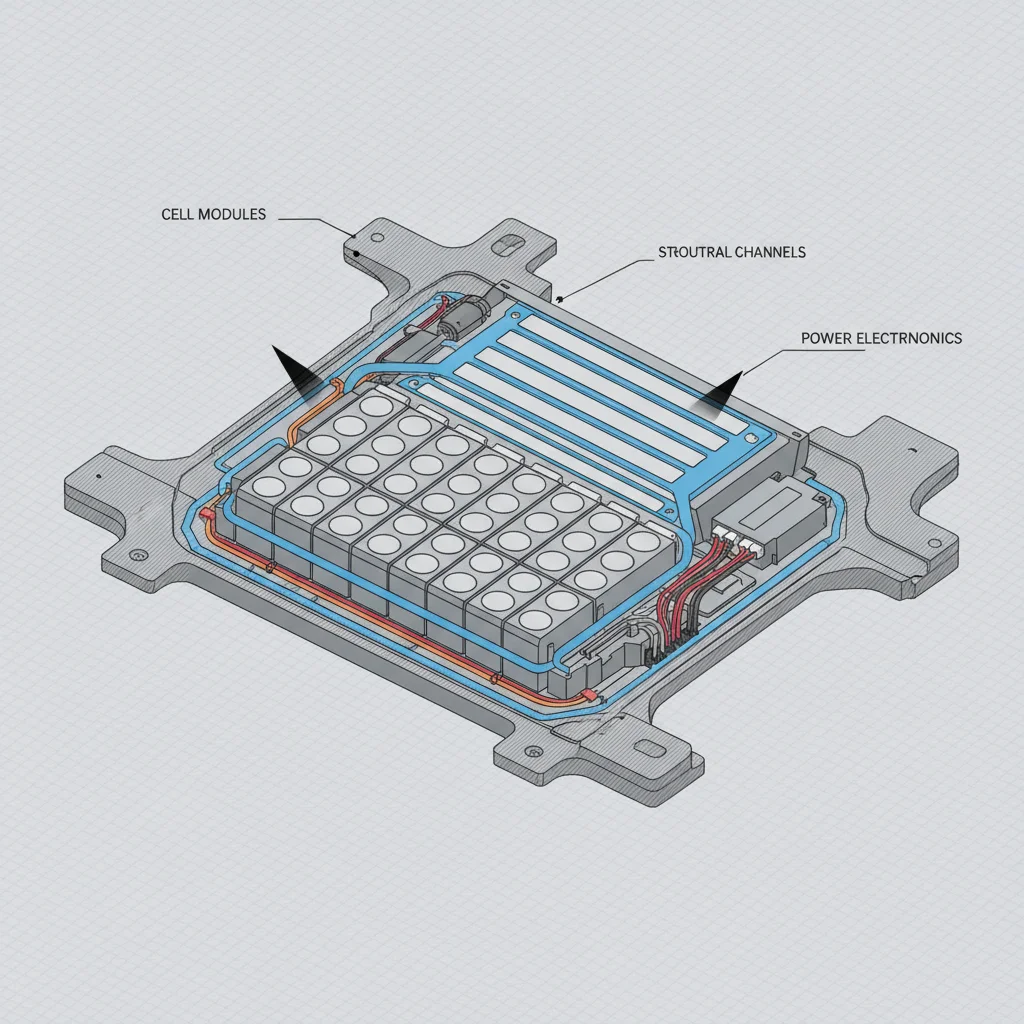
An EV's battery pack is its most expensive single component, typically representing 30–40% of the vehicle's total cost. Modern lithium-ion packs are engineered to last 150,000–200,000 miles or more, and most manufacturers back them with 8-year/100,000-mile warranties. Unlike a fuel tank, the battery doesn't fail suddenly — it degrades gradually, losing a few percentage points of capacity per year under typical use.
Battery degradation is a legitimate ownership consideration. Real-world data from high-mileage EV fleets suggests most packs retain 80–90% capacity after 100,000 miles. Extreme temperatures, frequent DC fast charging, and consistently charging to 100% accelerate degradation. Managed charging habits can significantly extend pack life.
Used EV Battery Risk: Know Before You Buy
If you're buying a used EV, the battery's state of health is the single most important variable — analogous to engine compression on a used gas car. Request a battery health report from the dealer or obtain one through a third-party diagnostic tool. A pack below 75–80% capacity may limit range significantly and could require costly replacement outside the original warranty period. Always check whether the remaining original battery warranty is transferable.
One structural advantage of battery packs: they're mounted low in the floor, which lowers the vehicle's center of gravity and improves handling. This packaging difference also enables the frunk (front trunk) found in many EVs.
What Disappears Entirely: Exhaust, Oil, and More
This is where the EV's mechanical simplicity becomes most tangible. Entire systems that ICE owners deal with routinely simply don't exist in a battery electric vehicle.
Exhaust System
A gas engine produces combustion byproducts — carbon dioxide, water vapor, unburned hydrocarbons, nitrogen oxides — that must be routed safely out of the vehicle. The exhaust system includes the manifold, catalytic converter, oxygen sensors, muffler, and tailpipe. Catalytic converters are expensive (they contain platinum-group metals) and are frequently stolen. Mufflers rust and fail. Oxygen sensors trigger check-engine lights. In a BEV, none of this exists.
Engine Oil and Cooling Complexity
An ICE requires motor oil to lubricate its hundreds of moving metal parts. That oil breaks down, gets contaminated, and must be changed every 5,000–10,000 miles. The cooling system — water pump, radiator, thermostat, coolant hoses — keeps the engine from overheating under load. These are recurring maintenance items that cost real money over time.
EVs do use thermal management systems to regulate battery and motor temperatures, but these are far simpler than ICE cooling systems. There's no oil to change, no timing belt to replace, and no coolant flush schedule tied to combustion heat cycles.
Ignition and Starting Systems
Gas engines require an ignition system — spark plugs, ignition coils, and a starter motor — to initiate combustion. Spark plugs wear and must be replaced on schedule. Ignition coils fail, often intermittently. The starter motor takes abuse every time you turn the key. An electric motor simply spins when current flows. There is nothing to ignite, and no separate starting system required.
Manage Your Battery Like a Long-Term Investment
To maximize battery longevity, keep your daily charge level between 20% and 80% unless you need full range. Avoid frequent DC fast charging if you primarily drive short distances — Level 2 home charging is gentler on cells. Most EV battery management systems include built-in charge limits you can set from the vehicle's touchscreen or companion app.
Factor Maintenance Savings Into Your Purchase Math
When comparing an EV's sticker price to a gas equivalent, run the 5-year total cost of ownership, not just the purchase price. Include projected oil changes, transmission service, spark plugs, and fuel costs for the ICE option. Over 60,000 miles, the maintenance and fuel savings of an EV often close or eliminate a $3,000–$5,000 purchase price gap. Many online calculators can do this math quickly with your local electricity rate.
For the full accounting of what maintenance tasks disappear in an EV versus what stays, why EVs have fewer moving parts and what that means for maintenance covers the complete picture.
Braking: Friction Pads vs. Regenerative Systems
Braking is one area where the EV doesn't just do things differently — it adds a capability that gas cars lack entirely.
Traditional Friction Braking (ICE)
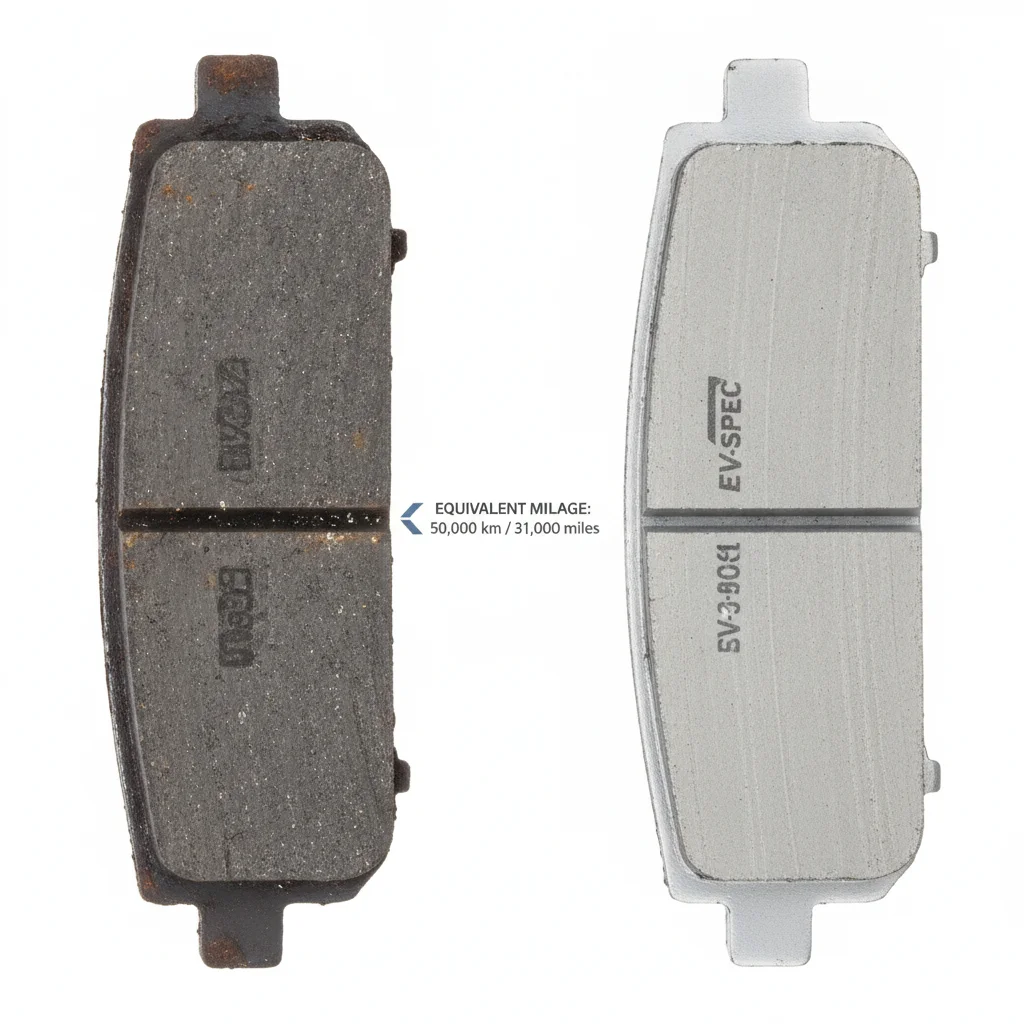
Conventional brakes convert kinetic energy into heat through friction. Brake pads press against rotors, slowing the vehicle. Every stop wears the pads and generates fine particulate dust — a source of air pollution that's only recently drawn regulatory attention. Brake pads on a typical gas car need replacement every 30,000–70,000 miles depending on driving habits.
Regenerative Braking (EV)
When you lift off the accelerator in an EV, the electric motor reverses its role and acts as a generator, slowing the vehicle while converting kinetic energy back into electricity stored in the battery. This is regenerative braking. In aggressive regeneration modes (often called one-pedal driving), many EV drivers rarely touch the friction brakes in normal city driving.
The practical result: EV brake pads last dramatically longer than those on gas cars. Some EV owners go 100,000 miles or more before needing brake service. The rotors can actually develop surface rust from disuse — a cosmetic issue rather than a functional one for most drivers.
Regenerative braking also contributes to the EV efficiency advantage in stop-and-go traffic. Where a gas engine wastes energy as heat at every stop sign, an EV recovers a portion of it.
Drive Layout and Power Delivery: What Changes Without an Engine
The physical packaging of an electric drivetrain opens up possibilities that are mechanically impossible with a combustion engine.
ICE Drive Layouts
In a front-engine, rear-wheel-drive car, a driveshaft runs the length of the vehicle to deliver power to the rear axle. Front-wheel-drive layouts use a transaxle that combines the transmission and differential. All-wheel drive on an ICE vehicle requires a transfer case, additional driveshafts, and often a center differential — significant mechanical complexity that adds weight and cost.
EV Motor Placement Flexibility
Electric motors are compact and can be placed almost anywhere in the vehicle. A single-motor EV typically mounts the motor at one axle. A dual-motor AWD EV puts one motor on each axle — no driveshaft connecting them, no transfer case, no center differential. Each motor independently drives its axle, enabling torque vectoring precision that ICE AWD systems can only approximate.
Some EVs go further with quad-motor setups that independently control each wheel. The performance and traction control implications are significant. How FWD, RWD, and AWD work differently in EVs explains the full layout picture.
This packaging flexibility also means EVs can be designed with a flat floor (no transmission tunnel), more interior space relative to exterior dimensions, and frunk storage — all byproducts of what the drivetrain doesn't need.
Long-Term Cost Implications: What the Component Differences Actually Cost You
Component differences aren't just mechanical trivia — they translate directly into your ownership costs over time.
Scheduled Maintenance
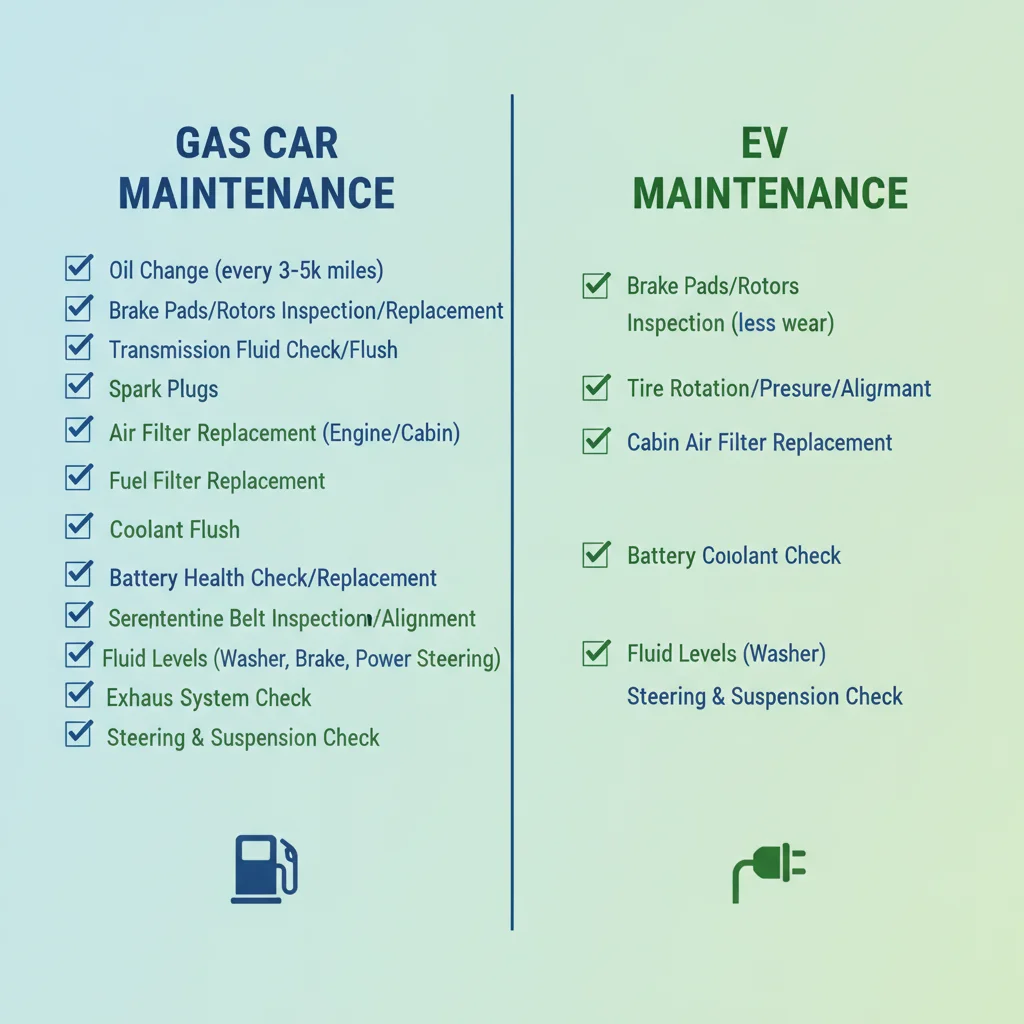
A gas vehicle's scheduled maintenance includes oil changes, transmission fluid, spark plugs, air filters, fuel filters, timing belt/chain service, coolant flushes, and more. Over 150,000 miles, these costs typically add up to $6,000–$12,000 depending on the vehicle and service interval discipline.
A BEV's scheduled maintenance is largely limited to tire rotations, cabin air filter replacements, brake fluid checks (less frequently needed), and battery coolant service on some models. Consumer Reports data consistently shows EV owners spend roughly half what ICE owners spend on maintenance and repairs over comparable ownership periods.
Repair Risk
Fewer moving parts means fewer things can break unexpectedly. The ICE powertrain's complexity — timing chains, water pumps, alternators, starter motors, oxygen sensors, EGR valves — creates dozens of potential failure points that don't exist in a BEV. The primary repair risk unique to EVs is the battery pack, which is expensive to replace if it fails outside warranty. Buying a used EV with a worn battery is a meaningful financial risk; buying a used ICE vehicle with a worn transmission is a comparable one.
Fuel vs. Electricity
At average US electricity rates (~$0.16/kWh) and a typical EV efficiency of 3–4 miles per kWh, electricity costs roughly $0.04–$0.05 per mile. At $3.50/gallon and 30 MPG, gasoline costs about $0.12 per mile. The energy cost advantage of electricity is roughly 60–70% per mile for most drivers — though this varies significantly by region, electricity rate plan, and whether you charge at home or on public networks.
For the full side-by-side maintenance cost comparison, EV vs. gas car maintenance: a full cost and task breakdown walks through each category in detail. And if you're weighing BEV against PHEV or HEV options, maintenance differences between BEVs, PHEVs, and HEVs over time covers how the savings vary by powertrain type.
Manage Your Battery Like a Long-Term Investment
To maximize battery longevity, keep your daily charge level between 20% and 80% unless you need full range. Avoid frequent DC fast charging if you primarily drive short distances — Level 2 home charging is gentler on cells. Most EV battery management systems include built-in charge limits you can set from the vehicle's touchscreen or companion app.
Factor Maintenance Savings Into Your Purchase Math
When comparing an EV's sticker price to a gas equivalent, run the 5-year total cost of ownership, not just the purchase price. Include projected oil changes, transmission service, spark plugs, and fuel costs for the ICE option. Over 60,000 miles, the maintenance and fuel savings of an EV often close or eliminate a $3,000–$5,000 purchase price gap. Many online calculators can do this math quickly with your local electricity rate.
The EV maintenance basics hub is a good starting point if you want to build out a complete picture of what EV ownership actually requires.

All claims are backed by peer-reviewed research. Sources on request.