Key Takeaways
Electric Motor (EV)
An electric motor is the device in an EV that converts electrical energy from the battery into rotational mechanical force — which is what actually spins the wheels. It works by using electromagnetism: electrical current flowing through copper windings creates a magnetic field that pushes and pulls against a spinning core called the rotor. There are no pistons, no combustion, and no multi-speed transmission required for most EVs.
Most modern EVs use a three-phase AC induction motor or a permanent-magnet synchronous motor (PMSM). The battery stores DC power, but an inverter converts it to AC before it reaches the motor — a distinction that matters for understanding peak torque and efficiency curves.
The Basic Principle: Magnetism Meets Motion
Understanding an electric motor doesn't require an engineering degree. It requires understanding one concept: opposite magnetic poles attract, and like poles repel. That push-and-pull is exactly what makes an EV move.
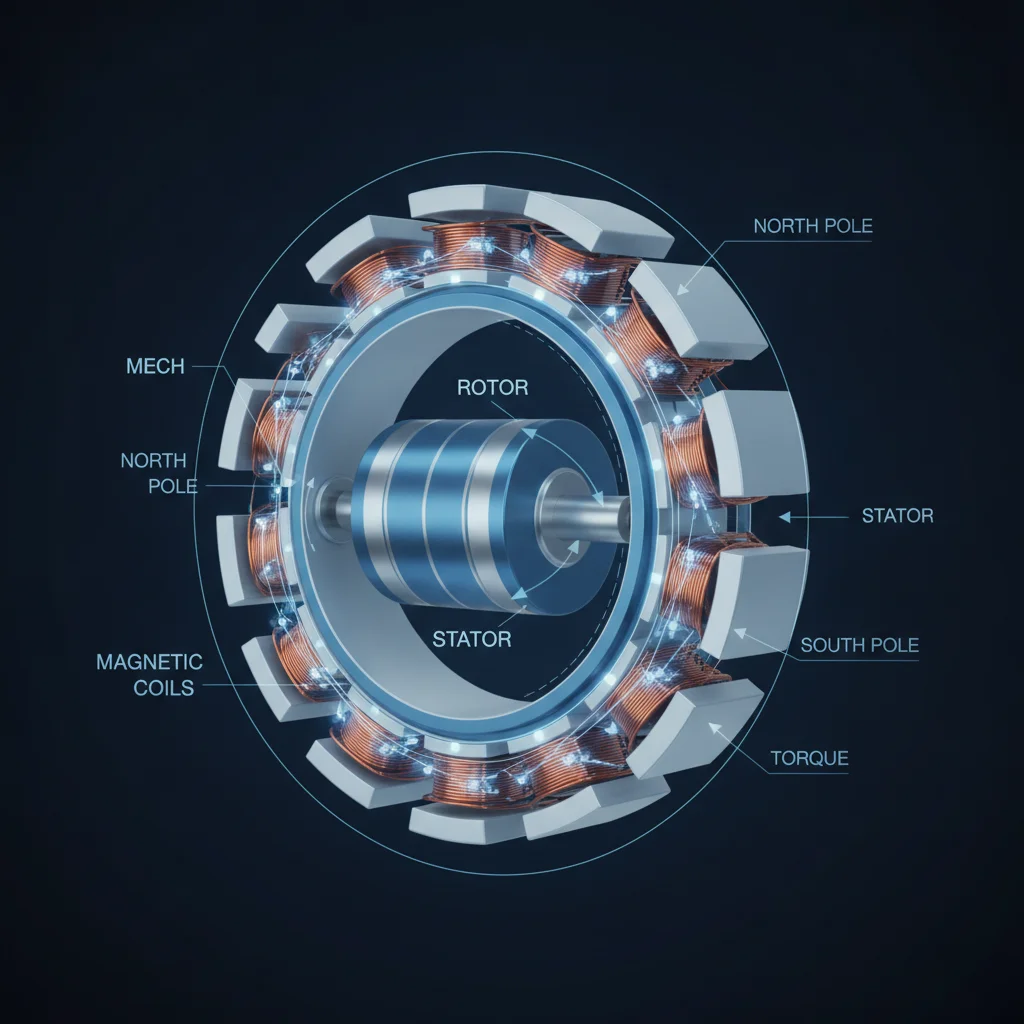
Every electric motor has two fundamental parts. The stator is the fixed outer shell wrapped in copper wire coils. The rotor is the spinning inner core. When electrical current flows through the stator's coils, it creates a rotating magnetic field. That field exerts force on the rotor, pulling it around in a continuous circle. The rotor's shaft connects to the drivetrain, and the drivetrain turns the wheels.
That's it. No fire, no explosions, no 2,000 moving parts. A single rotating magnetic field converts electricity into motion with remarkable directness.
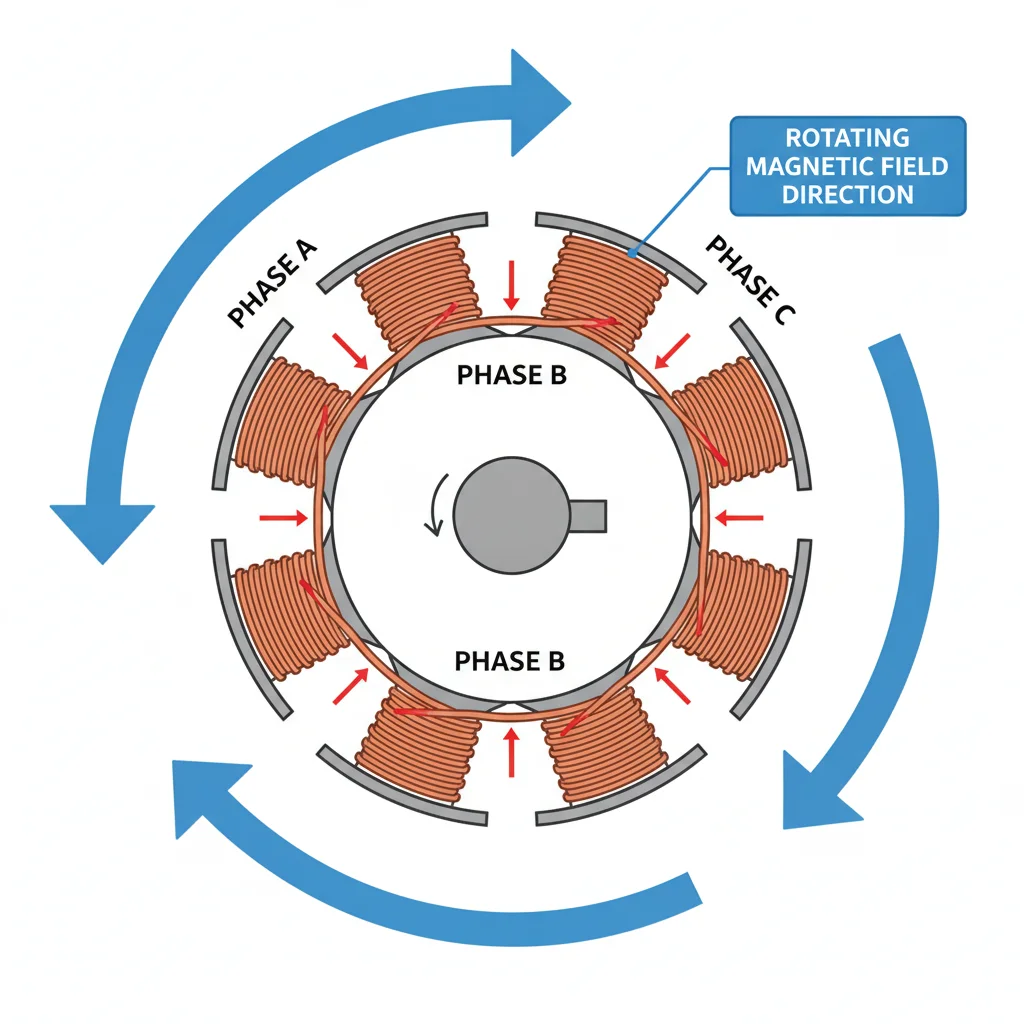
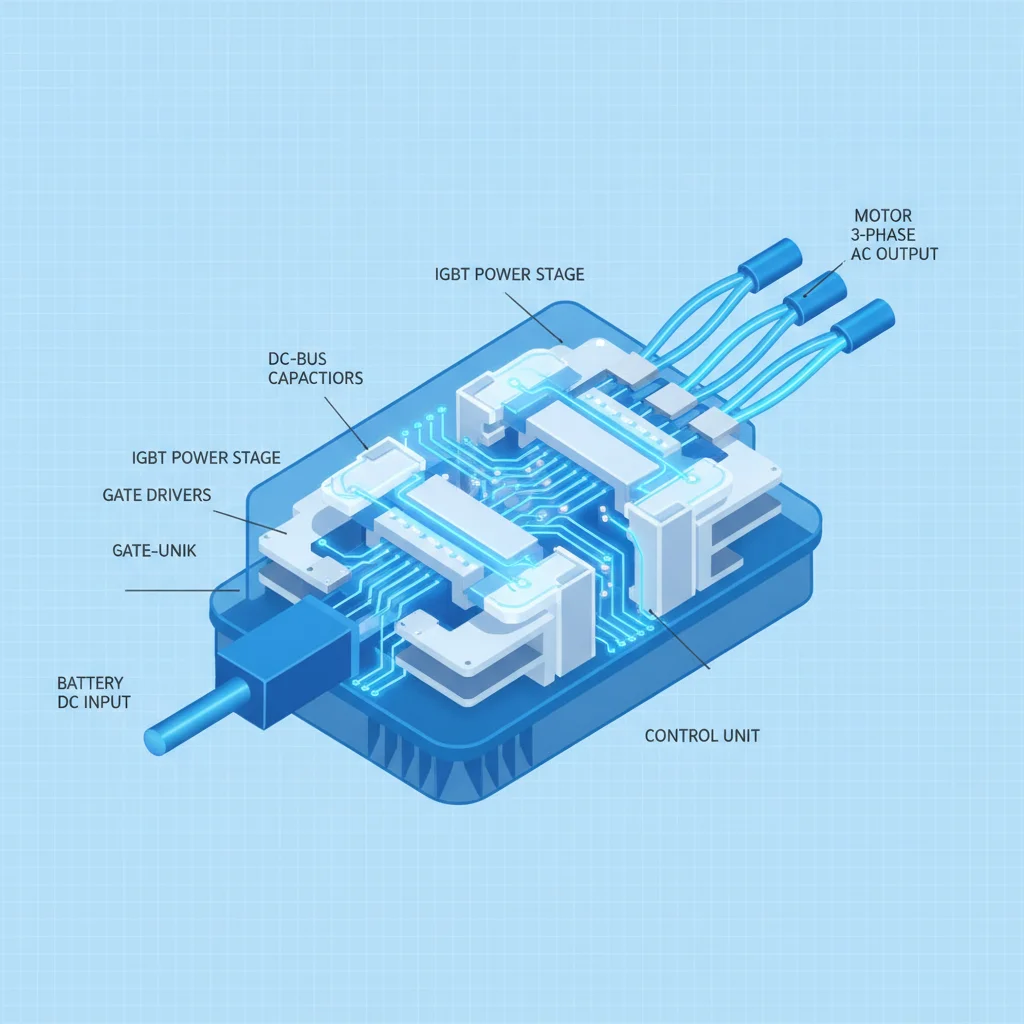
The speed of the motor is controlled by varying the frequency of the alternating current (AC) fed into the stator coils — faster frequency, faster rotation. This is the job of the inverter, a component that works in lockstep with the motor. For a deeper look at that relationship, see how the inverter translates battery power into motor motion.
The Two Motor Types You'll Encounter in Real EVs
Walk the EV market and you'll encounter two dominant motor architectures. Each has genuine strengths, and knowing the difference helps you read spec sheets with confidence.
Induction Motors (AC Induction)
Tesla's Model S and Model X rear motors are the most prominent examples. An induction motor has no permanent magnets — the rotor's magnetism is induced by the rotating field in the stator. Current flows into the rotor via electromagnetic induction, creating temporary poles that chase the stator's rotating field.
- Advantages: Robust, relatively inexpensive to manufacture, no rare-earth materials, handles high RPM well.
- Drawbacks: Less efficient at partial loads because the rotor always has some induced losses; generates more heat at sustained high output.
Permanent-Magnet Synchronous Motors (PMSM)
The majority of new EVs — including most from GM, Ford, Hyundai, Kia, BMW, and Tesla's front motors — use PMSMs. Fixed permanent magnets are embedded in the rotor. The stator's rotating field locks onto those magnets and pulls them around in synchrony.
- Advantages: Higher efficiency across a broad operating range; compact and lightweight for the torque they produce; excellent low-speed performance.
- Drawbacks: Relies on rare-earth elements like neodymium; can experience magnetic losses at very high temperatures; generally costs more to produce.
“The electric motor is one of the most efficient machines humanity has ever built. The efficiency of conversion from electrical energy to mechanical motion is extraordinary compared to any combustion process — and that efficiency advantage compounds across the entire life of the vehicle.”
— Amory Lovins, Co-founder and Chief Scientist, Rocky Mountain Institute; energy and transportation researcher
Some manufacturers — notably Tesla in the Model 3 — combine both types in a dual-motor setup: a PMSM up front for efficiency during normal driving, and an induction motor in the rear for sustained high-power output. It's a pragmatic engineering choice that gets the best from both architectures.
Why EVs Have Instant Torque — and What It Means for You
You've probably heard that EVs have "instant torque." That's not marketing language — it's a mechanical reality, and it has direct implications for how the car feels to drive.
In a combustion engine, peak torque arrives in a narrow RPM band. You have to rev the engine to get into that band, which takes time. An electric motor produces its maximum torque at zero RPM — the moment current flows, force is generated. There is no delay, no clutch engagement, no gear hunting.
100%
Torque available at 0 RPM in electric motors
Unlike combustion engines, which peak torque occurs mid-RPM range, electric motors deliver full rated torque the instant current flows — a fundamental physics advantage.
~90%
Average electric motor efficiency rating
The U.S. Department of Energy notes that electric motors convert roughly 85–95% of electrical energy into mechanical energy, compared to about 20–40% for internal combustion engines.
Up to 30%
Energy recovered via regenerative braking in city driving
Studies by the Idaho National Laboratory and others suggest regen systems can recover between 10% and 30% of energy in urban stop-and-go driving conditions, depending on aggressiveness settings.
~20
Moving parts in an EV motor vs. hundreds in an ICE
Industry comparisons consistently show electric drivetrains have dramatically fewer mechanical components than combustion engines, directly reducing maintenance frequency and failure points.
For everyday driving, this means smooth, immediate acceleration from traffic lights and confident merging on highways. For performance-oriented buyers, it means supercar-level 0–60 times from vehicles that cost less than a luxury sedan. For practical buyers, it translates to responsive, low-effort city driving.
Test Instant Torque Before You Decide
During any EV test drive, pay attention to how the car responds from a complete stop at a traffic light. Press the accelerator with moderate, steady pressure — not floored, just normal intent. The immediate, seamless surge you feel is the motor's full torque at zero RPM. If you find it unsettling, look for EVs with adjustable acceleration modes that soften the response curve.
Ask About Motor Cooling at the Dealership
Not all EV motors are cooled the same way. Liquid-cooled motors handle sustained high-output driving better than air-cooled designs, which matters if you tow, drive mountain grades frequently, or use public DC fast chargers regularly. Ask the salesperson specifically whether the motor and inverter use a liquid thermal management system — it's a detail that affects real-world durability.
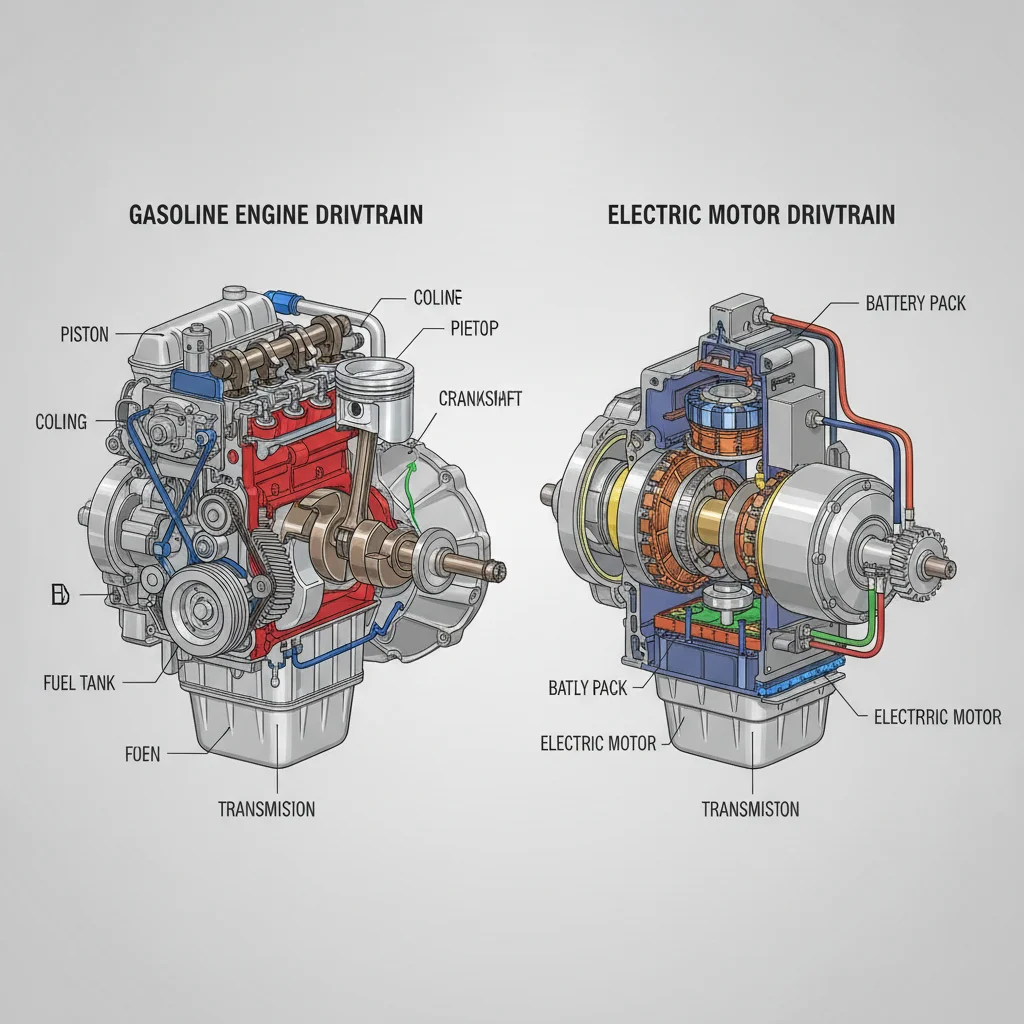
The flip side: electric motors also have an upper RPM limit where torque tapers off. Most manufacturers tune this range carefully. A single-speed reduction gear — typically a fixed ratio between the motor and the axle — bridges the gap between motor RPM and wheel speed, keeping the motor in its efficiency sweet spot across most driving scenarios. This is a key reason why the EV drivetrain looks so different from a gas-powered one when you compare them side by side.
Regenerative Braking: The Motor Working Backwards
One of the most practically useful features of an electric motor is something that happens when you're slowing down, not speeding up.
When you lift your foot off the accelerator, the control system can switch the motor from consuming electricity to producing it. The spinning wheels now drive the rotor, which induces current in the stator coils. That current flows back toward the battery through the inverter. The physical drag this creates is what slows the car — and the energy recaptured reduces the net drain on your battery pack.
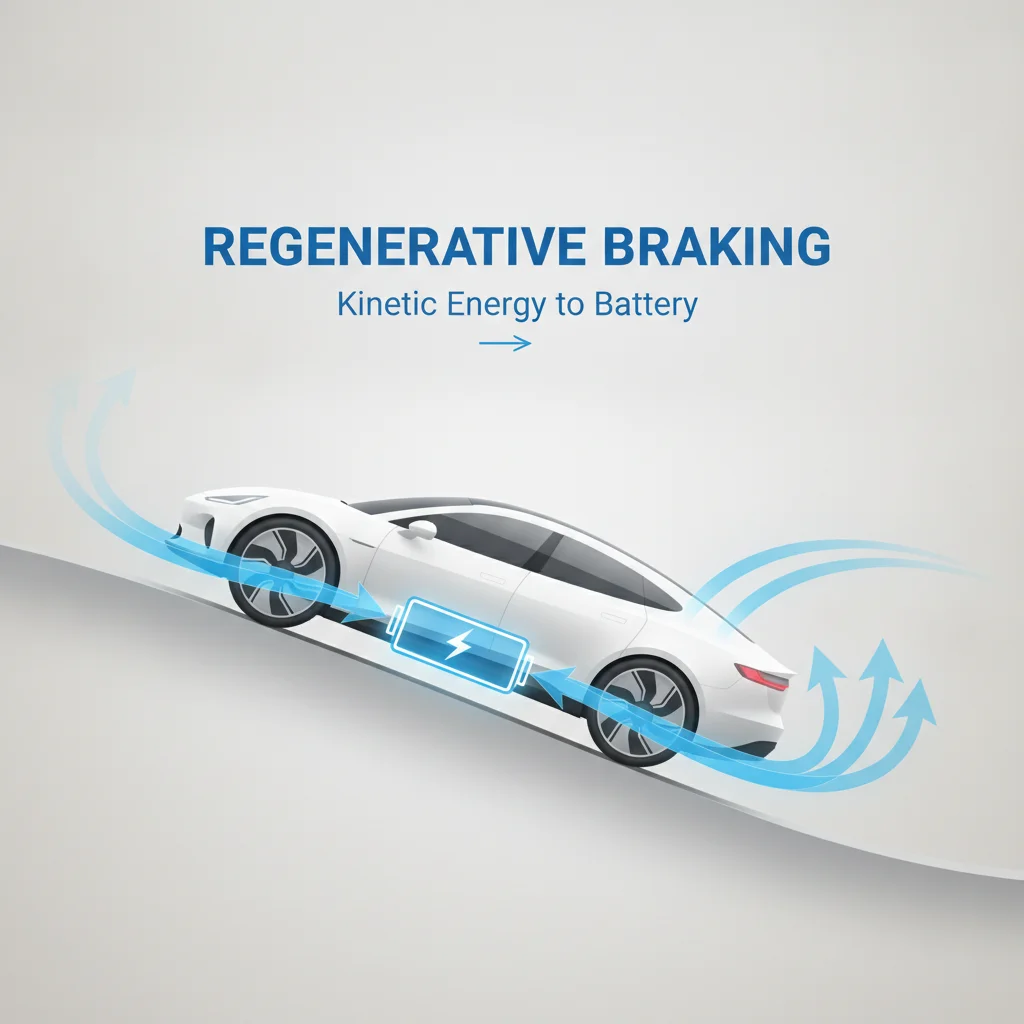
Depending on driving conditions, regenerative braking can recover a meaningful percentage of energy that would otherwise be lost as heat through conventional friction brakes. City driving — with its frequent stop-and-go cycles — benefits most. Highway driving at steady speed generates little regen opportunity.
Why the Battery Stores DC but the Motor Uses AC
Lithium-ion battery packs store and deliver direct current (DC). Most electric motors run on alternating current (AC). The inverter — a box of high-speed power electronics — bridges that gap by converting DC to AC and controlling the frequency to regulate motor speed. Without the inverter, the battery and motor couldn't communicate. This is why inverter quality is a real performance variable, not just a footnote in the spec sheet.
One-Pedal Driving Takes a Few Days to Adjust To
If you're coming from a gas car, strong regenerative braking feels unusual at first — the car decelerates more aggressively than you expect when you lift off the accelerator. Most owners report adapting within a week of daily driving. Stick with it: once it becomes natural, you'll use the brake pedal primarily for emergency stops, which extends brake pad life significantly.
Most EVs let you adjust regenerative braking intensity. At its strongest setting ("one-pedal driving"), lifting the accelerator brings the car nearly to a full stop without touching the brake pedal. At lighter settings, the car coasts more freely, similar to a gas vehicle in neutral. Preferences vary — try both modes during a test drive before committing to a purchase.
Dual Motors, AWD, and Performance: How It Scales Up
One of the cleanest engineering advantages of electric motors is how naturally they scale. Adding all-wheel drive to a combustion vehicle requires a driveshaft, transfer case, differentials, and a complex set of mechanical linkages. In an EV, AWD means adding a second motor.
Dual-motor EVs place one motor on the front axle and one on the rear. Each drives its wheels independently, with no mechanical connection between them. The vehicle's torque vectoring software coordinates power delivery between the two motors in milliseconds — faster and more precisely than any mechanical differential can manage.
- Traction benefit: Either axle can compensate instantly if the other loses grip, making dual-motor EVs genuinely capable in snow and rain.
- Performance benefit: Combined output of two motors dramatically raises peak power without requiring a turbocharged engine or complex powertrain.
- Efficiency trade-off: Two motors mean two sets of power electronics, more mass, and slightly higher energy draw at highway cruise. Manufacturers mitigate this by deactivating one motor at steady speed and re-engaging it when needed.
For buyers evaluating whether to pay the premium for a dual-motor trim, the real question is: do you need consistent traction in challenging weather, or do you want maximum performance? Either justification is legitimate. If your driving is mostly highway commuting in mild climates, the single-motor variant may serve you just as well for less money.
What This Means for Maintenance and Long-Term Costs
The mechanical simplicity of an electric motor has a direct line to your maintenance budget. A combustion engine has hundreds of moving parts — valves, pistons, connecting rods, camshafts, timing chains, and an exhaust system that spans the length of the car. An electric motor's rotating assembly is essentially a shaft with a rotor attached.
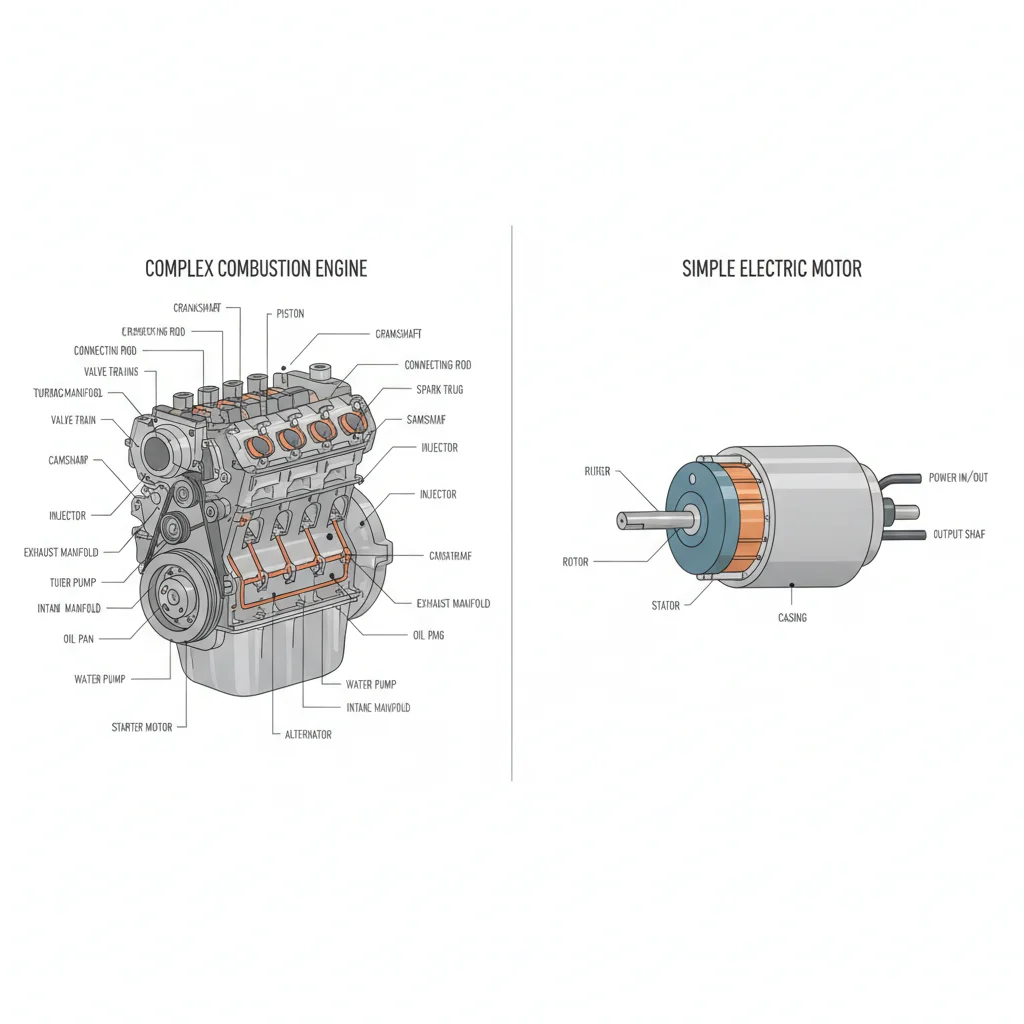
There is no oil to change in the motor itself (though some reduction gearboxes use a small volume of gear oil, typically inspected every 50,000–100,000 miles). No spark plugs. No belts. No catalytic converter. No exhaust system. The friction brakes last longer too, because regenerative braking handles the majority of deceleration.
Why the Battery Stores DC but the Motor Uses AC
Lithium-ion battery packs store and deliver direct current (DC). Most electric motors run on alternating current (AC). The inverter — a box of high-speed power electronics — bridges that gap by converting DC to AC and controlling the frequency to regulate motor speed. Without the inverter, the battery and motor couldn't communicate. This is why inverter quality is a real performance variable, not just a footnote in the spec sheet.
One-Pedal Driving Takes a Few Days to Adjust To
If you're coming from a gas car, strong regenerative braking feels unusual at first — the car decelerates more aggressively than you expect when you lift off the accelerator. Most owners report adapting within a week of daily driving. Stick with it: once it becomes natural, you'll use the brake pedal primarily for emergency stops, which extends brake pad life significantly.
What does require attention over time are the bearing seals in the motor, the coolant loop that manages motor temperature (most EV motors are liquid-cooled), and the reduction gear lubricant. These are measured in years and tens of thousands of miles, not the quarterly intervals of engine oil. For a full picture of what EV ownership actually costs to maintain, see EV maintenance basics.
The bottom line: lower maintenance complexity is a genuine long-term financial advantage of EV ownership, not just a talking point. The motor is one of the most reliable components on the vehicle — and understanding how it works helps you evaluate that claim rather than just taking it on faith.
Putting It All Together Before You Buy
You don't need to memorize the difference between induction and permanent-magnet motors to make a smart EV purchase. But knowing the basics changes what you look for in a spec sheet and what questions you ask at the dealership.
When you see a 0–60 time, you now know it's a product of peak torque delivered instantly from the motor — not engine displacement. When you see "dual motor AWD," you understand that's two separate drive systems coordinated by software, not a mechanical transfer case. When a salesperson mentions "one-pedal driving," you know that's regenerative braking intensity, not a gimmick.
Test Instant Torque Before You Decide
During any EV test drive, pay attention to how the car responds from a complete stop at a traffic light. Press the accelerator with moderate, steady pressure — not floored, just normal intent. The immediate, seamless surge you feel is the motor's full torque at zero RPM. If you find it unsettling, look for EVs with adjustable acceleration modes that soften the response curve.
Ask About Motor Cooling at the Dealership
Not all EV motors are cooled the same way. Liquid-cooled motors handle sustained high-output driving better than air-cooled designs, which matters if you tow, drive mountain grades frequently, or use public DC fast chargers regularly. Ask the salesperson specifically whether the motor and inverter use a liquid thermal management system — it's a detail that affects real-world durability.
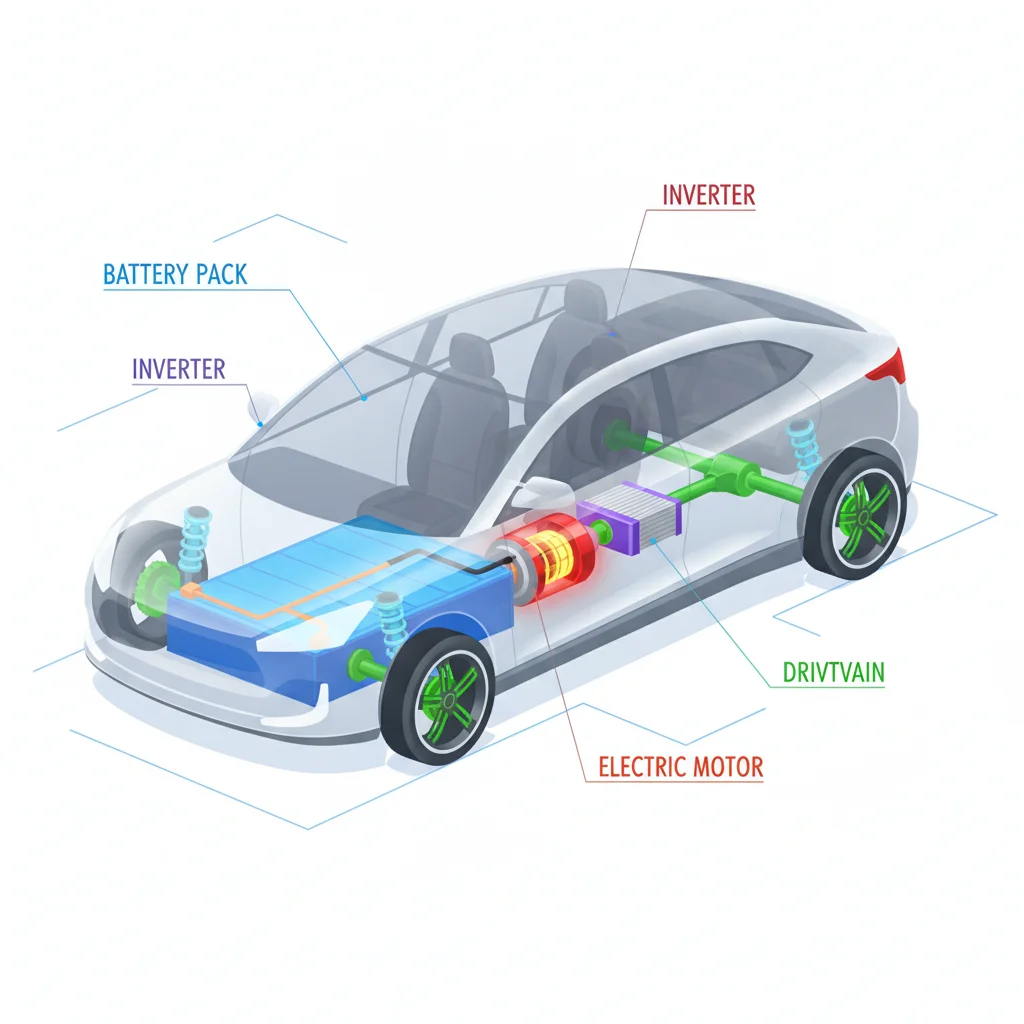
The larger context — how the motor fits into the full EV powertrain alongside the battery pack and inverter — is worth understanding before you sign anything. The EV mechanics guide for first-time buyers covers every major component in sequence. And if you want to understand exactly how the battery feeds that motor, how a battery electric vehicle powers itself is the logical next read.
The electric motor is, in many ways, the cleanest argument for EVs: fewer parts, immediate response, and a physics lesson you can feel every time you pull away from a light. That's not nothing when you're deciding where to put your money.

All claims are backed by peer-reviewed research. Sources on request.