Key Takeaways
Our Verdict
BEVs offer the lowest long-term maintenance burden and cost, particularly for high-mileage drivers who can charge at home. PHEVs sit in a complex middle ground — they reduce fuel costs but add mechanical complexity that erodes some of those savings. HEVs remain the most familiar to service, but their cumulative maintenance costs over 10+ years are meaningfully higher than a BEV's.
| Best for | Recommended |
|---|---|
| High-mileage commuters wanting the lowest service costs over time | BEV |
| Drivers who need range flexibility but want some electric efficiency | PHEV |
| Buyers who want familiar ownership and minimal behavior change | HEV |
| Those working within strict time or cost constraints for service | HEV |
What Actually Changes When You Electrify a Powertrain
The biggest misconception about electrified vehicles is that "electric" is a monolithic category. It isn't. A battery-electric vehicle (BEV), a plug-in hybrid (PHEV), and a conventional hybrid (HEV) share some DNA — but they have fundamentally different maintenance profiles that diverge more over time, not less.
The core reason: fewer combustion components means fewer things that wear, leak, or fail on a predictable schedule. Every time you remove an oil pan, a timing belt, or a multi-speed transmission from the equation, you subtract a maintenance line item. BEVs go furthest down that path. PHEVs go partway. HEVs make the smallest structural change from a conventional gas car.
To understand how each powertrain type works mechanically, it helps to know what's actually spinning under the hood — because that directly determines what a technician will need to touch over 100,000 miles.
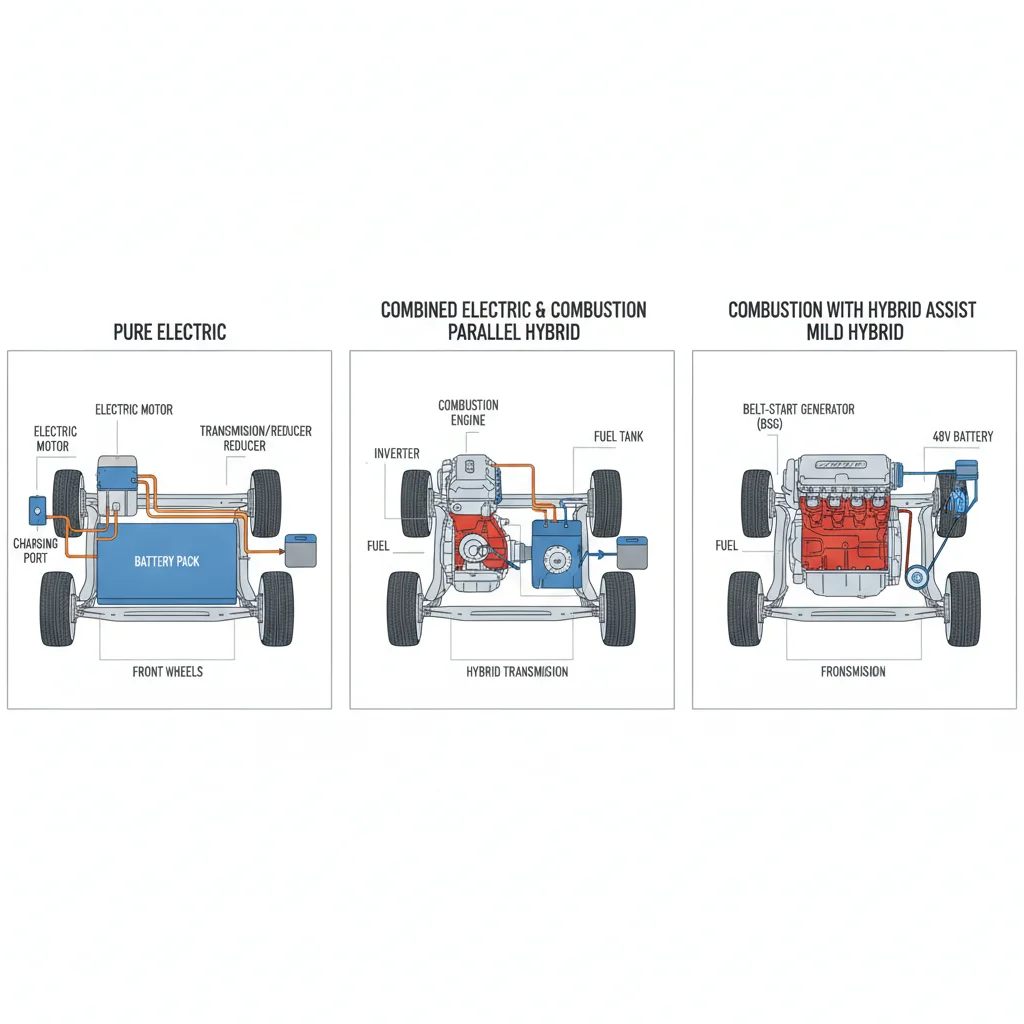
Here's the hierarchy in plain terms:
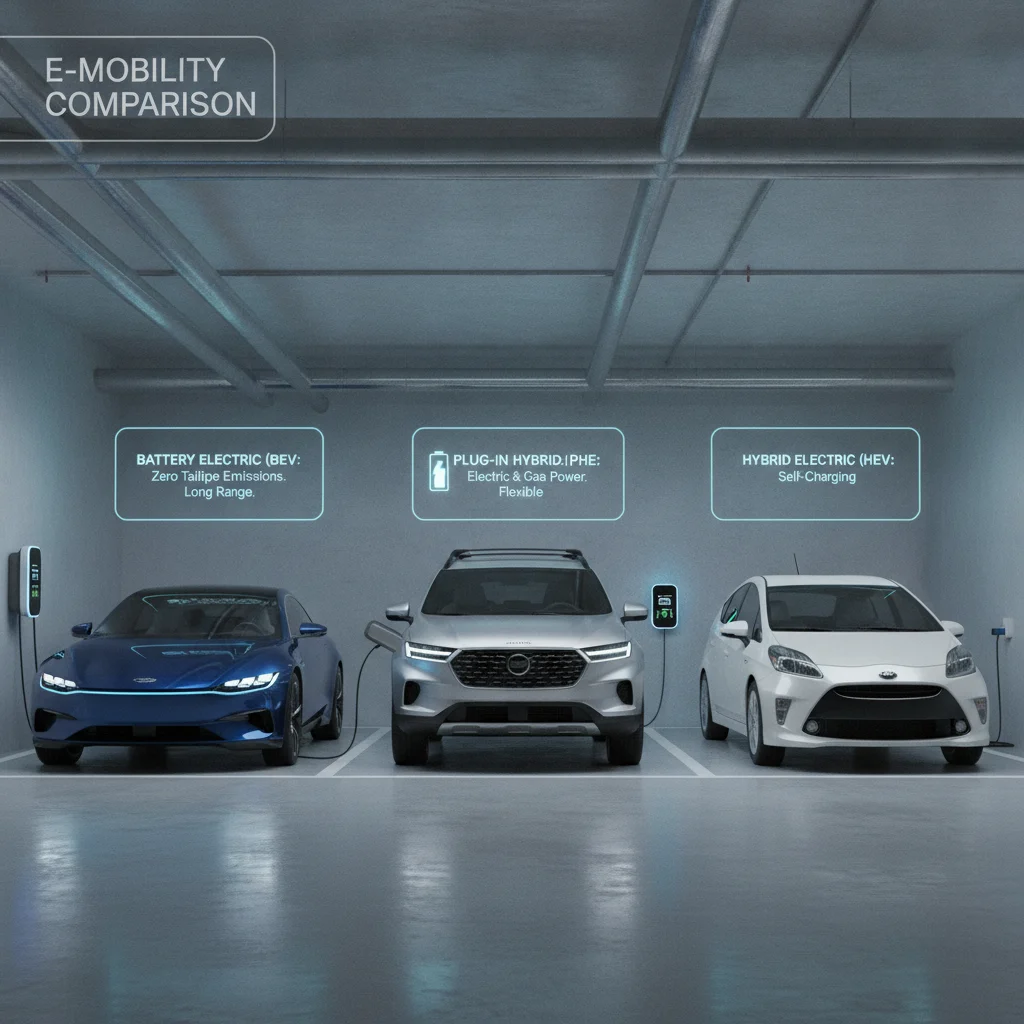
- BEV: Electric motor only. No combustion engine, no multi-gear transmission, no exhaust, no oil changes.
- PHEV: Electric motor plus a full combustion engine, a smaller battery that can be externally charged, and often a conventional automatic transmission. Full maintenance from both worlds.
- HEV: Combustion engine with an electric assist motor and a self-charging battery. No plug, but the electric system reduces strain on the gas engine.
BEV Maintenance: What You Lose, What Remains
A battery-electric vehicle eliminates an entire category of scheduled maintenance. There is no engine oil to change, no transmission fluid on most models, no coolant flush for an internal combustion system, no spark plugs, no timing belts or chains, and no exhaust system. For a high-mileage driver doing 15,000–20,000 miles per year, those line items add up fast on a conventional car. On a BEV, they simply don't exist.
What BEV owners do pay for:
- Tires: EVs are heavier than equivalent gas cars — often 10–20% heavier — due to battery packs. That extra weight, combined with the instant torque that encourages aggressive acceleration, accelerates tire wear. Budget for rotation every 5,000–7,500 miles and full replacement potentially sooner than you'd expect on a gas car.
- Brake fluid: Hydraulic brake fluid absorbs moisture over time and should still be tested or replaced every 2–3 years, even with light brake use.
- Cabin air filter: Standard replacement item, same as any car.
- Wiper blades and washer fluid: No change here.
- Battery thermal management system: Coolant used to manage battery temperature does require periodic inspection and, eventually, replacement — though intervals vary widely by manufacturer.
- Software updates: Many BEVs deliver OTA (over-the-air) updates, but some require dealer visits for more complex updates or module replacements.
The single largest wildcard for BEV owners is battery degradation. Most batteries lose some capacity over time — typically 2–3% per year under normal conditions — and eventual battery pack service or replacement is a real cost, though still rare before 150,000–200,000 miles on modern packs. Most manufacturers back their packs with an 8-year/100,000-mile warranty.
Use Regenerative Braking Aggressively
On any electrified vehicle — BEV, PHEV, or HEV — maximizing your use of regenerative braking directly extends brake pad life and reduces the cost of one of the most common maintenance items. Where available, select the highest regen setting and train yourself to lift off the accelerator early rather than coasting to brakes. Over 50,000 miles, this habit can save you $400–$800 in brake service costs.
Match Your Powertrain to Your Real Mileage
The maintenance savings of a BEV compound with mileage. If you drive 12,000 miles or fewer per year, the annual dollar difference versus an HEV may be smaller than you expect — and factors like charging convenience or purchase price may matter more. Run the numbers for your actual driving pattern before assuming a BEV automatically wins on cost.
Brakes are a major bright spot. Regenerative braking handles most of the deceleration load on a BEV, which means brake pads and rotors can last dramatically longer — sometimes two to three times longer than on a conventional vehicle. See our full breakdown of what EV maintenance still covers for more detail.
40%
Lower maintenance cost for BEVs vs. gas cars
Consumer Reports data found BEV owners spend roughly 40% less on maintenance and repairs than conventional gas car owners over comparable mileage.
$0.06/mile
Average BEV maintenance cost per mile
AAA's annual 'Your Driving Costs' study estimates battery-electric vehicles average around $0.06 per mile in maintenance — versus $0.10 for the average new gas car.
2–3x
Longer brake life on electrified vehicles
Regenerative braking systems on BEVs, PHEVs, and HEVs can extend brake pad life two to three times compared to conventional vehicles, according to industry service data.
8 yrs / 100K mi
Federal EV battery warranty minimum
U.S. federal law requires automakers to warranty BEV and PHEV battery packs for at least 8 years or 100,000 miles, providing a meaningful cost backstop for buyers.
$1,200+
Annual maintenance savings, BEV vs. HEV (high mileage)
For drivers logging 20,000+ miles annually, the cumulative elimination of oil changes, tune-ups, and exhaust service can exceed $1,200 per year in BEV savings versus an HEV.
PHEV Maintenance: The Dual-Powertrain Tax
Plug-in hybrids are arguably the most complex vehicles to maintain over time. You're not eliminating the combustion engine's maintenance burden — you're keeping it and adding an additional high-voltage electrical system on top. That means two sets of consumables, two sets of fluids, and two sets of potential failure modes.
PHEV owners still deal with:
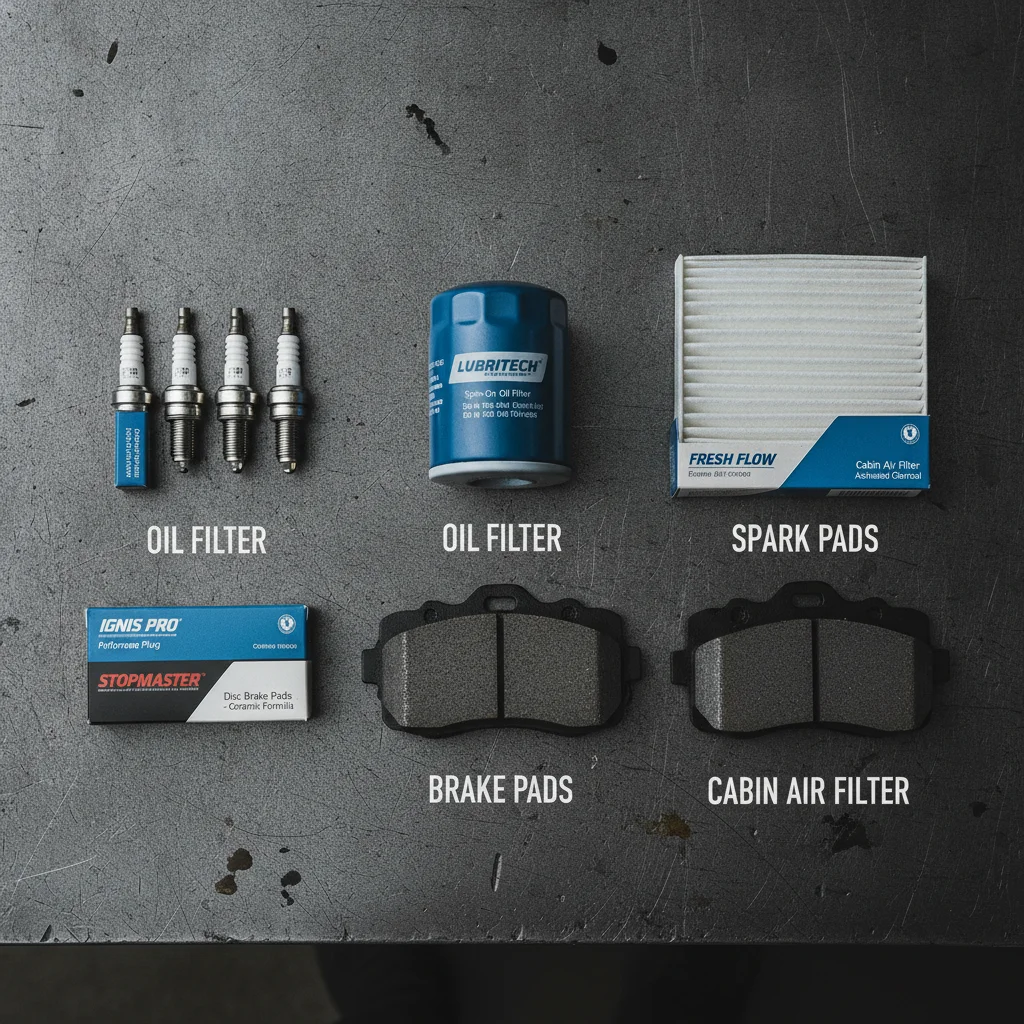
- Engine oil changes: Required, same as a gas car, though some owners find they can stretch intervals slightly if most driving is done on electric power.
- Transmission service: Most PHEVs use a conventional automatic or CVT. These require periodic fluid checks and eventual service.
- Spark plugs: Required on schedule, same as a gas vehicle.
- Coolant flushes: Both the engine cooling system and the battery thermal system need attention.
- Exhaust system: Catalytic converters and oxygen sensors remain in play.
PHEV Owners: Don't Neglect the Gas Engine
If you drive your PHEV primarily on electric power and rarely engage the combustion engine, you risk stale fuel, dried seals, and incomplete lubrication cycles in the gas engine. Most manufacturers recommend running the combustion engine at least periodically — check your owner's manual for specific guidance. Neglecting this can lead to expensive repairs that defeat the cost-savings purpose of the vehicle.
Complexity Is a Long-Term Risk Factor
PHEVs in particular carry more system complexity than either BEVs or HEVs — high-voltage battery packs, full combustion engines, and complex transmission systems all operating together. While modern PHEVs are reliable, more components mean more potential failure points over a 10–15 year ownership horizon. If long-term simplicity and low repair risk are priorities, a BEV or a proven HEV platform will generally be more predictable.
There is one notable risk for PHEV owners who do most of their driving on electric power: the combustion engine can go long stretches without running. While this sounds good, it can cause issues — gasoline goes stale, seals can dry out, and the engine's self-lubrication cycle may not complete properly. Running the engine regularly — even if just on a highway trip — is important maintenance in itself.
On the positive side, regenerative braking still applies, so brake wear is reduced substantially compared to a conventional gas car. And the electric assist motor reduces strain on the combustion engine, which may extend the engine's lifespan even if it doesn't eliminate engine service requirements.
For buyers evaluating the full cost picture, our analysis of five-year ownership costs across EV types shows how maintenance differences compound when combined with fuel and insurance expenses.
HEV Maintenance: Familiar but Not Free
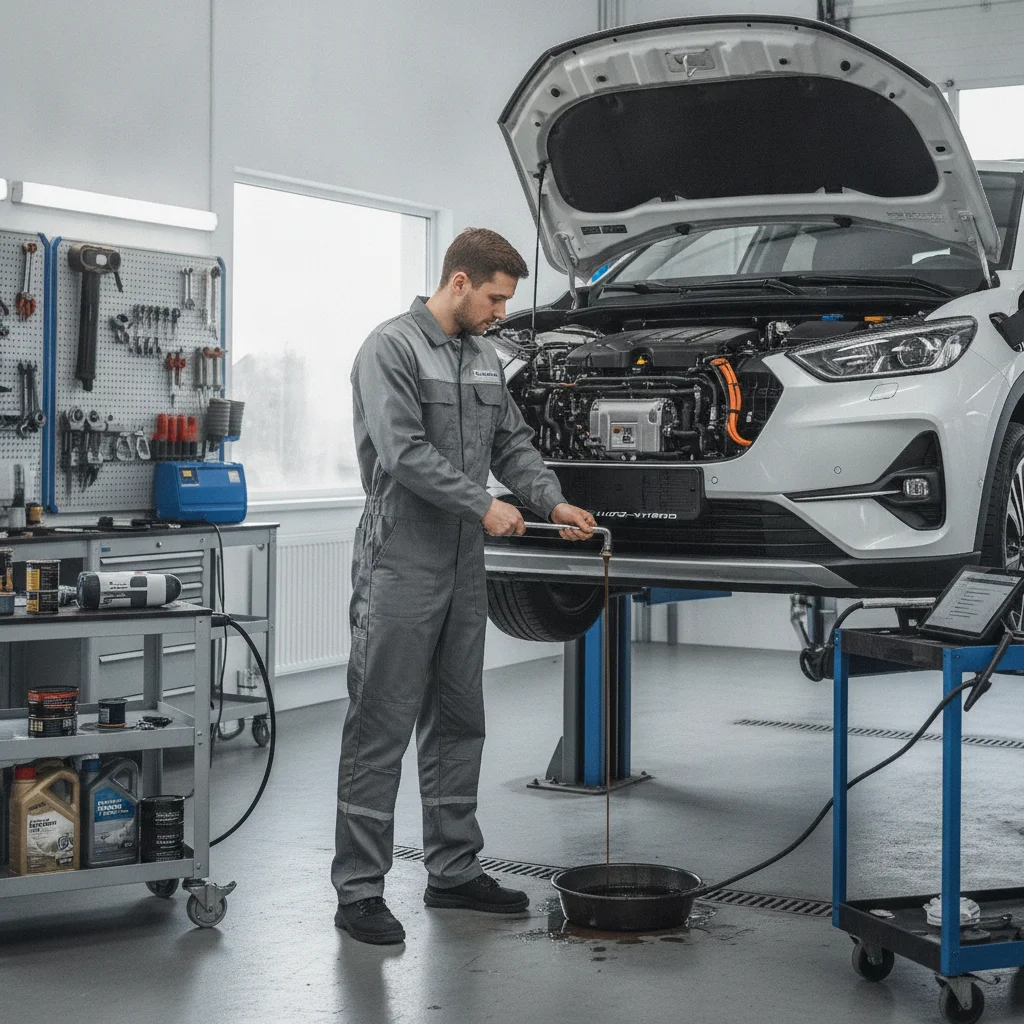
Conventional hybrids — Toyota Prius, Honda Accord Hybrid, Hyundai Sonata Hybrid — are the closest thing to a traditional car ownership experience among electrified vehicles. They don't plug in. The battery charges itself through regenerative braking and engine output. And apart from some meaningful savings on brakes and marginal fuel savings, the maintenance schedule looks very familiar.
HEV owners still carry the full combustion engine maintenance list:
- Engine oil changes on the manufacturer's recommended schedule
- Spark plugs and ignition system service
- Coolant flushes for the ICE cooling circuit
- Transmission service (most HEVs use a CVT or specialized hybrid transmission)
- Exhaust system maintenance including catalytic converter
- Air filter (engine and cabin)
What HEVs do save on is brakes. Regenerative braking is active on all hybrid systems, and HEV brake pads routinely outlast those on conventional gas vehicles by a meaningful margin. This is a real and recurring saving — brake jobs on a conventional car typically run $150–$400 per axle, and you'll push that interval out by 30,000–50,000 miles or more on a well-driven hybrid.
The HEV battery pack itself is generally less stressed than a PHEV's because it operates over a much smaller charge/discharge range. This makes HEV battery longevity quite strong — Toyota's hybrid system in the Camry and Prius has proven itself past 200,000 miles in fleet and taxi applications.
For buyers weighing how much their daily routine would change, see how each electrified type disrupts daily habits. For HEVs, the answer is: almost not at all.
Side-by-Side: What Each Type Costs to Maintain
The AAA and Consumer Reports both publish data on average annual maintenance costs by powertrain type. The figures vary by model and driving conditions, but the directional pattern is consistent: BEVs cost less to maintain, HEVs sit in the middle, and gas cars are the most expensive per mile. PHEVs don't follow a neat pattern — they depend heavily on how much of your driving is electric versus gas.
| BEV | PHEV | HEV | |
|---|---|---|---|
| Oil changes required | None | Yes, full schedule | Yes, full schedule |
| Spark plugs / ignition service | None | Yes | Yes |
| Brake wear rate | Very low (regen braking) | Low (regen braking) | Moderate-low (regen braking) |
| Transmission service | Minimal or none | Yes (CVT or auto) | Yes (CVT or hybrid trans.) |
| Exhaust system maintenance | None | Yes | Yes |
| High-voltage battery risk | Higher (larger pack) | Moderate (smaller pack) | Low (small, self-managed) |
| Est. annual maintenance cost | ~$400–$600 | ~$700–$1,100 | ~$600–$900 |
| Maintenance complexity over time | Low | High | Moderate |
| Drivetrain service simplicity | Very simple (single-speed) | Complex (dual powertrain) | Moderate (hybrid trans.) |
| Long-term cost trend (10+ yrs) | Improving vs. ICE | Mixed | Stable, higher than BEV |
These figures represent averages. A BEV driven hard in a hot climate with frequent DC fast charging may degrade its battery faster. An HEV driven mostly at highway speeds may see better fuel economy but similar maintenance costs. A PHEV driven entirely on gas because the owner never plugs it in is paying for two powertrains and getting the benefits of neither.
The long-term trajectory matters more than year-one numbers. By years 8–12 of ownership, the gap between BEV and HEV maintenance costs tends to widen — because BEVs have no engine wear accumulating while HEV engines continue to rack up normal combustion wear. See our lifetime EV maintenance breakdown for a detailed look at how these costs accumulate from purchase through resale.
Mileage, Driving Patterns, and Where the Math Shifts
Maintenance cost comparisons look very different depending on how much you drive. The savings from eliminating oil changes and combustion service are multiplied by mileage — so a driver doing 20,000 miles per year benefits far more from a BEV than one doing 8,000 miles per year.
Here's how driving pattern intersects with powertrain choice:
- High-mileage commuters (15,000+ miles/year)
- BEVs deliver the clearest maintenance advantage. Every skipped oil change, every extended brake service interval adds up. Over 5 years, the cumulative savings versus an HEV can reach $2,000–$4,000 depending on the vehicles being compared.
- Moderate-mileage drivers (8,000–15,000 miles/year)
- PHEVs can make more sense if most driving is local and electric-range-capable. But the dual-powertrain maintenance still applies on whatever gas miles accumulate.
- Low-mileage drivers (under 8,000 miles/year)
- The math tilts differently here. Maintenance savings are smaller in absolute terms, and battery considerations (like ensuring a BEV's thermal system stays conditioned) may matter more. HEVs or even PHEVs may be a better fit.
Climate is another variable. BEVs in extreme cold or heat may draw more heavily on battery thermal systems, and battery range (and longevity) is affected more than on HEVs, where the engine can compensate. How the math shifts at different mileage levels is worth reading if your annual mileage falls significantly above or below average.
Use Regenerative Braking Aggressively
On any electrified vehicle — BEV, PHEV, or HEV — maximizing your use of regenerative braking directly extends brake pad life and reduces the cost of one of the most common maintenance items. Where available, select the highest regen setting and train yourself to lift off the accelerator early rather than coasting to brakes. Over 50,000 miles, this habit can save you $400–$800 in brake service costs.
Match Your Powertrain to Your Real Mileage
The maintenance savings of a BEV compound with mileage. If you drive 12,000 miles or fewer per year, the annual dollar difference versus an HEV may be smaller than you expect — and factors like charging convenience or purchase price may matter more. Run the numbers for your actual driving pattern before assuming a BEV automatically wins on cost.
Drivetrain Simplicity and What It Means for Long-Term Reliability
One often-overlooked maintenance advantage of BEVs is drivetrain simplicity. Most BEVs use a single-speed fixed-ratio gearbox — no clutch packs, no torque converter, no gear changes under load. This eliminates one of the most common expensive repairs on conventional vehicles. Our deep dive on BEV single-speed gearboxes explains why this matters for long-term ownership costs.
HEVs and PHEVs, by contrast, use more complex transmission systems — often continuously variable transmissions (CVTs) or specialized planetary gear setups — that require fluid maintenance and can be expensive to repair if neglected. A CVT fluid service that's skipped too long can result in a transmission replacement that costs $3,000–$5,000 or more.
The full head-to-head against a conventional gas vehicle is worth reviewing too. EV maintenance versus gas car maintenance lays out the task-by-task comparison with cost ranges for each item.
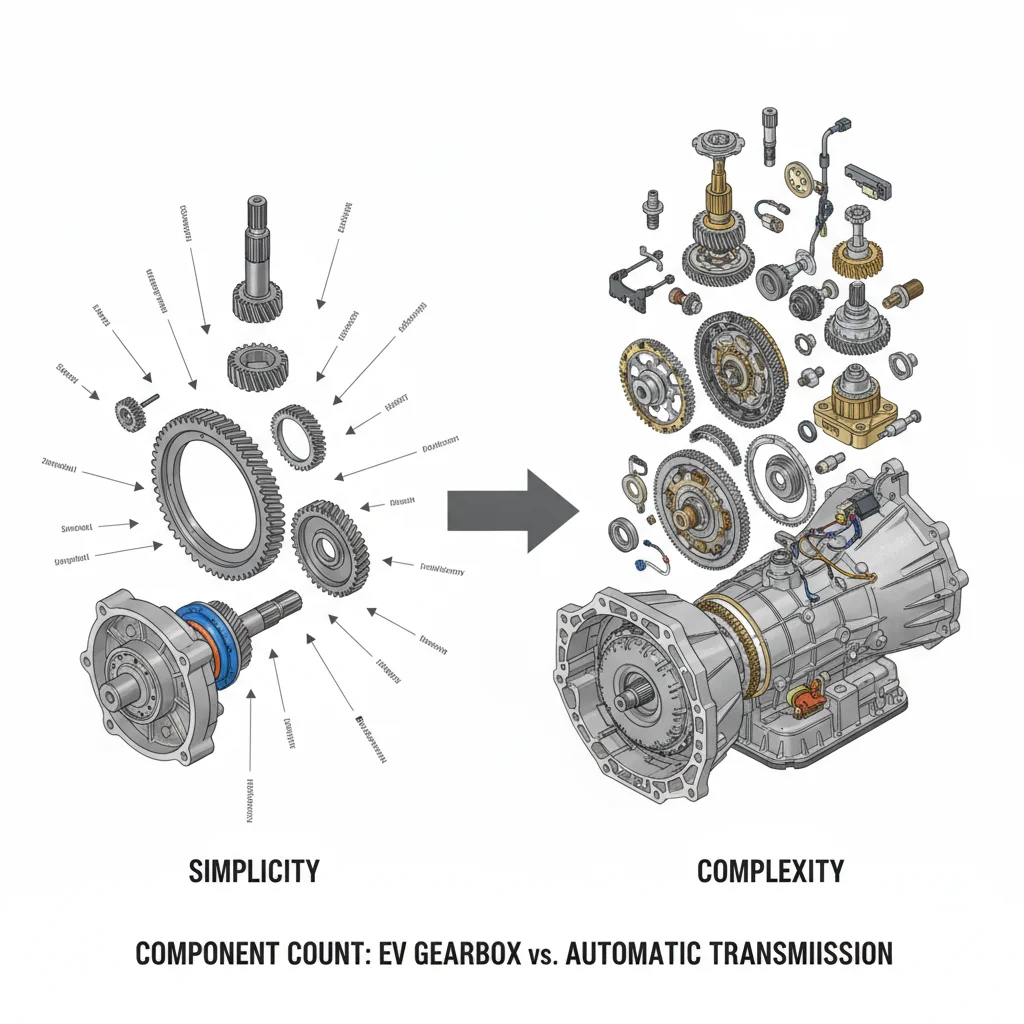
The bottom line on complexity: simpler drivetrains mean fewer failure modes, lower labor hours at the shop, and more predictable ownership costs. BEVs win here outright. HEVs sit closer to conventional cars. PHEVs carry the most system complexity — and while modern PHEVs are well-engineered, complexity is always a long-term risk factor.
PHEV Owners: Don't Neglect the Gas Engine
If you drive your PHEV primarily on electric power and rarely engage the combustion engine, you risk stale fuel, dried seals, and incomplete lubrication cycles in the gas engine. Most manufacturers recommend running the combustion engine at least periodically — check your owner's manual for specific guidance. Neglecting this can lead to expensive repairs that defeat the cost-savings purpose of the vehicle.
Complexity Is a Long-Term Risk Factor
PHEVs in particular carry more system complexity than either BEVs or HEVs — high-voltage battery packs, full combustion engines, and complex transmission systems all operating together. While modern PHEVs are reliable, more components mean more potential failure points over a 10–15 year ownership horizon. If long-term simplicity and low repair risk are priorities, a BEV or a proven HEV platform will generally be more predictable.

All claims are backed by peer-reviewed research. Sources on request.