Key Takeaways
EV Drive Layout
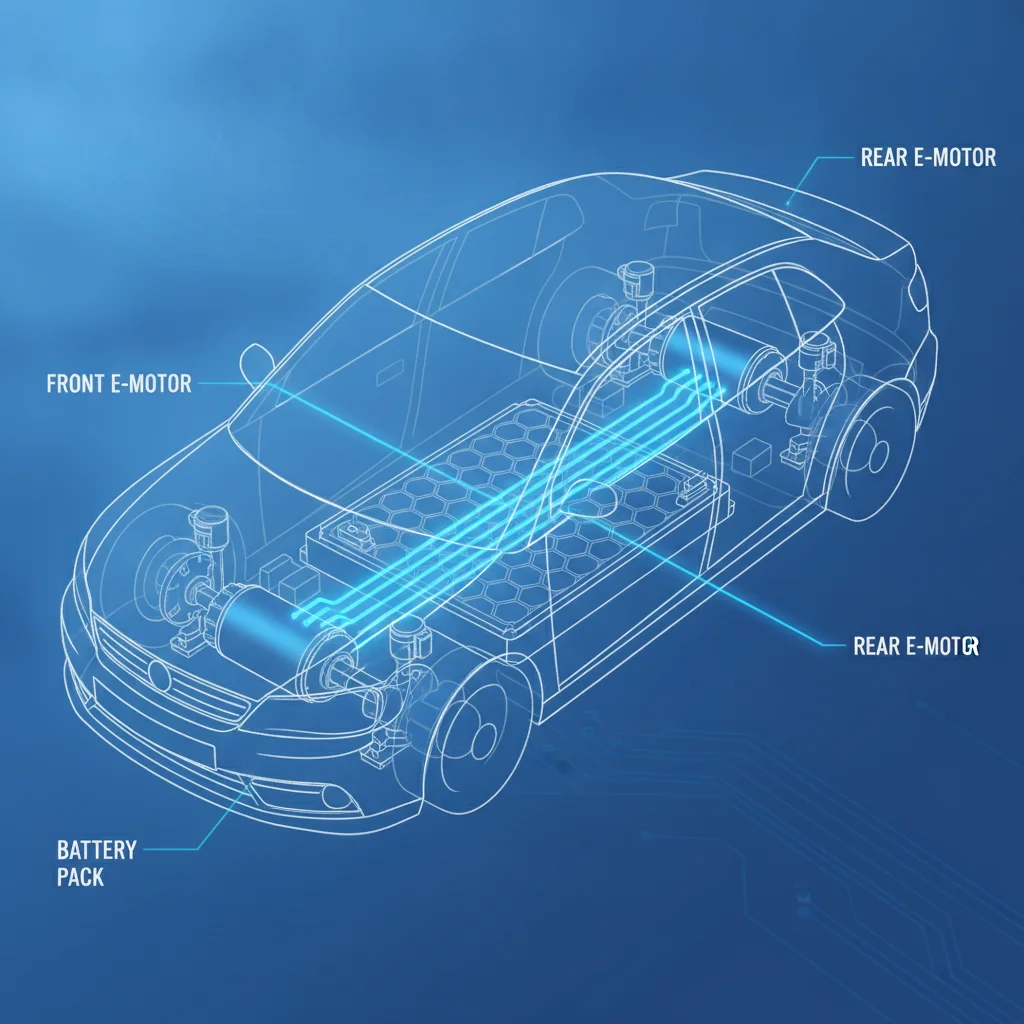
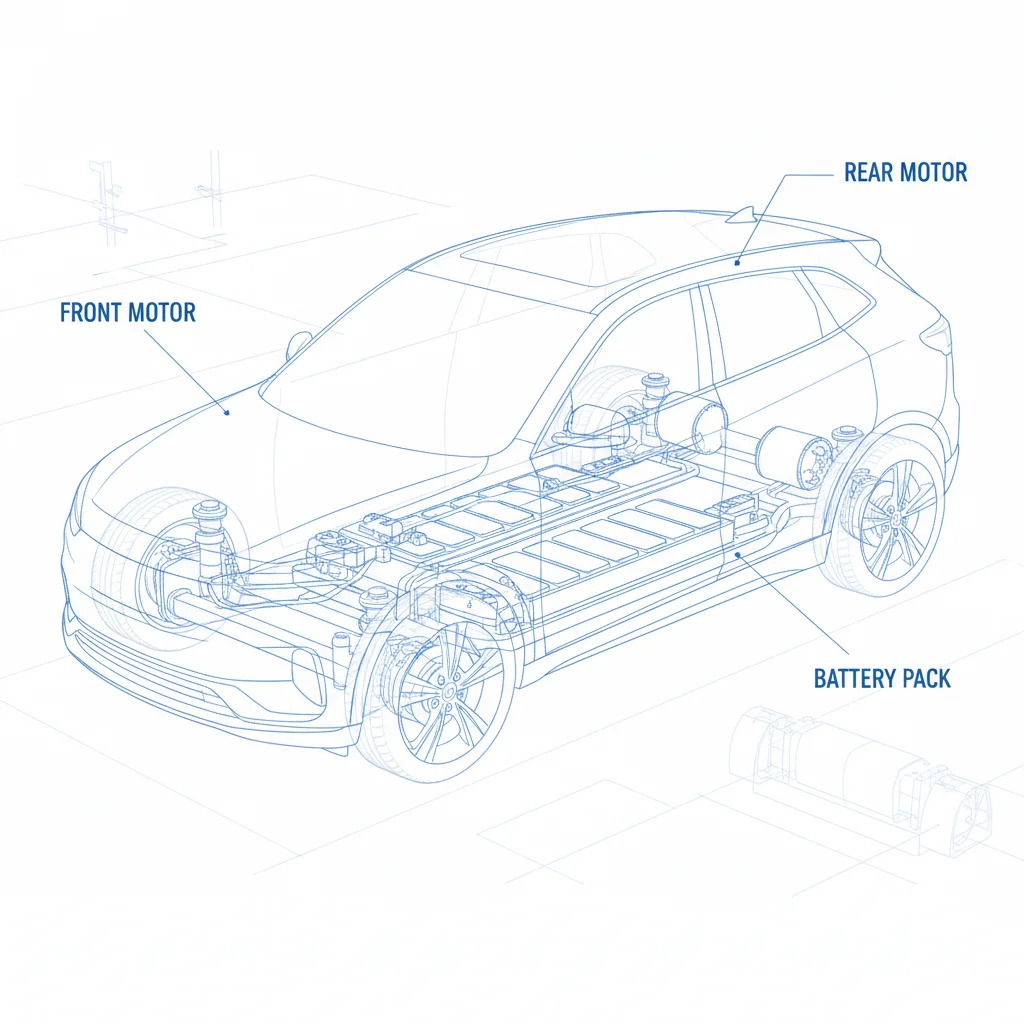
In an electric vehicle, the drive layout — front-wheel, rear-wheel, or all-wheel — refers to which wheels receive power from the electric motor or motors. Unlike gas vehicles, EVs can place motors almost anywhere near the wheels, making layout decisions simpler mechanically but more impactful on performance, efficiency, and cost. The absence of a combustion engine and traditional transmission fundamentally changes what each layout can and cannot do.
In many EVs, especially AWD models, each motor drives its respective axle independently — and some vehicles use individual in-wheel or near-wheel motors for per-wheel torque control, enabling torque vectoring without mechanical differentials.
Why the Engine's Absence Changes Everything
In a conventional gas-powered vehicle, where the power goes is largely dictated by where the engine sits and how the drivetrain is physically routed. A front-wheel drive sedan works the way it does because engineers designed a transaxle to combine the transmission and differential at the front. A rear-wheel drive sports car sends power backward through a long driveshaft. All-wheel drive adds a transfer case that splits torque between axles. It's a system built around the mechanical constraints of a combustion engine.
Strip out the engine, and most of that goes away. An electric motor is compact, self-contained, and can be mounted almost anywhere — directly at an axle, adjacent to a wheel, or even inside a wheel hub. There's no engine block to work around, no exhaust system dictating packaging, and no multi-speed gearbox required to keep the engine in its power band. That changes what FWD, RWD, and AWD actually mean in practice.
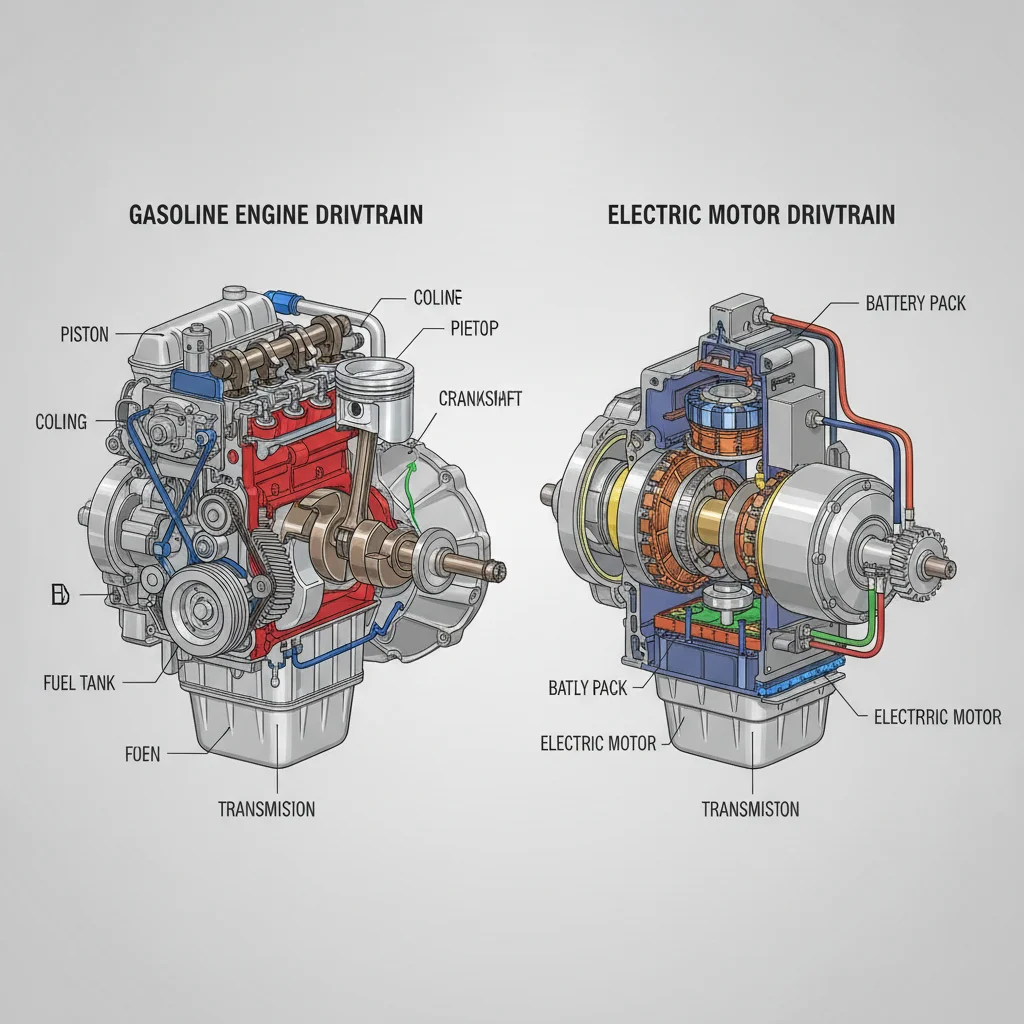
Gas and electric drivetrains share almost nothing under the skin — and understanding that gap is the foundation for understanding EV drive layouts.
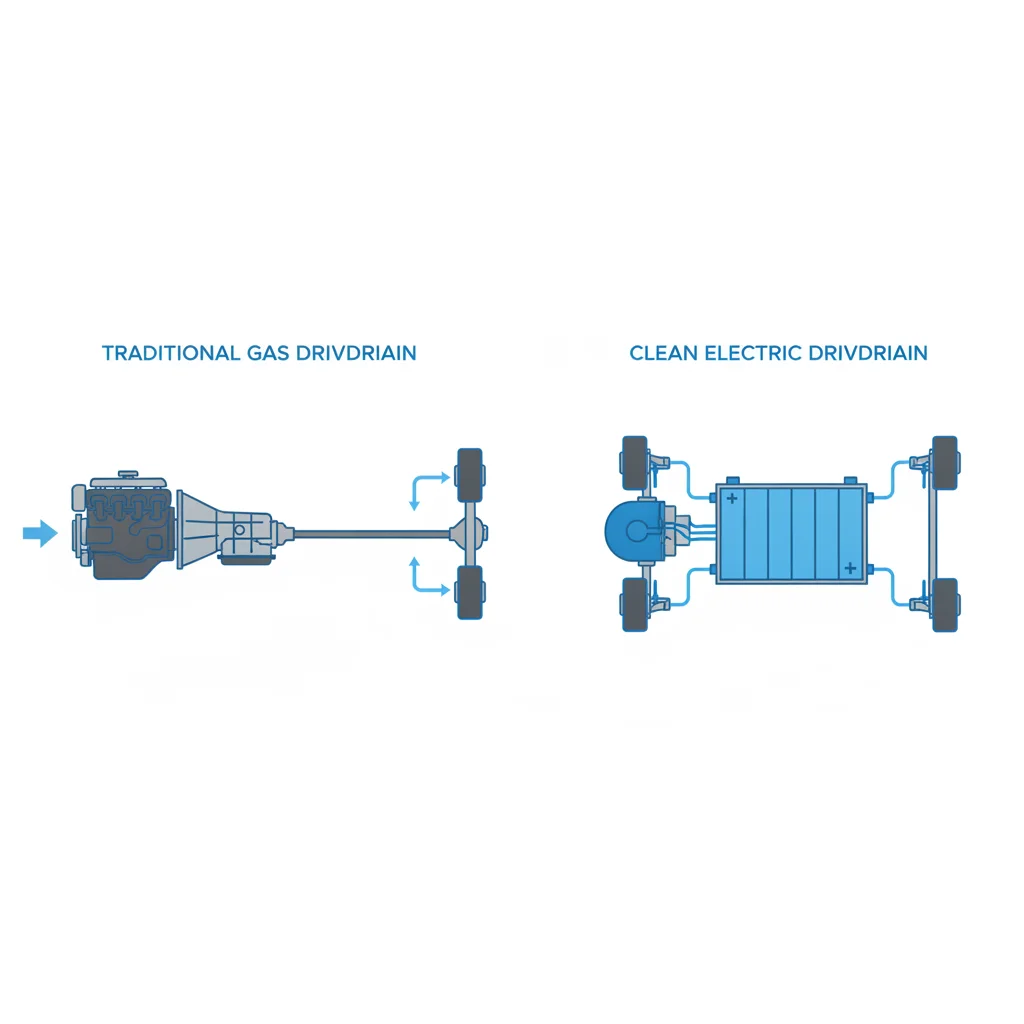
The practical result: EV manufacturers have more freedom in where they place motors, which means drive layout decisions are increasingly driven by cost, weight distribution, efficiency, and performance targets rather than mechanical necessity.
Front-Wheel Drive EVs: Efficient, Practical, and Underrated
Front-wheel drive is the most common layout in entry-level and mid-range EVs, and for good reason. Placing the motor at the front axle is mechanically straightforward — the motor drives the front wheels directly, with no need to send power to the rear. This keeps the drivetrain simple, reduces component count, and lowers the manufacturing cost that gets passed to the buyer.
The efficiency advantage is real. A single front-mounted motor means only one motor is consuming power, and the absence of a rear driveshaft, differential, or second motor means less rotational mass. For buyers who prioritize range on a budget, FWD EVs tend to deliver the best energy consumption figures for the dollar.
~60%
EV models sold in the US with AWD option
Based on 2024 new EV model listings across major manufacturers, the majority of EV nameplates offer an AWD dual-motor variant alongside a single-motor option.
5–15%
Typical AWD range penalty vs. single-motor EV
EPA range data across comparable FWD/RWD vs. AWD trims of the same model consistently shows a 5–15% range reduction in AWD configurations.
$3,000–$8,000
Average price premium for AWD EV trim
Based on MSRP comparisons across popular dual-motor AWD upgrades including Tesla Model Y, Ford Mustang Mach-E, and Hyundai IONIQ 5 as of 2024.
<100ms
Torque reallocation speed in dual-motor EVs
Independent motor control in dual-motor EVs allows torque distribution to shift between axles in under 100 milliseconds, faster than any mechanical AWD system.
3
Motors in Tesla Model S Plaid
The Tesla Model S Plaid uses one front motor and two rear motors, enabling rear-axle torque vectoring and a claimed 0–60 mph time under 2 seconds.
There's a handling caveat worth understanding. In powerful FWD gas vehicles, engineers struggle with torque steer — the tendency for the wheel receiving more torque to pull the car sideways under hard acceleration. In an FWD EV, the motor's torque can be precisely managed electronically, which reduces but doesn't fully eliminate this phenomenon in higher-output models. For the typical FWD EV in the 150–250 horsepower range, it's rarely a practical concern.
FWD EVs Are Not a Compromise
Buyers sometimes assume FWD is the budget option they'll eventually outgrow. In the EV world, it's often the rational choice for efficiency-first buyers. If your annual mileage is high and your routes are predictable, a FWD EV's lower purchase price and superior efficiency frequently outweigh the capability benefits of AWD on a dollars-per-mile basis.
Look at Motor Count When Comparing EV Trims
When shopping EV variants, the motor count tells you more than the drive layout label. "AWD" means a second motor was physically added — that's added weight, cost, and capability. Check whether a manufacturer's AWD system deactivates one motor during light driving, which significantly affects real-world efficiency compared to models that run both motors continuously.
Examples of notable FWD EVs include the Chevrolet Equinox EV (base trim), the Volkswagen ID.4 (standard range), and the Nissan Ariya (FWD variant). These are vehicles built for efficient, confident everyday driving — not track days.
Rear-Wheel Drive EVs: Better Balance, Sharper Feel
Rear-wheel drive has long been the layout of choice for driver-focused vehicles, and that logic carries over to EVs — though the reasons shift somewhat. In a gas car, RWD is favored partly because a front-engine/rear-drive setup enables near-even weight distribution. In an EV, the heavy battery pack sits in the floor, so weight distribution is already more predictable regardless of motor placement. Still, putting the motor at the rear axle has meaningful advantages.
First, under acceleration, weight naturally transfers to the rear. That weight transfer increases the load on the driven wheels, improving traction — exactly the opposite of what happens in a FWD vehicle, where the front wheels are lifting slightly as the car accelerates and the driven wheels lose grip. This is why sports cars have historically preferred RWD.
Second, with the front wheels freed from power delivery, steering feel improves. The front tires can focus purely on cornering. This is a genuine handling benefit that drivers notice in RWD EVs like the Tesla Model 3 Long Range RWD, the BMW i4 eDrive40, and the Hyundai IONIQ 6 RWD.
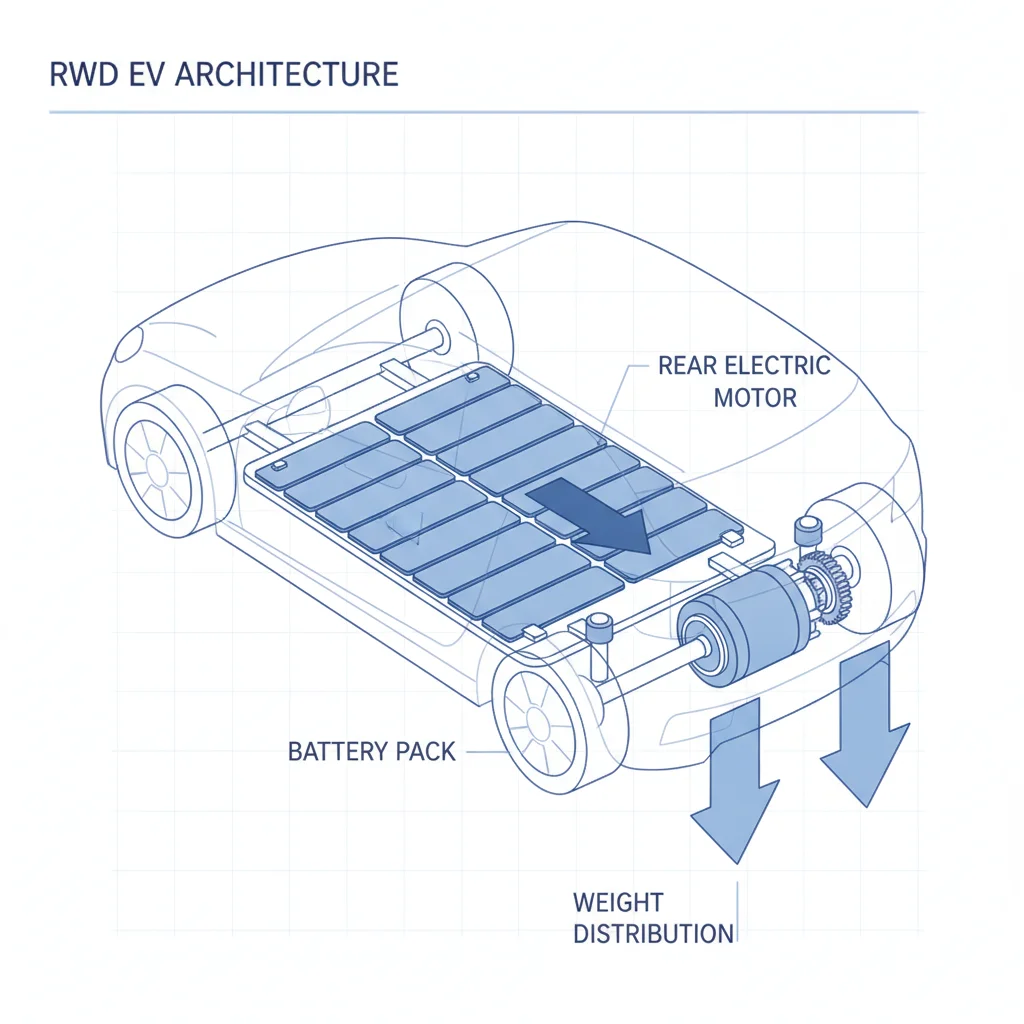
The concern many people bring up — that RWD is harder to manage in slippery conditions — deserves nuance. In a high-powered gas RWD vehicle, uncontrolled throttle input can cause the rear to step out. EV motors don't have the same violent, unpredictable power surge of a combustion engine at low RPM. Torque delivery is measured and electronically governed, and traction control systems in modern EVs are fast enough to manage wheel slip before you feel it. In light snow or rain, a RWD EV with decent tires handles better than many buyers expect. In serious winter conditions, the calculus changes.
For more on how electric motors generate torque so differently from combustion engines, it's worth understanding the fundamentals before comparing layouts.
All-Wheel Drive EVs: Two Motors, Completely Different Logic
All-wheel drive in an internal combustion vehicle is a mechanical system — one engine's output is split and routed to multiple axles via a transfer case, center differential, and various coupling devices. It is inherently compromised by the need to keep mechanical components synchronized.
AWD in an EV is, in concept, simpler: add a second motor at the other axle. Each motor drives its axle independently. There are no mechanical links between the two motors; instead, software decides how much torque each one produces at any given moment. The result is power distribution that can shift from 100% front to 100% rear — or anything in between — in under 100 milliseconds. No clutch packs, no viscous couplings, no driveshaft flex.
“With two independent motors, you don't need a mechanical link between the axles at all. The software becomes the drivetrain. You can do things with power distribution that simply aren't physically possible with a conventional transfer case.”
— Sandy Munro, Automotive teardown analyst and founder of Munro & Associates
This independent-motor architecture is why AWD EVs can offer genuine torque vectoring at the axle level without the expensive mechanical hardware required in gas vehicles. Dual-motor EVs do much more than just add grip — the performance and handling benefits go well beyond all-weather traction.
AWD Doesn't Replace Winter Tires
All-wheel drive improves traction on acceleration, but it does not improve braking or cornering in snow and ice. Stopping distance and lateral grip depend almost entirely on tire compound and tread design. Dedicated winter tires on a FWD or RWD EV will outperform a AWD EV on all-season tires in most cold-weather scenarios. Budget for tires before budgeting for AWD if winter safety is your primary concern.
Not All Dual-Motor AWD Systems Are Equal
The performance and efficiency of AWD vary significantly between EV manufacturers. Some use a high-output motor on one axle and a smaller efficiency-oriented motor on the other. Others run both motors at comparable output. This affects towing capacity, launch performance, and how aggressively one motor deactivates during light driving. Always review the front and rear motor output specs separately, not just the combined system figure.
The trade-off is weight and, in some conditions, efficiency. Two motors weigh more than one. When both are spinning, they each generate some internal friction losses. Most manufacturers address this by shutting down one motor under light-load driving — highway cruising at steady speed, for instance — and reactivating it when demand rises. The transition is nearly imperceptible to the driver.
Popular AWD EVs span a wide range: from the Ford Mustang Mach-E GT and Tesla Model Y Long Range AWD to the Rivian R1T and Lucid Air. Across these vehicles, the dual-motor architecture delivers 0–60 mph times and all-weather capability that no single-motor setup can match.
How EV Layouts Affect Range, Cost, and Real-World Decisions
Choosing between FWD, RWD, and AWD in an EV isn't just a performance decision — it's a financial and practical one. Here's how the trade-offs stack up in terms buyers actually care about:
| Layout | Typical Range Impact | Cost Relative to FWD | Best For |
|---|---|---|---|
| Front-Wheel Drive | Baseline (highest efficiency) | Lowest | Daily commuting, budget-conscious buyers |
| Rear-Wheel Drive | Roughly equivalent to FWD | Low to moderate premium | Driving enthusiasts, mild climates |
| All-Wheel Drive | Typically 5–15% less range | Moderate to significant premium | Winter driving, towing, performance |
The range penalty for AWD has narrowed as motor technology improves, but it hasn't disappeared. A Tesla Model Y RWD delivers an EPA-rated 260 miles; the Long Range AWD version gets 320 miles but costs roughly $6,000 more. The math is vehicle-specific, so always compare the EPA range and price gap for the exact model you're evaluating.
One nuance worth flagging: not all AWD EV implementations are equal. Some manufacturers use a smaller, less powerful motor on one axle specifically as an efficiency measure — it kicks in under high demand but runs minimally otherwise. Others run both motors more aggressively for performance. This affects real-world efficiency significantly, and EPA ratings don't always capture how a vehicle behaves under typical mixed driving.
For buyers who want the full picture on how electric powertrains are structured, this introduction to the all-electric powertrain covers motors, inverters, and battery integration in accessible terms.
What the Motor Count Actually Tells You
In the EV world, motor count and drive layout are directly connected in a way that has no parallel in gas vehicles. One motor almost always means one driven axle — FWD or RWD. Two motors almost always means AWD. Some vehicles, like certain Rivian models and the Tesla Model S Plaid, use three motors, with one at the front and two at the rear, enabling rear-axle torque vectoring.
This matters when you're comparing trims. "AWD" on an EV spec sheet means a second motor has been added, which adds weight, capability, and cost. It's not a marketing description of how well a single-motor car handles traction — it means a physical hardware difference.
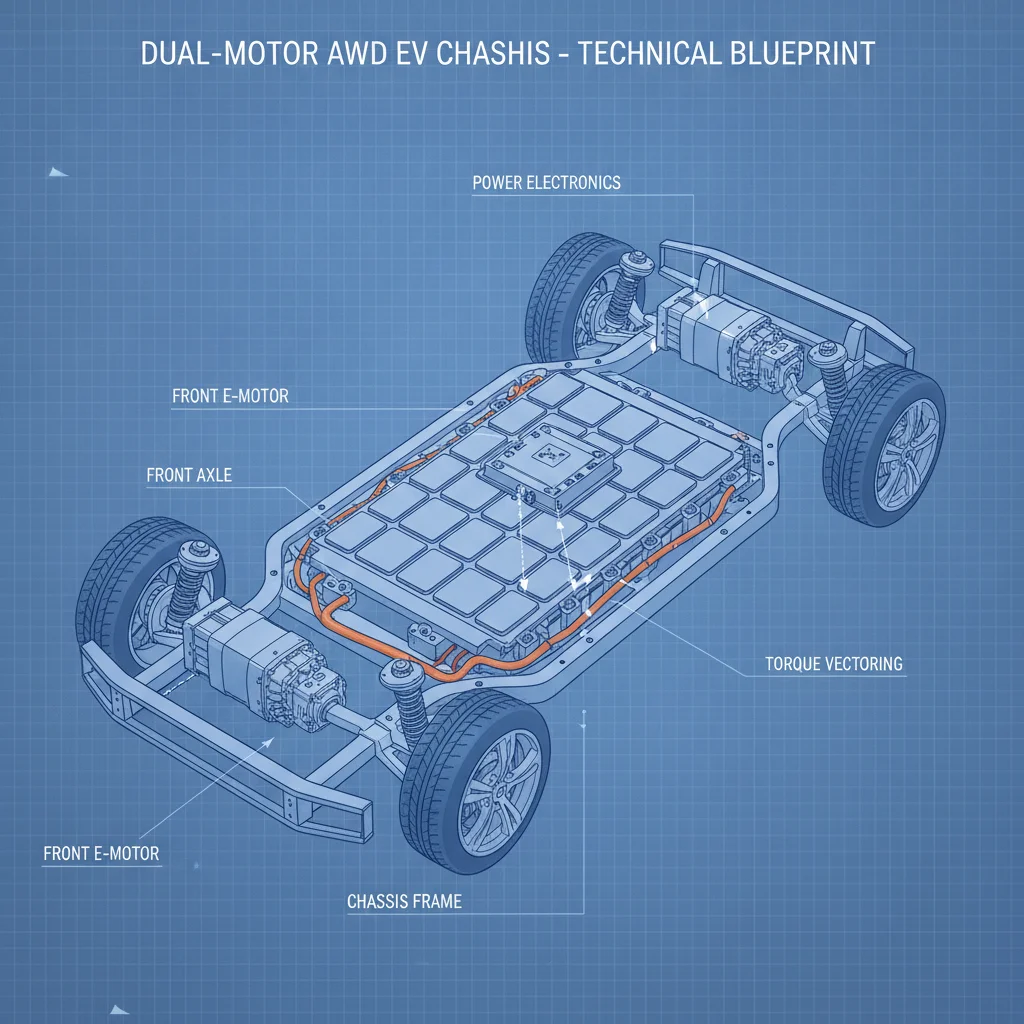
Motor placement also influences how weight is distributed across the vehicle. An EV with a single rear motor and a floor-mounted battery pack will have a different front-to-rear weight ratio than one with a single front motor. Engineers design suspension and steering geometry around these differences, which is why two EVs with the same battery size can feel quite different to drive.
The single-speed drivetrain that most EVs use also interacts with layout choices — without gear changes to manage, the motor's torque curve does all the work, which places added importance on how that torque reaches the wheels.
FWD EVs Are Not a Compromise
Buyers sometimes assume FWD is the budget option they'll eventually outgrow. In the EV world, it's often the rational choice for efficiency-first buyers. If your annual mileage is high and your routes are predictable, a FWD EV's lower purchase price and superior efficiency frequently outweigh the capability benefits of AWD on a dollars-per-mile basis.
Look at Motor Count When Comparing EV Trims
When shopping EV variants, the motor count tells you more than the drive layout label. "AWD" means a second motor was physically added — that's added weight, cost, and capability. Check whether a manufacturer's AWD system deactivates one motor during light driving, which significantly affects real-world efficiency compared to models that run both motors continuously.
Bottom line: when shopping an EV, look at motor count and placement as concrete hardware specs, not marketing terms. They tell you more about how the vehicle will actually behave than any drivetrain adjective in the brochure.
Making the Right Drive Layout Choice for Your Situation
There's no universally correct answer, but there are clear patterns that should guide your decision:
- Choose FWD if your priority is maximum range per dollar, you live in a mild climate, and most of your driving is urban or suburban commuting. FWD EVs are the practical majority — not a compromise.
- Choose RWD if you value handling, live somewhere winters are mild or you'll invest in dedicated winter tires, and want a more engaging driving experience without paying the AWD premium. Many of the best-driving EVs in their segments are RWD.
- Choose AWD if you face consistent winter driving, haul heavy loads, tow a trailer, or simply want the fastest acceleration your budget allows. The cost and range trade-offs are real, but so are the capability gains.
AWD Doesn't Replace Winter Tires
All-wheel drive improves traction on acceleration, but it does not improve braking or cornering in snow and ice. Stopping distance and lateral grip depend almost entirely on tire compound and tread design. Dedicated winter tires on a FWD or RWD EV will outperform a AWD EV on all-season tires in most cold-weather scenarios. Budget for tires before budgeting for AWD if winter safety is your primary concern.
Not All Dual-Motor AWD Systems Are Equal
The performance and efficiency of AWD vary significantly between EV manufacturers. Some use a high-output motor on one axle and a smaller efficiency-oriented motor on the other. Others run both motors at comparable output. This affects towing capacity, launch performance, and how aggressively one motor deactivates during light driving. Always review the front and rear motor output specs separately, not just the combined system figure.
One practical consideration that often gets overlooked: tire choice matters more than drive layout in winter conditions for most drivers. A FWD or RWD EV on dedicated winter tires will outperform an AWD EV on all-season tires in most snow and ice scenarios. Drive layout is one variable — don't let it crowd out others.
If you're still sorting through the broader EV landscape before deciding on a layout, the EV types overview is a useful starting point for understanding which vehicle category makes sense before drilling into drivetrain specifics. And once you've narrowed down to a BEV specifically, checking EV maintenance requirements by drivetrain layout will help you understand long-term cost differences between configurations.

All claims are backed by peer-reviewed research. Sources on request.