Key Takeaways
Our Verdict
For drivers logging 15,000 or more miles annually, a full battery-electric vehicle (BEV) delivers the most compelling long-term savings, especially for city-dominated routes. Moderate drivers between 8,000 and 15,000 miles will find PHEVs or strong HEVs the practical sweet spot. Below 8,000 miles a year, the math rarely favors paying a large electrification premium at all — a conventional HEV or even a fuel-efficient gas car may pencil out better.
| Best for | Recommended |
|---|---|
| High-mileage commuters driving 15,000+ miles annually | Battery Electric Vehicle (BEV) |
| Mixed-use drivers covering 8,000–15,000 miles per year | Plug-In Hybrid (PHEV) |
| Low-mileage drivers under 8,000 miles annually | Conventional Hybrid (HEV) |
| Drivers with long highway-heavy routes and limited home charging | Strong Hybrid (HEV) |
Why Mileage Is the Key Variable in the EV Decision
Most EV buying guides focus on range anxiety, charging speed, or tax credits. Those matter — but the single most powerful predictor of whether an electrified vehicle saves you money is how many miles you drive each year. It determines how quickly you recover a higher purchase price, how large your fuel savings actually are, and whether features like a bigger battery or a gas backup engine are worth the added cost.
The U.S. average sits around 14,500 miles per year according to the Federal Highway Administration, but that average hides a wide spread. A suburban commuter doing 20,000 miles annually and a retired driver doing 6,000 miles face fundamentally different math — and the best electrified vehicle for each can be a completely different answer.
Before diving into the numbers, it helps to understand the electrified vehicle spectrum you're choosing from. Every type of electrified vehicle ranked by routine disruption covers the full range from mild hybrids to pure BEVs — this article focuses on how mileage shifts the financial case for each.
Three vehicle categories dominate the practical comparison for most buyers:
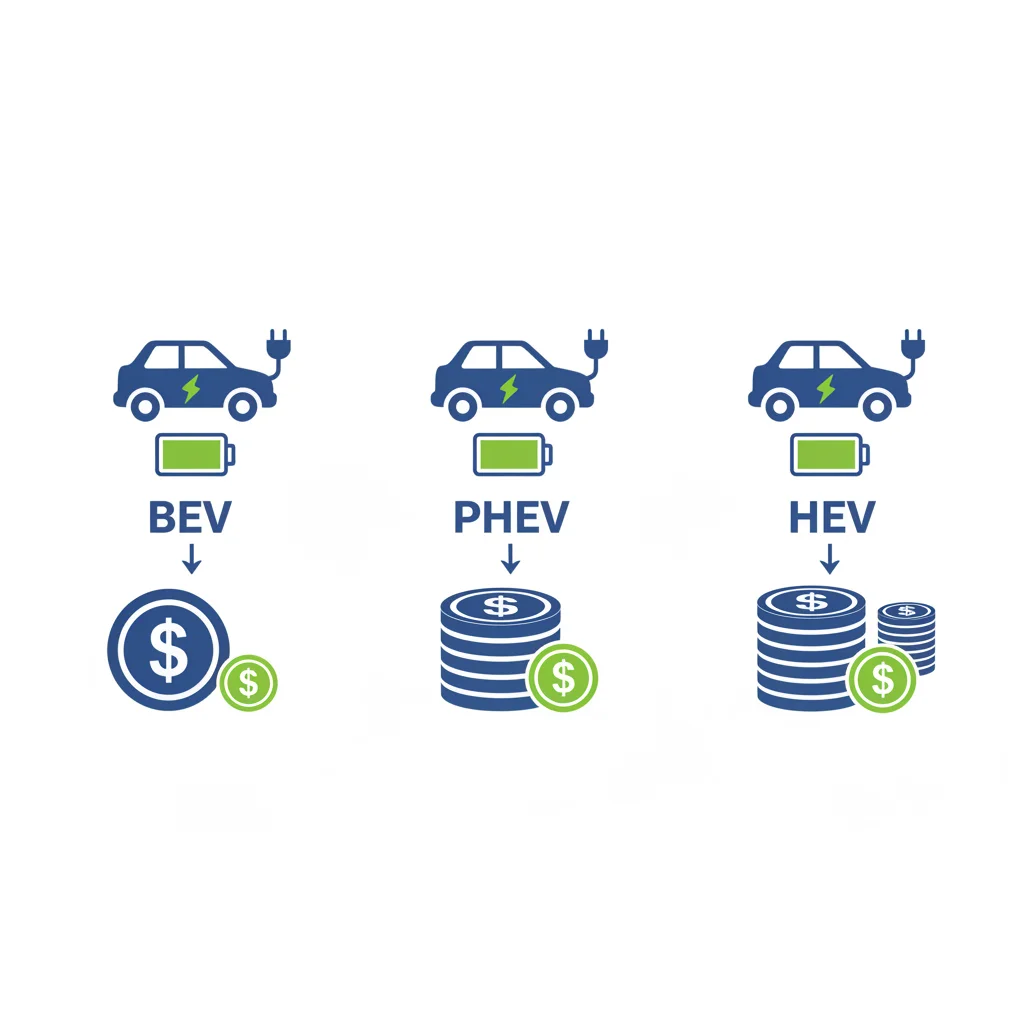
- Battery Electric Vehicles (BEVs): Run entirely on electricity. Highest upfront cost, lowest per-mile fuel and maintenance cost.
- Plug-In Hybrids (PHEVs): Carry both an electric motor with a modest battery (typically 20–50 miles of EV range) and a gasoline engine. Can be plugged in or run on gas alone.
- Conventional Hybrids (HEVs): Use regenerative braking and a small battery to improve efficiency but cannot be plugged in. Lower premium over a gas car, no charging required.
The Cost Structure of Each Powertrain Type
To understand how mileage changes the savings equation, you need to understand where each powertrain type spends and saves money.
| BEV | PHEV | HEV | |
|---|---|---|---|
| Typical purchase premium over gas | $5,000–$15,000 | $3,000–$8,000 | $2,000–$4,000 |
| Federal tax credit eligibility | Up to $7,500 | Up to $7,500 | None |
| Fuel cost per mile (home charging) | ~$0.04–0.05 | ~$0.04–0.08 (if plugged in) | ~$0.07–0.09 |
| Annual maintenance cost (typical) | Lowest (~$1,500) | Moderate (~$2,000) | Moderate-high (~$2,200) |
| Charging/plugging-in required | Yes — daily recommended | Optional but essential for savings | No |
| Best mileage profile | 15,000+ miles/year | 8,000–15,000 miles/year | Under 10,000 miles/year |
| City driving efficiency advantage | Highest (regen braking) | High within EV range | Moderate |
| Long road trip flexibility | Requires planning | Full flexibility | Full flexibility |
Purchase price premium is the first hurdle. BEVs typically carry a $5,000–$15,000 premium over a comparable gas vehicle before incentives. PHEVs run $3,000–$8,000 over their gas equivalents. HEVs are the closest to gas parity, often $2,000–$4,000 above a non-hybrid trim. The federal EV tax credit (up to $7,500 for new BEVs and PHEVs that qualify) can significantly shrink those gaps — but not everyone qualifies based on income and vehicle MSRP limits.
Fuel costs are where high-mileage drivers see the most dramatic divergence. The U.S. Energy Information Administration estimates electricity costs roughly 3–4 cents per mile for a typical BEV charged at home, versus 8–12 cents per mile for a 30 MPG gas vehicle at $3.50/gallon. PHEVs sit in between — depending on how often you plug in. A PHEV driver who charges daily and drives mostly within the electric range can approach BEV-level fuel costs. One who never plugs in effectively pays gas prices with a heavier vehicle penalty.
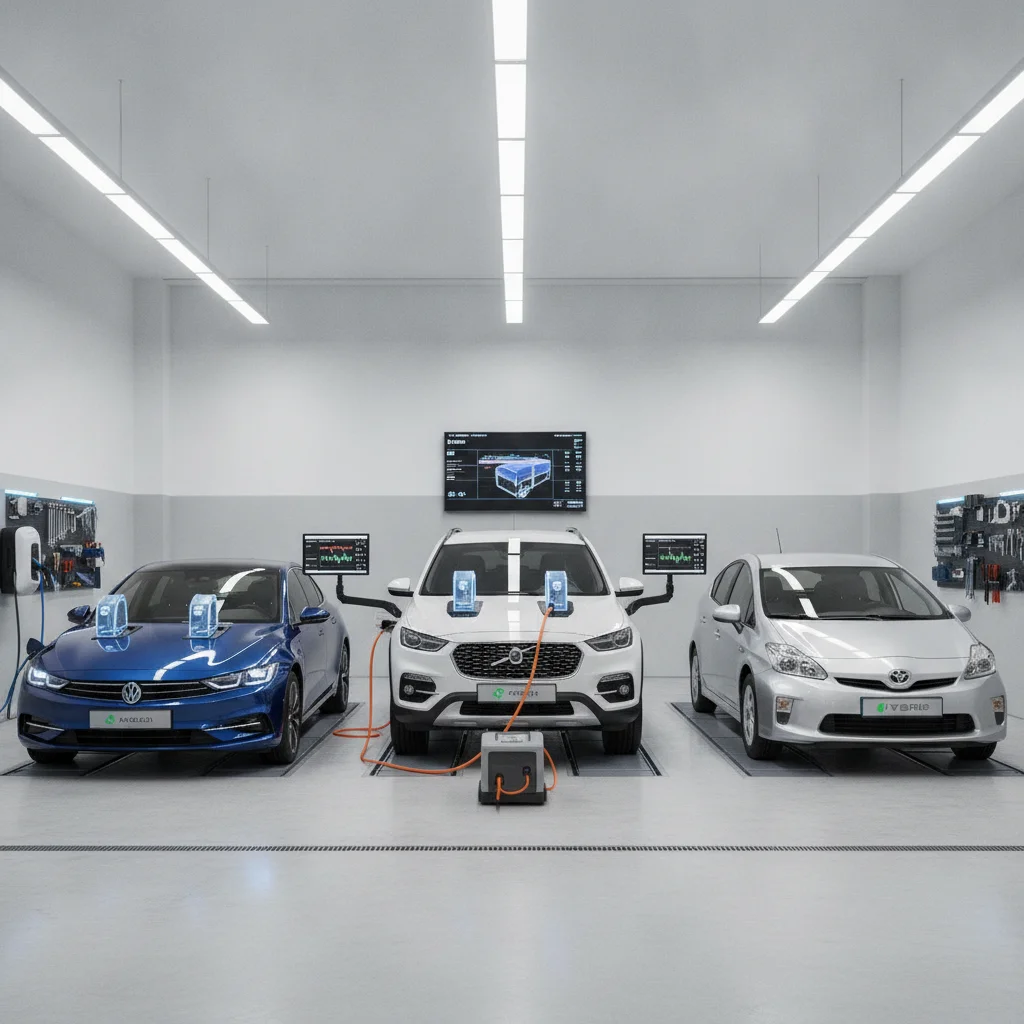
Maintenance costs also separate the field over time. BEVs eliminate oil changes, timing belts, transmission fluid services, and have regenerative braking that dramatically reduces brake wear. Maintenance cost differences between BEVs, PHEVs, and HEVs shows this plays out meaningfully over 5–10 years. PHEVs retain most gas car maintenance requirements. HEVs reduce some service items but still need oil changes and traditional drivetrain service.
14,500
Average annual miles driven by U.S. drivers
According to the Federal Highway Administration, this average masks significant variation — many drivers fall well above or below this figure.
~$0.04
Estimated BEV cost per mile (home charging)
Based on U.S. average residential electricity rates of ~$0.16/kWh and a 4 mi/kWh efficiency assumption for a mid-size BEV.
~$0.12
Estimated gas car cost per mile at $3.50/gal
Calculated for a vehicle averaging 30 MPG — roughly the U.S. fleet average for new non-electrified passenger vehicles.
3x
Fuel cost advantage of BEV over gas at high mileage
At 20,000 miles annually, the per-mile fuel cost difference between a BEV and a 30 MPG gas car compounds to over $1,600 per year in savings.
7–10 yrs
Typical BEV break-even for low-mileage drivers
For drivers under 8,000 miles annually, the higher purchase cost of a BEV often takes 7–10 years to recover through fuel and maintenance savings alone.
High-Mileage Drivers: The BEV Case Gets Stronger Fast
If you're driving 15,000 miles or more annually — especially if a significant portion is city or suburban stop-and-go — a BEV's economics tend to dominate. Here's why:
Fuel savings compound quickly. At 18,000 miles per year, a BEV driver paying $0.14/kWh at home and averaging 3.5 miles/kWh spends roughly $720 annually on fuel. A comparable 30 MPG gas driver at $3.50/gallon spends $2,100. That's a $1,380 annual gap. Over five years, that's $6,900 — enough to offset a meaningful portion of the purchase premium, especially after federal or state incentives.
Maintenance savings accelerate with mileage. A high-mileage driver hits oil change intervals more frequently, wears brakes faster, and eventually faces more drivetrain service. BEVs sidestep most of this. Consumer Reports data consistently shows BEV owners spend less on maintenance than owners of gas or hybrid vehicles. For someone putting on 20,000+ miles a year, those avoided service visits add up fast. See what high-mileage EV ownership looks like after 100,000 miles for a detailed breakdown of what does — and doesn't — change.
The efficiency edge is strongest in city driving. Unlike gas cars, EVs regenerate energy during braking and coasting, which means city driving is actually more efficient than highway driving for a BEV. How EVs perform in city vs. highway driving explains this dynamic in detail. High-mileage drivers doing primarily highway miles still save over gas, but the gap narrows somewhat.

One caution for high-mileage highway drivers: If your 20,000 miles are mostly long-distance interstate, you'll use DC fast charging more frequently, which costs more than home charging and carries a small long-term battery degradation consideration. For this profile, a long-range BEV (300+ miles) minimizes charging stops, and home charging should handle the bulk of energy needs.
Maximize BEV Savings With Home Charging
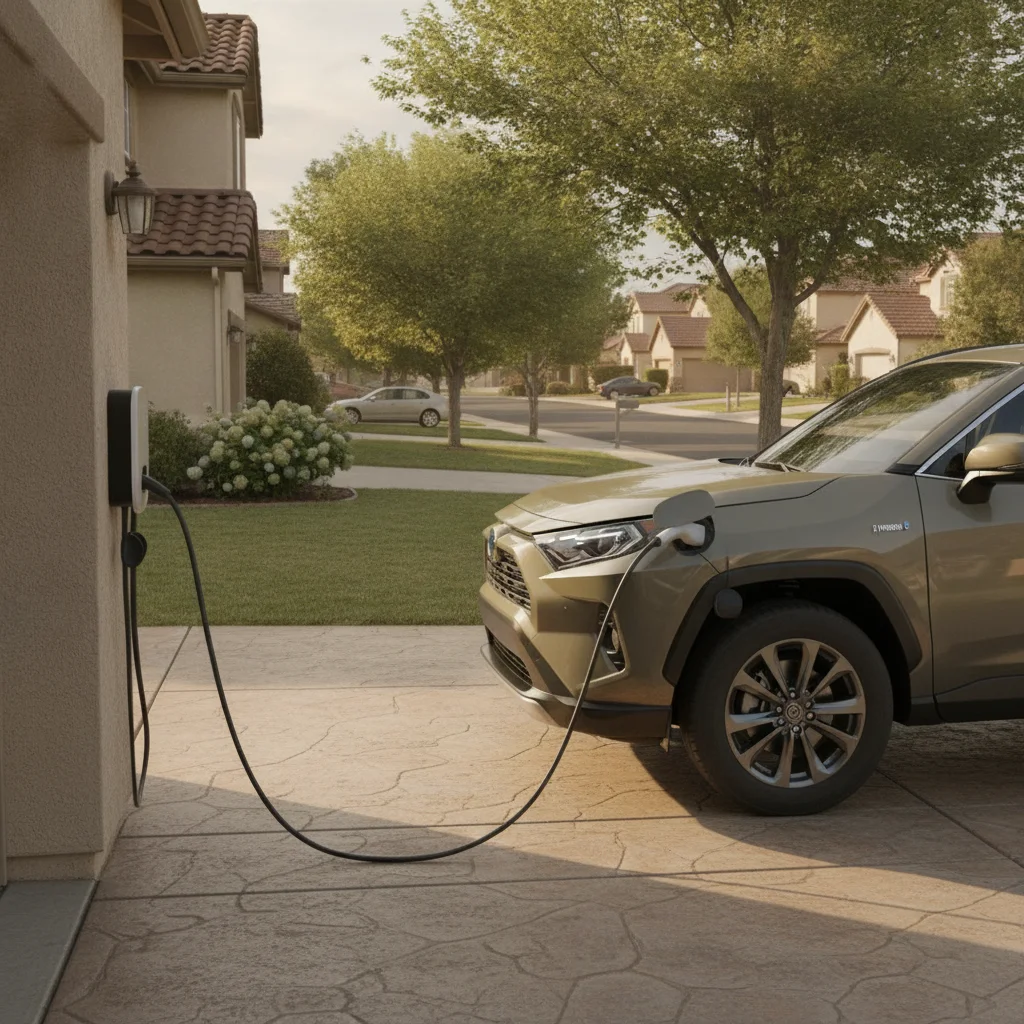
The fuel cost math for BEVs is built on home charging rates, which are typically far cheaper than public DC fast chargers. If you can install a Level 2 charger at home (240V, usually $800–$1,500 installed), you lock in the lowest possible per-mile fuel cost. High-mileage drivers who rely heavily on public fast charging will see their fuel savings shrink — factor this in before assuming the headline numbers apply to you.
PHEV Value Depends on Plugging In Every Day
A PHEV that isn't regularly charged is essentially a penalty — you've paid extra for battery hardware that isn't delivering fuel savings. Before buying a PHEV, honestly assess whether you have reliable access to a charger at home or work. If the answer is uncertain, a strong conventional hybrid will likely deliver better real-world value with less behavioral commitment.
Low-Mileage Drivers: Why Paying the BEV Premium Rarely Pencils Out
At 6,000–8,000 miles per year, the math for a full BEV gets uncomfortable quickly. Fuel savings are modest in absolute dollar terms — you're simply not burning much gas to begin with. If that low-mileage driver saves $900 per year in fuel over a gas car but paid a $10,000 purchase premium (after credits), the break-even point stretches past 10 years, well beyond typical loan or ownership cycles.
HEVs make the most financial sense for this group. A conventional hybrid adds 20–40% better fuel economy over a standard gas car with a modest $2,000–$4,000 price premium and zero behavior change — no plugging in, no charging infrastructure, no range planning. For a driver doing 7,000 miles a year at 50 MPG (HEV) vs. 30 MPG (gas), annual fuel savings are roughly $280. That's not transformative, but it's real, and the break-even on the price premium is achievable within 7–10 years without any lifestyle adjustment.
Don't Assume Tax Credits Always Apply
The federal clean vehicle tax credit (up to $7,500) has income caps and vehicle MSRP limits that disqualify a significant portion of buyers. For 2024, individual income must be under $150,000 (single filer) and SUV/truck MSRP must be under $80,000 to qualify for new vehicle credits. Run your eligibility numbers before using the credit as a cornerstone of your break-even calculation.
PHEVs are an awkward fit for very low mileage drivers unless they have a specific use case — like needing occasional long-range trips but wanting to minimize fuel costs on daily short drives. If your total mileage is low, you may rarely exceed the PHEV's electric range and never need to plug in, meaning you're carrying the weight and complexity of two powertrains with little benefit from either.
Low-mileage drivers should also look at insurance costs. Driving fewer miles often opens up pay-per-mile insurance as a viable option, which can be a meaningful savings avenue regardless of powertrain type. Pay-per-mile vs. traditional insurance for low-mileage drivers walks through when that switch makes sense.
The PHEV Sweet Spot: Middle-Mileage Drivers Who Actually Plug In
PHEVs are often marketed as the best of both worlds, and for a specific driver profile, that's genuinely true. The profile: 10,000–15,000 annual miles, mostly within 30–40 miles of home, reliable access to home or workplace charging, and occasional longer trips where a gas engine backup eliminates range anxiety.
For this driver, a PHEV can deliver near-BEV fuel costs on daily driving (fully electric) while retaining total flexibility for road trips. The federal tax credit applies to many PHEVs, further closing the price gap. And unlike a full BEV, there's no infrastructure commitment — if home charging is unavailable for a stretch, you just use the gas engine.
However, there are real pitfalls. The efficiency case collapses if you don't plug in regularly. A PHEV with a depleted battery is essentially a moderately heavy gasoline car with below-average MPG. Long-run fuel cost comparison between BEVs and PHEVs shows how quickly the savings diverge based on plug-in behavior.
Highway-heavy drivers in the 10,000–15,000 mile range also get less from a PHEV. If most miles are at highway speeds where regenerative braking adds little value and you frequently exceed the electric range, you're mostly running on gasoline. In that scenario, a strong HEV — which is optimized for efficiency across all conditions — might outperform a PHEV that rarely operates in its electric mode.
Maximize BEV Savings With Home Charging
The fuel cost math for BEVs is built on home charging rates, which are typically far cheaper than public DC fast chargers. If you can install a Level 2 charger at home (240V, usually $800–$1,500 installed), you lock in the lowest possible per-mile fuel cost. High-mileage drivers who rely heavily on public fast charging will see their fuel savings shrink — factor this in before assuming the headline numbers apply to you.
PHEV Value Depends on Plugging In Every Day
A PHEV that isn't regularly charged is essentially a penalty — you've paid extra for battery hardware that isn't delivering fuel savings. Before buying a PHEV, honestly assess whether you have reliable access to a charger at home or work. If the answer is uncertain, a strong conventional hybrid will likely deliver better real-world value with less behavioral commitment.
Mileage Patterns Matter as Much as Totals
Annual mileage totals are only half the picture. How you accumulate those miles shapes the efficiency math significantly.
City vs. highway composition: A 15,000-mile-per-year driver doing 80% city miles extracts far more from a BEV or HEV than one doing 80% highway. Regenerative braking is the core reason — in stop-and-go traffic, EVs recover energy that gas cars simply waste as heat. Why EVs are more efficient in city traffic than on highways explains the physics and real-world efficiency differences in detail.
Trip length and charging behavior: A driver doing five short daily trips totaling 40 miles is a very different BEV user than one making a single 40-mile one-way commute. Short trips favor BEVs with low-speed efficiency gains; long commutes may still favor BEVs but require careful range planning if charging is unavailable at the destination.
Elevation and climate: High-altitude or mountainous routes affect range meaningfully. How elevation gain affects usable EV range quantifies this impact. Cold-weather drivers also see reduced EV range in winter, which can make a PHEV or HEV a more resilient choice in northern climates with high annual mileage.
High-mileage drivers with optional insurance coverage face a different risk calculus than low-mileage drivers too. Putting 20,000+ miles on a vehicle increases exposure across multiple coverage categories. Where optional coverage makes sense for high-mileage drivers covers how mileage changes the value of gap insurance, roadside assistance, and other add-ons.

Running the Numbers: A Simplified Break-Even Analysis
To make this concrete, here's a simplified five-year cost comparison across three driver profiles using current average inputs: electricity at $0.16/kWh, gasoline at $3.50/gallon, home charging assumed for BEV/PHEV, and federal tax credit of $7,500 applied where eligible.
Assumptions for each vehicle type:
- BEV: $45,000 MSRP, 3.5 mi/kWh efficiency, $1,500/yr maintenance
- PHEV: $40,000 MSRP, 40 mi EV range (plugged in daily), 40 MPG when on gas, $2,000/yr maintenance
- HEV: $33,000 MSRP, 50 MPG blended, $2,200/yr maintenance
- Gas baseline: $30,000 MSRP, 30 MPG, $2,500/yr maintenance
6,000 miles/year driver (5-year total cost after incentives):
- BEV: ~$38,400 (net purchase) + $550 fuel + $7,500 maintenance = ~$46,450
- PHEV: ~$33,000 (net) + $450 fuel + $10,000 maintenance = ~$43,450
- HEV: ~$33,000 + $840 fuel + $11,000 maintenance = ~$44,840
- Gas: ~$30,000 + $3,500 fuel + $12,500 maintenance = ~$46,000
14,500 miles/year driver (5-year total cost after incentives):
- BEV: ~$38,400 + $1,330 fuel + $7,500 maintenance = ~$47,230
- PHEV: ~$33,000 + $1,085 fuel + $10,000 maintenance = ~$44,085
- HEV: ~$33,000 + $2,030 fuel + $11,000 maintenance = ~$46,030
- Gas: ~$30,000 + $8,458 fuel + $12,500 maintenance = ~$50,958
20,000 miles/year driver (5-year total cost after incentives):
- BEV: ~$38,400 + $1,829 fuel + $7,500 maintenance = ~$47,729
- PHEV: ~$33,000 + $1,750 fuel + $10,000 maintenance = ~$44,750
- HEV: ~$33,000 + $2,800 fuel + $11,000 maintenance = ~$46,800
- Gas: ~$30,000 + $11,667 fuel + $12,500 maintenance = ~$54,167
These are simplified figures — your actual numbers will vary with local electricity rates, gas prices, driving patterns, insurance, depreciation, and financing costs. But the directional story is consistent: the higher your mileage, the more aggressively a BEV's lower operating costs close the purchase premium gap. See EV maintenance costs vs. gas car maintenance over time for a more detailed cost-by-cost breakdown, and explore the EV maintenance basics hub for more context on ownership costs across vehicle types. For charging cost specifics, the charging costs and savings hub is the right starting point.

All claims are backed by peer-reviewed research. Sources on request.