
Key Takeaways
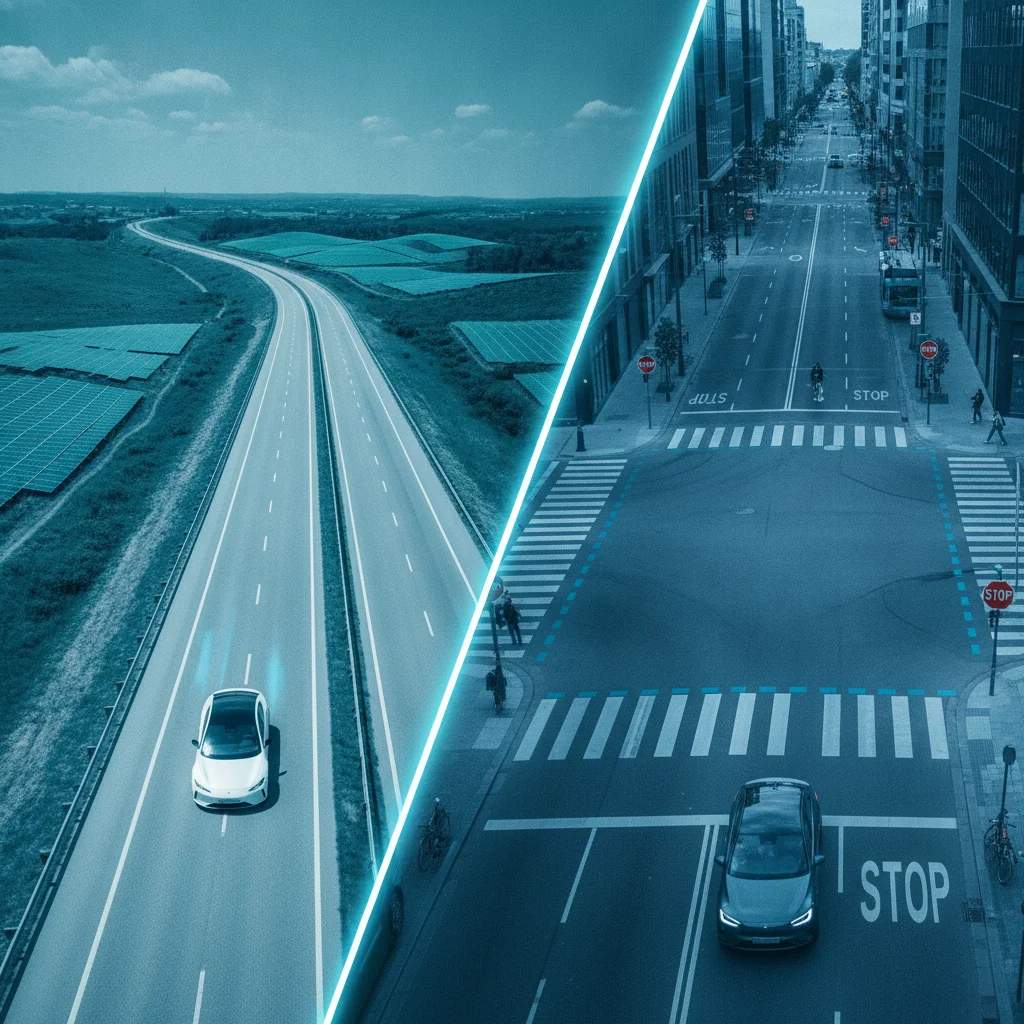
Option A
City Driving
The unexpected efficiency champion for EV owners.
Best for: Commuters and urban drivers who benefit from regenerative braking and lower average speeds.
Option B
Highway Driving
The range-draining reality of sustained high-speed travel.
Best for: Road-trippers and long-distance commuters who need accurate range planning and charging stop strategy.
If you primarily commute within a city or suburb
City Driving
Stop-and-go patterns allow regenerative braking to recapture energy, pushing real-world efficiency well above EPA estimates in many cases.
If you frequently drive long highway stretches
Highway Driving
Plan conservatively — expect 20–30% less range than the rated figure and map DC fast charger locations before departing.
If you mix city and highway driving regularly
City Driving
City segments in a mixed commute can partially offset the efficiency penalty of highway portions, but total range will still fall between the two extremes.
If you are choosing between EV models and want the best highway range
Highway Driving
Prioritize models with higher EPA highway ratings, larger battery packs, and low drag coefficients (Cd below 0.25) for road-trip scenarios.
If you are setting a charging routine or budget
City Driving
City-dominant drivers typically see lower per-mile energy costs and can rely on overnight Level 2 home charging without frequent public charging stops.
Why EVs Flip the Efficiency Script
Every driver who has owned a gasoline car carries the same assumption: highways are efficient, cities are wasteful. Steady cruising at 65 mph burns fuel predictably; stop-and-go traffic means constant acceleration from rest, and all that energy bleeds away as heat in the brakes. The EPA highway figure has always been the more flattering number on the window sticker.
Electric vehicles break that rule — and they break it decisively. When engineers replaced the internal combustion engine with an electric motor and a battery pack, they also changed the physics of where energy is lost. Understanding that shift is essential for anyone trying to set realistic range expectations, plan a charging routine, or simply decide which EV fits their life. See our plain-language guide to how EVs work if you want a deeper grounding in the hardware behind these differences.
The short explanation: gasoline engines are thermally inefficient at low loads and idle, wasting energy even when the car is standing still. Electric motors are near-perfectly efficient across their operating range and consume essentially zero energy at rest. The more nuanced explanation — involving aerodynamics, regenerative braking, and accessory loads — is where the real-world range numbers are made or lost.
This article uses that physics as its framework, contrasting city and highway drive cycles across efficiency, range, energy cost, and charging implications. The goal is not to declare a winner for all drivers — it is to give you the data to identify which environment dominates your own driving, and what that means for the EV you should buy or the range you should expect.
The Physics: Regenerative Braking vs. Aerodynamic Drag
Two forces define the efficiency gap between city and highway EV driving, and they push in opposite directions depending on speed.
Regenerative Braking: The City Advantage
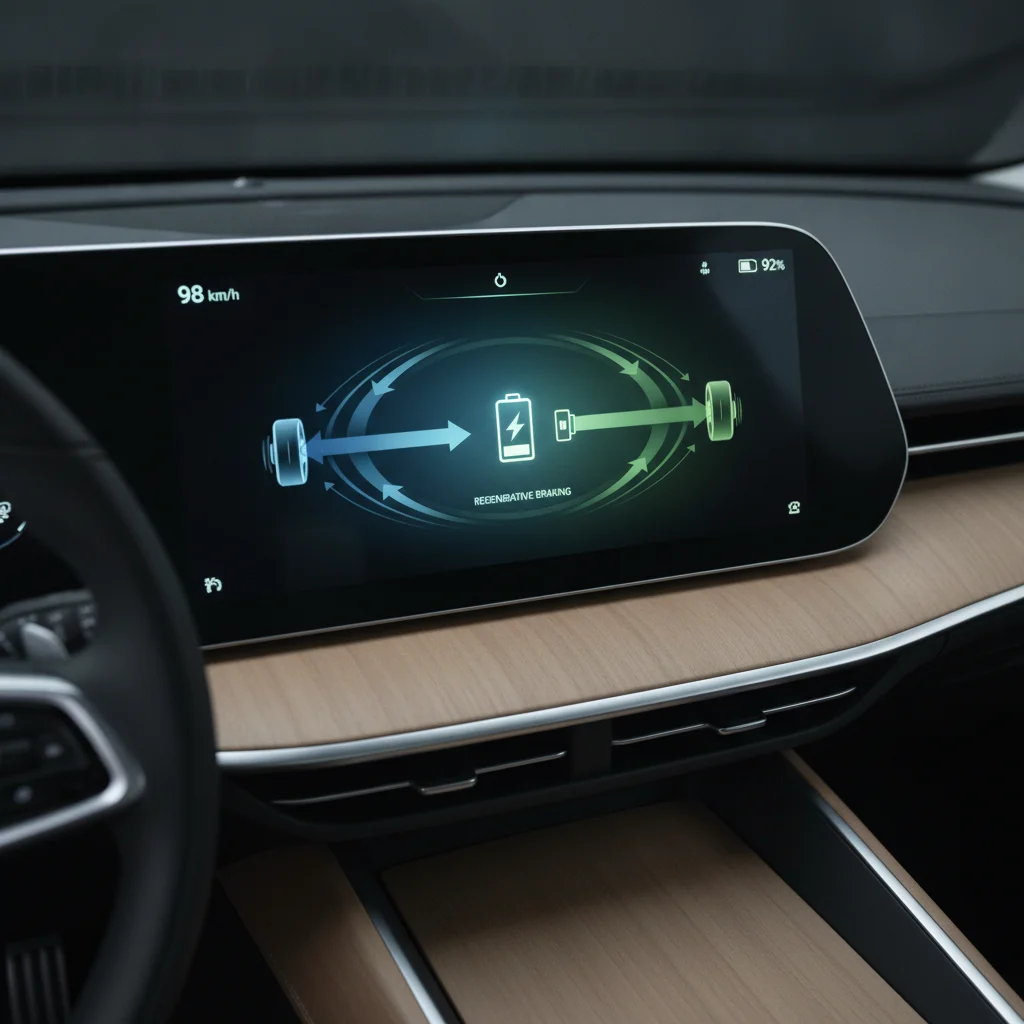
When a gasoline car brakes, kinetic energy converts to heat through friction and is discarded. When an EV brakes — or simply lifts off the accelerator — its electric motor runs in reverse as a generator, converting kinetic energy back into electricity and returning it to the battery. This process is called regenerative braking, and it is the primary reason EVs thrive in urban environments.
In real-world city driving, a meaningful portion of the energy used to accelerate can be recovered. Studies and onboard telemetry data from fleet operators consistently show regenerative braking recovering between 15% and 25% of total energy expended per urban trip, with some aggressive one-pedal driving scenarios recovering more. The exact figure depends on the vehicle's regen system, the driver's technique, and traffic density — but the directional benefit is unambiguous and substantial.
One-Pedal Driving and Regen Settings
Most modern EVs allow drivers to adjust the strength of regenerative braking, and many offer a 'one-pedal' mode where lifting off the accelerator decelerates the car strongly enough to come to a near-complete stop. In city driving, one-pedal mode maximizes energy recovery and reduces brake wear simultaneously. On the highway, where regen events are rare, the setting has little practical effect on range.
EPA Test Cycle Speed Limits
The EPA's highway fuel economy test (HWFET) has a maximum speed of just 60 mph and an average of around 48 mph — well below the 70–80 mph that characterizes real American highway driving. This is the primary reason EV owners frequently report worse highway range than the window sticker suggests. Some automakers publish separate real-world range estimates at 70 mph; Edmunds conducts standardized highway range tests at a consistent 70 mph as an independent benchmark.
PHEVs Behave Differently
Plug-in hybrid electric vehicles (PHEVs) do not follow the same efficiency reversal as battery-electric vehicles. On EV-only mode at city speeds, they benefit from regen like a BEV. But when the gasoline engine engages — which typically happens at highway speeds or when the battery is depleted — their efficiency patterns revert closer to a conventional hybrid or gasoline vehicle. If your driving is predominantly highway, a PHEV's electric range advantage shrinks considerably.
Highway driving offers almost no braking events. Traffic flows continuously, and when deceleration does occur, it is typically gradual enough that regen contribution is minimal. The efficiency mechanism that makes EVs work so well in cities is simply absent on the open road.
Aerodynamic Drag: The Highway Penalty
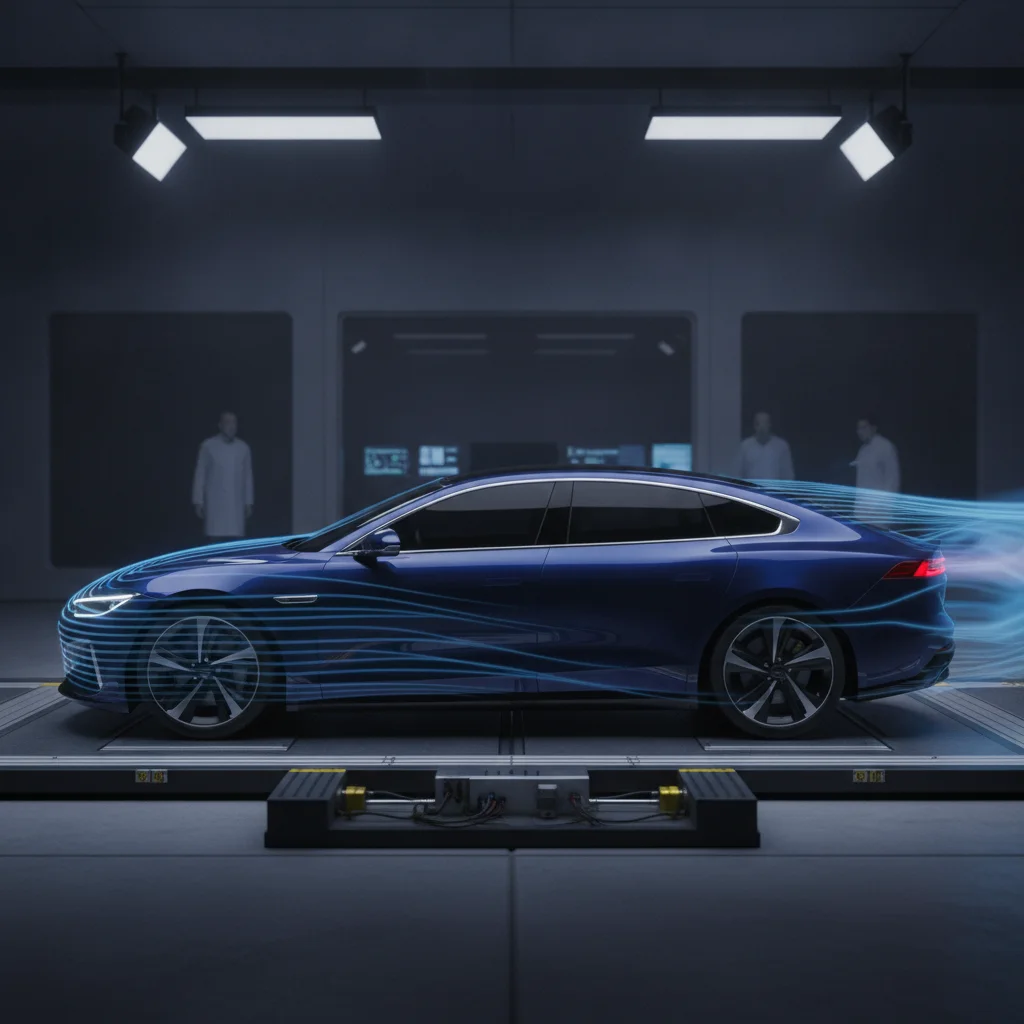
Aerodynamic drag force scales with the square of vehicle speed, and the power required to overcome it scales with the cube. Doubling your speed from 30 mph to 60 mph increases the drag force fourfold and the power demand eightfold. This is not specific to EVs — it is fundamental fluid dynamics — but it hits EVs differently because their energy source is finite and on board.
At 70 mph, a typical mid-size EV sedan is expending a majority of its drive energy purely on overcoming air resistance. At 30 mph in city traffic, that same vehicle's drag load is a fraction of its total energy demand. The difference in efficiency between 55 mph and 75 mph alone can amount to 15–20% more energy per mile, depending on the vehicle's drag coefficient (Cd). This is why manufacturers like Tesla, Hyundai, and Mercedes have invested heavily in achieving Cd values below 0.23 for their long-range models — aerodynamics matter enormously on the highway.
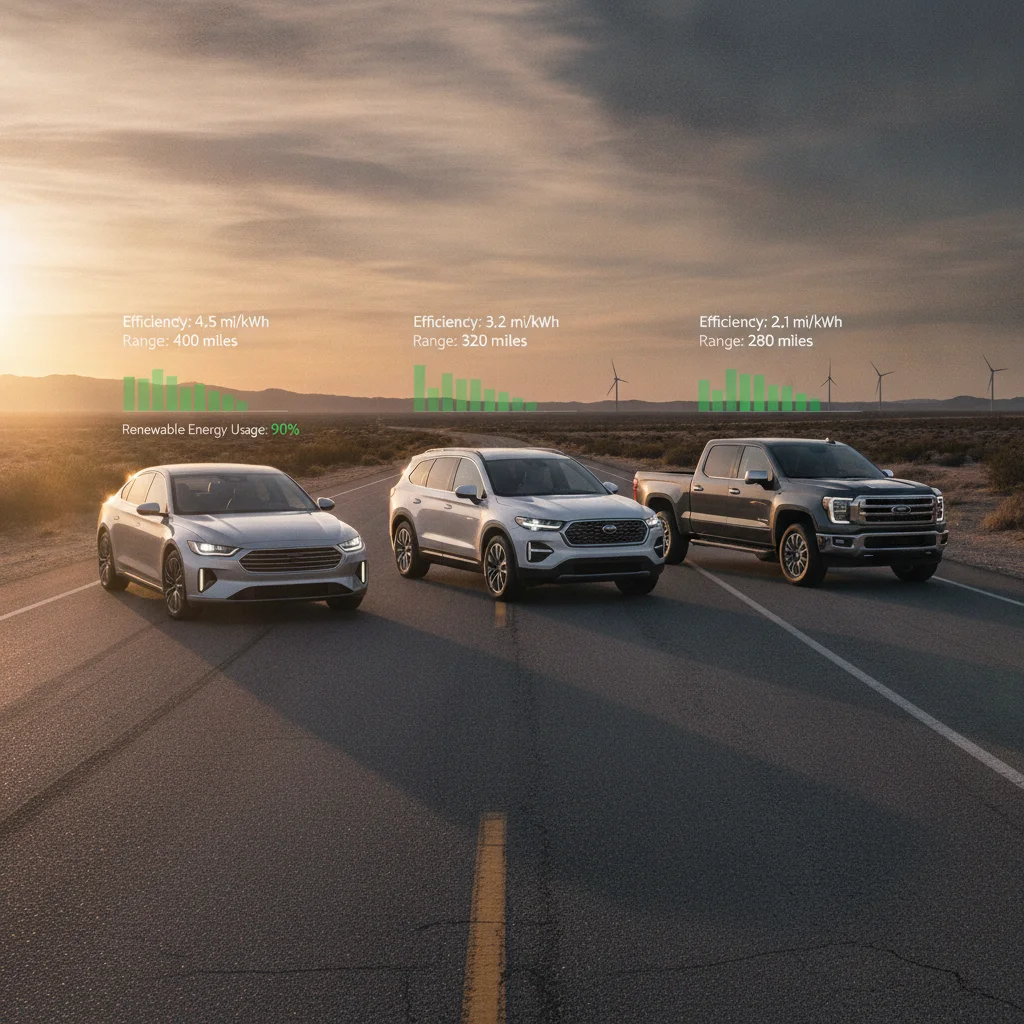
For context on how body style compounds these effects, our analysis of EV efficiency across sedans, SUVs, and trucks shows that a full-size electric truck can consume 50% more energy per mile at highway speeds than a compact sedan, driven largely by frontal area and drag.
| Criterion | City Driving | Highway Driving |
|---|---|---|
| Typical efficiency vs. EPA rating | 100–115% of EPA figure | 70–85% of EPA figure |
| Regenerative braking contribution | High (15–25% energy recovered) | Minimal (few braking events) |
| Aerodynamic drag impact | Low (speeds under 40 mph) | High (scales with speed cubed) |
| Average speed | 15–35 mph | 55–80 mph |
| HVAC impact on range | Moderate — fixed load, slower miles | High — faster battery draw rate |
| Charging requirement | Overnight Level 2 typically sufficient | DC fast charging stops required |
| Cost per mile (electricity) | $0.03–$0.08 (home charging) | $0.08–$0.20 (DC fast charging) |
| Range anxiety risk | Low for most battery sizes | Moderate to high without planning |
| Best vehicle priority | Efficient regen system, lower cost | Low Cd, large battery, fast charge rate |
Real-World Range: What the Numbers Actually Show
EPA ratings are generated using a standardized drive cycle that blends city and highway patterns, weighting each according to average American driving behavior. The city portion of that cycle — the FTP-75 — is relatively slow and stop-heavy. The highway portion — the HWFET — tops out at just 60 mph. Real-world highway driving in the United States routinely involves sustained speeds of 70–80 mph, which is meaningfully faster than the test cycle assumes.
~25%
Energy recovered via regen braking in city driving
Fleet telemetry and academic studies consistently show regenerative braking recovering 15–25% of total energy expended on urban drive cycles.
20–30%
Real-world highway range shortfall vs. EPA rating
Independent testing by Edmunds and owner data aggregated by Recurrent show sustained 70+ mph driving regularly produces this deficit versus the window sticker figure.
4×
Drag force increase when doubling speed
Aerodynamic drag scales with the square of vehicle speed — a fundamental physics relationship that disproportionately penalizes high-speed EV driving.
15–20%
Efficiency gain from reducing highway speed 10 mph
Dropping from 75 mph to 65 mph can recover approximately 15–20% of energy per mile, based on drag coefficient modeling for typical mid-size EVs.
30–40%
Range reduction in severe cold at highway speeds
AAA and Recurrent research shows battery-electric vehicles can lose 30–40% of rated range when temperatures fall below 20°F, with highway trips most exposed to this effect.
The consequence is predictable: highway-dominant drivers consistently report real-world range below the EPA estimate, while city-dominant drivers frequently beat it. Data aggregated by sites like Recurrent and PlugShare, as well as consumer surveys by J.D. Power and Consumer Reports, point to the same pattern. Urban drivers in temperate climates often achieve 100–110% of their rated range. Long-haul highway drivers in the same climate might see 70–80% of rated range.
Temperature compounds this effect. At highway speeds, cabin climate control — heating in winter, air conditioning in summer — draws power from the same battery as propulsion. At city speeds, where the climate load is a larger fraction of a smaller total energy demand, the proportional impact is similar, but slower speeds mean the car spends more time in the temperature-controlled cabin per mile anyway. The critical difference: at highway speeds, you are burning through miles quickly, so a fixed climate load drains proportionally more of your remaining range before your next charging opportunity.
For a direct comparison with how gasoline vehicles behave in the same environments, see our piece on where fuel actually goes in city vs. highway driving. The contrast with EV behavior is clarifying.
Efficiency by the Numbers: A Sample Comparison
Take a 2024 mid-size EV sedan with an EPA-rated range of 300 miles and a combined efficiency of approximately 3.5 miles per kilowatt-hour (mi/kWh):
- City driving (mixed urban, ~25 mph average): ~4.0–4.5 mi/kWh → effective range 340–385 miles
- EPA combined cycle: ~3.5 mi/kWh → 300 miles
- Highway at 65 mph: ~3.0–3.2 mi/kWh → effective range 255–275 miles
- Highway at 75 mph: ~2.5–2.7 mi/kWh → effective range 215–230 miles
These figures will vary by model, payload, tire pressure, and conditions — but the directional relationship holds across virtually every battery-electric vehicle currently on sale.
Charging Strategy: How Your Drive Cycle Shapes Your Charging Needs
Efficiency differences translate directly into practical charging decisions. City drivers and highway drivers essentially operate in different charging paradigms, and recognizing which one describes you will save money and reduce range anxiety.
City Commuters: The Home Charging Advantage
Urban and suburban drivers who cover 30–60 miles per day in city or mixed conditions are the natural beneficiaries of EV ownership. Their higher efficiency means each kilowatt-hour stretches further, their overnight Level 2 home charger (typically 7.2–11.5 kW) replenishes the battery fully by morning, and public fast charging is rarely needed. The economics are compelling: charging at home during off-peak rates in most U.S. markets costs $0.03–$0.08 per mile, compared to $0.12–$0.18 per mile for gasoline at current national average prices.
For more on how annual mileage interacts with these economics, our comparison of high-mileage vs. low-mileage driver savings breaks down the numbers at different usage levels.
Highway Drivers: Planning Around DC Fast Charging
Long-distance drivers face a fundamentally different challenge. With real-world highway efficiency running 20–30% below EPA ratings, a 300-mile rated vehicle becomes a practical 210–240-mile vehicle on the highway — less in cold weather or at higher speeds. Effective road-trip planning means treating 80% of remaining charge (not 100%) as the usable buffer, since charging from 80% to 100% on most lithium-ion batteries is significantly slower due to charge curve tapering.
Practically, that means planning DC fast-charging stops every 150–200 miles on a highway trip, depending on the vehicle and conditions. The growing Supercharger network, Electrify America, and EVgo are solving the infrastructure side of this equation — but the problem of reduced highway efficiency remains inherent to battery physics. Our deeper look at urban vs. highway charging infrastructure explains how networks are adapting to serve both driver types.

One underappreciated tip for highway drivers: reducing cruise speed by 5–10 mph has a disproportionately large efficiency benefit. Dropping from 75 mph to 65 mph can recover 15–20% of efficiency, potentially eliminating the need for an additional charging stop on a long trip. The aerodynamic math makes speed discipline one of the highest-leverage actions an EV driver can take on the highway.
Accessories, HVAC, and Other Range Factors
Beyond the two dominant forces — regen and drag — several secondary factors affect efficiency differently in city versus highway conditions.
HVAC Load
Heating and air conditioning draw power directly from the traction battery in most BEVs. A typical EV heat pump or resistive heater can consume 1–5 kW of power depending on outside temperature and cabin setpoint. At highway speeds where the vehicle is covering ground quickly, this fixed load represents a smaller fraction of energy per mile than it would at city speeds — but the faster depletion of the battery at highway speeds means you reach your next charging stop sooner regardless. In severe cold (below 20°F), resistive heating can reduce effective range by 30–40%, an effect that is more dramatic on highway trips where range buffers are already smaller.
Tire Pressure and Rolling Resistance
Under-inflated tires increase rolling resistance, which hurts efficiency at all speeds but is most noticeable in city driving where drag is not the dominant energy demand. Keeping tires at the manufacturer-recommended pressure — or slightly above for efficiency-focused drivers — is a low-effort gain across both environments.
Traffic-Adaptive Driving
Predictive driving — reading traffic ahead, coasting early, avoiding hard acceleration — pays dividends in both city and highway settings, but especially in cities where it maximizes regen capture. Many modern EVs now offer navigation-integrated predictive regen that adjusts motor braking based on upcoming traffic signals or elevation changes, squeezing additional efficiency from urban routes.
If you are still evaluating whether an EV suits your specific driving habits, the guide questions to ask before choosing an EV type walks through commute patterns, charging access, and range needs in practical terms.
Setting Realistic Range Expectations
The most common source of EV range disappointment is treating the EPA number as a fixed output rather than a reference point calibrated to a specific drive cycle. Real-world range is a variable, not a constant — and the single biggest driver of that variability is whether you spend more time on the highway or in the city.
A practical framework for any prospective or current EV owner:
- Identify your dominant drive cycle. What percentage of your weekly miles are highway versus city? If more than 60% is highway, plan around 75–80% of EPA range as your conservative estimate.
- Adjust for climate. Cold winters reduce range further; temperate climates are closer to EPA figures year-round.
- Choose a vehicle whose highway efficiency suits your longest regular trip. Cd, battery size, and onboard charge curve all affect highway usability more than city range.
- Use the vehicle's energy consumption display. Modern EVs show real-time and trip-averaged efficiency in mi/kWh or kWh/100mi. Monitoring these figures builds intuition quickly.
- Don't over-size the battery out of anxiety. City drivers in particular often find a smaller, lighter, more affordable battery pack fully meets their needs — and lighter vehicles are more efficient too.

The EPA is aware of the highway speed discrepancy and has periodically discussed updating test protocols to include higher sustained speeds. Until that happens, independent testing by outlets like Edmunds — which tests highway range at a consistent 70 mph — provides more realistic highway benchmarks than the official window sticker.
Ultimately, understanding where EVs are most efficient is not just a technical curiosity. It is the foundation of smart EV ownership: choosing the right vehicle, setting the right charging routine, and arriving at your destination with confidence rather than anxiety. The physics favors city drivers — but highway drivers can close much of the gap with informed planning and a modest adjustment to cruise speed.
All claims are backed by peer-reviewed research. Sources on request.