
Key Takeaways
Our Verdict
For most drivers who charge at home and cover moderate to high annual mileage, a battery-electric vehicle is cheaper to fuel over 100,000 miles than any hybrid variant — often by a margin of $3,000 to $5,500. However, plug-in hybrids earn their keep for drivers who frequently travel long distances, live in high-rate electricity markets, or lack reliable home charging access. The math is never one-size-fits-all, and your specific electricity rate and driving pattern matter more than the powertrain label on the window sticker.
| Best for | Recommended |
|---|---|
| High-mileage home chargers in low electricity rate regions | Battery EV (BEV) |
| Frequent long-distance drivers or those without home charging | Plug-In Hybrid (PHEV) |
| Urban commuters wanting lowest per-mile fuel cost with no range anxiety | Battery EV (BEV) |
| Mixed city-highway drivers in high-electricity-rate markets | Full Hybrid (HEV) |
Why 100,000 Miles Is the Right Benchmark
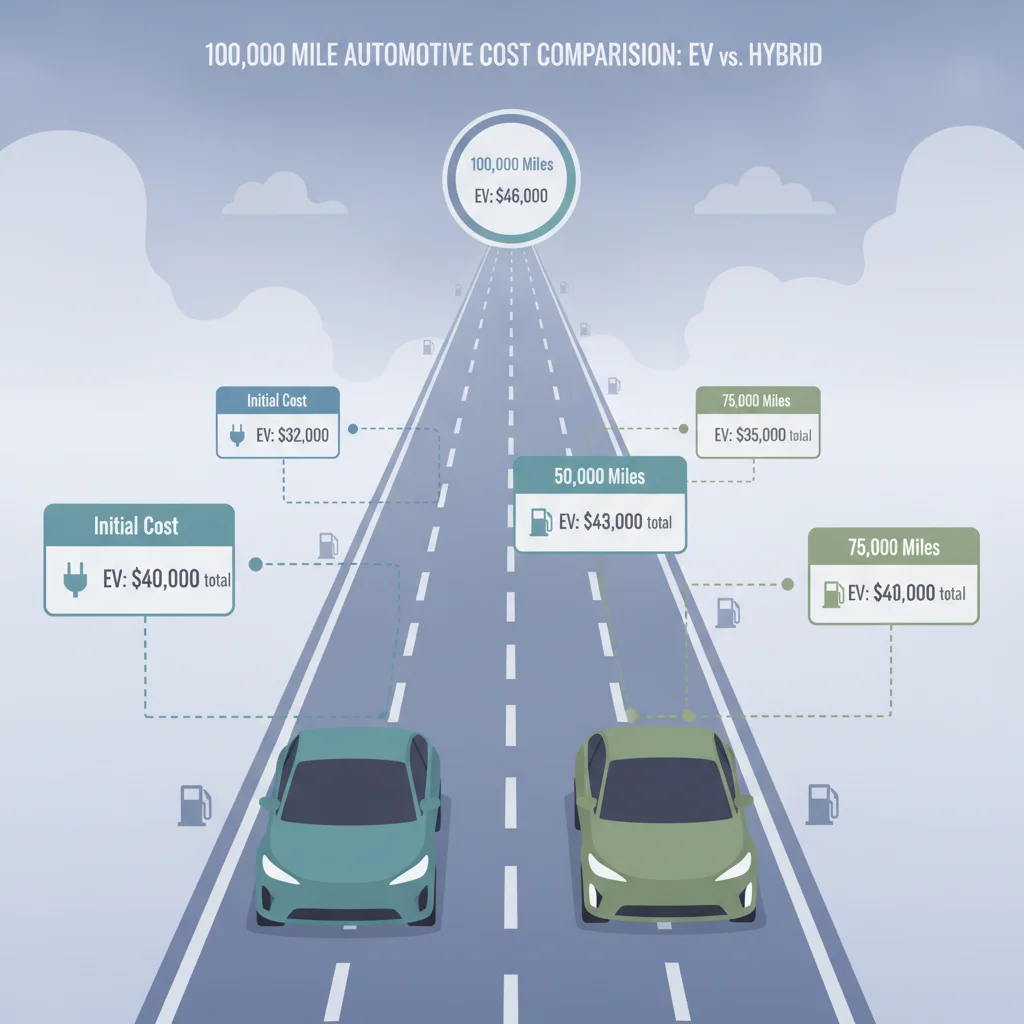
A single tank of gas or one charging session tells you almost nothing about long-run fuel economics. The real story emerges over tens of thousands of miles, where small per-mile differences compound into sums large enough to influence a buying decision. The 100,000-mile benchmark is useful precisely because it represents a realistic ownership window — roughly seven to ten years for the average American driver — and it's long enough for the structural cost differences between powertrains to fully surface.
This analysis compares three powertrain categories: battery-electric vehicles (BEVs), plug-in hybrid electric vehicles (PHEVs), and conventional full hybrids (HEVs). Each carries its own fueling logic. BEVs run exclusively on grid electricity. PHEVs draw from both a battery and a gasoline engine, with the ratio depending on daily mileage and charging discipline. HEVs burn gasoline but recover energy through regenerative braking, never needing a plug. For a deeper look at how those distinctions reshape ownership costs day-to-day, see Full Hybrid vs. Plug-In Hybrid: The Charging Question That Changes Everything.
The variables that matter most in this comparison: your local electricity rate, local gasoline price, how many miles per day you drive, and whether you have access to home charging. We'll walk through each scenario with real numbers.
Building the Model: Assumptions and Variables
To produce apples-to-apples comparisons, we need a consistent set of baseline assumptions. The vehicles used as proxies are representative of their class rather than any single model:
- BEV benchmark: 3.5 miles per kWh efficiency (roughly equivalent to a mid-size EV sedan at mixed driving)
- PHEV benchmark: 35 miles all-electric range, 45 MPG in hybrid mode after battery depletion
- HEV benchmark: 50 MPG combined (no plug-in capability)
Electricity and gasoline price inputs are drawn from U.S. Energy Information Administration (EIA) data. The national average residential electricity rate sits at approximately $0.17 per kWh as of early 2025. National average gasoline hovers near $3.30 per gallon. We model three electricity scenarios — $0.12/kWh (low-rate states like Louisiana or Washington), $0.17/kWh (national average), and $0.26/kWh (high-rate states like California or Hawaii) — and two gasoline scenarios ($2.80/gallon and $3.80/gallon) to capture regional and market variation.
For PHEVs, the electric-to-gasoline split is the trickiest assumption. A PHEV owner who commutes 25 miles daily and charges every night will run almost entirely electric. One who commutes 70 miles daily or rarely charges runs predominantly on gasoline. We model both: a plug-in disciplined driver (80% electric miles) and a charge-neglecting driver (30% electric miles).
$0.17/kWh
U.S. average residential electricity rate
According to the U.S. Energy Information Administration (EIA), the national average residential electricity rate in early 2025 is approximately $0.17 per kWh.
3.5 mi/kWh
Typical mid-size BEV efficiency
Most mid-size battery-electric sedans and crossovers achieve between 3.0 and 4.0 miles per kWh in mixed driving conditions per EPA testing.
$0.40–$0.56/kWh
National median public DC fast charge rate
Public DC fast charging at major U.S. networks typically costs two to three times the residential electricity rate, significantly increasing per-mile fuel cost for frequent users.
$3,000–$5,000
BEV maintenance savings over 100,000 miles
Industry estimates from Consumer Reports and AAA suggest battery EVs save roughly $3,000–$5,000 in maintenance compared to equivalent gasoline vehicles over a typical ownership period.
10–25%
Typical EV insurance premium increase
Multiple insurer and industry studies indicate battery-electric vehicles carry premiums 10–25% higher than equivalent gasoline models due to elevated repair and parts costs.
For a detailed breakdown of what electricity actually costs per mile at different rates, the article The True Cost of Charging an EV: What the Math Actually Shows provides the foundational math behind these figures.
The Numbers: Fuel Cost Over 100,000 Miles
With the model in place, here is what 100,000 miles of fuel actually costs across powertrain types and rate scenarios. All figures assume home charging for BEV and PHEV scenarios; DC fast charging costs are addressed separately below.
| BEV (Home Charging) | PHEV (Disciplined) | PHEV (Neglected) | Full HEV | |
|---|---|---|---|---|
| Fuel cost at $0.12/kWh & $3.30/gal | $3,429 | $4,100 | $5,700 | $6,600 |
| Fuel cost at $0.17/kWh & $3.30/gal | $4,857 | $5,400 | $6,100 | $6,600 |
| Fuel cost at $0.26/kWh & $3.30/gal | $7,429 | $6,500 | $6,600 | $6,600 |
| Fuel cost at $0.17/kWh & $3.80/gal | $4,857 | $5,250 | $5,900 | $7,600 |
| Fuel cost with 40% public fast charging ($0.48/kWh) | $8,857 | N/A | N/A | $6,600 |
| Home charging required | Essential | Strongly recommended | Optional | Not needed |
| Long-distance fuel flexibility | Limited by charger access | High | High | High |
| Fueling simplicity | High (if home charger) | Moderate | High | Very High |
The most striking finding in the data: at the national average electricity rate of $0.17/kWh, a BEV owner spending nothing on gasoline pays roughly $4,857 in electricity over 100,000 miles (at 3.5 mi/kWh). A full hybrid owner at $3.30/gallon pays approximately $6,600 in gasoline. The gap — just over $1,700 — widens or narrows dramatically depending on local rates.
A PHEV driver who maintains charging discipline (80% electric miles) spends roughly $5,400 combined — nearly as economical as the BEV, but still higher. A PHEV driver who rarely plugs in (30% electric miles) essentially bleeds toward HEV territory: approximately $6,100 in combined fuel costs, nearly erasing the advantage of having a plug at all.
Time-of-Use Rates Can Sharpen Your BEV Advantage
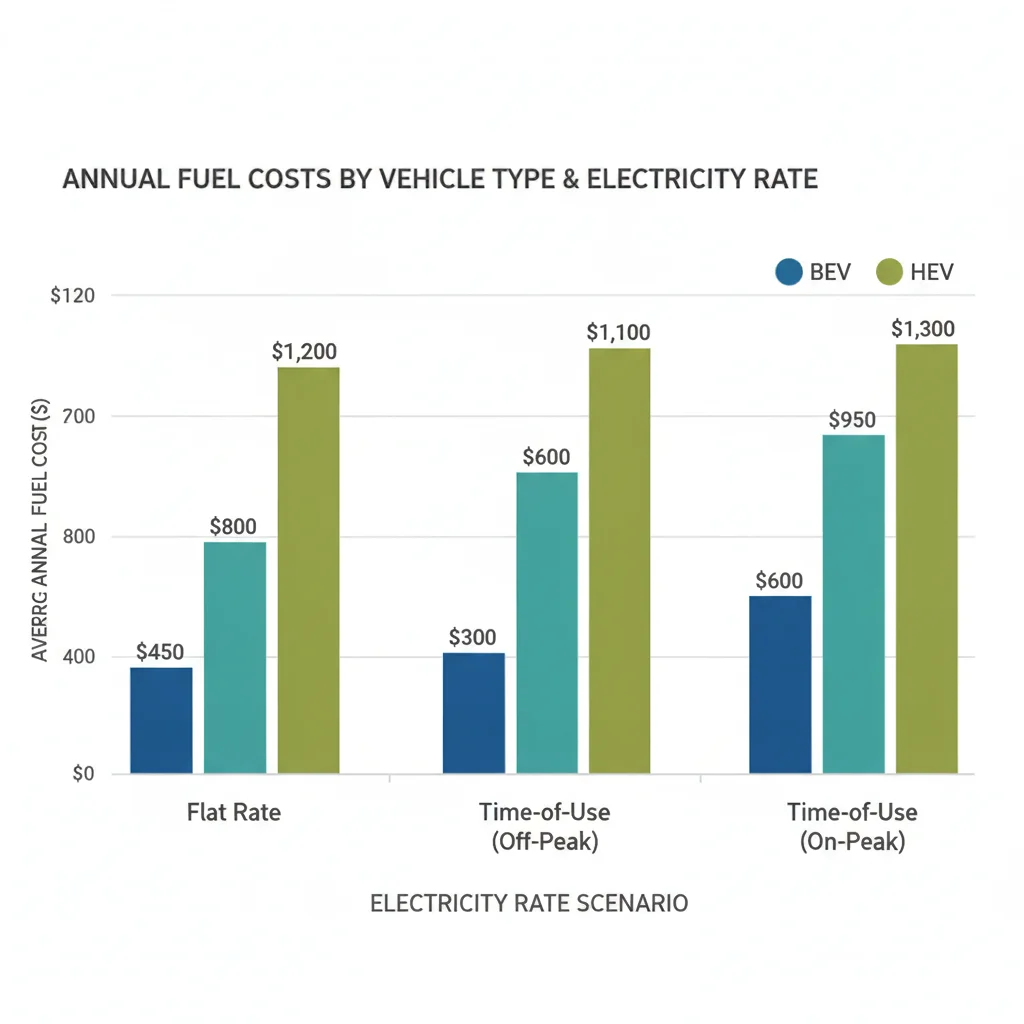
Many utilities offer time-of-use (TOU) pricing plans that charge as little as $0.09–$0.12/kWh during overnight off-peak hours — precisely when most EV owners charge. Enrolling in a TOU plan and setting your car to charge between midnight and 6 a.m. can reduce your effective charging rate by 30–40% versus the standard residential tariff. This single step can add $1,000–$1,500 to your BEV's 100,000-mile fuel advantage over a hybrid.
PHEV Savings Hinge on Charging Consistency
A plug-in hybrid that is never plugged in is effectively just an expensive conventional hybrid — you pay for the battery without capturing its fuel-cost benefit. Studies have found that a significant share of PHEV owners charge infrequently, sometimes because home charging setup was never completed after purchase. Before buying a PHEV, confirm you have a functional Level 1 or Level 2 charging solution in place, and budget the discipline to use it nightly.
At California's average residential rate of $0.26/kWh, the BEV's cost climbs to roughly $7,429 — actually more expensive than a 50 MPG hybrid at $3.30/gallon in that same market. This is why blanket statements like "EVs are always cheaper to fuel" require a geographic qualifier.
You can explore how these per-mile figures map across gasoline vs. electricity in more detail via Gasoline vs. Electricity: A Per-Mile Fuel Cost Breakdown.
The Public Charging Penalty: What It Does to the BEV Advantage
Every BEV cost analysis that stops at home charging rates is telling only half the story. Public DC fast charging — the kind used on road trips and by drivers without home charging access — costs dramatically more per kWh than residential electricity. The national median at major networks currently runs between $0.40 and $0.56 per kWh, with some networks billing by the minute rather than energy delivered, further inflating per-mile costs.
A BEV driver who relies on public fast charging for 40% of their miles — a realistic scenario for apartment dwellers — faces a blended rate that can exceed $0.30/kWh. Run those numbers out to 100,000 miles and the total electricity cost climbs to approximately $8,500–$9,200. At that point, a 50 MPG hybrid at average gasoline prices is cheaper to fuel over the same distance.
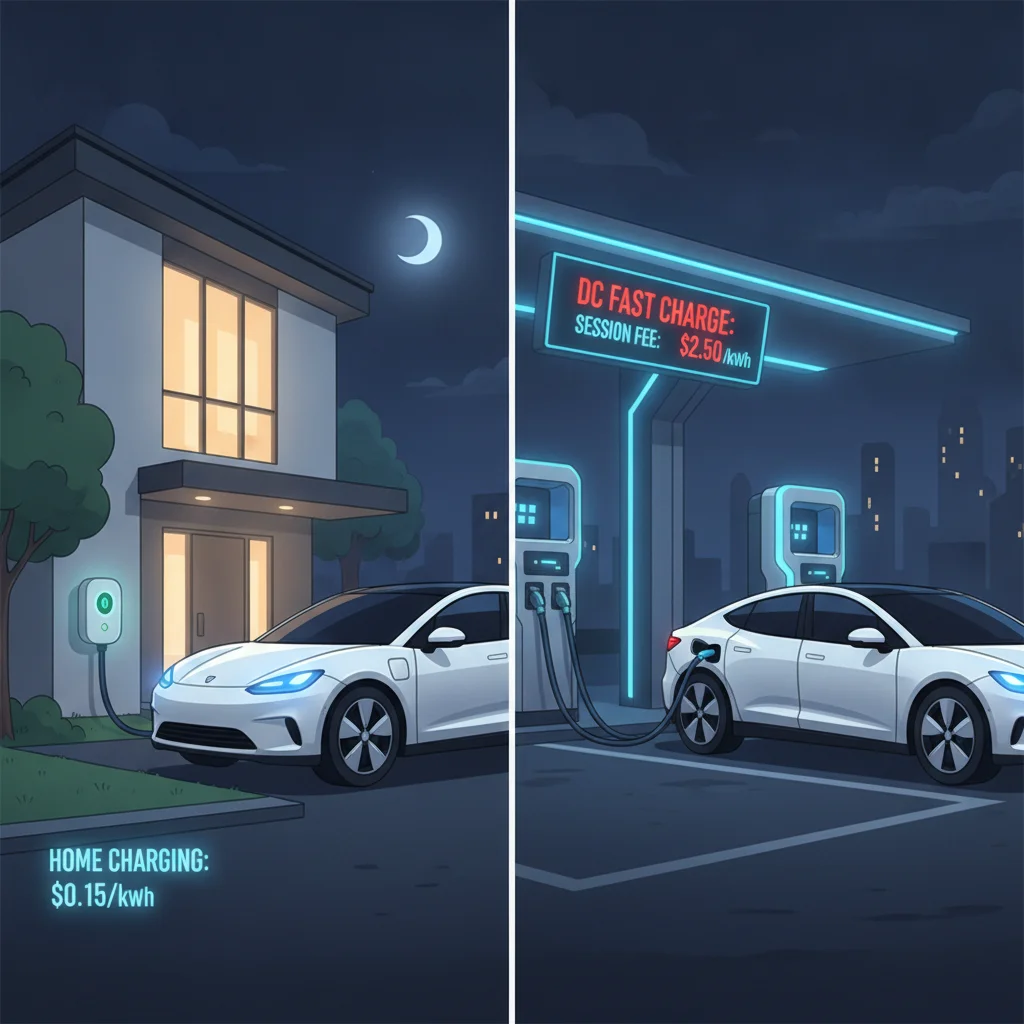
This is where the PHEV makes a compelling case for a specific driver: someone without home charging who drives moderate annual miles. A PHEV's gasoline fallback means it never needs expensive public DC fast charging sessions to cover basic daily needs. The PHEV's electric range handles local errands; the gasoline engine covers longer runs where public fast charging would otherwise be necessary for a BEV.
Public Charging Reliance Can Flip the BEV Equation
If you live in an apartment or condo without dedicated parking, do not assume a BEV will be cheaper to fuel than a hybrid simply because electricity is cheaper than gasoline. At $0.48/kWh or higher — common at highway fast chargers — a BEV can cost more per mile to fuel than a 50 MPG hybrid. Verify your charging access situation honestly before committing to a full BEV. A PHEV may deliver better economics if reliable home charging is not available.
Don't Overlook Rising Electricity Rates
Residential electricity rates in several U.S. states have risen 15–30% over the past three years, and grid modernization costs may continue pushing them higher. A fuel cost estimate based on today's $0.17/kWh average could look quite different in year five of ownership. Run your BEV vs. hybrid comparison at a conservatively higher rate — say $0.22/kWh — to stress-test your assumptions before signing a purchase agreement.
Annual mileage interacts with this dynamic in important ways. High-mileage drivers — those covering 20,000+ miles per year — benefit more from every cent of per-mile savings, meaning the home-charging BEV advantage compounds faster for them. Low-mileage drivers may never recoup the EV premium in fuel savings alone. See how mileage shifts the math in High-Mileage vs. Low-Mileage Drivers: Which EV Type Saves You More.
Driving Pattern Scenarios: Three Real-World Profiles
Abstract numbers become more useful when attached to actual driving behaviors. Here are three composite driver profiles and what the 100,000-mile fuel math looks like for each.
Profile 1: The Urban Commuter (Daily: 30 miles, Home Charger, Low Trips)
This driver charges every night, rarely needs a road trip fast charge, and covers about 12,000 miles per year. At $0.17/kWh, their BEV costs approximately $4,857 over 100,000 miles. Their PHEV alternative, if disciplined about charging, costs around $5,200. A full hybrid costs them $6,600. The BEV wins by a wide margin, and this is the profile most EV marketing materials implicitly assume.
Profile 2: The Suburban Highway Commuter (Daily: 60 miles, Home Charger, Regular Road Trips)
This driver charges at home but also uses public fast charging for quarterly long-distance trips, accounting for roughly 15% of annual miles. Their blended BEV electricity cost rises to approximately $5,600 over 100,000 miles. A PHEV that stays mostly electric on the 60-mile daily run but uses gasoline on road trips costs around $5,800. The BEV still leads, but narrowly. An HEV at this driver's highway-heavy pace might only achieve 46 MPG, pushing their 100,000-mile gasoline bill to $7,174 at $3.30/gallon.
Profile 3: The Apartment Dweller (No Home Charger, Mixed Public and Workplace Charging)
This driver relies on Level 2 workplace charging (approximately $0.20/kWh) for 60% of miles and public fast charging ($0.48/kWh) for 40% of miles. Blended rate: roughly $0.31/kWh. Their BEV costs approximately $8,857 to fuel over 100,000 miles — more expensive than a 50 MPG hybrid at any reasonable gasoline price. A PHEV that uses electricity for local miles and gasoline for longer runs becomes genuinely competitive here, at approximately $6,100 combined. The full hybrid, requiring no charging infrastructure at all, costs $6,600 and still beats the public-charging BEV.

Beyond Fuel: Maintenance and Insurance in the Total Picture
A fuel-cost-only analysis leaves money on the table — or overlooks money left in it. BEVs carry structural maintenance advantages: no oil changes, fewer brake jobs due to regenerative braking, no timing belts, fewer fluid services. Over 100,000 miles, these savings typically run $3,000–$5,000 compared to a gasoline vehicle. PHEVs split the difference — the gasoline engine still requires oil changes and conventional maintenance, though at reduced frequency if electric miles dominate.
The full maintenance comparison between EVs and conventional vehicles is detailed in EV Maintenance vs. Gas Car Maintenance: A Full Cost and Task Breakdown. For this comparison, maintenance gives BEVs an additional tailwind that partially offsets scenarios where their fuel cost advantage narrows.
Insurance tells a more complicated story. EVs generally carry higher premiums than equivalent gasoline vehicles — typically 10–25% more — because repair costs are higher and replacement parts remain more expensive. PHEVs face slightly elevated premiums versus standard HEVs but generally less than full BEVs. Over 100,000 miles, the insurance differential between a BEV and an HEV might run $800–$2,000 in the HEV's favor, depending on insurer, state, and vehicle. For a closer look at EV-specific insurance dynamics, see EV Insurance Guide.
Adding maintenance savings and insurance penalties together, the BEV's all-in advantage over an HEV typically survives — but it shrinks. The PHEV sits in an ambiguous middle position: better maintenance costs than an HEV, similar or slightly better insurance than a BEV, and fuel costs that depend almost entirely on charging discipline.
Time-of-Use Rates Can Sharpen Your BEV Advantage
Many utilities offer time-of-use (TOU) pricing plans that charge as little as $0.09–$0.12/kWh during overnight off-peak hours — precisely when most EV owners charge. Enrolling in a TOU plan and setting your car to charge between midnight and 6 a.m. can reduce your effective charging rate by 30–40% versus the standard residential tariff. This single step can add $1,000–$1,500 to your BEV's 100,000-mile fuel advantage over a hybrid.
PHEV Savings Hinge on Charging Consistency
A plug-in hybrid that is never plugged in is effectively just an expensive conventional hybrid — you pay for the battery without capturing its fuel-cost benefit. Studies have found that a significant share of PHEV owners charge infrequently, sometimes because home charging setup was never completed after purchase. Before buying a PHEV, confirm you have a functional Level 1 or Level 2 charging solution in place, and budget the discipline to use it nightly.
When Each Powertrain Wins — and When It Doesn't
The 100,000-mile comparison produces some consistent patterns that hold across different rate and price scenarios:
BEVs win when:
- Home charging is reliable and electricity costs below $0.20/kWh
- Annual mileage is above 12,000 miles (savings compound faster)
- The driver lives in a state with strong public charging infrastructure, reducing reliance on expensive DC fast charging sessions
- Local gasoline prices are above $3.50/gallon
PHEVs win when:
- The driver lacks home charging but has short daily commutes within all-electric range
- Long-distance driving is frequent, making BEV charging logistics burdensome
- Electricity rates exceed $0.22/kWh
- The driver consistently charges — an undisciplined PHEV owner loses most of the cost advantage
Full HEVs win when:
- No charging access is available at home or work
- Electricity rates are high and gasoline prices are moderate
- The driver prioritizes simplicity over optimization
- Annual mileage is low (below 8,000 miles), making the investment in charging infrastructure or PHEV premium harder to justify
Understanding where your own driving profile falls within the EV Types Explained spectrum is the essential first step before running any fuel cost calculation.
Public Charging Reliance Can Flip the BEV Equation
If you live in an apartment or condo without dedicated parking, do not assume a BEV will be cheaper to fuel than a hybrid simply because electricity is cheaper than gasoline. At $0.48/kWh or higher — common at highway fast chargers — a BEV can cost more per mile to fuel than a 50 MPG hybrid. Verify your charging access situation honestly before committing to a full BEV. A PHEV may deliver better economics if reliable home charging is not available.
Don't Overlook Rising Electricity Rates
Residential electricity rates in several U.S. states have risen 15–30% over the past three years, and grid modernization costs may continue pushing them higher. A fuel cost estimate based on today's $0.17/kWh average could look quite different in year five of ownership. Run your BEV vs. hybrid comparison at a conservatively higher rate — say $0.22/kWh — to stress-test your assumptions before signing a purchase agreement.
How to Run Your Own 100,000-Mile Fuel Estimate
The general model used in this article is straightforward enough to adapt to your own situation. Here's the framework:
- Find your local electricity rate: Check your utility bill for the per-kWh rate, not a bundled estimate. Time-of-use rates — lower at night — can significantly reduce your effective BEV charging cost.
- Estimate your BEV cost per mile: Divide your electricity rate by the vehicle's EPA efficiency in miles per kWh. At $0.17/kWh and 3.5 mi/kWh, that's $0.049 per mile.
- Estimate your HEV cost per mile: Divide local gasoline price by the vehicle's combined MPG. At $3.30/gallon and 50 MPG, that's $0.066 per mile.
- Multiply by 100,000: BEV = $4,900; HEV = $6,600. Difference = $1,700 over 100,000 miles in this example.
- Adjust for public charging share: If 20% of your BEV miles will be on public fast charging at $0.48/kWh, recalculate that portion at $0.137 per mile and blend it into your average.
- Apply the PHEV electric-mile split: Estimate what percentage of your daily miles fall within the PHEV's all-electric range. Apply electricity pricing to that share and gasoline pricing to the remainder.
This calculation gives you a fuel-cost-only snapshot. Add maintenance and insurance differentials for a more complete picture. The EV Types Explained hub has additional tools and comparisons to help you pressure-test your assumptions before committing to a powertrain.
One final note: fuel prices are volatile, and electricity rates are rising in some markets. A comparison that shows a modest BEV advantage today could look dramatically different in five years if gasoline climbs or residential electricity rates spike. Building in a margin of error — or running your estimate at both optimistic and pessimistic price assumptions — gives you a more honest picture of the risk you're accepting with each powertrain choice.
All claims are backed by peer-reviewed research. Sources on request.