Key Takeaways
Our Verdict
Home charging wins on cost for virtually every driver who has access to it, delivering per-mile rates that public DC fast charging simply cannot match. Public fast charging is an essential convenience for road trips and a necessary fallback for those without home access, but leaning on it daily can erode much of the fuel-cost advantage EVs hold over gas vehicles. The smartest EV ownership strategy layers home or workplace charging for routine miles with public fast charging used selectively.
| Best for | Recommended |
|---|---|
| Daily commuters with garage or driveway access | Home Level 2 Charging |
| Long-distance road trippers needing fast top-ups | DC Fast Charging (Public) |
| Apartment or condo dwellers without dedicated parking | Public L2 + Selective DC Fast Charging |
| Commuters whose employer offers free or subsidized charging | Workplace Charging |
Why the Cost Gap Between Home and Public Charging Is Bigger Than It Looks
The advertised price of public EV charging — whether displayed as cents per kilowatt-hour or dollars per minute — rarely tells the full financial story. Network fees, idle penalties, session initiation charges, and premium pricing tiers during peak hours can quietly inflate what you actually pay. Meanwhile, home charging costs are almost entirely transparent: your utility bill goes up, and the math is simple.
To make a fair comparison, cost needs to be expressed the same way for both options: cents per mile driven. That metric accounts for differences in your vehicle's efficiency, the local electricity rate, and the actual price you pay at any given charger — not just the listed rate.
For context, the average U.S. EV consumes roughly 3 to 4 miles per kilowatt-hour (kWh) depending on the vehicle, driving conditions, and climate. A Tesla Model 3 Long Range, for example, achieves around 3.9 miles/kWh in real-world use. A larger SUV like the Rivian R1S might return closer to 2.6 miles/kWh. These efficiency differences compound across every dollar spent charging.
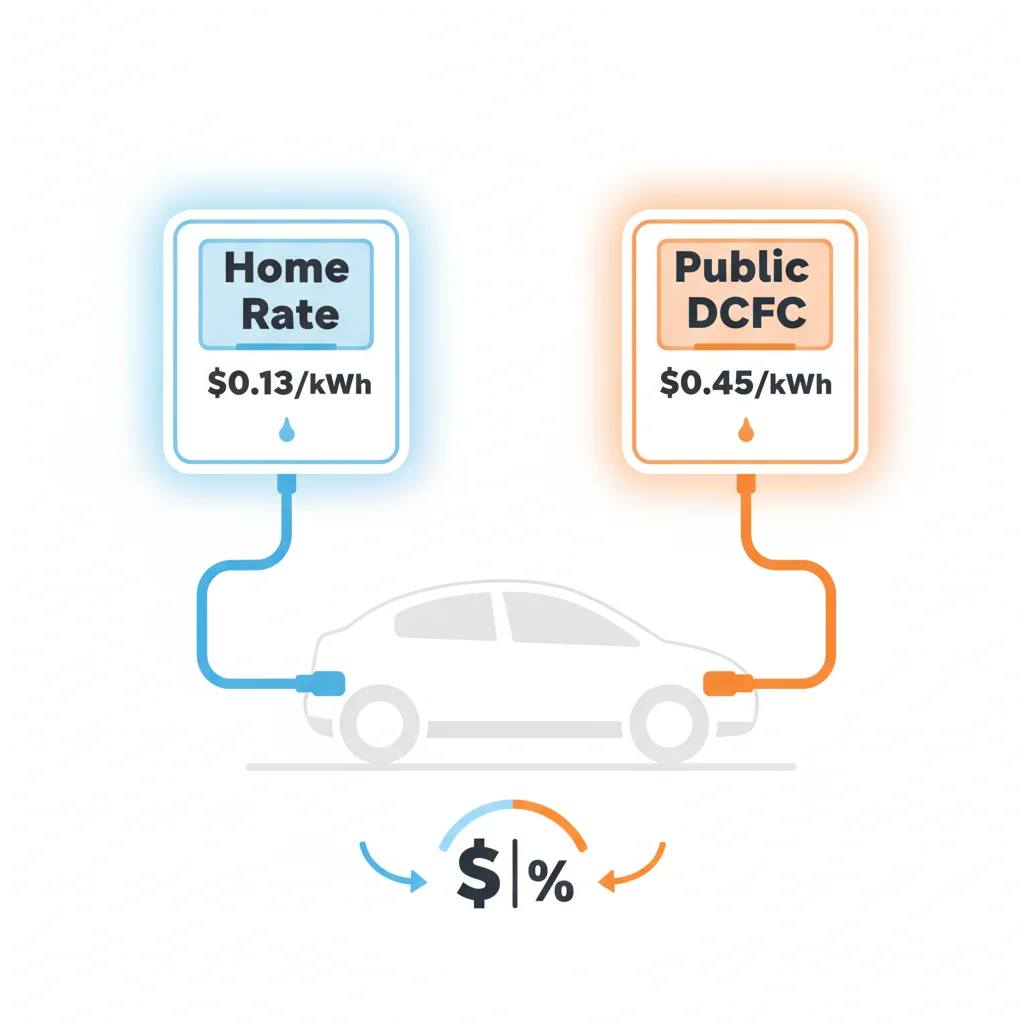
The gap between home and public charging is also not uniform across the country. States with cheap grid electricity — Louisiana, Oklahoma, Idaho — make home charging a relative bargain. States with expensive residential rates — California, Hawaii, Massachusetts — narrow the advantage somewhat, though public fast charging prices in those same states also tend to be higher. The relative cost ordering generally holds: home beats public, nearly everywhere.
For a full breakdown of how each charging level stacks up on speed and cost, see Level 1, Level 2, and DC Fast Charging: Cost and Speed Compared.
Home Charging: The Numbers Behind the Cheapest Option
Home charging costs hinge on two variables: your utility's electricity rate and your EV's efficiency. The national average residential electricity rate in the U.S. is approximately $0.16 per kWh as of 2024, according to the U.S. Energy Information Administration. At that rate, charging a vehicle that achieves 3.5 miles/kWh costs about $0.046 per mile — less than 5 cents.
Compare that to a gasoline vehicle averaging 28 mpg with regular fuel at $3.50/gallon: that's $0.125 per mile — roughly 2.7 times more expensive than home EV charging.
$0.046
Cost per mile at average U.S. home rate
Based on the national average residential electricity rate of $0.16/kWh and a vehicle efficiency of 3.5 miles/kWh (U.S. EIA, 2024).
3.5×
How much more DCFC can cost vs. home charging
At premium public DCFC rates of $0.56/kWh versus a home TOU rate of $0.10/kWh, per-mile costs differ by up to 3.5 times.
$1,700
Annual savings from free workplace charging
Estimated annual savings versus public DCFC at $0.50/kWh average for a driver covering 12,000 miles per year.
68%
EV owners who primarily charge at home
According to J.D. Power's 2023 U.S. Electric Vehicle Experience (EVX) Public Charging Study, the majority of EV owners rely on home charging for routine energy needs.
$0.02–$0.03
Per-mile cost on off-peak TOU electricity
Achievable by scheduling overnight charging during off-peak hours on utilities offering time-of-use rates as low as $0.08/kWh.
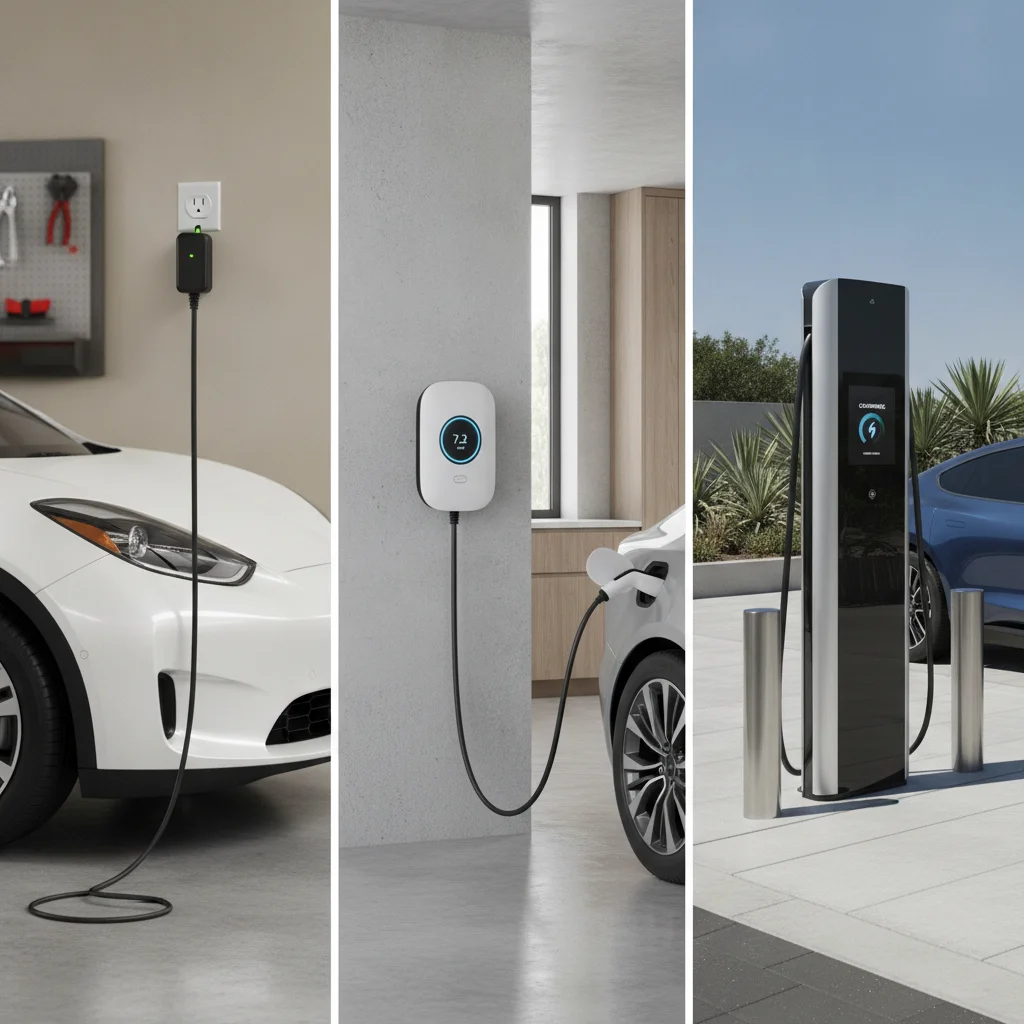
There are real-world caveats. Level 1 charging (standard 120V outlet) is the cheapest hardware option — no installation costs — but at 3–5 miles of range per hour, it's impractical for any driver covering more than 40 miles daily. Level 2 (240V, 7.2–19.2 kW) is the practical standard for home use, adding 20–35 miles of range per hour and topping off a typical EV overnight in 6–10 hours.
Level 2 EVSE (Electric Vehicle Supply Equipment) units range from about $200 to $800 for the hardware, with professional installation adding $200–$600 depending on whether your electrical panel needs an upgrade. Spread over five years, that's roughly $80–$280 per year in amortized costs — a minor addition to your per-mile rate.
Time-of-use (TOU) electricity rates offer an additional lever. Many utilities charge as little as $0.08–$0.10/kWh during off-peak overnight hours. EV owners who schedule charging between 11 p.m. and 6 a.m. can drop their effective per-mile cost to as low as $0.02–$0.03 — a level that no public charging network can approach.
Use Time-of-Use Rates to Cut Costs Further
Most U.S. utilities offer time-of-use electricity plans with significantly lower rates between 10 p.m. and 6 a.m. Check your utility's website or call customer service to enroll — many EV owners aren't automatically placed on TOU plans. Combined with a smart charger or your vehicle's built-in scheduled charging feature, TOU rates can cut home charging costs nearly in half compared to standard residential flat rates.
Consider Membership Plans Before Road Trips
If you're planning a long-distance trip that will involve several public DCFC sessions, signing up for a monthly membership plan from Electrify America, EVgo, or your network of choice beforehand can reduce per-kWh rates by 20–35%. Even one month's subscription often pays for itself in a single cross-state drive. Cancel after the trip if you don't expect continued heavy public charging use.
Track Network Pricing Before You Arrive
Public charging prices are not static — networks adjust rates by location, time of day, and demand. Use the network's own app or a third-party tool like PlugShare to check real-time pricing before committing to a particular station. A five-minute detour to a cheaper or faster charger can meaningfully reduce session costs on long hauls.
For guidance on setting up home charging efficiently, the Home Charging Setup hub covers hardware selection, installation considerations, and utility incentive programs.
Public DC Fast Charging: Convenience at a Price
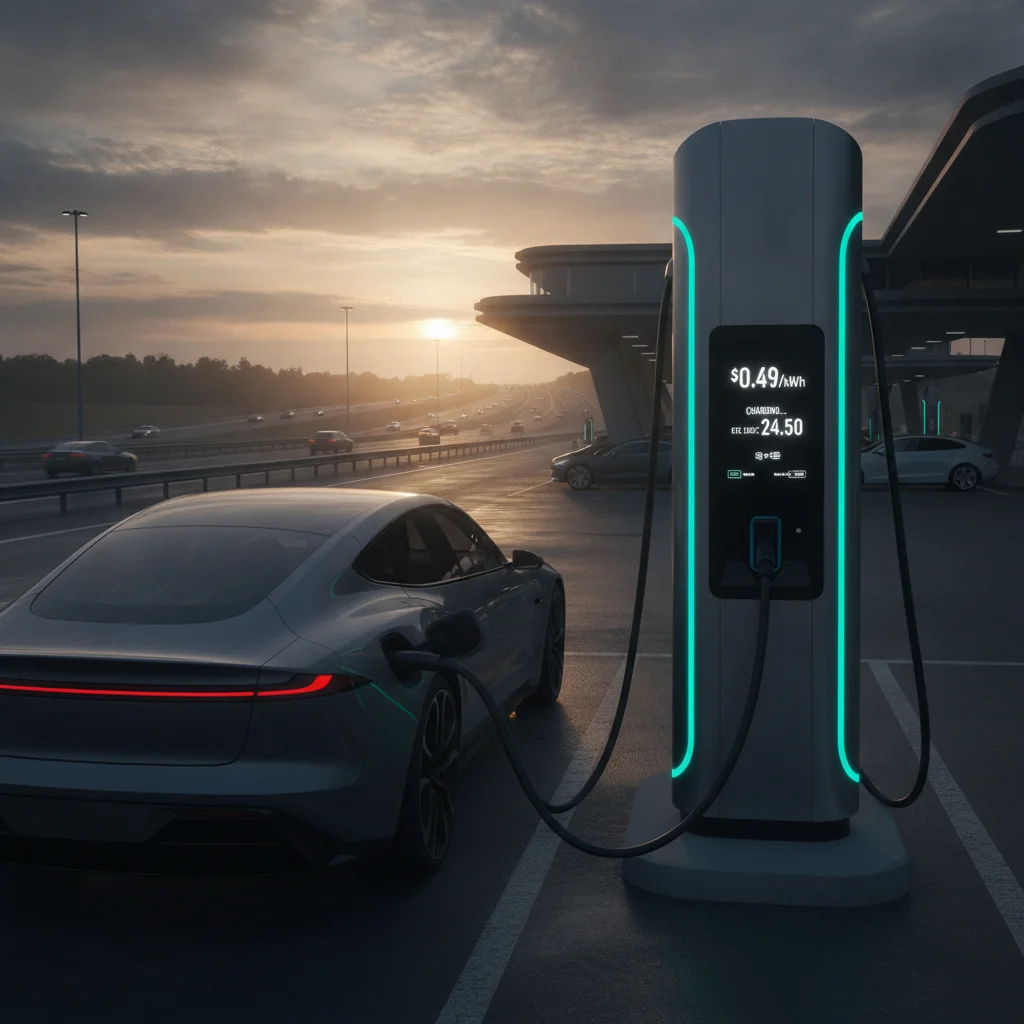
DC fast charging (DCFC) stations — the 50 kW to 350 kW units found at highway rest stops, retail centers, and dedicated EV hubs — can add 100–200 miles of range in 20–30 minutes. That speed is indispensable on road trips and a genuine lifeline for drivers without home charging access. But that convenience comes with a material cost premium.
Public DCFC pricing varies significantly by network and state. As a general range in 2024:
- Electrify America: $0.48–$0.56/kWh for non-members; $0.36/kWh with a $4/month Pass+ subscription
- Tesla Supercharger: $0.25–$0.50/kWh depending on location and membership tier; non-Tesla vehicles pay slightly more at many sites
- EVgo: $0.30–$0.45/kWh depending on plan; some locations bill per minute
- ChargePoint: Rates set by individual station owners, typically $0.25–$0.45/kWh for DCFC
- Blink: $0.39–$0.79/kWh, with significant location-by-location variation
Applying those rates to a vehicle returning 3.5 miles/kWh, the per-mile cost on public DCFC runs from roughly $0.07 to $0.16 per mile — between 1.5x and 3.5x the cost of home charging at average U.S. electricity rates.
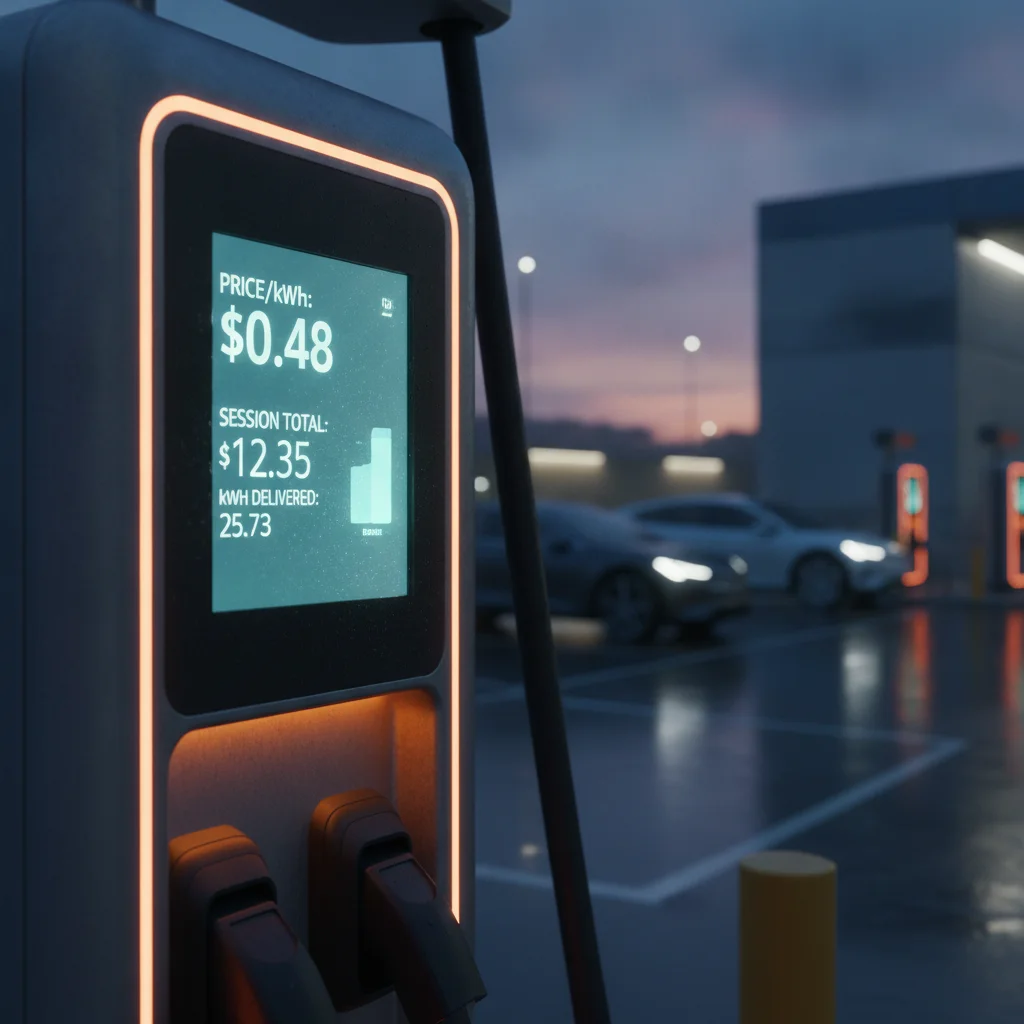
The per-minute billing model deserves special attention. Networks that charge by time rather than energy are particularly punishing for vehicles with slower onboard AC chargers or those whose charging speed tapers significantly as the battery fills. If your car charges at 50 kW but the network bills at a per-minute rate calibrated for 150 kW vehicles, you are effectively paying a surcharge for your car's hardware limitations.
For a detailed look at how per-kWh versus per-minute billing plays out in real sessions, see DC Fast Charging Is Convenient — But Here's What It Actually Costs.
| Home Level 2 | Public L2 | DC Fast Charging | |
|---|---|---|---|
| Typical rate (per kWh) | $0.10–$0.18 | $0.00–$0.20 | $0.25–$0.56 |
| Approx. cost per mile (3.5 mi/kWh vehicle) | $0.03–$0.05 | $0.00–$0.06 | $0.07–$0.16 |
| Speed (miles of range per hour) | 20–35 mph | 15–25 mph | 100–600+ mph equiv. |
| Hardware cost | $200–$1,400 installed | None (use public) | None (use public) |
| Availability | Wherever you park at home | Parking lots, retail, hotels | Highways, urban hubs |
| Best use case | Daily overnight charging | Opportunistic topping off | Road trips, emergency range |
| Idle/overstay fees | None | Sometimes, after grace period | Common, $0.40–$1.00/min |
| Membership discounts available | N/A (utility TOU rates apply) | Sometimes | Yes — most major networks |
The Middle Ground: Level 2 Public and Workplace Charging
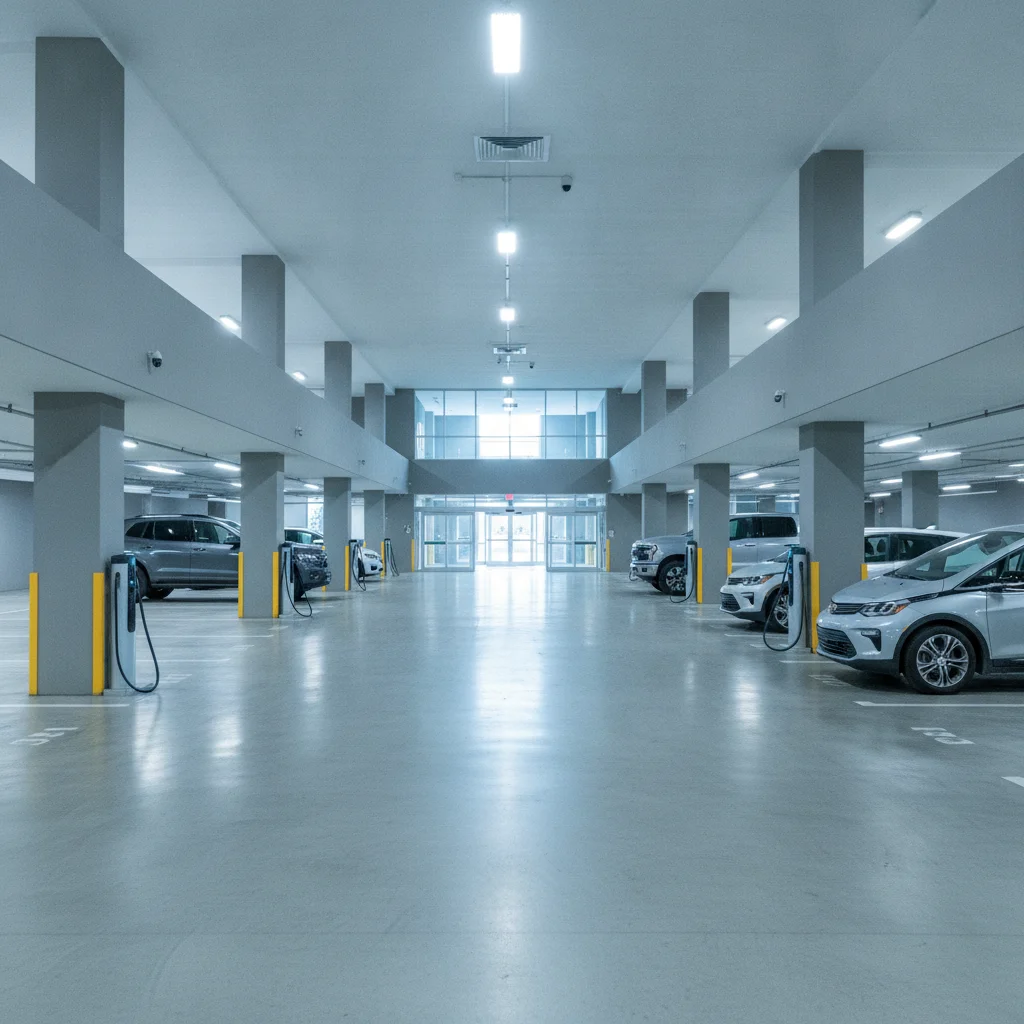
Between home charging and highway DCFC sits a tier of public Level 2 stations that is frequently overlooked in cost comparisons. These 7.2–19.2 kW AC chargers are found at parking garages, shopping centers, hotels, and — critically — workplaces. They add range more slowly than DCFC but typically cost far less.
Typical public L2 rates range from free to $0.20/kWh, with many municipal and retail-hosted stations still offering complimentary sessions as a customer amenity. At $0.15/kWh on a 3.5 miles/kWh vehicle, that's $0.043/mile — virtually identical to home charging at average utility rates.
Workplace charging deserves particular emphasis. Many employers — especially in the technology, healthcare, and government sectors — provide free or heavily subsidized Level 2 charging as a commuter benefit. For a driver covering 12,000 miles per year entirely on free workplace power, the annual savings versus public DCFC at $0.50/kWh run to roughly $1,700. Even against home charging at $0.16/kWh, free workplace charging saves approximately $550 per year.
To calculate what your specific workplace charging situation is worth, Workplace Charging as a Commuter Benefit: What It's Worth in Real Dollars walks through the math in detail.
Don't Let Idle Fees Erase Your Savings
Most major public charging networks impose idle fees — typically $0.40 to $1.00 per minute — once your EV is fully charged and still occupying the connector. On a busy highway charging stop where walking back to the car isn't immediately convenient, a 20–30 minute overstay can add more to your bill than the charging session itself. Set a phone alert for when your charge is expected to complete, and move your vehicle promptly.
Per-Minute Billing Can Be Deceptive
Some public DCFC networks still bill by the minute rather than by energy delivered. This pricing model disproportionately penalizes drivers whose vehicles accept power at lower rates — either due to onboard charger limitations or because the battery is nearly full and charging speed has tapered. Before initiating a per-minute session, calculate the implied per-kWh cost based on your vehicle's expected charging rate at that state of charge, and compare it to a nearby per-kWh alternative if one exists.
The right charging tier for any given stop also depends on how long you'll be parked and how much range you need. A two-hour grocery run pairs perfectly with a public L2 session; a 20-minute highway rest stop calls for DCFC. Workplace and Destination Charging vs. DC Fast Charging: Knowing Which to Use provides a decision framework for matching charging tier to context.
Who Pays More: Commuters, Road Trippers, or Apartment Dwellers?
The financial reality of EV charging divides cleanly along three driver profiles. Understanding which profile fits your life is the most actionable step you can take toward managing charging costs.
The Home-Based Commuter
A driver who owns or rents a home with driveway or garage access, commutes under 70 miles daily, and charges overnight on a Level 2 unit is in the best possible cost position. At $0.12/kWh on a TOU rate with a 3.5-mile/kWh vehicle, annual charging costs for 12,000 miles run to approximately $411. That's the floor of EV operating costs.
The Frequent Road Tripper
A driver who regularly covers 200+ miles in a single day will inevitably rely on public DCFC for significant portions of annual mileage. If 20% of 15,000 annual miles are charged on public DCFC at $0.45/kWh average, and 80% at home at $0.16/kWh, total annual charging costs rise to roughly $900 — still well below the $1,875 that same mileage would cost in a 28-mpg gas car at $3.50/gallon, but a meaningful increase over the home-only baseline.
The Apartment Dweller
Without home charging access, the cost picture changes substantially. An EV driver relying entirely on public L2 at $0.18/kWh and DCFC at $0.45/kWh in a 70/30 split faces annual charging costs of roughly $1,400–$1,600 for 12,000 miles — still cheaper than gasoline for most drivers, but the margin is narrower and more sensitive to local pricing.
For apartment and condo residents navigating this reality, Apartment Dwellers and EV Charging Costs: Navigating the Public Network offers practical strategies for minimizing public charging dependence.
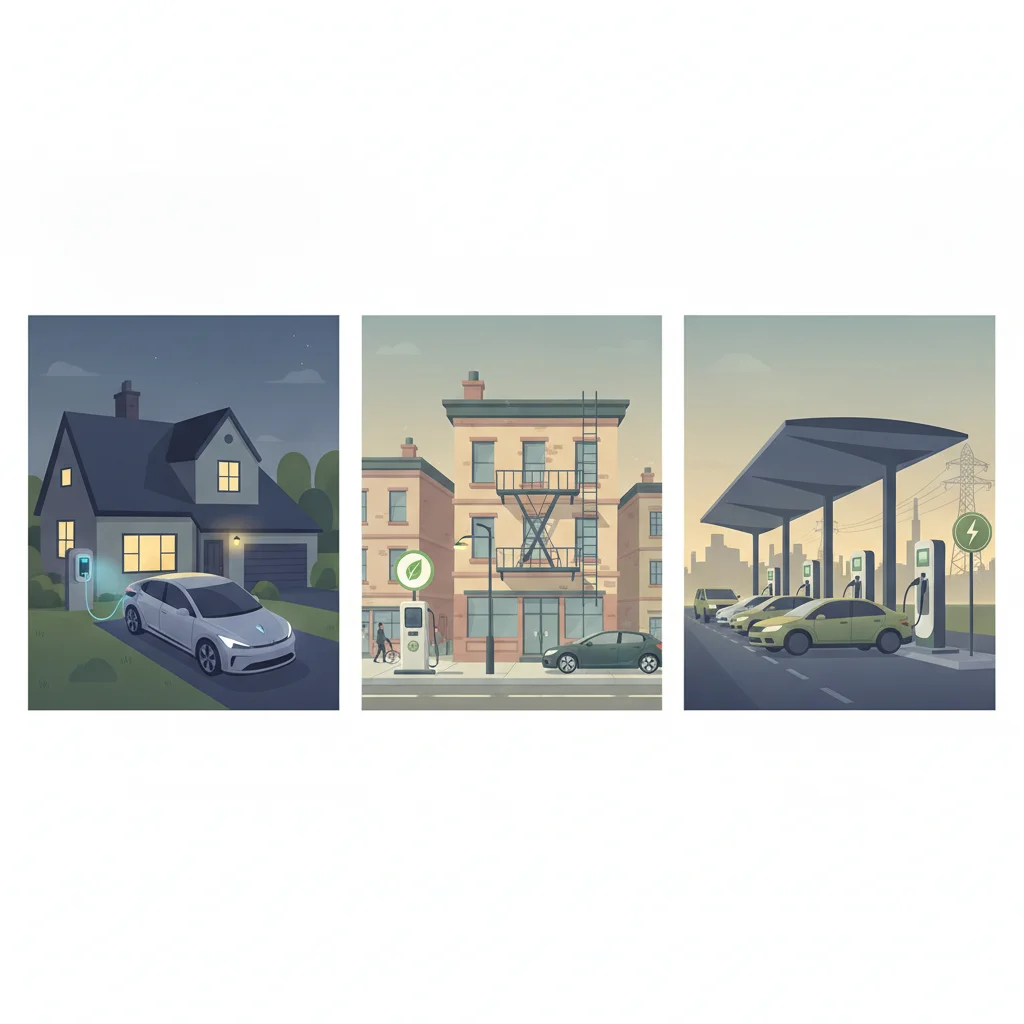
The urban versus highway charging infrastructure landscape is also fundamentally different in ways that affect cost and convenience. Urban Charging vs. Highway Fast Charging: Two Different Problems, Two Different Solutions maps those differences in useful detail.
Network Choice Matters: Not All Public Charging Costs the Same
Even within the public DCFC category, network selection has a measurable dollar impact. Membership plans offered by Electrify America, EVgo, and ChargePoint can reduce per-kWh rates by 20–35% for regular users. Tesla's network remains the most price-consistent and technically reliable for drivers of Tesla vehicles, with competitive per-kWh rates at most locations.
Third-party networks vary so widely in pricing that the same 20-kWh session — enough to add roughly 70 miles of range — can cost anywhere from $7 to $16 depending on which plug you use and which network owns the hardware. Roaming agreements between networks add another layer of complexity: charging through a partner network often incurs a per-session fee or a higher per-kWh rate.
Use Time-of-Use Rates to Cut Costs Further
Most U.S. utilities offer time-of-use electricity plans with significantly lower rates between 10 p.m. and 6 a.m. Check your utility's website or call customer service to enroll — many EV owners aren't automatically placed on TOU plans. Combined with a smart charger or your vehicle's built-in scheduled charging feature, TOU rates can cut home charging costs nearly in half compared to standard residential flat rates.
Consider Membership Plans Before Road Trips
If you're planning a long-distance trip that will involve several public DCFC sessions, signing up for a monthly membership plan from Electrify America, EVgo, or your network of choice beforehand can reduce per-kWh rates by 20–35%. Even one month's subscription often pays for itself in a single cross-state drive. Cancel after the trip if you don't expect continued heavy public charging use.
Track Network Pricing Before You Arrive
Public charging prices are not static — networks adjust rates by location, time of day, and demand. Use the network's own app or a third-party tool like PlugShare to check real-time pricing before committing to a particular station. A five-minute detour to a cheaper or faster charger can meaningfully reduce session costs on long hauls.
For a comprehensive side-by-side of how the major networks compare on coverage, speed, and pricing structure, The Major Public Charging Networks Side by Side provides that analysis. The Charging Costs & Savings hub is also a useful resource for ongoing cost benchmarks and strategies.
One underappreciated cost factor: idle fees. Most major networks charge $0.40–$1.00 per minute once a session ends and the vehicle remains plugged in beyond a grace period. On a busy travel day when moving your car promptly isn't possible, a 30-minute overstay can add $12–$30 to your session cost — more than the energy itself in some cases.
Building Your Personal Charging Cost Estimate
Rather than relying on averages, building a personalized charging cost model takes about five minutes and yields far more actionable numbers. Here's the framework:
- Identify your vehicle's real-world efficiency in miles/kWh (check owner forums or EPA ratings, then apply a 10–15% real-world discount).
- Estimate your annual mileage and split it by charging source: home, workplace, public L2, and public DCFC.
- Apply the relevant rate to each segment: your actual utility rate (or TOU rate if you charge off-peak), your workplace's cost (often $0), local public L2 averages, and public DCFC rates for your primary network.
- Sum the annual kWh cost for each segment and add them together.
As an example: a driver with a 3.5 miles/kWh vehicle covering 14,000 miles per year, with 75% at home ($0.13/kWh TOU), 15% at free workplace L2, and 10% on public DCFC ($0.42/kWh) pays approximately:
- Home: 10,500 miles ÷ 3.5 = 3,000 kWh × $0.13 = $390
- Workplace: 2,100 miles ÷ 3.5 = 600 kWh × $0.00 = $0
- DCFC: 1,400 miles ÷ 3.5 = 400 kWh × $0.42 = $168
- Total: $558/year, or about $0.040/mile blended
Run the same 14,000 miles through a 28-mpg gas vehicle at $3.50/gallon: $1,750/year. The EV advantage in this scenario is $1,192 annually — before factoring in reduced maintenance costs.
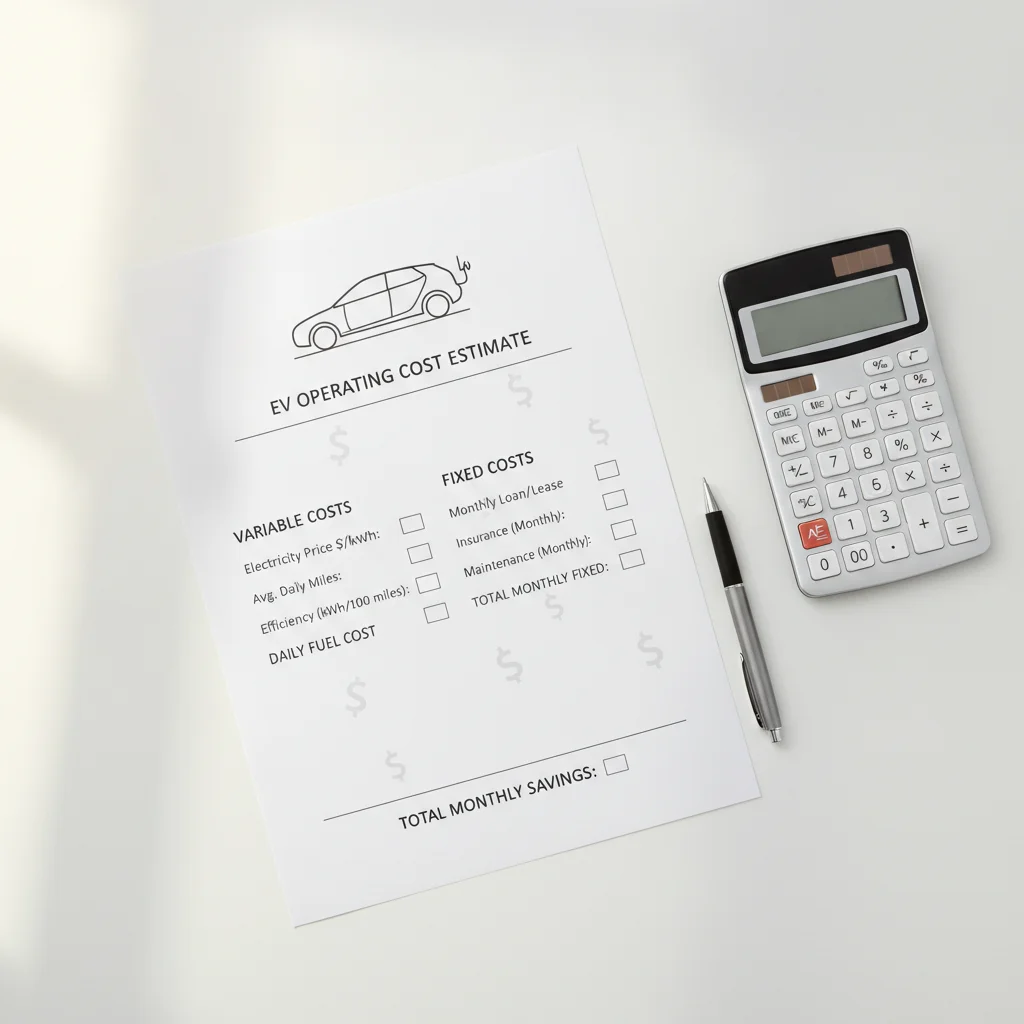
The calculation shifts materially if DCFC dependence rises. At 50% public DCFC dependence, blended costs climb to roughly $0.075/mile — still cheaper than gasoline at current prices, but the buffer shrinks. This is why understanding your own charging mix matters more than any network-level average.
For a complementary perspective on where charging dollars actually go, Home Charging vs. Public Charging: Where Your Money Goes breaks down the full cost structure in detail.
All claims are backed by peer-reviewed research. Sources on request.