Key Takeaways
Option A
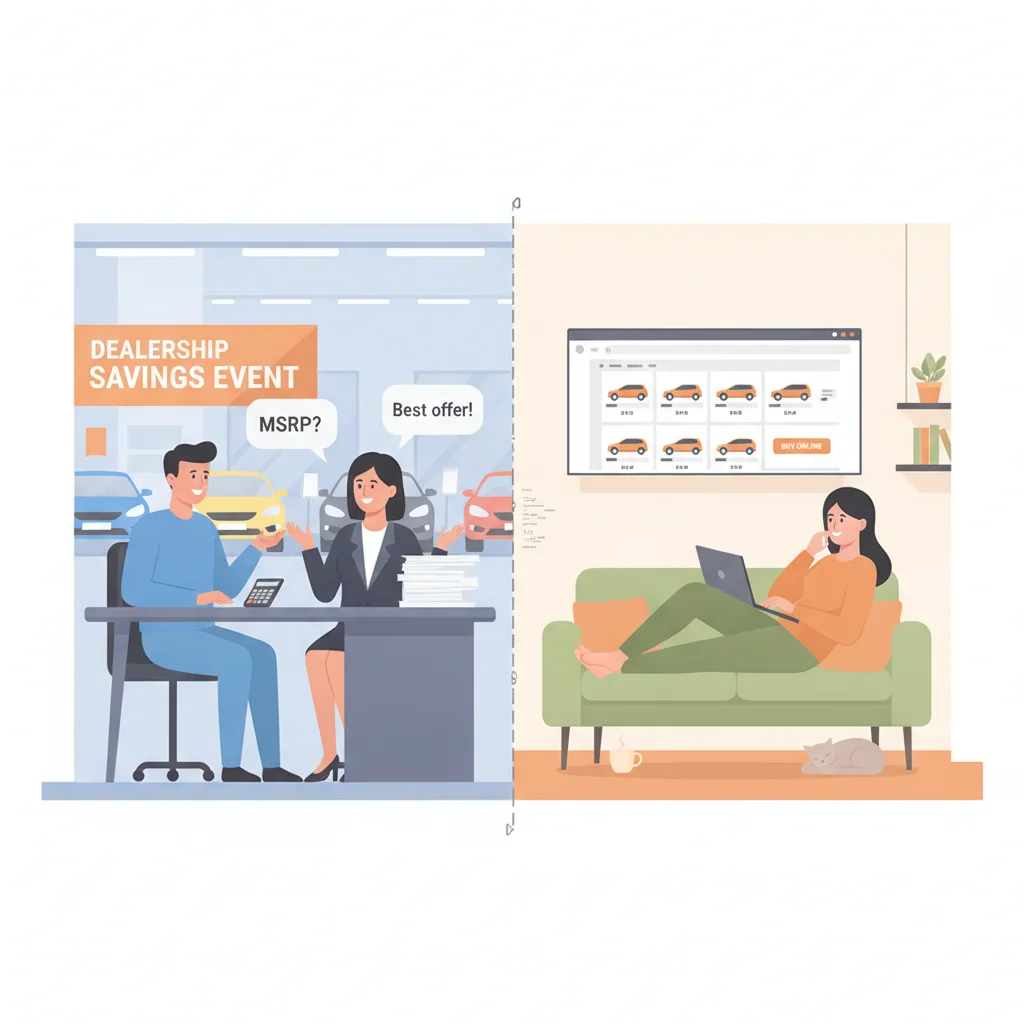
In-Person Dealership Negotiation
High-pressure, high-leverage — if you know the rules.
Best for: Buyers who have done their homework, can handle pressure, and want maximum flexibility on price, trade-in, and financing.
Option B
Online Car Buying
Convenient and transparent — but 'no-haggle' has a price.
Best for: Buyers who value simplicity and time over squeezing out the last dollar, and who are comfortable with fixed or lightly negotiable pricing.
If you're a first-time buyer who finds negotiation stressful
Online Car Buying
Fixed pricing removes the psychological pressure that costs inexperienced buyers the most. You'll likely pay a small premium, but you'll avoid costly impulse decisions made under pressure.
If you've researched invoice prices, incentives, and competing bids
In-Person Dealership Negotiation
A prepared buyer can leverage competing dealer quotes and real market data to beat online fixed prices by $500–$2,000 on popular models, especially at month-end.
If you need to trade in your current vehicle
In-Person Dealership Negotiation
Online platforms typically offer lower trade-in values or direct you back to a physical appraisal. In-person allows you to negotiate the trade and purchase price as separate line items.
If inventory is tight and your target vehicle is scarce
Online Car Buying
Online platforms aggregate inventory across more locations, giving you faster access to hard-to-find vehicles without geographic limits.
If you want to finance through the dealer
In-Person Dealership Negotiation
You can negotiate the interest rate buy-down and counter F&I add-ons face-to-face. Online financing is more opaque and harder to push back on in real time.
How Each Channel Actually Sets Your Price
Walk into a dealership without a plan, and the salesperson already knows more about pricing than you do. That information gap is the dealership's primary profit lever. They know the invoice price, the holdback (a manufacturer rebate paid back to the dealer after the sale), current factory-to-dealer incentives, and exactly how much they can flex on a given unit. You, in theory, know the sticker price — which is designed to anchor you high.
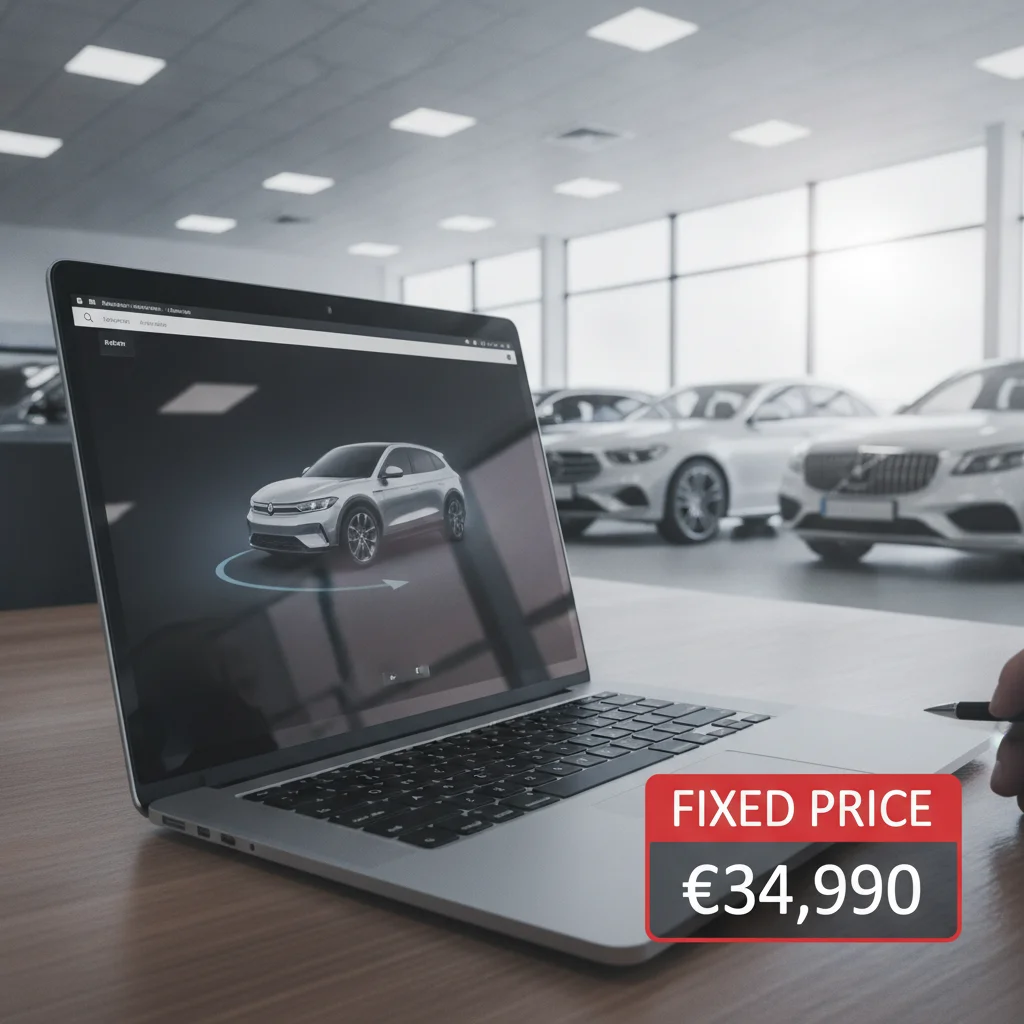
Online platforms — Carvana, CarMax, Vroom, and the digital storefronts that franchised dealers now operate — market themselves on transparency. Prices are posted, take-it-or-leave-it. What they don't advertise as loudly is that those posted prices are calibrated to the top of the fair market range. The platform earns a margin; the transparency is real, but it doesn't mean you're getting the best possible deal.
No-haggle pricing on online platforms sounds like a consumer win, but the reality is more nuanced. Fixed prices eliminate the pain of negotiation while locking in a margin the seller is comfortable with. The question is whether that margin is higher or lower than what you'd pay after a well-executed in-person negotiation.
Here's the practical truth: a well-prepared buyer negotiating in person can typically beat online fixed prices on new vehicles by $500 to $2,000 depending on the model, trim, and how close you are to the end of a model month or quarter. An unprepared buyer walking into the same showroom will often pay more than the online price — sometimes significantly more, once dealer add-ons and payment-focused deal structuring are factored in.

The price-setting mechanism is fundamentally different in each channel. In-person pricing is dynamic and negotiable. Online pricing is set but stable. Which is better for you depends almost entirely on your preparation level.
The Dealership Playbook — and How to Counter It
I spent years in dealership finance offices. The tactics are consistent enough that you can prepare for them specifically. Here are the most expensive ones, and what to do about each.
Payment Packing
The salesperson shifts the conversation from total price to monthly payment. "What can you afford per month?" is never an innocent question. Once you answer, they can inflate the loan term, increase the rate, or layer in add-ons — all while keeping the monthly number close to what you said. Always negotiate out-the-door price, never monthly payment. Full stop.
The Four-Square Worksheet
Many dealers use a four-square form showing purchase price, trade value, down payment, and monthly payment simultaneously. Changing one box always affects another, making it nearly impossible to track what you're actually agreeing to. Demand to negotiate each element separately, in sequence. Purchase price first. Trade value second. Financing last.
Anchoring on MSRP
The sticker price is the anchor. Anchoring works because the first number sets the frame for every counter. Counter by anchoring to invoice plus a reasonable profit — typically $200 to $500 over invoice on high-volume models, adjusting up for vehicles in genuine short supply.
The F&I Office
You've agreed on a car price, you're tired, and now a new person with a new pitch appears. Extended warranties, GAP insurance, paint protection, tire and wheel plans. Each one is a high-margin add-on. Some have legitimate value — GAP insurance on a car with low down payment and a long loan term is genuinely useful. Most dealer-sold extended warranties are overpriced compared to independent alternatives. Decline everything in the F&I office initially, then selectively add back only what you've independently verified as worthwhile.
| Criterion | In-Person Dealership | Online Platform |
|---|---|---|
| Price negotiability | Fully negotiable with leverage | Fixed or lightly negotiable |
| Pricing transparency | Low — requires research | High — price posted upfront |
| Time to complete purchase | 2–5 hours in-store | 30–90 minutes online |
| Trade-in leverage | Negotiable separately | Algorithm-based, often lower |
| Financing flexibility | Multiple lenders, negotiable rate | Platform lenders, less negotiable |
| F&I add-on pressure | High — face-to-face pitch | Moderate — digital upsell |
| Pre-purchase inspection | In person, same day | Limited — often post-delivery return |
| Inventory access | Local/regional lots only | National inventory aggregation |
| Delivery fees | None (or doc fee only) | $300–$800 shipping typical |
| Best-case savings potential | $500–$2,500 below online price | Consistent, predictable pricing |
A full breakdown of pre-visit preparation strategies can help you walk in with the right data and the right posture before you ever sit down.
What Online Buying Costs You — and What It Saves
Online platforms have genuinely disrupted the worst parts of dealership buying. You don't sit in a fluorescent-lit room for three hours. No one physically walks away to "check with the manager." The price is the price, and the paperwork often ships to your door. For a certain type of buyer, that's worth real money in time and stress.
But online buying has its own cost structure. Here's where it shows up:
- Fixed pricing at the top of market: Online vehicle prices are typically set at or near retail market value. The spread between what an online platform pays for a car (or what a dealer pays at auction) and the listed price is the platform's margin — and it's baked in.
- Delivery and documentation fees: Home delivery sounds appealing, but shipping fees of $300–$800 are common, and some platforms layer in processing or documentation fees that add another $200–$400.
- Limited trade-in leverage: Online platforms do offer trade-in quotes — often via a brief online form. Those quotes trend conservative. The dealer trade-in appraisal process is worth understanding regardless of channel, because undervaluing your trade is one of the biggest ways buyers lose money overall.
- No in-person inspection before commitment: Many platforms offer return windows (typically 7 days), but you're often completing a purchase before physically seeing the car. That introduces risk, particularly on used vehicles.

The real tradeoffs of buying a car online go beyond price — inspection access, documentation control, and after-sale support all differ materially from in-person purchases.
The F&I Office Exists Online Too
Many online platforms have digitized the finance and insurance upsell — you'll see prompts for extended warranties, GAP coverage, and protection packages during online checkout. The pressure is lower, but the margins are just as high. Treat every add-on with the same skepticism online that you'd apply at a physical dealership. Compare extended warranty prices against independent providers like Endurance or CARCHEX before accepting any dealer-sold plan.
One area where online buying can genuinely win: hard-to-find inventory. Online platforms aggregate stock across wide geographic areas, which matters when a specific trim or color combination has a 90-day wait at local lots. If you need a specific vehicle fast, the wider search radius alone can justify using an online platform even if the per-unit price is slightly higher.
Financing: Where Both Channels Hide the Real Cost
Here's something neither channel advertises clearly: the price of the vehicle and the cost of financing are two separate negotiations, and conflating them is how dealerships — physical and digital — extract additional margin.
At a traditional dealership, the finance office earns "dealer reserve" — the spread between the rate the lender approves you at and the rate the dealer actually quotes you. On a $35,000 loan at 60 months, a 1% rate markup costs you roughly $900 over the loan term. A 2% markup costs around $1,800. This is legal, common, and rarely disclosed unless you ask directly.
Online platforms typically present financing through their own lending partners or captive lenders. The rates may look straightforward, but the same reserve structure can exist behind the scenes. The difference is you have less ability to push back in real time.
$1,014
Average dealer reserve markup per auto loan
Consumer Financial Protection Bureau research found dealer interest rate markups averaged over $1,000 in additional finance charges per loan on marked-up contracts.
72%
Buyers who don't negotiate the vehicle price
A Cox Automotive car buyer study found nearly three-quarters of buyers accept the first or second price offered without pushing back on the vehicle purchase price.
$988
Average F&I gross profit per vehicle sold
NADA industry data shows the finance and insurance office generates nearly $1,000 in profit per retail unit, separate from the vehicle price margin.
3–5 days
Average time saved buying online vs. in-person
Cox Automotive Dealer Sentiment data indicates online buyers report spending significantly fewer hours across the entire purchase process compared to in-store buyers.
Your best defense in either channel is the same: get pre-approved for financing from your own bank or credit union before you start shopping. That pre-approval sets a ceiling. If the dealer or platform can beat it, let them — but you're negotiating from strength rather than ignorance.
Email negotiation with dealerships is one effective middle-ground strategy — you get a paper trail, time to think, and can solicit competing offers from multiple dealers without stepping into a showroom. It strips out much of the psychological pressure while preserving your ability to negotiate price.
For used vehicle purchases specifically, the channel comparison gets more complex. Online used car buying differs fundamentally from new car buying — the risk profile, platform options, and documentation requirements are all different, and that affects which approach makes more sense.
Which Approach Actually Saves You More Money?
After years in dealer finance and watching hundreds of real transactions, here's my honest answer: it depends on who you are as a buyer, not which channel is inherently cheaper.
A buyer who enters a dealership with invoice pricing data, a pre-approval letter, and three competing dealer quotes can realistically save $1,000–$2,500 compared to online fixed pricing on a new vehicle. That same buyer, without preparation, will likely pay $500–$1,500 more at the dealership than they would have online.
Online buying is a floor, not a ceiling. It protects you from the worst outcomes while preventing you from reaching the best ones. For many buyers — especially those buying for the first time, those with complex schedules, or those who genuinely dislike negotiation — that floor is exactly what they need.
A few scenarios where the math clearly favors one approach:
- Month-end or quarter-end at a dealership: Salespeople and dealers have volume targets. Buying in the last few days of a month, especially at quarter-end, puts real pressure on their side of the table. Online prices don't adjust for dealer calendars.
- High-demand, scarce inventory: When a vehicle has a waiting list, in-person negotiation advantage disappears. Some dealers charge over MSRP; online platforms at least post a consistent price. Factory ordering becomes worth considering in these situations.
- Complex transactions with trade-ins: Online platforms handle trades, but they consistently undervalue them. If your trade-in is worth $15,000 and an online platform quotes $13,500 while a dealer (negotiated separately) would give $14,500, that $1,000 difference swamps any price convenience the platform offered.
A deeper comparison of online versus traditional dealerships walks through the full experience — price, convenience, negotiation dynamics, and after-sale support — if you want to extend this analysis further.
A Practical Decision Framework
Stop thinking about this as "dealership vs. online" and start thinking about it as a question of your specific preparation level and transaction complexity.
Choose in-person negotiation if:
- You know the invoice price and current manufacturer incentives
- You have a pre-approval letter in hand
- You're trading in a vehicle and have an independent appraisal
- You can walk away — and mean it
- You're buying near the end of a calendar month
Choose online buying if:
- You value time over maximum savings
- The vehicle you want is widely available but geographically distant
- You've compared the online price to market data and it's genuinely competitive
- You have no trade-in to complicate the transaction
- You're buying used and the platform offers a meaningful return window
One more consideration: these channels aren't mutually exclusive. You can use an online platform's listed price as a benchmark — then walk into a dealership and say, "I can buy this vehicle right now on for $X. Can you beat it?" That's leverage. Use it.
Private sellers add a third option that's worth considering for used vehicles specifically — often lower prices but with fewer protections and more due-diligence requirements. And if you're still weighing where to buy used overall, the full comparison of private sellers versus dealerships covers the protection and paperwork differences in detail.
Neither channel is a shortcut to a good deal. Preparation is the shortcut. Whatever path you take, show up knowing more than the other side expects.
All claims are backed by peer-reviewed research. Sources on request.