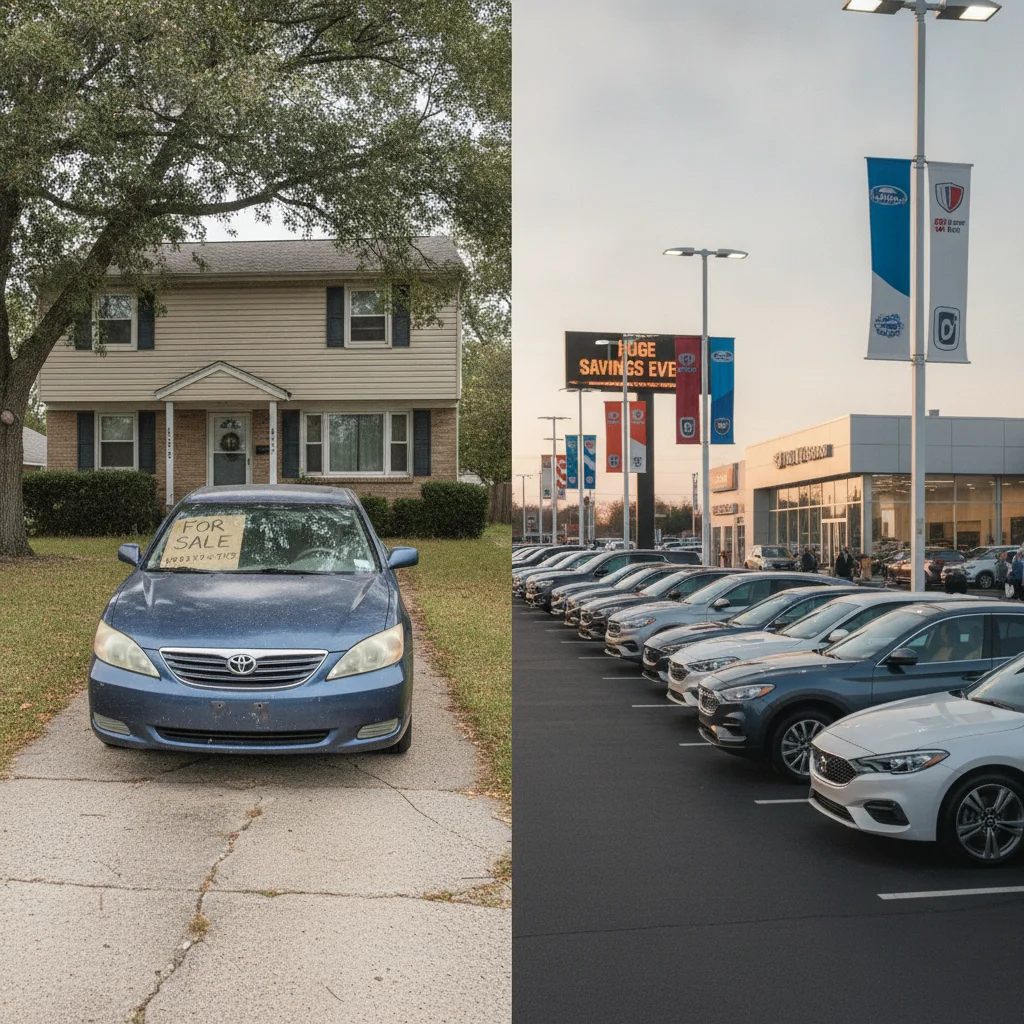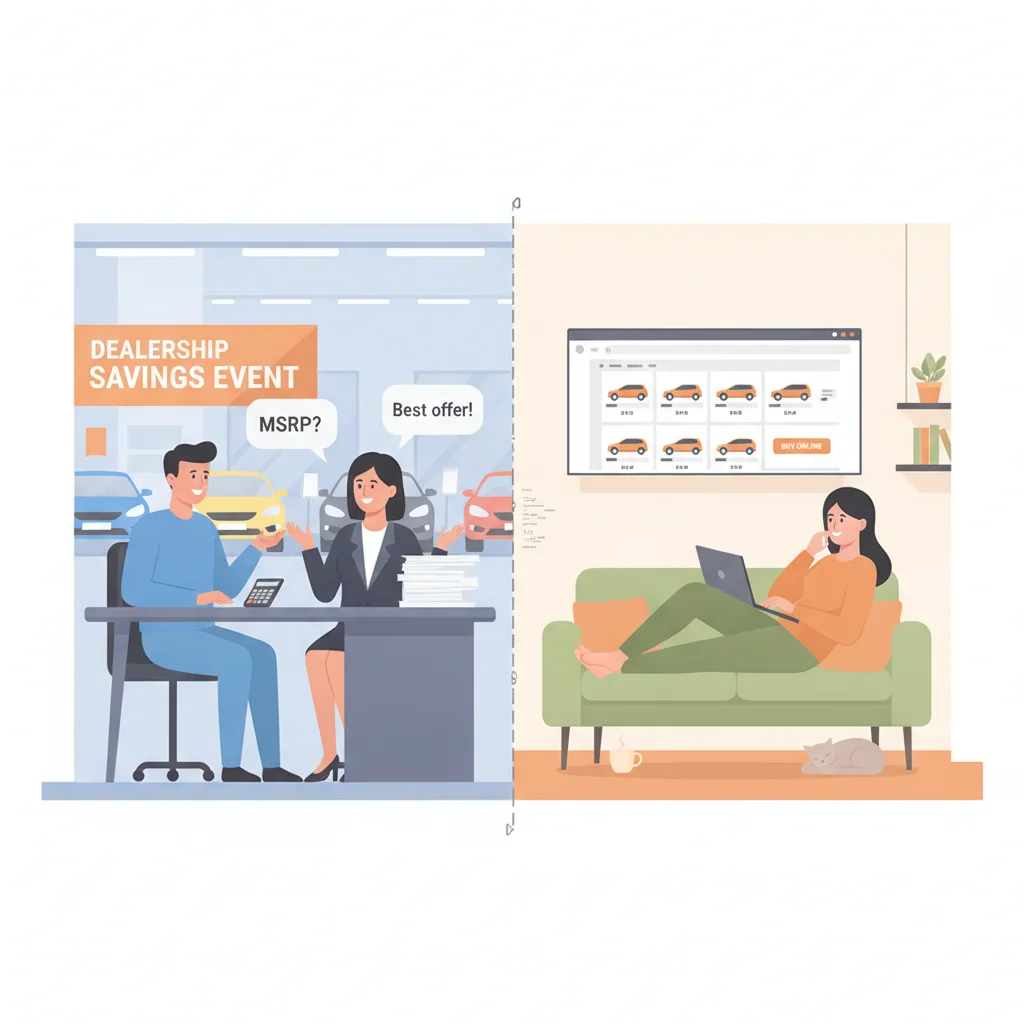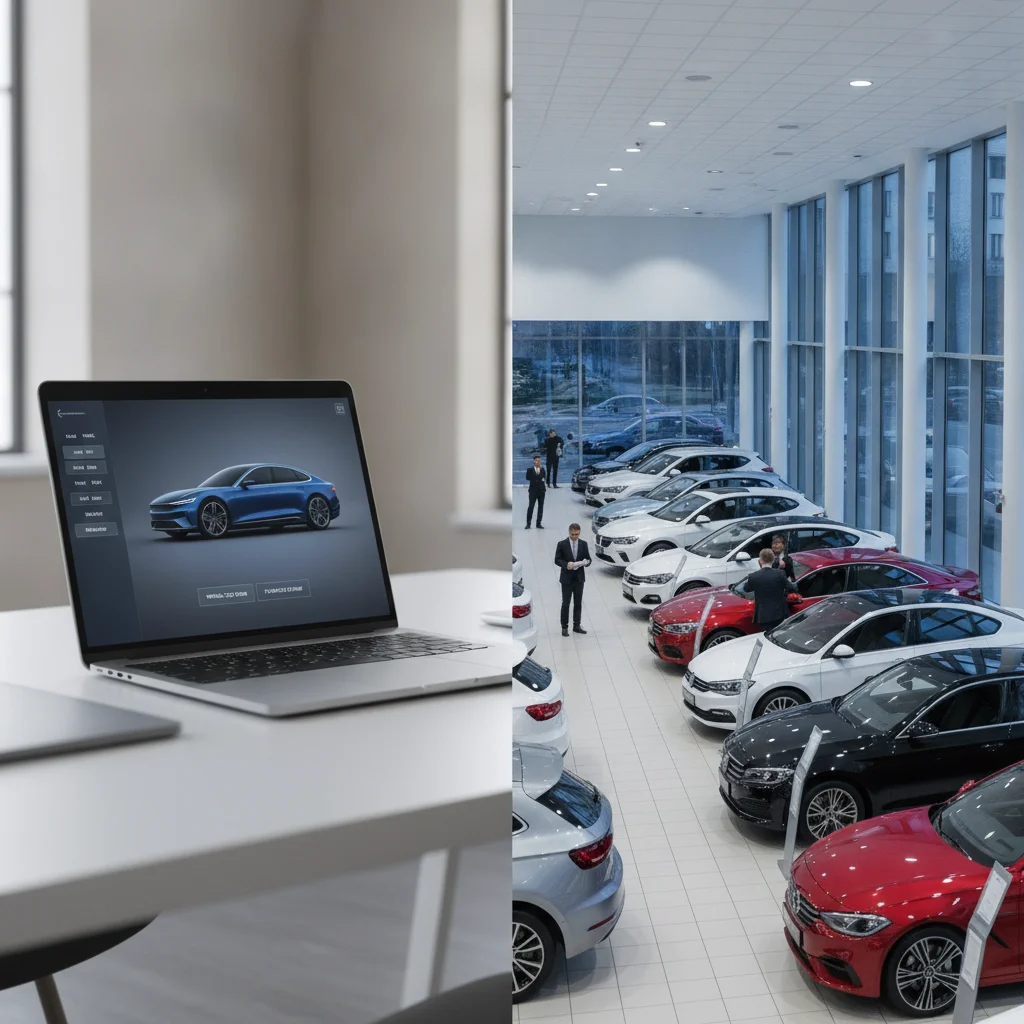
Key Takeaways
Option A
Online Dealerships
The streamlined, pressure-free digital buying experience.
Best for: Buyers who prioritize convenience, transparent pricing, and want to minimize high-pressure sales tactics.
Option B
Traditional Dealerships
The hands-on, negotiation-driven in-person experience.
Best for: Buyers who want to inspect vehicles physically, negotiate aggressively, and close the deal the same day.
If you hate high-pressure sales tactics and want to buy on your own schedule
Online Dealerships
Online platforms let you complete the entire purchase without sitting in a finance office, removing the single biggest source of buyer stress and add-on pressure.
If you want to physically inspect the vehicle before committing
Traditional Dealerships
No photo set or 360-degree tour fully replaces a test drive and an under-hood inspection; in-person buying is the only way to verify condition firsthand before signing.
If you have a trade-in and want to maximize its value
Traditional Dealerships
Online quotes are fast but often revised downward once the car is physically appraised — an in-person negotiation gives you more leverage to push back on the spot.
If you're buying a popular trim with straightforward specs and don't need to negotiate
Online Dealerships
For well-documented, high-demand models where pricing is transparent and consistent, the time savings and no-haggle experience of online buying offer clear value.
If you want maximum leverage to negotiate the lowest possible out-the-door price
Traditional Dealerships
Skilled negotiators can still outperform fixed online prices — especially on slow-moving inventory, end-of-month deals, and manufacturer incentive periods.
The Real Difference Between These Two Buying Channels
Let me be direct: online dealerships and traditional dealerships are not just the same process with different interfaces. They represent fundamentally different power dynamics between buyer and seller — and understanding that distinction is worth real money on your purchase.
When I worked in dealership finance, the goal in an F&I office was simple: maximize gross on every deal. Every minute a buyer spent in that chair was an opportunity to layer in add-ons — extended warranties, paint protection, GAP insurance marked up 200%. Online platforms have largely eliminated that room. That's genuinely good for buyers. But it also means the in-person advantages — real-time negotiation, physical inspection, same-day trade-in appraisal — disappear too.
The car market has shifted dramatically. Platforms like Carvana, Vroom, and CarMax online have normalized buying without ever setting foot on a lot. Meanwhile, traditional franchised dealers have adopted their own digital retailing tools to compete. The line is blurring — but the core trade-offs remain distinct.
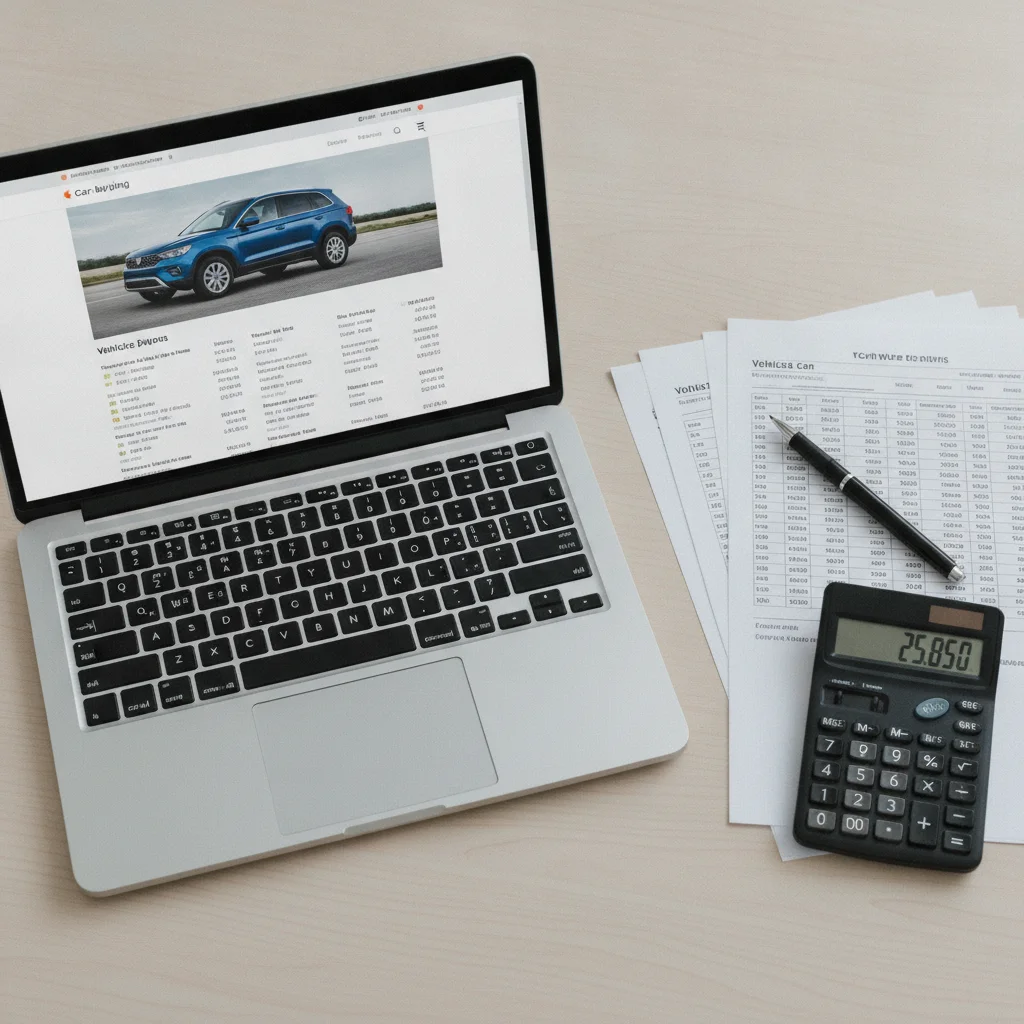
Here's what you actually need to weigh before choosing a channel. And if you're still deciding between buying from a private party versus either type of dealership, this comparison of private sellers vs. dealerships covers that dimension well.
Pricing Transparency and Negotiation Leverage
This is where the two channels diverge most sharply, and where buyers tend to misread the situation.
Online Dealerships: No-Haggle, But Not Always the Lowest Price
Online dealerships typically post fixed, no-haggle prices. That's marketed as transparency — and it is, to a degree. You know exactly what you'll pay before you click confirm. There's no ambiguity about dealer markup or back-end add-ons buried in a four-square worksheet.
But fixed pricing doesn't mean low pricing. Online platforms have overhead too — reconditioning centers, delivery logistics, return processing — and those costs get baked into the listed price. During inventory crunches (as we saw from 2021 through 2023), online platforms held prices firm at or above market just as aggressively as traditional dealers.
Negotiating at the dealership vs. buying online breaks down the pricing dynamics in more depth — but the short version is that online fixed prices aren't guaranteed to beat what a prepared negotiator can extract in person.
Traditional Dealerships: Haggling Has a Real Ceiling — If You Know It
In-person negotiation has a floor: the dealer's cost to own the vehicle (invoice plus holdback plus any floorplan interest). Experienced buyers who show up knowing invoice pricing, manufacturer-to-dealer incentives, and competing quotes can get below sticker regularly. End of month, end of quarter, and model-year changeovers are particularly productive windows.
For a primer on working these angles, dealer negotiation strategies covers the playbook thoroughly.
| Criterion | Online Dealerships | Traditional Dealerships |
|---|---|---|
| Pricing model | Fixed, no-haggle listed price | Negotiable from MSRP downward |
| Physical inspection | Photos and reports only | Full in-person inspection and test drive |
| Sales pressure | Minimal to none | High — F&I office add-on push standard |
| Return policy | 7–30 day window (major platforms) | Rarely offered; as-is is default |
| Trade-in process | Instant online quote; may revise on inspection | In-person appraisal; negotiable on the spot |
| Financing flexibility | Digital lender network; limited discretion | Multiple lenders; F&I manager can negotiate rate |
| Transaction speed | 1–2 hours online; delivery takes days | 3–5 hours in person; same-day drive-away |
| After-sale accountability | Varies; major platforms have formal processes | Physical location and manufacturer relationship |
| Inventory selection | Nationwide; broader geographic reach | Local and regional; limited to lot stock |
| Best price potential | Consistent but rarely below listed price | Lowest possible for prepared negotiators |
The negotiation gap matters most on high-margin vehicles — luxury SUVs, trucks with popular option packages — where the spread between invoice and MSRP can exceed $5,000. On a high-volume economy sedan with 2% margins, the practical gap between online and in-person pricing may be negligible.
43%
Buyers who completed purchase entirely online in 2023
According to Cox Automotive's 2023 Car Buyer Journey Study, 43% of buyers completed all or most of the purchase process online, up from 32% in 2020.
$1,200
Average savings from in-person negotiation vs. sticker
Edmunds data consistently shows that buyers who negotiate in person achieve discounts averaging $1,000–$1,500 below MSRP on eligible inventory.
30 days
CarMax return window — longest in the industry
CarMax's 30-day, 1,500-mile return policy is the most generous of any major dealer or online platform as of 2024.
64%
Buyers who say avoiding salespeople is a top priority
A 2023 Autotrader survey found 64% of car buyers would prefer to complete more of the buying process online specifically to reduce sales interaction.
~$800
Average difference between online trade-in quote and final offer
iSeeCars analysis found that online instant trade-in quotes are revised downward by an average of $600–$1,000 once vehicles are physically inspected.
Vehicle Inspection, Test Drives, and Condition Confidence
This is the category where online buying takes the clearest hit — and where traditional dealerships still hold a meaningful advantage that no digital tool has fully closed.
What Online Platforms Provide
Reputable online dealerships invest heavily in vehicle documentation: multi-angle photo sets, 360-degree interior walkthroughs, detailed condition reports, and third-party inspection disclosures. Carvana's listings typically include 150+ photos. Some platforms allow you to request a vehicle history report addendum or a pre-purchase inspection by a third-party mechanic before delivery.
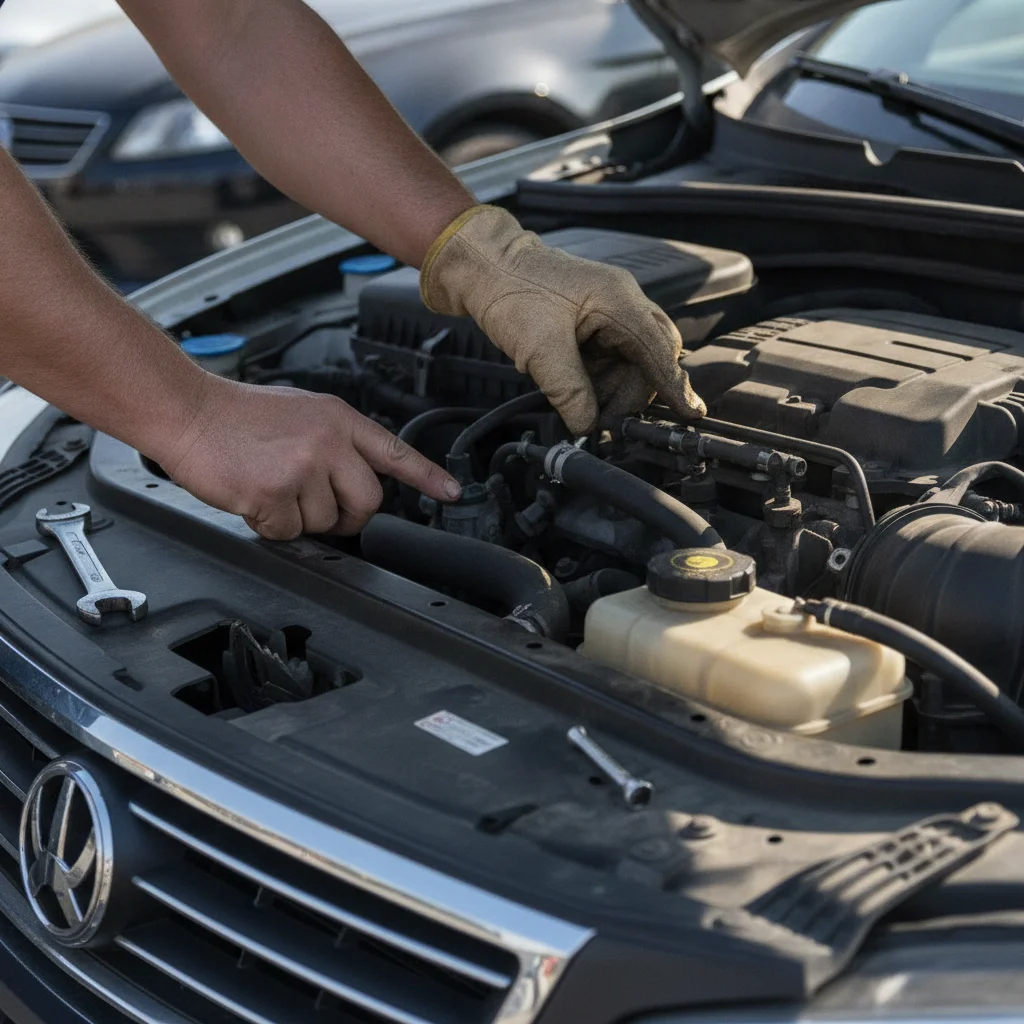
That's meaningful, but it's not the same as sitting in the driver's seat, feeling the clutch engagement, listening for suspension noise on a bumpy road, or smelling whether the interior has water intrusion. Photos are selected by the seller. Condition reports grade on relative scales. For used vehicles especially, physical inspection is a risk management exercise that online platforms can reduce but not eliminate.
If you're buying used online, read how online used car buying differs from online new car buying — the risk profile is completely different between the two.
What Traditional Dealerships Give You
An in-person test drive is still the gold standard for condition assessment. You can run a pre-purchase inspection at your chosen mechanic before signing — something every experienced buyer should insist on regardless of channel. You can examine panel gaps, look under the car, check the CarFax in your hand and then verify the VIN plate matches.
For buyers purchasing an unfamiliar model, or a used vehicle outside the certified pre-owned tier, the ability to physically verify condition before committing is a genuine financial protection. A problem you catch during a 20-minute inspection could save you thousands in undisclosed repairs.
Third-Party Pre-Purchase Inspections Are Always Worth It
Whether you're buying online or in person, a third-party mechanic inspection ($100–$200) is one of the highest-ROI steps in any used car purchase. For online purchases, most platforms will allow delivery to a local shop before you formally accept the vehicle. For in-person purchases, request a pre-signing inspection as part of the deal — reputable dealers will accommodate it. Any dealer who refuses should raise immediate red flags about what they're trying to conceal.
Certified Pre-Owned Narrows the Gap Significantly
If you're comparing an online platform's inventory to a franchised dealer's certified pre-owned (CPO) program, the inspection and warranty differences shrink considerably. Manufacturer CPO programs require multi-point inspections, include factory-backed warranties, and often come with roadside assistance. In that specific comparison, pricing and financing terms — not inspection quality — become the primary differentiating factors.
Financing, Trade-Ins, and the Back-End Game
Financing is where dealerships historically made the most off buyers who weren't paying attention — and it's an area where the online vs. in-person distinction matters in ways many buyers underestimate.
Online Financing: Cleaner, But Less Flexible
Online dealerships partner with lending networks and present you with rate options through a digital interface. The process is transparent — you see your rate, term, and monthly payment without a finance manager spinning you toward a longer term to hide a higher rate. That's a real advantage.
The downside: online lenders may not match what a credit union or community bank offers, and there's no F&I manager with discretion to push a rate buy-down or adjust a deal structure in real time. If you have complex credit — a short history, a recent derogatory, self-employment income — online platforms may simply decline or quote a non-competitive rate with no recourse.
Always arrive with a preapproval in hand regardless of channel. It's the single most effective way to neutralize rate manipulation at a traditional dealer and to benchmark the online platform's offer against a known-good alternative.
Trade-Ins: The Gap Between Quote and Reality
Online trade-in tools from platforms like Carvana, CarMax, and even traditional dealer groups offer instant quotes. They're useful as anchors. But understand the mechanics: that quote is conditional on physical inspection. If the car arrives at the reconditioning center with undisclosed wear, mechanical issues, or mileage that wasn't accurately entered, the offer changes.
In person, you have the ability to push back on the spot — point to the market comps, reference competing offers, and negotiate the trade-in and vehicle purchase as separate line items (which you should always do). Online trade-in offers vs. in-person dealer appraisals walks through exactly when each approach works to your advantage.
My recommended approach: get an online quote from at least two platforms, then bring those numbers into a traditional dealer negotiation. It establishes a floor the dealer must beat or match — and they usually will to keep the deal.
For more on maximizing what you get from any dealer appraisal process, dealer trade-in strategy is worth reviewing before you walk in.
Return Policies, After-Sale Support, and Accountability
The return policy question is the most misunderstood aspect of online car buying — and it trips up buyers who assume "money-back guarantee" means what it says on the homepage.
Online Return Windows: Read Every Line
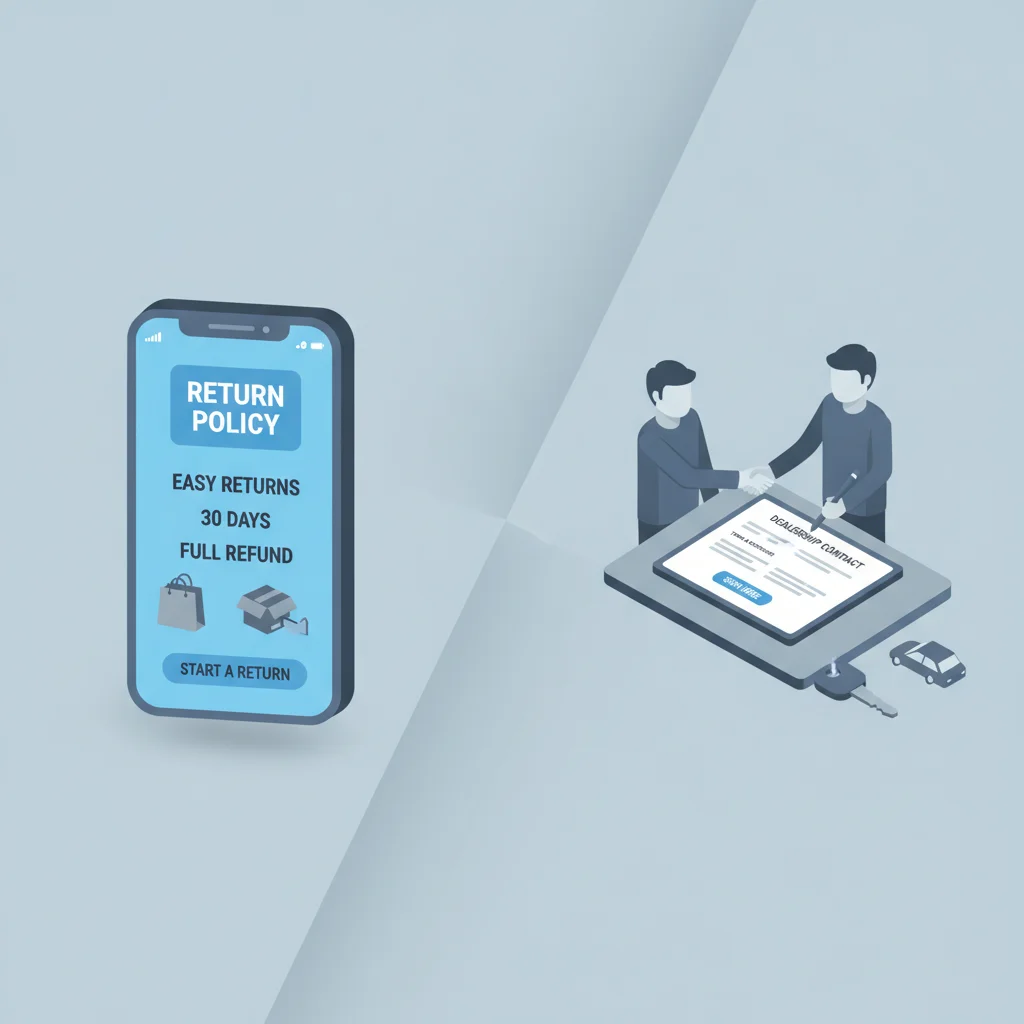
Most major online dealerships advertise some form of return window — Carvana's 7-day policy and CarMax's 30-day return are the most prominent examples. These are genuine consumer protections that traditional dealers almost universally don't offer. If you get the car home and it doesn't work for you, you have a structured path to unwind the deal.
But the fine print matters. Return windows typically exclude mileage limits (you may get 400 miles before the return becomes a buyback at depreciated value), require the car to be in the same condition as delivered, and may involve restocking or transfer fees. How return policies work on online car purchases decodes the specific terms you need to verify before assuming protection exists.
Traditional Dealers: No Return, But Local Accountability
Walk-in dealerships almost never offer return windows on completed sales — "as-is" is the default for used vehicles, and new car returns are rare exceptions tied to fraud claims. Once you sign and drive, the transaction is closed.
The counterbalancing factor is local accountability. A franchised dealer has a physical address, a manufacturer relationship, and a reputation in the community. If there's a post-sale dispute — an undisclosed problem, a title delay, a gap in what was promised vs. delivered — you have a physical location to go back to, a general manager to escalate to, and a manufacturer's customer service line as leverage.
Online-only operators, particularly smaller or regional ones without brick-and-mortar presence, are harder to hold accountable post-sale. The major national platforms (Carvana, CarMax) have established dispute processes, but smaller operators are a different story.
If you're weighing online vs. in-person specifically for a used vehicle purchase, private seller vs. online dealership adds another useful comparison layer.
How to Use Both Channels Together for the Best Outcome
The most sophisticated buyers I've seen don't choose one channel exclusively — they use both strategically to extract the best possible terms.
The Benchmark and Negotiate Play
Start online. Use platforms like Carvana, CarMax, and Autotrader to establish market pricing for the exact trim, mileage, and condition tier you want. Screenshot the listings. Get a trade-in quote from at least two digital tools. Now you walk into a traditional dealership armed with real numbers — not guesses. The internet price becomes your anchor, and the dealer must beat it to earn the deal.
Comparing online car listings without getting overwhelmed gives you a practical system for this research phase before you start talking to anyone.
The Online Close on Transparent Inventory
For new vehicles where pricing is straightforward — a specific trim at or near invoice on a model without allocation constraints — online buying may simply be faster and less stressful with no meaningful financial trade-off. The same logic applies to certified pre-owned vehicles from major branded platforms where the inspection and warranty are standardized.
For new vehicles you want exactly configured to spec, ordering from the factory vs. buying off the lot introduces another option entirely worth knowing about.
Email as a Bridge
If you prefer the in-person inspection but want to avoid the showroom pressure game, email negotiation vs. in-person negotiation outlines how to negotiate price with multiple dealers simultaneously via email before you ever walk in — giving you the documentation trail and leverage of digital shopping with the physical access of a traditional dealership.
The bottom line: online dealerships have genuinely disrupted the industry in ways that benefit buyers — more transparency, less pressure, cleaner financing presentations. But they haven't replaced every advantage of buying in person. The smartest move is knowing what each channel does well, and using that knowledge deliberately rather than defaulting to one out of habit or comfort.

All claims are backed by peer-reviewed research. Sources on request.