
Key Takeaways
Price Anchoring
Price anchoring is a psychological phenomenon where the first number introduced in a negotiation — the "anchor" — disproportionately influences every subsequent number discussed. In a car deal, whichever party names a price first sets a reference point that the other side instinctively negotiates around rather than ignoring. The anchor doesn't have to be reasonable to be powerful; its mere presence skews perception.
Anchoring bias was formally documented by psychologists Amos Tversky and Daniel Kahneman in their 1974 research on cognitive heuristics. Studies show that even obviously arbitrary numbers can shift final negotiated outcomes by thousands of dollars.
Why the First Number Wins
Walk into any dealership in America and within the first five minutes, a salesperson will find a way to mention a number. It might be the MSRP on the window sticker. It might be a monthly payment estimate scribbled on a notepad. It might be a "special" deal price that's already supposedly been reduced. Regardless of form, that number is doing exactly one thing: anchoring you.
The human brain doesn't evaluate numbers in a vacuum. We evaluate them relative to a reference point — and whatever number we hear first becomes that reference point, almost automatically. This isn't a character flaw or a sign of being gullible. It's a hardwired cognitive shortcut that affects financial professionals, experienced negotiators, and everyone in between. The difference between a savvy buyer and one who overpays is usually just awareness of this mechanism and a plan to counteract it.
Dealership finance teams understand this better than almost any other sales environment. They negotiate dozens of deals every month. Most buyers negotiate a car purchase a handful of times in their entire lives. That experience gap is real — and anchoring is one of the primary ways it gets exploited.
The good news: anchoring works both ways. The same cognitive machinery that makes you susceptible to a dealer's anchor can be turned around and used against them. The rest of this article is about exactly how to do that.
How Dealerships Deploy Anchoring Tactics
Dealers use several distinct anchoring strategies, each targeting a different part of the deal. Understanding each one is the first step to neutralizing it.
$1,500–$4,000
Extra cost paid by buyers anchored to dealer's opening price
Estimates from consumer research and automotive industry analysts tracking negotiated transaction prices vs. invoice pricing.
73%
Buyers who focus on monthly payments instead of total price
According to a Cox Automotive consumer study, the majority of buyers prioritize payment over total vehicle cost during dealership negotiations.
2.1–3.4%
Typical dealer markup on financed interest rates
Dealers routinely mark up the buy rate from lenders by 1–3.5 percentage points, according to CFPB research on dealer reserve practices.
$5,700
Average additional interest on a 72- vs. 60-month loan
Based on a $30,000 loan at 7% APR: extending the term by 12 months adds over $5,700 in total interest payments.
The MSRP Anchor
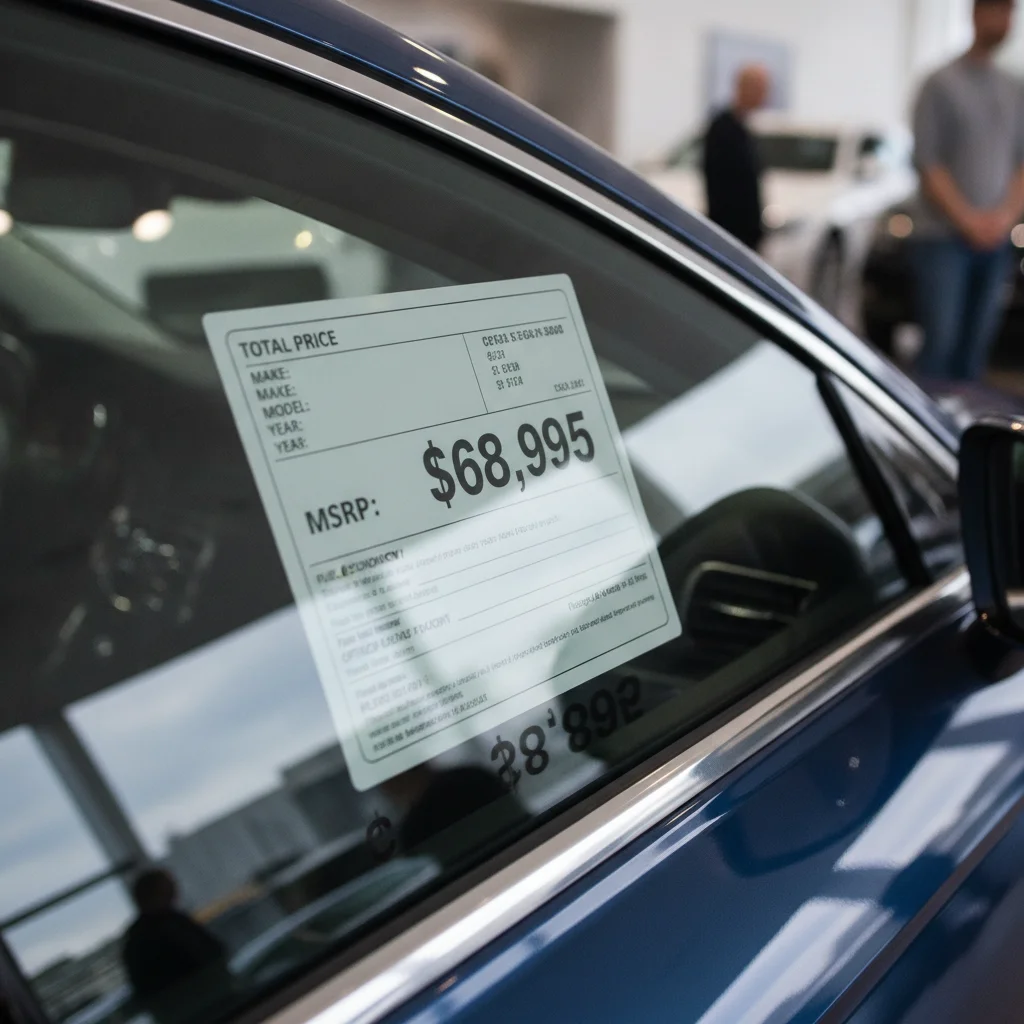
The manufacturer's suggested retail price is the most obvious anchor in any dealership. It's printed on the window sticker in large type, which is not an accident. MSRP is a ceiling, not a market price — most vehicles sell below it, and many sell significantly below it. But by presenting MSRP as the starting point, dealers frame any discount as a favor. A buyer who hears $45,000 MSRP and negotiates to $43,200 feels like they won. They may have, or they may have simply drifted from one anchor to a number that still benefits the dealer considerably.
The Monthly Payment Anchor
This is the more dangerous tactic of the two. When a salesperson asks "what are you looking to spend per month," they're not trying to help you budget — they're trying to anchor you to a payment figure that lets them manipulate the total price, loan term, and interest rate simultaneously. A buyer anchored to $500/month can end up in a 72-month or 84-month loan at a marked-up rate, paying far more in total than someone who anchored on vehicle price first.
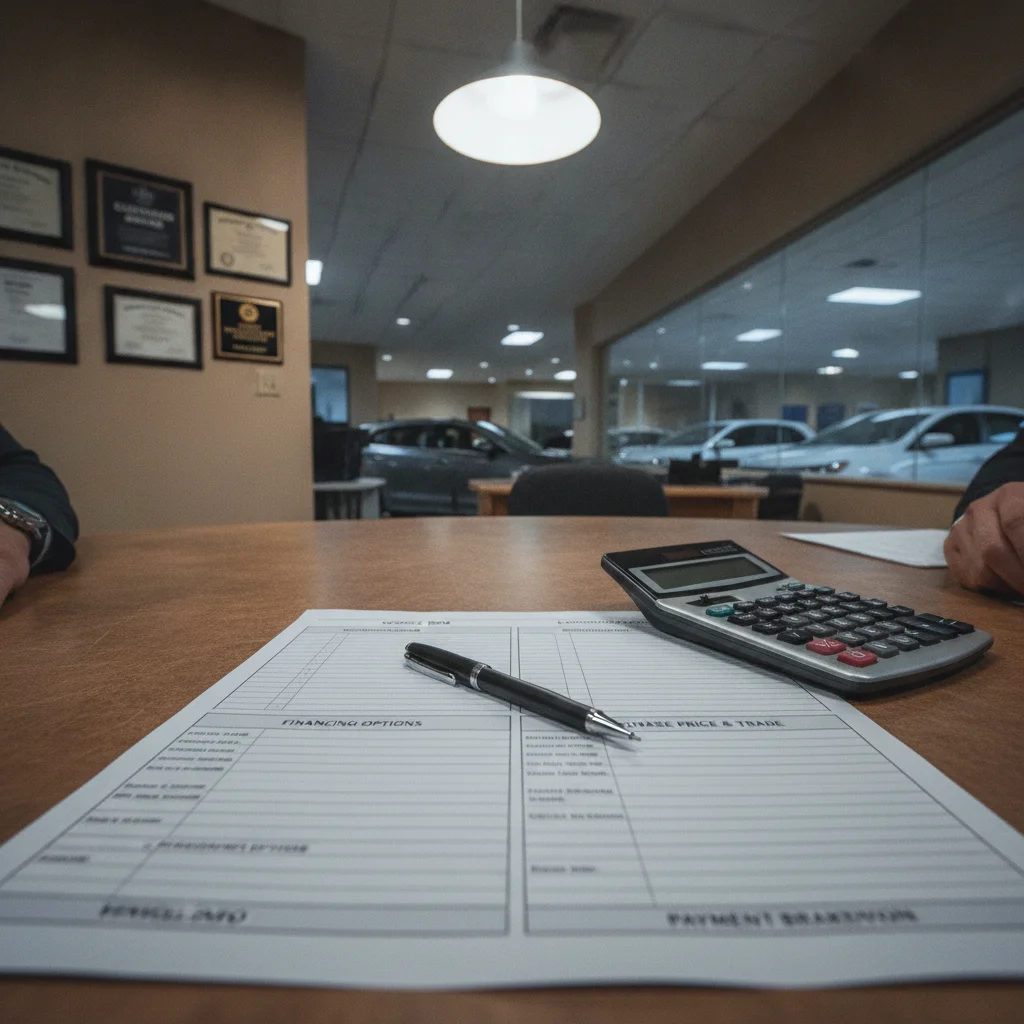
The four-square method that many dealerships use is built on this exact principle: fragment the deal into four separate boxes so no single number tells the whole story.
The "Already Discounted" Anchor
A dealer may present you a price that's supposedly already been reduced — "We took $2,000 off the sticker before you even sat down." This creates an anchor with a built-in fairness narrative. The implied message is that the deal is already generous, so further negotiation feels like overreach. In reality, that $2,000 may be coming straight off a markup that was added above MSRP, or the "discount" may be funded by a manufacturer incentive the dealer was going to apply anyway.
“The most powerful tool in any negotiation is the ability to walk away. But you can only use that tool if you've done the homework that proves you have somewhere else to go.”
— Chris Voss, Former FBI lead hostage negotiator and author of 'Never Split the Difference'
Trade-In Anchoring
If you mention your trade-in early, dealers use it as another anchoring device. A lowball appraisal on your trade becomes the reference point, and when they "move" to a slightly better number after you push back, it still may be well below market. This is why most seasoned negotiators recommend getting an independent trade-in quote — from Carmax, Carvana, or a competing dealer — before setting foot in the store. That outside number becomes your anchor, not theirs. The dealer trade-in process has its own set of dynamics worth understanding before you walk in.
The Cognitive Science Behind Why It Works
You don't have to take the psychological research on faith — you can feel anchoring working on yourself in real time if you pay attention. The moment a number appears in a negotiation, your brain begins using it as a benchmark. Subsequent numbers are evaluated as higher or lower than the anchor, not on their own merits.
In classic research, participants asked to spin a wheel of fortune (rigged to land on either 10 or 65) before estimating the percentage of African nations in the UN gave answers that tracked their wheel result. The number 10 or 65 had no rational connection to the estimate — but it moved the needle significantly anyway. Car prices are far more emotionally and financially loaded than a trivia question, which means anchoring effects are often even stronger in real negotiating situations.

What makes anchoring especially durable in car negotiations is the combination of social pressure and information asymmetry. The dealer knows invoice pricing, holdback, current incentive money, and exactly what margin exists in the deal. You're working from whatever research you've done. When you're already at an information disadvantage, a confident anchor from an authority figure carries even more psychological weight.
Anchoring Affects Experienced Buyers Too
Don't assume that having bought cars before makes you immune to anchoring bias. Research consistently shows that even financially sophisticated people are subject to anchoring effects, especially under social pressure and time constraints. The defense isn't experience — it's a written number you committed to before you walked in the door.
Online Quotes Shift the Anchor Before You Arrive
Requesting internet pricing from multiple dealers before visiting any of them resets the default anchoring dynamic. Dealers who quote online know they're competing, so those quotes tend to be closer to invoice price. Arriving at a dealership with three internet quotes in hand means the anchor conversation has already started in your favor — before anyone sits down.
The antidote isn't willpower — it's preparation. When you walk in with your own researched numbers, you have your own anchor ready. You're no longer relying on the dealer's frame because you've built your own.
Setting Your Own Anchor: A Practical Playbook
The single most actionable thing you can do is name a number before the dealer does. Here's how to do it effectively without blowing your credibility or your deal.
Do Your Pre-Work
Your anchor needs to be grounded in real data or it can be dismissed. Pull the invoice price from Edmunds or TrueCar. Check what the same trim is actually selling for in your market by looking at dealer listings and recent transaction data. Get quotes from two or three dealerships in writing. These form the foundation of a credible counter-anchor.
Going in prepared changes the entire dynamic of how a salesperson reads you. You're no longer a prospect to be worked — you're a buyer with options.
Name Your Number First
When you sit down, say something like: "I've done my research. Based on invoice pricing and what this vehicle is selling for at dealers in the area, I'm targeting $X out the door. If you can get there, I'm ready to make a decision today." That out-the-door number — taxes, fees, and everything included — becomes the anchor. The dealer now has to negotiate from your figure, not theirs.
Lead with an Out-the-Door Number
Always state your target as an out-the-door figure — including taxes, dealer fees, and any add-ons. This prevents the dealer from agreeing on a vehicle price and then adding $1,800 in documentation fees and accessories after the fact. A clean out-the-door anchor eliminates that room entirely.
Don't Counter Too Close to Their Number
If you counter within a few hundred dollars of the dealer's opening anchor, you've signaled that their number was close to acceptable. Leave meaningful distance between their anchor and yours — grounded in real data — so there's genuine negotiating room between you. The eventual settlement will land somewhere in the middle, and where that middle is depends entirely on where both anchors started.
Use Competing Quotes as Social Proof
A written quote from a competing dealer is one of the strongest anchoring tools you have because it's not just a number you invented — it's documented evidence of what the market will actually do. Hand it across the desk. The dealer who sees a real competing offer knows your anchor is credible, which means they're much more likely to work from it seriously.
Lock In the Total Price Before Financing
Get a written purchase agreement with the out-the-door price agreed and signed before you ever go into the finance and insurance office. If financing conversation bleeds into price conversation, dealers can adjust one to mask movement in the other. Keeping them separate eliminates a common way the monthly payment anchor gets layered on top of a price that hasn't actually been settled.
Walking in with a pre-approved rate from your bank or credit union does the same thing for financing — it sets the anchor before the F&I manager can quote a marked-up rate as if it were the starting point.
When Timing Changes the Anchoring Equation
Anchoring doesn't happen in isolation — it interacts with the broader context of when and where you're buying. A dealer who has three units of a slow-selling model on a lot at end of month is a very different negotiating partner than one selling an in-demand vehicle in short supply. Your anchor's effectiveness depends partly on how much pressure the dealer is under to move inventory.
Timing your purchase strategically — end of month, end of quarter, or during slow seasonal periods — doesn't change the anchoring dynamic, but it changes how much room exists below the anchor. A dealer with strong incentive to close will negotiate from your anchor more readily than one who knows they have a waiting list for the vehicle.
The online buying path changes anchoring dynamics considerably. When you request quotes online, you're often getting dealer invoice-adjacent pricing without ever having to counter a sticker price anchor in person. Comparing in-person and online approaches is worth doing before you decide which path to take.
Anchoring Affects Experienced Buyers Too
Don't assume that having bought cars before makes you immune to anchoring bias. Research consistently shows that even financially sophisticated people are subject to anchoring effects, especially under social pressure and time constraints. The defense isn't experience — it's a written number you committed to before you walked in the door.
Online Quotes Shift the Anchor Before You Arrive
Requesting internet pricing from multiple dealers before visiting any of them resets the default anchoring dynamic. Dealers who quote online know they're competing, so those quotes tend to be closer to invoice price. Arriving at a dealership with three internet quotes in hand means the anchor conversation has already started in your favor — before anyone sits down.
Recognizing and Resetting Bad Anchors Mid-Negotiation
Sometimes you don't manage to set the first anchor — the dealer gets there before you, or you didn't know to expect it. That doesn't mean the negotiation is lost. It means you need to explicitly reset the anchor rather than negotiating against theirs.
Call Out the Anchor Directly
You don't have to do this aggressively. Something as simple as "I hear your number, but let me give you the number I've come in with based on market data" neutralizes the anchor without creating conflict. You're not rejecting their price emotionally — you're introducing a competing reference point with a rational basis.
Don't Counter in Small Increments from Their Number
If a dealer opens at $44,000 and you counter at $43,500, you've implicitly accepted their anchor and you're negotiating from their frame. You've told them the anchor worked. Instead, counter from your own researched number — even if the gap looks wide — and be prepared to explain it. "I'm at $39,800 based on the invoice and what I see this selling for in this market." That's a credible counter-anchor, not an aggressive lowball.
Lead with an Out-the-Door Number
Always state your target as an out-the-door figure — including taxes, dealer fees, and any add-ons. This prevents the dealer from agreeing on a vehicle price and then adding $1,800 in documentation fees and accessories after the fact. A clean out-the-door anchor eliminates that room entirely.
Don't Counter Too Close to Their Number
If you counter within a few hundred dollars of the dealer's opening anchor, you've signaled that their number was close to acceptable. Leave meaningful distance between their anchor and yours — grounded in real data — so there's genuine negotiating room between you. The eventual settlement will land somewhere in the middle, and where that middle is depends entirely on where both anchors started.
Walk Away as an Anchor Reset
Standing up and moving toward the door is one of the most effective ways to reset an anchoring dynamic that isn't working in your favor. It signals that their anchor hasn't captured you, and it creates pressure on the dealer to re-engage on different terms. This works best when you've already done your research, have a real alternative, and genuinely are willing to leave. Dealers read bluffs quickly — real willingness to walk is a different energy than theater.
If you're heading to a dealership for the first time, knowing what to expect makes every one of these techniques easier to apply under pressure.

All claims are backed by peer-reviewed research. Sources on request.