Key Takeaways
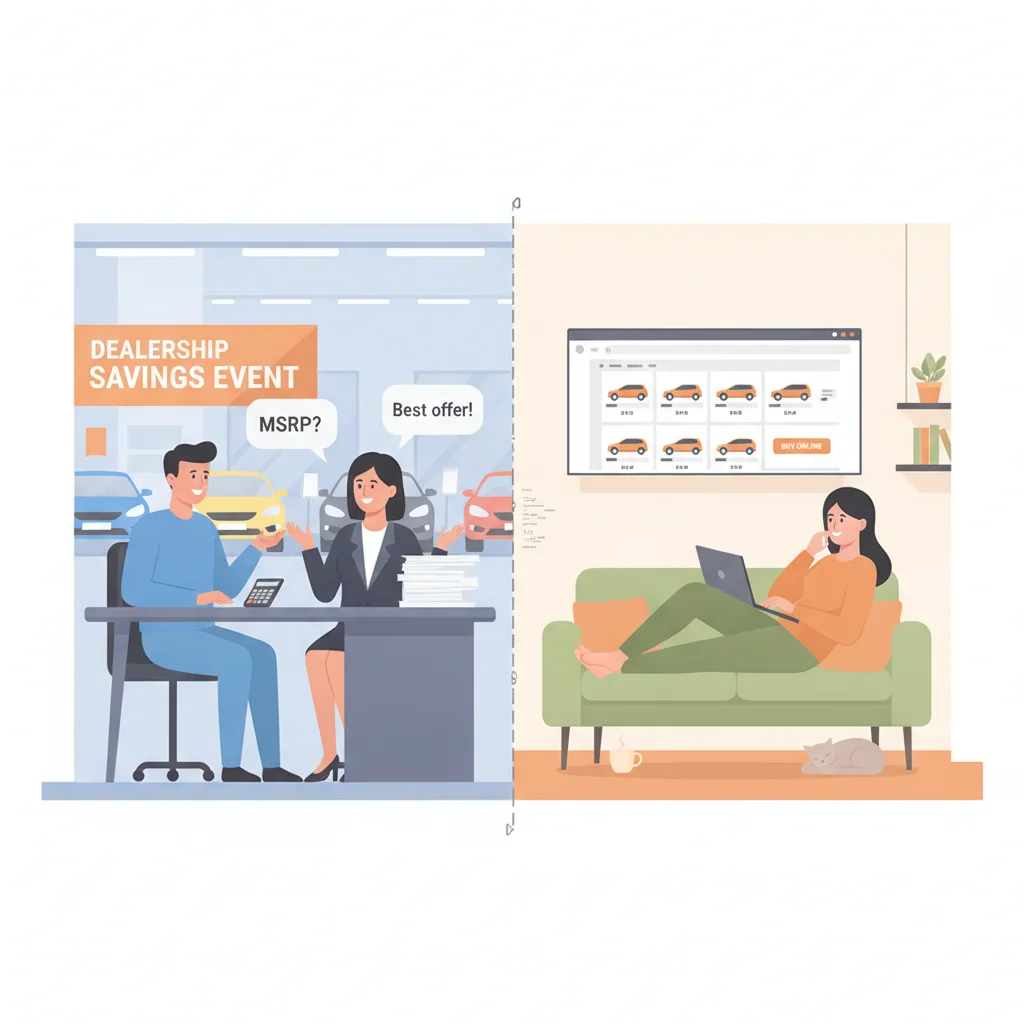
No high-pressure finance office environment
The finance office is where most dealer profit gets extracted through add-on products and payment manipulation. Online buying removes that room entirely, letting you evaluate terms on your own schedule.
Fixed, transparent pricing
Platforms like Carvana and CarMax list non-negotiable prices, which eliminates the back-and-forth that obscures total vehicle cost. You know exactly what you're paying before you commit.
Shop and compare across broader inventory
Online platforms aggregate inventory from multiple locations, giving you access to vehicles that may not exist within a 50-mile radius of your home dealership.
Home delivery removes scheduling friction
Delivery to your driveway eliminates the need to take time off work or spend a weekend afternoon at a dealership. For buyers with tight schedules, this is a concrete time savings.
Return windows reduce commitment anxiety
Most major online platforms offer a short return period — typically 7 days — that provides a safety net unavailable in traditional dealership purchases.
Digital paperwork is faster to complete
Online purchase contracts eliminate the hours spent in dealership signing rooms. E-signatures and digital document delivery can compress hours of in-person paperwork into 20–30 minutes.
No physical inspection or test drive before purchase
Photos and vehicle history reports don't capture transmission feel, unusual noises, or cabin wear. For used vehicles especially, buying without a test drive means accepting significant information asymmetry.
Return policies are more complicated than advertised
Return windows are real but limited, often 7 days or fewer. Logistics of returning a vehicle — especially after registration — can be burdensome, and some platforms charge restocking or delivery fees.
Limited financing flexibility
Online platforms partner with a narrow set of lenders, meaning the rates offered may not reflect the best available market. Buyers without outside pre-approval have less leverage.
Fixed pricing works against you in down markets
When dealer incentives and negotiating room expand — as during slow sales periods or model-year changeovers — fixed-price platforms don't pass those savings on. You can't negotiate below their asking price.
Add-on upsells still exist, just digitized
Extended warranties and GAP insurance are increasingly embedded into online checkout flows. The absence of a finance manager doesn't eliminate the overpriced products — it just makes them easier to click past without noticing.
Customer service issues are harder to resolve remotely
Post-purchase problems — title delays, documentation errors, mechanical issues — are more difficult to escalate when there's no physical location to visit and your contact is a call center.
Our Verdict
Buying a car online is a genuinely useful option for buyers who do their homework, understand the platform's policies, and are comfortable making a significant financial decision without a physical test drive. It cuts through dealership theater and can surface better pricing — but it shifts more responsibility onto the buyer and removes protections that come naturally with in-person purchases. The experience is only as good as the platform you choose and the preparation you bring.
Best for buyers who have already identified the exact make, model, and trim they want, are comfortable with digital paperwork, and want to avoid high-pressure dealership finance offices.
What Online Car Buying Actually Looks Like in Practice
Online car buying isn't just browsing listings on Autotrader and then calling a dealer. The modern version — through platforms like Carvana, Vroom, CarMax Online, and increasingly manufacturer-direct portals — means completing the entire transaction digitally: selecting the vehicle, submitting financing, signing contracts, and scheduling delivery, all without stepping into a showroom.
Some traditional dealerships have also built out online purchase flows, but the experience varies wildly. The cleanest version is a fully digital process with a hard price (no negotiation), home delivery, and a return window. The murkier version is a hybrid where you handle paperwork online but still visit the dealer to finalize — which gives you fewer of the conveniences with most of the limitations.
Before weighing pros and cons, know which type of experience you're actually signing up for. That distinction shapes every tradeoff on this list.

For a deeper breakdown of how these two purchase channels compare across pricing, leverage, and risk, see our comparison of negotiating in-person vs. buying online.
The Genuine Advantages of Buying a Car Online
Let me be clear: online car buying has real, measurable benefits — not just marketing claims from platforms trying to disrupt dealerships. Here's where the experience actually delivers.
No high-pressure finance office environment
The finance office is where most dealer profit gets extracted through add-on products and payment manipulation. Online buying removes that room entirely, letting you evaluate terms on your own schedule.
Fixed, transparent pricing
Platforms like Carvana and CarMax list non-negotiable prices, which eliminates the back-and-forth that obscures total vehicle cost. You know exactly what you're paying before you commit.
Shop and compare across broader inventory
Online platforms aggregate inventory from multiple locations, giving you access to vehicles that may not exist within a 50-mile radius of your home dealership.
Home delivery removes scheduling friction
Delivery to your driveway eliminates the need to take time off work or spend a weekend afternoon at a dealership. For buyers with tight schedules, this is a concrete time savings.
Return windows reduce commitment anxiety
Most major online platforms offer a short return period — typically 7 days — that provides a safety net unavailable in traditional dealership purchases.
Digital paperwork is faster to complete
Online purchase contracts eliminate the hours spent in dealership signing rooms. E-signatures and digital document delivery can compress hours of in-person paperwork into 20–30 minutes.
61%
Buyers who prefer completing purchase steps online
According to a 2023 Cox Automotive Car Buyer Journey study, 61% of buyers said they want to complete most or all of the purchase process online.
4–6 hrs
Average time spent at a traditional dealership to purchase
Cox Automotive research consistently finds that buyers spend four to six hours at a dealership during the purchase process, a primary driver of online buying appeal.
$1,200+
Average dealer profit from finance and insurance products
National Automobile Dealers Association data shows F&I products generate over $1,200 per vehicle in gross profit, the room online buying eliminates.
The elimination of the finance office alone is worth considering. That's the room where most dealer profit gets extracted — extended warranties you don't need, GAP insurance priced at two to three times what your own insurer charges, credit life insurance, and paint protection packages. When you buy online, that room doesn't exist. You handle financing terms on your own time, and you're far less susceptible to fatigue-based decisions.
Price transparency is another genuine win. Platforms like Carvana and CarMax list fixed prices. You know what you're paying. There's no back-and-forth about monthly payments designed to obscure the total cost of the vehicle. That said, fixed pricing cuts both ways — see the cons section for why that matters.
The Real Disadvantages You Need to Understand
The marketing for online car platforms makes the process sound frictionless. In reality, several significant tradeoffs get minimized or left out entirely.
No physical inspection or test drive before purchase
Photos and vehicle history reports don't capture transmission feel, unusual noises, or cabin wear. For used vehicles especially, buying without a test drive means accepting significant information asymmetry.
Return policies are more complicated than advertised
Return windows are real but limited, often 7 days or fewer. Logistics of returning a vehicle — especially after registration — can be burdensome, and some platforms charge restocking or delivery fees.
Limited financing flexibility
Online platforms partner with a narrow set of lenders, meaning the rates offered may not reflect the best available market. Buyers without outside pre-approval have less leverage.
Fixed pricing works against you in down markets
When dealer incentives and negotiating room expand — as during slow sales periods or model-year changeovers — fixed-price platforms don't pass those savings on. You can't negotiate below their asking price.
Add-on upsells still exist, just digitized
Extended warranties and GAP insurance are increasingly embedded into online checkout flows. The absence of a finance manager doesn't eliminate the overpriced products — it just makes them easier to click past without noticing.
Customer service issues are harder to resolve remotely
Post-purchase problems — title delays, documentation errors, mechanical issues — are more difficult to escalate when there's no physical location to visit and your contact is a call center.
The biggest risk is physical unknowns. Even with 360-degree photo tours and vehicle history reports, you cannot replicate the information you gather from a test drive and a hands-on inspection. Rattles, transmission hesitation, worn suspension feel, unusual smells — these don't show up in listing photos. For used vehicles in particular, this is a serious gap.

Return policies are often cited as the answer to this problem, but the reality is more complicated. A 7-day return window sounds generous until you realize it requires you to initiate a return, arrange pickup, and potentially wait weeks for a refund. And if you've already registered the vehicle in your state, unraveling that paperwork adds another layer of friction. Some platforms also charge restocking or delivery fees that eat into what you thought was a risk-free return.
For buyers comparing used car platforms specifically, our breakdown of private sellers vs. online dealerships shows where each option creates the most exposure.
The Financing Trap Online Buyers Miss
Online platforms make financing feel simple. Enter your info, get a rate, sign. But simple isn't the same as optimal.
Platform Financing vs. Outside Pre-Approval
Online car platforms typically offer their own financing through partner lenders, which is convenient but not always competitive. Before accepting a rate from any platform, check what your bank or credit union will offer first. Even a half-percentage-point difference on a $30,000 loan over 60 months adds up to several hundred dollars. Bringing your own approval also gives you a concrete number to compare against — and on some platforms, using outside financing may actually be the cleaner path.
Return Policies Differ Significantly by Platform
Carvana, CarMax, and Vroom each have different return window lengths, fee structures, and conditions. Some require the vehicle to be in the same condition as delivered; others have mileage caps. Before purchasing, read the actual return policy document — not the homepage summary — and confirm whether return delivery is covered or at your expense. This is especially important for buyers in states with complex vehicle registration processes.
Used Cars Warrant Independent Inspection Even Online
Most major online platforms allow buyers to request a pre-purchase inspection before delivery is finalized. Services like CARFAX inspections, mobile mechanic companies, or local shops can be arranged remotely for a fee that typically runs $100–$200. For any used vehicle over $15,000, that cost is trivial relative to what you might discover. Platforms that actively discourage or complicate independent inspections should be treated with caution.
Most online car platforms partner with a limited set of lenders. That means the rate you're offered reflects their relationships, not the full market. A buyer who walks into a credit union pre-approved with a 5.9% rate has real leverage — at a dealership, they can use that as a floor. Online, your ability to layer in outside financing varies by platform and isn't always as clean as it sounds in theory.
There's also the issue of add-on products. While you avoid the finance office pressure, online platforms increasingly build extended warranty upsells directly into their checkout flows. The prompts are softer, but the products are often just as overpriced. Always price any add-on separately before accepting what's bundled into your online purchase.
If you're considering financing through a platform, these habits of experienced online car buyers will help you avoid the most common financing mistakes.
New vs. Used: The Online Experience Is Not the Same
Buying a new car online is materially different from buying a used one, and treating them as equivalent is a mistake most first-time digital buyers make.
New cars have standardized specs. You know exactly what you're getting because every unit of that trim level is identical. The risk surface is narrow: it's mostly about price, financing, and delivery logistics. Used cars are each their own entity — different mileage, different service history, different wear patterns. The information asymmetry is much larger, and no amount of platform polish eliminates that.
For a full comparison of how the due-diligence requirements shift, see online used car buying vs. online new car buying. The short version: buying used online requires you to do more work, not less, even when the platform makes it feel easy.

If you're buying new and shopping online through a manufacturer portal or third-party aggregator, also check what to know before buying a brand-new vehicle to make sure you're not leaving incentives or rebates on the table.
When Online Buying Makes Sense — and When It Doesn't
The answer isn't that online buying is good or bad universally. It's that it fits certain buyer profiles and situations better than others.
Online buying works well when:
- You've driven the exact model and trim before and don't need another test drive to feel confident.
- You're buying a new vehicle with a fixed MSRP and want to avoid dealer markup games.
- You have a pre-approved loan from your bank or credit union and aren't dependent on platform financing.
- You're replacing a vehicle you know well and the priority is speed and minimal friction.
- You've researched the specific used car's history extensively and understand the return policy terms.
Online buying works poorly when:
- You're purchasing a used vehicle without a pre-purchase inspection option.
- You're unfamiliar with the model and need a test drive to inform your decision.
- You're financing for the first time and need guidance — in-person finance managers, despite their conflicts of interest, do at least walk you through the paperwork.
- The platform's return window is short or the return logistics are unclear.
- The fixed price is actually above market for the vehicle.
For a head-to-head look at how online dealerships stack up against traditional dealers across these factors, this comparison of online vs. traditional dealerships walks through the full picture.
How to Protect Yourself When You Buy Online
If you decide the convenience is worth it, there are specific steps that separate buyers who come out ahead from those who regret the decision.
- Get pre-approved before you start. Walk into any platform with your own financing already secured. This gives you a benchmark and prevents you from defaulting to whatever rate the platform offers.
- Request a third-party inspection if buying used. Many platforms allow this. Services like CARFAX inspections or local mechanic pre-purchase inspections can be arranged even for remote purchases, often before delivery.
- Read the return policy in full — not the summary. Understand who pays for return shipping, what the refund timeline is, whether you'll be charged fees, and what happens if the vehicle has been registered in your state.
- Price the vehicle against the market independently. Fixed pricing means no negotiation, but it doesn't mean fair pricing. Cross-reference the listing against comparable vehicles on competing platforms and local dealer inventories.
- Reject add-ons by default. Extended warranties, GAP insurance, and paint protection offered at checkout are nearly always overpriced. Price them separately from an outside provider if you actually want them.
If you're also weighing whether to sell your current vehicle through an online service, instant offer platforms compared shows how services like Carvana and CarMax stack up on payout and process. And for a direct comparison of selling privately vs. using one of those services, this breakdown of private sales vs. online car-buying services is worth reading before you commit your trade-in.


All claims are backed by peer-reviewed research. Sources on request.